Entertainment
Review: Clad in leather, 'The Bikeriders' evokes ’60s cool, then watches it fade in the mirror

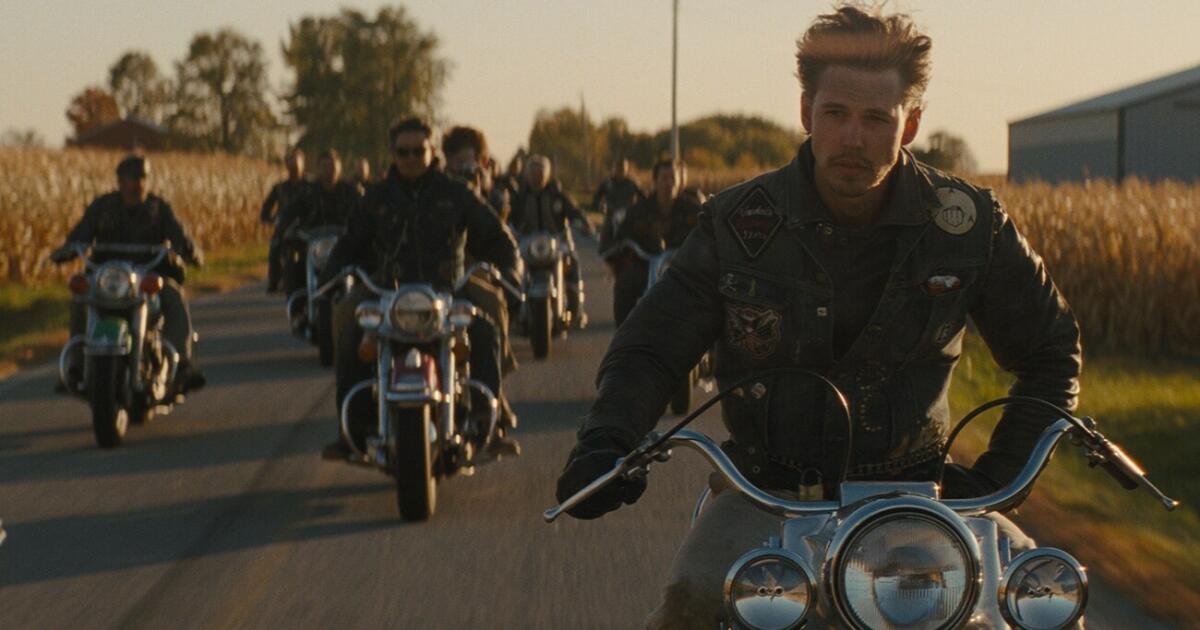
In the mid-1960s, photojournalist Danny Lyon embedded himself with the Outlaws Motorcycle Club in the suburbs of Chicago, snapping portraits and candid photographs while interviewing members of the gang. The result was a photo book called “The Bikeriders,” published in 1968, that serves as the inspiration for director Jeff Nichols’ latest film of the same name, a meditation on American motorcycle culture, the birthplace of a certain kind of cool.
Nichols is clearly enchanted by the inimitable style and intoxicating lore that Lyon’s photographs conjure, and he populates his cinematic Chicago-based motorcycle club — rechristened the Vandals — with a coterie of ruggedly handsome stars who can make sideburns and motor oil look good, including Tom Hardy, Austin Butler, Norman Reedus, Beau Knapp, Boyd Holbrook, Emory Cohen and Damon Herriman. There are also some unexpected and welcome casting choices like Karl Glusman and young Australian actor Toby Wallace, who is terrific as a young Vandals wannabe.
As the enigmatic Benny, Butler’s supernova star quality is undeniable, and the film opens with a bourbon and a bang — a shovel to the back of his head during a bar brawl that will haunt the rest of the film. In this bit of bravura filmmaking, Nichols demonstrates a slick style and rhythmic musicality that instantly draws us into this world.
When we next lay eyes on Benny, he’s hulking over a pool table at a bar, his long golden arms and tousled blond coif raked over by the greedy gaze of Kathy (Jodie Comer) who stops in for a drink and leaves with a lifetime lover. Nichols’ camera eats Butler up hungrily, every inch of battered denim and well-worn leather; every soulful pout and blood-spattered grin wordlessly seducing Kathy to the dark side. It’s no wonder Kathy’s boyfriend beats it as soon as Benny turns up on their curb, and it’s no wonder Kathy bends her life around her new brooding boyfriend and his clan of grease-streaked miscreants.
Kathy becomes our narrator, her mile-a-minute Midwestern patter adding a layer of percussion to the rumbling engines and plaintive crooning of ’60s rock ‘n’ roll on the soundtrack. In a rapid-fire Chicago cadence expertly enunciated by Liverpudlian actor and master of accents Comer, Kathy reels off stories about the boys into the microphone of photographer Lyon (Mike Faist). She’s the observant eyewitness and caretaker of their oral history, though the details are potentially lost, muddled or otherwise exaggerated by our storyteller. We see them though her eyes: sexy, dirty, violent and often tragic.
We also see them through recreations of Lyon’s photographs, which Nichols and longtime cinematographer Adam Stone painstakingly compose and set to motion. In a montage, we see Lyon snapping portraits of characters like Cockroach (Cohen), Wahoo (Knapp) and Corky (Glusman), or capturing candids of the gang from the back of a bike. We see an image of a relaxed Benny riding over a bridge, one hand lazily gesturing behind him. Nichols improves upon Lyon’s shot by having our subject face the camera, rather than looking away.
Jodie Comer and Austin Butler in the movie “The Bikeriders.”
(Kyle Kaplan / Focus Features)
Watching “The Bikeriders” feels like flipping through a photobook filled with arresting compositions and snippets of stories, and there’s a sketchy, snapshot quality to Nichols’ screenplay as well. The film is an evocation of character, place and time, the tempo alternating between moody and lively, like our central odd couple, laconic Benny and chatterbox Kathy.
Kathy has plenty to say about Benny, though we rarely see his unique qualities in action. He’s somewhat underwritten, and while Butler has the outsize presence to inhabit the iconic image, Kathy takes up all the air in the script. Benny is reduced to a symbol of sorts, a visual emblem of the Vandals’ dangerous glamour. Their mutual attraction is initially palpable, but we don’t see the glue that keeps them together throughout the years of peril and partying. The mysterious Benny has more chemistry with Johnny (Hardy), the Vandals founder and leader, and so too does Kathy.
Hardy is typically fantastic and fantastically weird, and he emerges as the gravitational center, not just of the Vandals, but of the film itself. Johnny leads by his own specific instinctual code based on whim and personal values, which gets harder to enforce as the club grows, with veterans returning from Vietnam seeking camaraderie, and bringing back darker vices.
“The Bikeriders” is a great hang until the party’s over and it’s time to hit the road. Though the dramatic thrust of the narrative never quite coheres, there is plenty of pathos, and the ebb and flow reflects both life itself and the uniquely human nature of the storytelling, as Kathy regales us with tales of these wild ones, who now live with the sound of roaring engines only haunting their memories.
Katie Walsh is a Tribune News Service film critic.
‘The Bikeriders’
Rating: R, for language throughout, violence, some drug use and brief sexuality
Running time: 1 hour, 56 minutes
Playing: In wide release Friday, June 21


Welcome to an exciting year-long project here at The Nerdy. 1986 was an exciting year for films giving us a lot of films that would go on to be beloved favorites and cult classics. It was also the start to a major shift in cultural and societal norms, and some of those still reverberate to this day.
We’re going to pick and choose which movies we hit, but right now the list stands at nearly four dozen.
Yes, we’re insane, but 1986 was that great of a year for film.
The articles will come out – in most cases – on the same day the films hit theaters in 1986 so that it is their true 40th anniversary. All films are also watched again for the purposes of these reviews and are not being done from memory. In some cases, it truly will be the first time we’ve seen them.
This time around, it’s June 13, 1986, and we’re off to see Karate Kid Part II and Legal Eagles.
Karate Kid Part II
Who knew this film would do so much work to make Cobra Kai the series it would become?
Six months following the events of the first film, Daniel finds himself at a crossroads as Ali has broken up with him and his mom is moving for work again and he doesn’t want to go. Mr. Miyagi (Pat Morita) Offers to take Daniel in, but as they work on what will become his room, he receives a letter asking him to come him to Okinawa as his father is dying. The two pack their bags and head to Japan where Mr. Miyagi’s past comes back to haunt him as Daniel looks forward to a potential new romance.
The film is fine, but it is definitely not the same quality as the first. Where the characters go story wise makes sense, but it still doesn’t feel that much like we needed to follow them any further in their lives.
As we all know in 2026, howver, their stories were far from over.
Where to watch: Available to stream.

Legal Eagles
There are some films where you wonder if anyone ever looked at a script and thought, “Could we maybe have one less plot?”
Tom Logan (Robert Redford) is an Assistant District Attorney who is possibly going to run for DA when his boss leaves the position. Laura Kelly (Debra Winger) is representing a performance artist, Chelsea Deardon (Daryl Hannah) who just can’t seem to get out of her own way. Everyone collides and starts making everything just that much more complicated for everyone involved.
I like every who stars in this movie, but the story is just so pointless. It has a weak foundation and instead of trying to build it up, they just keep piling one more thing on top of another and pretending that is how storytelling works.
Great cast. Horrible script.
Where to watch: Available to stream.
1986 Movie Reviews will continue on June 27, 2026, with American Anthem, Labyrinthm Running Scared, and Ruthless People.
Entertainment
From YouTube to the multiplex: How low-budget horror films are beating big-budget studio bets

Two of the biggest box-office standouts of 2026 so far were not made by established studio directors or built on franchise IP.
“Obsession” and “Backrooms” — horror films from internet-native directors in their 20s — have outperformed far more expensive studio releases.
The breakout success of these films has ignited debate across Hollywood about what made these movies so popular, especially among Gen Z moviegoers who haven’t been flocking to cinemas in recent years. Here’s what to know:
The numbers
”Obsession” was directed by 26-year-old Curry Barker, who got his start on YouTube with sketch comedy and horror shorts. Released May 15 by Focus Features, the film was made for just $750,000 but opened to a staggering $17 million and has improved on its debut every weekend since.
“Obsession” set an all-time horror record for the biggest fourth weekend for a film at the domestic box office, raking in $25.4 million. It now ranks as the year’s fifth most popular film, nearing $200 million domestically and roughly $295 million worldwide — ahead of Pixar’s “Hoppers” ($166 million) and Paramount’s “Scream 7” ($121 million), per Box Office Mojo.
“Backrooms,” from 21-year-old Kane Parsons — known on YouTube as Kane Pixels — drew on an online fascination with liminal spaces, leading audiences through an endless run of nearly indistinguishable rooms.
Released May 29 by A24 (known for such acclaimed films as “Moonlight” and Everything Everywhere All at Once”) on a reported $10-million budget, it opened to $81 million and crossed $100 million in under a week.
Within two and a half weeks, it had outgrossed the entire theatrical runs of horror films “Five Nights at Freddy’s 2,” “Smile” and “Scream 7.” It sits as 2026’s eighth-highest-grossing film.
Who is watching?
The audiences are young. In recent weeks, nearly 90% of “Backrooms’” viewers were under 35, with more than half under 25. Over “Obsession’s” first few weekends, 75% of the audience was 17 to 34, which is significant at a time when major studios have struggled to consistently get younger viewers to trek to the multiplex.
Why it’s working
Audiences have clearly latched onto the stories, said Jason Blum of Blumhouse–Atomic Monster, who worked on both films.
“There’s been an audience kind of waiting to get back to the movie theaters, and we in Hollywood really have not landed on what would get them back,” he told The Times in an interview this week.
Blum, who upended horror genre with the “Paranormal Activity” franchise, ties the success of “Backrooms” and “Obsession” to a connection to the directors’ origins.
Because the films were made by creators who speak to younger viewers daily on YouTube, he said, that generation “feels like they’re being spoken to.”
David Gross, an analyst at FranchiseRe, framed it as a new pipeline of talent and material. Creators can build large followings very inexpensively, he said, and their stories arrive further developed — which expedites the development and discovery process. He called internet-based storytelling “another additive source for material for movies.” Blum added that the films’ success could make studios more willing to bet on undiscovered directors who “might not have been considered” before.
Rosie Ramirez, chief marketing officer at Galaxy Theatres, said a young first-wave audience tends to generate buzz. More than a month after “Obsession” was released, she said, the Nevada chain’s four California locations are only now seeing a second wave of moviegoers curious about the hype.
Notably, the rise of these two films has unfolded in the shadow of major releases like Disney’s “Star Wars: The Mandalorian and Grogu,” and Mattel’s “Masters of the Universe,” both of which returned underwhelming numbers in their respective opening weekends.
Is it a trend or an anomaly?
Whether this marks a lasting shift or a fluke is unclear. May crossed $1 billion in box office — with “Backrooms” and “Obsession” doing much of the heavy lifting. Despite the improvement, the box office has yet to full return to pre-pandemic levels, with the summer tracking roughly 3.5% behind summer 2019, said Comscore’s Paul Dergarabedian.
And Dergarabedian questioned how the industry could replicate a success that, in his words, was “authentically and organically created” rather than manufactured: “It just happened,” he said.
Ramirez argued the broader summer slate — franchise tentpoles like “Toy Story 5” alongside some original surprises — points to a healthy box office regardless, a reminder that “it doesn’t always have to be the big summer blockbuster.”
Movie Reviews
‘Finnegan’s Foursome’ Review: Edward Burns’ Spiky-Quaint Sports Dramedy Is a Tale of Family Therapy Through Golf

Thirty years after “The Brothers McMullen,” the writer, director, and actor Edward Burns looks preserved in amber — his hair and beard have some silver, but at 58 he’s still lean and handsome in that prince-of-the-working-class Irish-American way. And it’s not just Burns who’s more or less unchanged; so is his filmmaking style. “Finnegan’s Foursome” is his 16th feature, and he’s still doing that shaggy-likable, spiky-quaint, semi-low-budget Edward Burns dramedy thing — the script that’s talky and kind of funny, though in a way that often sounds like a script; the camerawork that never strays too far from the functional; the acting that hovers between lively and broad. The style Burns works in is now closer to television than movies, and given that “Finnegan’s Foursome” is getting a streaming release (starting today), you could say it’s a minor indie movie that has found its rightful home.
It’s a sports comedy, about golf and Ireland and family conundrums (it would be overstating it to call them demons), and a key thing that might put you in the audience demo for it is if you happen to be a serious golfer. It’s a movie spun out of the love of the game. Burns, who first shows up in a samurai man-bun, plays Freddy Finnegan, a wealthy clothing entrepreneur who seems to have a happy and settled life, except that he’s got anger-management issues, all stemming from his rivalrous relationship with his irascible Irish father, Jack (Ian McElhinney).
At first, we think the movie is going to be about these two facing off. Jack, at his home in South Carolina (he came over from the old country in 1959), is hosting the latest edition of the Finnegan’s Cup — an annual golfing competition in which four members of the family face off against one another, mostly as an excuse for Jack, a retired golf instructor, to tell his old jokes and stories and reminisce about the days when he was good enough to rub shoulders with the Big 3 (Arnold Palmer, Jack Nicklaus, and Gary Player).
He’s a blustery egomaniac, though he strikes us as a warm-hearted one. And Freddy, of course, resents the hell out of him. But what we think are going to be the fireworks between these two come to a halt when one of the players hits a hole in one and Jack keels over in shock, dead of a heart attack.
The family now has to scatter Jack’s ashes in the four locations he has chosen in Ireland (two of them are golf courses). And that’s an excuse for Freddy, who resents his da even in death; his more benign older brother, Teddy (Brian d’Arcy James), a novelist who has been suffering from writer’s block; Freddy’s musician son, Frankie (Brian Muller), whom he treats nearly as cavalierly as his father treated him; and Teddy’s adult daughter, Marie (Erica Hernandez), to take a week’s vacation in Ireland, where they’ll play out the Finnegan’s Cup at a handful of fabled golf courses, smacking around some home truths along with the ball.
There’s plenty of on-the-nose dialogue (“His dying wish was to get us all back here to Ireland”), as well as cornball boasting (“It’s not about the clubs, little brother, it’s about the man who’s swingin’ ’em”) and generic braggadocio (“I believe that is what you call an eagle!”). Freddy and Teddy never stop making side bets and busting each other’s chops, mostly about who has the better golf game, this being the locker-room form of brotherly love. If the family tension simmers, it’s mostly because Freddy and Teddy have opposite feelings about their father. Listening to their back-and-forth taunts, Marie says, “I’m sorry, so this entire trip is nothing but constant ball-busting?” Swap in “movie” for “trip,” and you’ve got an idea of “Finnegan’s Foursome,” though you should also toss in Frankie doing his cringe mock-sports-announcer banter.
“Finnegan’s Foursome” is structured as a sports movie, and Burns, working with the cinematographer Jeff Muhlstock, connects you to the geometric majesty of the links. But when you watch a film like “Tin Cup,” part of the thrill is that you want to see the Kevin Costner hero win; that’s the dramatic Zen of a sports film. Watching “Finnegan’s Foursome,” we’re not overly invested in whether Edward Burns’ entitled a-hole gets a winning golf score over his novelist brother.
There’s a touching scene where three of the characters sing “The Parting Glass” at a pub. But here’s how “Finnegan’s Foursome” is a bit soft. The movie is about Freddy coming around to see that his da really did love him, and that he wasn’t such a bad guy (he gave him the love of golf, after all). But the reason we readily buy this is that it’s so apparent from the outset. Jack’s big crime? Being away “at the office” (i.e., the golf course) too much. As ultimate sins of parents go, it’s kind of a dated sin. You want to say to Freddy, “Stop whining.” Especially because the Jack we see, in his competitive Irish way, had a lot of spirit; he was no ogre. Of course, he also tried to “get into Freddy’s head” on the golf course, but that’s kind of a privileged problem. It’s Freddy who needs to dismantle the ogre of resentment in himself, and that’s not quite a movie — that’s therapy.
The blithe and likable “The Brothers McMullen” won the Grand Jury Prize at the 1995 Sundance Film Festival and went on to have a healthy theatrical life, launching Burns’ career as a homespun auteur — at the time, he almost seemed like the shoestring Irish-American answer to Woody Allen. I was a fan of the early Burns films (especially “She’s the One,” his 1996 crossover movie, costarring Jennifer Aniston and Cameron Diaz), but his moment in the spotlight didn’t last long. After crossing over, he kind of crossed back, retreating into the not-fully-on-the-radar indie wilderness. That’s where he has remained, and watching “Finnegan’s Foursome” you see why: He’s trying to stay true to his world (all the Irish chop-busting and piss-taking), but he hasn’t grown as a filmmaker. Then again, maybe that’s not so important. He doesn’t hit long drives, but by the end of “Finnegan’s Foursome” the ball is in the cup.
-

 Detroit, MI4 minutes ago
Tigers top Chicago White Sox 4-1; Detroit pitcher Troy Melton allows 1 hit in 6 innings
-

 San Francisco, CA16 minutes ago
MLB Rumors: Latest Intel on Potential Matt Chapman Trade for San Francisco Giants
-

 Dallas, TX17 minutes ago
Dallas’ Fair Park to Get $2.5M Boost From McKesson – Dallas Weekly
-

 Miami, FL24 minutes ago
Air quality alert in effect in Miami-Dade and Broward counties: National Weather Service
-

 Boston, MA31 minutes ago
Boston Signs Big Blueliner Rylind MacKinnon To One-Year Extension
-

 Denver, CO34 minutes ago
Fire destroys home under construction in northwest Denver
-

 Seattle, WA39 minutes ago
We can stop pretending that a suburban stadium would be better for soccer in Seattle
-

 San Diego, CA46 minutes ago
NASCAR Cup San Diego starting lineup: Shane van Gisbergen rockets to pole

