Movie Reviews
Two very different films about women in troubled marriages


With such alibis, it’s no wonder Sandra is indicted for murder, but these stories are only a taster for the many lies and puzzles of this marriage. We find Samuel also had aspirations to be a writer but could never get down to work, while his wife published one book after another. There were money worries. There was a rift over an accident that left Daniel partially blind when Samuel didn’t get to school on time. There were Sandra’s “flings”, mostly with women, which left her husband angry and jealous.
All these issues, and more, are aired in court, where the defence and prosecution seem to speak over one another at will. It’s a reminder the French court system is noticeably different from the more familiar American version. The dialogue switches between French and English, the latter being the language in which Sandra feels more comfortable. As she is German and Samuel was French, English became the common ground of their domestic life, but even this was a source of tension.
It adds another layer of linguistic ambiguity to the already tortuous problem of separating hypothesis from fact. The prosecutor even goes so far as to quote a passage from one of Sandra’s novels in which a wife contemplates murdering her husband, but if this sort of authorial fallacy were admissible as evidence, every major writer would have seen out their days behind bars.
It doesn’t mean Sandra is not a fantasist in everyday life, or that she is being completely honest with the court, or indeed with her own lawyers.
Daniel (Milo Machado Graner) gets mixed up when questioned in court.
A large part of the case hangs on Daniel’s testimony, but his story keeps changing, as he gets “mixed up”. It’s an understandable reaction to the spectacle of his parents’ relationship being put under the microscope in court. As one unpleasant secret after another is unearthed, his sympathies (and ours!) alternate between husband and wife. If Sandra can seem neither likeable nor trustworthy, Samuel had his own problems, held at bay by antidepressants.
Huller, who was so good in Maren Ade’s offbeat comedy Toni Erdmann (2016), is perfect in the lead role. Throughout the shoot, Triet allegedly refused to tell Huller whether her character was innocent or guilty. The ambiguity only seems to have bolstered a performance that has already gathered a swag of awards, with more to come.
The sheer length of Anatomy of a Fall seems designed to confirm this is no straightforward crime drama. The “fall” is not only Samuel’s plummet from the third floor, it’s the decline of a marriage, and we know that’s never a speedy process. Ingmar Bergman’s Scenes from a Marriage (1973) occupied six hour-long episodes.
The psychological struggle between Sandra and Samuel is reconstructed in the trial as the lawyers put their own portraits of the couple in front of judge and jury. In this contest, as in Sandra’s novels, it becomes impossible to separate truth from fiction – which may be one reason the lead characters have the same first names as the actors. By the end, we are left wondering if the point is not to discover what happened, but to show the impossibility of proving whether someone is ever definitively innocent or guilty.
Anatomy of a Fall
- Directed by Justine Triet
- Written by Justine Triet and Arthur Harari
- Starring Sandra Hüller, Swann Arlaud, Antoine Reinartz, Milo Machado Graner, Samuel Theis, Jehnny Beth, Saadia Bentaïeb, Camille Rutherford, Anne Rotger, Sophie Fillière
- France, MA 15+, 151 mins
The Color Purple
Blitz Bazawule’s new version of The Color Purple has been getting very positive responses, but when it comes to musicals, I’m the last person to ask.
I’ll listen to anything from Palestrina to Nirvana but have never had the slightest interest in seeing those blockbuster musicals on stage. It’s chiefly the music I can’t stand: syrupy and sentimental, full of forced cheerfulness with big choruses, a grotesque form of pop with operatic pretentions, made to a formula. When I’ve had to watch the film versions of musicals such as Les Miserables or Cats, it’s been a kind of torture. If this means I’m a musical snob, so be it.
And so, with The Color Purple, whenever the poor black folks in Georgia took a break from the cruelty and misery that surrounded them, and started singing and dancing, I felt a strong urge to head for the exit. Instead, I stayed the distance, and was rewarded with approximately one surprising and spontaneous laugh. The overwhelming bulk of the story is pure melodrama, in which the good people like Miss Celie (Fantasia Barrino) are so good they set your teeth on edge, while the baddies are simply horrid.
Taraji P. Henson plays Shug Avery, a woman who is not prepared to take nonsense from any man.

On the face of it, there’s not a lot in Celie’s life that warrants musical treatment. She is raped by the man she believes to be her father, and gives birth to two children who are taken away from her. The film is strangely reticent on these points, so viewers may spend the first part of the story wondering who exactly is the father of Celie’s children.
Next, young Celie (Phylicia Pearl Mpasi) is bartered away to a widower calling himself Mister (Colman Domingo), who needs a wife for cooking, cleaning, child-raising and sexual relief. He is a violent, misogynistic bastard, and Celie is the very definition of long-suffering.
In addition, she is separated from her beloved sister Nettie (Halle Bailey), whom Mister throws out of the house when she rejects his advances. Having taken a job as a governess and gone off to Africa, Nettie sends Celie numerous letters that Mister intercepts and conceals – and he’s not even collecting the stamps!
Relief arrives in the curvaceous form of jazz singer Shug Avery (a no-holds-barred Taraji Henson), who is not prepared to take nonsense from any man, including Mister. Celie’s relationship with Shug, which becomes briefly sexual, is her passport to another life. She is able to give up the perpetual victimhood and seize control of her destiny.
Fantasia Barrino plays put-upon Celie.
Connected with Celie’s story is that of Sofia (Danielle Brooks), a large, loud, brash young woman who marries Mister’s son Harpo (Corey Hawkins). Although Sofia is even harder on men’s fragile egos than Shug, she suffers under the heel of the institutionalised racism of the south, which has one law for whites and another for blacks.
Nevertheless, as this is a musical, we know that all bad things will be resolved in the end. As the director is from Ghana, he adds a little touch of Africa, which makes the last scenes even more ridiculous. Steven Spielberg’s award-winning 1985 adaptation of Alice Walker’s novel was pretty corny, but never frankly silly.
There’s no disputing that actors such as Barrino and Brooks are extraordinary singers, but the songs are so ghastly, their talent is thrown away. Along with the try-too-hard manipulation of the viewer’s emotions, this fable of empowerment delivers a familiar set of messages, alerting us that black people are nicer than whites, and women are nicer than men. I’m glad that’s finally sorted.
The entire package is bathed in an evangelical glow that would seem to be part of the problem rather than a promise of salvation. It’s a very American scenario. Whether you’re an aspiring politician or a poor, oppressed black house slave, a little of that old-fashioned religion goes a long way.
The Color Purple
- Directed by Blitz Bazawule
- Written by Marcus Gardley and Marsha Norman
- Starring Fantasia Barrino, Taraji P. Henson, Danielle Brooks, Colman Domingo, Corey Hawkins, H.E.R., Halle Bailey, Phylicia Pearl Mpasi
- USA, M, 141 mins


Carolina Caroline, 2025.
Directed by Adam Rehmeier.
Starring Samara Weaving, Kyle Gallner, Kyra Sedgwick, Jon Gries, Tommy G. Kendrick, P.J. Sosko, Gregg Gilmore, Jamald Gardner, Matthew Smitley, Ed Formica, and Robert Stevens Wayne.
SYNOPSIS:
A young woman joins a charming con man on the run, leaving a trail of crime and passion as they hustle through the Southeast in search of her estranged mother.

The eponymous Caroline of director Adam Rehmeier’s Carolina Caroline has never properly met her mother. That woman abandoned her and her father (Jon Gries) before she was one year old. Moving to South Carolina and growing up there, it’s also safe to say that the unfulfilled Caroline, working at a local convenience store and coming home to a father with no ambitions to leave his comfortable home chair let alone get out and see the world (actively dismissing soccer in the process, suggesting that there also might be some unsurprising internalized racism given his age and having only known the South), hasn’t properly lived.
A chance encounter with scuzzy but charming con man Oliver (Kyle Gallner, playing in the type of role he regularly excels in), which mostly consists of Caroline observing a mental-manipulation hustle at the cash register, swapping dollar bills with confused clerks to come away with more money than he entered with, lures her to him. Impressed with her ability to pick up on the small-time psychological heist, Oliver decides to take Caroline on as his protege and partner in crime. Naturally, his fascination is also romantic, considering Caroline is an attractive woman played by Samara Weaving.

While going out to dinner together, Oliver also demonstrates a wealth of knowledge about human behavior that helps him predict how people will react in certain situations, opening the door for him to steal something of value or play successful mind games. This also greatly intrigues Caroline, as part of the reason she has never expanded her horizons beyond her small South Carolina town is that, deep down, she fears there are similarities to her mother and that she will end up hurting someone. Meanwhile, as we are watching this, we justifiably wonder if trusting Oliver at all will come back to haunt her.
Nevertheless, as the duo embarks on a string of crimes across the Southeast that gradually escalates in seriousness (at first, it is teaching Caroline how to perfect the cash register con, but not long before moving into identity theft and actual bank robberies resembling Bonnie and Clyde), it is called into question which one here might be more dangerous in the grand scheme of their characterizations. The eventual destination is South Carolina, where Caroline will hopefully meet her mother and get answers to her burning questions, including why she and her father were abandoned in the first place.

And while there is no denying that Carolina Caroline is an effectively performed film with layers and nuances that fortunately saved the film from one-dimensionality, often drawing immersion from lived-in locales (whether it be towns themselves or the bars and banks characters end up in), with the occasional person who comes across more as someone pulled off the street rather than a traditional actor, some of the screenwriting here from Tom Dean borders on hokey and unconvincing.
This also leaves the film feeling as if it is sometimes nervously afraid to commit to the story’s grimy grittiness, more concerned with keeping the characters likable than with pushing them a step too far into moral ambiguity. It’s all a bit too clean and safe for a movie about a woman slowly becoming a career criminal whilst smitten with her mentor/friend, either testing herself to see if she can be destructive like her mother, or as a means to find a semblance of freedom in justified thieving and separate herself from a boring life. Samara Weaving is terrific throughout, but especially in the later stages, determined to push back against a terrible hand of cards dealt to her in life, ready to make her own future at any cost.

To put it bluntly, though, too much is accomplished by depicting robberies and intimacy through montages, typically filled with country songs, that don’t necessarily allow one to invest in the characters and their actions. There is a hollowness underneath the otherwise entertaining surface. Even the title and nickname Carolina Caroline feels like a misguided eccentricity, and something that belongs in that straight-up romance. Thankfully, the direction and performances capture the humanity of the characters and the story, making the inevitable third-act tragedy engaging and heartbreaking.
Flickering Myth Rating – Film: ★ ★ ★ / Movie: ★ ★ ★
Robert Kojder
https://www.youtube.com/watch?v=embed/playlist

I watched Christopher Nolan’s Insomnia before I watched the original. I was in my early twenties. I thought the film was fine and I moved on. It took me until Second Sight dropped this 4K edition to find out what fine had been covering up for twenty four years. I feel pretty bad about that. Not bad enough to not tell you to skip Nolan and start here, but bad.
Erik Skjoldbjærg’s 1997 original is a Norwegian thriller about a Swedish detective named Jonas Engström who goes to Tromsø to investigate a teenage girl’s murder and instead dismantles himself in daylight. Stellan Skarsgård plays Jonas. He is not a good man doing a bad thing. He is a man who was already doing bad things who then does a worse one, and the film is about watching him hold that together under a sun that will not go down.
The Sun Is the Monster Here
Skjoldbjærg called it “a reversed film noir with light instead of darkness as its dramatic force,” and that is exactly right, and also a polite way of saying the Arctic summer is doing something genuinely horrible to this movie. Tromsø in June means no night. No dark corner. No 3am where you can tell yourself it was a dream.
Cinematographer Erling Thurmann-Andersen shoots the whole thing overexposed and grey, and in the new 4K restoration that greyness lands like a fist. Every interior feels too bright. Every window is a problem. Jonas cannot sleep, cannot hide, cannot find a single hour that looks different from the one before it. That is the film’s horror, and it is more effective than it has any right to be.
What Skarsgård Actually Does
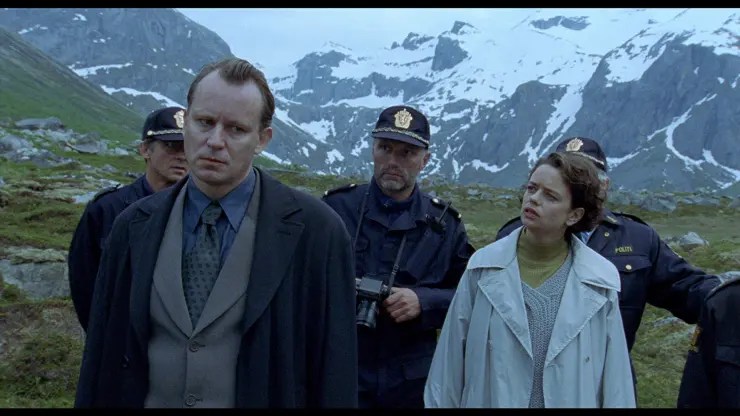
The performance does not announce itself. That is the whole thing. Skarsgård plays Jonas going still when he should flinch, pausing a half-beat too long before answering simple questions, watching every room he enters with the focus of a man who needs to know who in it already knows. He is calculating. He is also dissolving.
Roger Ebert compared the film to Dostoevsky when it opened stateside in 1998. The Crime and Punishment parallel is real, with one difference, Raskolnikov is tormented almost immediately. Jonas keeps choosing not to be. That is the colder read and the better film.
What Nolan Did With It

The 2002 remake moved everything to Alaska, added about 20 minutes, and made the detective a fundamentally decent man destroyed by circumstance. Al Pacino does the thing Pacino does. Robin Williams is genuinely unsettling in a way the film earns. Hilary Swank does more with her role than the script deserves. It is a competent Hollywood thriller and I have not thought about it since I watched it.
The key structural difference, in Nolan’s version, the detective dies. Some weight lifted. In the original, Jonas lives. Goes home. Carries it. That is the correct ending and the more disturbing one, and I will not call it a spoiler because you needed to know.
About This Release

Second Sight did not cut corners. The 4K restoration carries a director-approved HDR grade with Dolby Vision, and Thurmann-Andersen’s washed-out oppressive whites have never looked this punishing. The dual format edition puts the feature and bonus material on both the UHD and Blu-ray, which is a small detail that collectors notice and appreciate.
The physical package is a rigid slipcase with new art by Peter Strain, a 120-page book with essays from Jenn Adams, Mitchell Beaupre, Barry Forshaw, Francesco Massaccesi, Priscilla Page, and Travis Woods, and six collector art cards. The book reads like it was commissioned from people who actually watched the film. That sounds like a low bar. It is not.
What Is on the Discs

The audio commentary with Skjoldbjærg and co-writer Nikolaj Frobenius is the feature you will come back to. A director revisiting his debut nearly thirty years out has usually dropped the defensiveness and kept the honesty, and this one has that quality. Two new interviews accompany it: “Running on Instinct” with Skjoldbjærg, and “Falling Into It” with producer Petter J. Borgli. The producer interview fills in context the film itself never bothers to explain.
Alexandra Heller-Nicholas contributes a piece called “Private Prisons” that treats the film analytically without treating it as a sacred object. Three of Skjoldbjærg’s short films are included: Spor, Close to Home, and Near Winter. Watch those first if you want to know where Insomnia came from.
Buy It or Don’t

If you have never seen this film, the answer is yes. Full stop.
If you own the Criterion edition and you are doing upgrade math. The restoration is the definitive visual presentation and the commentary is new material unavailable anywhere else. Whether that moves the needle depends on you.
Insomnia is a Norwegian film about guilt dressed as a detective story. Jonas Engström did not need the midnight sun to lose his mind. He was already most of the way there.

Surrealism is not my favorite film genre, but I will make a massive exception if it’s in the hands of Boots Riley. Not unlike his debut, Riley’s latest feature, I Love Boosters, is a weird, vibrant, funny, thoughtful, hopeful thesis on collective action and workers’ rights. At a time when satire is almost impossible (an episode of The Boys where the key villain announced that he was God aired just days after the president of the United States posted an AI meme of himself as Jesus), Riley manages to create something just bonkers enough actually feels like it has something to say, and is bright and colorful enough to demand your attention.
Corvette (Keke Palmer) is struggling to get where she wants to be in life, so poor that she’s squatting in a closed chicken restaurant. She and her friends, Sade (Naomi Ackie) and Mariah (Taylour Paige), steal clothes from the high-end boutique Metro and resell them at a lower price to people in their community. As part of their desire to get better at boosting, the three take jobs at Metro, hoping to figure out how to clear out an entire store.
But one day, while they are being reprimanded by Grayson for wearing last year’s Metro line from designer Christie Smith (Demi Moore), they leave the meeting to discover that someone has beaten them to emptying the store. They track down Jianhu (Poppy Liu), a Chinese woman who has a teleporting device that allows her to send the clothes back to China, where they are manufactured, hoping to force Christie to give them better wages and safer working conditions. They realize that they need to work together if they are going to see the changes they are striving for.
Also, LaKeith Stanfield plays a character who is so sexy, I can never watch this movie with my family.
At a time when so many trailers give away the entire movie, I Love Boosters is so wholly unique that if someone explained every plot point to you, you would still need to see it in order to fully grasp everything happening on screen. Like Corvette’s full-to-bursting pink tracksuit, this movie is stuffed with ideas and colors and characters, but it somehow all manages to stay together, creating an absolute feast for your eyes and ears.
The performances in this are absolutely spectacular from top to bottom. Keke Palmer sparkles, even as we see her running away from a literal ball of her problems. Demi Moore gets to play the opposite side of her role in The Substance, this time as the person trying to amass more wealth at the expense of those beneath her, primarily other women, and she tears it up. Don Cheadle is almost unrecognizable as Dr. Jack, a man Sade idolizes for his Friends Being Friendly pyramid scheme. Will Poulter is absolutely hilarious as Grayson, a Metro manager who has fully embraced everything Christie Smith is selling.
One thing you can glean from the trailer is the film’s overall look. Christie works in monochrome, so each location is filled with a single color. But even so, the colors are bright, not like the relentless desaturation that we are cursed with right now. Even when we are taken to the sweatshops in China, everything is bright and colorful. We are drenched in color and unique styles in I Love Boosters, but it is always singular, which is a fascinating way to show the uniformity that is often the hallmark of a hyper-capitalist society that is torn between conformity and individuality.
What makes this movie special is that in the midst of all of the hilarity, bright-but-monochromatic costuming, and a sex demon, there lies a deep philosophical examination of capitalism through the lens of dialectical materialism. This complex ideology isn’t dumbed down in any way, but is instead told to us through a magical device that is able to show us the world beneath the glitz and glamor of the fashion world. And sometimes what is underneath the literal skin of some of the people seeking to prop up the system as it is.
There are some issues with this film that don’t quite come together. The whole LaKeith Stanfield arc is very funny, but doesn’t quite fit with the rest of the movie. Taylour Paige is fantastic in her role, but there is more depth between Sade and Corvette, leaving less for Paige’s Mariah to do. But the messiness is so minor compared to the rest of I Love Boosters that it tends to get swept away in the maximalist filmscape that Riley has created.
Throughout the movie, Christie Smith has a lot to say about creating art and how her clothes allow people to become art themselves. At one point, someone tells her that people don’t want to be art, they want to make art. And that feels very much at the heart of this film. Most people want to create something beautiful that helps their community, but are constantly chased by the pressure to simply survive. To put a roof over your head, food on the table, clothes on your back. I Love Boosters says this dream is possible, but we might have to significantly change how we look at things and recognize that we’re stronger together than apart.
I Love Boosters is now in theaters.
Learn more about the film at the IMDB site for the title.
You might also like…
-
World3 minutes ago
Movie Review: ‘Masters of the Universe’ does not have the power
-

 News6 minutes ago
Map: 3.7-Magnitude Earthquake Shakes the San Francisco Bay Area
-

 Health33 minutes ago
Why Weight Loss Efforts Can Sometimes Lead to Constipation and Digestive Changes
-

 Lifestyle48 minutes ago
Video: The Fashion References in ‘Cats: The Jellicle Ball’
-

 Education51 minutes ago
Video: Are These Portable Fans Worth It?
-

 Technology56 minutes ago
The best Switch 2 screen protector you should buy
-

 World1 hour ago
Fireworks reportedly trigger mass horse stampede through Rome streets, injuring several soldiers
-

 Politics1 hour ago
SEE IT: LA voters split on Pratt’s mayoral bid as one issue dominates Election Day


