Movie Reviews
Humane (2024) – Movie Review


Humane, 2024.
Directed by Caitlin Cronenberg.
Starring Jay Baruchel, Emily Hampshire, Peter Gallagher, Enrico Colantoni, Sebastian Chacon, Alanna Bale, Sirena Gulamgaus, Uni Park, Martin Roach, Blessing Adedijo, Joel Gagne, and Franckie Francois.
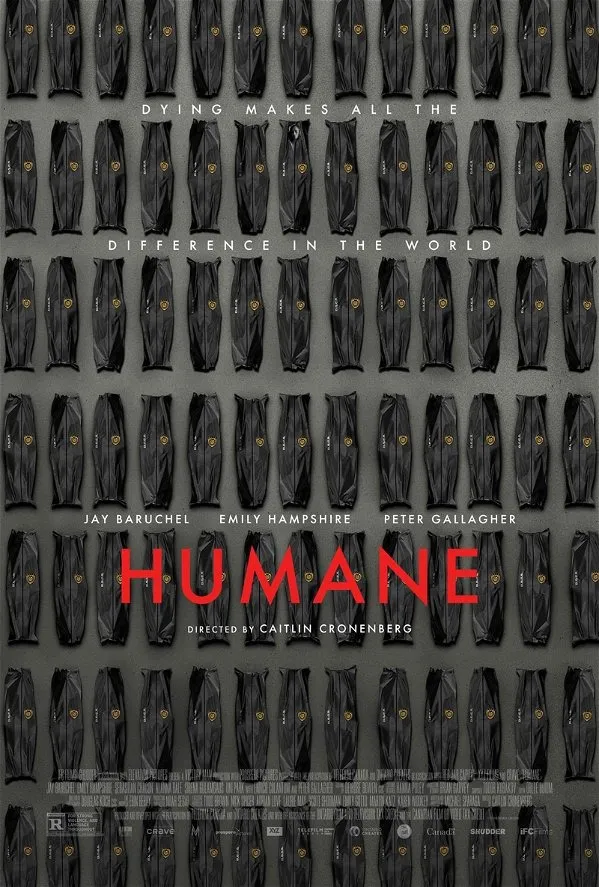
SYNOPSIS:
In the wake of an environmental collapse that is forcing humanity to shed 20% of its population, a family dinner erupts into chaos when a father’s plan to enlist in the government’s new euthanasia program goes horribly awry.

Humane takes a darkly fascinating, timely concept regarding ecological collapse and overpopulation, competently establishes some of that world-building that’s not too far off from a potentially bleak future reality, and then devolves into an hour of filthy rich siblings, most of whom are unlikeable, shouting at each other in an attempt to decide who they are going to sacrifice as part of an ongoing government-funded euthanasia cleansing.
There is also nothing wrong with these characters being offputting and morally bankrupt when a sudden gathering organized by patriarch Charles York (Peter Gallagher) turns into an evening of survival, especially when there are military personnel and individuals even more psychotic overseeing the euthanasia process (a procedure with rewards that seemingly sets up the rest of one’s family financially for life), but the script from Michael Sparaga lacks characterization and complexity beyond one or two defining traits for each sibling. As a result, much of the backstabbing and betrayal between two particular siblings strains credibility and comes across as the screenplay looking to stretch the physical family feud long past its repetitive breaking point.

This is frustrating since, again, the hook grabs attention. Charles is a former celebrated news reporter who financially benefited from years of society ignoring climate change, among other pressing issues. Somewhat of a failure as a parent and husband, currently with a new partner named Dawn Kim (Uni Park), who has faced racism at extreme lengths of having her restaurant burned down (the script also mentions that for whatever reason, Asians, in general, have been made public enemy number one for the current disastrous state of the planet, without ever really expanding on that.) Charles cares deeply about his legacy. He is also looking for some form of redemption, so he signs himself and Dawn up for the euthanasia process while inviting his four adult children (one adopted son) over to say goodbye without explaining what the reunion is about.
The children are Jared’s (Jay Baruchel) government mouthpiece for the euthanasia program, Rachel’s (Emily Hampshire) sociopathic businesswoman who doesn’t realize or seem to care that her heartlessness gets her daughter Mia (Sirena Gulamgaus) endlessly bullied at school, recovering junkie and adopted son Noah (Sebastian Chacon) and aspiring actress Ashley (Alanna Bale.) Due to not knowing the nature of this reunion, Mia also ends up in the house. It is also established that Noah and Ashley are closer to one another than everyone else in this dysfunctional family.

Following dinner, Charles blurts out what is happening here; the euthanasia enforcements arrive, insisting that the family figure out a way to provide a second body since Dawn had run off before they arrived. Whether there is a deeper significance to that remains a mystery. There is no backing out, and the menacing ringleader, Bob (Enrico Colantoni), scrambles the Wi-Fi and is certain that these people are so selfish they will try to kill each other to ensure they are not the second death. He also makes clear that this group does not euthanize children (although the slimy Jared is seen on television early on promoting the idea, admitting that he would allow his teenage son to consider it), ordering his armed guards to bring Mia outside and into his van as insurance while the family decides what to do.
The euthanasia process is unsettlingly creepy, as fully seen during an opening prologue juxtaposed with an upbeat, cheerful song choice. The film consistently finds pockets to quickly drop tiny bits of information about this world and how the service is handled in the public eye, including gallows humor commercials thanking regular citizens for their suicide contributions.
That’s all one way of saying Humane has the ingredients to be a sharp and socially aware takedown of the rich and a reflection of a grim, possible reality if everyone on this planet doesn’t get on the same page to do something about devastating global concerns. However, the film takes that intrigue and squanders it all on a sibling match of who can yell the loudest and survive the most injuries. Characters repeatedly try to kill each other, form alliances, betray one another, and show their worst sides in ways that don’t always feel believable, even for these wealthy, self-centered assholes. It becomes exhausting, and at one point, we side with the gleeful euthanizing murderer for trying to convince Mia that her mom is an awful person. Hilariously, it also tries to give that character a dramatic backstory while dropping the psychopathic behavior for roughly two minutes.
What Humane does have going for it is that it is the debut from Caitlin Cronenberg, and while this is a different kind of horror from what her father and brother would craft (and sometimes a black comedy with Jay Baruchel eliciting some laughs), the violence still has some body horror that fits right in with the family portfolio. Fingers are forced inside stab wounds, and blood squirts so often that it becomes confounding no one is dead yet. As a director, there should be interest in what she does next, preferably something with a stronger screenplay and layered characters.
Flickering Myth Rating – Film: ★ ★ / Movie: ★ ★
Robert Kojder is a member of the Chicago Film Critics Association and the Critics Choice Association. He is also the Flickering Myth Reviews Editor. Check here for new reviews, follow my Twitter or Letterboxd, or email me at MetalGearSolid719@gmail.com
https://www.youtube.com/watch?v=embed/playlist



In the modern entertainment age, franchising for the sake of it has become entirely commonplace. So long as intellectual properties are financially successful and capable of regularly turning a profit, no franchise is ever truly finished. Strangely enough, over the past decade, this has become especially true even in the medium of animation. Where sequels to animated films used to be predominantly relegated to straight-to-DVD releases and bargain bins at discount stores, they are now the bread and butter of the industry.
I say all of this to say that it’s easy to get jaded and uber-cynical when you see a title like “Toy Story 5” preparing for release. However, what’s so wonderful about Andrew Stanton and Kenna Harris’ long-gestating sequel is that it’s about as far from an easy cash grab as humanly possible. Instead, this fourth sequel to Pixar’s seminal original launching pad of a film overtly embraces several of the themes and subtextual threads that have emerged organically throughout the series, recontextualizing the three-decade-long-running franchise of cinematic bangers in a way I had never really thought about before: modern mythology.
TOP FIVE THINGS ABOUT “TOY STORY 5”
5. The Dynamic Duo of Andrew Stanton and Kenna Harris
Toy Story 5 is written and directed by the duo of Andrew Stanton and Kenna Harris. Stanton is a longtime Pixar veteran, a creative who has a writing credit on the first Toy Story and who also directed films like Finding Nemo and the masterpiece that is WALL-E. Harris, meanwhile, is a newer voice within Pixar, having made their directorial debut on the Luca-adjacent short film Ciao Alberto. In this combination of old and new, Toy Story 5 is able to strike a balance that is both traditional and innovative.
The film is both ruthlessly focused and astoundingly audacious. The first act spends time juggling multiple story threads, all of which inevitably collide in the latter half of the film. However, the fact that Stanton and Harris have crafted a structure that allows for these big, ambitious narrative swings while still remaining firmly rooted in the distinct perspective of Jessie as a character is nothing short of mesmerizing. Toy Story 5 is very much a film that could have simply played the hits and raked in the cash, but Stanton and Harris’ combined work, alongside their collaborators at Pixar, results in something far more nuanced, articulate, and affecting.
4. The Music
Randy Newman has long been the stalwart of the Toy Story franchise, writing original songs for all of the films and orchestrating the entire musical scores for them as well. That remains predominantly the case in this fifth entry, though he does receive a musical assist from Taylor Swift as well, with her bespoke end credits song, “I Knew It, I Knew You.”
The song is killer (and that is coming from someone who was kind of dreading new Swift music after the debacle that was The Life of a Showgirl), and Newman’s score is fantastic. The venerated musician finds inspiration anew in key elements of the plot, such as the legion of marooned high-tech Buzz Lightyear toys, who get their own operatic vocal arrangements to underscore their scenes. Elsewhere, Newman digs even deeper into the roots of his earlier inspirations, most notably with Jessie as a character, who receives a stronger twang in her theme music, along with numerous symphonic renditions of the iconic “When She Loved Me” from Toy Story 2. All in all, it’s phenomenal music across the board, worth hearing on the best sound system you can get.
3. The Playtime Setpieces
The masterpiece that is Lee Unkrich’s Toy Story 3 opens with one of my favorite sequences from any Toy Story film: a playtime sequence that sees the animators bringing young Andy’s imagination to cinematic life in thrilling fashion. It’s exciting, hysterical, and altogether enthralling. In Toy Story 5, with the toys and the films as a whole having shifted over to Bonnie, she gets numerous instances of her own playtime set pieces, and they are all just as fantastic.
Incorporating an entirely new animation style and aesthetic, these sequences bring the imaginations of these young girls (newcomer Blaze gets a playtime set piece as well) to life in the same way that the third film brought Andy’s to life. These sequences are full of innovation and bursting with creativity, while also gaining an immense amount of traction from contrasting themselves with the playtime sequences from earlier in the franchise. They are thrilling, insightful, and enlightening all at once, more than worth the price of admission.
2. The Performances
There are so many fantastic vocal performances throughout Toy Story 5. Tim Allen is as reliably broad as ever as Buzz, but it’s the other two-thirds of the main trio here that really get to shine in unexpected ways. First up is Joan Cusack as Jessie, who gets to be this film’s full-on protagonist and absolutely rises to the occasion. Jessie has long been a rich character, but seeing her get more room to breathe is a bona fide treat, and Cusack delivers her greatest vocal performance of the series as a result.
Then there is Tom Hanks as Woody, who absolutely soars as a result of the exact opposite approach: he’s unencumbered by the narrative and instead freed up to go kind of bonkers. In installments past, Woody has often been relegated to the role of the comedic straight man in one way or another. But here, Woody is unleashed, and Hanks subsequently goes completely off the rails. This is the most scenery he has ever chewed in one of these movies, hamming it up with several line deliveries in absolutely gut-busting ways.
Also, the scene-stealer of the movie is Conan O’Brien as Smarty Pants, a tech-based toilet aid. Conan goes full-blown gonzo in the ways that only Conan can, while also delving into some unanticipated nuance and pathos. All around, miraculous stuff.
1. What They Grow Beyond
The central narrative hook of Toy Story 5 is “tech versus toys.” There are about a million different ways this could have gone horribly wrong, and yet Stanton, Harris, and the team manage to pull it off with aplomb. The film is ultimately about the ways childhood has changed over the course of the franchise’s run: how technology has infiltrated this once-idyllic daydream of playtime and the implications of outsourcing childhood imagination to a series of devices.
On top of this, the franchise’s treatment of its characters remains consistent and earnestly authentic as ever. The way the Toy Story films continue to function as “yes, and” storytelling, building off each installment in ways that feel organic and deeply satisfying, is astounding. I don’t want to spoil some of this film’s greatest moments, but suffice it to say it engages meaningfully with its past while also charting a new course forward.
Where the previous two installments each brought things toward a sense of closure for the series as a whole, Toy Story 5 distinctly does not. Instead, it recontextualizes the franchise and redefines what a Toy Story film can be in the process.
GRADE
(A-)
Andrew Stanton and Kenna Harris’ Toy Story 5 is a Pixar film that more than lives up to the studio and franchise’s reputation. In an entertainment ecosystem full of seemingly unyielding franchises that keep proliferating for the sole sake of producing more monetizable content, Toy Story 5 stands in stark contrast as a passion-filled artistic statement. It is almost certainly not the sequel many Toy Story fans want, but it is instead the one they need: a film about the intrinsic beauty of growing, to infinity and beyond.

Discover more from RGM
Subscribe to get the latest posts sent to your email.

Welcome to an exciting year-long project here at The Nerdy. 1986 was an exciting year for films giving us a lot of films that would go on to be beloved favorites and cult classics. It was also the start to a major shift in cultural and societal norms, and some of those still reverberate to this day.
We’re going to pick and choose which movies we hit, but right now the list stands at nearly four dozen.
Yes, we’re insane, but 1986 was that great of a year for film.
The articles will come out – in most cases – on the same day the films hit theaters in 1986 so that it is their true 40th anniversary. All films are also watched again for the purposes of these reviews and are not being done from memory. In some cases, it truly will be the first time we’ve seen them.
This time around, it’s June 13, 1986, and we’re off to see Karate Kid Part II and Legal Eagles.
Karate Kid Part II
Who knew this film would do so much work to make Cobra Kai the series it would become?
Six months following the events of the first film, Daniel finds himself at a crossroads as Ali has broken up with him and his mom is moving for work again and he doesn’t want to go. Mr. Miyagi (Pat Morita) Offers to take Daniel in, but as they work on what will become his room, he receives a letter asking him to come him to Okinawa as his father is dying. The two pack their bags and head to Japan where Mr. Miyagi’s past comes back to haunt him as Daniel looks forward to a potential new romance.
The film is fine, but it is definitely not the same quality as the first. Where the characters go story wise makes sense, but it still doesn’t feel that much like we needed to follow them any further in their lives.
As we all know in 2026, howver, their stories were far from over.
Where to watch: Available to stream.

Legal Eagles
There are some films where you wonder if anyone ever looked at a script and thought, “Could we maybe have one less plot?”
Tom Logan (Robert Redford) is an Assistant District Attorney who is possibly going to run for DA when his boss leaves the position. Laura Kelly (Debra Winger) is representing a performance artist, Chelsea Deardon (Daryl Hannah) who just can’t seem to get out of her own way. Everyone collides and starts making everything just that much more complicated for everyone involved.
I like every who stars in this movie, but the story is just so pointless. It has a weak foundation and instead of trying to build it up, they just keep piling one more thing on top of another and pretending that is how storytelling works.
Great cast. Horrible script.
Where to watch: Available to stream.
1986 Movie Reviews will continue on June 27, 2026, with American Anthem, Labyrinthm Running Scared, and Ruthless People.
Movie Reviews
‘Finnegan’s Foursome’ Review: Edward Burns’ Spiky-Quaint Sports Dramedy Is a Tale of Family Therapy Through Golf

Thirty years after “The Brothers McMullen,” the writer, director, and actor Edward Burns looks preserved in amber — his hair and beard have some silver, but at 58 he’s still lean and handsome in that prince-of-the-working-class Irish-American way. And it’s not just Burns who’s more or less unchanged; so is his filmmaking style. “Finnegan’s Foursome” is his 16th feature, and he’s still doing that shaggy-likable, spiky-quaint, semi-low-budget Edward Burns dramedy thing — the script that’s talky and kind of funny, though in a way that often sounds like a script; the camerawork that never strays too far from the functional; the acting that hovers between lively and broad. The style Burns works in is now closer to television than movies, and given that “Finnegan’s Foursome” is getting a streaming release (starting today), you could say it’s a minor indie movie that has found its rightful home.
It’s a sports comedy, about golf and Ireland and family conundrums (it would be overstating it to call them demons), and a key thing that might put you in the audience demo for it is if you happen to be a serious golfer. It’s a movie spun out of the love of the game. Burns, who first shows up in a samurai man-bun, plays Freddy Finnegan, a wealthy clothing entrepreneur who seems to have a happy and settled life, except that he’s got anger-management issues, all stemming from his rivalrous relationship with his irascible Irish father, Jack (Ian McElhinney).
At first, we think the movie is going to be about these two facing off. Jack, at his home in South Carolina (he came over from the old country in 1959), is hosting the latest edition of the Finnegan’s Cup — an annual golfing competition in which four members of the family face off against one another, mostly as an excuse for Jack, a retired golf instructor, to tell his old jokes and stories and reminisce about the days when he was good enough to rub shoulders with the Big 3 (Arnold Palmer, Jack Nicklaus, and Gary Player).
He’s a blustery egomaniac, though he strikes us as a warm-hearted one. And Freddy, of course, resents the hell out of him. But what we think are going to be the fireworks between these two come to a halt when one of the players hits a hole in one and Jack keels over in shock, dead of a heart attack.
The family now has to scatter Jack’s ashes in the four locations he has chosen in Ireland (two of them are golf courses). And that’s an excuse for Freddy, who resents his da even in death; his more benign older brother, Teddy (Brian d’Arcy James), a novelist who has been suffering from writer’s block; Freddy’s musician son, Frankie (Brian Muller), whom he treats nearly as cavalierly as his father treated him; and Teddy’s adult daughter, Marie (Erica Hernandez), to take a week’s vacation in Ireland, where they’ll play out the Finnegan’s Cup at a handful of fabled golf courses, smacking around some home truths along with the ball.
There’s plenty of on-the-nose dialogue (“His dying wish was to get us all back here to Ireland”), as well as cornball boasting (“It’s not about the clubs, little brother, it’s about the man who’s swingin’ ’em”) and generic braggadocio (“I believe that is what you call an eagle!”). Freddy and Teddy never stop making side bets and busting each other’s chops, mostly about who has the better golf game, this being the locker-room form of brotherly love. If the family tension simmers, it’s mostly because Freddy and Teddy have opposite feelings about their father. Listening to their back-and-forth taunts, Marie says, “I’m sorry, so this entire trip is nothing but constant ball-busting?” Swap in “movie” for “trip,” and you’ve got an idea of “Finnegan’s Foursome,” though you should also toss in Frankie doing his cringe mock-sports-announcer banter.
“Finnegan’s Foursome” is structured as a sports movie, and Burns, working with the cinematographer Jeff Muhlstock, connects you to the geometric majesty of the links. But when you watch a film like “Tin Cup,” part of the thrill is that you want to see the Kevin Costner hero win; that’s the dramatic Zen of a sports film. Watching “Finnegan’s Foursome,” we’re not overly invested in whether Edward Burns’ entitled a-hole gets a winning golf score over his novelist brother.
There’s a touching scene where three of the characters sing “The Parting Glass” at a pub. But here’s how “Finnegan’s Foursome” is a bit soft. The movie is about Freddy coming around to see that his da really did love him, and that he wasn’t such a bad guy (he gave him the love of golf, after all). But the reason we readily buy this is that it’s so apparent from the outset. Jack’s big crime? Being away “at the office” (i.e., the golf course) too much. As ultimate sins of parents go, it’s kind of a dated sin. You want to say to Freddy, “Stop whining.” Especially because the Jack we see, in his competitive Irish way, had a lot of spirit; he was no ogre. Of course, he also tried to “get into Freddy’s head” on the golf course, but that’s kind of a privileged problem. It’s Freddy who needs to dismantle the ogre of resentment in himself, and that’s not quite a movie — that’s therapy.
The blithe and likable “The Brothers McMullen” won the Grand Jury Prize at the 1995 Sundance Film Festival and went on to have a healthy theatrical life, launching Burns’ career as a homespun auteur — at the time, he almost seemed like the shoestring Irish-American answer to Woody Allen. I was a fan of the early Burns films (especially “She’s the One,” his 1996 crossover movie, costarring Jennifer Aniston and Cameron Diaz), but his moment in the spotlight didn’t last long. After crossing over, he kind of crossed back, retreating into the not-fully-on-the-radar indie wilderness. That’s where he has remained, and watching “Finnegan’s Foursome” you see why: He’s trying to stay true to his world (all the Irish chop-busting and piss-taking), but he hasn’t grown as a filmmaker. Then again, maybe that’s not so important. He doesn’t hit long drives, but by the end of “Finnegan’s Foursome” the ball is in the cup.
-

 Los Angeles, Ca1 hour ago
Kids, teens can enjoy free lunch at over 90 parks across Los Angeles
-

 Detroit, MI1 hour ago
Metro Detroit church hosts community event to support youth: “We’re here for you”
-

 San Francisco, CA2 hours ago
San Francisco celebrates Black freedom at weekend Juneteenth parade: ‘We’re all people’
-

 Dallas, TX2 hours ago
Redesign debate intensifies as Dallas convention center faces costly delays
-

 Miami, FL2 hours ago
‘An insane memory’: New World Cup super hero plays in Miami but not with Messi
-

 Boston, MA2 hours ago
FAA investigates close call between two aircraft at intersecting runways at Boston Logan International Airport | CNN
-

 Denver, CO2 hours ago
Proposed September 2026 Service Changes
-

 Seattle, WA2 hours ago
Seattle gets a heat wave and rain storm in the same week? – Emerald City Weather Blog

