Movie Reviews
Clear Cut (2024) – Movie Review


Clear Cut, 2024.
Directed by Brian Skiba.
Starring Clive Standen, Tom Welling, Stephen Dorff, Alec Baldwin, Jesse Metcalfe, Lochlyn Munro, Lucy Martin, Chelsey Reist, Tom Stevens, and Mike Dopud.
SYNOPSIS:
A team of loggers discover a meth cook site in the middle of the forest and are forced to fight for their lives while being hunted by a drug cartel.

With a title such as Clear Cut, one might think director Brian Skiba is trying to be cutely vague and intentionally jumbling since his narrative distractingly jumps back and forth in time with no grace. The reality is that what the film is trying to do with its story is fairly obvious after roughly the second flashback, executed with such outright poor editing technique (Skiba also performs those duties) that one sits there in shock at the ineptitude when it cuts back to a scene with Alec Baldwin who was recently killed at the beginning.
Dead characters appearing in flashbacks is inherently fine, but watching it play out here is baffling; you could reconfigure the scenes chronologically, and this already lousy film might play better. Alec Baldwin isn’t a recurring presence after that; the movie is just pointlessly like this. At the very least, the not-so-smooth attempt at (I think?) trying to trick the audience regarding what is happening with its central plot could have been avoided. It’s hard to tell since the editing makes everything come across as more confusing than the story is. Furthermore, the fact that I have so many questions about the filmmaker’s intent mostly already proves whatever he was trying to do with structure didn’t pan out. That’s an understatement.

The story itself concerns Clive Standen’s Jack, taking on logging work en route to a job site with his superior and mentor (Alec Baldwin.) Now, if reading this brings about some interest that there might be some positive and earnest deforestation messaging at the heart of the action, let me remind readers that this is one of those super cheaply made Lionsgate VOD entities that somehow slides its way into a few theaters across America. Jack is seeking revenge on some criminals running a meth operation out here in the woods, which also brings up several questions of logistics that the film never bothers to take a stab at answering.
Unsurprisingly, the one cooking up the meth gives the zaniest performance, which basically means Lochlyn Munro is playing clichéd psychopathic redneck running around with a crossbow, murdering anyone who might throw his shady business out of whack. Bringing an inexplicably large amount of money to a deal where the one cooking up the meth lives in a camper, presumably in the middle of nowhere, the leader of the buyers conveniently leaves the money in the back of a truck for Jack to steal and run off with. Stephen Dorff also plays a Park Ranger who gets involved in the two battling sides. The less said about the women who pop up in this movie is probably for the better.

For as much as Clive Standen gives a passable performance regarding both the emotional toll recent tragic events have taken on him and the close-quarters action, it’s also undermined by the film (written by Joe Perruccio) concocting scenarios that tastelessly ramp up that drama. Regarding the direction, nothing here stands out aside from one or two moments toward the end of Clive Standen letting loose some of that bottled-up anger and sadness. There’s a chance that if you show someone the final 10 minutes of Clear Cut, they will wrongly assume you just watched a decent movie. Fortunately, what is clear-cut is that this is anything but worth checking out.
Flickering Myth Rating – Film: ★ / Movie: ★ ★
Robert Kojder is a member of the Chicago Film Critics Association and the Critics Choice Association. He is also the Flickering Myth Reviews Editor. Check here for new reviews, follow my Twitter or Letterboxd, or email me at MetalGearSolid719@gmail.com
https://www.youtube.com/watch?v=embed/playlist



Heat Advisory
from THU 12:00 PM EDT until THU 8:00 PM EDT, Eastern Montgomery County, Lower Bucks County, Philadelphia County, Delaware County, Eastern Chester County, Gloucester County, Northwestern Burlington County, Camden County, Mercer County, New Castle County

By and large, the zombie subgenre has bitten off more than it can chew in modern times. Between George Romero survival films and camp comedies, the well has become pretty infected. But once in a while, along comes a movie like This Is Not A Test.
Let’s sink our teeth into this new release and see how it stacks up against the classics.
The tone and tenor of this film represent the classic survival movies like Night Of The Living Dead. But the thing that grabs the audience about This Is Not A Test is the trauma of the characters. Holt shines as a withdrawn survivor of an abusive home, trying to cut through the wreckage to reunite with her sister. Each of the main characters have standout traits, and they bathe in strongly acted moments as the stress of the situation changes who they are.
The gore in This Is Not A Test is pretty strong. The attacks spring quickly and when they do, the special effects team does a good job showcasing the battle scars. The camera work is also frenetic in a good way, because the chaos of the chase scenes puts the viewers in a first-person perspective. This film lets you feel like a part of the survivors, so their journeys are interactive.

Longtime fans may say that there’s nothing new in This Is Not A Test, and maybe they’re right. There’s no fresh take on the monsters here, no crazy origin, nothing that we haven’t seen in the past fifty-eight years. But the pacing nails a great balance between getting to know the characters and getting the zombie splatter fest. The mental meltdowns of the characters feel well earned, and the arc of Sloane and her sister brings a lot of heart and investment to the story. Even the most jaded zombie horror fans will find something to appreciate here, even as a background movie.
Adam MacDonald has made another intense hit here, and This Is Not A Test is currently available to stream on Shudder.

- THE ODYSSEY
- Starring: Matt Damon, Tom Holland and Anne Hathaway
- Directed by: Christopher Nolan
- Rated: R
- Running time: 2 hrs 45 mins
- Universal
Our score: 4.5 out of 5
EPIC. If I was asked to describe Christopher Nolan’s latest film, that is the word I would use. He has mounted a film that rivals the greatest achievements of filmmakers like Cecil B. DeMille or David Lean. And, like the films of those mentioned, it’s runs a tad too long.
I was shocked, but pleased, to see that my 12-year-old granddaughter recently did a school paper on King Agamemnon. Thank goodness they’re still teaching History in our schools. Based on Homer’s “The Odyssey,” the film tells the story of King Odysseus (Damon) and his adventures which, if you’ve read “The Odyssey,” include the Trojan Horse, the Cyclops and assorted angry Greek gods. The film covers each of these adventures in great detail, sparing nothing in the production design department. While Odysseus is away – and he’s gone for a l-o-n-g time, his wife Penelope (Hathaway) has to endure a never ending string of “suitors,” men lining up in the hopes of replacing the King should he not return. The men are nothing more then scavengers, taking advantage of the law of Zeus, which decrees no one should be turned away. This angers the Queen’s son, Telemachus (Holland), who must control his temper when the men try to bait him into a fight, the idea being if Telemachus is killed, the new husband would become the King. It’s all very interesting and complicated. And long.
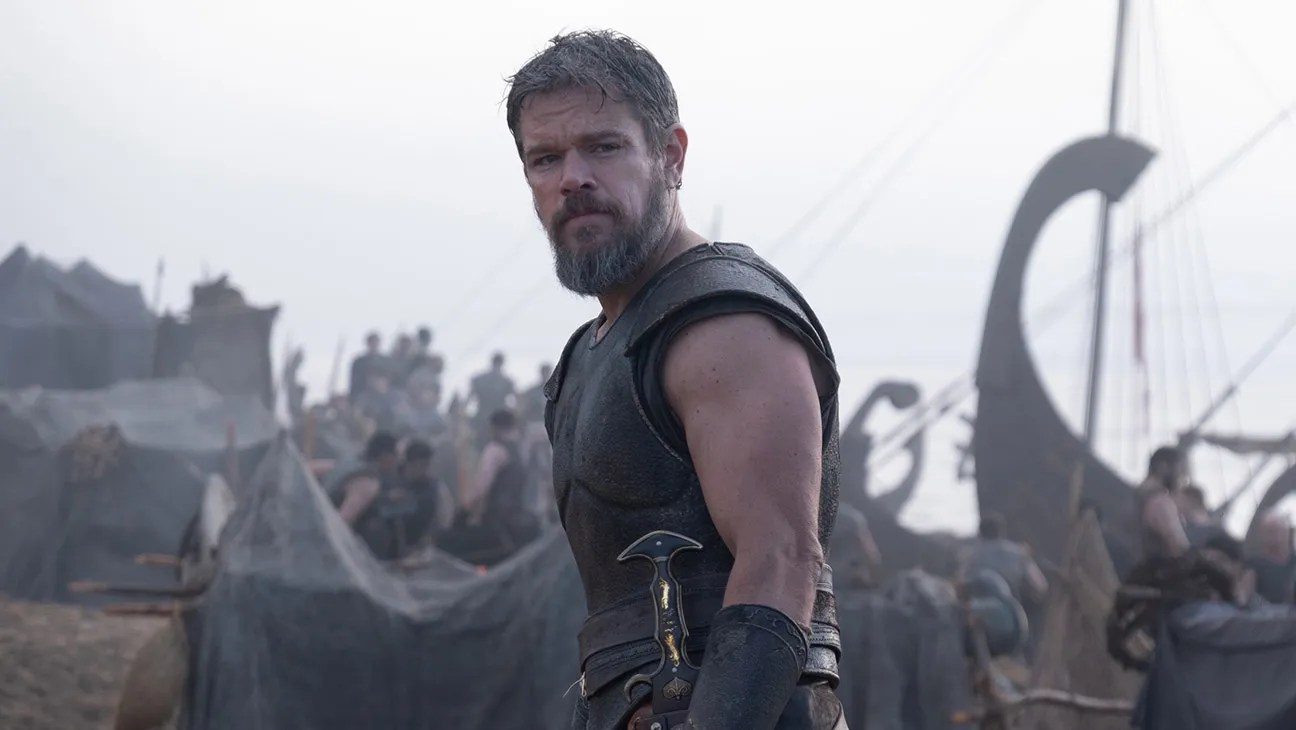
Director Nolan is one of the rare filmmakers who, in my opinion, has never made a bad film. From “Memento” to the “Dark Knight” trilogy to the Oscar-winning “Oppenheimer,” he has proven himself a true master of cinema. “The Odyssey” only adds to that distinguished resume’
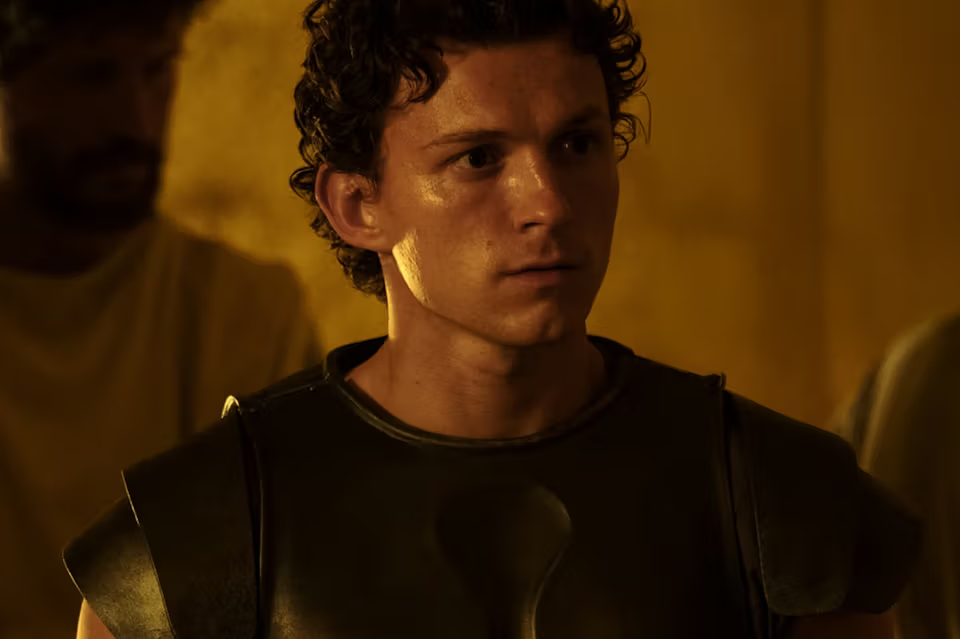
The cast is a tribute to Nolan himself who, like Woody Allen, can pretty much get anyone he wants for his films because, as an actor, why wouldn’t you want a credit in one of his films. Besides the three stars named above, the cast includes Robert Pattinson, John Leguizamo, Zendaya, James Remar, Jon Bernthal, Oscar nominees Samantha Morton and Elliot Page as well as Oscar winners Charlize Theron and Lupita Nyongo. As MGM used to advertise, “more stars than there are in heaven.”
The script and story are pretty faithful to the source material, though for some reason it bothered me whenever Telemacus referred to Odysseus as “dad.” Never father. The weird things you notice. Visual.y the film is stunning and the Trojan Horse and battle of Troy are worth the price of admission alone. I will add that I did see the film in 70 mm and, if that format is playing in your town, I urge you to see it in that format.
On a scale of zero to five, “The Odyssey” receives ★★★★ ½
-

 Louisiana5 minutes ago
Why Louisiana is one of the most mosquito infested states in the US
-

 Maine11 minutes ago
Wife of Colombian father killed by ICE in Maine says they had planned to grow old together
-

 Maryland17 minutes ago
Washington Nationals 1st-round pick from Potomac Md. signs contract – WTOP News
-

 Michigan23 minutes ago
Michigan AG Dana Nessel visits Kalamazoo to address rising energy prices
-

 Massachusetts29 minutes ago
Springfield attorney named to 2026 Massachusetts Super Lawyers list
-

 Minnesota35 minutes ago
Hundreds of Canada wildfires prompt US air quality alerts as smoke spreads south
-

 Mississippi41 minutes ago
Mississippi homeowners blame a noisy data center plant for sleepless nights. The mayor’s advice? “Consider selling.”
-

 Missouri47 minutes ago
Missouri health officials report 80 current cases of cyclosporiasis

