
Connect with us

Entertainment

'Love is Blind' finally gets political. Is supporting Trump a relationship dealbreaker?

Published

on

'Love is Blind' finally gets political. Is supporting Trump a relationship dealbreaker?

Over seven seasons, contestants on “Love Is Blind” have shared difficult, sometimes deal-breaking conversations about issues like race, religion, money, birth control and abortion.

But one subject has been largely absent from conversation in the “pods,” despite being virtually unavoidable in the real world: politics. We never saw any would-be couples asking each other explicitly how they voted. And even though “Love Is Blind” premiered in 2020, at the tail end of President Trump’s divisive term in office, his name was never uttered onscreen.

Then came Season 7, set in Washington, D.C.

The latest installment of the dating experiment, as the show markets itself, follows singles from the Capitol region and arrives in the final stretch of yet another contentious presidential race. It also happens to be the first season in which contestants discuss their personal political beliefs in partisan terms.

“OK, let’s start with this,” Monica Davis, a 36-year-old sales executive, asks Stephen, a 33-year-old electrician, during an early pod date. “Did you vote in the last presidential election? And the election before that?” Stephen Richardson explains that in 2016, he voted for Trump “because I didn’t like Hillary [Clinton].” But he came to “despise” the way Trump handled himself in office, and voted for now President Biden in 2020.

Advertisement

“I will happily admit that my first vote wasn’t the most educated vote,” he tells Monica, who (briefly) becomes his fiancée, until she catches him sending racy text messages to another woman.

It’s not the only mention the former president receives in the pods. Bohdan Olinares, 36, and Marissa George, 32, both military veterans, bond over their shared liberal views. Marissa confesses that she dated a Trump supporter for three years but found that “there’s just a difference in thinking about how our society works.”

”When it comes down to it, are you gonna vote for a guy who tried to overthrow the government?” Bohdan says. “I’m never gonna agree with that.”

“I’m not gonna vote for a rapist, right?” she replies.

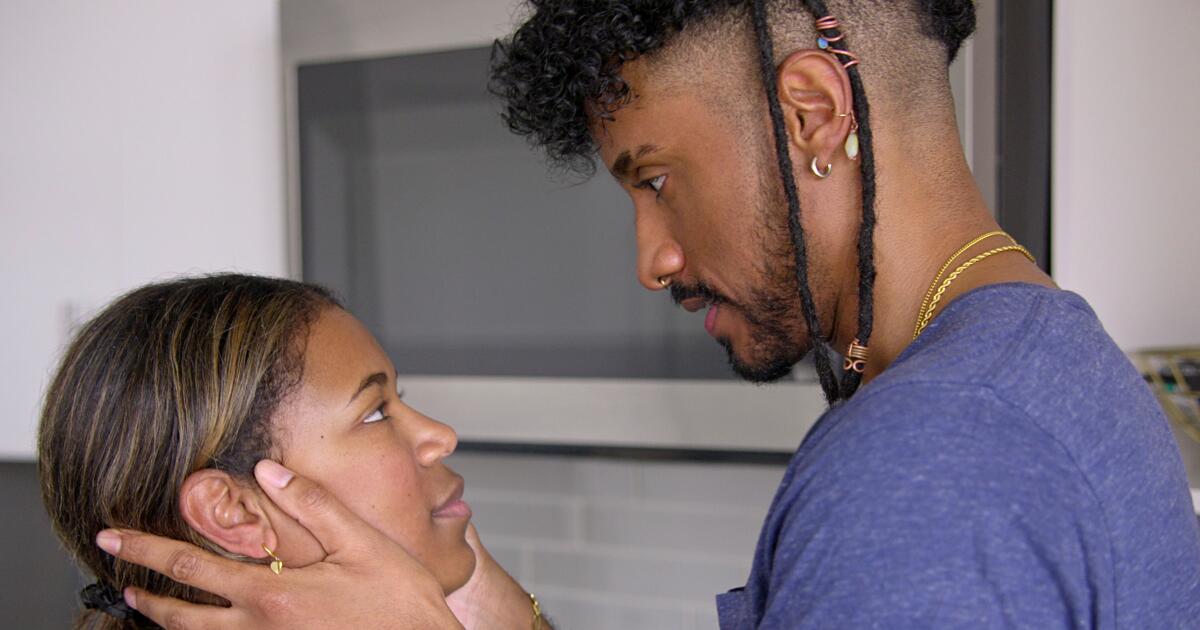
Marissa ultimately gets engaged to Ramses Prashad, 34, who works at a justice nonprofit and may be the most performatively woke person who has ever appeared on the show. With hair that Marissa’s brother compared to that of ’80s R&B singer El DeBarge and a wardrobe of leather pants and Coogi sweaters, Ramses also is the first person on “Love Is Blind” to quote James Baldwin or use the phrase “hammer of American imperialism” between sips from a golden goblet. When Marissa tells him that the movie “Barbie” made her realize she couldn’t be with someone who supported the patriarchy, he scoffs, “It took ‘Barbie’ to make you realize that?” He also is openly disdainful of Marissa’s military service, and tells her he’d break up with her if she reenlisted. (Meanwhile, the only thing he should be judging Marissa for is her belief that Adam Sandler is funnier than Will Ferrell, but I digress.)

Advertisement

On one hand, this season’s political bent should not be surprising. Washington, D.C., is one of the most overwhelmingly Democratic places in the country: Biden won 93% of the vote there in 2020. The entire region is full of people who work in government, advocacy, lobbying and the military. And while there are no congressional staffers in the cast this season, there are numerous veterans and at least one “clean energy policy consultant,” Taylor Krause, who recently published a white paper about hydrogen.

Ramses Prashad and Marrisa George eventually get engaged.

(Netflix)

Yet previously, it often felt like the producers of “Love Is Blind” were going out of their way to elide overtly partisan conversations, or the discussions were so vague that they were almost incomprehensible. (In Season 1, Giannina Gibeli and Damian Powers got in what seemed to be an argument about Trump but no one knew for sure.) The singles in “Love Is Blind” seem to exist in a parallel universe, curiously devoid of the intense polarization that consumes the rest of the country and compels many Americans to size up their neighbors, prospective romantic partners, athletes and favorite pop stars based on how they vote.

Advertisement

There have been a few coded dog whistles (e.g., Season 6’s Sarah Ann Bick, who described herself as a “patriot,” meaning “Republican”). But for the most part, viewers have been left to draw conclusions about contestants’ political leanings based on circumstantial evidence such as their social media history or predilection for star-spangled clothing.

All of which makes Season 7, with its frank, uncomfortable discussions about the role of politics in people’s intimate lives, feel like a watershed moment for “Love Is Blind” as it finally bursts its escapist bubble. It also feels like an overdue acknowledgment of our hyperpartisan reality, particularly as we approach an election in which issues like abortion, IVF and childcare will be central to how people cast their vote, especially women, who have been most affected by the fall of Roe vs. Wade and bear the brunt of child rearing. Many pundits expect that this election will feature a bigger-than-ever gender gap between women, mobilized to support Vice President Kamala Harris because of her stance on abortion, and men, drawn to Trump’s blustering machismo.

But as we see with Ramses and Marissa, there is more to being compatible than mutual disdain for Trump or a shared support for liberal ideas. The couple’s initially blissful relationship begins to fray as they return to D.C. and realize their personal values don’t necessarily align, even if their politics kinda-sorta do.

The first signs of trouble appear when Ramses expresses reservations about Marissa’s military service — which he was aware of when they got engaged. “I don’t view politics and those types of things as something that exists in a vacuum,” he says. “These ideas, they affect real people.”

In other words, the personal is political. It’s true, especially when it comes to marriage and family, but for Ramses, it increasingly appears to be an empty, self-serving slogan. In last week’s batch of episodes, he and Marissa shared a tense and infuriating conversation about birth control. (The Infuriating Conversation About Family Planning has become something of a “Love Is Blind” trope.) She says she doesn’t want to go on the pill, but he balks at the idea of using a condom during sex “because it’s not enjoyable” even though he is also adamant about not starting a family for several years. (Here’s where I ask, not for the first time: Has anyone on this show heard of an IUD?) Ramses — or at least the edited version of him we see on the show — is a hypocrite, someone who boasts that he “doesn’t try to follow traditional expectations of what masculinity should look like” and yet gives his fiancée a hard time for making choices about her body that create minor inconveniences for him.

Advertisement

This week, we witness yet another painful fight: After Marissa apparently turns Ramses down for sex because she’s sick, exhausted and has a nasty case of PMS, he gives her a guilt trip over the lack of physical affection. He even implies he’s having second thoughts about getting married because of this single rejection. Usually bubbly and upbeat, Marissa is visibly deflated and worn down by her partner’s demands. She listens to his concerns, then counters that in the future, she may not want or be able to have sex for any number of reasons — like, for instance, if she just gave birth. “This is probably going to come up multiple times in our relationship. Is this going to be an issue for you?” she asks.

“That’s a fair question,” he replies.

It’s also one he isn’t ready to answer, because for all his liberal posturing, he still can’t quite accept his fiancée’s bodily autonomy. The “Love Is Blind” fandom has already started to turn on Ramses, slamming him as a toxic “gaslighter.” We still have a finale and a reunion to go, so Ramses has a chance to redeem himself — or at least provide some context for his cringe-inducing conversations with Marissa. But this season has already made it clear that while love may be blind, relationships are always political.

Advertisement

Movie Reviews

Review | Hoppers: Pixar’s new animation is a hilarious, heartfelt animal Avatar

Published

on

Review | Hoppers: Pixar’s new animation is a hilarious, heartfelt animal Avatar

4/5 stars

Bounding into cinemas just in time for spring, the latest Pixar animation is a pleasingly charming tale of man vs nature, with a bit of crazy robot tech thrown in.

The star of Hoppers is Mabel Tanaka (voiced by Piper Curda), a young animal-lover leading a one-girl protest over a freeway being built through the tranquil countryside near her hometown of Beaverton.

Because the freeway is the pet project of the town’s popular mayor, Jerry (Jon Hamm), who is vying for re-election, Mabel’s protests fall on deaf ears.

Everything changes when she stumbles upon top-secret research by her biology professor, Dr Sam Fairfax (Kathy Najimy), that allows for the human consciousness to be linked to robotic animals. This lets users get up close and personal with other species.

Advertisement
“This is like Avatar,” Mabel coos, and, in truth, it is. Plugged into a headset, Mabel is reborn inside a robotic beaver. She plans to recruit a real beaver to help populate the glade, which is set to be destroyed by Jerry’s proposed road.
Continue Reading

Entertainment

Kurt Cobain’s Fender, Beatles drum head among $1-billion collection going to auction

Published

on

Kurt Cobain’s Fender, Beatles drum head among -billion collection going to auction

In the summer of 1991, Nirvana filmed the music video for “Smells Like Teen Spirit” on a Culver City sound stage. Kurt Cobain strummed the grunge anthem’s iconic four-chord opening riff on a 1969 Fender Mustang, Lake Placid Blue with a signature racing stripe.

Nearly 35 years later, the six-string relic hung on a gallery wall at Christie’s in Beverly Hills as part of a display of late billionaire businessman Jim Irsay’s world-renowned guitar collection, which heads to auction at Christie’s, New York, beginning Tuesday. Each piece in the Beverly Hills gallery, illuminated by an arched spotlight and flanked by a label chronicling its history, carried the aura of a Renaissance painting.

  • Share via

    Advertisement

Advertisement

Irsay’s billion-dollar guitar arsenal, crowned “The Greatest Guitar Collection on Earth” by Guitar World magazine, is the focal point of the Christie’s auction, which has split approximately 400 objects — about half of which are guitars — into four segments: the “Hall of Fame” group of anchor items, the “Icons of Pop Culture” class of miscellaneous memorabilia, the “Icons of Music” mixed batch of electric and acoustic guitars and an online segment that compiles the remainder of Irsay’s collection. The online sale, featuring various autographed items, smaller instruments and historical documents, features the items at the lowest price points.

A portion of auction proceeds will be donated to charities that Irsay supported during his lifetime.

The instruments of famous musicians have long been coveted collector’s items. But in the case of the Jim Irsay Collection, the handcrafted six-strings have acquired a more ephemeral quality in the eyes of their admirers.

Amelia Walker, the specialist head of private and iconic collections at Christie’s, said at the recent highlight exhibition in L.A. that the auction represents “a real moment where these [objects] are being elevated beyond what we traditionally call memorabilia” into artistic masterpieces.

“They deserve the kind of the pedestal that we give to art as well,” Walker said. “Because they are not only works of art in terms of their creation, but what they have created, what their owners have created with them — it’s the purest form of art.”

Advertisement

Cobain’s Fender was only one of the music history treasures nestled in Christie’s gallery. A few paces away, Jerry Garcia’s “Budman” amplifier, once part of the Grateful Dead’s three-story high “Wall of Sound,” perched atop a podium. Just past it lay the Beatles logo drum head (estimated between $1 million and $2 million) used for the band’s debut appearance on “The Ed Sullivan Show,” which garnered a historic 73 million viewers and catalyzed the British Invasion. Pencil lines were still visible beneath the logo’s signature “drop T.”

A drum head.

Pencil lines are still visible on the drum head Ringo Starr played during the Beatles’ debut appearance on “The Ed Sullivan Show.”

(Christie’s Images LTD, 2026)

It is exceptionally rare for even one such artifact to go to market, let alone a billion-dollar group of them at once, Walker said. But a public sale enabling many to participate and demonstrate the “true market value” of these objects is what Irsay would have wanted, she added.

Dropping tens of millions of dollars on pop culture memorabilia may seem an odd hobby for an NFL general manager, yet Irsay viewed collecting much like he viewed leading the Indianapolis Colts.

Advertisement

Irsay, the youngest NFL general manager in history, said in a 2014 Colts Media interview that watching and emulating the legendary NFL owners who came before him “really taught me to be a steward.”

“Ownership is a great responsibility. You can’t buy respect,” he said. “Respect only comes from you being a steward.”

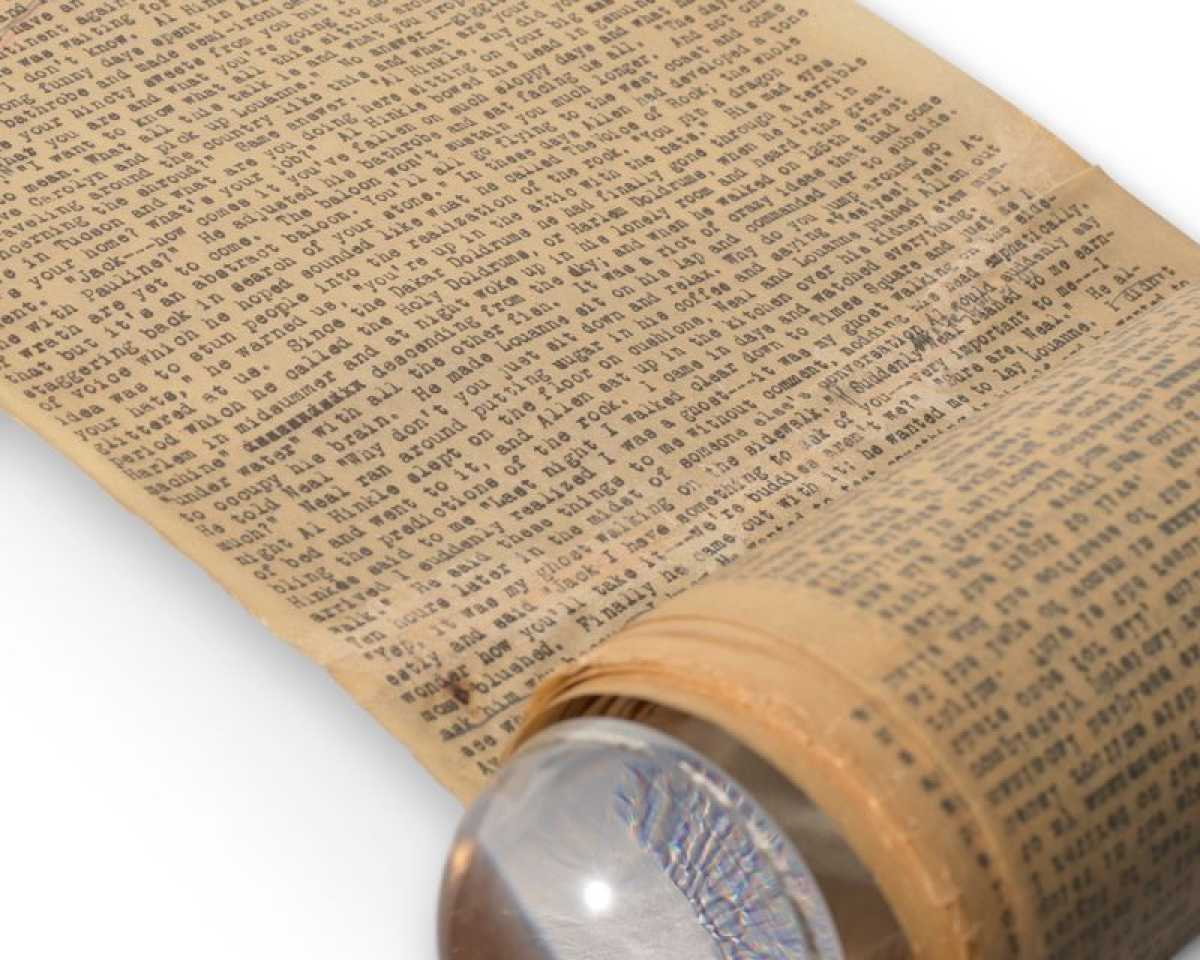
The first major acquisition in Irsay’s collection came in 2001, with his $2.4-million purchase of the original 120-foot scroll for Jack Kerouac’s 1957 novel, “On the Road.” He loved the book and wanted to preserve it, Walker said. But he also frequently lent it out, just like he regularly toured his guitar collection beginning 20 years later.

A scroll of writing.

Jim Irsay purchased the original 120-foot scroll manuscript of Jack Kerouac’s “On the Road” for $2.4 million in 2001.

(Christie’s Images)

Advertisement

“He said publicly, ‘I’m not the owner of these things. I’m just that current custodian looking after them for future generations,’ ” Walker said. “And I think that’s what true collectors always say.”

At its L.A. highlight exhibition, Irsay’s collection held an air of synchronicity. Paul McCartney’s handwritten lyrics for “Hey Jude” hung just a few steps from a promotional poster — the only one in existence — for the 1959 concert Buddy Holly, Ritchie Valens and J.P. “The Big Bopper” Richardson were en route to perform when their plane crashed. The tragedy spurred Don McLean to write “American Pie,” about “the day the music died.”

Holly was McCartney’s “great inspiration,” Christie’s specialist Zita Gibson said. “So everything connects.”

Later, the Beatles’ 1966 song “Paperback Writer” played over the speakers near-parallel to the guitars the song was written on.

Irsay’s collection also contains a bit of whimsy, with gems like a prop golden ticket from 1971’s “Willy Wonka & the Chocolate Factory” — estimated between $60,000 and $120,000 — and reading, “In your wildest dreams you could not imagine the marvelous surprises that await you!”

Advertisement

Another fan-favorite is the “Wilson” volleyball from 2000’s “Cast Away,” starring Tom Hanks, estimated between $60,000 and $80,000, Gibson said.

Historically, such objects were often preserved by accident. But as the memorabilia market has ballooned over the last decade or so, Gibson said, “a lot of artists are much more careful about making sure that things don’t get into the wrong hands. After rehearsals, they tidy up after themselves.”

If anything proves the market value of seemingly worthless ephemera, Walker added, it’s fans clawing for printed set lists at the end of a concert.

“They’re desperate for that connection. This is what it’s all about,” the specialist said. It’s what drove Irsay as well, she said: “He wanted to have a connection with these great artists of his generation and also the generation above him. And he wanted to share them with people.”

In Irsay’s home, his favorite guitars weren’t hung like classic paintings. Instead, they were strewn about the rooms he frequented, available for him to play whenever the urge struck him.

Advertisement

Thanks to tune-up efforts from Walker, many of the guitars headed to auction are fully operational in the hopes that their buyers can do the same.

“They’re working instruments. They need to be looked after, to be played,” Walker said. And even though they make for great gallery art, “they’re not just for hanging on the wall.”

Continue Reading

Movie Reviews

Film reviews: ‘How to Make a Killing,’ ‘Pillion,’ and ‘Midwinter Break’

Published

on

Film reviews: ‘How to Make a Killing,’ ‘Pillion,’ and ‘Midwinter Break’

‘How to Make a Killing’

Directed by John Patton Ford (R)

★★

Continue Reading

Trending
