Entertainment
James Conlon to step down as L.A. Opera music director in 2026, a transformative year for city's classical music


James Conlon, the second music director in Los Angeles Opera’s almost 40-year history, will step down from his role after the 2025-26 season, the company will announce Wednesday. Conlon will have led L.A. Opera for 20 years by the time of his exit, and will be named conductor laureate in recognition of his many contributions to the company. Fans can expect his return as a guest conductor.
Conlon’s departure from his leadership role coincides with that of Los Angeles Philharmonic’s music director, Gustavo Dudamel, who last year announced his plans to leave the L.A. Phil for the New York Philharmonic in 2026. In an interview with The Times, Conlon called the timing “a total coincidence,” but the simultaneous loss of two of the city’s most notable artistic leaders will nonetheless signal a sea change for the classical music scene in Los Angeles at a time when the city is awash in rich cultural and musical offerings and has distinguished itself as a center of cutting-edge artistic experimentation and expression.
Who Conlon and Dudamel’s successors will be is now almost as important as the tremendous legacies both are set to leave behind.
“I will look forward, together with [President and CEO] Christopher Koelsch, to find a good succession and we worked a long time on this to be sure that the public and the organization have a sense of continuity,” Conlon says. “I’m in good health. I have a lot of energy left, a lot of passion left. And there are other things that I feel I have wanted to do and I just can’t. I can’t do them without dedicated time.”
Conlon, 73, stresses that he’s not retiring and has no plans to stop conducting, “And, as you can tell from the appointment to laureate conductor, I’m not disappearing from L.A. Opera either.”
Educating young people about classical music and, most importantly, exposing them to the joys of it, remains one of Conlon’s most urgent callings. He grew up in the New York public school system, where he says he received a great musical education. Such an education, he believes, goes on to provide the basis for audiences going forward. When that education drops off — as it began to do for a variety of sociopolitical reasons in the 1980s — audiences begin to dwindle.
Today, Conlon says the situation has led to what he calls the “American paradox.” He says we probably have more great orchestras, conservatories and universities than any country in the world and are producing musicians at the highest level, yet musical organizations are “fighting to build and keep an audience.”
“We don’t have the demand we want,” says Conlon. “And as such, we’re called an elite art because we seem to be for fewer people. But it’s not an elite art. It’s for everyone.”
Conlon has displayed this sensibility over the years through his popular pre-show talks geared at educating and informing the audience in a relaxed, low-pressure way; as well as in the L.A. Opera performances that he has staged for free at the Cathedral of Our Lady of the Angels in downtown L.A.
“I like educating. So I want to continue education. Not in the formal sense. It’s possible, but I don’t think of myself as going to an institution as an educator,” Conlon says. “But I would like to do it through writing, through public speaking, through direct communication of that sort in order to stimulate and encourage and uninhibit people to come through the doors and give classical music a chance.”
Conlon has been a towering figure in classical music, both at home and internationally — with stints as principal conductor of the Paris Opera (1995-2004), general music director of the City of Cologne, Germany (1989-2002), music director of the Rotterdam Philharmonic Orchestra (1983-91) and principal conductor of the RAI National Symphony Orchestra. He has conducted more than 270 performances at the Metropolitan Opera since his 1976 debut there. He has also made appearances at major opera houses and festivals worldwide, including the Vienna State Opera, Salzburg Festival, La Scala, Teatro dell’Opera di Roma, Mariinsky Theatre, Covent Garden, Lyric Opera of Chicago, Deutsche Oper Berlin, Teatro Real of Madrid, Teatro Comunale di Bologna and Teatro del Maggio Musicale Fiorentino.
During his tenure at L.A. Opera, Conlon has conducted 68 operas by 32 composers and presided over 460 performances to date, making him the most prolific leader in the company’s history. Career highlights include the company’s first Wagner “Ring” cycle; 2015’s “Figaro Trilogy” featuring John Corigliano’s “The Ghosts of Versailles,” Rossini’s “The Barber of Seville” and Mozart’s “The Marriage of Figaro”; and conducting a performance of “The Anonymous Lover” by Joseph Bologne, Chevalier de Saint-Georges, a prominent Black composer in 18th century France.
Conlon is also known for his devotion to his “Recovered Voices” initiative, which is dedicated to the performance of neglected or overlooked music by composers who were kept down by the Third Reich.
Conlon steered L.A. Opera through back-to-back turbulence, first in 2019 when general director Plácido Domingo resigned from the company amid allegations of sexual harassment after 16 years in that role; and a year later when COVID-19 ravaged live arts around the world, forcing the L.A. Opera stage at Dorothy Chandler Pavilion to go dark as the company canceled fall shows and projected losses up to $31 million.
“We’re living in difficult times and contentious times,” Conlon says, adding that the waters have smoothed significantly since the pandemic. “And so I believe that the constant availability of the arts, in whatever form — whether it’s museums or a symphony orchestra, whether it’s opera companies, whether it’s dance, or classical or modern ballet — I think that the classical arts have a stabilizing and humanizing influence on our society, and we need them.”
The arts are a privilege, says Conlon, but they are not just for privileged people. Art is for everybody, he says again. Because art is a spiritual force.


By and large, the zombie subgenre has bitten off more than it can chew in modern times. Between George Romero survival films and camp comedies, the well has become pretty infected. But once in a while, along comes a movie like This Is Not A Test.
Let’s sink our teeth into this new release and see how it stacks up against the classics.
The tone and tenor of this film represent the classic survival movies like Night Of The Living Dead. But the thing that grabs the audience about This Is Not A Test is the trauma of the characters. Holt shines as a withdrawn survivor of an abusive home, trying to cut through the wreckage to reunite with her sister. Each of the main characters have standout traits, and they bathe in strongly acted moments as the stress of the situation changes who they are.
The gore in This Is Not A Test is pretty strong. The attacks spring quickly and when they do, the special effects team does a good job showcasing the battle scars. The camera work is also frenetic in a good way, because the chaos of the chase scenes puts the viewers in a first-person perspective. This film lets you feel like a part of the survivors, so their journeys are interactive.

Longtime fans may say that there’s nothing new in This Is Not A Test, and maybe they’re right. There’s no fresh take on the monsters here, no crazy origin, nothing that we haven’t seen in the past fifty-eight years. But the pacing nails a great balance between getting to know the characters and getting the zombie splatter fest. The mental meltdowns of the characters feel well earned, and the arc of Sloane and her sister brings a lot of heart and investment to the story. Even the most jaded zombie horror fans will find something to appreciate here, even as a background movie.
Adam MacDonald has made another intense hit here, and This Is Not A Test is currently available to stream on Shudder.
Entertainment
‘You’re scaring my people.’ Shia LaBeouf’s alleged stalker arrested after posting viral video
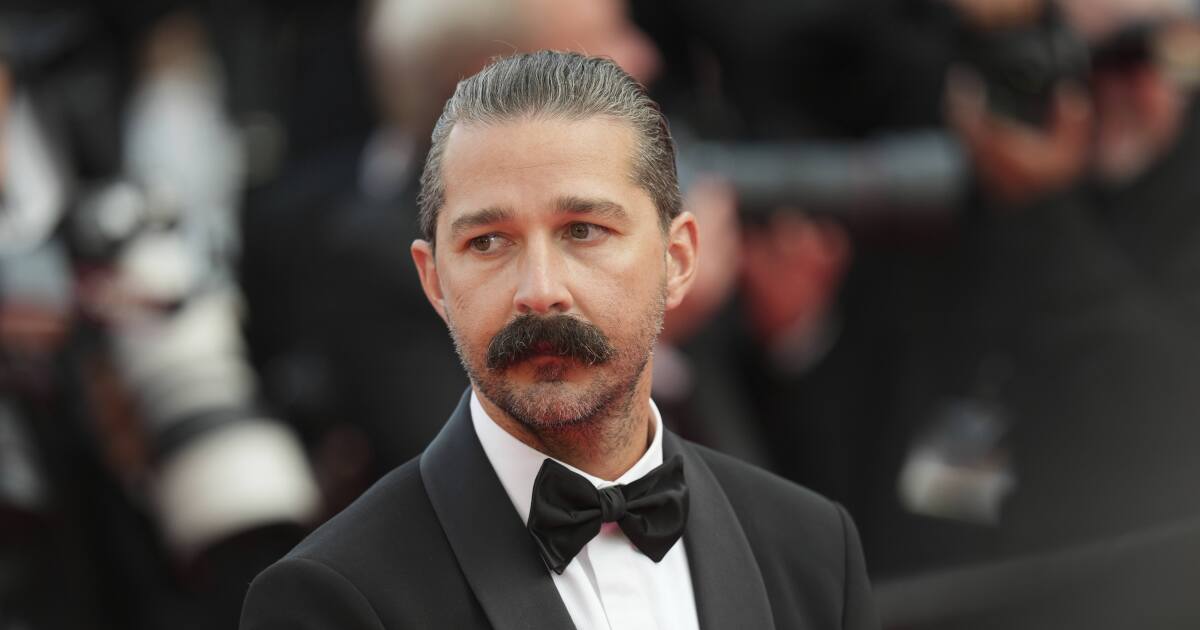
Shia LaBeouf’s alleged stalker has been arrested after posting a video of the actor asking to be left alone.
According to Orleans Parish Sheriff’s Office booking records, Alyssa Lee Couture, 40, was arrested Monday night and booked on a misdemeanor charge of stalking. Hours earlier, Couture had posted a video of a confrontation with LaBeouf in what appeared to be a grocery store parking lot. The “Honey Boy” actor is shown speaking to Couture through the window of a car.
“Leave me alone. God bless you. Leave me alone,” LaBeouf says calmly in the video. “You’re scaring my dad. You’re scaring my people. Leave me alone.”
Couture has posted more than 5,000 videos on her Instagram, most of which feature the woman addressing the embattled actor, whom she appears to believe is her husband. In a GoFundMe launched in May, Couture wrote that she was hoping to raise $70,000 to find permanent housing and that she had been living in her car and staying with family members. She also wrote that she had schizophrenia, among other disabilities.
Although the New Orleans Police Department does not identify Couture’s stalking victim as LaBeouf due to privacy policies, the timeline of her booking appears to line up with the confrontation with LaBeouf.
According to People, LaBeouf left Los Angeles after his split from actor Mia Goth last year and relocated to Louisiana to be closer to family.
In June, he pleaded guilty to three counts of simple battery, months after he went viral for his involvement in a Mardi Gras altercation in New Orleans. The actor, 39, was arrested in New Orleans on Feb. 17. At the time, New Orleans police confirmed LaBeouf was charged with two counts of simple battery for allegedly assaulting two men near a bar in the French Quarter. TMZ published bystander video of the incident and footage of LaBeouf walking through the French Quarter hours before the brawl.
The actor was released from jail shortly after his arrest and posted $100,000 in bond. More than a week after LaBeouf’s initial arrest, the New Orleans Police Department issued a second warrant for the actor’s arrest in connection with the same incident, and he racked up an additional simple battery charge. Prior to the second arrest, a New Orleans judge ordered LaBeouf to begin substance abuse treatment and undergo weekly drug testing.
Times staff reporter Alexandra Del Rosario contributed to this report.

- THE ODYSSEY
- Starring: Matt Damon, Tom Holland and Anne Hathaway
- Directed by: Christopher Nolan
- Rated: R
- Running time: 2 hrs 45 mins
- Universal
Our score: 4.5 out of 5
EPIC. If I was asked to describe Christopher Nolan’s latest film, that is the word I would use. He has mounted a film that rivals the greatest achievements of filmmakers like Cecil B. DeMille or David Lean. And, like the films of those mentioned, it’s runs a tad too long.
I was shocked, but pleased, to see that my 12-year-old granddaughter recently did a school paper on King Agamemnon. Thank goodness they’re still teaching History in our schools. Based on Homer’s “The Odyssey,” the film tells the story of King Odysseus (Damon) and his adventures which, if you’ve read “The Odyssey,” include the Trojan Horse, the Cyclops and assorted angry Greek gods. The film covers each of these adventures in great detail, sparing nothing in the production design department. While Odysseus is away – and he’s gone for a l-o-n-g time, his wife Penelope (Hathaway) has to endure a never ending string of “suitors,” men lining up in the hopes of replacing the King should he not return. The men are nothing more then scavengers, taking advantage of the law of Zeus, which decrees no one should be turned away. This angers the Queen’s son, Telemachus (Holland), who must control his temper when the men try to bait him into a fight, the idea being if Telemachus is killed, the new husband would become the King. It’s all very interesting and complicated. And long.
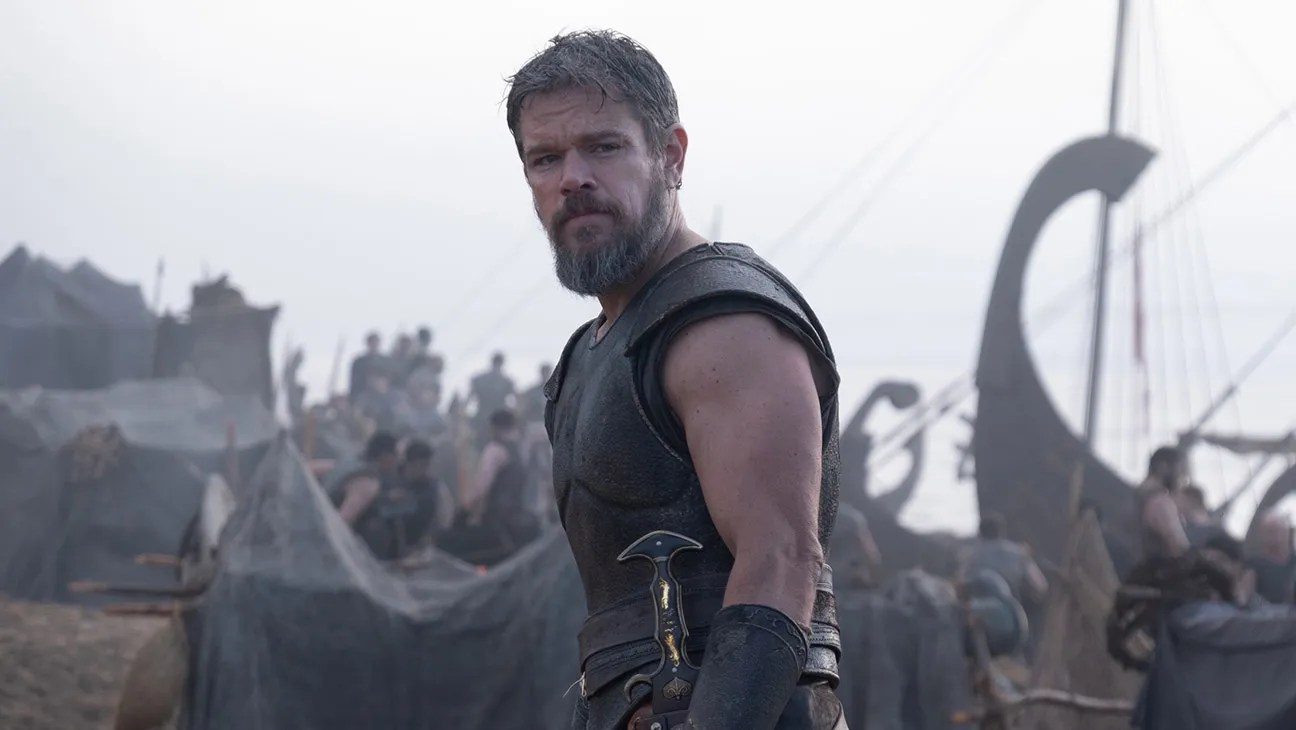
Director Nolan is one of the rare filmmakers who, in my opinion, has never made a bad film. From “Memento” to the “Dark Knight” trilogy to the Oscar-winning “Oppenheimer,” he has proven himself a true master of cinema. “The Odyssey” only adds to that distinguished resume’
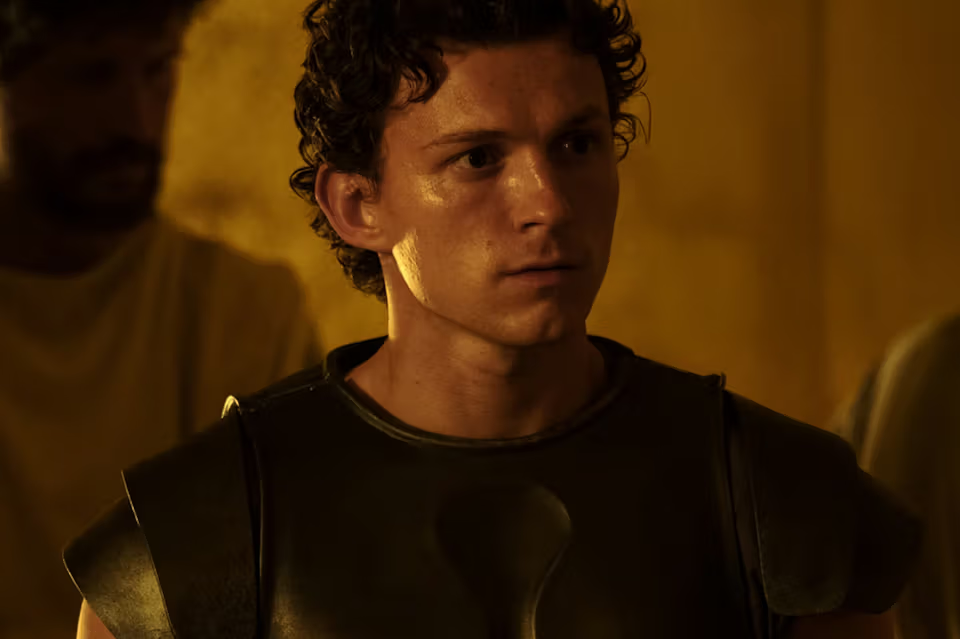
The cast is a tribute to Nolan himself who, like Woody Allen, can pretty much get anyone he wants for his films because, as an actor, why wouldn’t you want a credit in one of his films. Besides the three stars named above, the cast includes Robert Pattinson, John Leguizamo, Zendaya, James Remar, Jon Bernthal, Oscar nominees Samantha Morton and Elliot Page as well as Oscar winners Charlize Theron and Lupita Nyongo. As MGM used to advertise, “more stars than there are in heaven.”
The script and story are pretty faithful to the source material, though for some reason it bothered me whenever Telemacus referred to Odysseus as “dad.” Never father. The weird things you notice. Visual.y the film is stunning and the Trojan Horse and battle of Troy are worth the price of admission alone. I will add that I did see the film in 70 mm and, if that format is playing in your town, I urge you to see it in that format.
On a scale of zero to five, “The Odyssey” receives ★★★★ ½
-

 Oklahoma2 minutes ago
Failed report, recorded calls offer look inside Oklahoma County Jail
-
Oregon8 minutes ago
Oregon Lottery Powerball, Pick 4 results for July 15
-

 Pennsylvania14 minutes ago
Fifth Time’s The Harm: Pennsylvania Gov. Shapiro Again Signed A Budget With No Money For Transit — Streetsblog USA
-

 Rhode Island20 minutes ago
Jamestown Swarm Chaser has unique talent for catching, moving bees
-

 South-Carolina26 minutes ago
South Carolina Lottery Powerball, Pick 3 results for July 15, 2026
-
South Dakota32 minutes ago
SD Lottery Powerball, Lotto America winning numbers for July 15, 2026
-

 Tennessee38 minutes ago
Heavy police presence reported near Highway 31W in White House
-

 Texas44 minutes ago
NTSB Confirms Texas Tesla Had 100% Floored Accelerator Pedal During Fatal Crash

