Entertainment
Isaac Psalm Escoto finds the intersection between L.A.’s art galleries and graffiti

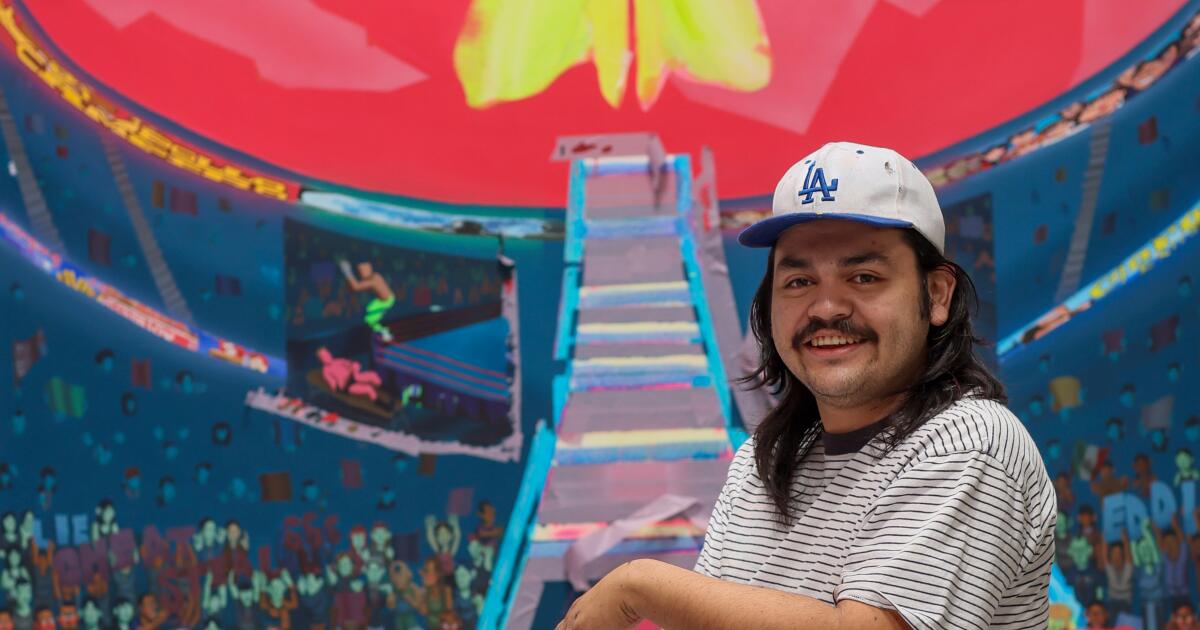
“My car got impounded again. I am so sorry I’m late,” said Isaac Psalm Escoto, practically running into Jeffrey Deitch, a contemporary art gallery on Santa Monica Boulevard, energy drink in hand.
It was the second night in a row that his 2006 Scion xA got towed. Escoto, also known by the graffiti alias Sickid, is on a tight deadline to finish the final installment in his first solo exhibition, “Gas Station Dinner.” From the crevice of his ear to the shoelaces on his Converse sneakers, he’s covered entirely in unintentional paint splatters.
The unfinished piece is a 20- by 60-foot canvas wall that mimics a billboard — a size the graffiti artist is well acquainted with. The painting depicts a cityscape that brings together imagery from Escoto’s artistic world of dysfunction. A massive woman is sprawled across the horizon. Her body is framed by warped skyscrapers branded with Cup Noodles, the Playboy Bunny, Western Exterminators’ mascot, Mr. Little, and a blimp reading, “Ice Cube’s a Pimp.” Below the woman, the chaos of the city ensues, including depictions of a car accident, a police chase, a wounded skater, a strip of discount stores and a piano-playing duo. The spray-painted mural is complete with the religious imagery of a crucifix and several battling angels and devils wreaking havoc. All of Escoto’s work is set in this florescent realm of mischief and humor.
Isaac Psalm Escoto pauses in front of one of his works in “Gas Station Dinner.”
(Robert Gauthier / Los Angeles Times)
Inspired by his diet of 7-Eleven hot dogs and taquitos, the 25-year-old painter came upon the name “Gas Station Dinner” as both a joke and a tribute to the people in his life who have stuck by him and his art. The show will be on display until Aug. 10. Walking the line between hyper-realism and hyperbole, his ambiguous reality is inhabited by characters with brown skin, pointy eyeballs, rosy cheeks and rug-burned knees.
Escoto also exhibits a series of canvases featuring characters in acts of misconduct. They are pictured punching the screen of a Taco Bell drive-thru menu, chainsawing an ankle monitor and pointing a gun from behind the counter of a convenience store. No matter how outrageous the characters’ behavior, the artist grounds them in familiar settings such as a messy bedroom, a grocery store and a gas station bathroom.
In the gallery’s back room are a series of smaller-scale works that continue to explore points of view within the context of Escoto’s world. In some paintings, viewers are looking at the world through a microwave door, a fishbowl or a security camera lens.
“I’m inspired a lot by my viewing history of different forms of media. I’ll take something that was super impactful, like ’90s anime that inspired ‘The Matrix’ and ‘Blade Runner.’ Those kinds of things depict cities with a dystopian tone and mix it with culturally rich, diverse and funny imagery,” Escoto said. “I look to Eastern ways of shelling futuristic cities and landscapes and fuse them with my ideas of modern Los Angeles lifestyle.”
The show is a product of Escoto’s first official practice at Tlaloc Studios, where he focused on painting. Before landing a coveted spot at the artist-run studio in South Central L.A., he worked out of a space he created within his mother’s walk-in closet. Over the last three years, Ozzie Juarez, founder of Tlaloc Studios and a fellow artist, has witnessed Escoto transition to bigger-scale works and continuously introduce new techniques.
“When I look at [Escoto’s] paintings, I see an artist that’s enjoying himself while making work,” said Juarez. “The amount of work he puts in tiny sections throughout his paintings is ridiculous. It’s those details that really give you an insight of who Isaac is, what his personality is like and, above all, what it’s like to grow up as Latino in Los Angeles.”
Escoto’s parents emigrated from Mexico and Guatemala. As he reflects on his childhood in East Hollywood, he says the neighborhood helped form his “opinions and viewpoints.”
The works included in “Gas Station Dinner” showcase Escoto’s ability to flesh out his world, where “uncommonality becomes the mundane” and his devious characters are free to run amok.
“It’s a city that’s shaped by other cultures from other countries and by the immigrant lifestyle. That’s kind of how I view my city,” Escoto said. As he says “my city,” he lets out a laugh.
Alongside the inventive cityscape, Escoto’s work is deeply rooted in humor. Making fun of modernity while portraying absurdity is a balance he is well acquainted with. In the painting where a woman aims a gun from behind a convenience store counter, she is surrounded by SpongeBob SquarePants bongs, a wall of sex pills and potato chip bags with rappers’ faces on them.
“It’s not necessarily putting a bow on it or trying to romanticize a delinquency or dysfunction. Instead, I’m just putting out an image saying, ‘This is reality, and it’s not necessarily good or bad,’” said Escoto.
Although this is Escoto’s first major gallery exhibition, Los Angeles is already well acquainted with his work. Before he put his characters on canvases, he spent years painting them all over the city under the guise of Sickid. Instead of tagging his name like other graffiti artists, he is known for creating intricate scenes on billboards, the sides of buildings, bus stops and abandoned storefronts.
From a red devil baby urinating on an obstructed wall in Chinatown to outlandish depictions of luchadores, police officers and angels on an Echo Park billboard, Escoto first found his artistic style as a graffiti-addicted teenager.
He adopted the practice at age 14, spending weeknights sneaking out at all hours to draw his characters around town.
“I was lucky enough to have supportive older siblings who took me to the places that were like gateway drugs to a deeper art experience,” said Escoto.
They first took him to Meltdown Comics, a beloved, now closed comic shop in West Hollywood that specialized in all things comedy and collectibles. Upon entering the storefront, everything changed for him. He equates the experience to entering an art museum for the first time; it was an introduction to a whole new world where he could blend the grit of graffiti with the lively spirit of comics.
“Graffiti is an empowering act because it’s so lawless, and there are consequences to it. So maybe it’s lawful. I don’t know,” Escoto said. “It puts my brain in a place where I put out only images I want to.”
The urgency of graffiti helped him commit to imagery and build confidence as an artist. Saving his “weirder subject matter” for the studio, he found that in the streets he didn’t need to worry about perfection.
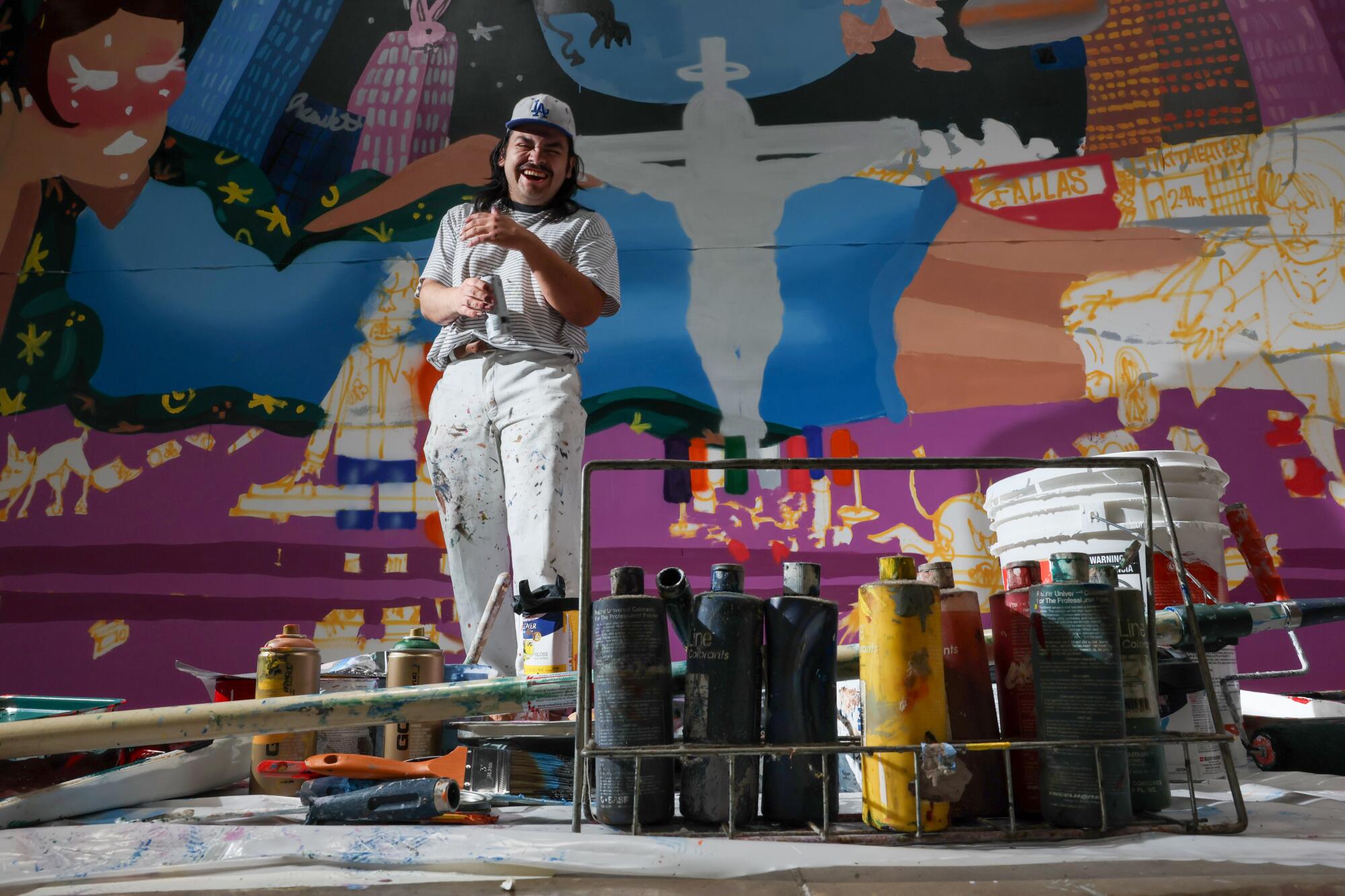
Isaac Psalm Escoto is working on a tight deadline for his debut exhibition.
(Robert Gauthier / Los Angeles Times)
“What matters most is what you’re trying to come across in a piece. It’s all about your intention behind it and how are you trying to communicate that,” Escoto adds.
The namesake and owner of the gallery, Jeffrey Deitch, first discovered a Sickid billboard while driving on the 101 Freeway. Allured by the eye-catching imagery, he knew he had to meet the artist.
“Isaac is painting a different kind of L.A. that we all know. It’s those little convenience stores inside gas stations, the rack of products in car washes and the interior of liquor stores,” said Deitch. “He introduces us to that world which we all know but we haven’t seen yet in art. It’s a very interesting thing how he captures this essential aspect of contemporary Los Angeles.”
As Escoto enters his mid-20s, he‘s realized that the true theme of his work is rooted in the struggles that come with adulthood and wanting to return to a childlike place of comfortability.
“A lot of pieces are not biographical but I’m projecting myself into a lot of my subject matter. I live vicariously through my figures, and that’s the basis of the painting,” said Escoto. “I’m depicting the struggles and insecurities of growing up and trying to find yourself through dysfunction.”
Hence the need for gas station dinners.
“As I was sketching the mural with the big extension roller with no ladder, an extreme sense of gratitude came over me, like this is what I would do down the street on a billboard,” Escoto said. “I’m using the same hand, and it’s like I’m looking up at a black billboard, but I’m on the inside of Jeffrey Deitch.”



“Lethal Weapon” star Danny Glover has revealed he has been living with Alzheimer’s disease for years.
In an interview with NBC’s Lester Holt that aired on the “Today” show on Wednesday, the 79-year-old actor and activist opened up about living with the disease. According to People, he received his diagnosis in 2023, which was not long after he was awarded an honorary Oscar in 2022.
“I could live with it, in a sense,” Glover says of his condition, which has been affecting his movement, speech and memory. “I’m sure as it advances, things are going to be different and changing.”
A neurodegenerative disease, Alzheimer’s is a type of dementia that affects memory, thinking and behavior and worsens over time, according to the Alzheimer’s Assn. Holt reports that more than 7 million Americans over 65 are living with Alzheimer’s, with Black men suffering at a rate double the national average.
Glover and his family say the Hollywood icon is sharing his story now to “have ownership of his life” and to help remove the stigma around the disease.
“They’ve got my back,” Glover says of his family’s support.
Besides his portrayal of L.A. police Det. Roger Murtaugh in the “Lethal Weapon” film series, Glover is known for roles in movies including “Places in the Heart” (1984), “The Color Purple” (1985), “To Sleep With Anger” (1990), “Angels in the Outfield” (1994), “Dreamgirls” (2006) and “The Last Black Man in San Francisco” (2019). He’s also been a vocal advocate for social justice and humanitarian causes both in the U.S. and abroad.
He was the recipient of the Academy of Motion Picture Arts and Sciences’ Jean Hersholt Humanitarian Award in 2022.
“I don’t feel like it’s the end of my life,” he said in his interview with People about living with Alzheimer’s. “There’s work to do.”

Enter your email and we’ll send a secure one-click link to sign in.
WKRN is provided by Nexstar Media Inc., and uses the My Nexstar sign-in, which works across our media network.
Nexstar Media Inc. is a leading, diversified media company that produces and distributes engaging local and national news, sports, and entertainment content across its television and digital platforms. The My Nexstar sign-in works across the Nexstar network—including The CW, NewsNation, The Hill, and more. Learn more at nexstar.tv/privacy-policy.
On the Shelf
Come Undone: A Novel
By Eddie Huang
One World: 240 pages, $29
If you buy books linked on our site, The Times may earn a commission from Bookshop.org, whose fees support independent bookstores.
Eddie Huang has never felt lighter. Last month, after his debut novel, “Come Undone,” finally released, something shifted.
“I have a family. I feel healed,” he said over coffee and short ribs in Santa Monica hours ahead of a live talk with Ottessa Moshfegh, the bestselling, critically acclaimed author of Huang’s favorite book, “My Year of Rest and Relaxation.”
“People always write me off as a personality or a multi-hyphenate,” he said. “It’s a nice way of saying I’m not really good at anything. But I didn’t have any of that this time.” He leaned forward, serious. “I have to be honest. I do think the Knicks are a big, big part of it.”
His beloved Knicks winning the championship, he said, kept him from spiraling over the book. In person, Huang subdues his ironic braggadocio with polite eye contact and rolling belly laughs at his own jokes. For years, audiences have watched Huang resist whatever box you put him in. His particular brand of cultural fluency — a rapid-fire mix of food, fashion, basketball, politics and pop culture — is what made the “Gua Bao Bad Boy” impossible to categorize.
For most of his career, Huang has seemed constitutionally incapable of standing still. Chef. Memoirist. TV host. Filmmaker. Lawyer. Comic. Podcaster. His first book, “Fresh Off the Boat,” became the longest-running network sitcom centered on an Asian American family, even as Huang publicly distanced himself from the show. Since leaving post-fires L.A. for New York, he’s reopened Baohaus — returning to the kitchen that built his career. Waiting for him at home after the book tour is his wife, Natashia Perrotti, and their 2-year-old son.
Now there’s “Come Undone,” fiction that Huang called his most honest — and vulnerable — work to date.
“It’s sort of this next-gen auto fiction type thing that is creating its own rules,” Moshfegh said ahead of their Q-and-A. “It made me think about my own appreciation for the experience of male heterosexuality and how much it’s been commodified.”
The book follows Hubie, a globe-trotting food-show host drifting through Chateau Marmont, Madeo, Nobu and other “dirtbag L.A” (as Huang coins) spots. He meets Janine, his equal in appetite and id, sending him into a tailspin of yearning and loops of Sky Ferreira’s “Everything Is Embarrassing” on sadboi walks. The “two walking red flags” decide to try to make it work.
Huang called the novel an “autofictional riddle.” The puzzle isn’t especially difficult if you’ve followed his relationship with Perrotti, who co-hosts their podcast, “Canal Street Dreams.” Marrying a writer, she’s learned, often means finding out what he feels by reading it. “We’ll get into a fight,” she said, “and I’ll wake up to a Substack article about it.”
It’s also part of the private life she’s since conceded. “It’s annoying,” she added. “But now I can read it, and maybe understand him a little bit better. He’s trying to communicate through the writing, like sending somebody a song and saying, ‘I want you to listen to these lyrics.’”
The novel goes further, drawing from experiences the couple has never discussed publicly. In the novel, Hubie and Janine’s relationship pivots after an ectopic pregnancy ends in loss. Perrotti said the scene is fictionalized but mirrors a similar experience they had early in their own relationship.
“It brought us closer together,” she said. “It was the catalyst for us realizing we were serious.”
Before Huang could finish the book, the life he was writing about had to fall apart. “This book was very much about breaking up with your family to start your own,” he said. “There was a lot of anger in the book that had not been resolved.”
By the end of 2024, Huang had stopped speaking to his mother. The break followed what he described as a blowup at a Cheesecake Factory. It also unlocked the ending he’d been chasing.

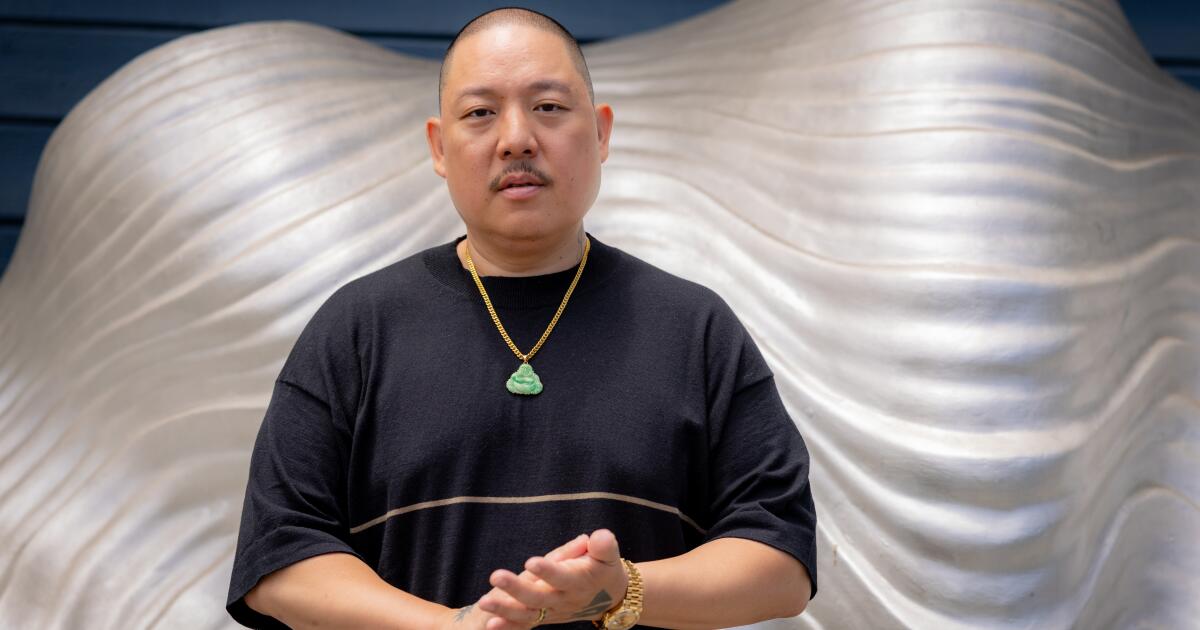
Eddie Huang.
(Jason Armond / Los Angeles Times)
Looking back, Huang thinks the earlier versions failed because he was still arguing with her. He’s still trying, in some way, to communicate with her through his writing. “If there’s one person I wish would read the book,” he said, “it would be my mom.”
There were other chapters he had to close the book on, mainly Hollywood. His foray into fiction coincided with the writers’ strike, drying up all his income and future projects. That same year, he became a father. “I had to accept and realize that my value was not in making money,” he said. “Because for three years, I couldn’t.”
He recalled a particular low point researching life insurance policies. “I had to rebuild my whole self. Really love myself despite not being able to offer anybody anything.”
That new certainty didn’t make Huang any less willing to pick fights. Last year, as his documentary “Vice Is Broke” — an autopsy of the media company behind “Huang’s World” and its eventual bankruptcy — awaited release, Huang said distributor Mubi shelved the film after he boycotted the company over Sequoia Capital’s investment in an Israeli defense technology startup. (Mubi denied this and said it still planned to distribute the film.)
The ghost of Vice still lingers in today’s media ecosystem in what he called our “era of cartel journalism:” creators navigating a world of blurred incentives and corporate interests. He traced this instinct to challenge those systems back to Socrates’ “gadfly” — the person whose job was to annoy power. “As a writer, you should be challenging people,” he said. “If your memoir can be turned into a sitcom, it probably wasn’t challenging.”

Eddie Huang.
(Jason Armond / Los Angeles Times)
After the 2025 L.A. fires drove his new family back to New York, Huang went back to cooking. He worked pop-ups, reopened Baohaus and found himself alongside line cooks half his age. In March 2025, he rewrote the novel in five days. That same month “was the first month I didn’t overdraft my credit card,” he said, with the majority of his income today coming from the restaurant. It’s allowed him to make films, write books and walk away from deals he doesn’t believe in. “Being a chef is the anchor that allows me to maintain my artistic integrity.”
For years, comparisons to Anthony Bourdain followed Huang everywhere. The two eventually became friends.
“He was one of the few people who was as advertised,” Huang said. “Nicer and more generous in person. And wounded.”
Bourdain is the only real person who appears in “Come Undone” under his own name.
When Huang mentions him, he stops talking. He covers his face. Tears come.
“I don’t believe in God,” he said, “but I asked the universe why for many, many years.”
Bourdain’s suicide, he said, was one of the reasons he walked away from “Huang’s World” in 2018. At the time, few people understood why. “It was Tony. It was family. It was everything.”

Eddie Huang.
(Jason Armond / Los Angeles Times)
Now, looking back, Huang thinks he was writing “Come Undone” toward a different ending than the one he’d imagined.
“This book is a guy saying, ‘I don’t want to be like my biological father,’” he said. “And, in the most respectful, loving way, I don’t want to go out like Tony.”
He paused. “I needed to name the sadness in me. I needed to allow myself to be loved.”
Huang is already writing another memoir about getting back into the kitchen. Still, he said, these days, he’d rather write fiction.
Rudi, an L.A. native, is a freelance art and culture writer. She’s at work on her debut novel about a stuttering student journalist.
-
World5 minutes ago
Bereaved South Koreans try AI-generated videos of deceased loved ones
-

 News10 minutes ago
How a Nation of Immigrants Traces Its Roots
-

 Health32 minutes ago
What Is Retatrutide? Dr. Dubrow Calls It the Most Powerful Weight-Loss Drug
-
 Lifestyle47 minutes ago
How World Cup fans reflect America back at us : It’s Been a Minute
-

 Technology55 minutes ago
Apple’s entry-level MacBook Pro could be up for a redesign
-

 World1 hour ago
Khamenei body in cold storage as feared Basij mobilizes ahead of historic Iran funeral
-

 Politics1 hour ago
Coalition of 25 states sues Trump admin over Medicaid work rule designed to prevent fraud
-

 Health1 hour ago
West Nile virus detected in southern state as health officials warn residents about mosquitoes

