Entertainment
In defense of helicopter parents
This column is the latest in a series on parenting children in the final years of high school, “Emptying the Nest.” Read the previous installment, about relearning how to be alone at home, here.
I recently saw a headline in the New York Times that I thought was the answer to my prayers: “Anxious Parents are the Ones Who Need Help.”
Yes, please, I thought, hoping to find acknowledgment of all the very real forces that can turn any parent into an anxious mess.
Things like school shootings, worsening teen mental health, the ongoing debate over the danger of smartphones, the rising cost of a college education, the growing restrictions on female reproductive rights, the housing crisis, the opioid crisis, the fentanyl crisis, and, of course, the climate crisis.
As I prepare to launch my third child out of the nest, my personal and parental anxiety is at a fever pitch; I’ll take any offer of help I can get.
Alas, it was not to be. The piece, written by a senior staff psychiatrist at Boston University Health Services, focused exclusively on parental anxieties that can arise during a child’s college experience, particularly freshman year.
In a tone as kind and generous as possible, the author advised parents to just try to detach and chill.
It’s something parents hear all the time, when they are not being inundated with every type of story that can fit under the headline “The Kids Are Not Alright”: Modern American parents need to stop trying to control every moment of their children’s lives and relax.
Wouldn’t that be nice? To just, you know, let it all go and relax?
To be fair, I absolutely plan to relax, at least a little, once I have deposited my third and youngest child at the college of her choice.
(This may be wishful thinking. Her current top picks include three UCs, each with an average admission GPA of 4.0, and an out-of-state school that costs — as the young woman leading the orientation informed us with a completely straight face — $90,000 a year.)
After we sent our older kids to college, my husband and I left them to their own devices, which worked out just fine — though I can see why some parents feel justified in demanding that their child have a VIP college experience when the sticker price, as it is for Boston University, is $82,000.
But honestly, it’s the time before college that can turn even the most stoic, no-nonsense parent into an insomniac mess.
Because no one gets more dire warnings, eye-rolling criticism or conflicting information thrown at them than parents.
The kids, we are told repeatedly, are not doing well. They are depressed, they are anxious, they hate their bodies. They are addicted to their phones, don’t know how to make friends, can’t read or do math well enough and are easy prey for sexual predators and brainwashing extremists. They don’t want to work, they can’t find work, and the work they do find doesn’t offer benefits and they can’t afford to live close to it.
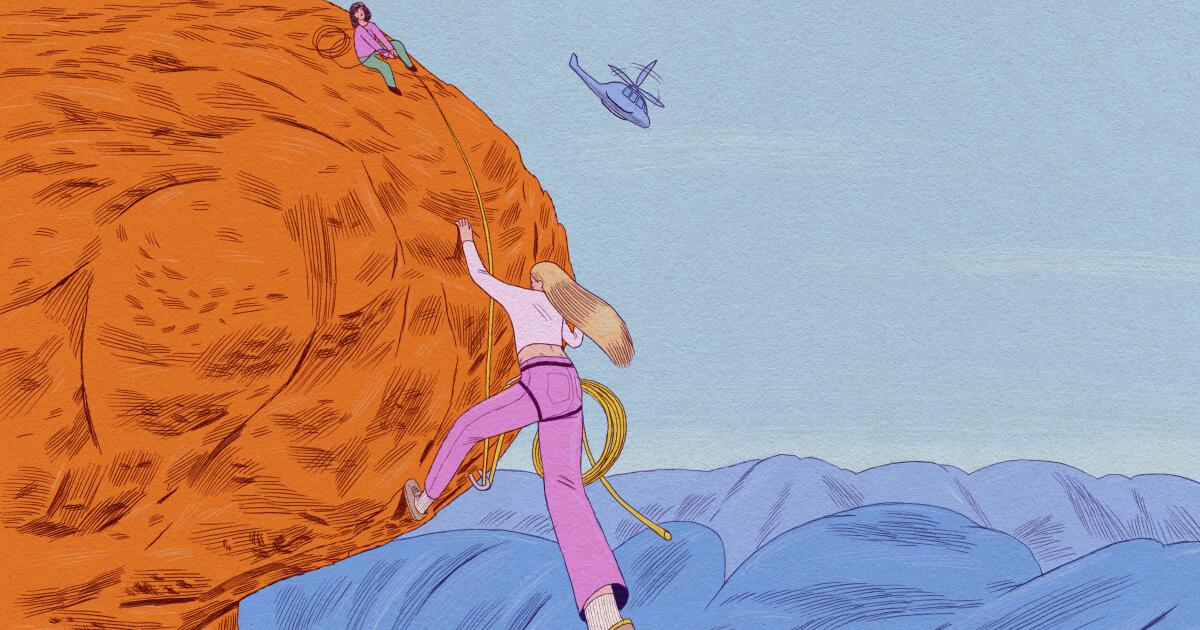
Try to prevent or mitigate any of the above and you risk being labeled neurotic, a “helicopter parent.” Take a more hands-off approach and you’re accused of being uninvolved or neglectful.
Occasionally it is acknowledged that larger forces — gun violence; overcrowded schools stripped of arts and vocational programs; racism, sexism, homophobia; the unregulated force of social media — could be contributing factors in our children’s perceived problems.
More usually, however, the parents somehow shoulder the blame.
Either we’re not giving our children enough free time or we’re not monitoring what they do. We’re too fixated on conventional definitions of success or we’re pressuring them to be unconventional. We’re not allowing them to make their own mistakes and face the consequences or we’re not seeing signs of trouble early and getting them the help they clearly need.
All on our own, by the way. As research shows, the historic safety nets of extended family and involved community are increasingly frayed by mobility and the economic necessity of a two-income family, and nothing has been offered to replace them.
If you can afford help, you are faced with inevitable criticism for putting your kids in day care or “handing them over” to a nanny, a relationship that often raises issues of economic disparity, immigration status and racism.
And it doesn’t end when the little geezers turn 18 or graduate from college. Parents of young adults are increasingly expected to force them to be independent while also either underwriting their rent/down payments or allowing them to return home.
But sure, parents are anxious because they are paranoid control freaks.
I love being a parent, and most of the time I simply ignore the endless criticism that has been spewed my way. You don’t think I should breastfeed in public / put my kids in day care / let them have sleepovers / give them smartphones /track those phones’ locations / enroll them in club sports / encourage them to have birth control, Narcan and fentanyl testing strips on hand? I don’t remember asking you.
And if you are not willing to come to my house and cook a meal or empty this damn dishwasher, I really don’t want to hear it.
But in recent years, I have felt myself wilt, felt myself waver, felt myself surrender to all the studies and opinion pieces and become a big hot mess.
Perhaps it was the pandemic, which traumatized so many of us in so many ways. Perhaps it’s just because my youngest is, and always will be, the baby of the family. But I find myself beset by second-guessing.
She seems happy. Is that happiness real? She’s doing well in school. Is she too worried about grades? She has a job, participates in extracurriculars. Is her schedule too full? She has an active social life. Is wherever she’s going safe? She seems a little down. Is she clinically depressed?
It’s exhausting and slightly ridiculous: “Don’t choke on the one-yard line,” I tell myself. In a few months, she’ll be 18; in a year, she’ll be out the door. But then what?
I’m not a helicopter parent, a term I have come to loathe. But I am currently an anxious one. And you know what? That’s a perfectly reasonable thing to be.

Entertainment
Tommy Lee Jones’ daughter reportedly found dead at San Francisco hotel on New Year’s Day
Victoria Jones, the daughter of Academy Award-winning actor Tommy Lee Jones, was reportedly found dead at a hotel in San Francisco on New Year’s Day. She was 34.
According to TMZ, the San Francisco Fire Department responded to a medical emergency call at the Fairmont San Francisco early Thursday morning. The paramedics pronounced Victoria dead at the scene before turning it over to the San Francisco Police Department for further investigation, the outlet said.
An SFPD representative confirmed to The Times that officers responded to a call at approximately 3:14 a.m. Thursday regarding a report of a deceased person at the hotel and that they met with medics at the scene who declared an unnamed adult female dead.
Citing law enforcement sources, NBC Bay Area also reported that the deceased woman found in a hallway of the hotel was believed to be Jones and that police did not suspect foul play.
“We are deeply saddened by an incident that occurred at the hotel on January 1, 2026,” the Fairmont told NBC Bay Area in a statement. “Our heartfelt condolences are with the family and loved ones during this very difficult time. The hotel team is actively cooperating and supporting police authorities within the framework of the ongoing investigation.”
The medical examiner conducted an investigation at the scene, but Jones’ cause of death remains undetermined. Dispatch audio obtained by TMZ and People indicated that the 911 emergency call was for a suspected drug overdose.
Jones was the daughter of Tommy Lee and ex-wife Kimberlea Cloughley. Her brief acting career included roles on films such as “Men in Black II” (2002), which starred her father, and “The Three Burials of Melquiades Estrada” (2005), which was directed by her father. She also appeared in a 2005 episode of “One Tree Hill.”
Page Six reported that Jones had been arrested at least twice in 2025 in Napa County, including an arrest on suspicion of being under the influence of a controlled substance and drug possession.
Movie Reviews
Movie Review: “I Was a Stranger” and You Welcomed Me
Just when you think that you’ve seen and heard all sides of the human migration debate, and long after you fear that the cruel, the ignorant and the scapegoaters have won that shouting match, a film comes along and defies ignorance and prejudice by both embracing and upending the conventional “immigrant” narrative.
“I Was a Strranger” is the first great film of 2026. It’s cleverly written, carefully crafted and beautifully-acted with characters who humanize many facets of the “migration” and “illegal immigration” debate. The debut feature of writer-director Brandt Andersen, “Stranger” is emotional and logical, blunt and heroic. It challenges viewers to rethink their preconceptions and prejudices and the very definition of “heroic.”
The fact that this film — which takes its title from the Book of Matthew, chapter 25, verse 35 — is from the same faith-based film distributor that made millions by feeding the discredited human trafficking wish fulfillment fantasy “Sound of Freedom” to an eager conservative Christian audience makes this film something of a minor miracle in its own right.
But as Angel Studios has also urged churchgoers not just to animated Nativity stories (“The King of Kings”) and “David” musicals, but Christian resistence to fascism (“Truth & Treason” and “Bonheoffer”) , their atonement is almost complete.
Andersen deftly weaves five compact but saga-sized stories about immigrants escaping from civil-war-torn Syria into a sort of interwoven, overlapping “Babel” or “Crash” about migration.
“The Doctor” is about a Chicago hospital employee (Yasmine Al Massri of “Palestine 36” and TV’s “Quantico”) whose flashback takes us to the hospital in Aleppo, Syria, bombed and terrorized by the Assad regime’s forces, and what she and her tween daughter (Massa Daoud) went through to escape — from literally crawling out of a bombed building to dodging death at the border to the harrowing small boat voyage from Turkey to Greece.
“The Soldier” follows loyal Assad trooper Mustafa (Yahya Mahayni was John the Baptist in Martin Scorsese Presents: The Saints”) through his murderous work in Aleppo, and the crisis of conscience that finally hits him as he sees the cruel and repressive regime he works for at its most desperate.
“The Smuggler” is Marwan, a refugee-camp savvy African — played by the terrific French actor Omar Sy of “The Intouchables” and “The Book of Clarence” — who cynically makes his money buying disposable inflatable boats, disposable outboards and not-enough-life-jackets in Turkey to smuggle refugees to Greece.
“The Poet” (Ziad Bakri of “Screwdriver”) just wants to get his Syrian family of five out of Turkey and into Europe on Marwan’s boat.
And “The Captain” (Constantine Markoulakis of “The Telemachy”) commands a Hellenic Coast Guard vessel, a man haunted by the harrowing rescues he must carry out daily and visions of the bodies of those he doesn’t.
Andersen, a Tampa native who made his mark producing Tom Cruise spectacles (“American Made”), Mel Gibson B-movies (“Panama”) and the occasional “Everest” blockbuster, expands his short film “Refugee” to feature length for “I Was a Stranger.” He doesn’t so much alter the formula or reinvent this genre of film as find points of view that we seldom see that force us to reconsider what we believe through their eyes.
Sy’s Smuggler has a sickly little boy that he longs to take to Chicago. He runs his ill-gotten-gains operation, profiting off human misery, to realize that dream. We see glimpses of what might be compassion, but also bullying “customers” and his new North African assistant (Ayman Samman). Keeping up the hard front he shows one and all, we see him callously buy life jackets in the bazaar — never enough for every customer to have one in any given voyage.
The Captain sits for dinner with family and friends and has to listen to Greek prejudices and complaints about this human life and human rights crisis, which is how the worlds sees Greece reacting to this “invasion.” But as he and his first mate recount lives saved and the horrors of lives lost, that quibbling is silenced.
Here and there we see and hear (in Arabic and Greek with subtitles, and English) little moments of “rising above” human pettiness and cruelty and the simple blessings of kindness.
“I Was a Stranger” was finished in 2024 and arrives in cinemas at one of the bleakest moments in recent history. Cruelty is running amok, unchecked and unpunished. Countries are being destabilized, with the fans of alleged “strong man” rule cheering it on.
Andersen carefully avoids politics — Middle Eastern, Israeli, European and American — save for the opening scene’s zoom in on that Chicago hospital, passing a gaudily named “Trump” hotel in the process, and a general condemnation of Syria’s Assad mob family regime.
But Andersen’s bold movie, with its message so against the grain of current events, compromised media coverage and the mostly conservative audience that has become this film distributor’s base, plays like a wet slap back to reality.
And as any revival preacher will tell you, putting a positive message out there in front of millions is the only way to convert hundreds among the millions who have lost their way.

Rating: PG-13, violence, smoking, racial slurs
Cast: Yasmine Al Massri, Yahya Mahayni, Ziad Bakri, Omar Sy, Ayman Samman, Massa Daoud, Jason Beghe and Constantine Markoulakis
Credits: Scripted and directed by Brandt Andersen. An Angel Studios release.
Running time: 1:43
Related
Entertainment
Review: ‘Best Medicine’ has more whimsy but it’s less real than ‘Doc Martin’
It’s nothing new or extraordinary to remake a foreign TV show for a different country.
“All in the Family” was modeled on the British series “Till Death Us Do Part,” as “Steptoe and Son” became “Sanford and Son.” The popular CBS sitcom “Ghosts” comes from the show you can find retitled as “U.K. Ghosts” on American Netflix. The British mysteries “Professor T” and “Patience” (from Belgian and Franco-Belgian productions, respectively), have been successful on PBS. And there is, of course, “The Office,” which outlasted its original by many, many seasons and nearly 200 episodes. It doesn’t always work out (“Life on Mars”; “Viva Laughlin,” from “Blackpool,” which lasted a single episode despite starring Hugh Jackman; “Payne” and “Amanda’s,” two failed stabs at adapting “Fawlty Towers”), but there’s nothing inherently wrong with the practice.
The new Fox series “Best Medicine,” arriving Sunday as an advance premiere before its time slot premiere on Tuesdays, remakes the U.K. “Doc Martin,” previously adapted in France, Germany, Spain, Greece, the Netherlands and the Czech Republic. For better or worse, I have a long, admiring relationship with the original, having signed on early and attended every season in turn — and interviewed star Martin Clunes three times across the run of the series (10 seasons from 2004 to 2022). And I am surely not alone. Unlike with most such remakes, whose models may be relatively obscure to the local audience, “Doc Martin” has long been widely available here; you can find it currently on PBS, Acorn TV and Prime Video, among other platforms — and I recommend that you do.
In “Doc Martin,” Clunes played a brilliant London surgeon who develops a blood phobia and becomes a general practitioner in the Cornwall fishing village where he spent summers as a child. He’s a terse, stiff, antisocial — or, more precisely, non-social — person who doesn’t stand on ceremony or suffer fools gladly, but who time and again saves the people of Portwenn from life-threatening conditions and accidents or, often, their own foolishness. A slow-developing, on-again, off-again love-and-marriage arc with schoolteacher Louisa Glasson, played by the divine Caroline Catz, made every season finale a cliffhanger.
Obviously, the fair thing would be to take “Best Medicine” as completely new. But assuming that some reading this will want to know how it follows, differs from or compares to the original — which was certainly the first thing on my mind — let us count the ways.
Josh Segarra, Josh Charles and Abigail Spencer in “Best Medicine.”
(Francisco Roman/FOX)
The names have mostly not been changed. For no clear reason — numerology, maybe? — Martin Ellingham is now Martin Best (Josh Charles); Aunt Joan is Aunt Sarah (Annie Potts), a fisherwoman instead of a farmer. Sally Tishell, the pharmacist in a neck brace, has become Sally Mylow (Clea Lewis); and distracted receptionist Elaine Denham has been rechristened Elaine Denton (Cree). Keeping their full names are Louisa Gavin (Abigail Spencer), father and son handymen Bert (John DiMaggio) and Al Large (Carter Shimp), and peace officer Mark Mylow (Josh Segarra). Portwenn has become Port Wenn, Maine. (Lobsters are once again on the menu.)
As in the original, Martin is hounded by dogs (no pun intended, seriously), to his displeasure; teenagers are rude to him, because they are rude teenagers. Mark Mylow is now Louisa’s recently jilted ex-fiance. Liz Tuccillo, who developed the adaptation, has added a gay couple, George (Jason Veasey) and Greg (Stephen Spinella), who run the local eatery and inn and have a pet pig named Brisket (sensitive of them not to name it Back Ribs); and Glendon Ross (Patch Darragh), a well-to-do blowhard who bullied Martin in his youth. Apart from the leads Charles and Spencer, few have much to do other than strike a quirky pose, though Segarra, recently familiar as school district representative Manny Rivera on “Abbott Elementary,” makes a meal of Mark’s every line, and Cree, who gets a lot of scenes and a personal plotline, makes a charming impression. Spencer is good company; Potts, whom I am always happy to see, is more an instrument of exposition than a full-blown character, and it feels a little unfair.
The first episode is modeled closely on the “Doc Martin” pilot, from Martin and Louisa’s antagonistic meet cute — in which he offends her, leaning in unannounced to examine her eye — to the episode’s main medical mystery (gynecomastia), a punch in the nose for our hero. Other details and plotlines will arrive, but there has been an attempt to give “Best Medicine” its own identity and original stories.
On the whole, it’s cuter, milder, more cuddly (multiple vomit jokes notwithstanding), more obvious and more whimsical, but less real, less intense and less sharply written than “Doc Martin.” The edges and angles have been sanded down and polished; tonally, it resembles “Northern Exposure” more than the show it’s adapting. Port Wenn (represented by the coincidentally named Cornwall, N.Y., with a wide part of the Hudson River subbing for the Atlantic Ocean) itself comes across as comparatively upscale; the doctor’s office and quarters are here plushly appointed, rather than spare, functional and a little shopworn.
As Martin, Charles stiffens himself and keeps his facial expressions generally between neutral and annoyed, though he’s softer than Clunes, less a prisoner of his own body, less abrasive, less otherworldly. Where Dr. Ellingham remained to a large degree inexplicable — the series expressly refused to diagnose him — Tuccillo has given Dr. Best a quickly revealed childhood trauma to account for his blood phobia and make him more conventionally sympathetic.
I freely admit that in judging “Best Medicine,” my familiarity with “Doc Martin” puts me at a disadvantage — or an advantage, I suppose, depending on how you look at it. But taken on its own merits it strikes me as a rather obvious, perfectly ordinary example of a sort of show we’ve often seen before, a feel-good celebration of small town values and traditions and togetherness that will presumably improve the personality of its oddball new resident, as the townspeople come to accept or tolerate him anyway in turn. In the first four episodes, we get a celebration of baked beans, a town-consuming baseball championship and a once-a-year day when the women of Port Wenn doll themselves off and go out into the woods to meet a jacked, shirtless, off-the-grid he-man, right off the cover of a romance novel, who steps out of the forest, ostensibly to provide wilderness training. It’s like that.
All in all, “Best Medicine” lives very much in a television reality, rather than creating a reality that just happens to be on television. To be sure, some will prefer the former to the latter.
-
World1 week agoHamas builds new terror regime in Gaza, recruiting teens amid problematic election
-
Indianapolis, IN1 week agoIndianapolis Colts playoffs: Updated elimination scenario, AFC standings, playoff picture for Week 17
-
Business1 week agoGoogle is at last letting users swap out embarrassing Gmail addresses without losing their data
-
Southeast1 week agoTwo attorneys vanish during Florida fishing trip as ‘heartbroken’ wife pleads for help finding them
-
Politics1 week agoMost shocking examples of Chinese espionage uncovered by the US this year: ‘Just the tip of the iceberg’
-
News1 week agoRoads could remain slick, icy Saturday morning in Philadelphia area, tracking another storm on the way
-
World1 week agoPodcast: The 2025 EU-US relationship explained simply
-
News1 week agoMarijuana rescheduling would bring some immediate changes, but others will take time