It was a text from Sutton Foster that got Amy Sherman-Palladino to drop everything. The Tony-winning actor was leading a new production of “Once Upon a Mattress,” a musical take on “The Princess and the Pea” that in previous incarnations starred Carol Burnett and Sarah Jessica Parker. Might the creator of “Gilmore Girls,” “The Marvelous Mrs. Maisel” and Foster’s own “Bunheads” take a pass at the stage show’s script?
“For Sutton Foster, anything,” Sherman-Palladino recalls. What was supposed to be a quick punch-up gig for a two-week Encores! stint has turned out to be the scribe’s Broadway debut, as the production — about a queen who discourages her son’s wedding prospects with impossible tests, and a swamp princess who takes on the challenge — has begun a four-month run at New York’s Hudson Theatre before moving to Los Angeles’ Ahmanson Theatre in December.
The revival, directed by Lear deBessonet (“Into the Woods”), also stars Michael Urie, Ana Gasteyer, Will Chase, Brooks Ashmanskas, Daniel Breaker, Nikki Renée Daniels and David Patrick Kelly. And Sherman-Palladino, who left the stage behind to pursue her TV dreams, has joined a burgeoning club of writers updating classic musicals for new generations (Amber Ruffin and “The Wiz,”Larissa FastHorse and “Peter Pan”).
Between rehearsing “Once Upon a Mattress” and shooting her Prime Video ballet-centric series “Étoile,” the showrunner-turned-librettist got candid about rewriting a musical’s book on a tight timeline, ridding a fairy tale of its misogyny and bringing physical comediennes back to Broadway. This conversation has been edited and condensed.
You made an early career choice between writing for “Roseanne” and attending a “Cats” callback. Since then, you’ve consistently cast stage actors and snuck musical numbers into your TV shows. How does it feel to finally be working on a theater project?
Advertisement
It’s completely bananas. I just lucked into the fact that this wonderful person in my life named Sutton Foster texted me one sentence — that was the extent of the negotiation, I drove a hard bargain — that has changed everything, and now I’m getting to be a little part of a world I admire so much. What world am I in that my job is to sit at this table read and listen to these people harmonize around me like this?
Had you seen the musical before?
I had never seen it. I knew some of the music — “Shy,” “Happily Ever After” — and I think I’d seen a version on television. What I did know is Carol Burnett. There’s not a lot of women who have that comedy, that big voice, that command of the stage — well, except this kid named Sutton Foster who’s been running around.
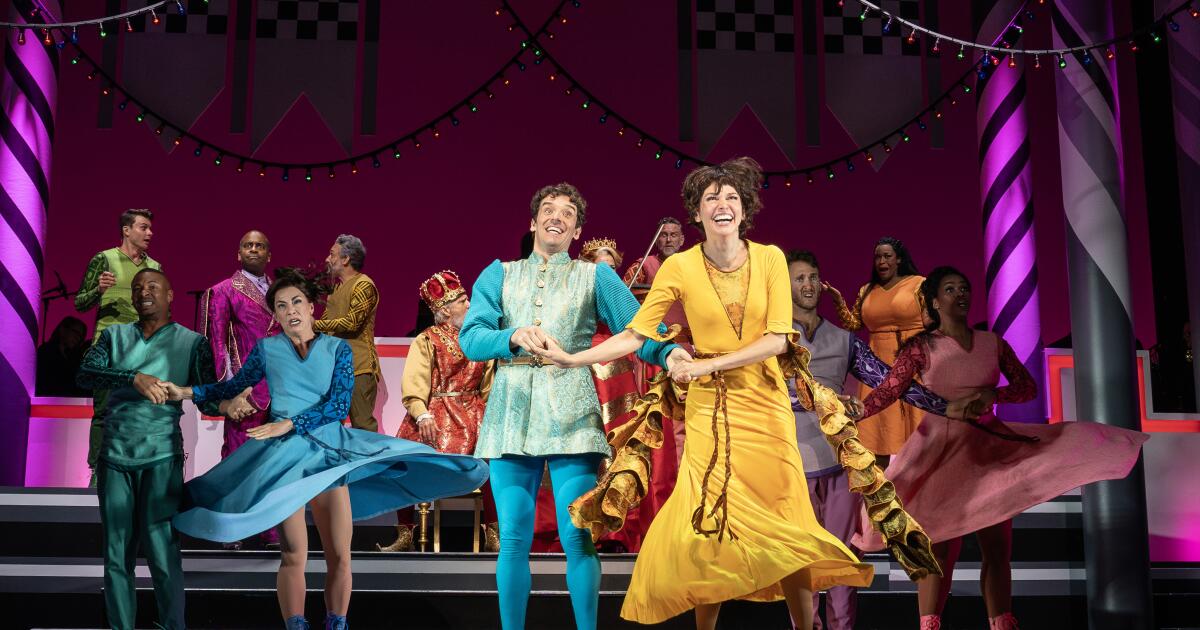
Sutton and “Mattress,” that’s perfect casting. The first thing she said to me was, “I want to be so gross, I want to be as disgusting as possible, I want to be this true Swamp Thing that crawled out of the muck.” And yet you fall in love with her, even with s— in her hair and leeches on her back. Nobody finds moments of humanity in insanity like Sutton Foster, and in this she’s certainly at her most insane.
Sutton Foster, center, and the Broadway cast of “Once Upon a Mattress.”
Advertisement
(Joan Marcus)
When you first signed onto the rewrite, was Broadway in the conversation?
I thought this was just for City Center, where they rehearse for like two weeks and then perform for two weeks. I may have had two weeks to get them the draft — a fun couple of weeks of writing jokes and lobbying hard for one classless d— joke, come on, Lear, let me get one in! It’s amazing to watch because it’s so fast and frenetic, and the fact that they can pull it off at all and at the level at which they pull it off, it’s such a thrill. So I thought it was over, and then suddenly, it’s going to Broadway. Well, I had all this other stuff I wanted to put in it, so can I put it in now?
Sometimes, these things take years to get to Broadway, and in that time you do try things and throw out things and put things in. But the whole thing has happened unbelievably fast. I think part of the reason that everybody thought it could go to Broadway so quickly is because it felt like Michael Urie and Sutton [as Prince Dauntless and Princess Winnifred, respectively] had been rehearsing for months. From day one, they were so in the pocket of being weird together and speaking each other’s language that it was a kind of magic.
Advertisement
I managed to shove a few more things in there that I had really, really wanted to, but in my dream of dreams, we would have had a proper time frame to really dig deep. But for me, nothing is ever done. I look at the “Gilmore” pilot, and I’m like, can I rewrite that? I remember when they sold “Gilmore” to Netflix, I said, “Can I remix the whole thing? Because I was never really happy with the sound on it.” And they’re like, “Yeah, can you not call us again? It’s a done deal, lady, you’ve got to move on.”
How did you go about rewriting the book by Jay Thompson, Dean Fuller and Marshall Barer, especially in such limited time?
Making everybody happy was hard. Over the years, there have been several kinds of incarnations of this show: The structure was changed, some characters were left out, and there was actually not one definitive blueprint to follow. So I’m working off of production drafts and working with three different estates, and the originators aren’t around to explain, “That’s what this very shorthand stage direction meant.” And at the same time, I’m in production. I’m on set on [forthcoming TV series] “Étoile,” [where] my [assistant directors] would get a glimpse of the [“Mattress”] script and go, “Who’s Winnifred?!” No, don’t look over there, your script is over here! It was insane, keeping everything straight.
I wrote a movie version of “Gypsy” — which has never seen the light of day, but I’m still hopeful — and I remember getting on the phone with Stephen Sondheim, and after all the wonderful compliments, he goes, “I just have a few thoughts, if you want to hear them.” I’m like, “Oh my God, of course!” And he goes, “I want to hurry, because page one…” It was like 15 hours, and it was the best 15 hours of my life.
That’s what you always want to be able to do, is really rip through things. This was not the project for that. It was very, very fast, and you never get to do everything you want to do at that speed.
Advertisement
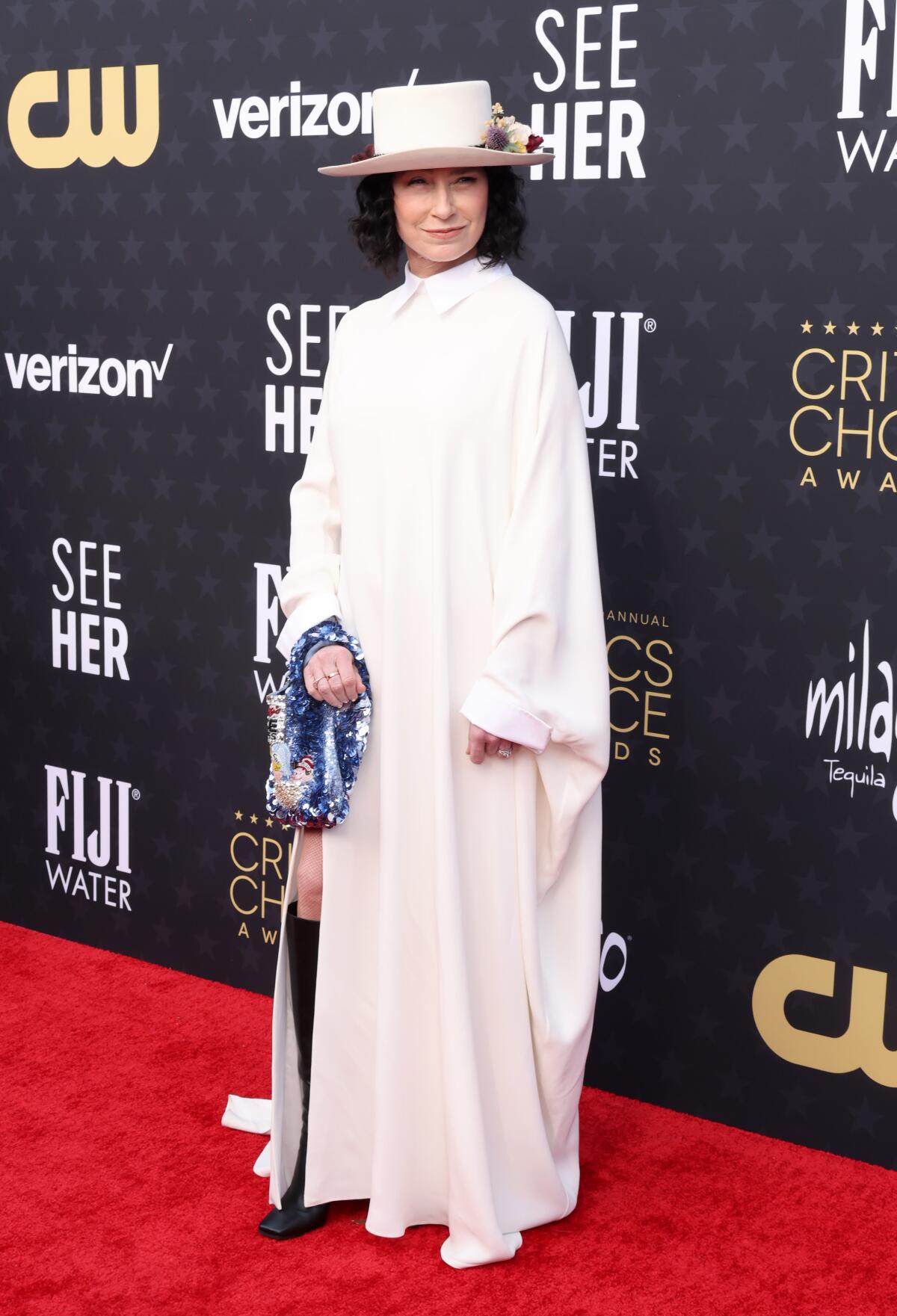
Amy Sherman-Palladino, pictured at the Critics Choice Awards earlier this year.
(Amy Sussman / WireImage)
What’s the hardest thing about updating a text tied to multiple estates?
They’re all protecting their own legacies, and you end up having to work within the confines of other people in control of your destiny. Sometimes it’s a good exercise to do that: On “Gilmore Girls,” we had zero money. “The Drew Carey Show’’ would send over their extra water and half a sheet cake if someone had a birthday over there. I mean, it takes place in Connecticut, and we’re in Burbank where there’s no snow!
Learning to craft a world and a story and seven seasons of a journey out of nothing and with nothing — that lean, mean training prepares you for anything. My job is to fight the battles that I feel are worth fighting, and to keep fighting them so that the cast feels supported by the material and Lear has what she needs to do something we’re all proud of.
Advertisement
I was so f— naive — I went through a draft and changed all the things I’d change in a [TV] script, and some of it was as little as changes for spacing on the page or moving the comma so the person doesn’t pause at the wrong time, not realizing that they had to redline everything for the estates. It’s one of those dumb things that was so automatic for me, but I’d just made Lear’s world 15 times harder. So I apologize, Lear, I love you, it was not on purpose.
This musical, as beloved as it is, had its share of misogynistic material. How did you approach the update for a new generation?
That was the most important thing. It is a fairy tale, which does have a lot of, “I gotta marry a prince in the end,” but that’s not the [universal] female journey anymore, which is a great thing.
We wanted to lean more into the naivete of Winnifred, somebody who has a vision in her mind of what happily ever after is. She’s got this ridiculous speech about how it means you get to do gymnastics and climb trees, but it’s the end of that monologue where she says, “You get a pal” — you have someone to share this life with. She doesn’t want someone to put her on a pedestal, to dress her up in pretty clothes and look at her like an object. She wants someone to share s— with and laugh with, someone to look at all of her weirdness that she can’t do anything about because that’s who she is, and go, “I think you are special.”
That journey of love and acceptance, of wanting to belong someplace and having someone see you for the greatness that you are, even if you did crawl out of the slime — that’s the princess journey.
Advertisement
This is a female-led musical driven by broad, physical comedy — a type of show Broadway hasn’t seen much lately. How do you feel it will be received by today’s ticket-buying audiences?
I think all of us are aligned in the fact that you’re not going to walk out of the show having learned any lessons. We’re not teaching you d—. You gotta learn that somewhere else. If you want to break it down and make it sound deeper than it is, it’s about being different and finding the one person who sees what’s cool about you. But it’s just a fun show. There’s nothing you’re taking away from “Oh, Mary!” either, except that, for an hour and 20 minutes, you’re going to laugh your ass off and it’s gonna leave you on a high.
Broadway is best and thrives the most when everything is represented: the dramas that make you feel hard things or change your perspective or make you cry, the shows that really make you feel s— about yourself. Sometimes, you gotta walk out of a theater feeling like absolute crap, and that’s just part of the theater experience.
But there’s also a place in theater where, for a few hours, you’ve forgotten that your kid won’t talk to you, politics are madness and the world is falling apart. It hasn’t gone anywhere, it’s all waiting for you the minute you walk back out, but you’ve had something joyous that makes it OK to wake up the next day and go into your challenging life. So why not be someplace wonderful for a couple hours?
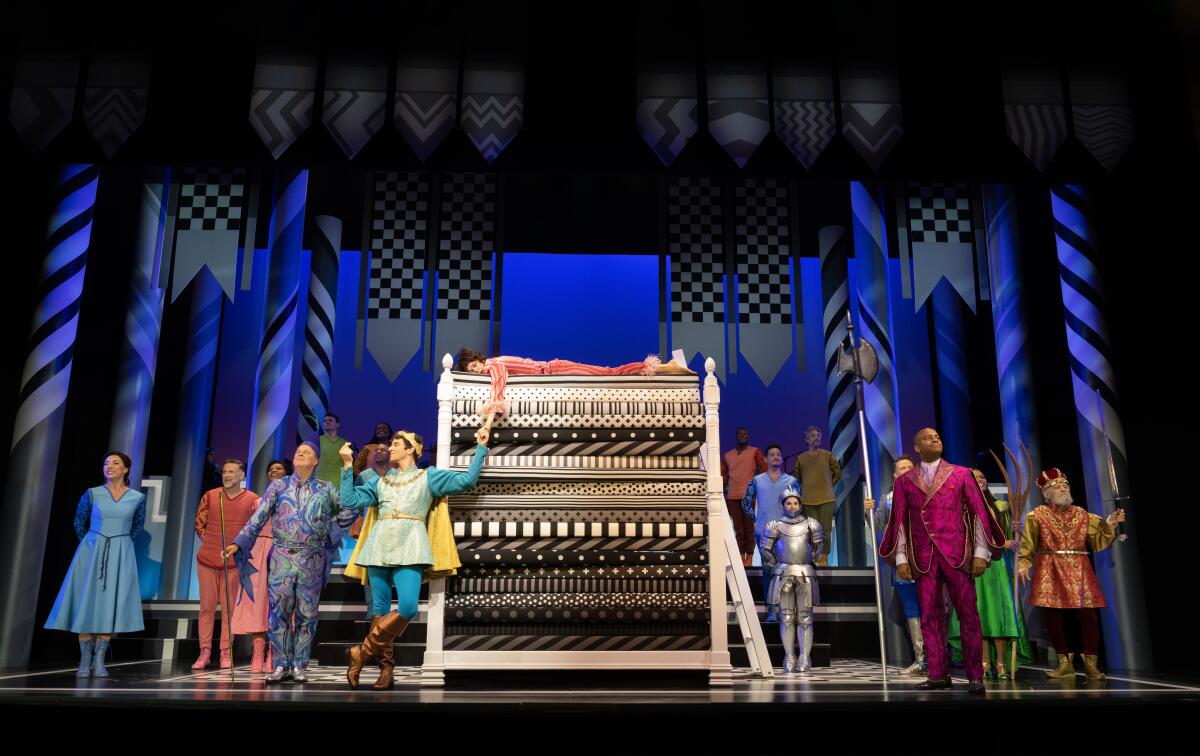
Michael Urie and Sutton Foster, center, with the Broadway cast of “Once Upon a Mattress.”
(Joan Marcus)
Advertisement
Are negotiations underway to have your version be the licensable “Mattress” moving forward?
There’s been discussions about it. I don’t think they wanted to take that step at this moment. Which, to me, says I gotta prove it, because if this version scores with audiences, maybe people will want to do this version. If not, then maybe people are like, “As long as she sings ‘Shy,’ I’m good.”
That’s the gig. I can’t worry about that because I have too many other things to be nauseous about. But I would love for that to happen because I love the show. And, I’d love to take another pass at it, if they’d let me, and probably another pass after that.
What was given to me by Sutton and Lear was a gift. I embrace this gift wholeheartedly and I hope I’ve done well by them. That’s all I can control at this moment. But I want to do more theater, because there’s nothing like it. It’s dangerous, anything can happen, so it’s not for the faint of heart. But I want to do more of the things that are truly and utterly terrifying, and theater is terrifying in the best way.
Advertisement
What advice would you give to another writer tasked with updating a classic musical?
Valium. Get a vat of Valium, up the dosage, just do it. Every time you get that call about your latest draft, just have that bottle right there. It’s gonna make everything go so much smoother.
A still from ‘Song Sung Blue’.
| Photo Credit: Focus Features/YouTube
There is something unputdownable about Mike Sardina (Hugh Jackman) from the first moment one sees him at an Alcoholics Anonymous meeting celebrating his 20th sober birthday. He encourages the group to sing the famous Neil Diamond number, ‘Song Sung Blue,’ with him, and we are carried along on a wave of his enthusiasm.
Song Sung Blue (English)
Director: Craig Brewer
Cast: Hugh Jackman, Kate Hudson, Michael Imperioli, Ella Anderson, Mustafa Shakir, Fisher Stevens, Jim Belushi
Runtime: 132 minutes
Advertisement
Storyline: Mike and Claire find and rescue each other from the slings and arrows of mediocrity when they form a Neil Diamond tribute band
We learn that Mike is a music impersonator who refuses to come on stage as anyone but himself, Lightning, at the Wisconsin State Fair. At the fair, he meets Claire (Kate Hudson), who is performing as Patsy Cline. Sparks fly between the two, and Claire suggests Mike perform a Neil Diamond tribute.
Claire and Mike start a relationship and a Neil Diamond tribute band, called Lightning and Thunder. They marry and after some initial hesitation, Claire’s children from her first marriage, Rachel (Ella Anderson) and Dayna (Hudson Hensley), and Mike’s daughter from an earlier marriage, Angelina (King Princess), become friends.
Members from Mike’s old band join the group, including Mark Shurilla (Michael Imperioli), a Buddy Holly impersonator and Sex Machine (Mustafa Shakir), who sings as James Brown. His dentist/manager, Dave Watson (Fisher Stevens), believes in him, even fixing his tooth with a little lightning bolt!
The tribute band meets with success, including opening for Pearl Jam, with the front man for the grunge band, Eddie Vedder (John Beckwith), joining Lightning and Thunder for a rendition of ‘Forever in Blue Jeans’ at the 1995 Pearl Jam concert in Milwaukee.
There is heartbreak, anger, addiction, and the rise again before the final tragedy. Song Sung Blue, based on Greg Kohs’ eponymous documentary, is a gentle look into a musician’s life. When Mike says, “I’m not a songwriter. I’m not a sex symbol. But I am an entertainer,” he shows that dreams do not have to die. Mike and Claire reveal that even if you do not conquer the world like a rock god, you can achieve success doing what makes you happy.
Advertisement
ALSO READ: ‘Run Away’ series review: Perfect pulp to kick off the New Year
Song Sung Blue is a validation for all the regular folk with modest dreams, but dreams nevertheless. As the poet said, “there’s no success like failure, and failure’s no success at all.” Hudson and Jackman power through the songs and tears like champs, leaving us laughing, tapping our feet, and wiping away the errant tears all at once.
The period detail is spot on (never mind the distracting wigs). The chance to hear a generous catalogue of Diamond’s music in arena-quality sound is not to be missed, in a movie that offers a satisfying catharsis. Music is most definitely the food of love, so may we all please have a second and third helping?
Stephen A. Smith is arguably the most-well known sports commentator in the country. But the outspoken ESPN commentator’s perspective outside the sports arena has landed him in a firestorm.
The furor is due to his pointed comments defending an Immigration and Customs Enforcement agent who fatally shot a Minneapolis woman driving away from him.
Just hours after the shooting on Wednesday, Smith said on his SiriusXM “Straight Shooter” talk show that although the killing of Renee Nicole Good was “completely unnecessary,” he added that the agent “from a lawful perspective” was “completely justified” in firing his gun at her.
He also noted, “From a humanitarian perspective, however, why did he have to do that?”
Smith’s comments about the agent being in harm’s way echoed the views of Deputy of Homeland Security Secretary Kristi Noem, who said Good engaged in an “act of domestic terrorism” by attacking officers and attempting to run them over with her vehicle.
Advertisement
However, videos showing the incident from different angles indicate that the agent was not standing directly in front of Good’s vehicle when he opened fire on her. Local officials contend that Good posed no danger to ICE officers. A video posted by partisan media outlet Alpha News showed Good talking to agents before the shooting, saying, “I’m not mad at you.”
The shooting has sparked major protests and accusations from local officials that the presence of ICE has been disruptive and escalated violence. Minneapolis Mayor Jacob Frye condemned ICE, telling agents to “get the f— out of our city.”
The incident, in turn, has put a harsher spotlight on Smith, raising questions on whether he was reckless or irresponsible in offering his views on Good’s shooting when he had no direct knowledge of what had transpired.
An angered Smith appeared on his “Straight Shooter” show on YouTube on Friday, saying the full context of his comments had not been conveyed in media reports, specifically calling out the New York Post and media personality Keith Olbermann, while saying that people were trying to get him fired.
He also doubled down on his contention that Good provoked the situation that led to her death, saying the ICE agent was in front of Good’s car and would have been run over had he not stepped out of the way.
Advertisement
“In the moment when you are dealing with law enforcement officials, you obey their orders so you can get home safely,” he said. “Renee Good did not do that.”
When reached for comment about his statements, a representative for Smith said his response was in Friday’s show.
It’s not the first time Smith, who has suggested he’s interesting in going into politics, has sparked outside the sports universe. He and journalist Joy Reid publicly quarreled following her exit last year from MSNBC.
He also faced backlash from Black media personalities and others when he accused Democratic Rep. Jasmine Crockett of Texas of using “street verbiage” in her frequent criticisms of President Trump.
“The way that Jasmine Crockett chooses to express herself … Aren’t you there to try and get stuff done instead of just being an impediment? ‘I’m just going to go off about Trump, cuss him out every chance I get, say the most derogatory things imaginable, and that’s my day’s work?’ That ain’t work! Work is, this is the man in power. I know what his agenda is. Maybe I try to work with this man. I might get something out of it for my constituents.’ ”
In 1977, a man named Tony Kiritsis fell behind on mortgage payments for an Indianapolis, Indiana, property that he hoped to develop into an affordable shopping center for independent merchants. He asked his mortgage broker for more time, but was denied. This enraged him because he suspected that the broker and his father, who owned the company, were conspiring to defraud him by letting the property go into foreclosure and acquire it for much less than market value. He showed up at the offices of the mortgage company, Meridian, for a scheduled appointment regarding the debt in the broker’s office, where he took the broker, Richard O. Hall, hostage, and demanded $130,000 to settle the debt, plus a public apology from the company. He carried a long cardboard box containing a shotgun with a so-called dead man’s wire, which he affixed to Hall as a precaution against police interference: if either of them were shot, tackled, or even caused to stumble, the wire would pull the trigger, blowing Hall’s head off.
That’s only the beginning of an astonishing story that has inspired many retellings, including a memoir by Hall, a 2018 documentary (whose producers were consultants on this movie) and a podcast drama starring Jon Hamm as Tony Kiritsis. And now it’s the best current movie you likely haven’t heard about—a drama from director Gus Van Sant (“Good Will Hunting”), starring Bill Skarsgård as Tony Kiritsis and Dacre Montgomery as Richard Hall. It’s unabashedly inspired by the best crime dramas from the 1970s, including “Dog Day Afternoon,” “The Sugarland Express,” “Network,” and “Badlands,” and can stand proudly alongside them.
From the opening sequence, which scores the high-strung Tony’s pre-crime prep with Deodato’s immortally groovy disco version of “Thus Spake Zarathustra” played on the radio by one of Tony’s local heroes, the philosophical DJ Fred Temple (Colman Domingo); through the expansive middle section, which establishes Tony as part of a thriving community that will see him as their representative in the one-sided struggle between labor and capital; through the ending and postscript, which leave you unsure how to feel about what you’ve seen but eager to discuss it with others, “Dead Man’s Wire” is a nostalgia trip of the best kind. Rather than superficially imitate the style of a specific type of ’70s drama, Van Sant and his collaborators connect with the essence of what made them powerful and memorable: their connection to issues that weighed on viewers’ minds fifty years ago and that have grown heavier since.
Tony is far from a criminal genius or a potential folk hero, but thinks he’s both. The shotgun box with a weird bulge, barely held together with packing tape, is a correlative of the mentality of the man who carries it. His home is filled with counterculture-adjacent books, but he’s a slob who loudly gripes during a brief car ride that his “shorts have been ridin’ up since Market Street,” and has a vanity license plate that reads “TOPLESS.” His eloquence runs the gamut from Everyman acuity to self-canceling nonsense slathered in profanity . He accurately sums up the mortgage company’s practices as “a private equity trap” (a phrase that looks ahead to the 2008 financial collapse, which was sparked by predatory lending on subprime mortgages) and hopes that his extreme actions will generate some “some goddamn catharsis” for himself and his fellow citizens, and “some genuine guilt” among Indianapolis’ lending class.
He’s also intoxicated by his sudden local fame. The hostage situation migrates from the mortgage company to Tony’s shabby apartment complex, which is quickly surrounded by beat cops, tactical officers, and reporters (including Myha’La as Linda Page, a twenty-something, Black local TV correspondent looking to move up. Tony also forces his way into the life of his idol Temple, who tapes a phone conversation with him, previews it for police, and grudgingly accepts their or-else request to continue the dialog and plays their regular talks on his morning show.
Advertisement
Despite these inroads, Tony is unable to prevent his inner petty schmuck from emerging and undermining his message, such as it is. He vacillates between treating Hall as a useless representative of the financial elite (when the elder Hall finally agrees to speak with Tony via phone from a tropical vacation, Tony sneers to Hall the younger, “Your daddy’s on the line—he wants to know when you’ll be home for supper!”) and connecting with him on a human level. When he’s not bombastic, he’s needy and fawning. “I like you!” he keeps telling people he just met, but Fred most of all—as if a Black man who’d built a comfortable life for himself and his wife in 1977 Indiana could say no when an overwhelmingly white police force asked him to become Tony’s fake-confidant; and as if it matters whether a hostage-taking gunman feels warmly towards him.
Ultimately, though, making perfect sense and effecting lasting change are no higher on Tony’s agenda than they were for the protagonists of “Dog Day Afternoon” and “Network.” Like them, these are unhinged audience surrogates whose media stardom turned them into human megaphones for anger at the miserable state of things, and the indifference of institutions that caused or worsened it. These include local law enforcement, which—to paraphrase hapless bank robber Sonny Wirtzik taunting cops in “Dog Day Afternoon”—wanna kill Tony so bad that they can taste it. The discussions between Indianapolis police and the FBI (represented by Neil Mulac’s Agent Patrick Mullaney, a straight-outta-Quantico robot) are all about how to set up and take the kill shot.
The aforementioned phone call leads to a gut-wrenching moment that echoes the then-recent kidnapping of John Paul Getty III, when hostage-takers called their victim’s wealthy grandfather to arrange ransom payment, and got nickel-and-dimed as if they were trying to sell him a used car. The elder Hall is played by “Dog Day Afternoon” star Al Pacino, inspired casting that not only officially connects Tony with Wirtzik but proves that, at 85, Pacino can still bring the heat. The character’s presence creeps into the rest of the story like a toxic fog, even when he’s not the subject of conversation.
With his frizzy grey toupee, self-satisfied Midwest twang, and punchable smirk, Pacino is skin-crawlingly perfect as an old man who built a fortune on being good at one thing, but thinks that makes him a fountain of wisdom on all things, including the conduct of Real Men in a land of women and sissies. After watching TV coverage of Tony getting emotional while keeping his shotgun on Richard, Jr., he beams with pride that Tony shed tears but his own son didn’t. (Kelly Lynch, who costarred in another classic Van Sant film about American losers, “Drugstore Cowboy,” plays Richard, Sr.’s trophy wife, who is appalled at being confronted with irrefutable evidence of her husband’s monstrousness, but still won’t say a word against him.)
Van Sant was 25 during the real-life incidents that inspired this movie. That may partly account for the physical realism of the production, which doesn’t feel created but merely observed, in the manner of ’70s movies whose authenticity was strengthened by letting the main characters’ dialogue overlap and compete with ambient sounds; shooting in existing locations when possible, and dressing the actors in clothes that looked as if they’d been hanging in regular folks’ closets for years. Peggy Schnitzer did the costumes, Stefan Dechant the production design, and Arnaud Poiter the cinematography, all of which figuratively wear bell-bottom pants and platform shoes; the soundscape was overseen by Leslie Schatz, who keeps the environments believably dense and filled with incidental sounds while making sure the important stuff can be understood. It should also be mentioned that the film’s blueprint is an original script by a first-timer, Adam Kolodny, with a bona-fide working class worldview; he wrote it while working as a custodian at the Los Angeles Zoo.
Advertisement
More impressive than the film’s behind-the-scenes pedigree is its vision of another time that unexpectedly comes to seem not too different from this one. It is both a lovingly constructed time machine highlighting details that now seem as antiquated as lithography and buckboard wagons (the film deserves a special Oscar just for its phones) and a wide-ranging consideration of indestructible realities of life in the United States, which are highlighted in such a way that you notice them without feeling as if the movie pointed at them.
For instance, consider Tony’s infatuation with Fred Temple, which peaks when Tony honors his hero by demonstrating his “soul dancing” for his hostage, is a pre-Internet version of what we would now call a “parasocial relationship.” An awareness of racial dynamics is baked into this, and into the film as a whole. Domingo’s performance as Temple captures the tightrope walk that Black celebrities have to pull off, reassuring their most excitable white fans that they understand and care about them without cosigning condescension or behavior that could escalate into harassment. Consider, too, the matter-of-fact presentation of how easy it is for violence-prone people to buddy up to law enforcement officers, especially when they inhabit the same spaces. When Indianapolis police detective Will Grable (Cary Elwes) approaches Tony on a public street soon after the kidnapping, Tony’s face brightens as he exclaims, “Hi Mike! Nice to see you!”
And then, of course, there’s the economic and political framework, which is built with a firm yet delicate hand, and compassion for the vibrant messiness of life. “Dead Man’s Wire” depicts an analog era in which crises like this one were treated as important local matters that involved local people, businesses, and government agents, rather than fuel for a global agitprop industry posing as a news media, and a parasitic army of self-proclaimed influencers reycling the work of other influencers for clout. Van Sant’s movie continually insists on the uniqueness and value of every life shown onscreen, however briefly glimpsed, from the many unnamed citizens who are shown silently watching news coverage of the crisis while working their day jobs, to Fred’s right hand at the radio station, an Asian-American stoner dude (Vinh Nguyen) with a closet-sized office who talent-scouts unknown bands while exhaling cumulus clouds of pot smoke.
All this is drawn together by Van Sant and editor Saar Klein in pop music-driven montages that show how every member of the community depicted in this story is connected, even if they don’t know it or refuse to admit it. As John Donne put it, “No man is an island/Entire of itself/Each is a piece of the continent/A part of the main.” The struggle of the individual is summed up in one of Fred’s hypnotic radio monologues: “Let’s remember to become the ocean, not disappear into it.”