Things were getting weird again between mission control and the space station S.A.B.E.R. For one thing, both places were crawling with cats, turning a high-concept livestream from Marvel Entertainment into a chaotic scene of tumbling, jumping, eating, purring felines that just might have been extraterrestrials in disguise (a.k.a. “flerkens”).
Mission control was on the back patio of the CatCafé Lounge in West Los Angeles, where creative marketing agency IHeartComix positioned a row of video monitors and computer gear amid dozens of wandering cats. Jesus Rivera directed the day’s cosmic live broadcast on YouTube, clad in a burgundy tracksuit and white fedora, a scorpion ring on his right hand. “Cue music,” he said to the crew around him, his monitor showing a closeup of a cat’s furry face. “Throw the balls in!”
Fans of the Marvel Cinematic Universe were introduced to flerkens in the 2019 hit movie “Captain Marvel,” starring Brie Larson; the creatures are back for a sequel, “The Marvels.” But at the time, with the end of the Hollywood actors’ strike still weeks away, and no cast members available to promote the film’s November release, the MCU turned to a different kind of hero: IHeartComix, a company known for inventive and immersive events for Adult Swim, Vice and Hulu, colliding the epic and ridiculous, the flamboyant and sublime.
For IHC, herding flerkens was just another strange day at the office.
Hype and marketing are nothing new in Los Angeles, but when major artists and movie studios want to roll out their new music, film or TV project and make a memorable (and viral) splash, they frequently turn to the creative team at IHeartComix. The firm didn’t emerge from a traditional business plan, rising organically from L.A.’s indie-dance scene.
Advertisement
IHeartComix founder Franki Chan, right, sits for a portrait with co-workers, from left, Sarah Fleisher, Carina Gutierrez, Jesus Antonio Rivera and Jess Doren on Dec. 14, 2023.
(Brian van der Brug / Los Angeles Times)
“They’ve come to appreciate us for the ideas that we come up with that are usually pretty wild or wacky or unique,” says Franki Chan, IHC’s soft-spoken founder, at the CatCafé clad in a “Love and Rockets” comics T-shirt, with traces of black and red polish on his fingernails. “It’s not so traditional.”
This month, IHeartComix marks its 20th anniversary, two decades after the name first appeared on a flier for a party called “F— Awesome” at Beauty Bar in Hollywood. From there, the company evolved into a promoter and producer of various L.A. parties, concerts and content. Now as a marketing and culture agency, IHC found a sweet spot by bringing their energy and style from the music scene into the movie world.
Advertisement
While competing agencies are often great at making things to order, says Chan, 45, “We’re the opposite. We want to have a point of view. We want to have a voice. We only want to work on the things that we like.”
IHeartComix created this Guardians of the Galaxy Knowhere pop-up bar and screening in Los Angeles
(David Morrison)
Last spring, the firm built a space-traveler’s cantina in the desert en route to the Coachella Valley Music and Arts Festival to promote the third “Guardians of the Galaxy” film, giving festival-goers a roadside attraction for Instagram snapshots and TikTok posts. And when the Rolling Stones prepared for the October release of their album “Hackney Diamonds,” the classic rock legends had IHC create an elegant rock ‘n’ roll setting in Manhattan for a surprise performance on a small cabaret stage at the 650-capacity club Racket NYC.
Advertisement
The main directive from frontman Mick Jagger was simple, recalls IHC project manager Sarah Fleischer: “It needs to be like a sexy club show, not a toothpaste launch.” So there was flowing red drapery, tabletops decorated with flowers and smashed crystal hearts (echoing the album cover art), and animated graphics on video screens.
Things have only gotten bigger for the firm since 2018, when it created a party at New York Fashion Week for Marvel’s “Black Panther” film, drawing inspiration from the fictional African nation of Wakanda. Chan’s team collaborated with Disney Consumer Products and a group of Bronx-based chefs called Ghetto Gastro to create a night called “The Taste of Wakanda,” with six different dishes, one desert and three beverages, offering an imagined cultural experience from the country.
“We created all the serving utensils from scratch, the forks, the spoons, the cups, the plates, the serving trays, the bars, and then the environment around it,” Chan recalls. “All of the cast was there. They actually ended up spending most of the time in the kitchen with us because they just loved the food.”
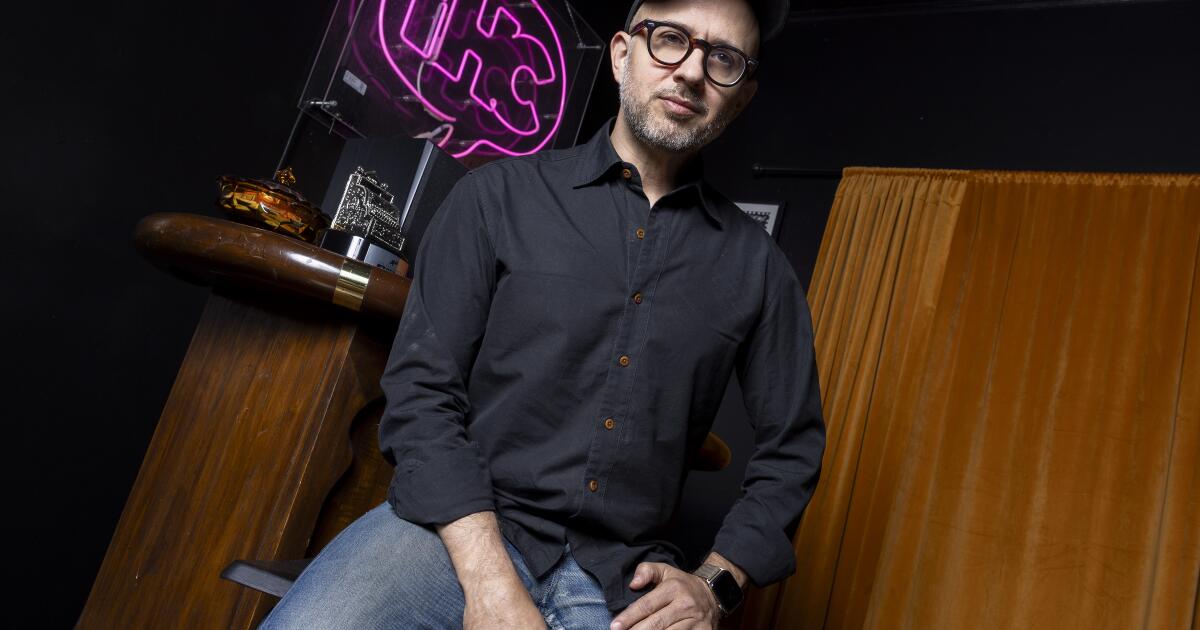
IHeartComix founder Franki Chan sits for a portrait on Thursday, Dec. 14, 2023.
(Brian van der Brug / Los Angeles Times)
Advertisement
It was a transformational event for company, says Chan, a knockout production that showed the range of IHeartComix stretched far beyond the music scene that birthed it. “It was really unique and different,” says Dustin Sandoval, Disney’s vice president of digital marketing, who often calls on IHC for promotional events for Disney, Marvel and more. “That’s the kind of thinking the IHeartComixteam brings to the table, and their passion just shines through because they are true fans of this more than anything.”
At the height of the pandemic, IHC moved its offices into an old Hollywood house near Sunset Boulevard. Chan also lives there, like a flashback to his early years living and working out of a small apartment or warehouse space. The living room shelves are filled with vinyl records, and in the corner is an ancient “Pac-Man” machine. On top is a dragon made of leather named Chester. A replica of Thor’s hammer rests nearby.
Handmade props from past events are everywhere. The firm only recently cleared out a garage filled with layers of ephemera from a few years of projects, but the backyard is still guarded by a green statue of a Tyrannosaurus rex.
Over two decades, Chan has steadily expanded beyond his early role as a force on the L.A. club scene to conceiving these high-concept events with his creative team. The goal is always to reach well beyond the experience of the party itself.
Advertisement
“None of it matters if no one posts,” says Chan, noting the viral imperative. “It’s all about creating the press headline: ‘Guardians of the Galaxy goes to Coachella.’”
On the other hand, a room filled only with influencers is not much fun either. “That party’s going to be boring because those people don’t know each other. There’s no relationship there,” Chan explains. “They’re all people that only care about themselves and want to take pictures of themselves. There’s not going to be any vibe.
“People respond to genuine things. You can tell if someone’s genuinely having a good time and having a real experience versus posting something for money.”
The name of IHeartComix means exactly what it says: Chan relocated from Seattle to Los Angeles in 2003 with dreams of becoming a comic book artist. He landed in L.A. after selling out a self-published comic book at Comic-Con International in San Diego, expecting more success to follow. When that didn’t happen, he was soon broke and sleeping in his car most nights.
In Seattle, he’d been in punk bands and then a promoter-DJ, but now was scraping by as a holiday temp at the Virgin Megastore in West Hollywood. He sometimes got gigs as a background extra on TV series. (He appeared on “The OC” as either “high school student” or “pedestrian.”) By chance, the brother of a Seattle friend was manager of a new club in Hollywood called Beauty Bar, and he needed DJs.
Advertisement
Chan immediately signed up. The idea then was just “to help pay the bills (and mainly to meet people so we had couches to crash on).”
The bar quickly took off, and by the next month, the DJ nights became a hot event, with Chan, Har Mar Superstar and DJ Steve Aoki at its core. That evolved into the larger Cinespace Tuesdays. The nights were documented with style in the pre-Instagram era by a teenage photographer calling himself the Cobrasnake (a.k.a. Mark Hunter). Chan and Aoki, among others, became characters in the Cobrasnake’s popular nightlife photographs.
“You’re taking pictures and you’re posting it on the internet, and people could see what the party looked like, which was a radical idea at the time. He was the first person to do that,” says Chan.
Within a year of that first night, they were also hosting parties in New York, and being hired to create events at Sundance and for various corporate entities. On the decks, Chan’s playlist mingled eclectic tunes from Jay-Z, the Neptunes and Beyoncé to Daft Punk, LCD Soundsystem and Le Tigre.
IHeartComix was the name of Chan’s indie record label, which had early success with the Brooklyn duo Matt & Kim, and their playfully raw pop single “Yea Yeah.” His partnership with Aoki split in 2006 into competing parties as Chan created Check Yo Ponytail under his new IHeartComix banner. Aoki was on his way to becoming a superstar DJ, and there was real tension between the camps, but it had the effect of helping the scene double in size.
Advertisement
Check Yo Ponytail landed an open-ended residency in 2010 at Echoplex, hosting a wide range of cutting-edge DJs and live acts, from the rediscovered Detroit protopunk act Death to haunting singer-songwriter Chelsea Wolfe. Chan also continued to promote events at Sundance, South By Southwest and other major gatherings across the country.
“We didn’t want to be a local party,” Chan says now. “We wanted to be a national brand.”
The Rolling Stones were joined by Lady Gaga at their “Hackney Diamonds” album release show at Racket in New York City.
(Kevin Mazur)
Advertisement
In 2013, as the Rolling Stones were celebrating 50 years as a band, they wanted to play a Los Angeles warm-up show in a small L.A. venue a week before launching a U.S. tour. The Stones chose the Echoplex, on a night already reserved for Check Yo Ponytail, which put Chan in a key role for hottest ticket in town that week.
“We didn’t tell the Echoplex who was playing” until two nights before the show, Chan remembers. “It was so secret.” It was also a milestone for what IHC would become.
Chan calls the stretch of time between 2013 and early 2017 “our puberty years,” a time of left turns and general risk-taking, with streaming content and even developing a TV pilot with Seth Rogen. “We were always on the verge of going out of business and experimenting a bunch and trying to start the engine of something new without really understanding what we were trying to do.”
When the COVID-19 pandemic landed in March 2020, all live entertainment stopped. IHeartComix revenue was down 60% that year. Rather than lay off staff, IHC experimented with four streaming shows that covered music, comedy, politics, and a talk show called “Hot Chats” hosted by Chan. No money changed hands for those shows, but they led to opportunities later.
“In February of 2021, I was more poor than the day I moved to Los Angeles,” Chan recounts now. “IHeartComix was totally broke. I put all my money in because we didn’t fire anybody. Even though the money was bad, we were having so many conversations. I was like, ‘I just gotta hold on long enough.’ Then we ended up at the end of ‘21 doing better than we had the last five years combined.”
Advertisement
The first big job as the pandemic receded that year was creating an immersive, action-packed premiere event for the Bob Odenkirk thriller “Nobody,” which unfolded on the Universal Studios backlot with speeding cars, guns, explosions and a dozen stuntmen from the movie. Because of the lingering coronavirus work slowdown, the lot was surprisingly available, along with first-rate cast and crew. Among the guests to witness it was singer Billie Eilish.
That led to an invitation to pitch ideas for the release party for Eilish’s highly anticipated second album, “Happier Than Ever.” IHC came back with a lavish party on an eight-acre private estate in Beverly Hills, designed around lyrical themes on the album. There was a 1950s bedroom with ancient TV sets showing Eilish footage, a koi pond and red footbridges, a palm tree painted blue, green grand piano, a creamy white 1955 Thunderbird, and a pool surrounded by dolphin-shaped fountains. At the party, Eilish welcomed her guests and then dove into the pool fully clothed.
“That’s Franki’s Midas touch: He knows how to throw a good party with good music,” says booking agent Tom Windish, who counts Eilish among his clients. “The Billie one was fantastic, but it seems like they’re generally pretty great, with really nice production. They don’t have a corporate feel to them.”
Chan is contemplating a movie from IHeartComix, and a documentary to recollect its history. But even as the firm celebrates in 2024, its roots in the indie music scene are as important as ever, says Chan, who still DJs a few times a month.
“It’s definitely not a career, but since the pandemic I’ve found a renewed love for it,” he says of performing. “We can never go backwards. It makes more sense for us to move forward with the lessons that we’ve learned and the tools that we’ve built — to take the essence of the scene that we’re from and the things that we love and contribute back to it in new ways.”
Bounding into cinemas just in time for spring, the latest Pixar animation is a pleasingly charming tale of man vs nature, with a bit of crazy robot tech thrown in.
The star of Hoppers is Mabel Tanaka (voiced by Piper Curda), a young animal-lover leading a one-girl protest over a freeway being built through the tranquil countryside near her hometown of Beaverton.
Because the freeway is the pet project of the town’s popular mayor, Jerry (Jon Hamm), who is vying for re-election, Mabel’s protests fall on deaf ears.
Everything changes when she stumbles upon top-secret research by her biology professor, Dr Sam Fairfax (Kathy Najimy), that allows for the human consciousness to be linked to robotic animals. This lets users get up close and personal with other species.
Advertisement
“This is like Avatar,” Mabel coos, and, in truth, it is. Plugged into a headset, Mabel is reborn inside a robotic beaver. She plans to recruit a real beaver to help populate the glade, which is set to be destroyed by Jerry’s proposed road.
In the summer of 1991, Nirvana filmed the music video for “Smells Like Teen Spirit” on a Culver City sound stage. Kurt Cobain strummed the grunge anthem’s iconic four-chord opening riff on a 1969 Fender Mustang, Lake Placid Blue with a signature racing stripe.
Nearly 35 years later, the six-string relic hung on a gallery wall at Christie’s in Beverly Hills as part of a display of late billionaire businessman Jim Irsay’s world-renowned guitar collection, which heads to auction at Christie’s, New York, beginning Tuesday. Each piece in the Beverly Hills gallery, illuminated by an arched spotlight and flanked by a label chronicling its history, carried the aura of a Renaissance painting.
Share via
Advertisement
Advertisement
Irsay’s billion-dollar guitar arsenal, crowned “The Greatest Guitar Collection on Earth” by Guitar World magazine, is the focal point of the Christie’s auction, which has split approximately 400 objects — about half of which are guitars — into four segments: the “Hall of Fame” group of anchor items, the “Icons of Pop Culture” class of miscellaneous memorabilia, the “Icons of Music” mixed batch of electric and acoustic guitars and an online segment that compiles the remainder of Irsay’s collection. The online sale, featuring various autographed items, smaller instruments and historical documents, features the items at the lowest price points.
A portion of auction proceeds will be donated to charities that Irsay supported during his lifetime.
The instruments of famous musicians have long been coveted collector’s items. But in the case of the Jim Irsay Collection, the handcrafted six-strings have acquired a more ephemeral quality in the eyes of their admirers.
Amelia Walker, the specialist head of private and iconic collections at Christie’s, said at the recent highlight exhibition in L.A. that the auction represents “a real moment where these [objects] are being elevated beyond what we traditionally call memorabilia” into artistic masterpieces.
“They deserve the kind of the pedestal that we give to art as well,” Walker said. “Because they are not only works of art in terms of their creation, but what they have created, what their owners have created with them — it’s the purest form of art.”
Advertisement
Cobain’s Fender was only one of the music history treasures nestled in Christie’s gallery. A few paces away, Jerry Garcia’s “Budman” amplifier, once part of the Grateful Dead’s three-story high “Wall of Sound,” perched atop a podium. Just past it lay the Beatles logo drum head (estimated between $1 million and $2 million) used for the band’s debut appearance on “The Ed Sullivan Show,” which garnered a historic 73 million viewers and catalyzed the British Invasion. Pencil lines were still visible beneath the logo’s signature “drop T.”
Pencil lines are still visible on the drum head Ringo Starr played during the Beatles’ debut appearance on “The Ed Sullivan Show.”
(Christie’s Images LTD, 2026)
It is exceptionally rare for even one such artifact to go to market, let alone a billion-dollar group of them at once, Walker said. But a public sale enabling many to participate and demonstrate the “true market value” of these objects is what Irsay would have wanted, she added.
Dropping tens of millions of dollars on pop culture memorabilia may seem an odd hobby for an NFL general manager, yet Irsay viewed collecting much like he viewed leading the Indianapolis Colts.
Advertisement
Irsay, the youngest NFL general manager in history, said in a 2014 Colts Media interview that watching and emulating the legendary NFL owners who came before him “really taught me to be a steward.”
“Ownership is a great responsibility. You can’t buy respect,” he said. “Respect only comes from you being a steward.”
The first major acquisition in Irsay’s collection came in 2001, with his $2.4-million purchase of the original 120-foot scroll for Jack Kerouac’s 1957 novel, “On the Road.” He loved the book and wanted to preserve it, Walker said. But he also frequently lent it out, just like he regularly toured his guitar collection beginning 20 years later.
Jim Irsay purchased the original 120-foot scroll manuscript of Jack Kerouac’s “On the Road” for $2.4 million in 2001.
(Christie’s Images)
Advertisement
“He said publicly, ‘I’m not the owner of these things. I’m just that current custodian looking after them for future generations,’ ” Walker said. “And I think that’s what true collectors always say.”
At its L.A. highlight exhibition, Irsay’s collection held an air of synchronicity. Paul McCartney’s handwritten lyrics for “Hey Jude” hung just a few steps from a promotional poster — the only one in existence — for the 1959 concert Buddy Holly, Ritchie Valens and J.P. “The Big Bopper” Richardson were en route to perform when their plane crashed. The tragedy spurred Don McLean to write “American Pie,” about “the day the music died.”
Later, the Beatles’ 1966 song “Paperback Writer” played over the speakers near-parallel to the guitars the song was written on.
Irsay’s collection also contains a bit of whimsy, with gems like a prop golden ticket from 1971’s “Willy Wonka & the Chocolate Factory” — estimated between $60,000 and $120,000 — and reading, “In your wildest dreams you could not imagine the marvelous surprises that await you!”
Advertisement
Another fan-favorite is the “Wilson” volleyball from 2000’s “Cast Away,” starring Tom Hanks, estimated between $60,000 and $80,000, Gibson said.
Historically, such objects were often preserved by accident. But as the memorabilia market has ballooned over the last decade or so, Gibson said, “a lot of artists are much more careful about making sure that things don’t get into the wrong hands. After rehearsals, they tidy up after themselves.”
If anything proves the market value of seemingly worthless ephemera, Walker added, it’s fans clawing for printed set lists at the end of a concert.
“They’re desperate for that connection. This is what it’s all about,” the specialist said. It’s what drove Irsay as well, she said: “He wanted to have a connection with these great artists of his generation and also the generation above him. And he wanted to share them with people.”
In Irsay’s home, his favorite guitars weren’t hung like classic paintings. Instead, they were strewn about the rooms he frequented, available for him to play whenever the urge struck him.
Advertisement
Thanks to tune-up efforts from Walker, many of the guitars headed to auction are fully operational in the hopes that their buyers can do the same.
“They’re working instruments. They need to be looked after, to be played,” Walker said. And even though they make for great gallery art, “they’re not just for hanging on the wall.”
“Trying to find your niche as a movie star isn’t easy,” said Frank Scheck in The Hollywood Reporter. Take Glen Powell. A year ago, the Twisters and Anyone but You star was being talked about as possibly the next Tom Cruise. But he “stumbled badly” when he tried to play a macho action hero in November’s remake of The Running Man, and he’s now turned in a second straight box office flop. He took a risk with How to Make a Killing, playing a guy cheated by fate who we’re supposed to root for as he begins murdering off the seven rich relatives standing between him and an enormous inheritance. But c’mon. “Powell is charming, but he’s not that charming.”
The Week
Escape your echo chamber. Get the facts behind the news, plus analysis from multiple perspectives.
Advertisement
SUBSCRIBE & SAVE
Sign up for The Week’s Free Newsletters
From our morning news briefing to a weekly Good News Newsletter, get the best of The Week delivered directly to your inbox.
From our morning news briefing to a weekly Good News Newsletter, get the best of The Week delivered directly to your inbox.
The movie “needed to pick a side,” said Jacob Oller in AV Club. It could have been “a clownish class comedy” or “bitter sociopathic satire,” but it winds up being neither, and “at the center of it all is Powell, making the same face for an hour and 45 minutes, too unflappable to root for, too smug to magnetize as an inhuman American Psycho.” I’m not ready to give up on him, said Nick Schager in the Daily Beast. To me, he and co-star Margaret Qualley, who plays the femme fatale who eggs on the killing spree, come across as “such alluringly nasty delights” that this reworking of the 1949 black comedy Kind Hearts and Coronets “ survives its potentially lethal missteps and works on its own limited terms.” Though its teeth aren’t as sharp as they should be, “it’s smart and spiky enough to leave a pleasurably painful mark.”
‘Pillion’
Directed by Harry Lighton (Not rated)
Advertisement
★★★★
While this gay BDSM rom-com from a rookie director “might sound niche,” said Amy Nicholson in the Los Angeles Times, “free yourself to see it and you’ll discover it’s a universal romance.” Former Harry Potter side figure Harry Melling stars as a shy singleton who’s figuring out what he wants in a relationship when he happens into a submissive-dominant entanglement with a tall, handsome biker played by Alexander Skarsgard. Soon, Melling’s Colin is obeying his lover’s every order, including by shaving himself bald and sleeping like a dog on the floor. But the “kinky-funny” screenplay, which won a prize at Cannes, makes sure we see that Colin is not stuck but growing.
A free daily email with the biggest news stories of the day – and the best features from TheWeek.com
While the movie’s sex scenes are “refreshingly graphic,” they’re “never used or shock value,” said Odie Henderson in The Boston Globe. “The real shock comes from how emotionally involved the characters become within the construct of their kink.” And when Colin brings his new lover home to meet the parents, Skarsgard and Lesley Sharp, as Colin’s suburban London mom, do memorable work because “neither of them approaches the scene in a way you’d expect.” Until the ending, which “feels a little neat,” said Zachary Barnes in The Wall Street Journal, the movie “proceeds with an assurance of tone that’s especially impressive for a first-time filmmaker handling material like this.” Harry Lighton’s debut “could have been simply shocking, revving its engine in sexed-up style. Instead, Pillion purrs.”
‘Midwinter Break’
Directed by Polly Findlay (PG-13)
Advertisement
★★
Lesley Manville and Ciarán Hinds “would be appealing to watch just fumbling for their reading glasses,” said Natalia Winkelman in The New York Times. Unfortunately, this “staid” drama about an aging Irish couple puts that claim to the test. A “slow-moving film with a sappy score and mellow mood,” Midwinter Break opens with Manville’s Stella surprising Hinds’ Gerry by arranging a spur-of-the-moment trip to Amsterdam. Alas, “precious little conflict occurs until long afterward.”
But while Polly Findlay’s adaptation of a Bernard MacLaverty novel is a “delicate” film, said Lindsey Bahr in the Associated Press, its impact can be profound “if you can get on its level.” Stella, a devout Catholic, has an ulterior motive for dragging Gerry abroad, and when she nervously proposes how she’d like to live more purposefully in retirement, “it feels earth-shattering.” This is a couple accustomed to leaving much unsaid, including how the violence of the Troubles led them to flee Belfast years earlier for Scotland. Manville and Hinds give the movie everything they’ve got, said Caryn James in The Hollywood Reporter. In a scene in which Stella pours out her heart to a stranger, “Manville delivers one of her most magnificent performances, which is saying a lot.” Alas, the script lets them down, “not because it needs more action but because this ordinary couple’s problems seem so unsurprising, their inner lives so veiled.”