Entertainment
How Erin Foster's real-life romance inspired 'Nobody Wants This'

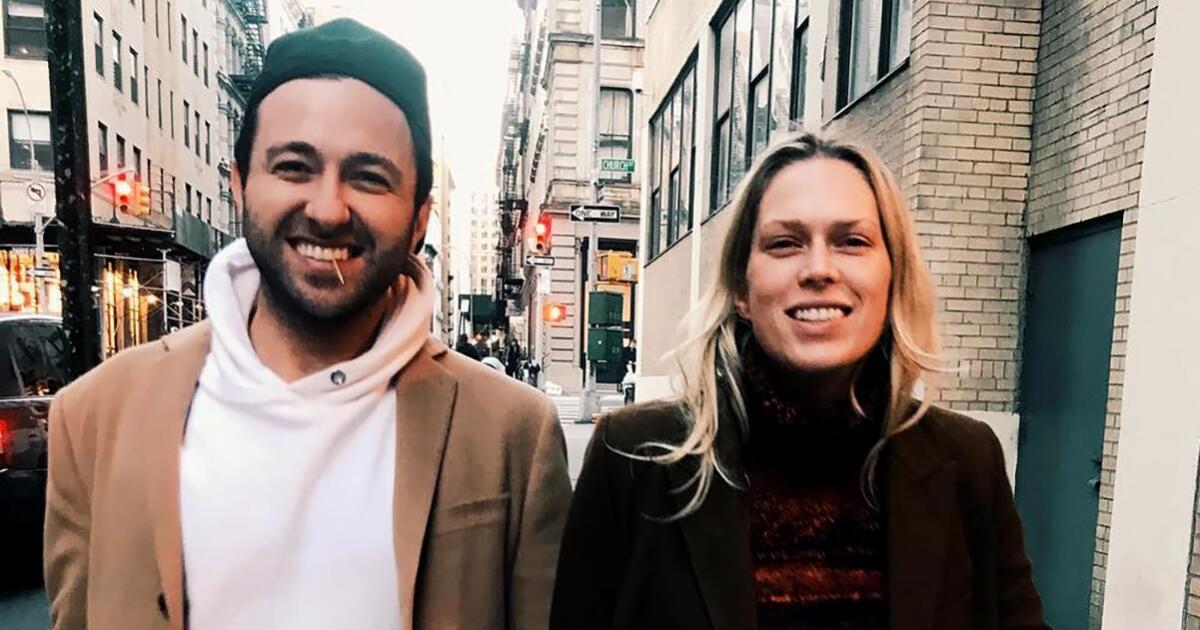
She didn’t spot any glaring red flags the first time she stalked his Instagram page. No photos of him boarding a private jet. Zero reels showing off bottle service sparklers. Nary a shirtless mirror selfie in sight.
Instead, what Erin Foster found as she scrolled through the account of the cute guy from her gym was disarmingly wholesome. Shots of him posing with his parents or playing on a local basketball team.
The photographic evidence led her to two possible conclusions: Either he was too good for her, or he was too nice — the kind of guy who’d fall all over himself trying to please her, causing her to inevitably get the ick.
Erin Foster, the creator of Netflix’s “Nobody Wants This,” at her home in West Hollywood this month.
(Christina House / Los Angeles Times)
Her assumptions about Simon Tikhman would end up, thankfully, being incorrect. But Foster’s early social media investigation into her new crush did not uncover a big part of his identity: He was Jewish. That didn’t matter to her — but the fact that she was a gentile mattered to him.
Tikhman mentioned it the first time they ever hung out in 2018, chatting over juice after the gym — “so L.A.,” they say in unison, rolling their eyes. “Whoever I marry, she has to be Jewish,” he’d said.
The story of how the couple fell in love while grappling with their different cultural backgrounds would go on to serve as the inspiration for Foster’s new show, “Nobody Wants This.” The series, which debuted on Netflix this week, stars Adam Brody as Noah, a rabbi who catches feelings for sex-advice podcaster Joanne, played by Kristen Bell.
Tikhman, 40, is not a spiritual leader — he co-founded a music management company. He doesn’t even consider himself particularly religious. But his parents fled the former Soviet Union in 1979 after being persecuted for being Jewish. When they settled in San Francisco, they instilled in Tikhman the notion that he had an obligation to continue the Jewish lineage.
“I really respect my parents and know the adversity they went through because they were Jewish,” he says. “I wouldn’t want to disappoint them.”
Foster, meanwhile, had been raised without religion in a nontraditional family. Her father, the songwriter David Foster, has been married five times — his second wife was Erin’s mom, former model Rebecca Dyer, with whom he had three of his six children. One of the men her mother dated later was Jewish, and Foster says she enjoyed going to temple during that period more than church. A decade later, she opted to attend a few classes about Judaism with a friend who was trying to delve deeper into her religion.
So the idea of converting — it didn’t scare her. Because of her “complicated family structure,” Foster found herself craving the type of tradition she never grew up with.
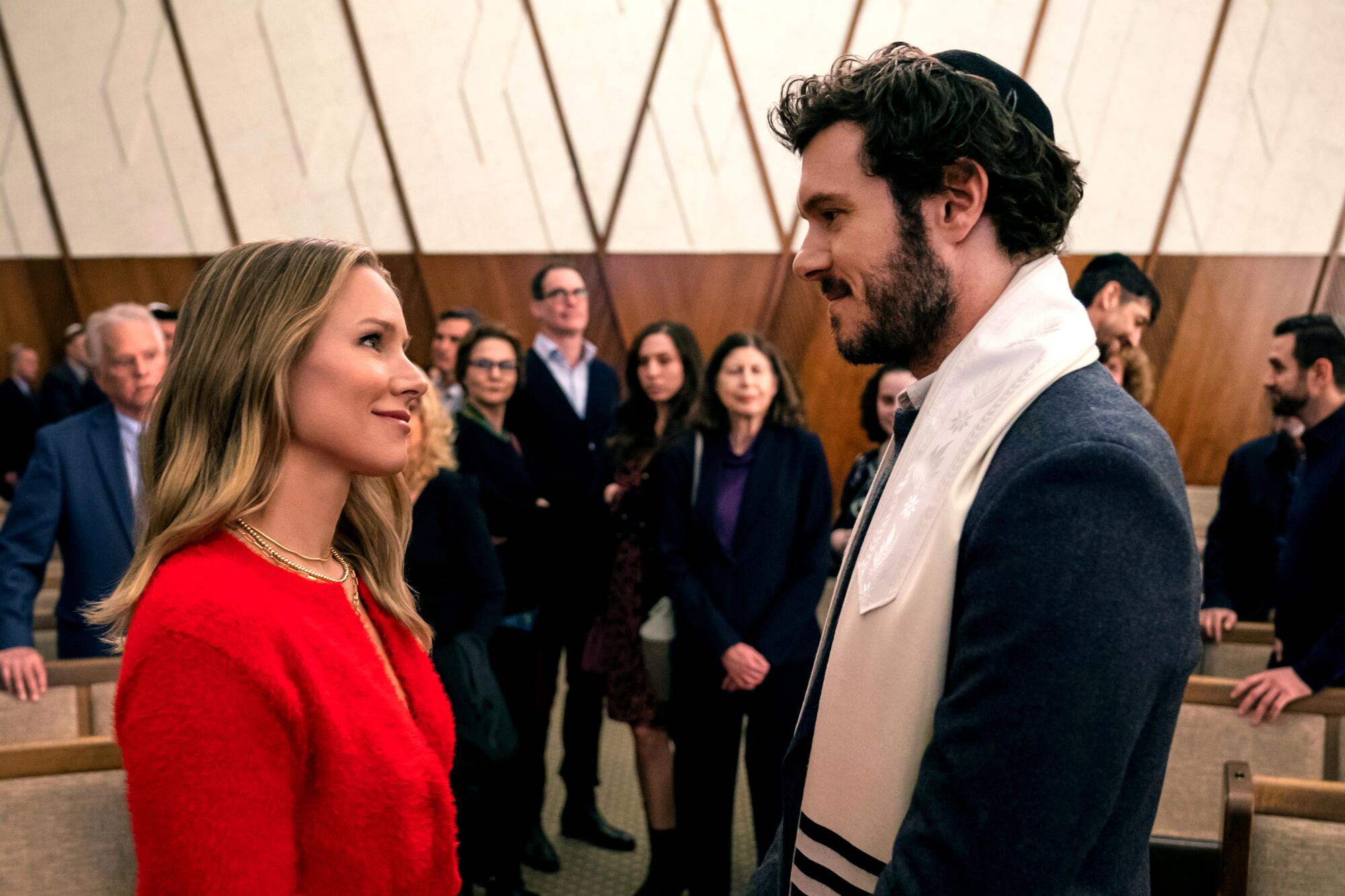
Kristen Bell and Adam Brody star in “Nobody Wants This,” which is loosely based on Erin Foster’s own love life.
(Stefania Rosini / Netflix)
“A big part of what drew me to Simon was that he was someone who was funny and cool and modern, but he had a bit of an old-fashioned feel about him,” says Foster, 42. “He’ll be like, ‘Hey, we should go check in on that person, or ‘We need to go see your grandma.’ I didn’t grow up with etiquette around those things.”
It’s early afternoon when Tikhman arrives home to the couple’s West Hollywood apartment, only a seven-minute drive from his office, which is housed in the Live Nation building. They’ve been living here for two years while the home they bought in Hancock Park is renovated. It’s a modern, new build with top-end amenities, but their floor-to-ceiling windows also overlook a grocery store parking lot.
Before coming over to kiss Foster, Tikhman peeks his head into the nursery where the couple’s 4-month-old daughter, Noa, has just woken up from a nap. The baby was born in this very apartment in May, the result of 20 grueling rounds of IVF over six years. After the birth, Foster posted pictures on Instagram of herself laboring here in an inflatable tub.
Online and on “The World’s First Podcast,” which she hosts with her sister Sara, Foster is exceptionally open about her life. When Tikhman initially accepted Foster’s Instagram friend request — he strategically, and annoyingly, waited two days to do so — he wasn’t thrilled to learn that she was a public figure.
“It wasn’t an ideal situation,” he admits to thinking. “I’m just more of a private person.”
It wasn’t enough to stop him from dating her. But a few years later, when she told him she’d sold a TV show idea based on their love story, he freaked out. It was one thing if Foster was in the spotlight, but he didn’t want to be. So he asked her not to move forward with writing the show.

“Simon is not sweet in a wimpy way. He has a feminist soul with a masculine energy,” Foster says of her husband.
(Courtesy of Erin Foster)
It was 2022, and she hadn’t written a word in three years. After a brief acting stint in her 20s — her biggest part was a five-episode arc on “The O.C.” — Foster made a career shift in 2012, landing a job as a staff writer on Ryan Murphy’s NBC show “The New Normal.” She and her sister Sara went on to co-create the VH1 mockumentary series “Barely Famous,” spoofing their Hollywood-adjacent lives. It lasted two seasons, and then in 2018, Foster sold a pilot called “Daddy Issues” to 20th Century Fox. She starred opposite Don Johnson as a girl whose father starts dating her best friend; it didn’t get picked up.
So Foster pivoted again. She partnered with Sara, working as creative heads for Bumble and then co-launching a fashion line, Favorite Daughter. At 35, she met Tikhman. But being in a healthy relationship wasn’t exactly a font of inspiration. She’d always written about characters who self-sabotaged, who made the same mistakes over and over without getting to the root of their issues. Without that cynical worldview, her writer’s block overwhelmed her.
“When I met Simon, I really felt like I might have to choose between being happy with the person I was meant to be with, or being inspired,” she says. “Because there was nothing funny about what was happening.”

“When I met Simon, I really felt like I might have to choose between being happy with the person I was meant to be with, or being inspired,” Erin Foster says.
(Christina House / Los Angeles Times)
That changed when she started going through the conversion process, which took place over 10 weeks at American Jewish University. Toward the end of the journey, she faced questions from a trio of rabbis about her intentions:
Are you sure you want to do this? It’s not easing being Jewish.
Are you ready to be hated by people?
If someone is being antisemitic and asks who is Jewish, are you going to stand up?
If you and your husband get divorced, will you keep being Jewish?
They were inquiries she’d never pondered before. She quickly nodded and agreed, but the quandaries stuck with her. It sparked her creativity for the first time in years, and soon she’d sold “Nobody Wants This” to Fox. (It was originally called “Shiksa,” a word that Brody’s character describes as an old Yiddish insult that “these days, just means you’re a hot, blonde non-Jew.”)
The only thing was, she never ran it past Tikhman.
“He was like, ‘Sorry, you sold a show about what?’” Foster recalls. “I immediately panicked. I hadn’t even considered it [being a problem]. To me, I was like, ‘Oh, my God, I’m taking our story and turning it into something cool. You’re welcome.’ And he had a different point of view.”
“I’m from a very private family,” Tikhman says, reiterating his perspective. “My mom would always tell us stories about how if you said the wrong thing in the Soviet Union as a Jew, you could be taken to jail.”
Fearful that the show could harm her relationship, Foster started trying to wish it away. She dragged her feet on a pilot script, hoping that the producers might just forget about the idea eventually. They didn’t.
But one of the EPs, Steve Levitan — the creator of “Modern Family” — had a script suggestion that helped to solve some of Foster’s problems. Noah was initially written to be a lot more like Tikhman, leaving Levitan unsure whether the stakes between a Jew and gentile who fall in love were high enough for a TV audience. A rabbi and a gentile who fall in love? Now there was some real conflict.
It also helped that Tikhman’s parents were totally on board, despite their son’s fears. She spent hours on the phone with his dad talking about potential storylines, and later during filming, she put her mother-in-law in the background of a scene shot at Sinai Temple.
“Also, this is what Erin’s supposed to be doing,” Tikhman says now. “She’s a writer and she’s incredible at it. I was sitting here the other day watching an episode and thinking, ‘I wish I was as good as this character.’ ”

“He was like, ‘Sorry, you sold a show about what?’’ ” Erin Foster recalls her husband, Simon Tikhman, saying. “I immediately panicked. I hadn’t even considered it [being a problem].”
(Christina House / Los Angeles Times)
The obsession with Brody’s hot rabbi will no doubt rival the early 2000s fan frenzy over Seth Cohen, his character who was a core of “The O.C.” He’s emotionally available, almost immediately telling Bell’s character that he’s interested in a serious relationship with her. He pulls out chairs, listens to her podcast to get to know her better, buys flowers for her mother. And he teaches her about Jewish traditions in a way that’s not condescending, like taking her outside to see the stars to mark the end of Shabbat.
Not all of that happened in real life, but Foster says the core of the character is true to Tikhman’s essence. She cites an example: When they’d been dating for only four months, she had a work trip booked to Dallas for 24 hours. Tikhman found out and said he’d join. Foster was confused — it was such a short trip.
“He goes, ‘Doesn’t your grandma live there? I’ve never met her and I need to,’ ” says Foster, who hadn’t even been planning to see her. But sure enough, Tikhman came, they all met and soon, he and grandma were talking on the phone a couple of times a week.
Foster genuinely seems to view her spouse in an exalted light — frequently referencing his “goodness” or how much “better” he is than her. Predictably, this drives him crazy.
“Simon just exudes this energy that I assumed wouldn’t match up with mine — that I’d be too negative,” she says. “In my past, if I ever chose someone who was good, they were too soft for me — too sweet or a pushover. And Simon is not sweet in a wimpy way. He has a feminist soul with a masculine energy.”
As if on cue, the couple’s new nanny walks over with Noa; the caretaker just started two days ago and speaks Russian, which they hope their daughter will eventually learn.
“This is my other girl,” Tikhman says proudly, pinching the child’s cheek.
The reason Foster talks so much about him — about how happy their family makes her — is that she wasn’t always sure this was in the cards for her. She did, after all, date Chad Michael Murray in her 20s.
But for a long time, she enjoyed being single. She liked flirting and reveled in her routines — drinking her morning coffee in solace in her breakfast nook. She wondered who she’d ever want to give that up for, who she could deal with in her space all the time.
“I didn’t think it was possible, and I had gotten kind of OK with that,” she says. “And now I have to stop myself from going over and sitting in his lap. I’m obsessed with Simon; he’s my muse. And this show is like a love letter to him.”



U.S. Premiere Report:
#MSG Review: Free Flowing Chiru Fun
ADVERTISEMENT
It’s an easy, fun festive watch with a better first half that presents Chiru in a free-flowing, at-ease with subtle humor. On the flip side, much-anticipated Chiru-Venky track is okay, which could have elevated the second half.
#AnilRavipudi gets the credit for presenting Chiru in his best, most likable form, something that was missing from his comeback.
With a simple story, fun moments and songs, this has enough to become a commercial success this #Sankranthi
Rating: 2.5/5
First Half Report:
#MSG Decent Fun 1st Half!
Chiru’s restrained body language and acting working well, paired with consistent subtle humor along with the songs and the father’s emotion which works to an extent, though the kids’ track feels a bit melodramatic – all come together to make the first half a decent fun, easy watch.
– Mana Shankara Vara Prasad Garu show starts with Anil Ravipudi-style comedy, with his signature backdrop, a gang, and silly gags, followed by a Megastar fight and a song. Stay tuned for the report.
U.S. Premiere begins at 10.30 AM EST (9 PM IST). Stay tuned Mana Shankara Vara Prasad Garu review, report.
Cast: Megastar Chiranjeevi, Venkatesh Daggubati, Nayanthara, Catherine Tresa
Writer & Director – Anil Ravipudi
Producers – Sahu Garapati and Sushmita Konidela
Presents – Smt.Archana
Banners – Shine Screens and Gold Box Entertainments
Music Director – Bheems Ceciroleo
Cinematographer – Sameer Reddy
Production Designer – A S Prakash
Editor – Tammiraju
Co-Writers – S Krishna, G AdiNarayana
Line Producer – Naveen Garapati
U.S. Distributor: Sarigama Cinemas
Mana Shankara Vara Prasad Garu Movie Review by M9
ADVERTISEMENT
Entertainment
‘The Night Manager’ Season 2 returns with explosive reveals: ‘Every character’s heart is on fire’

This article contains spoilers for the first three episodes of “The Night Manager” Season 2.
It wasn’t inevitable that “The Night Manager,” an adaptation of John le Carré’s 1993 spy novel, would have a sequel. Le Carré didn’t write one and the six-episode series, which aired in 2016, had a definitive ending.
But after the show’s debut, fans clambered for more. They loved Tom Hiddleston’s brooding, charismatic Jonathan Pine, a hotel manager wrangled into the spy game by British intelligence officer Angela Burr (Olivia Colman). And at the heart of the series was the parasitic dynamic between Pine and his delightfully malicious foe, an arms dealer named Richard Onslow Roper (Hugh Laurie).
The show was so good that even the story’s author wanted it to continue. After the premiere of Season 1 at the Berlin International Film Festival, Le Carré sat across from Hiddleston, a twinkle in his eye, and said, “Perhaps there should be some more.”
“That was the first I’d heard of it or thought about it,” Hiddleston says, speaking over Zoom alongside the show’s director, Georgi Banks-Davies, from New York a few days before the U.S. premiere of “The Night Manager” Season 2 on Prime Video, which arrived Sunday with three episodes, 10 years after the first season. “But it was so extraordinary and inspiring to come from the man himself. That’s when I knew there might be an opportunity.”
Time passed because no one wanted a sequel of less quality. Le Carré died in 2020, leaving his creative works in the care of his sons, who helm the production company the Ink Factory. That same year, screenwriter David Farr, who had penned the first series, had a vision.
“We didn’t want to rush into doing something that was all style and no substance that didn’t honor the truth of it,” Farr says, speaking separately over Zoom from London. “There was this big gap of time. But I had this very clear idea. I saw a black car crossing the Colombian hills in the past towards a boy. I knew who was in the car and I knew who the boy was.”
That image transformed into a scene in the second episode of Season 2 where a young Teddy Dos Santos (Diego Calva) is waiting for his father, who turns out to be none other than Roper. From there, Farr fleshed out the rest of the season, as well as the already-announced third season. He was interested in the relationship between fathers and sons, an obsession of Le Carré’s, and in how Jonathan and Roper would be entangled all these years later.
Teddy Dos Santos (Diego Calva) is revealed to be Roper’s son.
(Des Willie / Prime Video)
“Teddy crystallized very quickly in my head,” Farr says. “All of the plot came later — arms smuggling and covert plans for coups in South America. But the emotional architecture, as I tend to call it, came to me quite quickly. That narrative of fathers and sons, betrayal and love is what marks Le Carré from more conventional espionage.”
“There was enormous depth in his idea,” Hiddleston adds. “It was a happy accident of 10 years having passed. They were 10 immeasurably complex years in the world, which can only have been more complex for Jonathan Pine with all his experience, all his curiosity, all his pain, all his trauma and all his courage.”
Farr sent scripts to Hiddleston in 2023 and planning for Season 2 began in earnest. The team brought Banks-Davies on in early 2024, impressed with her vision for the episodes. Hiddleston was especially attracted to her desire to highlight the vulnerability of the characters, all of whom present an exterior that is vastly different than their interior life.
“Every character’s heart is on fire in some way, and they all have different masks to conceal that,” Hiddleston says. “But Georgi kept wanting to get underneath it, to excavate it. Explore the fire, explore the trauma. She came in and said, ‘This show is about identity.’ ”
“I’m fascinated with how the line of identity and where you sit in the world is very fragile,” Banks-Davies says. “I’m fascinated by the strain on that line. In the heart of the show, that was so clearly there. I’m also always searching for what brings us together in a time, particularly in the last 10 years, that’s ever more divisive. These characters are all at war with each other. They’re all lying to each other. They’re deceiving each other for what they want. But what brings them together … instead of pushes them apart?”
The new season opens four years after the events of Season 1 as Jonathan and Angela meet in Syria. There, she identifies the dead body of Roper — a reveal that suggests his character won’t really be part of Season 2. After his death, Pine settles into a requisite life in London as Alex Goodwin, a member of an unexciting intelligence unit called the Night Owls.
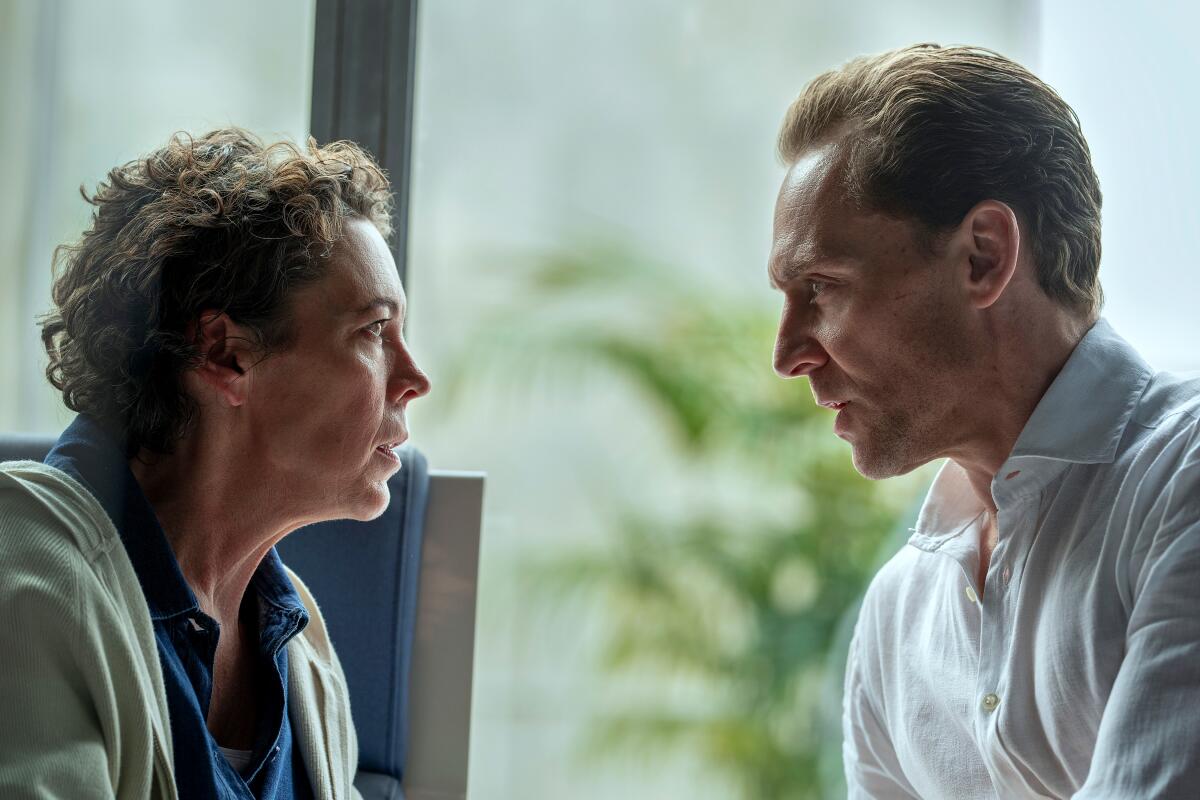
Angela (Olivia Colman) and Jonathan (Tom Hiddleston) meet in Syria, four years after the events of Season 1.
(Des Willie / Prime Video)
“He’s half asleep and he lacks clarity and definition,” Hiddleston says. “His meaning and purpose have been blunted and dulled. He is only alive at his greatest peril, and the closer his feet are to the fire, the more he feels like himself. He’s addicted to risk, but also courageous in chasing down the truth.”
That first episode is a clever fake-out. Soon, Jonathan is on the trail of a conspiracy in Colombia, where the British government appears to be involved in an arms deal with Teddy. It quickly becomes the globe-trotting, thrill-seeking show that captivated fans in Season 1. There are new characters, including Sally (Hayley Squires), Jonathan’s Night Owls’ partner, and Roxana Bolaños (Camila Morrone), a young shipping magnate in league with Teddy, and vibrant locations. Jonathan infiltrates Teddy’s organization, posing as a cavalier, rich businessman named Matthew Ellis. He believes Teddy is the real threat. But in the final moments of Episode 3 there’s another gut-punching fake-out: Roper lives.
“The idea was: We must do the classic thing that stories do, which is to lose the father in order that he must appear again,” Farr says. He confirms there was never an intention to make “The Night Manager” Season 2 without Laurie. “What makes it work is this feeling that you are off on something completely new,” Farr says. “But that’s not what I want this show to be.”
Hiddleston compares it to the tale of St. George and the dragon. “They define each other,” he says. “At the end of the first series, Jonathan Pine delivers the dragon of Richard Roper to his captors. But after that, he is lost. The dragon slayer is lost without the presence of the dragon to define him. And, similarly, Roper is obsessed with Pine.”
Jonathan realizes the truth as he sneaks up to a hilltop restaurant to listen in on a meeting. Banks-Davies opted to shoot the entire series on location, and she kept a taut, quick pace during filming because she wanted the cast to feel the tension all the way through. She and Hiddleston had a shared motto on set: “There’s no time for unreal.” Thanks to her careful scene-setting, Roper’s arrival and Jonathan’s reaction were shot in only 10 minutes.
“I felt everything we talked about for months and everything we’d shot up until that point and everything we’d been through was in that moment,” Banks-Davies says. “There are so many emotions going on, so much being expressed, and it’s just delivered like that. But it was hard to get us there.”
Farr adds, “It is the most important moment in the show in terms of everything that then follows on from that.” He wrote into the script that Roper’s voice would be heard before Laurie was seen on camera. “It’s more frightening when something is not instantly fully understood and seen,” he says. “You hear it and you think, ‘Oh, God, I know that [voice].’ ”
Hiddleston wanted to play a range of emotions in seconds. He describes it as a “moment of total vitality.” Right before the cameras rolled, Banks-Davies told Hiddleston, “The dragon is alive.”
“After all the work, that’s all I needed to hear,” he says. “This moment will be memorable to him and he’ll be able to recall it in his mind for the rest of his life. He is wide awake, and reality is re-forming around him. His sense of the last 10 years, his sense of what he can trust and who he can trust, the way he’s tried to evolve his own identity — the sky is falling. There is a mixture of shock, grief, disenchantment, disillusionment, surprise and perhaps even relief.”
As soon as Jonathan arrives in Colombia and meets Teddy, a calculating live-wire dealing with his own sense of isolation, he becomes more himself. Hiddleston expresses him as a character desperate to feel the edge. Despite his layered duplicity, Jonathan understands and defines himself by courting risk.
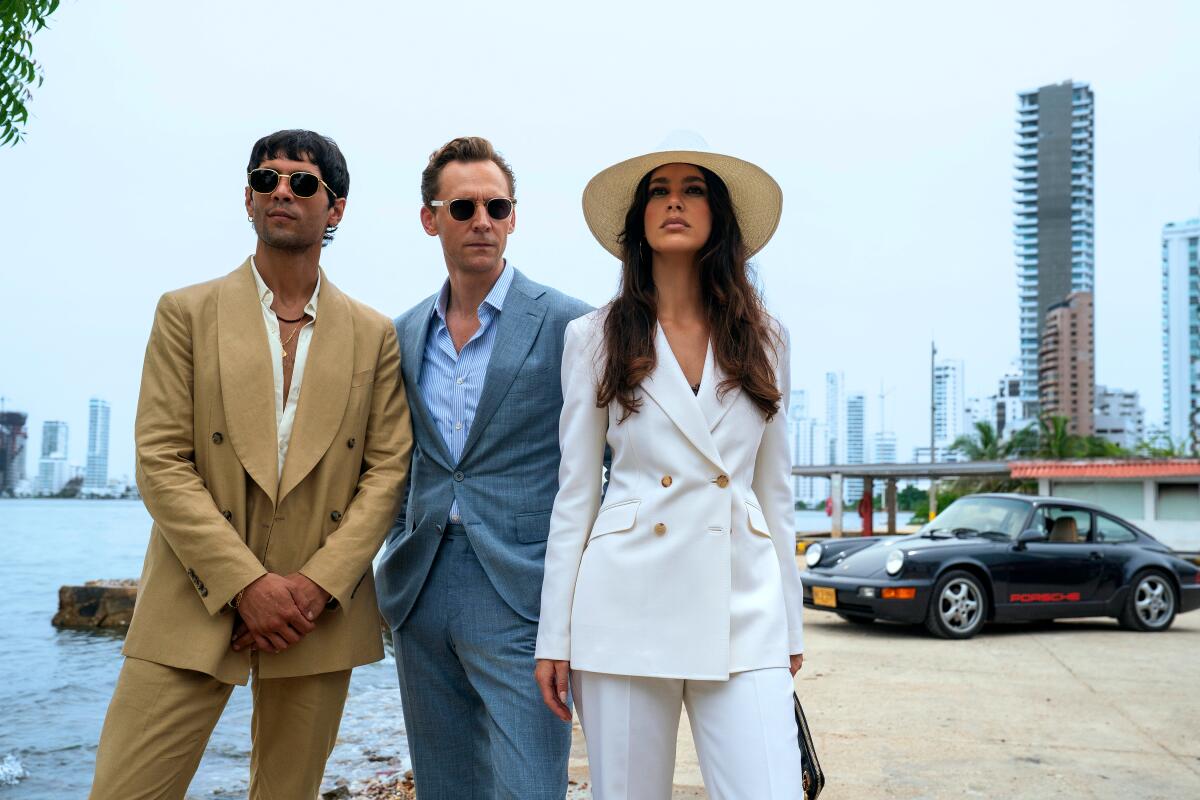
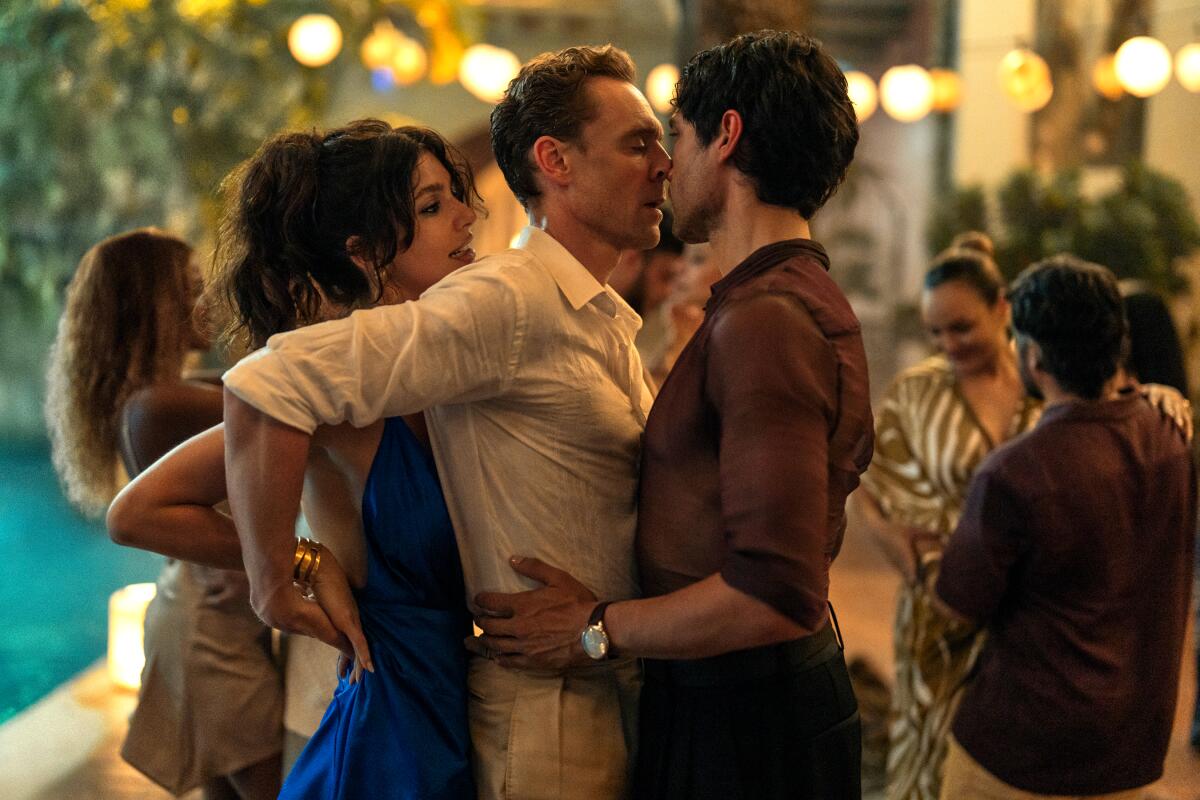
Teddy (Diego Calva), Jonathan (Tom Hiddleston) and Roxana (Camila Marrone) get close. “This is a character who pushes his body to the limit and sacrifices enormous parts of himself at great personal cost to his body and soul,” Hiddleston says of Jonathan. (Des Willie/Prime Video)
“This is a character who pushes his body to the limit and sacrifices enormous parts of himself at great personal cost to his body and soul,” Hiddleston says. “He goes through a lot of pain, but also there’s great courage and resilience and enormous vulnerability. That’s what I relish the most, these are heightened scenarios that don’t arise as readily and in my ordinary life.”
“I could feel that shooting moments like this,” Banks-Davies adds. “Like, ‘It’s right there. Are we going to get it?’ Our whole show exists in that space between safety and death.”
Roper’s presence sends a ripple effect across the remaining three episodes. As much as Jonathan and Teddy are in opposition, they are parallel spirits, both with complicated relationships to Roper. Hiddleston describes them as “a mirror to each other,” although they can’t quite figure out what to be to each other. And neither knows who the other person really is.
“It is interesting, isn’t it, that my first image of him was 7 years old and that stays in him all the way through,” Farr says. “This sense of this boy who is seeking something — an affirmation, a place in the world. And he’s done terrible things, as he says to Pine in Episode 3. All of that was present in that first image I had.”
Hiddleston adds, “There is a competition, too, because Roper is the father figure, and they both need him in very different ways. Teddy is a new kind of adversary because he’s a contemporary. He’s got this resourcefulness and this ruthlessness, but also this very open vulnerability, which he uses as a weapon. They recognize each other and see each other.”
The characters’ dynamic is at the root of what drew Banks-Davies to the series. “It’s not about where they were born, it’s not about their economic status or their religion or their cultural identity,” she says. “It’s about two men who are lost and alone and solitary, and see a kinship in that. They are pulled together on this journey.”
Season 2, which will release episodes weekly after the first drop, will lead directly into Season 3, although no one involved will spill on when it can be expected. Hopefully they will arrive in less than a decade.
“It won’t be as long, I promise,” Farr says. “I can’t tell you exactly when, because I don’t know. But definitely nowhere as long.”
“That was the thrill for us, of knowing that when we began to tell this story, we knew we had 12 episodes to tell it inside, rather than just six,” Hiddleston says. “So we can be slightly braver and more rebellious and more complex in the architecture of that narrative. And not everything has to be tied up neatly in a bow. There’s still miles to go before we sleep, to borrow from Robert Frost, and that’s exciting. It’s exciting for how this season ends, and it’s exciting for where we go next.”


Iowa football lands explosive running back L.J. Phillips Jr.

$660,000 Daily Tennessee Jackpot winner in La Vergne – WBBJ TV

Texas A&M Lands Second Big-Time Defensive Line Commitment In Transfer Portal

5 vehicles hit exercise equipment on I-15 near Arizona-Utah border

The rise and fall and rise of Vermont-schooled skier Mikaela Shiffrin – VTDigger

Florida High School Football Rankings: Top 25 teams – Oct. 21

Cleary's 21 help Le Moyne down Central Connecticut State 69-64 in OT

How old is Bo Nix? What to know about Oregon quarterback ahead of 2024 NFL Draft

99th annual Pony Swim held in Virginia

Video: ‘It Didn’t Have to Happen This Way:’ U.Va. Faculty Call for Review of Police Response to Protests

Federal judge blocks Trump administration from enforcing mail-in voting rules in executive order

Four killed, 20 injured in overnight Russian strikes across Ukraine

Nationwide anti-ICE protests call for accountability after Renee Good’s death

Trump says Venezuela has begun releasing political prisoners ‘in a BIG WAY’

Somali minister says Israel plans to displace Palestinians to Somaliland
-

 Detroit, MI1 week ago
2 hospitalized after shooting on Lodge Freeway in Detroit
-

 Technology5 days ago
Power bank feature creep is out of control
-

 Dallas, TX3 days ago
Anti-ICE protest outside Dallas City Hall follows deadly shooting in Minneapolis
-

 Dallas, TX6 days ago
Defensive coordinator candidates who could improve Cowboys’ brutal secondary in 2026
-

 Delaware2 days ago
MERR responds to dead humpback whale washed up near Bethany Beach
-

 Iowa5 days ago
Pat McAfee praises Audi Crooks, plays hype song for Iowa State star
-

 Health1 week ago
Viral New Year reset routine is helping people adopt healthier habits
-

 Nebraska4 days ago
Oregon State LB transfer Dexter Foster commits to Nebraska