The mystery story is a relatively recent innovation, whether dated from Edgar Allan Poe’s 1841 short story “Murders in the Rue Morgue,” with its amateur detective C. Auguste Dupin, or Wilkie Collins’ 1868 novel “The Moonstone,” which established many of the conventions still in use today, or even the 1887 debut of Sherlock Holmes, so popular that his creator, Arthur Conan Doyle, could not kill him. But the form has made up for lost time, with mystery series filling entire bookstores and invading every other storytelling platform — theater, film, radio and perhaps most prolifically, television, where it has held fast while other genres have come and gone. It’s fantastically adaptable. Comedy, tragedy, cozy, gritty, formulaic, metafictional, historical, futuristic, highbrow, lowbrow, middle brow — something for every taste.
The advantage of a mystery, from a broadcaster or streamer’s perspective is that no matter the quality, viewers, once even a little invested, will stick around until the end just to find out who did it, or how they did it, or why they did it, even though the solution may be the least interesting aspect of the tale; often, if not inevitably, it will be a version of something you have seen before, there being a relatively few reasons people kill one another, and ways to do it, and to establish a phony alibi. This doesn’t really matter much, because above all, a mystery is an armature on which to hang a bunch of distinct, disparate characters, without the necessity of character development. (Though that is certainly allowed.) And because in this world, familiarity counts as novelty.
Although the mystery is evergreen, we seem to be in a period of expansion. Why? The pop psychologist in me would suggest in a world without answers to crises in the near and the long term, they propose successful solutions, based on demonstrable facts, arrived at through human intelligence. Tension is released instead of ongoing. And villains typically, though not always, get their comeuppance.
The critic in me, on the other hand, would observe that in follow-the-leader Hollywood, success breeds imitation, or repetition. On the big screen we have lately had Rian Johnson‘s “Knives Out” and “Glass Onion” and Kenneth Branagh‘s Hercule Poirot adaptations. On television, we’ve seen “A Murder at the End of the World,” Agatha Christie for the 2020s; Natasha Lyonne’s “Columbo”-inspired “Poker Face” (created by Johnson); “Dark Winds,” set in the 1970s, starring Zahn McClarnon as a Navajo tribal police chief; the satirical yet tightly structured “The Afterparty,” with Tiffany Haddish as its eccentric gumshoe. Even “Wednesday” was a mystery story, with Charles Addams’ dour teen its dark Nancy Drew, played by Jenna Ortega. And the starry comedy “Only Murders in the Building” is getting a secondary airing on ABC — strike-related, but whatever — after three seasons on Hulu, with a fourth to come.
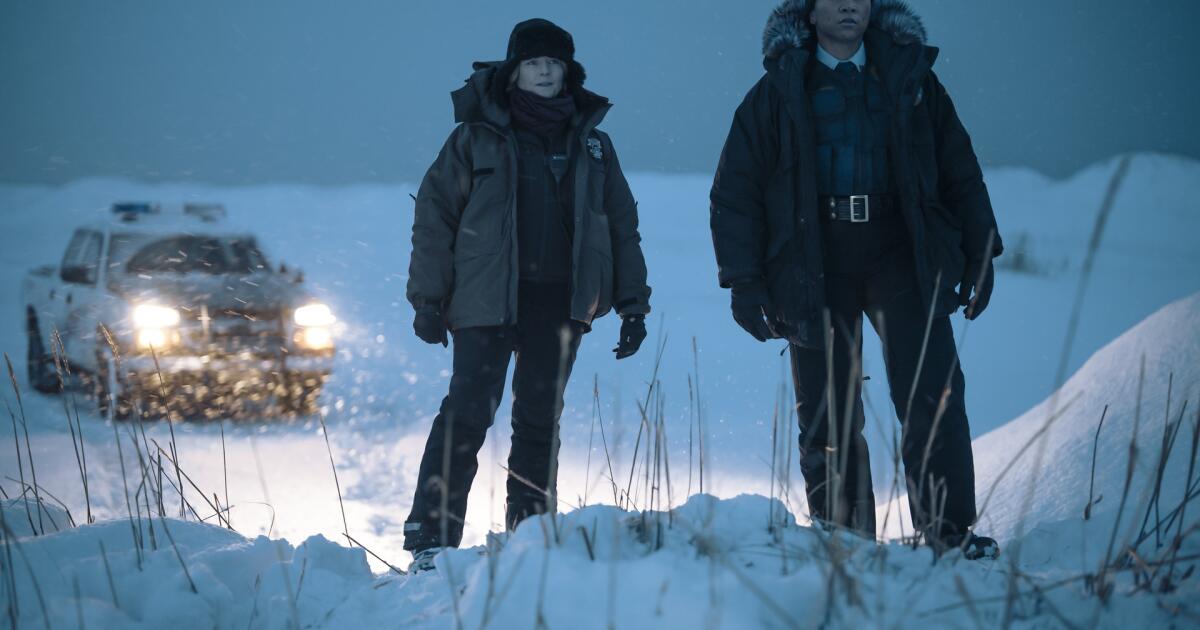
In the space of a single week, four prestige major mysteries of different flavors, each with its particular pleasures, have premiered or are about to. There is “Night Country,” the fourth season of “True Detective” (HBO, Sunday) — I would call it long-awaited, but I’m not sure anyone expected to see it again — set within a sunless Arctic Circle, with Jodie Foster and Kali Reis its philosophically contrary investigators; “Monsieur Spade” (AMC, Sunday), from Scott Frank (“The Queen’s Gambit”) and Tom Fontana (“Oz”), which finds Dashiell Hammett‘s detective, played by Clive Owen, living in the south of France two decades after “The Maltese Falcon”; the fanciful, oceangoing “Death and Other Details” (Hulu, Tuesday) with Mandy Patinkin as the “world’s greatest detective,” maybe; and “Criminal Report” (Apple+, now streaming), in which London police detectives Cush Jumbo and Peter Capaldi clash over a possible miscarriage of justice.
Advertisement
Kali Reis, left, and Jodie Foster in HBO’s “True Detective: Night Country.”
(Michele K. Short/HBO)
The excellent “True Detective: Night Country” leads this pack. The anthology series, created by the novelist Nic Pizzolatto, began as an HBO-brand elevation of the police procedural, a metaphysical whodunit in which the dialectical double act of Matthew McConaughey and Woody Harrelson, a refined version of the odd-coupling seen in “Beverly Hills Cop” and countless other cop adventures — was the real subject of the show, or in any case, the reason for its success. The current season, created, directed and mostly written by the Mexican writer and director Issa López (“Tigers Are Not Afraid”), seems fashioned to follow closely in the footsteps of the first, but now those footsteps are tracking through the snow.
There are the same scenes of the principals driving and talking and the presentation of differing points of view, one more empirical, one more spiritual. There is the recurring, sometimes chilling presence of a mysterious folk symbol, “older than the ice probably.” And there is one reference so specific that it can only be described as fan service.
Advertisement
Set in the fictional Alaskan small town of Ennis, the story begins on the day of the last sunset before night moves in for six months, and runs through Christmas and New Year’s. Snowbound crime shows are nothing new, but given the demands and costs of production, they are uncommon, and special. And there’s something beautifully unsettling about all the darkness surrounding this isolated town, an environment that, without the proper gear, will kill you, and where it always seems to be the same time of day, or night.
“Tigers Are Not Afraid” was a horror film shot through with magic realism, and both those elements find a home in “Night Country.” Indeed, it begins more like a horror movie than a crime show, with a herd of suddenly stampeding reindeer, and then a delivery man discovering that the scientists at a remote research station, whose exact business no one seems to know, have all disappeared, leaving the legend “WE ARE ALL DEAD” written on a white board. (There is no actual on-screen violence in the show, but plenty of shocking images and an ongoing sense of dread. (You breathe a sigh of relief whenever someone enters a space where the lights are on and people are around.)
A severed tongue discovered on the site seems to link the disappearance to the unsolved murder of an Indigenous midwife and activist. It piques the interest of trooper Evangeline Navarro (Reis), who brings her suspicions to Ennis police chief Liz Danvers (Foster). Navarro and Danvers, physical and philosophical opposites, though they share a consuming doggedness, have a lot of old business, which will be revealed through the season, and explain much — though not everything will be explained. Foster is every bit as good as anyone who has paid her the least bit of attention since the Disney days would expect her to be; but Reis, a boxer only recently turned actor, is terrific as well.
Echoing the investigators’ conversations about the living and the dead, God and the beyond, the show plays along the lines of the natural and the supernatural, without fully throwing in with either — it leaves some things mysterious and open to discussion; that Rose (Fiona Shaw), the local bohemian, actually sees her dead husband, is merely a fact in this world, but at the same time people do things for human reasons. This isn’t a story of demons.
Ennis is one of those small isolated communities where everyone knows everyone or knows someone who does, but at the same time is afflicted by a general air of loneliness and disconnection. Even as the investigation proceeds, by fits and starts, we are involved in various well-drawn (or sketched) family and relationship and community dramas. Danvers’ teenage stepdaughter (Isabella Star LaBlanc) wants to explore her Indigenous heritage, much to Danvers’ unexplained displeasure; deputy Peter Prior (Finn Bennett) is devoted to his boss and his job to the point of endangering his marriage, and his relationship with his underling policeman father (John Hawkes); Navarro’s younger sister Julia (Aki Niviâna) has mental health issues. And this is certainly not the first mystery story in which corporate interests — the local mine — are set against the needs of the people. (See: “Dark Winds.”) It has political resonance, but it’s also the most commonplace element in a largely extraordinary series.
Advertisement
Clive Owen as Sam Spade in AMC’s “Monsieur Spade.”
(Jean-Claude Lother/AMC)
“Monsieur Spade” begins in the mid-1950s, as the San Francisco detective attempts to deliver the daughter of the late Brigid O’Shaughnessy — the femme fatale Spade delivers to justice at the end of the “The Maltese Falcon,” who, in this world, has subsequently gone free and later died — to her father in a small town in the south of France. The story then jumps ahead into the early 1960s; Spade, who has traded his suit and fedora for polo shirts and sunglasses, is now a French-speaking, amiable member of the community, a rich widower who fills his bags at the farmers market, pets local dogs and swims naked in his swimming pool. Teresa (Cara Bossom), the daughter, is a sullen, clever, dangerously independent teenager living in a convent, where Spade pays for her keep. And then things get nutty, with six murdered nuns, a mad monk and an Algerian golden child over whom various parties fight for possession. (The Algerian War has recently concluded, and it’s an issue here.)
Owen is the right age and shape and can do the accent, but it does seem odd not to have cast an American actor in this quintessentially American role. Unlike Raymond Chandler’s Philip Marlowe, and most every other literary detective, Spade’s fame is based on a single book and film, which makes Humphrey Bogart inseparable from the character, even as it’s unfair to reckon another actor against him. (It’s impossible to imagine Bogart submitting to a prostate examination on-screen, as Clive Owen does here, though that is, of course, the point.) Owen studied Bogart’s speech patterns for the role, but he lacks his music; his portrayal is oddly static, his delivery so dry as to be almost monotonal. His Spade is forever cracking wise, but few of his remarks register as funny, either to this viewer or his interlocutors. (“Do you know where the word ‘sabotage’ comes from?” “The dictionary.”) It occurred to me that this might be intentional, to signify his being a man out of his time or place, but that feels like overthinking; the effect in any case is to render the character oddly inert, as busy as the screenplay keeps him. Still, the angrier or more frustrated or active Spade grows, the more effective Owen becomes, which does pep up the later episodes.
Advertisement
And, as in “The Maltese Falcon,” he is only one of a colorful cast of characters, including an impressive Bossom, a very appealing Denis Ménochet as the local police chief, who merits a series of his own; Louise Bourgoin as Marguerite, a Juliette Gréco-esque singer with whom Spade co-owns a bar; and Matthew Beard and Rebecca Root as Spade’s new British neighbors who don’t seem for a moment to be who they claim and might loosely be termed the Sydney Greenstreet and Peter Lorre of the piece. Whatever the demerits of Owen’s performance, it isn’t fatal to an enjoyable series; he gets the job done, and is particularly good in his scenes with Bossom, whose Teresa he regards with paternal annoyance. And the series departs on a final shot and line so lovely it’s worth the getting there.
Violett Beane and Mandy Patinkin in Hulu’s “Death and Other Details.”
(Michael Desmond/HULU)
“Death and Other Details” is a Christie-style country house mystery in which the country house is a sort of bespoke ocean liner, chartered by the Collier family, who are using the occasion to pitch a business deal to Chinese investors, with whom various Colliers also have personal relationships. (It’s a cavalcade of personal relationships.) Among the travelers are Imogene Scott (Violett Beane), the Colliers’ ward, who as a child saw her mother blown up in a car in the Colliers’ driveway, and Rufus Coteworth (Patinkin), a detective who reneged on his promise to the girl to find the killers. In the course of the series, the two will go, I don’t need to tell you, from adversaries to collaborators. There is a lot of hanky-panky going on among the main characters — the ship is filled with extras who have no influence on the story — and a little romance and a lot of relationship issues, which means you do not have to wait long for a sex scene. The series hops around a lot in time and memory — Rufus and Imogene appear as witnesses in one another’s flashbacks — and is not perfectly plausible, in big and little ways, but its energy and reveals upon reveals make that moot. Patinkin, in an indefinable accent, is his usual Big Presence, but Beane holds her own, and the arrival of Linda Emond as Interpol agent Hilde Eriksen pays constant comic dividends.
Advertisement
Peter Capaldi and Cush Jumbo in Apple TV+’s “Criminal Record.”
(Apple TV+)
The absorbing “Criminal Record” takes us to modern-day London, and has that quality of crisp reality peculiar to British series (see also: “Slow Horses”); it’s not a documentary feel, but there are few layers of cinematic gloss separating the view from the viewed, and as a result one feels closer to the characters, the action and the environment. The locations are appropriate; the details of a police station and the institutional bureaucracy feel exactly right. The series has a persuasive immediacy.
The story begins with an anonymous call to the police from a woman, fearing for her life from a violent boyfriend, in the course of which she tells the operator that he’s claimed responsibility for a murder for which another man sits in prison. This falls into the lap of Detective Sergeant June Lenker (Jumbo), who runs with it farther than any of her associates would like, particularly the original investigator, Detective Chief Inspector Daniel Hegarty (Capaldi), a respected officer who clearly has something to hide and, remembering the case, describes the convicted Errol Matthis as “the poor man’s O.J.” (“Excuse me?” asks Lenker, to no response.) He’s calm and collected; she’s impulsive and patient, with a tendency to alienate her colleagues, bend and break rules and a disinclination to wait for backup — support is always too many minutes away — charging into dangerous situations with sometimes bad results.
Advertisement
The narrative proceeds with the usual red herrings, flurries of action and suspense and unsuspected revelations, some of which are telegraphed long before the moment they’re meant to take us by surprise. Answers will be forthcoming, but, as with “True Detective,” the real mystery resides within individuals, and how they are with one another — not only the relationship between Lenker and Hegarty, working sometimes together, and sometimes against each other, but between parents and children and partners. And Capaldi and Jumbo work beautifully together. There’s no mystery in that.
Bounding into cinemas just in time for spring, the latest Pixar animation is a pleasingly charming tale of man vs nature, with a bit of crazy robot tech thrown in.
The star of Hoppers is Mabel Tanaka (voiced by Piper Curda), a young animal-lover leading a one-girl protest over a freeway being built through the tranquil countryside near her hometown of Beaverton.
Because the freeway is the pet project of the town’s popular mayor, Jerry (Jon Hamm), who is vying for re-election, Mabel’s protests fall on deaf ears.
Everything changes when she stumbles upon top-secret research by her biology professor, Dr Sam Fairfax (Kathy Najimy), that allows for the human consciousness to be linked to robotic animals. This lets users get up close and personal with other species.
Advertisement
“This is like Avatar,” Mabel coos, and, in truth, it is. Plugged into a headset, Mabel is reborn inside a robotic beaver. She plans to recruit a real beaver to help populate the glade, which is set to be destroyed by Jerry’s proposed road.
In the summer of 1991, Nirvana filmed the music video for “Smells Like Teen Spirit” on a Culver City sound stage. Kurt Cobain strummed the grunge anthem’s iconic four-chord opening riff on a 1969 Fender Mustang, Lake Placid Blue with a signature racing stripe.
Nearly 35 years later, the six-string relic hung on a gallery wall at Christie’s in Beverly Hills as part of a display of late billionaire businessman Jim Irsay’s world-renowned guitar collection, which heads to auction at Christie’s, New York, beginning Tuesday. Each piece in the Beverly Hills gallery, illuminated by an arched spotlight and flanked by a label chronicling its history, carried the aura of a Renaissance painting.
Share via
Advertisement
Advertisement
Irsay’s billion-dollar guitar arsenal, crowned “The Greatest Guitar Collection on Earth” by Guitar World magazine, is the focal point of the Christie’s auction, which has split approximately 400 objects — about half of which are guitars — into four segments: the “Hall of Fame” group of anchor items, the “Icons of Pop Culture” class of miscellaneous memorabilia, the “Icons of Music” mixed batch of electric and acoustic guitars and an online segment that compiles the remainder of Irsay’s collection. The online sale, featuring various autographed items, smaller instruments and historical documents, features the items at the lowest price points.
A portion of auction proceeds will be donated to charities that Irsay supported during his lifetime.
The instruments of famous musicians have long been coveted collector’s items. But in the case of the Jim Irsay Collection, the handcrafted six-strings have acquired a more ephemeral quality in the eyes of their admirers.
Amelia Walker, the specialist head of private and iconic collections at Christie’s, said at the recent highlight exhibition in L.A. that the auction represents “a real moment where these [objects] are being elevated beyond what we traditionally call memorabilia” into artistic masterpieces.
“They deserve the kind of the pedestal that we give to art as well,” Walker said. “Because they are not only works of art in terms of their creation, but what they have created, what their owners have created with them — it’s the purest form of art.”
Advertisement
Cobain’s Fender was only one of the music history treasures nestled in Christie’s gallery. A few paces away, Jerry Garcia’s “Budman” amplifier, once part of the Grateful Dead’s three-story high “Wall of Sound,” perched atop a podium. Just past it lay the Beatles logo drum head (estimated between $1 million and $2 million) used for the band’s debut appearance on “The Ed Sullivan Show,” which garnered a historic 73 million viewers and catalyzed the British Invasion. Pencil lines were still visible beneath the logo’s signature “drop T.”
Pencil lines are still visible on the drum head Ringo Starr played during the Beatles’ debut appearance on “The Ed Sullivan Show.”
(Christie’s Images LTD, 2026)
It is exceptionally rare for even one such artifact to go to market, let alone a billion-dollar group of them at once, Walker said. But a public sale enabling many to participate and demonstrate the “true market value” of these objects is what Irsay would have wanted, she added.
Dropping tens of millions of dollars on pop culture memorabilia may seem an odd hobby for an NFL general manager, yet Irsay viewed collecting much like he viewed leading the Indianapolis Colts.
Advertisement
Irsay, the youngest NFL general manager in history, said in a 2014 Colts Media interview that watching and emulating the legendary NFL owners who came before him “really taught me to be a steward.”
“Ownership is a great responsibility. You can’t buy respect,” he said. “Respect only comes from you being a steward.”
The first major acquisition in Irsay’s collection came in 2001, with his $2.4-million purchase of the original 120-foot scroll for Jack Kerouac’s 1957 novel, “On the Road.” He loved the book and wanted to preserve it, Walker said. But he also frequently lent it out, just like he regularly toured his guitar collection beginning 20 years later.
Jim Irsay purchased the original 120-foot scroll manuscript of Jack Kerouac’s “On the Road” for $2.4 million in 2001.
(Christie’s Images)
Advertisement
“He said publicly, ‘I’m not the owner of these things. I’m just that current custodian looking after them for future generations,’ ” Walker said. “And I think that’s what true collectors always say.”
At its L.A. highlight exhibition, Irsay’s collection held an air of synchronicity. Paul McCartney’s handwritten lyrics for “Hey Jude” hung just a few steps from a promotional poster — the only one in existence — for the 1959 concert Buddy Holly, Ritchie Valens and J.P. “The Big Bopper” Richardson were en route to perform when their plane crashed. The tragedy spurred Don McLean to write “American Pie,” about “the day the music died.”
Later, the Beatles’ 1966 song “Paperback Writer” played over the speakers near-parallel to the guitars the song was written on.
Irsay’s collection also contains a bit of whimsy, with gems like a prop golden ticket from 1971’s “Willy Wonka & the Chocolate Factory” — estimated between $60,000 and $120,000 — and reading, “In your wildest dreams you could not imagine the marvelous surprises that await you!”
Advertisement
Another fan-favorite is the “Wilson” volleyball from 2000’s “Cast Away,” starring Tom Hanks, estimated between $60,000 and $80,000, Gibson said.
Historically, such objects were often preserved by accident. But as the memorabilia market has ballooned over the last decade or so, Gibson said, “a lot of artists are much more careful about making sure that things don’t get into the wrong hands. After rehearsals, they tidy up after themselves.”
If anything proves the market value of seemingly worthless ephemera, Walker added, it’s fans clawing for printed set lists at the end of a concert.
“They’re desperate for that connection. This is what it’s all about,” the specialist said. It’s what drove Irsay as well, she said: “He wanted to have a connection with these great artists of his generation and also the generation above him. And he wanted to share them with people.”
In Irsay’s home, his favorite guitars weren’t hung like classic paintings. Instead, they were strewn about the rooms he frequented, available for him to play whenever the urge struck him.
Advertisement
Thanks to tune-up efforts from Walker, many of the guitars headed to auction are fully operational in the hopes that their buyers can do the same.
“They’re working instruments. They need to be looked after, to be played,” Walker said. And even though they make for great gallery art, “they’re not just for hanging on the wall.”
“Trying to find your niche as a movie star isn’t easy,” said Frank Scheck in The Hollywood Reporter. Take Glen Powell. A year ago, the Twisters and Anyone but You star was being talked about as possibly the next Tom Cruise. But he “stumbled badly” when he tried to play a macho action hero in November’s remake of The Running Man, and he’s now turned in a second straight box office flop. He took a risk with How to Make a Killing, playing a guy cheated by fate who we’re supposed to root for as he begins murdering off the seven rich relatives standing between him and an enormous inheritance. But c’mon. “Powell is charming, but he’s not that charming.”
The Week
Escape your echo chamber. Get the facts behind the news, plus analysis from multiple perspectives.
Advertisement
SUBSCRIBE & SAVE
Sign up for The Week’s Free Newsletters
From our morning news briefing to a weekly Good News Newsletter, get the best of The Week delivered directly to your inbox.
From our morning news briefing to a weekly Good News Newsletter, get the best of The Week delivered directly to your inbox.
The movie “needed to pick a side,” said Jacob Oller in AV Club. It could have been “a clownish class comedy” or “bitter sociopathic satire,” but it winds up being neither, and “at the center of it all is Powell, making the same face for an hour and 45 minutes, too unflappable to root for, too smug to magnetize as an inhuman American Psycho.” I’m not ready to give up on him, said Nick Schager in the Daily Beast. To me, he and co-star Margaret Qualley, who plays the femme fatale who eggs on the killing spree, come across as “such alluringly nasty delights” that this reworking of the 1949 black comedy Kind Hearts and Coronets “ survives its potentially lethal missteps and works on its own limited terms.” Though its teeth aren’t as sharp as they should be, “it’s smart and spiky enough to leave a pleasurably painful mark.”
‘Pillion’
Directed by Harry Lighton (Not rated)
Advertisement
★★★★
While this gay BDSM rom-com from a rookie director “might sound niche,” said Amy Nicholson in the Los Angeles Times, “free yourself to see it and you’ll discover it’s a universal romance.” Former Harry Potter side figure Harry Melling stars as a shy singleton who’s figuring out what he wants in a relationship when he happens into a submissive-dominant entanglement with a tall, handsome biker played by Alexander Skarsgard. Soon, Melling’s Colin is obeying his lover’s every order, including by shaving himself bald and sleeping like a dog on the floor. But the “kinky-funny” screenplay, which won a prize at Cannes, makes sure we see that Colin is not stuck but growing.
A free daily email with the biggest news stories of the day – and the best features from TheWeek.com
While the movie’s sex scenes are “refreshingly graphic,” they’re “never used or shock value,” said Odie Henderson in The Boston Globe. “The real shock comes from how emotionally involved the characters become within the construct of their kink.” And when Colin brings his new lover home to meet the parents, Skarsgard and Lesley Sharp, as Colin’s suburban London mom, do memorable work because “neither of them approaches the scene in a way you’d expect.” Until the ending, which “feels a little neat,” said Zachary Barnes in The Wall Street Journal, the movie “proceeds with an assurance of tone that’s especially impressive for a first-time filmmaker handling material like this.” Harry Lighton’s debut “could have been simply shocking, revving its engine in sexed-up style. Instead, Pillion purrs.”
‘Midwinter Break’
Directed by Polly Findlay (PG-13)
Advertisement
★★
Lesley Manville and Ciarán Hinds “would be appealing to watch just fumbling for their reading glasses,” said Natalia Winkelman in The New York Times. Unfortunately, this “staid” drama about an aging Irish couple puts that claim to the test. A “slow-moving film with a sappy score and mellow mood,” Midwinter Break opens with Manville’s Stella surprising Hinds’ Gerry by arranging a spur-of-the-moment trip to Amsterdam. Alas, “precious little conflict occurs until long afterward.”
But while Polly Findlay’s adaptation of a Bernard MacLaverty novel is a “delicate” film, said Lindsey Bahr in the Associated Press, its impact can be profound “if you can get on its level.” Stella, a devout Catholic, has an ulterior motive for dragging Gerry abroad, and when she nervously proposes how she’d like to live more purposefully in retirement, “it feels earth-shattering.” This is a couple accustomed to leaving much unsaid, including how the violence of the Troubles led them to flee Belfast years earlier for Scotland. Manville and Hinds give the movie everything they’ve got, said Caryn James in The Hollywood Reporter. In a scene in which Stella pours out her heart to a stranger, “Manville delivers one of her most magnificent performances, which is saying a lot.” Alas, the script lets them down, “not because it needs more action but because this ordinary couple’s problems seem so unsurprising, their inner lives so veiled.”