Entertainment
Heavy new investments in the arts promise to lift Bunker Hill

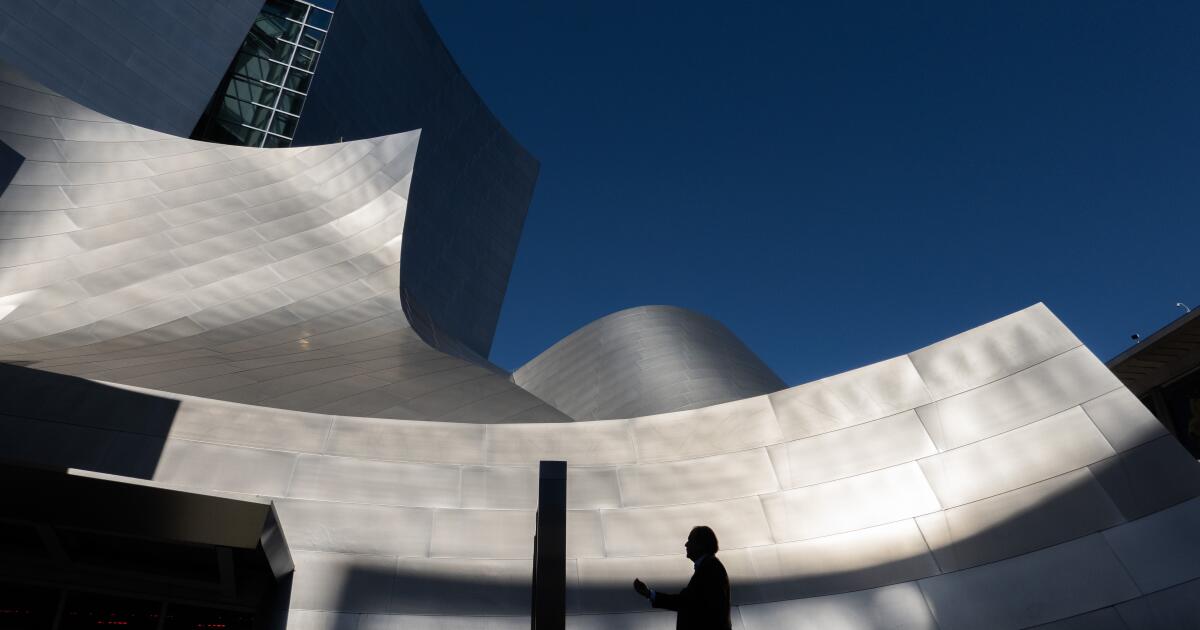
With two major expansions of downtown Los Angeles cultural institutions in the works, Bunker Hill is primed to elevate its status as the region’s leading arts center even as the area around it struggles with persistent homelessness and post-pandemic losses of office tenants.
Bunker Hill will soon have the largest concentration of buildings designed by Frank Gehry in the world and promises to become a cultural center “like no other place,” the architect told the Los Angeles Times.
The Broad recently announced a $100-million project that will increase gallery space at one of the city’s most popular museums by 70%, and the Colburn School for performing arts just broke ground on a $335-million expansion that will include a mid-size concert hall — designed by Gehry — that is expected to be in near-constant use for events put on by students, professional artists and academics.
Gehry has been a key player in the decades-long comeback of Bunker Hill, a former residential neighborhood that is now home to cultural institutions, office skyscrapers, apartment towers and hotels. With the coming additions, Gehry said, Bunker Hill stands to surpass the vision he, museum founder Eli Broad and other civic leaders had in the 1990s when work got underway on Walt Disney Concert Hall as part of the government-led Grand Avenue Project to revitalize the neighborhood.
Planners at the time hoped to build on the appeal of the Music Center, which was built in the 1960s and served as a popular destination for arts patrons who typically drove in and out without stepping outside its boundaries.
A rendering of the future Broad expansion as viewed from Hope Street.
(Courtesy of the Broad. © Diller Scofidio + Renfro (DS+R))
“We have come a long way since the Dorothy Chandler Pavilion and the other Music Center venues opened,” Gehry said. “So much great energy has come to the fore.”
Bunker Hill is still unlikely to feel similar to cultural centers in other big cities, he acknowledged, and laughed off a reminder that Broad had suggested Grand Avenue could become L.A.’s version of Paris’ Champs-Elysees.
“Los Angeles cannot be compared to anywhere else in the world. It’s different than other cities,” Gehry said.
Bunker Hill is slightly removed from the homelessness and safety concerns that trouble the financial district just south of it, said John Sischo, who has worked in the real estate business downtown since the 1980s.
“Homelessness is a big problem that keeps office tenants from coming downtown,” he said. Safety issues are both “real and perceived.”
In the two decades before the COVID-19 pandemic, civic leaders and landlords pushed to elevate the financial district that Sischo recalled as a “doughnut hole” between Bunker Hill — with its highbrow cultural scene — and the booming new neighborhood of South Park near Crypto.com Arena and L.A. Live, where sports and entertainment ruled.
Thousands of apartments and condominiums were added to the financial district — followed by bars, restaurants and stores that thrived on the residents and office workers whose bosses took advantage of comparatively low rents in gleaming towers that were being upgraded by their owners.
The drop in street life from workers staying at home during the pandemic and continuing to work remotely has been a drain on the vibrancy and sense of security in the financial district, which is depressing office leasing and hampering the neighborhood’s comeback, Sischo said.
Falling office values have led to foreclosures on some prominent office towers, including 444 S. Flower St., which was owned by Sischo’s company, Coretrust Capital Partners.
Acclaimed architect Frank Gehry stands in an outdoor lounge area of the bar Sed, part of Conrad Los Angeles, a luxury hotel across from Walt Disney Concert Hall, which Gehry also designed.
(Jay L. Clendenin / Los Angeles Times)
“Pre-COVID, it was really jelling,” he said of the financial district.
The most transformative addition to Bunker Hill in recent years was the Grand, a $1-billion hotel, apartment and retail complex designed by Gehry that stands across Grand Avenue from Walt Disney Concert hall, which he also designed.
“Now Disney has context,” Gehry said in 2022 on a balcony at the Grand overlooking the home of the Los Angeles Philharmonic. “For me, it all fits now. Disney Hall doesn’t look like an outlier.”
In the nearly two years since the Grand opened, its 45-story apartment tower has been nearly fully leased, owner Related Cos. said.
The Conrad Los Angeles hotel there is “outperforming the market,” Nicholas Vanderboom, chief operating officer of Related California, said, in part by “catering to growing interest in L.A’.s arts institutions.”
Spanish chef José Andrés operates restaurants at the Grand and more places to eat are coming in a part of the complex that has been dark since it opened, to the dismay of neighbors who have been waiting for long-promised retail venues on Grand Avenue. One of the features Gehry designed was space for stores and restaurants on the avenue and on terraces above that overlook the Disney Concert Hall, but it’s still mostly unoccupied.
Later this year, Andrés will open a Bazaar Meat, his high-end steakhouse that originated in Las Vegas, on the second level. Santa Monica Italian, French and & Moroccan restaurant Massilia will also open a branch on Grand Avenue this year, and other tenants will be announced in 2024, Related said.
The additions to the Broad and the Colburn promise to boost foot traffic on Grand Avenue, said Sel Kardan, president of the Colburn School, which opened on Bunker Hill in 1998 and has around 2,000 students.
The Broad Museum on Grand Avenue in downtown Los Angeles in April 2019.
(Jay L. Clendenin / Los Angeles Times)
Construction began recently on the expansion of the Colburn School that includes a mid-size concert hall Kardan expects to be in near-constant use for events put on by students, professional artists and academics. It is the third Gehry-designed building on Bunker Hill, which gives downtown L.A. the highest concentration of Gehry buildings anywhere, his firm said.
Colburn Center, as the addition will be called, will include a 1,000-seat concert hall with an in-the-round design meant to create intimacy between the performers and the audience. The hall will have an orchestra pit and a stage large enough to accommodate “the grandest works,” Kardan said, making it suitable for orchestra, opera and dance.
He expects the new hall will host more than 200 events a year at various times of day. The Colburn Center will also more than double facilities for the school’s Trudl Zipper Dance Institute, creating what the school called “one of the most comprehensive dance education complexes in Southern California.” The dance facilities will include a 100-seat theater for dance and four professional-size studios for dance instruction and rehearsal.
With the new addition, “there could be three or four performances going on on our campus on any given night,” Kardan said, a combination of educational performances, guest artists and events put on by local arts organizations.
The Colburn Center is set for completion in 2027. The Broad expansion should open a year later, museum President Joanne Heyler said, and add to street life on Grand Avenue.
A model of architect Frank Gehry’s design of an addition for Colburn School, a private performing arts school in downtown Los Angeles, which will make Bunker Hill the only place with three Gehry-designed buildings in close proximity, on January 31, 2024.
(Christina House / Los Angeles Times)
Attendance at the Broad returned to pre-pandemic highs of more than 900,000 annual visitors, she said, with a new daily record of more than 6,000 visitors set in March.
With the expansion,”we’re simply responding to the tremendous enthusiasm of our audience that is now consistent with pre-pandemic levels and and seemingly growing,” she said.
“I am under no illusion that downtown in general is free of challenges,” Heyler said. “We in the entire area have a lot to work on, but as a meeting point, a place to enjoy a cultural destination, our experience with the Broad is that things are vibrant. And I know that goes against the typical narrative of downtown.”
The Grand was “the next-to-the-last piece of the puzzle” for Bunker Hill, said landlord Christopher Rising, whose firm Rising Realty Partners owns two office buildings there. The final piece will be Angels Landing, he said, a $1.6-billion hotel-housing-retail complex set to rise next to Bunker Hill’s historic Angels Flight railway in time for the 2028 Olympics.
Rising laments that office attendance is still below pre-pandemic levels, especially among nearby government buildings that were packed with public employees who helped bring a sense of activity to Grand Avenue and other downtown streets.
“There are years of vision that are coming to fruition” on Bunker Hill, Rising said, “but the vision was heavily dependent on synergies with government workers. Without them, it’s slowing things down.”
More can be done to improve Bunker Hill, Gehry said, and the streets near Grand Avenue that are thick with parking lots are now ripe for development. The Colburn addition is going up next to the existing school on a former asphalt lot at 2nd and Olive streets.
“To keep upping the ante, we still have work to do,” Gehry said, such as “fixing” the Chandler Pavilion to make it a better venue for opera performances.
“There are also opportunities to connect down to the arts district, the civic center, and Little Tokyo on the east-west streets,” he said. “That is very exciting to me.”



(Credits: Far Out / Elevation Pictures)
Maxime Giroux – ‘In Cold Light’
The action is relentless in the complex thriller In Cold Light, a tense combination of crime and fugitive tale and family drama. It is the third feature and first English language film by Maxime Giroux, best known for a very different kind of film, the critically acclaimed 2014 drama Felix & Meira.
The tension and high energy of In Cold Light almost overwhelm the film, but are relieved, barely, by moments of character development and introspection that keep the audience pulling for the restrained and outwardly cold main character.
Speaking at the film’s Canadian premiere, director Giroux admitted he found creating an action film a challenge. Part of his approach was using very minimal dialogue, especially for the central character, letting the action speak for itself, and allowing silence to intensify suspense. Giroux has said he likes the lack of dialogue and speaks highly of the importance of silence in cinema; he prefers using “physical aspects of communication” in his films.
Young Ava Bly (Maika Monroe) is a competent and businesslike drug dealer, working in partnership with her brother Tom (Jesse Irving) and a small team. As the film begins, Ava has just been released from a brief prison sentence. She is hoping to return to her former position, but her brother’s associates consider her a risk due to her recent incarceration. While she works to re-establish herself, a shocking encounter with a corrupt police officer sends Ava’s life into chaos and forces her to go on the run.
Ava’s fugitive experience introduces a new character, to whom Ava turns for help: her father, Will Bly, played by Troy Kotsur, known for his excellent performance in CODA. Their first interaction is handled in a fascinating way, as Will is deaf and the two communicate through sign language. This, of course, provides another form of the silent interaction the director prefers; he explained that much of the father-daughter interaction was rewritten with the actor in mind. Their conflict is nicely expressed through a scene in which their initial conversation is intermittently cut off by a faulty light which goes out periodically, making communication through sign momentarily impossible, nicely expressing the rift between father and daughter.
As Ava continues to evade danger, her escape becomes complicated by new information, placing her in a painful dilemma. We gradually learn more about Ava, her background, and her character through occasional flashbacks and glimpses of her dreams. The plot becomes more complex and more poignant, and gains features of a mystery as well as an action tale, as she is pressed to choose from among equally unacceptable alternatives.
The climax of her efforts to protect both herself and those close to her comes to a head as she meets with the director of a rival drug gang. Veteran actress Helen Hunt is perfect in the minor but significant role of Claire, the rival drug lord, who plays odd mind games with Ava in an intriguing psychological fencing match. It’s an unusual scene, in which Ava’s personality is made clearer, and Claire’s understated dominance and casual speech do not quite conceal the threat she represents.
The frantic pace and emotional turmoil are enhanced by the camera work, which tends to focus tightly on Ava, and by a harsh, minimal musical score that sets the tone without distracting from the action. Giroux chose to shoot the film in Super 60; he describes digital as “too perfect” for the look he was going for, and since “Ava is rough,” the film portrays her better. The director describes the entire movie as “rough,” in fact, and deliberately chose a dark, washed-out look for much of the footage, occasionally using light and colour, in the form of fireworks, lightning, or a colourful carnival, to both relieve and emphasise the darkness.
The dynamic, intense story holds the attention in spite of the lengthy, sometimes repetitive chase scenes and subdued dialogue. Ava’s predicament, and the difficult decisions she is forced to make, are made surprisingly relatable, from the initial disaster that starts the action to the surprising flash-forward that concludes the film, on as high a note as the situation could allow. Fans of action movies will definitely enjoy this one.

The House of Pies, a Los Feliz institution, is bustling on a chilly January morning.
It wouldn’t be shocking if some of the patrons here for breakfast were casually chit-chatting about the cultural behemoth that “KPop Demon Hunters” has become. After all, the 2025 animated saga about three music stars fighting otherworldly foes is now the most-watched movie ever on Netflix; “Golden,” its showstopping track, has since become the first Korean pop song to ever win a Grammy.
But for Danya Jimenez, 29, who sits across from me sipping coffee, the reception to the movie she began writing on back in 2020 isn’t entirely surprising, but certainly delayed.
“When we first started working on it, I was like, ‘People are going to be obsessed with this. It’s going to be the best thing ever,’” she recalls. But as several years passed, and she and her writing partner and best friend Hannah McMechan, 30, moved on to other projects. They weren’t sure if “KPop” would ever see the light of day. Production for animation takes time.
It wasn’t until she learned that her Mexican parents were organically aware of the movie that Jimenez considered it could actually live up to the potential she initially had hoped for.
“Without me saying anything, my parents were like, ‘People are talking about this’ — like my dad’s co-workers or my aunt’s friends — that’s when I started to realize, ‘This might be something big,’” she says.
“But never in my life did I think it would be at this scale.”
“KPop Demon Hunters” is now nominated for two Academy Awards: animated feature and original song. And that’s on top of how ubiquitous the characters — Rumi, Mira and Zoey — already are.
“Everyone sends me photos of knockoff ‘KPop Demon Hunters’ dolls from across the border,” Jimenez says laughing. “My friend got me a shirt from Mexicali with the three girls, but they do not look anything like themselves. She even got my name on it, which was awesome.”
After graduating from Loyola Marymount University in 2018, Jimenez and McMechan quickly found their footing in the industry, as well as representation. But it was their still unproduced screenplay, “Luna Likes,” about a Mexican American teenage girl obsessed with the late chef and author Anthony Bourdain, that tangentially put them on the “KPop” path.
“Luna Likes” earned the pair a spot at the prestigious Sundance Screenwriters Lab, where Nicole Perlman, who co-wrote “Guardians of the Galaxy,” served as one of their advisors. Perlman, credited as a production consultant on “KPop,” thought they would be a good fit.
Jimenez didn’t see the connection between her R-rated comedy about a moody Mexican American teen and a PG animated feature set in the world of K-pop music, but the duo still pitched. Their idea more closely resembled an indie dramedy than an epic action flick.
“If [our version of ‘KPop’] were live-action, it would’ve been a million-dollar budget. It was the smallest movie ever. Our big finale was a pool party,” Jimenez says. “We had all of the girls and the boys with instruments, which obviously is not a thing in K-pop, and everyone was making out.”
Even though their original pitch wouldn’t work for the film, Maggie Kang, the co-director and also a co-writer, believed their voices as two young women who were best friends, roommates and creative collaborators could help the movie’s heroines feel more authentic.
“Maggie had already interviewed all of the more established writers, especially older men,” Jimenez says. “She knows the culture. She knew K-pop, she’s an animator. She just needed the girls’ voices to come through, so I think that’s why we got hired.”
Kang confirms this via email: “It’s always great to collaborate with writers who are the actual age of your characters! Hannah and Danya were exactly that,” she says. “They were very helpful in bringing a fresh, young voice to HUNTR/X.”
Neither Jimenez nor McMechan were K-pop fans at the time. As part of their research, they both started watching K-pop videos, but it was McMechan who got “sucked into the K-hole” first. Still, it didn’t take long until the video for BTS’ “Life Goes On” entranced Jimenez.
“K-pop is a river that you fall into, and it just takes you,” Jimenez says. BTS and Got7 are her favorite groups. For McMechan, the ensemble that captivates her most is Stray Kids.
In writing the trio of demon hunters, the co-writers modeled them after themselves. The characters’ propensity for ugly faces, silliness and a bit of grossness too, stems from the portrayals of girlhood and young womanhood that appeal to them. Jimenez, who says she was an angsty teen, most closely identifies with the rebellious Mira.
“I have a monotone vibe,” says Jimenez. “People always think that I’m a bitch just because I have a resting bitch face,” she says. “But as you can see in the movie, Mira cares so much about having everyone be really close. I feel like that’s how I’m with all my friends.”
Characters with strong personalities that are not simplistically likable feel the truest to Jimenez. In “Luna Likes,” the prickly protagonist is directly inspired by her experiences growing up, as well as the bond she shared with her dad over Bourdain’s “Parts Unknown” show.
“There’s a pressure to show that Mexicans are nice people and we’re hard workers. I was like, ‘Let’s make her kind of bitchy and very flawed,’” Jimenez says about Luna. “She’s a teenager in America and she should be given all the same opportunities — and also the forgiveness for being an ass— and [as] selfish at that age as anybody else.”

Hannah McMechan, left, and Danya Jimenez, co-writers of “KPop Demon Hunters,” met in college.
(Carlin Stiehl / For The Times)
Though their upbringings were markedly different, it was their shared comedic sensibilities that connected Jimenez and McMechan when they met in college. The two were close long before deciding to pen stories together. “Having a writing partner is the best. I feel bad for people who don’t have a writing partner, no offense to them,” says Jimenez.
McMechan explains that their writing partnership works because it’s grounded on true friendship. And she believes they would not have gotten this far without each other. While McMechan’s strong suit is looking at the bigger picture, Jimenez finds humor in the details.
“Danya is definitely funnier than me,” says McMechan. “It’s really hard to write comedy in dialogue versus comedy in a situation because if you’re putting the comedy in the dialogue, it can sound so forced and cringey. But she’s really good at making it sound natural but still really funny.”
Though she had been writing stories for herself as a teen, Jimenez didn’t consider it a career path until as a high schooler she watched the romantic comedy “No Strings Attached,” in which Ashton Kutcher plays a production assistant for a TV series.
“He is having a horrible time. But I was so obsessed with movies and TV, and I was like, ‘That looks incredible. I want to be doing what he’s doing,’” she recalls. “And my dad was like, ‘That’s a job.’”

Danya Jimenez grew up in Orange County.
(Carlin Stiehl / For The Times)
As an infant, Jimenez spent some time living in Tijuana, where her parents are from, until the family settled back in San Diego, where she was born. And when she was around 5 years old, Jimenez, an only child, and her parents relocated to Orange County. Until then, Jimenez mostly spoke Spanish, which made for a tricky transition when starting school.
“I knew English, but it just wasn’t a habit,” she recalls. “I would raise my hand and accidentally speak Spanish in class. My teachers would be like, ‘We’re worried about her vocabulary.’ That was always an issue, so it’s really funny that I turned out to be a writer.”
As she points out in her professional bio, it was movies and TV that helped with her English vocabulary, especially the Disney sitcom “Lizzie McGuire.”
Jimenez describes growing up in Orange County with few Latinos around outside of her family as an alienating experience. She admits to feeling great shame for some of her behaviors as a teenager afraid of being treated differently and desperate to fit in.
“I would speak Spanish to my mom like in a corner because I didn’t want everyone else to hear me speak Spanish,” Jimenez confesses. “If my mom pulled up to school to drop me off playing Spanish hits from the ‘80s or banda, I was like, ‘Can you turn it down please?’”
Like a lot of young Latinos, she’s now taking steps to connect with her heritage, and, in a way, atone for those moments where she let what others might think rob her of her pride.
“During the pandemic I cornered my grandma to make all of her recipes again so I could write them down,” she recalls. “Now I have them all written down on a website. Or if my mom corrects me for something that I’m saying in Spanish, I now listen.”
At the risk of angering her, Jimenez describes her mother as a “cool mom,” and compares her to Amy Poehler’s character in “Mean Girls.” Raised in a household without financial struggles, Jimenez doesn’t often relate to stories about Latinos in the U.S. that make it to film and TV. Her hope is to expand Latino storytelling beyond the tropes.
“That’s very important to me, to just tell Latino stories or Mexican stories in a way that’s just authentic to me and hopefully someone else is like, ‘Yes, that’s me,’” she says. “A lot of people have certain expectations for Latino stories that I’m not willing to compromise on.”
Though they still would like to make “Luna Likes” if given the chance, for now, Jimenez and McMechan will continue their rapid ascent.
They’re “goin’ up, up, up” because it is their “moment.” They recently wrapped the Apple TV show “Brothers” starring Matthew McConaughey and Woody Harrelson that filmed in Texas. They are also writing the feature “Attack of the Fifty Foot Woman” for Tim Burton to direct, with Margot Robbie in talks to star.
“I feel like I’ve just been operating in a state of shock for the past, I don’t know how many months since June,” says Jimenez in her signature deadpan affect. “But if I think about it too much, I’d be a nervous wreck.”

PopHorror had the chance to check out Anacoreta (2022) ahead of its streaming release! Does this meta-horror flick provide interesting story telling or is it a confusing mess.
Let’s have a look…
Synopsis
A group of friends heads to a secluded woodland cabin for a weekend getaway, planning to film an experimental horror movie. As the shoot progresses, the project begins to fall apart—until a real and terrifying presence emerges from the darkness.
Anacoreta is directed by Jeremy Schuetze. It was written by Jeremy Schuetze and Matt Visser. The film stars Antonia Thomas (Bagman 2024), Jesse Stanley (Raf 2019), Jeremy Schuetze (Jennifer’s Body 2009), and Matt Visser (A Lot Like Christmas 2021)
My Thoughts
Antonia Thomas delivered an outstanding performance as the female lead in Anacoreta. It was remarkable to watch her convey such a wide range of emotions with authenticity and depth. I was continually impressed by her ability to switch seamlessly between different dialects. I absolutely loved her delivery of the dialogue of telling The Scorpion and the Frog fable.
Anacoreta employs a distinctive, meta-horror style of storytelling. The narrative follows a group of friends creating a “scripted reality” horror film, and as the plot unfolds, the boundary between their staged production and their actual lives becomes increasingly blurred. This was interesting, but at the same time frustrating as a viewer.

Check out Anacoreta on Prime Video and let us know your thoughts!

NJ’s biggest Catholic diocese hits pause on plan to merge parishes

Retired Wright-Patterson general mentioned in UFO report missing in NM

Statewide tornado drill has NC schools and workplaces practicing safety
The North Dakota Attorney General issued an opinion to the ND State Auditor – North Dakota Attorney General

2026 NFL mock draft 6.0: Chiefs stick with offense after big trade with Rams; Ohio State defenders rise after stellar combines

Florida High School Football Rankings: Top 25 teams – Oct. 21

Cleary's 21 help Le Moyne down Central Connecticut State 69-64 in OT

How old is Bo Nix? What to know about Oregon quarterback ahead of 2024 NFL Draft

99th annual Pony Swim held in Virginia

Indiana Members Credit Union announced as new anchor tenant at Bottleworks District

US submarine sinks Iranian warship by torpedo in a first since World War II

Which oil and gas facilities in the Gulf have been attacked?

Mojtaba Khamenei, son of former supreme leader, tipped to become Iran’s next head of state

Video: Senators Question Kristi Noem on ICE Immigration Tactics

Combustible Republican Senate primary in Texas heading into overtime
-

 World7 days ago
Exclusive: DeepSeek withholds latest AI model from US chipmakers including Nvidia, sources say
-

 Massachusetts1 week ago
Mother and daughter injured in Taunton house explosion
-

 Denver, CO7 days ago
10 acres charred, 5 injured in Thornton grass fire, evacuation orders lifted
-

 Louisiana1 week ago
Wildfire near Gum Swamp Road in Livingston Parish now under control; more than 200 acres burned
-

 Florida3 days ago
Florida man rescued after being stuck in shoulder-deep mud for days
-

 Maryland3 days ago
AM showers Sunday in Maryland
-

 Oregon5 days ago
2026 OSAA Oregon Wrestling State Championship Results And Brackets – FloWrestling
-

 Wisconsin3 days ago
Setting sail on iceboats across a frozen lake in Wisconsin