Entertainment
Granderson: Give stunt work its own category at the Oscars


It’s especially noteworthy that there’s still no Oscar category for stunt coordinator because at the first Academy Awards, the movie that earned best picture did so by showcasing breathtaking stunt work. The 1927 film “Wings” was nominated in only one other category — engineering effects — when it took home the trophy for what was then called “Outstanding Picture.”
Since then the academy has selected 15 more war movies as the year’s best, with “Oppenheimer” expected to make it 17 this weekend. Most of them undergirded by the brave men and women who put themselves in harm’s way to make the cinematic experience as lifelike as possible.
Opinion Columnist
LZ Granderson
LZ Granderson writes about culture, politics, sports and navigating life in America.
That’s how “Wings,” a film about a love triangle set during World War I, could win the night’s biggest prize without its actors, director or screenwriters receiving a nomination. That’s not to say they weren’t snubbed (if you believe in such a thing). But clearly voters were in awe of the coordination of a dozen tanks, hundreds of planes and 5,000 extras — soldiers, actually. The film was shot in San Antonio — affectionately known as Military City — where the War Department was eager to support movies featuring patriotism. In today’s numbers, it is estimated the government supplied “Wings” filmmakers with more than $250 million in manpower and equipment. Directed by William Wellman, a wartime pilot who had been shot down by Germans in 1918, the film is preserved by the Library of Congress.
Over the decades, technology has enabled creatives to bring fictional galaxies to Earth and extinct dinosaurs back to life. And the Academy of Motion Picture Arts and Sciences has come to recognize the storytelling contributions of the special effects industry. Same goes for sound, hair and makeup, costume design. And yet stunt coordinators are still not honored with a category. The academy clearly loves war movies, and yet the people most responsible for making those films feel real are not celebrated.
Not to mention there wouldn’t be summer blockbusters or slapstick comedies without stuntmen, because everyone is not made for that Tom Cruise life. The actor is famous for not only doing his own stunts but also breaking his own bones. And not just him. Daniel Craig has done a number of interviews talking mostly about the scores of injuries that came with James Bond stunt work — and keep in mind, he didn’t do all of the stunts in the films.
Many members of the crew and cast of “Black Panther: Wakanda Forever” first had to learn to swim before shooting began because half of the film is underwater. Incredibly, that film’s aquatic stunt team worked with novices and helped turn a comic book film into an Oscar winner. And disappointingly, there wasn’t a way to celebrate their critical work at the movie industry’s biggest night.
After seven films and 30 years of Cruise running on rooftops and jumping out of planes, his “Mission Impossible” series finally received two Oscar nominations: for best sound and best visual effects. Wouldn’t it be nice if by the time the eighth installment is released in 2025, there’s a stunt coordinator category waiting for it?
There could not have been a “Braveheart” as we know it (which won best picture in 1996) without a stunt coordinator. Same with “Platoon” (in 1987), “Deerhunter” (in 1979), “Patton” (in 1971).
What is “Lawrence of Arabia” (which won in 1963) without the stunts performed on camelback? In fact Peter O’Toole, who received an honorary Oscar in 2002, almost died making the film after a gun meant to signal the start of a scene fired prematurely. O’Toole’s camel was startled, and he fell off as a stampede of horses approached. Fortunately, the camel was trained to shield him from harm.
The tragedy surrounding the making of “Rust” and the death of cinematographer Halyna Hutchins is a painful reminder that filmmaking isn’t without its dangers. And the people responsible for coordinating the exciting stunts are also the ones minimizing danger.
Not only that. They’re also often the ones guaranteeing the laughs.
Earlier this year Conrad Palmisano passed away. Be sure to look for him in the “In Memoriam” segment of the broadcast. He was the stunt coordinator for “Weekend at Bernie’s,” “Sleepless in Seattle” and sequels for “Rush Hour,” among other classics. The man was an icon, whose stunt work goes all the way back to the A-Team.
“Richard Burton once complained to me,” Palmisano recalled in an interview. “He said: ‘I do a soliloquy of Shakespeare and I don’t get anything out of the crew. You fall down a flight of stairs, everyone applauds.’ I said: ‘What are you complaining about? You’re married to Elizabeth Taylor.’ ”
It’s a great quip about the chasm between Hollywood’s stars and the stunt doubles responsible for some of our most visceral responses in the theater. As a member of the academy, Palmisano lobbied for years to have the Oscars formally recognize his field’s contribution to the industry.
Going all the way back to the very first award show, in 1929, it’s been clear that stunts are essential to great filmmaking. That’s why when it comes to the topic of Oscar snubs, this feels like the biggest one every year.
It’s also one the academy could easily remedy.


The Fetus, 2025.
Directed by Joe Lam.
Starring Bill Moseley, Lauren LaVera, Julian Curtis, Evan Towell, and Ariel Yasmine.
SYNOPSIS:
A couple become pregnant with a half-human, half-demonic fetus with a thirst for blood-and must uncover its terrifying origins before it’s too late.

In The Fetus, Alessa (Lauren LaVera) discovers she has accidentally gotten pregnant by her boyfriend Chris (Julian Curtis), but instead of this being a cause for celebration Alessa tells Chris that they must visit her father Maddox (Bill Moseley) instead of going to a hospital as Maddox insisted she do that if she ever got pregnant. Chris has his own reasons for not wanting a baby and goes along with her, but Maddox is not an easy man to get to know as he is blind and suffering from PTSD as a result of being in Vietnam.
However, there are bigger stakes here than just trying to impress your girlfriend’s father as it is revealed that Alessa’s baby is the result of a pact Maddox made with a demon decades before, and that his blindness was due to him not sacrificing Alessa to that demon. Now he has a second chance to appease the demon with the vampiric tentacle monster that keeps appearing to suck the blood of anyone who isn’t kin, and Chris has to step up and decide whether he wants to be a father or not.

Or something like that, as The Fetus is a little confused by its own mythology. Taking its cue from Larry Cohen’s It’s Alive!, The Fetus is a low-budget indie affair that has its star names to thank for lifting it up and out of the bin marked ‘utter nonsense’ and into the realms of watchable nonsense. What’s the difference? Well, there is no way to try and sell it as a serious horror movie as the premise is totally daft, the visuals give it the look of a Megadeth music video from the 1990s and it ties itself up in knots trying to tell us who needs to be sacrificed and why (although neither become very clear by the end of it), but Bill Moseley has made enough of these types of schlocky horror movies to know exactly what he’s doing and how to pitch it, plus Lauren LaVera has enough clout with modern horror audiences to give it some appeal and she proves once again why she is one of the best scream queens of recent times (although she is better than this movie), and so the combination of these two actors gives The Fetus more weight than it would have had if two lesser-known actors were in the roles.
Julian Curtis as Chris also lends an air of comic relief, although when the plot is as silly as it is you cannot help but deliver your lines with that sort of sarcastic smirk on your face (”You can’t get pregnant overnight” – well, she did and no one questions it). He plays off against Bill Moseley very well and, if nothing else, his character is the one that has the biggest arc, and if you wanted to dig deeper and salvage some sort of message about nature versus nurture, what it means to be a father, telling your girlfriend when the condom splits and that type of thing then it is there, but don’t stress too much if you just want to watch vampiric tentacles coming out from between Lauren LaVera’s legs because that is really what everyone is here for rather than social commentary.

The Fetus works because everyone involved knows exactly what kind of movie they are making, and that movie is a low-budget black comedy about a demonic baby with naff-but-passable effects and three lead performers who bounce off each other very well. Going into it expecting The Exorcist or The Omen levels of filmmaking quality is only going to lead to anger and disappointment, and you can’t really be angry at a movie that has a man sticking his you-know-what into a fiery hole in the floor to conceive a baby. Temper your expectations and go into The Fetus prepared to enjoy 84 minutes of diabolical baby B-movie hilarity and you’ll have a good time… maybe.
Flickering Myth Rating – Film: ★ / Movie: ★ ★ ★
Chris Ward
https://www.youtube.com/watch?v=embed/playlist
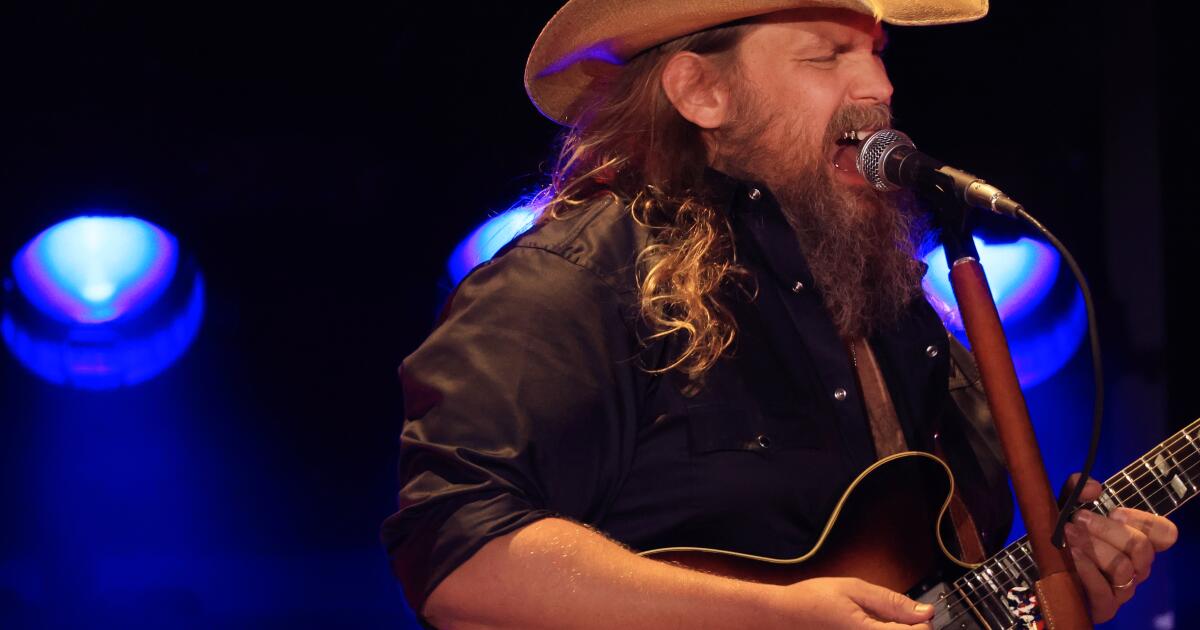
In New York, the Brooklyn Bridge went up in flames briefly during a fireworks display. In Washington D.C., stormy weather delayed a grievance-filled speech by President Trump.
And here in Los Angeles? On Saturday night, tens of thousands of Angelenos joined voices peacefully at the L.A. Memorial Coliseum to sing along with Chris Stapleton as the country star compared a lover to Tennessee whiskey.
A unifying cultural figure beloved by both liberals and conservatives, Stapleton was the headlining act at a Fourth of July benefit concert that also featured Smashing Pumpkins, Chaka Khan, Maren Morris and Queen Latifah. (I’d be surprised if those five names had previously appeared together in the same sentence.) The show, with tickets priced at $17.76, was presented by America250, a bipartisan commission that Congress created in 2016 to plan celebrations for the country’s 250th birthday; proceeds went to Feeding America, which calls itself the largest domestic hunger-relief organization in the United States.
-
Share via
“No politics — just purpose” is how America250 Chair Rosie Rios described the night in remarks from the stage, and it wasn’t hard to interpret the distinction she was seeking to draw between her group and Freedom 250, Trump’s rival semiquincentennial initiative that organized Saturday’s windblown event on the National Mall (not to mention an earlier concert by Vanilla Ice that was called off due to the threat of rain).
But here’s the thing: Compared with the president’s celebration, where he complained about his treatment by the justice system and suggested we should refer to his current term as his third, the show at the Coliseum really did feel like a politics-free zone — the somewhat rare occasion these days when folks from different walks of life come together just to listen to music and drink overpriced micheladas.
Said Stapleton not long into his set: “I won’t waste time talking.”
America250’s success was hardly a sure thing. Despite the relatively low price, tickets moved slowly in the weeks before the concert; one guy I talked to Saturday told me he’d paid six bucks for a discounted pass. Yet to my eyes the Coliseum was close to full by the time Stapleton came on.
The country singer was as solid and soulful as always, snarling gently through “Bad as I Used to Be,” then trading loving harmonies with his wife, Morgane, in “Millionaire.” He closed with “Tennessee Whiskey,” of course — a trusty yet somehow un-shopworn piece of Americana that’s earned a place on the shelf next to Ray Charles’ “Georgia on My Mind” and Willie Nelson’s “Angel Flying Too Close to the Ground.”
Smashing Pumpkins was perhaps a stranger fit for an explicitly patriotic event — “The world is a vampire,” frontman Billy Corgan sneered in “Bullet With Butterfly Wings” — yet the band sounded sharp and punchy in the ’90s alt-rock hits that have brought zoomers and even Gen Alpha kids into its audience.
Billed not inaccurately on the concert’s poster as “the legendary Chaka Khan,” the 73-year-old funk doyenne flexed her vocal chops in jammy renditions of “Ain’t Nobody” and “Tell Me Something Good” and got people hoisting their drinks for “I’m Every Woman.” Morris, who’d flown in from New York after attending her pal Taylor Swift’s wedding on Friday night, made an improbably smooth segue between her and Zedd’s synthed-up “The Middle” and the rustic “My Church.”
As the show’s host, Queen Latifah dispensed uplifting thoughts about American idealism throughout the evening but also got a slot of her own to do her classic “U.N.I.T.Y.” with help from a rambunctious drum line. It’s an unapologetic message song about demanding respect, and what was moving about hearing it here is that nobody seemed put off by that idea.
I’ll wave a flag for that.
Here are more photos from Saturday’s concert:
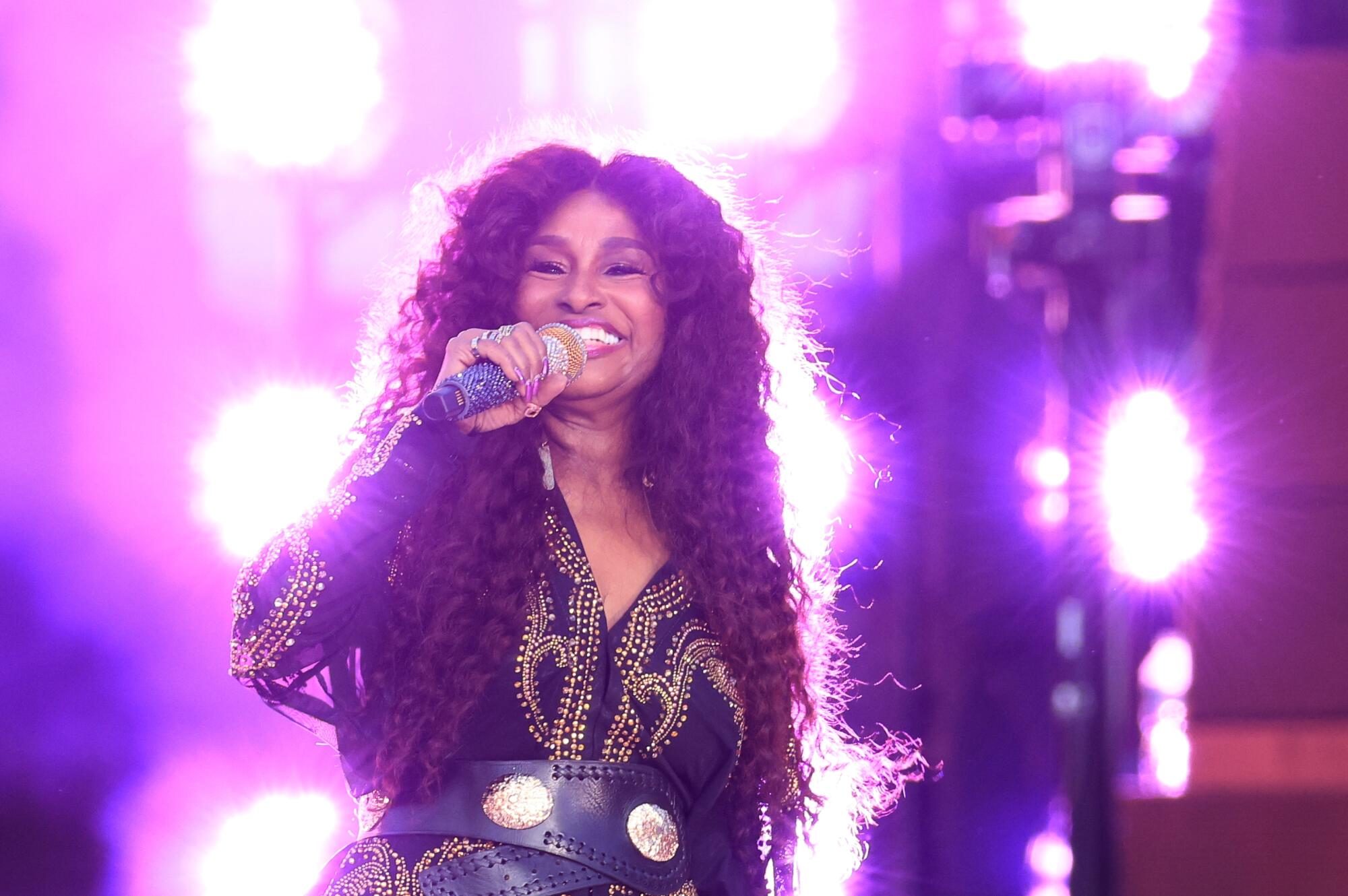
Chaka Khan performs.
(Myung J. Chun / Los Angeles Times)

Queen Latifah hosted the show.
(Myung J. Chun / Los Angeles Times)

A couple in patriotic garb share a kiss.
(Myung J. Chun / Los Angeles Times)

Smashing Pumpkins performs.
(Myung J. Chun / Los Angeles Times)

A concertgoer enjoys confetti.
(Myung J. Chun / Los Angeles Times)

Maren Morris performs.
(Myung J. Chun / Los Angeles Times)

It’s a good year when we get movies like Remarkably Bright Creatures and The Sheep Detectives at the same time. If there’s one type of emotional draw we’ll never say no to when it comes to the fiction we consume, it’s wholesome. The kind of movies and TV shows that leave you with a bit more hope than you expected. The kind of stories that make you believe that humanity isn’t as broken as it really is.
The Sheep Detectives is essentially tailor-made for anyone who loves a good whodunnit that’s rich with nuance and humor. The clever decision to shift the genre into something both kids and adults could appreciate together is no small feat, and that’s largely where its mass appeal lies. Murder is a heavy subject to deal with—as is grief—yet this story makes sitting with the weight of both a little easier. It could kickstart a number of thoughtful conversations while it simultaneously delivers plenty of laughs along the way.
For adults, there’s also a huge appeal in the casting—the voice actors especially. Anyone who knows me knows that Ted Lasso is the kind of show I’ll always put first, so hearing Brett Goldstein voice a sheep is the kind of A+ decision that’s effortless to appreciate. Hugh Jackman, Nicholas Galitzine, Molly Gordon, Nicholas Braun, Emma Thompson, Julia Louis-Dreyfus, Bryan Cranston, Bella Ramsey, Regina Hall, Rhys Darby, Patrick Stewart, Hong Chau, and the whole cast do an exceptional job as well, making every moment of The Sheep Detectives thoroughly entertaining.

It’s hard to imagine anyone coming out of the movie not thinking it’s one of the best things we’ll watch all year, and that’s a high compliment considering 2026 is full of gems like Project Hail Mary and the upcoming The Odyssey. It’s the exact kind of movie we could all use, but more than anything, the kind of story we could use more of. If there’s any sort of sequel, sign me up. Let’s make it a trilogy. Give us more of the sheep.
The cinematography is gorgeous, the writing is sharp, the performances are thrilling, and the message is a gem worth holding onto. The Sheep Detectives is the kind of feel-good treasure that does an excellent job of reminding us why movies like this will always matter. There’s a thoughtful message about how grief is meant to be shared and why it’s so important to carry those who’ve passed with us. Yes, it’d be convenient to forget our pain by sheer mental willpower, but we aren’t meant to do that. As humans and as animals, I imagine that the good, bad, and ugly are all part of what makes life beautiful, and that’s a comforting message to sit with.
The concept of a whodunnit featuring sheep solving a murder sounds so wild on paper, yet everything about it results in the kind of movie that should signal to Hollywood we want more creative approaches to what’s familiar. There’s a reason The Muppets are so popular, and we shouldn’t be afraid of making things that sound a bit too whimsical on paper. In other words, The Sheep Detectives embraces the whimsy, and it’s exactly what makes it so delightful.
The Sheep Detectives is now streaming on Prime Video.
First Featured Image Credit: ©Amazon MGM Studios
Related
-
Delaware3 minutes ago
What Delaware’s New Probate Threshold Means for Your Estate Plan
-

 Florida6 minutes ago
South Florida’s top deals: Davie school building sells for $16M
-

 Georgia11 minutes ago
10 Best Towns In Georgia For Retirees
-

 Hawaii18 minutes ago
Paid parking lots debate continues – Hawaii Tribune-Herald
-

 Idaho21 minutes ago
ATV Crash in Pine Takes Life of Gooding Man
-

 Illinois26 minutes ago
Catholic Charities Fort Worth Expands Research-Backed Anti-Poverty Program to Illinois
-

 Indiana28 minutes ago
Indiana gov to Porter County: If you want to miss out on fun of giving $250m in tax money to Bears, your loss
-

 Iowa33 minutes ago
Iowa attorney general sues Temu, alleging deceptive sales, data theft

