

Connect with us

Entertainment

Commentary: The new 'Mean Girls' isn't perfect. But it's justice for Janis

Published

on

Commentary: The new 'Mean Girls' isn't perfect. But it's justice for Janis

While the new “Mean Girls” movie includes many, many punchlines from the first film, recited verbatim, devout fans will clock plenty of changes. Bullying, once the province of three-way calling on landlines, now occurs on social media. Gone are the misguided Asian jokes, the sizeism slander, the ableist language and the whole pedophilia plot. And no, the cafeteria cliques aren’t categorized by racist stereotypes.

“Sometimes you write something and 20 years go by and you go, ‘Oh, I wish maybe we hadn’t said that,’” Tina Fey, who wrote both screenplays, said in a “Today” interview. “And what a gift to be able to open the hood and fix things up a bit.”

Whether updated for contemporary sensitivities or to acknowledge two decades have passed since the first movie’s release, most of these tweaks are as cosmetic as the millennial-to-Gen Z costume changes. But the one drastic alteration in the Paramount musical turns out to be its most meaningful, a model for future onscreen reimaginings of retrograde material: the overdue overhaul of Janis Ian.

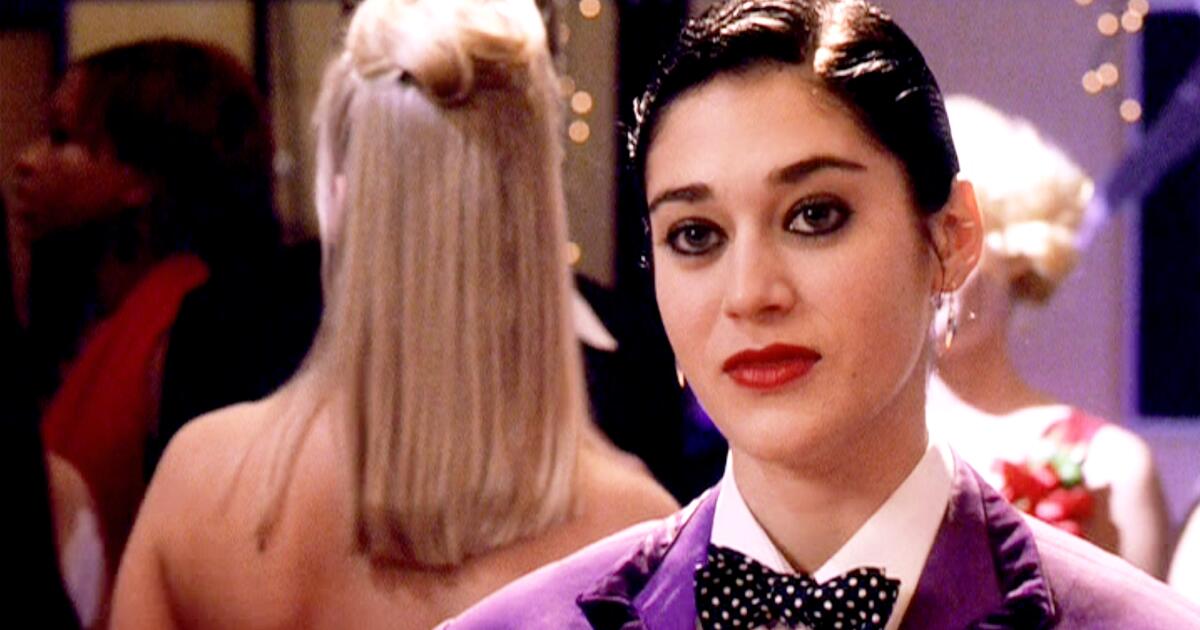
In the 2004 version, Janis (Lizzy Caplan), wearing grunge outfits and thick black eyeliner, is introduced as an acerbic, art-loving rebel who has been socially ostracized by Regina George. The former best friends fell out after Regina started a rumor that Janis was a lesbian, accused her of being obsessively in love with her and refused to invite her to a pool party because there would be other girls there. In bathing suits.

Janis’ entry in the “Burn Book” her bullies use to tear apart their underlings on the social ladder simply labels her with a slur — one presented in the film as the most brutal comment imaginable about a female student. Newcomer Cady Heron, desperate to stay in the good graces of these popular “Plastics,” later betrays her erstwhile friend Janis by weaponizing the rumor: She too accuses Janis of being in love with her, and Regina reinforces it when she tells their fellow classmates Janis’ “dream come true” is “diving into a big pile of girls.”

Advertisement

Lindsay Lohan as Cady, left, Lizzy Caplan as Janis and Daniel Franzese as Damian in the 2004 movie “Mean Girls.”

(Michael Gibson / Paramount Pictures)

Fast-forward 20 years and Janis Ian has become Janis ‘Imi’ike, played by Auli’i Cravalho, and she is now actually queer — instead of being saddled with a last-minute heterosexual pairing with a male mathlete. And in a particularly satisfying twist, she’s also the new movie’s narrator, along with the other out queer character, her best friend Damian (Jaquel Spivey).

This time, Janis isn’t bullied because of her sexual orientation. In fact, Regina, to whom Janis had come out privately when they were still close, attempted to use it to her advantage, putting on “a show” with Janis during a game of Spin the Bottle to make a boy jealous — and then disclaiming her own interest by saying, “I knew she would let me. She’s, like, obsessed with me.”

Advertisement

In the fallout, we learn, Regina began describing Janis as an “obsessed lesbian” to their classmates — leading, ultimately, to a science-lab incident that got Janis kicked out of school and permanently labeled a weirdo, or worse. “Regina had been making fun of Janis this entire time and everyone but her knew it,” explains Damian. To the adults, he says, “Janis just seemed crazy.”

Jaquel Spivey plays Damian and Auli’i Cravalho plays Janis in “Mean Girls.”

(Jojo Whilden / Paramount Pictures)

Janis’ new characterization as an out queer woman of color — one whose sexual orientation, rumored or otherwise, isn’t weaponized against her by her classmates — is most effective in an iconic scene from the original: the apology exercise, in which math teacher Ms. Norbury (Fey) challenges female members of the student body to admit their part in perpetuating the “mean girl” behavior that has exploded on campus.

Advertisement

Though Regina tries to humiliate Janis ahead of her turn — it is “Mean Girls,” after all — it’s not for her queerness. The moment is a far cry from the first movie, in which Janis responds to Regina’s homophobic taunt by bitterly joking about her “big lesbian crush.”

Most importantly, the new film then turns this revised understanding of Janis into its defining musical number, one that underscores a new generation’s social ecosystem: Janis can be queer without letting it define her; her queerness might inflect her rejection by the Plastics but definitely no longer drives it.

In this version of the scene, she stares directly into the camera to sing “I’d Rather Be Me,” an anthemic showstopper by composer Jeff Richmond and lyricist Nell Benjamin in which Janis calls out the insidious, unspoken ways in which women deceive and undercut each other for their own gain, and unapologetically opts out of such mutually destructive efforts in the future:

We’re supposed to all be ladies and be nurturing and care
Is that really fair? Boys get to fight, we have to share
Here’s the way that that turns out: We always understand
How to slap someone down with our underhand
So here’s my right finger to how girls should behave
’Cause sometimes what’s meant to break you just makes you brave

So I will not act all innocent, I won’t fake apologize
Let’s just fight and then make up, not tell these lies
Let’s call our damage even, clean the slate ’til it’s like new
It’s a new life for me where I’d rather be me
I’d rather be me than be with you

Advertisement

It’s cinematic justice for a character previously maligned for the sake of a joke (the original Regina simply mistook “Lebanese” for “lesbian”). And in a remake so packed with cameos and callbacks to the first film, the overhaul of Janis is the only major update made to “Mean Girls” that seems especially attuned to today’s high schoolers — teens who are more accepting of diverse sexual orientations, racial/ethnic backgrounds and other forms of difference — than those of 2004.

So many adaptations of once-beloved stories fall flat with new viewers because they’re held down by outdated setups and cringe-worthy punchlines that previously played without protest. Sure, old-schoolers might say such choices are made to check politically correct boxes or lessen the likelihood of a widespread cancellation. (Although the cuts made from both the original and the stage show suggest there was some of that done too.) This “Mean Girls” is proof that such changes needn’t be about sanitizing a script so much as freshening it up, retaining the drama of familiar social dynamics while updating the social mores that change over time.

As Regina George actor Reneé Rapp sings in her end credits track — with Janis and her femme date shown dancing at the Spring Fling — “Can a gay girl get an amen?”

It only took 20 years, but finally, she can.

Advertisement

‘Mean Girls: The Musical’

Rating: PG-13, for sexual material, strong language and teen drinking

Running time: 1 hour, 52 minutes

Playing: In theaters nationwide

Advertisement

Movie Reviews

1986 Movie Reviews – Black Moon Rising | The Nerdy

Published

on

1986 Movie Reviews – Black Moon Rising | The Nerdy
by Sean P. Aune | January 10, 2026January 10, 2026 10:30 am EST

Welcome to an exciting year-long project here at The Nerdy. 1986 was an exciting year for films giving us a lot of films that would go on to be beloved favorites and cult classics. It was also the start to a major shift in cultural and societal norms, and some of those still reverberate to this day.

We’re going to pick and choose which movies we hit, but right now the list stands at nearly four dozen.

Yes, we’re insane, but 1986 was that great of a year for film.

The articles will come out – in most cases – on the same day the films hit theaters in 1986 so that it is their true 40th anniversary. All films are also watched again for the purposes of these reviews and are not being done from memory. In some cases, it truly will be the first time we’ve seen them.

Advertisement

This time around, it’s Jan. 10, 1986, and we’re off to see Black Moon Rising.

Black Moon Rising

What was the obsession in the 1980s with super vehicles?

Sam Quint (Tommy Lee Jones) is hired to steal a computer tape with evidence against a company on it. While being pursued, he tucks it in the parachute of a prototype vehicle called the Black Moon. While trying to retrieve it, the car is stolen by Nina (Linda Hamilton), a car thief working for a car theft ring. Both of them want out of their lives, and it looks like the Black Moon could be their ticket out.

Blue Thunder in the movies, Airwolf and Knight Rider on TV, the 1980s loved an impractical ‘super’ vehicle. In this case, the car plays a very minor role up until the final action set piece, and the story is far more about the characters and their motivations.

Advertisement

The movie is silly as you would expect it to be, but it is never a bad watch. It’s just not anything particularly memorable.

1986 Movie Reviews will continue on Jan. 17, 2026, with The Adventures of the American Rabbit, The Adventures of Mark Twain, The Clan of the Cave Bear, Iron Eagle, The Longshot, and Troll.


Continue Reading

Entertainment

Commentary: California made them rich. Now billionaires flee when the state asks for a little something back.

Published

on

Commentary: California made them rich. Now billionaires flee when the state asks for a little something back.

California helped make them the rich. Now a small proposed tax is spooking them out of the state.

California helped make them among the richest people in the world. Now they’re fleeing because California wants a little something back.

The proposed California Billionaire Tax Act has plutocrats saying they are considering deserting the Golden State for fear they’ll have to pay a one-time, 5% tax, on top of the other taxes they barely pay in comparison to the rest of us. Think of it as the Dust Bowl migration in reverse, with The Monied headed East to grow their fortunes.

The measure would apply to billionaires residing in California as of Jan. 1, 2026, meaning that 2025 was a big moving year month among the 200 wealthiest California households subject to the tax.

The recently departed reportedly include In-n-Out Burger owner and heiress Lynsi Snyder, PayPal co-founder and conservative donor Peter Thiel, Venture Capitalist David Sacks, co-founder of Craft Ventures, and Google co-founder Larry Page, who recently purchased $173 million worth of waterfront property in Miami’s Coconut Grove. Thank goodness he landed on his feet in these tough times.

Advertisement

The principal sponsor behind the Billionaire Tax Act is the Service Employees International Union-United Healthcare Workers West (SEIU-UHW), which contends that the tax could raise a $100 billion to offset severe federal cutbacks to California’s public education, food assistance and Medicaid programs.

The initiative is designed to offset some of the tax breaks that billionaires received from the One Big Beautiful Bill Act recently passed by the Republican-dominated Congress and signed by President Trump.

According to my colleague Michael Hiltzik, the bill “will funnel as much as $1 trillion in tax benefits to the wealthy over the next decade, while blowing a hole in state and local budgets for healthcare and other needs.”

The drafters of the Billionaire Tax Act still have to gather around 875,000 signatures from registered voters by June 24 for the measure to qualify on November’s ballot. But given the public ire toward the growing wealth of the 1%, and the affordability crisis engulfing much of the rest of the nation, it has a fair chance of making it onto the ballot.

If the tax should be voted into law, what would it mean for those poor tycoons who failed to pack up the Lamborghinis in time? For Thiel, whose net worth is around $27.5 billion, it would be around $1.2 billion, should he choose to stay, and he’d have up to five years to pay it.

Advertisement

Yes, it’s a lot … if you’re not a billionaire. It’s doubtful any of the potentially affected affluents would feel the pinch, but it could make a world of difference for kids depending on free school lunches, or folks who need medical care but can’t afford it because they’ve been squeezed by a system that places much of the tax burden on them.

According to the California Budget & Policy Center, the bottom fifth of California’s non-elderly families, with an average annual income of $13,900, spend an estimated 10.5% of their incomes on state and local taxes. In comparison, the wealthiest 1% of families, with an average annual income of $2.0 million, spend an estimated 8.7% of their incomes on state and local taxes.

“It’s a matter of values,” Rep. Ro Khanna (D-Fremont) posted on X. “We believe billionaires can pay a modest wealth tax so working-class Californians have Medicaid.”

Many have argued losing all that wealth to other states will hurt California in the long run.

Even Gov. Gavin Newsom has argued against the measure, citing that the wealthy can relocate anywhere else to evade the tax. During the New York Times DealBook Summit last month, Newsom said, “You can’t isolate yourself from the 49 others. We’re in a competitive environment.”

Advertisement

He has a point, as do others who contend that the proposed tax may hurt California rather then help.

Sacks signaled he was leaving California by posting an image of the Texas flag on Dec. 31 on X and writing: “God bless Texas.” He followed with a post that read, “As a response to socialism, Miami will replace NYC as the finance capital and Austin will replace SF as the tech capital.”

Arguments aside, it’s disturbing to think that some of the richest people in the nation would rather pick up and move than put a small fraction of their vast California-made — or in the case of the burger chain, inherited — fortunes toward helping others who need a financial boost.

Advertisement
Continue Reading

Movie Reviews

‘Song Sung Blue’ movie review: Hugh Jackman and Kate Hudson sing their hearts out in a lovely musical biopic

Published

on

‘Song Sung Blue’ movie review: Hugh Jackman and Kate Hudson sing their hearts out in a lovely musical biopic

A still from ‘Song Sung Blue’.
| Photo Credit: Focus Features/YouTube

There is something unputdownable about Mike Sardina (Hugh Jackman) from the first moment one sees him at an Alcoholics Anonymous meeting celebrating his 20th sober birthday. He encourages the group to sing the famous Neil Diamond number, ‘Song Sung Blue,’ with him, and we are carried along on a wave of his enthusiasm.

Song Sung Blue (English)

Director: Craig Brewer

Cast: Hugh Jackman, Kate Hudson, Michael Imperioli, Ella Anderson, Mustafa Shakir, Fisher Stevens, Jim Belushi

Runtime: 132 minutes

Advertisement

Storyline: Mike and Claire find and rescue each other from the slings and arrows of mediocrity when they form a Neil Diamond tribute band

We learn that Mike is a music impersonator who refuses to come on stage as anyone but himself, Lightning, at the Wisconsin State Fair. At the fair, he meets Claire (Kate Hudson), who is performing as Patsy Cline. Sparks fly between the two, and Claire suggests Mike perform a Neil Diamond tribute.

Claire and Mike start a relationship and a Neil Diamond tribute band, called Lightning and Thunder. They marry and after some initial hesitation, Claire’s children from her first marriage, Rachel (Ella Anderson) and Dayna (Hudson Hensley), and Mike’s daughter from an earlier marriage, Angelina (King Princess), become friends. 

Members from Mike’s old band join the group, including Mark Shurilla (Michael Imperioli), a Buddy Holly impersonator and Sex Machine (Mustafa Shakir), who sings as James Brown. His dentist/manager, Dave Watson (Fisher Stevens), believes in him, even fixing his tooth with a little lightning bolt!

The tribute band meets with success, including opening for Pearl Jam, with the front man for the grunge band, Eddie Vedder (John Beckwith), joining Lightning and Thunder for a rendition of ‘Forever in Blue Jeans’ at the 1995 Pearl Jam concert in Milwaukee.

There is heartbreak, anger, addiction, and the rise again before the final tragedy. Song Sung Blue, based on Greg Kohs’ eponymous documentary, is a gentle look into a musician’s life. When Mike says, “I’m not a songwriter. I’m not a sex symbol. But I am an entertainer,” he shows that dreams do not have to die. Mike and Claire reveal that even if you do not conquer the world like a rock god, you can achieve success doing what makes you happy.

Advertisement

ALSO READ: ‘Run Away’ series review: Perfect pulp to kick off the New Year

Song Sung Blue is a validation for all the regular folk with modest dreams, but dreams nevertheless. As the poet said, “there’s no success like failure, and failure’s no success at all.” Hudson and Jackman power through the songs and tears like champs, leaving us laughing, tapping our feet, and wiping away the errant tears all at once.

The period detail is spot on (never mind the distracting wigs). The chance to hear a generous catalogue of Diamond’s music in arena-quality sound is not to be missed, in a movie that offers a satisfying catharsis. Music is most definitely the food of love, so may we all please have a second and third helping?

Song Sung Blue is currently running in theatres 

Advertisement
Continue Reading

Trending
