Ever since network television started covering presidential election nights in 1948, there have been only two occasions when viewers had to wait more than a day to learn the outcome.
The first was in 2000, when the country was on hold for five weeks before the U.S. Supreme Court put an end to the vote recounts in Florida and gave George W. Bush the White House over Al Gore.
Twenty years later, viewers sweated it out for four days before the networks put 270 electoral votes in President Biden’s column on Nov. 7, 2020. Pandemic restrictions led to officials counting an unprecedented number of mail-in ballots, slowing the process. Former President Trump’s legal challenges to the results and his attempts to block the certification of the vote became a saga that culminated in the Jan. 6, 2021, insurrection.
CNN anchor Wolf Blitzer calls the election for Joe Biden.
(CNN)
Advertisement
The bumpy ride of 2020 has TV news operations preparing for more uncharted territory when ballot counting begins Tuesday night in the tight race between Trump and Vice President Kamala Harris. The 2024 election could be decided by narrow margins in as many as seven states, and Trump already is making accusations of voter fraud, as he did four years ago.
“If the polls are accurate, we’re in for a real doozy,” said Chris Stirewalt, political editor for cable network NewsNation and a senior fellow at the American Enterprise Institute, a Washington think tank.
Executives across the network news divisions say they will deploy a greater number of correspondents throughout the swing states, some assigned specifically to deal with election security and protests. Attorneys with experience in election issues have become a very hot commodity in TV newsrooms.
“We really bolstered up our state election law expertise,” said Catherine Kim, executive vice president for editorial at NBC News. “They’re going to be working around the clock.”
Advertisement
NBC News and MSNBC will have a “reading room” at its Rockefeller Center headquarters where its team of legal correspondents and analysts will be ready to break down court cases if they come in.
CNN has hired Benjamin Ginsberg, the election lawyer who represented the Bush campaign in 2000. Fox News has added Thomas Dupree, an assistant district attorney during the Obama administration, to its team of legal experts.
CBS News will have a “Democracy Desk” to analyze voting-related matters and its CBS News Confirmed unit to fact-check reports. ABC has a “Ballot Watch” unit that will monitor election integrity.
Networks once prided themselves on being the first to declare the election results. Not anymore.
“Calling the election is treacherous territory,” said Rick Klein, vice president and Washington bureau chief for ABC News. “I think very few viewers know or care who projects a state first, but every viewer should care that they are projected right.”
Advertisement
Being first and right can even have its drawbacks in the current hyper-partisan environment.
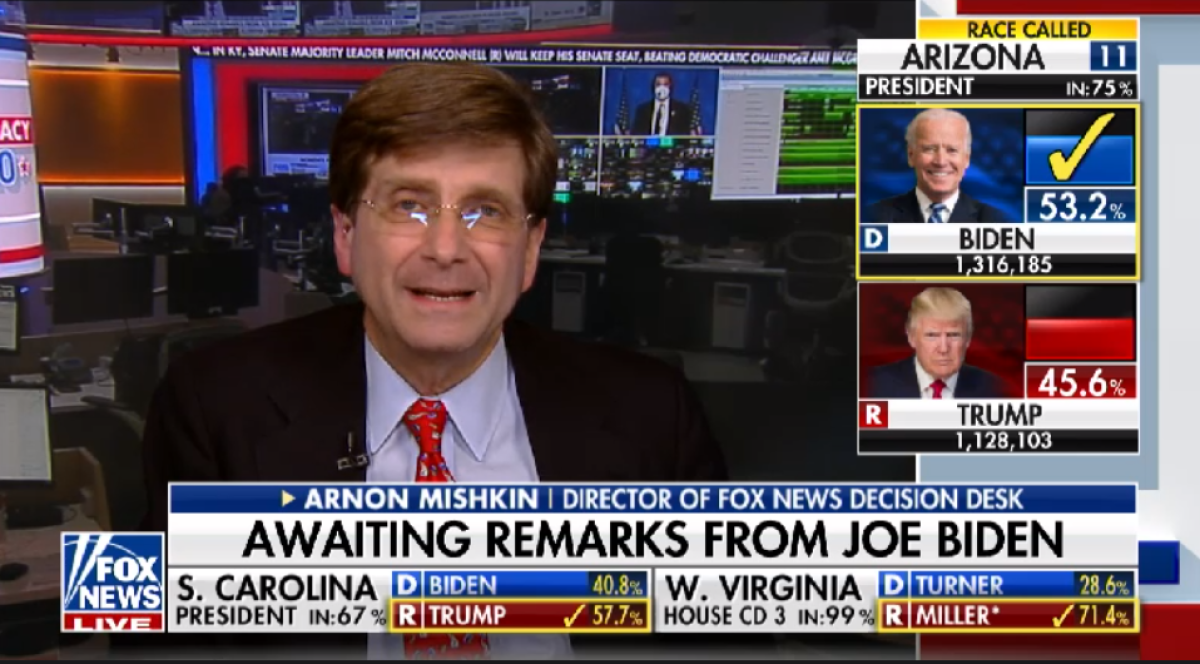
In 2020, Fox News, which teams with the Associated Press and research organization NORC at the University of Chicago to analyze the results, correctly called Arizona for Biden at 11:20 (Eastern) on election night with roughly 80% of the vote counted. The decision, which shifted the unfolding narrative of the race, angered the Trump campaign and caused consternation internally at the network. The conservative-leaning channel even saw an exodus of angry viewers in the months that followed.
Fox News never wavered in its decision to award Arizona’s 11 electoral votes to Biden days before its competitors. But this time around, viewers should be prepared to wait.
“There may not be projections at all on election night,” Klein said. “I think we just need to be honest about the extent of the uncertainty out there even as polls close and the results start to roll in.”
“We’ve come to expect the unexpected along the way, and that will be our approach on election night,” said Doug Rohrbeck, senior vice president, Washington news and politics, for Fox News.
Advertisement
While the process in 2020 was influenced by the tens of millions of people who had voted early, a group that leaned Democratic, no one is sure what the impact will be this time around.
“Republicans, smarting from their loss in 2020, have embraced early and absentee voting,” Stirewalt said. “And former President Trump no longer talks about the problem of mail-in ballots, or certainly not as much. So I think we had better proceed into election night with a lot of humility and a real openness to the possibility that assumptions we’ve had in the past might be wrong.”
Arnon Mishkin, director of the Fox News decision desk, explains his call of Arizona for Biden.
As charges of irregularities in the voting are likely to pop up, news organizations are expected to be transparent.
In previous elections, the political scientists, analysts and statisticians who make up the teams that call the races appeared on camera only when absolutely necessary. This time CBS News plans to give viewers a closer look at the process of calling states. NewsNation is partnering with Decision Desk HQ to handle its vote counting and will have a camera fixed on the room where the counting happens.
Advertisement
“There may not be projections at all on election night,” says Rick Klein, vice president and Washington bureau chief for ABC News.
There will be more correspondents and producers deployed in key counties inside the swing states showing the official process.
“I think we’re going to see more live counting of ballots than ever before,” said Mary Hager, executive editor for politics at CBS News.
There is also another possible scenario for election night 2024: The prognostications could be off, as they have been in the last three presidential election cycles, with the possibility of a winner declared after the polls close on the West Coast.
It happened in 2012 when President Obama was running neck and neck with his Republican opponent, Mitt Romney, in the final weeks of the campaign. Obama ended up winning the popular vote by four points and swamped Romney in the electoral vote count 332 to 206.
Advertisement
“It could be an electoral landslide in either direction,” Klein said. “No one should be surprised by either outcome.”
“If the polls are accurate, we’re in for a real doozy,” said Chris Stirewalt, political director for cable network NewsNation.
(NewsNation)
Stirewalt believes viewers will get some guidance from the results in North Carolina and Georgia, where polls close before 8 p.m. (Eastern) and which have a reputation for counting votes quickly.
“We will get an immediate core sample of what the electorate looks like, and we’ll start to figure out between 7:30 [and] 9:30 which way the polls were wrong, or maybe they were right and it’s just a very close race,” Stirewalt said. “If the polls are wrong, they tend to be in the same direction everywhere.”
Stirewalt’s hope is that whatever the outcome, it doesn’t replicate the drawn-out battle of 2000 between Bush and Gore, which happened during a comparatively more civil time in the nation’s politics.
Advertisement
“I do not think we have the institutional strength and confidence in our leaders to go through an ordeal like that,” he said.
by Sean P. Aune | January 10, 2026January 10, 2026 10:30 am EST
Welcome to an exciting year-long project here at The Nerdy. 1986 was an exciting year for films giving us a lot of films that would go on to be beloved favorites and cult classics. It was also the start to a major shift in cultural and societal norms, and some of those still reverberate to this day.
We’re going to pick and choose which movies we hit, but right now the list stands at nearly four dozen.
Yes, we’re insane, but 1986 was that great of a year for film.
The articles will come out – in most cases – on the same day the films hit theaters in 1986 so that it is their true 40th anniversary. All films are also watched again for the purposes of these reviews and are not being done from memory. In some cases, it truly will be the first time we’ve seen them.
Advertisement
This time around, it’s Jan. 10, 1986, and we’re off to see Black Moon Rising.
Black Moon Rising
What was the obsession in the 1980s with super vehicles?
Sam Quint (Tommy Lee Jones) is hired to steal a computer tape with evidence against a company on it. While being pursued, he tucks it in the parachute of a prototype vehicle called the Black Moon. While trying to retrieve it, the car is stolen by Nina (Linda Hamilton), a car thief working for a car theft ring. Both of them want out of their lives, and it looks like the Black Moon could be their ticket out.
Blue Thunder in the movies, Airwolf and Knight Rider on TV, the 1980s loved an impractical ‘super’ vehicle. In this case, the car plays a very minor role up until the final action set piece, and the story is far more about the characters and their motivations.
Advertisement
The movie is silly as you would expect it to be, but it is never a bad watch. It’s just not anything particularly memorable.
1986 Movie Reviews will continue on Jan. 17, 2026, with The Adventures of the American Rabbit, The Adventures of Mark Twain, The Clan of the Cave Bear, Iron Eagle, The Longshot, and Troll.
California helped make them the rich. Now a small proposed tax is spooking them out of the state.
California helped make them among the richest people in the world. Now they’re fleeing because California wants a little something back.
The proposed California Billionaire Tax Act has plutocrats saying they are considering deserting the Golden State for fear they’ll have to pay a one-time, 5% tax, on top of the other taxes they barely pay in comparison to the rest of us. Think of it as the Dust Bowl migration in reverse, with The Monied headed East to grow their fortunes.
The measure would apply to billionaires residing in California as of Jan. 1, 2026, meaning that 2025 was a big moving year month among the 200 wealthiest California households subject to the tax.
The recently departed reportedly include In-n-Out Burger owner and heiress Lynsi Snyder, PayPal co-founder and conservative donor Peter Thiel, Venture Capitalist David Sacks, co-founder of Craft Ventures, and Google co-founder Larry Page, who recently purchased $173 million worth of waterfront property in Miami’s Coconut Grove. Thank goodness he landed on his feet in these tough times.
Advertisement
The principal sponsor behind the Billionaire Tax Act is the Service Employees International Union-United Healthcare Workers West (SEIU-UHW), which contends that the tax could raise a $100 billion to offset severe federal cutbacks to California’s public education, food assistance and Medicaid programs.
The initiative is designed to offset some of the tax breaks that billionaires received from the One Big Beautiful Bill Act recently passed by the Republican-dominated Congress and signed by President Trump.
According to my colleague Michael Hiltzik, the bill “will funnel as much as $1 trillion in tax benefits to the wealthy over the next decade, while blowing a hole in state and local budgets for healthcare and other needs.”
The drafters of the Billionaire Tax Act still have to gather around 875,000 signatures from registered voters by June 24 for the measure to qualify on November’s ballot. But given the public ire toward the growing wealth of the 1%, and the affordability crisis engulfing much of the rest of the nation, it has a fair chance of making it onto the ballot.
If the tax should be voted into law, what would it mean for those poor tycoons who failed to pack up the Lamborghinis in time? For Thiel, whose net worth is around $27.5 billion, it would be around $1.2 billion, should he choose to stay, and he’d have up to five years to pay it.
Advertisement
Yes, it’s a lot … if you’re not a billionaire. It’s doubtful any of the potentially affected affluents would feel the pinch, but it could make a world of difference for kids depending on free school lunches, or folks who need medical care but can’t afford it because they’ve been squeezed by a system that places much of the tax burden on them.
According to the California Budget & Policy Center, the bottom fifth of California’s non-elderly families, with an average annual income of $13,900, spend an estimated 10.5% of their incomes on state and local taxes. In comparison, the wealthiest 1% of families, with an average annual income of $2.0 million, spend an estimated 8.7% of their incomes on state and local taxes.
“It’s a matter of values,” Rep. Ro Khanna (D-Fremont) posted on X. “We believe billionaires can pay a modest wealth tax so working-class Californians have Medicaid.”
Many have argued losing all that wealth to other states will hurt California in the long run.
Even Gov. Gavin Newsom has argued against the measure, citing that the wealthy can relocate anywhere else to evade the tax. During the New York Times DealBook Summit last month, Newsom said, “You can’t isolate yourself from the 49 others. We’re in a competitive environment.”
Advertisement
He has a point, as do others who contend that the proposed tax may hurt California rather then help.
Sacks signaled he was leaving California by posting an image of the Texas flag on Dec. 31 on X and writing: “God bless Texas.” He followed with a post that read, “As a response to socialism, Miami will replace NYC as the finance capital and Austin will replace SF as the tech capital.”
Arguments aside, it’s disturbing to think that some of the richest people in the nation would rather pick up and move than put a small fraction of their vast California-made — or in the case of the burger chain, inherited — fortunes toward helping others who need a financial boost.
A still from ‘Song Sung Blue’.
| Photo Credit: Focus Features/YouTube
There is something unputdownable about Mike Sardina (Hugh Jackman) from the first moment one sees him at an Alcoholics Anonymous meeting celebrating his 20th sober birthday. He encourages the group to sing the famous Neil Diamond number, ‘Song Sung Blue,’ with him, and we are carried along on a wave of his enthusiasm.
Song Sung Blue (English)
Director: Craig Brewer
Cast: Hugh Jackman, Kate Hudson, Michael Imperioli, Ella Anderson, Mustafa Shakir, Fisher Stevens, Jim Belushi
Runtime: 132 minutes
Advertisement
Storyline: Mike and Claire find and rescue each other from the slings and arrows of mediocrity when they form a Neil Diamond tribute band
We learn that Mike is a music impersonator who refuses to come on stage as anyone but himself, Lightning, at the Wisconsin State Fair. At the fair, he meets Claire (Kate Hudson), who is performing as Patsy Cline. Sparks fly between the two, and Claire suggests Mike perform a Neil Diamond tribute.
Claire and Mike start a relationship and a Neil Diamond tribute band, called Lightning and Thunder. They marry and after some initial hesitation, Claire’s children from her first marriage, Rachel (Ella Anderson) and Dayna (Hudson Hensley), and Mike’s daughter from an earlier marriage, Angelina (King Princess), become friends.
Members from Mike’s old band join the group, including Mark Shurilla (Michael Imperioli), a Buddy Holly impersonator and Sex Machine (Mustafa Shakir), who sings as James Brown. His dentist/manager, Dave Watson (Fisher Stevens), believes in him, even fixing his tooth with a little lightning bolt!
The tribute band meets with success, including opening for Pearl Jam, with the front man for the grunge band, Eddie Vedder (John Beckwith), joining Lightning and Thunder for a rendition of ‘Forever in Blue Jeans’ at the 1995 Pearl Jam concert in Milwaukee.
There is heartbreak, anger, addiction, and the rise again before the final tragedy. Song Sung Blue, based on Greg Kohs’ eponymous documentary, is a gentle look into a musician’s life. When Mike says, “I’m not a songwriter. I’m not a sex symbol. But I am an entertainer,” he shows that dreams do not have to die. Mike and Claire reveal that even if you do not conquer the world like a rock god, you can achieve success doing what makes you happy.
Advertisement
ALSO READ: ‘Run Away’ series review: Perfect pulp to kick off the New Year
Song Sung Blue is a validation for all the regular folk with modest dreams, but dreams nevertheless. As the poet said, “there’s no success like failure, and failure’s no success at all.” Hudson and Jackman power through the songs and tears like champs, leaving us laughing, tapping our feet, and wiping away the errant tears all at once.
The period detail is spot on (never mind the distracting wigs). The chance to hear a generous catalogue of Diamond’s music in arena-quality sound is not to be missed, in a movie that offers a satisfying catharsis. Music is most definitely the food of love, so may we all please have a second and third helping?