Entertainment
Box office: ‘Deadpool & Wolverine’ continues strong box office run during second weekend

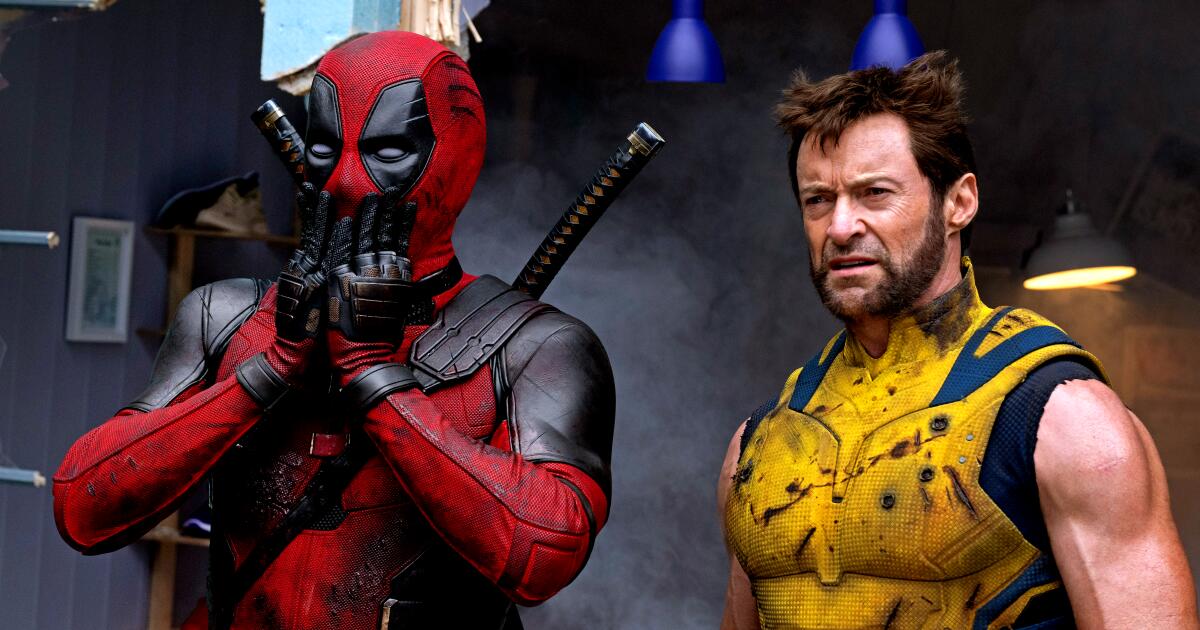
Marvel’s “Deadpool & Wolverine” extended its domination of the box office, bringing in $97 million in its second weekend of release, making it the second-biggest movie of the year, behind “Inside Out 2.”
The comic book franchise sequel, starring Ryan Reynolds and Hugh Jackman, already broke the record for the biggest domestic opening for an R-rated movie, with a $205-million first weekend, according to Comscore estimates.
The movie took the eighth spot for the biggest sophomore weekend opening in domestic box office history, eclipsing last year’s summer phenomenon “Barbie,” which earned $93 million in its second weekend outing, according to Variety.
At a time of concern over superhero fatigue, “Deadpool & Wolverine” has given a jolt to the genre, grossing $395 million domestically, overtaking the first two “Deadpool” installments. It is largely expected to cross the $1 billion threshold within days. “Inside Out 2” has grossed more than $1.55 billion worldwide, after eight weekends in release.
“Twisters,” Universal’s reimagining of the 1996 blockbuster, starring Glen Powell, Daisy Edgar-Jones and Anthony Ramos, took the No. 2 spot domestically with $22 million during its third weekend, grossing $195 million to date.
Not screened for critics, M. Night Shyamalan’s new thriller “Trap” opened in third place with $15 million. Sony’s “Harold and the Purple Crayon,” adapted from the children’s book of the same name, earned a disappointing $6 million, placing sixth.
This weekend, Walt Disney Studios became the first studio to cross the $3 billion mark globally during a year’s ticket sales — a success fueled by the 2024 releases of “Inside Out 2,” “Deadpool & Wolverine,” “Kingdom of the Planet of the Apes” and “The First Omen.”
Overall, the box office had its strongest week of the year to date, a robust $418 million. Per Comscore analysis, July alone generated $1.2 billion in domestic revenue, making it the first billion-dollar-plus month since July 2023.



Entertainment
Criticism by Winter Olympic athletes of Trump policies mirror reaction to iconic 1968 protest

History is once again unfolding at the Milan-Cortina Winter Games as Team USA members break records and score dominant triumphs.
But as the Games move into their second week, a different and more provocative history is starting to repeat itself, casting a politically charged shadow over the event.
Champion skier Mikaela Shiffrin, snowboarder Chloe Kim, and freestyle skiers Hunter Hess and Chris Lillas are among the top athletes who have been vocal about their uneasiness in representing their home country during a period of deep political crisis revolving several volatile issues, including the violent federal crackdown in Minnesota by Immigration and Customs Enforcement agents and the Trump administration’s attacks nationwide on immigrants and the LGBTQ+ community.
“It brings up mixed emotions to represent the U.S. right now,” Hess said at a press conference last week. “Just because I’m wearing the flag doesn’t mean I represent everything that’s going on in the U.S.”
Trump blasted Hess’ comments in a Truth Social post, calling him “a real Loser,” adding, “He says he doesn’t represent his Country … If that’s the case, he shouldn’t have tried out for the Team, and it’s too bad he’s on it. Very hard to root for someone like this.”
Commenting on the athletes in an interview with CNN, Vice President JD Vance, who was attending the Games, said the athletes who are critical should expect “some pushback.”
Vance, who was booed when he was shown on a large screen during the opening ceremonies, added, “You’re there to play a sport, you’re there to represent the country and hopefully win a medal. Most Olympic athletes, whatever their politics, are doing a great job, certainly enjoy the support of the entire country, and I think recognize that the way to bring the country together is not to show up in a foreign country and attack the president of the United States, but it’s to play your sport and to represent the country well.”
Vice President JD Vance and his wife Usha at the Winter Olympics opening ceremony in Milan on Feb. 6. Vance said athletes should expect pushback if they criticize the country.
(Natacha Pisarenko/AP)
The outspokenness of the Winter Olympic athletes echoes a dramatic protest by Olympians Tommie Smith and John Carlos which electrified the 1968 Summer Games in Mexico City. The sprinters, who placed first and third respectively in the 200 meter race, spoke not with words but with black-gloved raised fists on the victory stand, producing one of the most iconic images in Olympic history.
As the national anthem played following their victories, Smith and Carlos expressed their anger about racial injustice in America by bowing their heads and raising their fists. The gesture provoked a seismic reaction internationally while infuriating Olympic officials who claimed Smith and Carlos used the world stage to humiliate their home country.
Smith and Carlos’ salute to Black Power is explored in HBO Max’s documentary “Fists of Freedom: The Story of the ’68 Summer Games.” The 1999 Peabody Award-winning film chronicles the fiery moment and its aftermath for Smith and Carlos, who earned both heroic praise and pointed condemnation.
George Roy, who produced and directed “Fists of Freedom,” said “there are similarities between what happened in 1968 and what’s going on now. The similarities are it’s the Olympics and the United States, and in both cases there are athletes saying they wish they could be a little prouder given the current state of things.”

U.S. athletes Tommie Smith, center, and John Carlos, right, hold their fists up in protest after winning medals at the 1968 Summer Olympic games.
(AP)
However, Roy, who has won multiple Emmys and is the founder of Jersey Line Films, added that there are marked differences.
“What Smith and Carlos did was so consequential because it affected them directly,” he said. “They were protesting along with millions in their community. Their point was that they were good enough to represent their country. But when they got back to the real world, they would have trouble getting into restaurants or finding an apartment.”
He added, “It was just more personal than what is happening now.”
In an interview included in the documentary, Smith said the gesture by him and Carlos was often misinterpreted.
“As soon as the national anthem was playing, my glove is going toward God,” said Smith. “The Black fist in the air was only in recognition of those who had gone. It was a prayer of solidarity. It was a cry for help by my fellow brothers and sisters in the country who had been shot, who had been bitten by dogs … It was a cry for freedom.”
He added, “I don’t like the idea of people looking at it as negative. It was nothing but a raised fist in the air and a bowed head to the American flag. Not symbolizing a hatred for it.”
Though he heard cheers, he also heard boos and jeers.
“Fists of Freedom” contains several interviews from sports and media figures who were present or covered the proceedings and had strong opinions about the gesture.
Bob Paul, who was the press secretary for the United States Olympic Committee in 1968, said, “[Smith and Carlos] were wrong. You are supposed to observe due order and decorum to the nth degree at every victory ceremony.”
Veteran TV sportscaster Brent Musburger, who at the time was a columnist with the Chicago American newspaper, wrote: “Airing one’s dirty laundry before the entire world during a fun and games tournament was no more than a juvenile gesture. Smith and Carlos looked like a couple of Black-skinned storm troopers.”
Incensed, Olympic committee head Avery Brundage ordered the sprinters to be expelled from the Games.
Despite the uproar, experts said the salute by Smith and Carlos was a defining moment for Black people, galvanizing the Civil Rights Movement. However, the two men encountered personal and professional difficulties when they returned home.
Both Smith and Carlos have participated in speaking engagements in recent years. They could not be reached for comment.
“We’re not Antichrists,” said Smith in “Fists of Freedom.” “We’re just human beings who saw a need to be recognized.”
Movie Reviews
Assi Movie Review: Hard-hitting, horrifying, and heartfelt, this courtroom drama is impossible to ignore

Story: The courtroom drama follows a teacher, Parima (Kani Kusruti), who is brutally gang raped while returning home, and her lawyer Raavi’s (Taapsee Pannu) fight for justice. Beyond the horrific crime, it explores themes such as vigilantism, patriarchy, systemic corruption, and societal apathy that normalises sexual assault and crimes against women.Review: Director Anubhav Sinha’s title denotes the approximate number of rapes that take place each day in India — around 80. The film does not allow the viewer to sit comfortably with this statistic. Every 20 minutes, a reminder flashes on screen that another assault has occurred somewhere in the country during the film’s runtime. Alongside the alarming figure, the legal drama unsettles with its unflinching portrayal of how cruel society can be toward survivors.After Parima is violated, her male students joke about it in WhatsApp groups, while her husband Vinay (Zeeshan Ayyub) is pressured by his family to drop the case to “save honour.” Police corruption sabotages the investigation, victim-blaming becomes routine, and the accused display chilling apathy. They turn the crime into a game, with the loser buying beer; two of the four swap scarves in court to match their outfits, and one heads to a disco to party. Each culprit has a sister, girlfriend, or daughter — an irony the narrative quietly underscores.Parallelly, the story examines vigilantism through the rise of a ‘Chhatri Man,’ who begins targeting these rapists when the system fails. The film logically dissects the dangers of trial by media and mob justice. One of its most powerful moments sees Raavi’s face smeared with black ink by an irate supporter after she publicly speaks against vigilante justice. The success of any courtroom drama rests on the strength of its arguments and verbal sparring, and writer Gaurav Solanki delivers some of the sharpest exchanges through Raavi. Among the most heartrending sequences are her impassioned references to real cases, from infants assaulted to minors abusing an 80-year-old woman.Though hard-hitting, the narrative resists melodrama, making it more thought-provoking than sensational. It adopts a forward-looking stance through the children who appear during the proceedings, suggesting the need to sensitise the next generation. This is portrayed through the moving relationship between Vinay and his son, Dhruv. When Dhruv visits Parima in the hospital, Vinay quietly admits that the aftermath will follow them home anyway; there is no shielding a child from such a reality. Besides the legal battle, the narrative also has plot twists that will shake you to the core.Taapsee Pannu leads from the front here, embodying frustration, empathy, and even dry humour with finesse. Kani Kusruti is outstanding as a survivor attempting to rebuild her life. Revathy brings gravitas as the presiding judge, while Kumud Mishra leaves a mark with his layered performance. Zeeshan Ayyub’s restraint is moving.For its poignant storytelling, hard-hitting narrative, and fine performances, and to fully absorb the message it delivers, Assi deserves to be experienced in a theatre.
Entertainment
Review: Sylvia Plath haunts ‘Sylvia Sylvia Sylvia,’ an ambitious but shapeless new work, at Geffen Playhouse
Poor Sylvia Plath has found little rest in the afterlife.
The New Yorker’s Janet Malcolm had choice words for the army of Plath’s biographers. She likened this species of writer to “the professional burglar, breaking into a house, rifling through certain drawers that he has good reason to think contain the jewelry and money, and triumphantly bearing his loot away.”
Plath, the deserted wife of fellow poet Ted Hughes, mother of two young children, died by suicide at age 30, leaving behind a collection of poems that anatomized her mental descent in scorching language that secured a permanent place in American letters. More than 60 years have passed since her death in 1963, yet the literary myth that has taken the name Sylvia Plath lives on.
I confess I’m not impervious to the posthumous allure. When visiting friends who were staying in the Primrose Hill area of London a few years ago, I would pass by the flat that Plath shared with her husband there and stare wonderingly at the town house, adorned with a blue plaque commemorating its former resident.
“Sylvia Sylvia Sylvia,” a new play by Beth Hyland that opened Thursday at the Geffen Playhouse, is set in a different apartment that the couple shared. This cozily claustrophobic home is located in Boston’s historic Beacon Hill district in the period before they had children and were striving anxiously to realize their early promise.
As Sylvia (Marianna Gailus) and Ted (Cillian O’Sullivan) confront the problems that will eventually drive them apart, two contemporary married writers who have taken up residence at the Boston address grapple with many of the same issues (marital discord, competitive egos and mental health woes) as their more famous literary predecessors.
World premieres are risky, and the writing for this one hasn’t yet settled. The play’s split focus, moving between 1958 and the present, is a sign of conceptual ambition. But Hyland struggles to find the pacing and rhythm of her complicated vision.
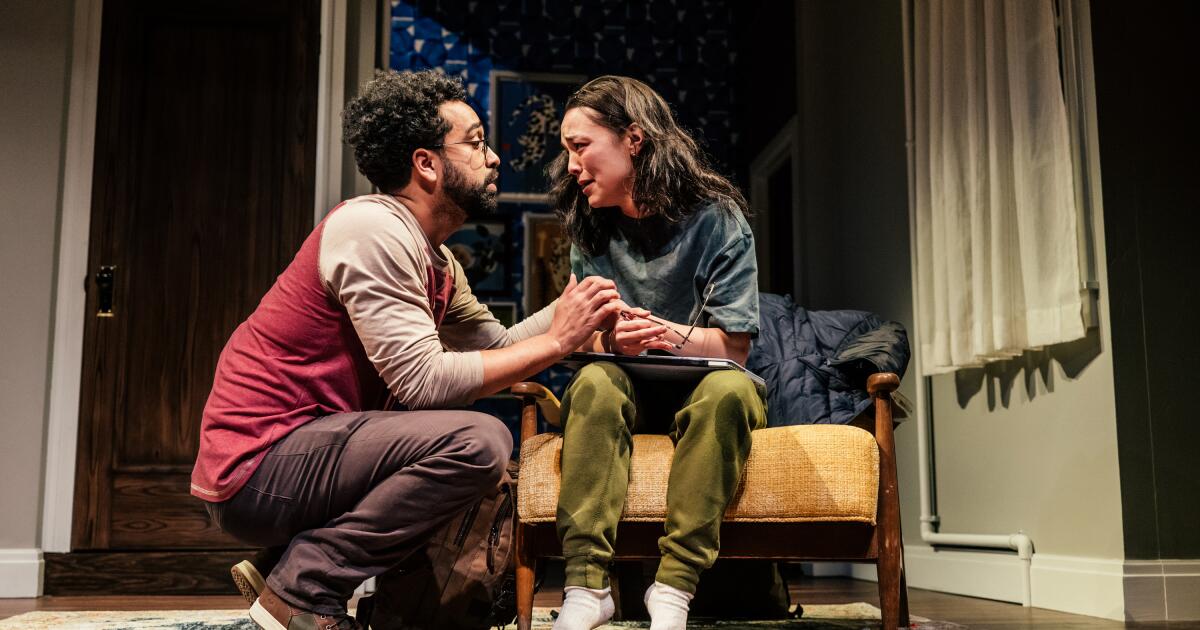
Sally (Midori Francis), a writer whose first book was a big hit but whose second book is long overdue, and Theo (Noah Keyishian), who just found out he won a major literary prize for his first novel and is now up for a game-changing job at Columbia University, are at different points in their careers. Sally is processing both the shock of a miscarriage and her ambivalence about her marriage.
She’s also worried that her publisher is going to make her pay back the advance for the book about Plath and Hughes that she’s been unable to make any headway on. “I have to finish the draft,” she tells Theo. “If I can’t do that when I’m living in their apartment, I should honestly just kill myself.”
Clearly, Sally is having a hard time holding it together. The precarious state of her mind forces us to question whether Sylvia and Ted are ghosts, hallucinations or literary inventions sprung to life. But these characters are initially presented as objectively real. We meet them before we meet Sally and Theo, and whether they are figments or not, they are unmistakably haunting the new occupant who’s writing about them.
Unfortunately, these illustrious figures are badly written and stiffly played. O’Sullivan can’t keep Ted’s accent straight, and Gailus seems to be offering a Ryan Murphy version of Plath.
Marianna Gailus, left, and Cillian O’Sullivan in “Sylvia Sylvia Sylvia” at Geffen Playhouse.
(Jeff Lorch)
Sally may be struggling to give Sylvia and Ted life on the page, but Hyland is having her own trouble ushering them to the stage. The word “factitious” kept coming to mind. Artificiality might be the point, but it’s not one that gives much pleasure in the theater.
Who wants to sit through a fictitious novelist’s clumsy drafts? The scenes between Sally and Theo are more convincing, but the dynamic between them grinds on snappishly. Theo tries his best to be a sensitive and supportive husband, but Sally can’t seem to get what she needs from him. And as her marriage and literary career fall apart, her psychiatric problems intensify.
Writing in a desperate junk-food-fueled all-nighter, Sally appears to have entered a manic phase. Theo, terrified that she might make another suicide attempt, looks on helplessly. Their small, spare yet tasteful apartment (the work of the collective Studio Bent) turns into a marital pressure cooker as Theo’s fortunes rise and Sally’s self-belief craters.
Hyland captures the parallels between the two couples. Her Ted is a patriarchal monster, controlling, moody and sexually malignant. Theo is far more psychologically evolved, but he has his own blind spots that provoke Sally, who’s more emancipated than Sylvia but less professionally assured and just as unstable.
The times are vastly different, but the balance of power between these married writers remains precarious. There might be a fascinating play here, but the amorphous scenes that Hyland provides lack a dramatic through line.
As the play flounders, director Jo Bonney casts about for solutions. A playful ghost story that has Sylvia entering and exiting through the refrigerator takes a bloody turn. As Sally spirals, the set turns crimson. This detour into horror is only temporary, but there’s no clear destination in sight.
The unstoppable force of Sally’s resentment and the immovable object of Theo’s perseverance are not an ideal dramatic combination. Francis bravely doesn’t soften Sally’s prickly nature, but she doesn’t give us much reason to sympathize with her character either. Keyishian’s gentle Theo is so solicitous that Sally’s abrasiveness begins to feel abusive, not to say theatrically off-putting. Perhaps that too is intentional. But just as there’s a difference between depicting chaos and depicting chaotically, there’s a difference between presenting theatergoers with a realistic image of mental illness and driving an audience nuts.
Ted is a cartoon creep with an Oxbridge hauteur, but Theo’s shortcomings may be too subtly rendered for a play that cries out for more definition. (Even his betrayal, involving the use of private marital material for literary purposes, seems equivocal.)
Hyland can’t resolve her shapeless play, so she has Sally talk her way into the future in a rambling monologue that’s a complete cop-out.
Sylvia warned Sally that if she tried to write about her, she would do everything in her power to stop her. The ghost of Plath, however, has nothing to worry about. “Sylvia Sylvia Sylvia” conks out on its own.
‘Sylvia Sylvia Sylvia’
Where: Gil Cates Theater at Geffen Playhouse, 10886 Le Conte Ave., L.A.
When: 7:30 p.m. Wednesdays-Thursdays, 8 p.m. Fridays, 3 and 8 p.m. Saturdays, 2 and 7 p.m. Sundays. Ends Mar. 8
Tickets: $45 – $139 (subject to change)
Contact: (310) 208-2028 or www.geffenplayhouse.org
Running time: 1 hour, 45 minutes (no intermission)

‘Wait Wait’ for February 14, 2026: With Not My Job guest Arden Cho

Jikipedia turns Epstein’s emails into an encyclopedia of his powerful friends

Global protests call for Iran regime change in major cities worldwide after bloody crackdown

Fetterman slams Democrats’ ‘Jim Crow 2.0’ voter ID rhetoric as party unity fractures

Certain bitter foods may trigger a brain response similar to working out, study finds

Florida High School Football Rankings: Top 25 teams – Oct. 21

Cleary's 21 help Le Moyne down Central Connecticut State 69-64 in OT

How old is Bo Nix? What to know about Oregon quarterback ahead of 2024 NFL Draft

99th annual Pony Swim held in Virginia

Indiana Members Credit Union announced as new anchor tenant at Bottleworks District
Fetterman slams Democrats’ ‘Jim Crow 2.0’ voter ID rhetoric as party unity fractures

Will Warsaw become the seat of a new EU agency? To be decided in March

Four people on NASA’S Crew-12 arrive at the International Space Station

Video: Vermont Made Child Care Affordable. Could It Lead by Example?

Here’s how the DHS shutdown could impact the lives of everyday Americans
-

 Politics1 week ago
White House says murder rate plummeted to lowest level since 1900 under Trump administration
-

 Alabama1 week ago
Geneva’s Kiera Howell, 16, auditions for ‘American Idol’ season 24
-

 Ohio1 week ago
Ohio town launching treasure hunt for $10K worth of gold, jewelry
-

 News1 week ago
The Long Goodbye: A California Couple Self-Deports to Mexico
-

 Science1 week ago
Video: Rare Giant Phantom Jelly Spotted in Deep Waters Near Argentina
-

 Culture1 week ago
Video: Farewell, Pocket Books
-

 News1 week ago
Video: Investigators Say Doorbell Camera Was Disconnected Before Nancy Guthrie’s Kidnapping
-

 Technology1 week ago
Apple might let you use ChatGPT from CarPlay