Entertainment
Behind the spectacular collapse of the Alec Baldwin 'Rust' shooting prosecution


The spectacular collapse of New Mexico’s criminal prosecution of Alec Baldwin in the deadly “Rust” movie shooting laid bare nearly three years of errors by state officials who were eager to prove themselves on a world stage.
Legal experts had long said it was a risk to charge Baldwin with involuntary manslaughter, a felony, for the 2021 death of cinematographer Halyna Hutchins, whom the actor accidentally shot while preparing for a scene with a firearm. Baldwin had been told — incorrectly — that his prop gun contained no actual ammunition.
New Mexico First Judicial District Court Judge Mary Marlowe Sommer threw out Baldwin’s charge late Friday following a day-long hearing in which defense attorneys alleged Santa Fe County deputies and a special prosecutor concealed potential evidence — a bag of bullets an Arizona retired police officer turned in after the incident — that may have proved helpful to Baldwin’s case.
Judge Mary Marlowe Sommer, center, questions special prosecutor Kari T. Morrissey, second from left, Friday in Santa Fe, N.M., about evidence not turned over to defense attorney Alex Spiro, second from right, during actor Alec Baldwin’s trial alleging involuntary manslaughter during filming of the movie “Rust.”
(Eddie Moore / Associated Press)
“If this conduct does not rise to the level of bad faith, it certainly comes so near to bad faith to show signs of scorching,” Marlowe Sommer said, directing her scorn at prosecutor Kari T. Morrissey.
Baldwin, who had been facing an 18-month prison sentence if convicted, sobbed as he heard the decision.
Legal experts were stunned at what they said was the prosecution’s botching of the case. “What a catastrophic end to this case for the special prosecutor,” said Santa Fe attorney John Day, who was not involved in the case. “It was a disaster — a complete train wreck.”
Three days into the trial, Baldwin’s high-powered legal team had successfully steered the case away from issues Morrissey wanted to explore, including evidence Baldwin may have pulled the trigger. They focused on an investigation that failed to answer a central question in the “Rust” shoooting: Where did the live rounds originate?
The Baldwin criminal case may have been doomed from the start.
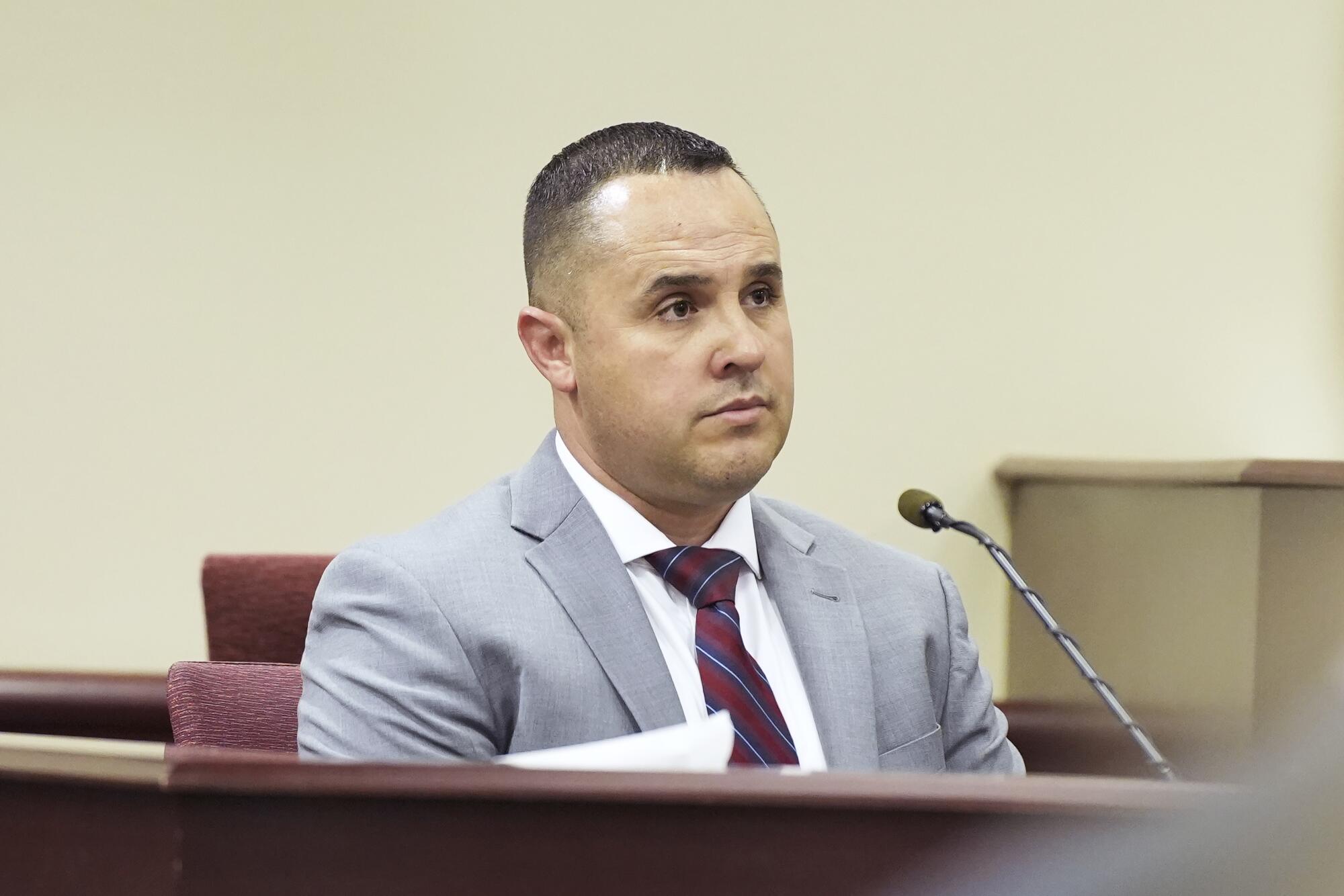
Santa Fe Sheriff’s Office Lt. Brian Brandle testifies during the trial of actor Alec Baldwin on Friday at Santa Fe County District Court in Santa Fe, N.M.
(Ramsay de Give / Associated Press)
Santa Fe County sheriff’s deputies arriving at western movie location Bonanza Creek Ranch near Santa Fe on Oct. 21, 2021, were rattled by the mayhem. Two victims lay bleeding on the floor of an old wooden church, Hutchins and director Joel Souza. Armorer Hannah Gutierrez Reed appeared to be having a panic attack. Baldwin declined a deputy’s invitation to sit in a patrol car, saying he was smoking a cigarette.
Law enforcement officers were gobsmacked: How could two people filming a movie be shot with a prop gun held by one of Hollywood’s most famous actors?
As journalists from around the world descended on Santa Fe, the sheriff and district attorney projected swagger. The sheriff was preparing for a reelection fight. At a news conference six days after the shooting, Dist. Atty. Mary Carmack-Altwies was asked whether Baldwin might be charged. “All options are on the table,” she told the crowd.
Pressure quickly mounted after Baldwin told ABC News anchor George Stephanopoulos that he didn’t pull the trigger. Gun enthusiasts howled, saying that gun model doesn’t fire on its own.
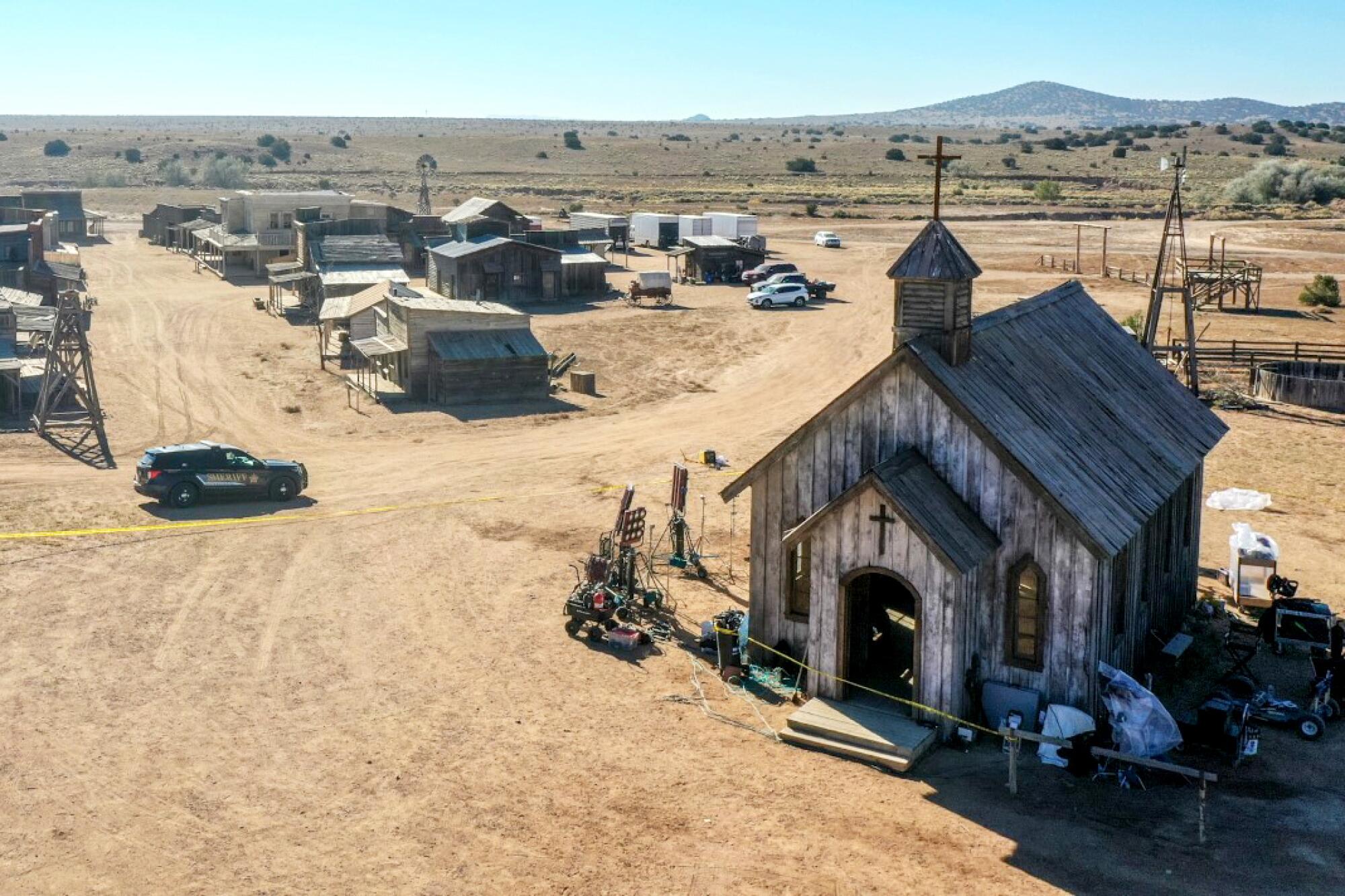
Bonanza Creek Ranch one day after Halyna Hutchins died on set.
(Roberto E. Rosales / Albuquerque Journal)
By year’s end, sheriff’s detectives had made mistakes that would haunt the case.
The movie’s prop master threw bullets from other actors’ weapons into the trash. The “Rust” prop truck, which held guns and ammunition, wasn’t searched for nearly a week. And it took another month before detectives showed up with a warrant at the Albuquerque prop house of weapons and ammunition provider, Seth Kenney.
The deputies found the military green ammo box they were looking for — Thell Reed, the armorer’s father, told investigators it contained live bullets that may have been the same batch as those on “Rust” — but it was empty.
Baldwin’s team asserted it was Kenney who co-mingled real bullets with dummies — an allegation that Kenney has denied, including while testifying Friday.
Adding another wrinkle, violent tests of Baldwin’s revolver at the FBI Laboratory in Virginia in mid-2022 fractured key gun components.
“I don’t think anyone would say this was a good, clean law enforcement investigation,” Day said. “And the prosecutors compounded the problems with their own missteps and poor judgment calls.”
After more than a year of investigating, the sheriff shipped the case to prosecutors so they could make charging decisions. The D.A. had hired a special prosecutor to help. It looked like a powerful team.
Carmack-Altwies was a progressive Democrat. The first special prosecutor, Andrea Reeb, was a Republican who championed gun rights.
But emails between the pair, later turned over to Baldwin’s team, revealed that Reeb had joked that prosecuting Baldwin could boost her state House campaign. To some, the disclosure made it look like Baldwin’s prosecution was politically motivated because many conservatives dislike Baldwin, who lampooned former President Trump on NBC’s “Saturday Night Live.”
Further, prosecutors blundered in January 2023 by adding a “gun enhancement” when filing involuntary manslaughter charges against Baldwin and Gutierrez Reed. The enhancement carried a mandatory five-year prison sentence but wasn’t on the books at the time of the “Rust” shooting, forcing prosecutors to scale back.
Reeb stepped down and Carmack-Altwies soon followed. That’s when Morrissey, a respected Albuquerque criminal defense lawyer, dug into the case.
Baldwin’s lead attorney, Luke Nikas, flew to New Mexico. He gave Morrissey evidence that he said showed Baldwin’s gun had been modified before arriving on set, according to court filings. With little time before a pivotal hearing, Morrissey dropped charges against Baldwin.
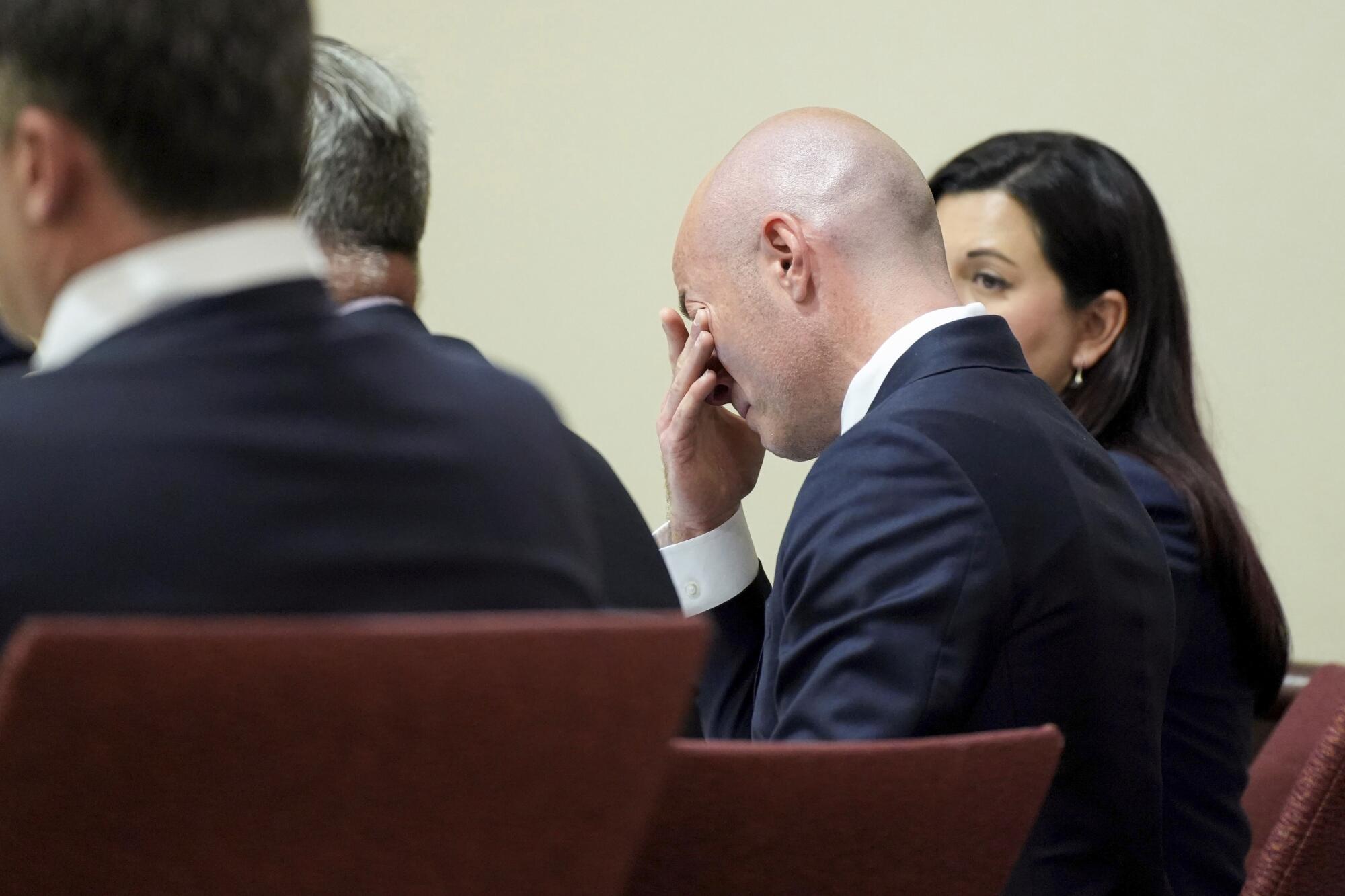
Attorney Luke Nikas reacts during Baldwin’s trial for involuntary manslaughter Friday at Santa Fe County District Court in Santa Fe, N.M. The judge threw out the case against Baldwin in the middle of his trial and said it cannot be filed again.
(Ramsay De Give / Associated Press)
The “Rust” star immediately traveled to Montana to finish filming the movie. Meanwhile, Morrissey ordered more tests to determine whether Baldwin’s gun had a hair-trigger, as the defense team suggested.
Arizona gun expert Lucien Haag rebuilt the revolver, and ultimately concluded the gun hadn’t been modified. He was also convinced Baldwin pulled the trigger.
By last summer, tensions between Morrissey and Baldwin’s team were growing. But Morrissey offered Baldwin a deal in October to plead guilty to negligent use of a deadly weapon, a misdemeanor, and receive a suspended sentence. Weeks went by with no answer. Then Morrissey learned Baldwin’s team had shared the plea details with NBC News and planned to sue the state of New Mexico. Baldwin also allegedly pressured a crew member to be interviewed in a documentary Baldwin commissioned about himself, according to an April court filing by the prosecutor.
Morrissey withdrew the offer, sending the case to a grand jury. Baldwin was indicted in January and pleaded not guilty.
The trial, which began Wednesday, was to be the most-publicized court action in New Mexico’s 112-year history. Legal experts saw it as a huge gamble by the prosecution.
“This case clearly should not have been criminally brought,” New York defense attorney Duncan Levin said Thursday. “The shooting was a tragic mistake but mistakes are not crimes.”
It wasn’t long before the case brought by Morrissey and fellow prosecutor Erlinda O. Johnson started to fall apart. Baldwin’s team filed a motion to dismiss the case after the second day of testimony. Marlowe Sommer called an 8:45 a.m. hearing Friday for the lawyers and told the jury to report by 9:30 a.m.
Spiro began Friday’s hearing by accusing Morrissey of signaling directions to her witnesses. Nikas then launched into a litany of alleged evidence violations, stemming from a bag of bullets that Troy Teske, a retired police officer who lives in Arizona, turned over to the Sheriff’s Office in March — potential evidence that was not disclosed to the defense.
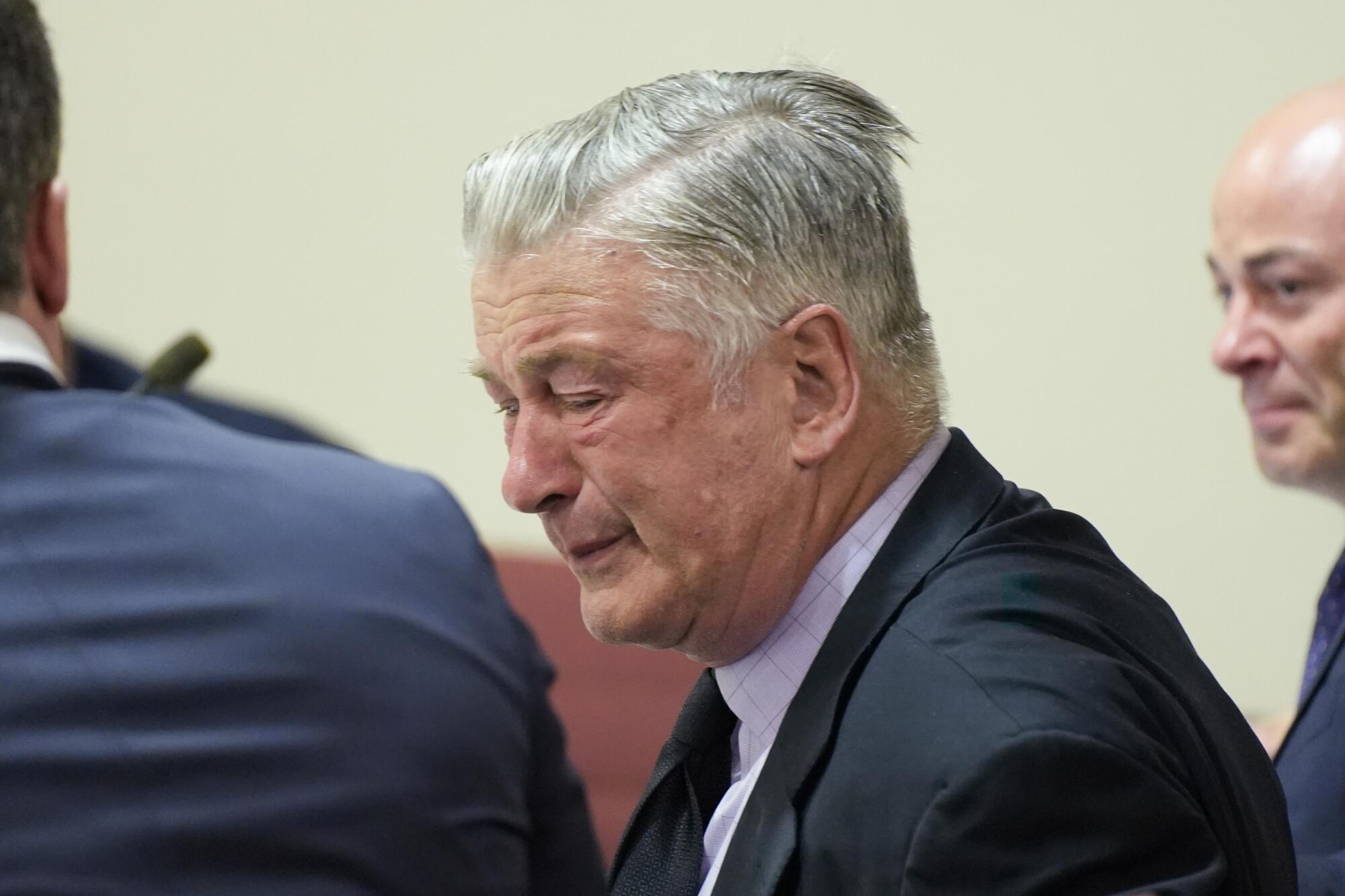
Actor Alec Baldwin, center, reacts as he sits between his attorneys Alex Spiro, left, and Luke Nikas after the judge threw out the involuntary manslaughter case against him Friday.
(Ramsay de Give / Associated Press)
Morrissey insisted the envelope contained nothing of “evidentiary value” because the bullets remained in Arizona — far from the “Rust” set.
“This defies everything they teach you in law school, and when starting out as a prosecutor,” University of New Mexico law professor Joshua Kastenberg said. “Prosecutors should never determine what evidence is relevant — that’s up to a judge.”
With a stern look, the judge donned blue latex gloves and opened the evidence envelope with scissors.
Marlowe Sommer directed crime scene technician Marissa Poppell to categorize the bullets.
Gasps rippled through the courtroom when it was revealed that three bullets had casings stamped with Starline Brass — the identifying marker of the deadly bullets on “Rust.”
Furious, the judge scrapped the day of testimony and sent home the jurors who had been waiting in a back room. Johnson, the new prosecutor, resigned from the case and took a seat on a bench reserved for the public.
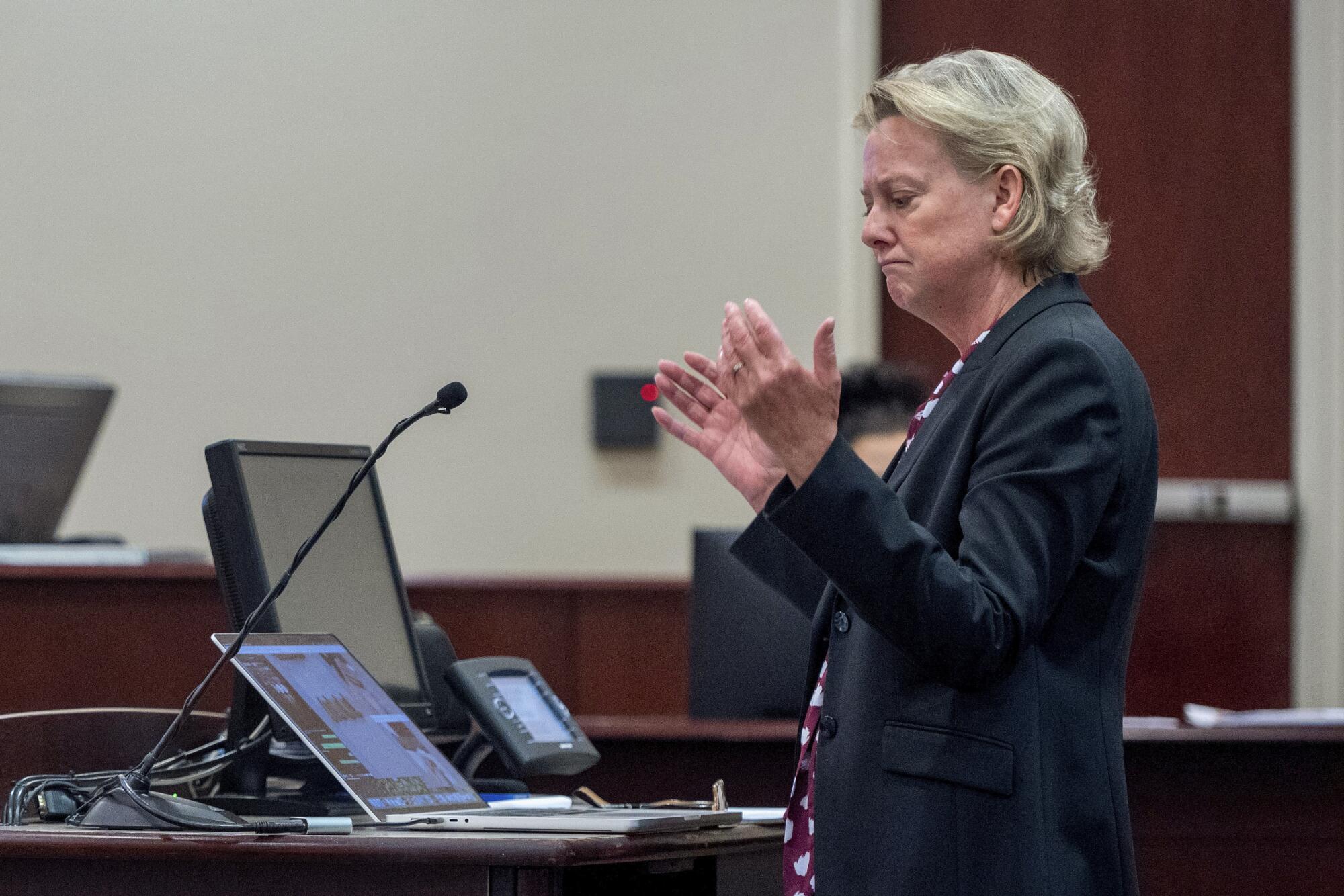
Special prosecutor Kari Morrissey talks about evidence not turned over to the defense during actor Alec Baldwin’s trial Friday.
(Eddie Moore / Associated Press)
The two sides clashed over the value of the Teske bullets. Teske was a former friend of Kenney, the ammo provider, and a current friend of Thell Reed. Baldwin’s lawyers argued the bullets might show a connection to Kenney, one of Morrissey’s main witnesses.
Morrissey disagreed, saying the bullets only pointed to Thell Reed. She has alleged his daughter brought some to the “Rust” set.
The judge also was deeply troubled that sheriff’s deputies logged the Teske bullets under a different case number, not the one for “Rust” evidence, making it impossible for defense attorneys to find on their own.
Marlowe Sommer grilled the lead detective, Alexandria Hancock. The judge asked whether Morrissey had participated in discussions this spring about the Teske bullets.
“Yes,” Hancock said. Louder gasps were heard in the courtroom.
At the end, Morrissey took to the witness stand to defend her conduct in the case. The judge was not swayed.
“There was no excuse for what happened from a prosecutorial standpoint,” Kastenberg said. “The recriminations are just starting.”
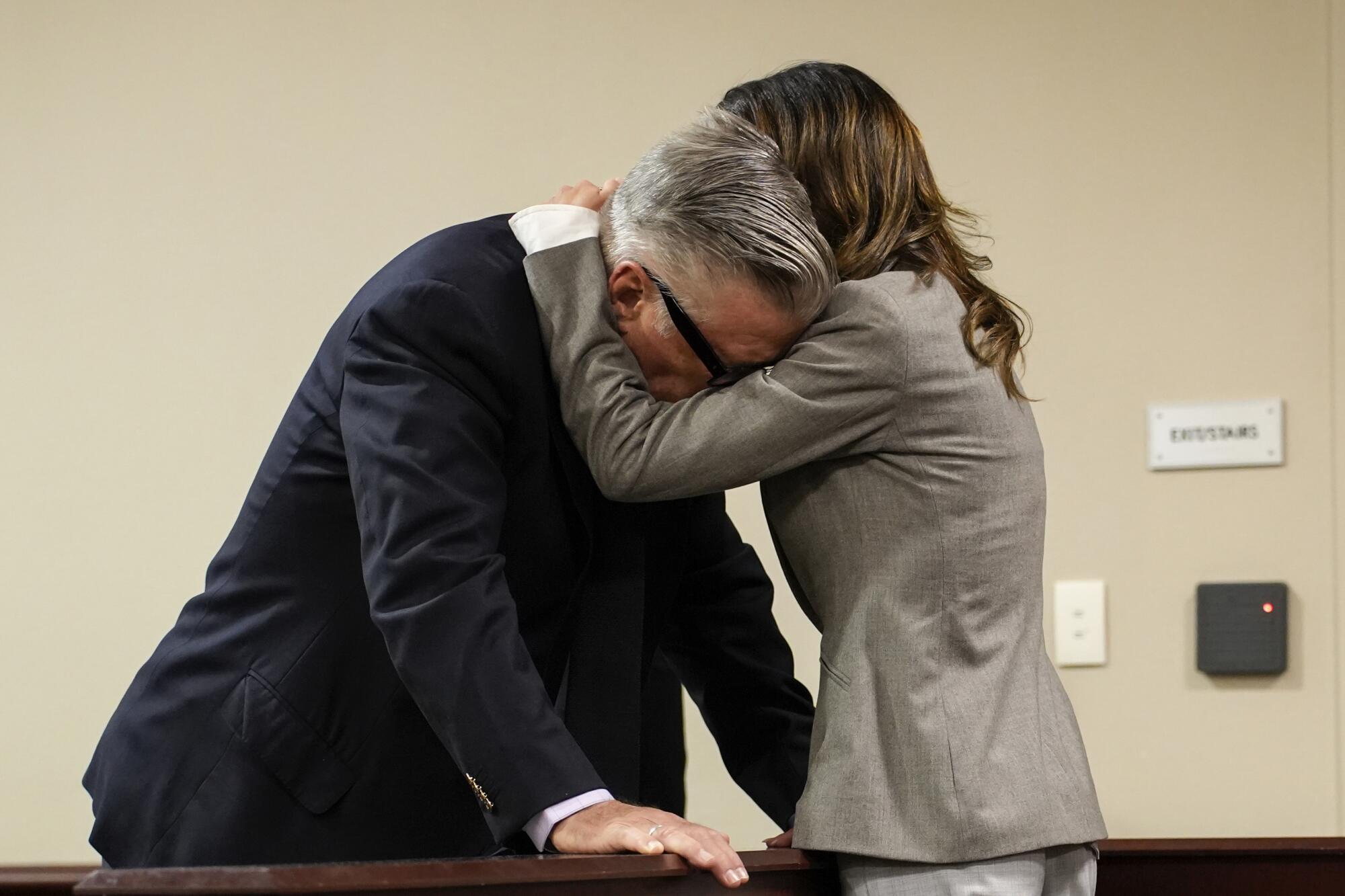
Hilaria Baldwin, right, speaks to her husband, actor Alec Baldwin, at his trial Friday.
(Ramsay de Give / Associated Press)
“Rust” legal wranglings are not over.
Certain civil lawsuits against Baldwin and the producers, including from Hutchins’ family members, remain unresolved.
“We respect the court’s decision,” said Brian Panish, lawyer for Hutchins’ husband, Matthew, after the judge dismissed Baldwin’s criminal case. “We look forward to presenting all the evidence to a jury and holding Mr. Baldwin accountable for his actions in the senseless death of Halyna Hutchins.”
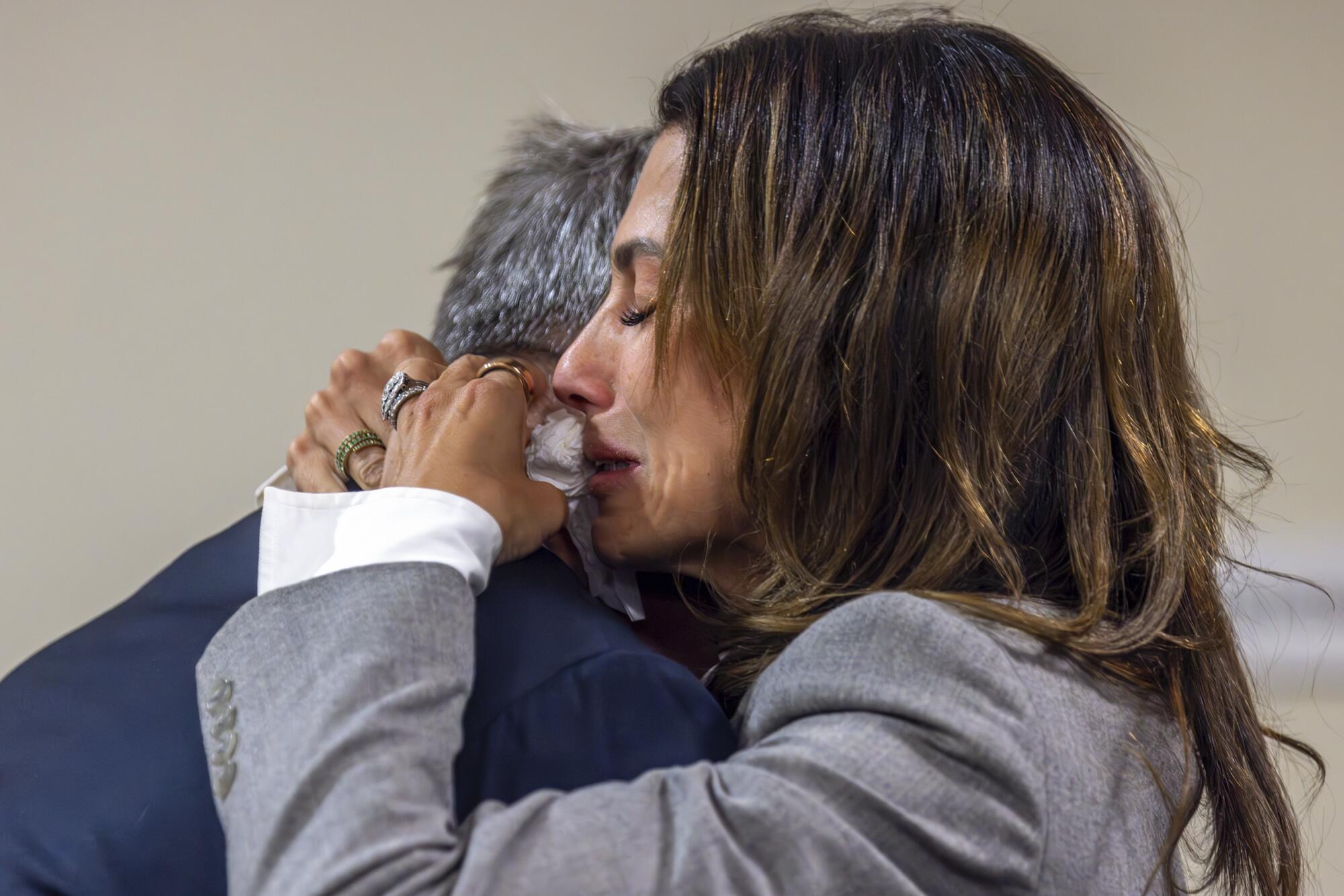
Actor Alec Baldwin hugs wife Hilaria Baldwin after District Court Judge Mary Marlowe Sommer threw out the involuntary manslaughter case against Baldwin on Friday.
(Luis Sánchez Saturno / Associated Press)
Gloria Allred, who represents the victim’s Ukranian family, added: “The dismissal of the criminal case against Alec Baldwin is in no way, shape or form an exoneration of him.”
Others took a more charitable view, including LeAnn Brightwell, 80, who moved to Santa Fe two years ago from Palm Desert.
“I never thought he was guilty of murder; they shouldn’t have charged him,” Brightwell said. “What a horrific thing to know that you killed someone — that’s punishment enough.”



Thor Moreno’s 2026 semi–found footage thriller Van Life presents a compelling premise that ultimately struggles to sustain its feature-length ambitions. The film follows Zoe (Kelsey Osborne), a law school dropout who abandons her conventional path to pursue solitude and self-discovery in the forests of the Pacific Northwest. When Zoe goes missing and an official search effort turns up empty, her brother (Adam Meirick) begins his own investigation. His discovery of Zoe’s abandoned cell phone offers a fragmented window into her final days — footage that gradually reveals her journey from quiet adventure to psychological and physical peril.
Drawing clear inspiration from the survivalist introspection of Into the Wild and the escalating dread of The Blair Witch Project, Van Life sets out to explore the dangers of isolation in an era where even solitude is mediated through digital self-documentation. Zoe’s travel vlog initially captures the beauty and tranquility of the Northern California wilderness, but as her recordings continue, the tone darkens, suggesting that something far more unsettling may be stalking her beyond the reach of her camera.
Osborne delivers a grounded performance that anchors much of the film’s early momentum, and the found-footage cinematography makes effective use of the region’s stark landscapes to create a persistent sense of unease. Unfortunately, the film’s pacing undermines these strengths. Much of the narrative unfolds at a languid pace, with genuine tension and horror elements not emerging until the final act. By the time the film’s more overt scares arrive, the earlier promise of its premise has largely dissipated. A post-credits scene offers little in the way of narrative or thematic resolution.
The film is also hampered by several distracting inconsistencies. Most notably, despite its title and repeated dialogue references to Zoe purchasing a van to facilitate her travels, she is instead shown driving a Subaru hatchback throughout the film. No van in the film. While this discrepancy does not directly impact the plot, it creates an avoidable disconnect between the film’s premise and its on-screen reality.
Additional logical gaps — including the improbable recovery of Zoe’s phone months after her disappearance in a snow-covered wilderness, and the apparent existence of an active vlog audience unknown to both her family and law enforcement — further strain the film’s credibility.
Van Life contains the foundations of an effective suspense narrative: a likable central character, an evocative setting, and a timely thematic focus on curated independence in the digital age. However, its execution rarely capitalizes on these elements in a way that justifies its runtime. The material might have been better served in a more concise format, where its atmospheric strengths could be emphasized without the burden of narrative sprawl.
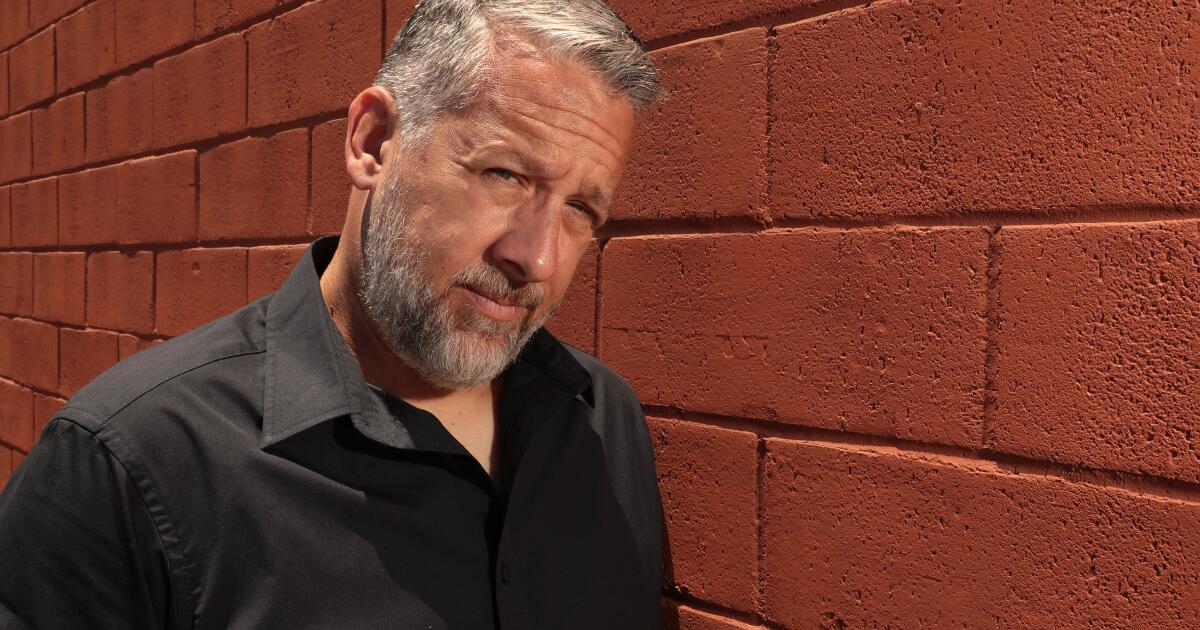
Ryan Sickler is used to asking the question that people are afraid to ask: “Is there anyone here who has ever actually died and come back and would be comfortable talking about it in front of all of us?”
It’s not your typical comedy show crowd work but it has profound results. During his special “Ryan Sickler: Live & Alive” released on YouTube in October, a woman in the audience talked about a near-death experience as a child where she rode her bicycle in front of a neighbor’s station wagon. But Sickler pointed out that this remarkable level of candor in the audience is something he continues to marvel about. In fact, he said they did two shows the night they taped his special and during the second show two people in the crowd said they had near-death experiences.
“When I ask the question, I know there’s someone in the crowd that’s like, ‘There’s nobody in here that’s died and come back,’” Sickler said. “So now they’re all very excited to listen too. Like, what happened to this lady, or what happened to this guy? You know, there’s been some wild ones, some real funny ones out there too.”
Given how many comedy specials are being released on various streaming platforms, he says that “we have lost the specialness of the special.” But Sickler said since coming so close to death and being able to talk about it with candor and relatability, he is still calling his latest self-produced YouTube special, special. It now has more than 1 million views on YouTube. Sickler has been on the comedy scene for more than 30 years and released his comedy special “Lefty’s Son” in 2023. He also hosts the “HoneyDew Podcast.” His comedy career has often incorporated his lived experience with a rare blood-clotting disease called Factor V Leiden that almost killed him.
But these days, he’s grateful to be alive, to have been able to wake up when it looked like he might not, to watch his daughter continue to grow up and the laughs along the way. Sickler has long been candid about his chronic health issues with his comedy but he has found particular meaning in doing crowd work when he performs, that talks about death and what it means to live.
The Times recently spoke with Sickler about his special and how he thinks about his sense of health, humor and mortality.
Ryan Sickler in the studio where he films the “HoneyDew Podcast.”
(Al Seib / For The Times)
What did you want to say this time around in your new special?
My first special was something that was a bit of a hybrid of stuff that had been out there and around, but I didn’t own it. It was out there on people’s platforms. They’re making the money off of it. And so I did a bit of, “Let me get this stuff on my channel where I can control it.” And then the other part of that special was becoming a new single dad, all those things this time, specifically, I really just wanted to talk about what had happened and the results after that. I follow these comedy accounts and in October, there were 31 stand-up specials that hit between Netflix, Hulu, YouTube. November was 30. This month was a little slow because the holidays, but it was still at 18 the last time I checked. So I don’t think there’s anything special about stand-up specials anymore. You’re in an environment now where there’s a stand-up special a day, people are doing that with podcasts. There’s so much content going on out there, and I feel like a lot of it is the same. So I this time wanted to just take something that happened very personal to me, this incident, and then tell the story, not only behind it, but what happened after and I was really proud of being able to just focus on that and make that into this special instead of just my observations on this or my thoughts on that. I’m a storyteller and I really think that’s what art is.
When did you realize you had the courage to write about this near–death experience?
I know I had the courage to write about it a long time ago. When I’m making people laugh at my father’s funeral and things like that, I knew I was comfortable being able to take on the material. But what I didn’t know was, could I make it funny? Could I make it relatable? Could I make this one thing that happened to this one person on this rock in outer space matter to anybody and make them care? Because it’s not like we all had this happen to us. This is just one thing that happened to this one dude. So that was really what I was more worried about, is like, can I get this message across and make it relatable, funny and entertaining at the same time? Which is why I threw in those really expensive light cues.
It can be very challenging to hear about these traumatic [near–death] experiences that people have had. How do you absorb that and not absorb it too much?
I’ve been doing this show for so long that it does start to wear on you a little bit hearing a lot of the trauma. So I created a new podcast a couple years ago called the Wayback, which is just fun, funny, nostalgia. So that also for me, was like, let’s not dig into the tears and let’s just laugh about growing up. So that was one way where I could still keep it in my lane and do my job, where I alleviate that a little bit. But the other thing, and I make fun of myself a little, is I’m like the paramedic at the party now. I’m the guy that’s like “You think that’s bad, wait until you hear this.” “This one guy …” “This one lady …” You know what I mean? So I’ve almost become sort of their voice, and I have absorbed it in a way that isn’t so negative, where I carry it home with me. I always forget the quote how it’s worded, but it’s something to the tune of, if we all stood in a circle and threw our problems in the middle, we’d all take our shit right back. It’s like you know what, that’s what you’re dealing with? I’m gonna go ahead and take mine.
How is hearing all these stories and connecting with the crowd and fans in this way [about near–death experiences] changed how you think about your own sense of mortality?
Even with my close call, like, that one angered me, because you start to think about things. You never know how you’re really going to go. You might have an idea if you’re getting older and cancer runs in your family, whatever, but the fact that you could go to a hospital for a simple surgery, they don’t listen to you, everything’s there in your paperwork. You’re your own advocate. You’re doing all the right stuff by yourself, and you’re among professionals, medical professionals, not Yahoos, and you can still have someone else make a mistake and your life is gone. That started me thinking a lot like, “Oh man, for no fault of my own, I could also be gone.” So I go day by day, and I try to be happy day by day. And I’m not going to lie, I also like to know I got a little something tomorrow too.

Do you think that incorporating death and near–death in your comedy helps people work through their own feelings about death and grief?
I only say yes to that because the amount of emails I get, the amount of feedback we get, the amount of guests that still continue to show up [to support] the Patreon. I’ve definitely found, I would say, a purpose in my people. If you’re someone saying you’re a jerk for laughing at this lady talking about cancer, we’re not laughing at her cancer. We’re laughing at something, some light that she found in the darkness of this and trying to have a moment here together, all about, “Hey, there’s some positive ways to look at things at your lowest.” So I know it’s helped people. I mean, we have, over the years, probably thousands of emails now. We have people telling us how much it’s helped. And I mean just through podcasting, I found out I have this blood disease. I was 42 at the time, and already been podcasting. There’s a lady I went to high school with. She’s like “Ryan, my son is 17. He started clotting.” I said, “Go ahead and check for this.” He listens to the podcast. This kid has it. I said, “Well, bad news. It’s genetic.” Now the whole family’s got to get tested. And if you have it from one parent, it’s not great, but having it from two is bad. The whole family gets tested. The parents have it. She’s got it from both her parents. So I can’t get over the fact that a woman I knew when we were children, 35 years later is like, “Hey, that thing you’re talking about on your podcast, my kids, my family, we all have it.” And then I’ve talked about another disease I also have, called Charcot-Marie-Tooth disease, which is CMT. And from bringing that up, people hit me up on that like “I have it, no one ever talks about that.”
What have you found to be one of the positives — besides surviving — of your near–death experience?
Gosh, so many. I have a child, so getting to see her grow and really taking care of my health and things. Not that I wasn’t before, but just I dove in even deeper. I went and got what’s called a gallery test for prescreening for cancer. I started doing all these blood works and like, “Let’s go find out everything you know, because I didn’t find out that I had this blood disease until I was 42 when I clotted.” I’m living my whole life, not even knowing I have this thing and and if I don’t clot, there are plenty of people out there that live to 100 years old and have it. It’s really made me appreciate life and trying to take things day by day. I also was living in a little single-dad pad at the time. We had no central air. We had tandem parking. We were above dumpsters. Our laundry was outside in a room with quarters. And when I got home — I’m still on a walker — and I was like, “What are we doing? We’re going to die without central air? Are we going to die with a bucket of quarters on the fridge? No more.” And so I moved my home, I moved my studio, I did all these things that are, like, the biggest thing you can do in life. We’re going to roll the dice, scared money don’t win, and we’re just going to go for it. Also, as a comedian and anybody in entertainment will tell you, a lot of times you work scared, you hold that money and you wait until the next thing comes. And also, as a single parent, you know we got to budget. And I was like, no more. We’re not going to go out and buy 10 Porsches. We’re going to be responsible. But I was on point with let’s go get a living will and trust. Let’s make sure we have that life insurance policy. Let’s make sure we have all the proper paperwork and stuff done before we do anything like go on a vacation, you know, let’s get this done now and get it done proper.
What do those conversations look like, if you have them at all, about encouraging your male friends to go to the doctor or encouraging them to take care of themselves, physically and emotionally?
I would say the conversations go something like this. My younger brother is like, “Hey, man, I just went in for a test, and they’re telling me I got to have an old school triple bypass,” and then that’s what we all get tested. “Hey guys, I found I got a blood disease.” “Oh man, we all better look into it now.” That’s usually how it goes. I don’t know many men who are proactive. There are a few of us these days. But it’s usually something horrible happens and then we’ll be proactive about everything else.
Do you have male fans who also say “I [saw] your special … I went to your show, and it made me go [to the doctor]”?
Yeah, but I’m saying, though, it still took them to come see a professional clown to get them to go to the damn doctor. I actually have been very good about going, because everyone in my family died. So I’ve been proactive in the sense that I go get two physicals a year. I’ve been doing that since my 20s. I always tell my doctor, if I can go buy expensive sushi, if I go buy weed, if I go buy all these things, I can put money into myself here and come see you a second time and pay for all that. So I do two physicals a year, and I’ve been doing that forever. But I’ve never done any sort of like gallery test. And now we’re in our 50s, so we got to go get the prostate and all that. That’s when you start hearing about that stuff. There’s a lot of ignorance that goes into it as well. I just had a guest here on the “HoneyDew” and said he didn’t go to a doctor or anything for over 20 years because he was just scared of what they were going to tell him. He was scared to get the bad news. You can kind of get the bad news and you could turn that into good news. It doesn’t need to be deadly news.
How do you know when you’ve been too open?
It usually tends to be a personal thing where someone’s like, “I don’t really appreciate you bringing that up.” So I don’t anymore. I’m always cognizant of [saying] like, “Hey, would it be cool if I talked about this or whatever?” I feel like the question you’re asking me would have been great for me just before I started, like, the “HoneyDew” and stuff because this is what I really want to talk about. Everyone wants to talk about the best and bring their best and I just really do want to hear about, you know, the trauma bond. I want to hear about the worst times in your life. I want to know because, honestly, that tells me so much more about you than you verbally talking about you. You know who you were in those moments, how you reacted, how you behaved, how you’ve adjusted. Those things really end up defining who you are, and that’s more what I want to know about. I don’t want to know your best polished version of yourself.
Movie Reviews
‘A Child of My Own’ Review: Award-Winning Chilean Documaker Maite Alberdi Ventures North to Mexico for a Chronicle of a Faked Pregnancy

Following her justly acclaimed documentaries (The Mole Agent, The Eternal Memory) that play like dramas and a scripted feature inspired by actual events (In Her Place), Chilean director Maite Alberdi continues to blur, smudge and gleefully mess with the lines between fiction and fact in her latest, the by-turns highly comical and then suddenly moving A Child of My Own (Un hijo propio).
Revolving around a news story from the early 2000s that brings Alberdi north of the equator for her first Mexican-set feature, Child layers interviews with the actual participants in this strange tale with a scripted and performed re-enactment of the events. But don’t worry, this is nothing like the tacky reconstructions one often sees in made-for-TV docs to break up the monotony of talking heads telling the story, thanks in part to Alberdi’s deft narrative footwork. It helps that the cast is led by the immensely engaging Ana Celeste Montalvo Peña, who stars as Alejandra, a young hospital administrator who fakes a pregnancy and takes drastic measures to assuage her intense maternal longings. And also shut up all the pesky relatives who keep asking her about when she and husband Arturo (Armando Espitia) are going to start a family of their own.
A Child of My Own
The Bottom Line A playful and touching blur of fiction and fact.
Venue: Berlin Film Festival (Berlinale Special Presentation)
Cast: Ana Celeste Montalvo Peña, Luisa Guzmán, Armando Espitia, Mayra Sérbulo, Casio Figueroa, Alejandro Porter, Mayra Batalla, Ángeles Cruz
Director: Maite Alberdi
Screenwriter: Julián Loyola, Esteban Student
1 hour 36 minutes
Recalling Kitty Green’s darker but similarly genre-tweaking doc Casting JonBenet, this starts with a flurry of edits showing different actors trying out for the role of Alejandra, nicknamed Ale, our complicated protagonist. Montalvo Peña’s audition gets across in just a few minutes Ale’s distinctive blend of perk, pluck and pastel-pink girlishness spiked with a generous dollop of disassociated delusionality. From there, the film goes into a mostly straightforwardly chronological account of how Ale and later Arturo get into the desperate situation they eventually find themselves in.
As (staged) footage unfurls of Ale and Arturo dancing at their wedding to “Unchained Melody” (we get to see the real thing later on), Ale explains how even at this, what should have been the happiest moment of her life, she sensed that Arturo’s mother didn’t think Ale was good enough for her son. A sly freeze frame reveals a scowling mother-in-law (Ángeles Cruz), looking very grumpy indeed. The confetti has barely settled before the extended family of aunties and cousins start asking when they’re going to produce a child. Unfortunately, poor Ale has two miscarriages in short succession, and eventually an OB-GYN at the hospital where Ale works warns her that she may never carry a child to full term.
Just after a third pregnancy also miscarries, Ale meets a young woman named Mayra in a hospital waiting room and the two get talking. A single mother of one child already and due around the time that Ale would have had her baby, Mayra is unhappily pregnant. She’s come to the hospital seeking an abortion, although she’d prefer to “give [the baby] away rather than throw it away.” Ale suggests that Mayra passes over her baby to her when the time comes, and Mayra implausibly agrees.
To keep the deception going, Ale starts eating for two, piling on the pounds, fortunately carrying a lot of her new extra weight in her midsection. Concerned that Arturo might figure out she’s not knocked up, she puts him off when he tries to get conjugal in bed (it could be bad for the baby, she says) and insists he doesn’t have to come to any of her pre-natal check-ups at the hospital. Armed with marabou-feather festooned pens, an in-depth knowledge of the hospital’s procedures and familiarity with staff on many wards, she manages to fake a hospital record for herself, obtain a fake ultrasound picture and generally keep the whole deception going until it all falls apart in a matter of days.
To reveal what happens exactly would spoil the film’s several canny surprises, but it’s worth noting that we get to spend considerable time in the last half hour with the real Ale and Arturo — at least enough time to appreciate how well the actors inhabited the characters. And yet there remains an ineffable quality, especially in Ale — a placid dreamy blankness, inimitable, touching in its naiveté, and a tragic flaw all at once.
DP Sergio Armstrong and his team ensure that the candy-colored palette pops just enough to suggest we’re not quite in the realm of reality at times, while frequent overhead shots and odd angles enhance the sense of discombobulation. Nevertheless, the documentary footage also has a polished sheen to it, minimizing the separation between fact and fiction in a way that feels respectful of the subjects, putting them on the same level as the dramatis personae.

‘Quiet’ Pennsylvania father allegedly stabbed 3-month-old son, threw him in the snow as part of ‘sacrifice’

Two wrong-way drivers arrested on I-95 in separate incidents. What to know.

South Carolina Tops Jacksonville 3-1 for Third Straight Win

‘Once-in-a-generation’ announcement to include details about Smithfield’s Sioux Falls pork facility

Booker helps No. 4 Texas hold on against No. 22 Tennessee 65-63

Florida High School Football Rankings: Top 25 teams – Oct. 21

Cleary's 21 help Le Moyne down Central Connecticut State 69-64 in OT

How old is Bo Nix? What to know about Oregon quarterback ahead of 2024 NFL Draft

99th annual Pony Swim held in Virginia

Indiana Members Credit Union announced as new anchor tenant at Bottleworks District

Department of War transports next-generation reactor in nuclear energy milestone

Hungary’s opposition leader Magyar promises greater privacy protection
Obama responds to Trump sharing racist AI video depicting him as an ape

Chicago-area teacher breaks silence after losing job over 2-word Facebook post supporting ICE: ‘Devastating’

A pardon for a price? How Donald Trump has reimagined presidential clemency
-

 Alabama1 week ago
Geneva’s Kiera Howell, 16, auditions for ‘American Idol’ season 24
-

 Culture1 week ago
Video: Farewell, Pocket Books
-

 Illinois6 days ago
2026 IHSA Illinois Wrestling State Finals Schedule And Brackets – FloWrestling
-

 Technology1 week ago
Apple might let you use ChatGPT from CarPlay
-

 Politics1 week ago
Hegseth says US strikes force some cartel leaders to halt drug operations
-

 World1 week ago
‘Regime change in Iran should come from within,’ former Israel PM says
-

 Movie Reviews1 week ago
With Love Movie Review: A romcom with likeable leads and plenty of charm
-
 News1 week ago
Hate them or not, Patriots fans want the glory back in Super Bowl LX