

Connect with us

Entertainment

20 years ago at the Emmys: A clean sweep for 'Angels in America'

Published

on

20 years ago at the Emmys: A clean sweep for 'Angels in America'

There’s no such thing as a sure thing in awards season — but HBO’s “Angels in America,” which swept the 56th Primetime Emmy Awards on Sept. 19, 2004, at the Shrine Auditorium in Los Angeles, sure came close.

The miniseries came with every pedigree possible: Tony Kushner writing the script based on his Tony-winning play; director/executive producer Mike Nichols; and stars Meryl Streep, Al Pacino, Mary-Louise Parker and Jeffrey Wright — all of whom won that evening. “Angels” was the most-watched made-for-cable series in 2003, and it gave dramatic voice to the AIDS epidemic in a way no other TV project had before.

An ‘Angelic’ evening

And so, “Angels” had an angelic evening at the Emmys, beating the record “Roots” had held since 1977 for the most Emmys given to a miniseries in a single year (11 awards from 21 nominations). It became the first program to sweep every major category in which it was eligible, and became only the second series to that point to win all four main acting miniseries categories.

Today, there is no longer simply a miniseries category; over the decades, the “more than a single-episode fictional scripted show” label has evolved. Today, the category is for limited or anthology series.

Advertisement

“Angels” overcame solid competition from “American Family” (Season 1) on PBS; “Horatio Hornblower” on A&E; “Prime Suspect 6: The Last Witness” on PBS; and “Traffic” on USA.

Continuing the fight against AIDS

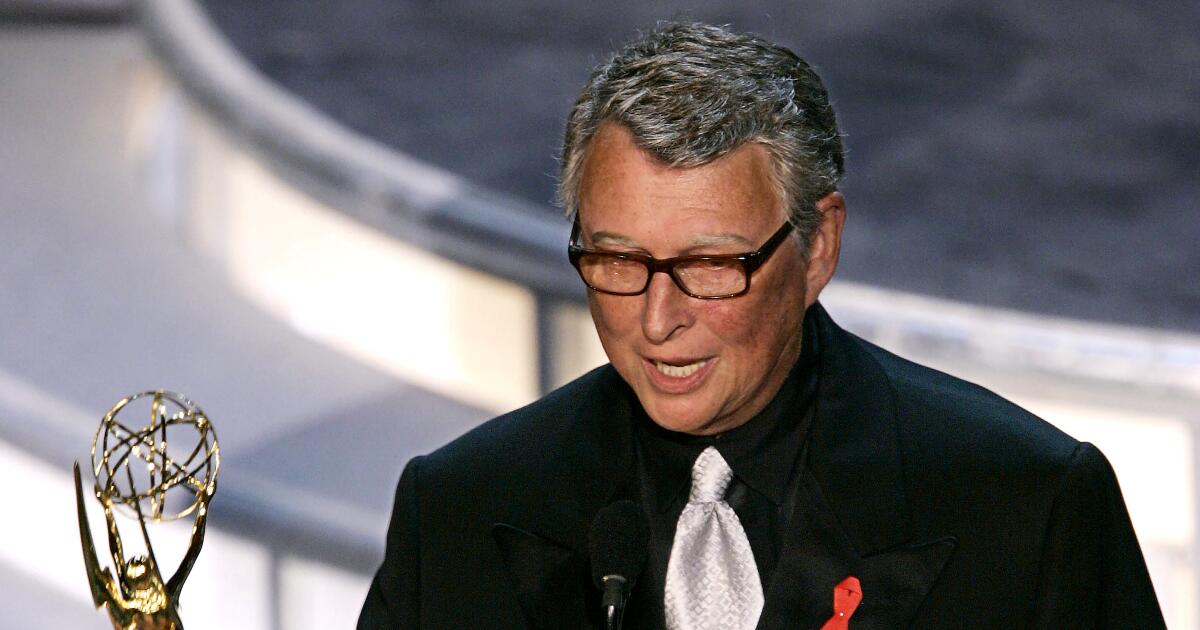
Nichols accepted the award from presenter Barbara Walters and promptly handed it over to Kushner, who joined him onstage along with many members of the cast and his fellow producers. After thanking HBO executives and his fellow producers (executive producer Cary Brokaw; co-EP Mike Haley and producer Celia D. Costas also were winners), Nichols added, “As you know, the fight against AIDS isn’t over yet and we must do what we can for Africa, and that is what we want to leave you as far as ‘Angels in America’ is concerned. Let’s see what we can do.”

This was Nichols’ fourth Emmy; he’d won for directing earlier in the evening, and his other two came in 2001 for “Wit,” on which he also worked with Brokaw and Haley. This was Brokaw’s second Emmy (his first came for “Wit”); and Haley’s and Costas’ first wins. Costas would go on to win a second in 2005 for “Warm Springs.”

Pioneers of heart surgery get their beat

Advertisement

The choice as to who would win in the television movie category was less predictable, but “Something the Lord Made” (also from HBO) earned awards for executive producers Robert W. Cort, Eric Hetzel and David Madden and producers Michael Drake and Julian Krainin.

The film about the pioneers of heart surgery brought a second Emmy to Cort (who had won in 1990 for “A Mother’s Courage: The Mary Thomas Story”); and first wins for Hetzel, Madden, Drake and Krainin (Krainin had an Oscar from 1974 for documentary short with “Princeton: A Search for Answers”).

After accepting the award from presenters Kiefer Sutherland and Joely Richardson, Cort spoke for the producers and gave a shoutout to the film’s nominated director, Joe Sargent, who was in the audience and already had four Emmys for projects spanning from 1973 to 1992. Cort noted that Sargent’s “courageous heart infuses every frame of our film.”

“Something the Lord Made” also took home awards for cinematography in a miniseries and single-camera picture editing for a miniseries, but no acting wins for nominated stars Yasiin Bey (Mos Def) and Alan Rickman.

“Something” was in competition with “Ike: Countdown to D-Day” (A&E); “And Starring Pancho Villa as Himself” (HBO); “The Lion in Winter” (Showtime); and “The Reagans” (Showtime).

Advertisement

Entertainment

Movies, books, art and music to explore as America turns 250

Published

on

Movies, books, art and music to explore as America turns 250

A crazed newscaster prompts his viewers to do a wild thing: open their windows and shout, “I’m as mad as hell and I’m not going to take this anymore.” And they do it, from Atlanta to Baton Rouge, so much yelling. It’s a prescient scene in “Network” from 1976, the year of America’s bicentennial. Fast forward to the semiquincentennial and Americans holler versions of that slogan through windows in real life, just on phones and computers.

When the national mood wobbles, we turn to the arts, which have the power to free buried desires, soothe souls and cross divides. So as America turns 250, the Entertainment team considered how this country’s ups and downs have shaped what we watch, listen to and read. Throughout this week those stories will appear here. Bookmark this page to come back for more.

To start, “Network” makes our list of movies that illustrate frictional historical moments. (“Team America: World Police” does too so expect range!) We also spotlight a new generation of playwrights reimagining Americanness with a sense of hope that America’s best years are still ahead of us. —Brittany Levine Beckman, Entertainment and Features editor

Advertisement
Continue Reading

Movie Reviews

‘Balaramana Dinagalu’ review: A restrained look at the gangster mind

Published

on

‘Balaramana Dinagalu’ review: A restrained look at the gangster mind

In K M Chaitanya’s Aa Dinagalu (2007), actor Atul Kulkarni, playing gangster Agni Sreedhar, says man is the biggest weapon in the underworld. “The rest are just properties,” he adds. The yesteryear Kannada crime drama, based on the real incidents from a big chapter of the Bengaluru underworld, stood out for its understated storytelling.

In Balaramana Dinagalu, which has the skeleton of a sequel to Aa Dinagalu, weapons are seen in the first scene. As the film progresses, we encounter an arsenal of knives, razors, machetes, and guns — each an extension of the gangsters’ identities and an indispensable tool in their quest to remain feared and lethal. Chaitanya attempts to make the movie a mix of reality and entertaining tropes.

Balaramana Dinagalu (Kannada)

Director: K M Chaitanya

Cast: Vinod Prabhakar, Priya Anand, Atul Kulkarni, Ashish Vidyarthi, Ramesh Indira

Runtime: 151 minutes

Advertisement

Storyline: Balarama, an ordinary young man from a remote village in Karnataka, becomes a dreaded gangster who rules Bengaluru

The director has roped in the same cast, who played the dreaded gangster trio of Kotwal Ramachandra (essayed by Sharath Lohitashwa), Jayaraj (Ashish Vidyarthi), and Agni Sreedhar (Atul) in Aa Dinagalu. That’s what makes one instantly curious about Balaramana Dinagalu. The only difference in the latest movie from the previous one is the fictionalised names of the real dons. Jayaraj becomes Jayaram, Sreedhar is Shashidhar, and Muthappa Rai is called Monnappa Rai (played by Ramesh Indira).

Even if these characters are the big draw in the movie, the plot revolves around the journey of Balarama, a character with a small yet significant presence in Aa Dinagalu. Vinod Prabhakar’s portrayal of the titular role is the film’s biggest takeaway. He makes us feel for the character, and is quite impressive in the final portions of the movie, where Balarama struggles to break free from the underworld’s trap.

Balaramana Dinagalu is impressive when it reflects the psychology of a gangster. Jayaram is shown helping the needy while Balarama urges young boys to focus on education. It’s as if these men who commit heinous acts, have a heart as well. Shashidhar is often called “intellectual gangster”, as the film reflects how the underworld fears well-read men in the field. Politicians and policemen, the supposedly the protectors of people being part of the crime nexus, strengthen the movie’s world-building.

The film falters in its inability to rise above the plot’s predictability. Balarama’s journey is no different from the often-seen life of an innocent man from a small town who becomes a gangster owing to uncontrollable circumstances. I wish the film had delved a bit more into Balaram’s personality. Why does he not resist becoming a gangster? What dreams did he have when he moved to Bengaluru from a small town?

Advertisement

“My hands speak louder than my words,” says Balarama. This signals that he is someone who settles conflicts with fists rather than conversations. Despite this detail, Balaram’s entry into the underworld feels too sudden. The predictability strips the sheen away from the well-shot action sequences, as the result of every fight is known beforehand.

Chaitanya is careful not to glorify the act of violence. He wants to portray the negative effects of violence on the children in a family, as the movie ends with a hard-hitting frame. It’s impressive that the actor-director duo has delivered a non-hero-worshipping gangster saga.

That said, the movie could have benefited from a couple of gripping episodes. While it’s important not to romanticise the life of a gangster, there is no harm in delivering moments of peak tension, the biggest plus of the genre. 

The assassination of Jayaram, the impact of Kotwal’s elimination on the underworld, or the Sakleshpura incident involving Monnappa Rai, had the potential to offer edge-of-the-seat, high-stakes portions, but they are rushed. The love story is simple, but it lacks emotional intensity between the lead couple. Santhosh Narayanan’s dance numbers are forgettable (despite it being his forte) while his montage melodies are beautiful.

Balaramana Dinagalu adopts a restrained, almost clinical approach to the gangster genre. While that keeps it from glorifying violence, it also leaves the narrative feeling a touch too neat and emotionally muted.

Advertisement

Balaramana Dinagalu is currently running in theatres

Published – June 28, 2026 07:58 pm IST

Continue Reading

Entertainment

Sigh. Again? ‘Love Island USA’ confirms another contestant fired over apparent use of racial slur

Published

on

Sigh. Again? ‘Love Island USA’ confirms another contestant fired over apparent use of racial slur

It seems “Love Island USA” producers pulled one bombshell aside for a chat, one that has led to her firing from the hit reality dating series.

Contestant Alannah Keyser’s time in Fiji has officially come to an end as she faces backlash for apparently using a racial slur in a video and social media comments that recently resurfaced on social media. “Love Island USA” streamer Peacock confirmed to The Times on Friday that Keyser, a film student at USC from Miami, will no longer appear on the series. She is the second contestant Peacock dismissed this season over a racial slur scandal.

Keyser made her “Love Island USA” debut last week as one of the six women hopeful to strike up a connection with the male contestants in Casa Amor, testing the men’s relationship with their partners back in the villa. Keyser appeared to pair up with contestant Zach Georgiou. In her debut episode, she informed Georgiou she had a brief romance with his older brother Charlie, a previous “Love Island USA” contestant.

“Love Island USA” parted ways with contestant Alannah Keyser after she used a racial slur in social media comments and posts.

(Ben Symons / Peacock)

Advertisement

She faced allegations of racism amid her first “Love Island USA” episode when a social media user surfaced screenshots of Keyser allegedly using the N-word on Snapchat and Instagram. A user on X (formerly Twitter) also published video of Keyser seemingly saying the slur as she sings along to Roddy Ricch’s “The Box” at a party. Some viewers — and other contestants on the series — also observed that Keyser interacted less with the Black men on the series in her debut episode.

A source familiar with “Love Island USA” production said the controversial video and posts only became public on social media after Keyser’s first episode and that the posts were not viewable during the series’ vetting process. Peacock confirmed Kesyer’s firing hours after the U.S. Sun reported her exit and minimized screen time. “Producers were disappointed and embarrassed that this has become another mishap,” a source told the outlet.

Keyser did not immediately respond to a request for comment via social media.

Keyser is the fourth “Love Island USA” contestant in two years to face scrutiny for her past use of racial slurs. Earlier this month, Peacock pulled beauty technician Vasana Montgomery from its Season 8 lineup before the season started. Last year, contestant Cierra Ortega prematurely left the villa as she faced criticism for her past social media posts that included a slur for Chinese (and, more generally, Asian) people. A month before that, contestant Yulissa Escobar was dismissed by the season’s second episode amid social media outcry over her use of the N-word.

Advertisement

Those three contestants have since publicly apologized for their posts.

Continue Reading
Advertisement

Trending
