Culture
NBA free agency: Russell Westbrook, Quentin Grimes and the odd situations that loom


Get ready for a different kind of free agency this summer: Less wild, perhaps, but weirder.
At first, the 2025 NBA free-agent class doesn’t exactly overwhelm you with front-line talent. This isn’t the year for superstars holding meetings in the Hamptons while teams wait on pins and needles for franchise-altering decisions. Only one likely All-NBA selection can become a free agent this summer, and that one (the Los Angeles Lakers’ LeBron James) isn’t going anywhere. The next-best potential free agent, the Dallas Mavericks’ Kyrie Irving, turns 33 soon and just tore his ACL.
However, what the free-agent class lacks in superstar talent, it makes up for in sheer quirkiness. Between the most recent collective bargaining agreement, some existing rules that rarely came into play before and several players massively outplaying small contracts, this summer could offer some real financial puzzles for front offices.
Here’s a preview of some of the more interesting conundrums as we truck toward the offseason:
Ty Jerome’s unlikely breakout
Jerome might have the best value non-rookie contract in the league; the Cleveland Cavaliers’ breakout super sub only makes $2.56 million after signing a two-year deal with the Cavs in 2023.
The issue this summer is that the Cavs only have early Bird rights on him as a free agent because of that two-year deal. Nobody ever considered the possibility that Jerome would be so awesome that “only” being able to pay him $14 million next season would make him a potential flight risk, but here we are.
Jerome is having one of the most unlikely breakout seasons in league annals, suddenly emerging in his sixth season out of Virginia (wahoowa!) as a serious contender for both the Sixth Man of the Year and Most Improved Player awards. He’s shooting 41.8 percent from 3 and an unfathomable 55.6 percent from floater range, boasts the league’s 10th-highest steal rate among players with at least 1,000 minutes, averages nearly three assists for every turnover and has compiled a 20.1 PER for a team that’s a phenomenal 56-13.
Knowing the Cavs can only get to $14 million, if you’re a team like the Brooklyn Nets or Chicago Bulls that has some cap space this summer, is it out of the question to offer Jerome $20 million a year? He’s 27, so his next deal would pay him for his prime years.
The cap rules on paying Jerome are only half the problem for Cleveland. The other half is … what if he re-signs? Locking up Jerome at that $14 million number becomes a very expensive proposition for the Cavs, who are plunging deep into the luxury tax next year regardless because of Evan Mobley’s likely supermax extension.
Paying Jerome market-rate money on top of that would blast Cleveland way past the second-apron threshold. While it’s possible other trades could soften the blow (what would you give me for a lightly used Isaac Okoro?), it’s clear Jerome’s unlikely success has added another layer to what was already a tricky cap problem facing Cleveland.
Could he take a cheapo one-plus-one deal that would let the Cavs pay him as a Bird rights free agent a year from now? That might be the only palatable endgame from Cleveland’s side, but it’s tough to ask a guy who has never been paid to wait another year for his bag.
Ty Jerome has taken a major leap in Year 6. (Gary A. Vasquez / Imagn Images)
Russell Westbrook’s option
Westbrook is thriving in Denver, yet he and the Nuggets face a very interesting fork in the road. He has a player option for 2025-26 for $3.5 million, and he’s pretty clearly worth massively more than this, at least to the Nuggets. That’s good news for this season but bad news once we get to the summer.
Westbrook opting out feels like a no-brainer, but Denver has few mechanisms for paying him much more. The best possibility is probably to use its taxpayer midlevel exception, which would cap the Nuggets at the second apron but would allow them to pay Westbrook a projected $5.7 million in 2025-26. A two-year deal with a player option would let him opt out of that contract again in 2026 to get more jelly as an early Bird free agent.
Anything more than $5.7 million requires some serious digging. For instance, getting to the point where the Nuggets could pay Westbrook some or all of the projected $14.1 million nontaxpayer midlevel exception would require the Nuggets to shed about $10 million in other salaries to get themselves below the first apron.
That would most likely be accomplished by trading Dario Šarić (who, incredibly, was signed for more money than Westbrook last summer) and Zeke Nnaji (who is playing better of late but still owed $23 million over the next three years). The Nuggets, however, have no draft picks left to incentivize a trade, because they’ve already used so many to offload other bad contracts. They can trade their two 2032 picks after the draft, but do they really want to ditch those picks already? At what price point is it worth just trying to find their next Westbrook?
Jake LaRavia’s contract ceiling
The Sacramento Kings acquired LaRavia from the Memphis Grizzlies with a second-round pick at the trade deadline, a needed piece in a lineup that lacked size at the forward spot.
The conundrum for Kings fans is that they want a “Goldilocks” LaRavia … one who plays well but not too well. As a result of Memphis declining his fourth-year option for 2025-26 this past fall, LaRavia is limited in free agency to re-signing for that declined fourth-year salary of $5,163,127. That limit carried over in the trade; neither Memphis nor Sacramento can pay him more than this but 28 other teams can.
That puts Sacramento at a disadvantage in free agency, but the Kings have a way to get that advantage back if LaRavia doesn’t play too well. The Kings could give him a two-year deal with a second-year player option that starts at that $5.16 million figure; he could then opt out of the second year in 2026 if he has a good year and would have full Bird rights with the Kings and be able to re-sign for any amount.
Obviously, that goes out the window if somebody drops a full midlevel exception offer on him this summer, but thus far, it seems like LaRavia will thread the needle where nobody values him at that amount.
Guerschon Yabusele’s minimum
The Dancing Bear hasn’t played quite as well as Westbrook, but he’s in a similar situation: Playing well enough on a short deal for a taxed-out team that keeping him will be a bit of a pickle.
Yabusele is on a one-year minimum deal; he has non-Bird rights, and the most he can get from Philly without using exception money is a 20 percent raise on his minimum for next year, or $2.85 million. His market value seems pretty clearly more than that, although there is a glimmer of possibility that the Sixers could get him to sign a one-plus-one deal that lets him try free agency again next summer.
As with Westbrook above, the cleanest solution would be for the Sixers to re-sign Yabusele with their taxpayer midlevel exception of $5.7 million. The problem is that it would cap the Sixers at the second apron, and they might need that money for…
Quentin Grimes, superstar
One of the most bizarre situations in the league is happening in Philadelphia right now, where the Sixers are simultaneously navigating a tank job to possibly keep a top-six protected pick and a contract push from Grimes as he hits restricted free agency. A low-usage role player in his first three seasons, Grimes had stepped things up a bit in 47 games in Dallas this season, but he didn’t really blow up until he got to Philly at the trade deadline.
On a denuded Sixers roster with three injured All-Stars, Grimes has averaged 21.8 points while making shots from everywhere — he’s shooting 39.5 percent on 3s and 60.1 percent on 2s, the latter a fairly incredible figure for a 6-foot-5 guard with middling athleticism.
At some point, you figure he’ll cool off a bit, but even after regressing his shooting to the mean, the stat line is impressive. (He’s also increased his rates of rebounds, blocks, steals and assists. Dude is balling.)
What does that mean for Grimes this summer? Being a restricted free agent might limit the market, but given the Sixers’ position vis-a-vis the luxury tax and aprons, teams might also be tempted to test the Sixers’ willingness to spend by dropping a big offer sheet. It could actually tempt a rival team to spend more, in the hopes of creating such a poisonous sheet that the Sixers run away shrieking. Right now, Brooklyn is the only team in a strong position to do this, but things can change before July 1; Grimes will only be 25 this summer, so as with Jerome above, a team would be buying his theoretical prime.
That takes us to the other aspect of Grimes’ situation. Paying him something on the order of $20 million a year would take the Sixers right to the second-apron line, assuming their three players with options choose to pick them up. (Kelly Oubre, Andre Drummond and Eric Gordon have player options worth a total of $17 million; none set hearts aflame with their play in 2024-25.)
That is, unless the Sixers keep their pick, which would add several million to their cap number (the fourth pick will make $8.4 million, for instance) and tighten the screws in other places. In particular, it would seemingly be very difficult to keep both Grimes and Yabusele at their market rates with a top-six pick in the draft.
This takes us back to the tank. The Sixers are in quite a “race” with Toronto and Brooklyn for the fifth- through seventh-worst records in the league, with the three teams resorting to increasingly impressive hijinks to, um, keep up … except that Philly keeps playing Grimes. The Sixers have gone 4-17 since Feb. 4, but Grimes singlehandedly delivered one of the wins (a 44-point masterpiece against the Golden State Warriors) and nearly pulled out another when he hung 46 on the Houston Rockets in an overtime loss.
The difference between fifth and seventh might not seem like much, but it literally doubles the Sixers’ odds of keeping the pick (from 31.9 percent to 63.9 percent). If Grimes leads them to enough wins that the Sixers don’t keep the pick, there’s more money left to pay him!
Malik Beasley, shooting star
I’m not sure what the Pistons’ plans were for their non-max trove of cap space this summer (roughly $25 million), but I’m guessing “using it all to re-sign Malik Beasley” wasn’t anywhere on the list when they were mapping out scenarios last fall.
That was before Beasley basically turned into Stephen Curry from beyond the 3-point line. No, seriously. Beasley’s 16.2 3-point attempts per 100 possessions this season are second only to Curry’s 16.9, and Beasley has knocked down an incredible 41.9 percent of them.
Wait, it gets better: Beasley’s 6.8 3-point makes per 100 are the most ever for a player not named Curry — Steph has beaten it four times, but James Harden in 2018-19 is the only other player to reach 6.5 in a season of 1,500 or more minutes.
This, obviously, has made Beasley a very valuable player. Beasley signed a one-year deal worth $6 million last summer; there is no scenario where the Pistons can keep him for anything close to that. At a bare minimum, they would seemingly need to pay him the full nontaxpayer midlevel exception of $14.1 million; even if that contract didn’t require cap room, it would essentially nuke any cap-room scenarios for Detroit.
Fortunately, Detroit’s books are in a strong enough position that retaining Beasley should be fairly straightforward; the only question is deal length and player options. Would Beasley rather have a short deal with a player option to get more bread a year from now, or would he prefer the security of a longer deal?

Malik Beasley is having a season for the ages from 3. (Rick Osentoski / Imagn Images)
Moe Wagner and Orlando’s tight tax
The Magic have the full allotment of 15 players under contract for next season, have four draft picks this June and are $11 million over the projected tax line. All of that would make it seem unlikely that they would pick up Mo Wagner’s $11 million team option, especially since he’s out with a torn ACL.
However, all may not be as it appears. Wagner is a highly-valued player in Orlando, and not just because he’s the brother (and housemate!) of Magic star Franz Wagner; his injury more or less marked the turning point in the Magic’s season. (They were 18-12 at the time and 14-25 since.)
For one, the Magic have other options they can decline to get the roster down to reasonable size. Declining options on Gary Harris and little-used Cory Joseph and Caleb Houstan would put them under the projected tax (at least until the draft picks put them back over) and open enough roster breathing room to bring back Wagner. Also, because the Magic would retain Bird rights on him, a cheap one-year deal with a second-year player option could be a palatable option for both sides; he could have his “rehab year” then get paid off his work in the second half of the season when he returns.
Either way, declining the option seems like the only play for Orlando. The question is what the Magic can do to retain somebody they would prefer to keep amid a tricky cap environment and a roster that, once Paolo Banchero’s likely max extension hits in 2026, will become fairly expensive.
Lakers decline-and-sign pathway
This little trick is likely to come up in the case of several teams dancing the first-apron tightrope, most notably with the Lakers and Dorian Finney-Smith.
The idea is that L.A. can get Finney-Smith to decline his player option for $15.4 million for 2025-26 in return for re-signing on a longer deal for less money. The risk of overpaying on the back end of the deal (Finney-Smith turns 32 this summer) is offset by managing the immediate tax situation by shaving a few million off his 2025-26 cap number.
The motivation for L.A. would be to leave enough wiggle room under the first apron to either use its nontaxpayer midlevel exception to sign a real center or to trade for one. It’s a tight squeeze right now, even if the Lakers decline Shake Milton’s $3 million nonguaranteed deal. They might even consider stretching Maxi Kleber’s $11 million to generate the necessary space, especially since they’re running out of draft picks to put into trades to incentivize a deal. (I’ll also note this option exists for James as well; there is no rule requiring him to sign for the max, and he actually took a slight haircut on that amount last summer to keep L.A. below the second apron and allow it to aggregate salary in trades. That decision has worked out very well, based on recent events.)
The Minnesota Timberwolves could potentially go this route, too, with Julius Randle, who has a $31 million player option for next season with incentives that could raise the value. Locking in a lower number for Randle on a long-term deal might make it easier to keep Naz Reid in free agency and still make Minnesota’s tricky cap math work in future seasons.
And then there are the Rockets. Houston has a similar issue with Fred VanVleet, except it’s a team option instead of a player option, so the Rockets have a lot more control over the situation. VanVleet is due $44.9 million next season, one where the Rockets are likely to push into the tax. Things don’t get any easier in the future, as their talented young players need to be paid (most notably Amen Thompson in the summer of 2027), but 2025-26 is a squeeze point unless VanVleet’s cap number goes way down.
Thus, locking in VanVleet at a lower number for a longer tenure has a lot of advantages for Houston. However, there’s a case to be made that the Rockets could go the complete opposite route by opting to pay him the $44.9 million, in return for extending his contract at a much lower number in the out years. That concept trades a single year of pain in 2025-26 in return for making the salary structure more manageable in the out years when Houston’s other young players will be ready to get paid. It’s a fascinating puzzle for the Rockets with no clear answer, beyond the obvious one that Houston still very much needs to keep VanVleet one way or another.
Decline-and-sign, discount version
Finally, you may have noticed an unusual number of players this season were signed off two-way deals into two-year contracts with second-year team options.
There’s a reason for that: The teams can decline the option and, as non-Bird free agents, re-sign the player to a much longer four-year deal worth up to 20 percent over the minimum. Given the limited likelihood of a bidding war on players of this ilk (and the protection of restricted free agency, just in case), it’s a good way for teams to play their hands. This is particularly true for those teams that either don’t have access to their nontaxpayer midlevel exception or want to save it for potential use at the trade deadline.
This category includes several rookie two-way players who have since been promoted to roster deals, such as Oklahoma City’s Ajay Mitchell, Golden State’s Quinten Post, New York’s Ariel Hukporti and Philadelphia’s Justin Edwards. All are likely looking at summer “decline-and-sign” situations that end with them returning to their present teams on three- or four-year deals at or near the minimum. (One slight exception: Mitchell got $3 million out of the Thunder’s room exception money and thus can sign for a starting salary of as much as $3.6 million if the option is declined.)
(Top photo of Russell Westbrook: Katelyn Mulcahy / Getty Images)



Welcome to Great Adaptations, the Book Review’s regular multiple-choice quiz about printed works that have gone on to find new life as movies, television shows, theatrical productions and more. With ancient Greek texts back in the cultural conversation — thanks to the new film based on Homer’s “Odyssey” — this week’s challenge highlights screen adaptations of other Greek plays, poems and histories. Just tap or click your answers to the five questions below. Scroll down after you finish the last question for links to the works and their screen versions.
Homer’s “Odyssey” has been translated into English countless times, with versions ranging from contemporary and accessible to highly poetic. A.O. Scott, critic at large for The New York Times Book Review, breaks down three translations and explains which one might be right for you.

Among the many complaints made about the modern American novelist, the loudest, if not the most intelligent, has been the charge that he is not speaking for his country. A few seasons back an editorial in Life magazine asked grandly, “Who speaks for America today?” and was not able to conclude that our novelists, or at least our most gifted ones, did.
This opening paragraph is from an essay titled “The Fiction Writer and His Country” by a writer whose work was influenced by Catholicism, the rural South and peacocks. Who was it?
-

 News22 minutes ago
Where Wildfire Smoke Is The Worst Right Now—And What To Do About It
-

 Los Angeles, Ca2 hours ago
LADWP begins long-term repairs after West Hollywood water main rupture
-

 Detroit, MI2 hours ago
Livestream: Mayor Sheffield, Detroit health chief to address wildfire smoke threat
-
 San Francisco, CA3 hours ago
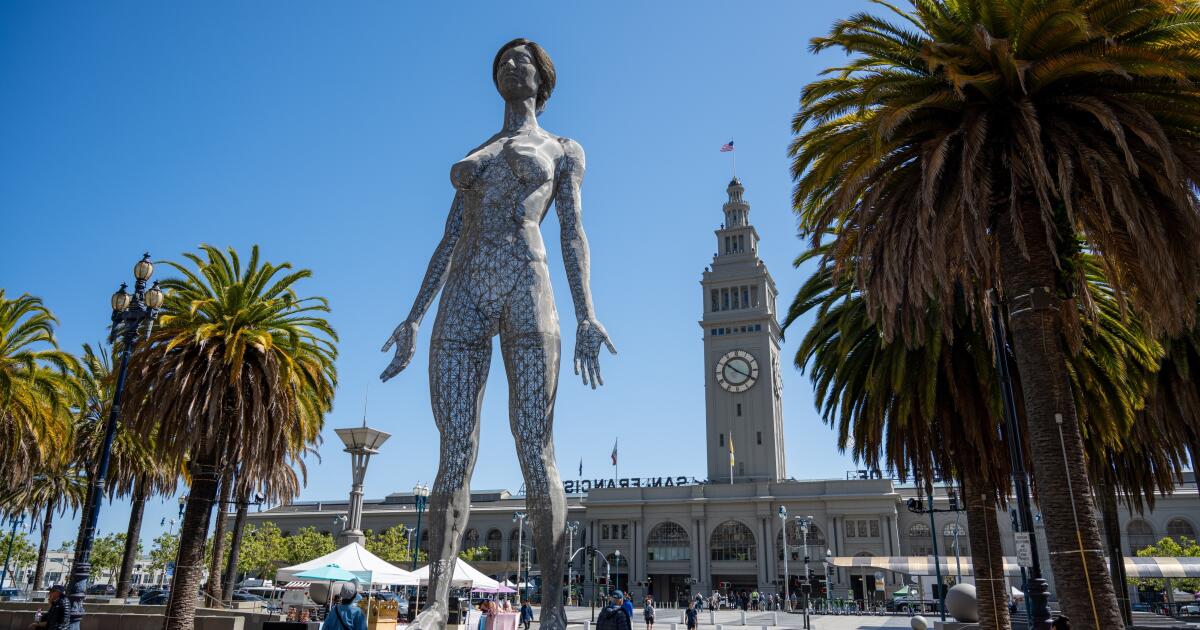
A sculpture of a giant naked woman goes on sale in San Francisco. Bring a crane
-

 Dallas, TX3 hours ago
No ‘straight answer’: Why Pioneer Cemetery is the latest battleground at City Hall
-

 Miami, FL3 hours ago
TSA hosts news conference ahead of World Cup third place match at Miami Stadium
-

 Boston, MA3 hours ago
ICE Boston arrests Barbados national during targeted operations in Attleboro
-

 Denver, CO3 hours ago
Denver Broncos training camp is 2 weeks away

