Culture
Do You Know the Jobs These Authors Had Before They Found Literary Success?


Welcome to Lit Trivia, the Book Review’s regular quiz about literary culture. This week’s installment salutes the tenacity of the literary strivers who worked a variety of jobs before finding success as novelists. In the five multiple-choice questions below, tap or click on the answer you think is correct. After the last question, you’ll find links to some of their most popular works.



At 53, and after more than a decade in the industry, things are happening for the romance writer Kennedy Ryan that were not on her bingo card.
The most recent: a first look deal with Universal Studio Group that will allow her to develop various projects, including a Peacock adaptation of her breakout 2022 novel “Before I Let Go,” the first book in her Skyland trilogy, which considers love and friendship among three Black women in a community inspired by contemporary Atlanta.
With a TV series in development, Ryan — who published her debut novel in 2014 and subsequently self-published — joins Tia Williams and Alanna Bennett at a table with few other Black romance writers.
“What I am most excited about is the opportunity to identify other authors’ work, especially marginalized authors, and to shepherd those projects from book to screen,” said Ryan, a former journalist. (Kennedy Ryan is a pen name.) “We are seeing an explosion in romance adaptations right now, and I want to see more Black, brown and queer authors.”
Her latest novel, “Score,” is set to publish on Tuesday. It’s the second volume in her Hollywood Renaissance series, after “Reel,” about an actress with a chronic illness who falls for her director on the set of a biopic set during the Harlem Renaissance. The new book follows a screenwriter and a musician, once romantically involved, working on the same movie.
In a recent interview (edited and condensed for clarity), Ryan shared the highs and lows of commercial success; her commitment to happy endings; and her north star. Spoiler: It isn’t what readers think of her books on TikTok.
Your work has been categorized as Black romance, but how do you see yourself as a writer?
I see myself as a romance writer. I think the season that I’m in right now, I’m most interested in Black romance, and that’s what I’ve been writing for the last few years. It doesn’t mean that I won’t write anything else, because I don’t close those doors. But the timeline we’re in is one where I really want to promote Black love, Black art and Black history.
What intrigued you about the period of history you capture in the Hollywood Renaissance series?
I’ve always been fascinated by the Harlem Renaissance and the years immediately following. It felt like a natural era to explore when I was examining overlooked accomplishments by Black creatives. I loved the art as agitation and resistance seen in the lives of people like James Baldwin or Zora Neale Hurston, but also figures like Josephine Baker, Lena Horne and Dorothy Dandridge, who people may not think of as “revolutionary.” The fact that they were even in those spaces was its own act of rebellion.
What about that period feels resonant now?
The series celebrates Black art and Black history and love at a time when I see all three under attack. Our art is being diminished and our history is being erased before our very eyes. I don’t hold back on the relationship between what I see going on in the world and the books I write.
How does this moment in your career feel?
I didn’t get my first book deal until I was in my 40s, so I think this is the best job I’ve ever had. I’m wanting to make the most of it, not just for myself, but for other people, and I think the temptation is to believe that it will all go away because that’s my default.
Why would it all go away?
Part of it is because we — my family, my husband and I — have had some really hard times, especially early in our marriage when my son was diagnosed with autism, my husband lost his job, and we experienced hard times financially. I’ll never forget that.
When I say it could all go away, I mean things change, the industry changes, what people respond to changes, what people buy and want to consume changes. So I don’t assume that what I am doing is always going to be something that people want.
Why are you so firmly committed to defending the “happy ending” in romance novels?
It is integral to the definition of the genre that it ends happily. Some people will say it’s just predictable every one ends happily. I am fine with that, living in a world that is constantly bombarding us with difficulty, with hurt, with challenge.
I write books that are deeply curious about the human condition. In “Score,” the heroine has bipolar disorder, she’s bisexual, there’s all of this intersectionality. For me, there is no safer genre landscape to unpack these issues and these conditions because I know there is guaranteed joy at the end.
You have a pretty active TikTok account. How do you engage with reviews and commentary on the platform about you or the genre?
First of all, I believe that reader spaces are sacred. Sometimes I see authors get embroiled with readers who have criticized them. I never ever comment on critical reviews. I definitely do see the negative. It’s impossible for me not to, but I just kind of ignore it. I let it roll off.
How does this apply to being a very visible Black author in romance?
I am very cognizant of this space that I’m in right now, which is a blessing, and I don’t take it for granted. I see a lot of discourse online where people are like, “Kennedy’s not the only one,” “Why Kennedy?,” “There should be more Black authors.” And I’m like, Oh my God, I know that. I am constantly looking for ways to amplify other Black authors. I want to hold the door open and pull them along.
How do you define success for yourself at this point?
I have a little bit of a mission statement: I want to write stories that will crater in people’s hearts and create transformational moments. Whether it’s television or publishing, am I sticking true to what I feel like is one of the things I was put on this earth to do? I’m a P.K., or preacher’s kid. We’re always thinking about purpose. And for me, how do I fit into this genre? What is my lane? What is my legacy? Which sounds so obnoxious, you know, but legacy is very important to me.

Welcome to Great Adaptations, the Book Review’s regular multiple-choice quiz about printed works that have gone on to find new life as movies, television shows, theatrical productions and more. This week’s challenge highlights the screen adaptations of popular books for middle-grade and young adult readers. Just tap or click your answers to the five questions below. Scroll down after you finish the last question for links to the books and their screen versions.

In an email interview, she talked about why she followed up a memoir with “Poetry Says It Better” — and when and why she leans on the “For Dummies” series. SCOTT HELLER
Describe your ideal reading experience.
Next to a warm fire in a house in the woods. Barring that, at home in bed.
How have your reading tastes changed over time?
When I first began reading, I read fiction. My favorite novel was “The Magic Mountain,” by Thomas Mann. Over the years I find that I am less interested in fiction and more interested in trying to learn about science and mathematics. I love the “For Dummies” series. I remember reading or hearing many years ago, maybe in high school, that the first law of thermodynamics is that energy cannot be created or destroyed; it can only change form. So, I was thrilled to learn there was such a book as “Thermodynamics for Dummies.” It was interesting reading, but I’m afraid I could not quote you anything from that book.
What’s the best book you’ve ever received as a gift?
I received the “Rubaiyat” of Omar Khayyám from someone, probably from my first husband, Bill. It stimulated my love of poetry, beautifully illustrated books and also my fascination with the East and the Mideast.
Why write “Poetry Says It Better” rather than, say, a follow-up to your 2006 memoir?
“Poetry Says It Better” has some references to my life, but I feel I wrote enough about myself in my memoir, and I include some of my personal history in this book.
You write that you’ve memorized poems your whole adult life. What’s the last poem you memorized?
I am working on “Shadows,” by D.H. Lawrence. I am trying to get that securely in my memory. Of course, at 93 I am not as good at memorizing as I used to be, or at holding on to what I have already memorized. But it is good exercise for the memory to use it.
You quote a line from Kaveh Akbar: “Art is where what we survive survives.” Why does that line resonate so much for you?
That line is so meaningful to me because I know that the difficult first 18 years of my life is the emotional library I descend into for every part I’ve ever played, and every poem that has landed in my heart.
Of all the characters you’ve played across different media, which role felt the richest — the most novelistic?
I would have to say Lois in “The Last Picture Show.” She was a character I didn’t really understand right away. I had to dig for her. She was multidimensional. I feel literary characters are like that.
What’s the best book about acting, or the life of an actor, you’ve ever read?
I have to name two. “My Life in Art,” by Konstantin Stanislavsky, and “A Dream of Passion,” by Lee Strasberg.
How do you organize your books?
I’ve collected my library for 70 years. All my classic literature is together, on two facing walls in the front of my living room. On the other end of the room, I have my art books. Facing them are my travel and music books. On the fourth wall are some of my science books.
In the large entrance hall, I have one standing bookcase of the complete Carl Jung collection, and near it another bookcase of poetry anthologies. In my kitchen office are all the books about food. Then I have a writing room that contains books of poetry and science, and my Sufi books. In my bedroom are my spiritual and religious books.
What books are on your night stand?
Currently: “Anam Cara: Spiritual Wisdom From the Celtic World,” by John O’Donohue; “Prayers of the Cosmos,” by Neil Douglas Klotz; “The Courage to Create,” by Rollo May; “Radical Love,” by Omid Safi; Pema Chödrön’s “How We Live Is How We Die”; “The Trial of Socrates,” by I.F. Stone; “Our Green Heart: The Soul and Science of Forests,” by Diana Beresford-Kroeger; and “On Living and Dying Well,” by Cicero.
What book might people be surprised to find on your shelves?
Probably Ken Wilber’s “A Brief History of Everything” and Michio Kaku’s “Physics of the Future.” These are two of my favorite books. I love to read books on science that are not written for scientists but for curious readers like me.
You’re organizing a literary dinner party. Which three writers, dead or alive, do you invite?
Oh, definitely Mary Oliver, my favorite poet of all time, and Edgar Allan Poe. The thought of those two people talking to each other. Finally, Tennessee Williams, who’s written some of the greatest plays ever.
-

 World8 minutes ago
Shakira Is Found Not Guilty of Tax Fraud in Spain
-

 News14 minutes ago
Video: Deal Ends Long Island Rail Road Strike
-

 Business26 minutes ago
Video: Jury Rejects Elon Musk’s Lawsuit Against OpenAI and Microsoft
-

 Culture50 minutes ago
Kennedy Ryan on ‘Score,’ Her TV Deal, and Finding Purpose
-
 Lifestyle56 minutes ago
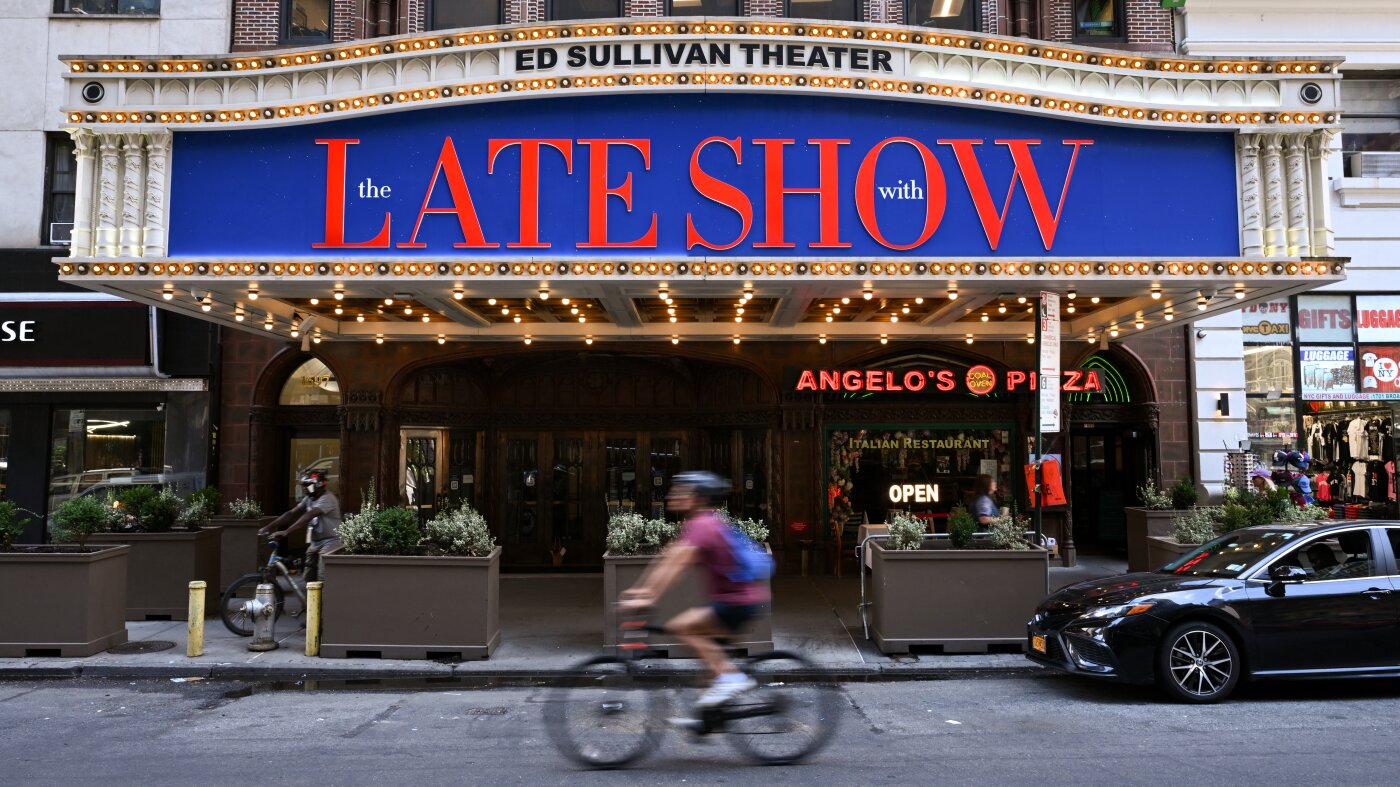
Colbert’s last episodes: What happened on ‘The Late Show’ last night
-

 Technology1 hour ago
LG will release the first 1000Hz, 1080p gaming monitor this year
-

 World1 hour ago
American tourists arrested in Japan after alleged break-in at viral monkey Punch’s enclosure
-

 Politics1 hour ago
Hegseth unleashes on Massie in GOP primary showdown against Trump-backed Navy SEAL vet

