Business
You can't buy a Chinese EV in the United States. But they dominate in Southeast Asia

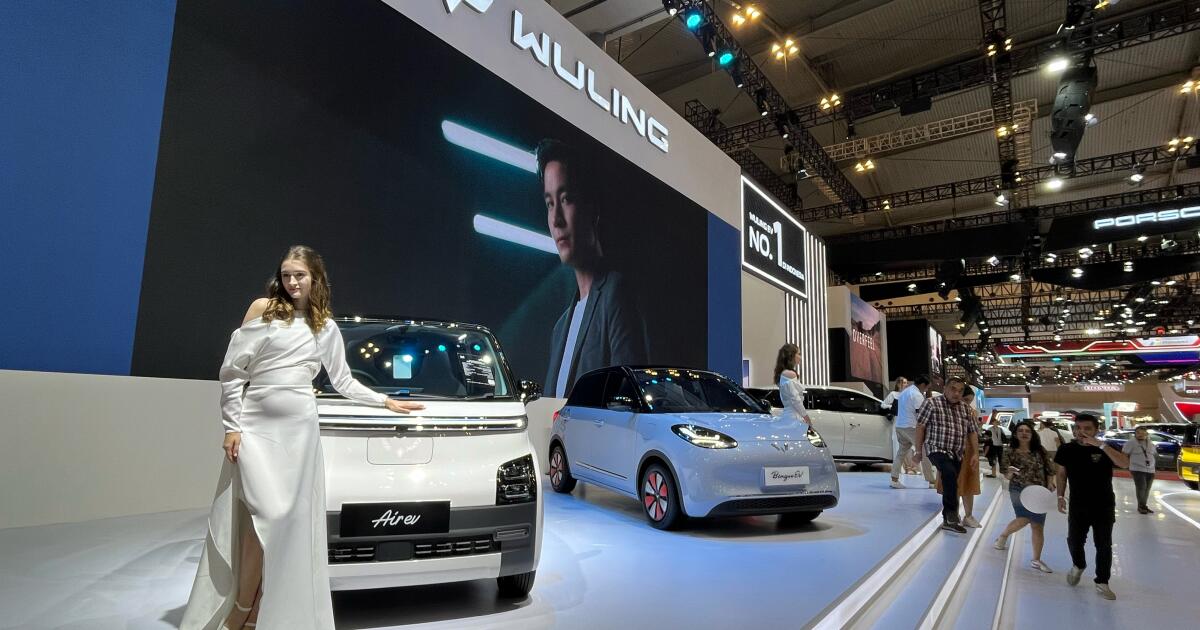
Late last year Chinese automaker BYD surpassed Tesla as the world’s biggest seller of electric vehicles.
But you won’t find its cars in the United States anytime soon. With the Chinese auto industry facing tariffs in the U.S. and the European Union, one of its most important markets is Southeast Asia.
Of the 31 passenger car brands represented last month at the sprawling Indonesia International Auto Show outside Jakarta, about a third were from China. The vast majority of those were electric vehicles.
Striding past fashion models and huge video displays, Safik Bahsein made his way to the BYD display, where he honed in on a BYD Dolphin, which promises 300 miles on a single charge and sells for the equivalent of $26,000.
Visitors look at a BYD car during an auto show last month. Chinese car companies have been gaining ground in Indonesia, particularly in EVs.
(Tatan Syuflana / Associated Press)
It’s one of three EV models that BYD now sells in Indonesia, the world’s fourth most populous country — with more than 275 million people — and the largest car market in Southeast Asia. The company’s first shipment of 1,000 EVs arrived last month.
“It’s quite beautiful,” said Bahsein, 49, who works in shipping. “Compared with European cars, I think BYD has good prospects in the future.”
In his view, the quality of Chinese cars now matches those from Europe and Japan. He said he was considering buying one for his wife, though he still prefers his Tesla Model 3, which he had to have specially imported two years ago because there are no dealers in Indonesia.
The country’s car market has long been dominated by the Japanese brands Toyota, Daihatsu and Honda. But Chinese companies have been gaining ground, particularly in EVs, where Japanese automakers have lagged.
Chinese brands accounted for 43% of EV sales in the first half of 2024, according to the Assn. of Indonesia Automotive Industries.
But getting people to buy EVs has been especially challenging in Indonesia, where there are many cheaper alternatives and a dearth of charging stations. Only 17,121 EVs were sold last year — just 2% of all auto sales.
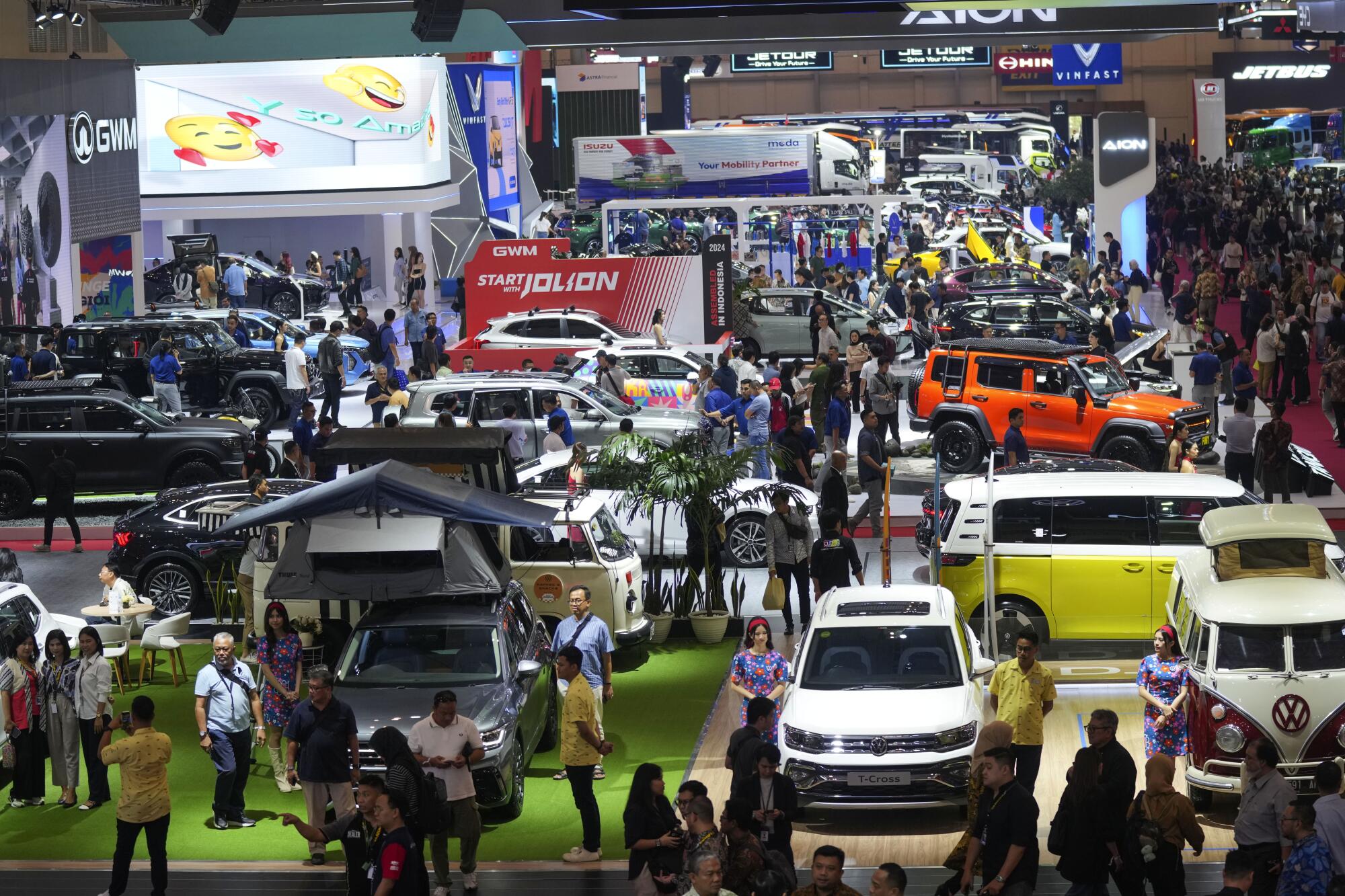
“Southeast Asia, specifically Thailand and Indonesia, is the beachhead, both as a market and a production base,” said Lei Xing, former chief editor of the China Automotive Review.
(Tatan Syuflana / Associated Press)
The Indonesian government has created incentives for EV buyers and set a goal of 400,000 EV sales next year. But the international data analytics firm Fitch Solutions has suggested that a more realistic expectation is 56,000 by 2028.
For Goldie Liem, 24, who recently bought a Binguo EV from the Chinese carmaker Wuling, the biggest incentive was the license plate, which exempts Jakarta drivers from road restrictions meant to cut down on traffic.
That saves her time on her daily office commute, which can take up to two hours. She said she also saves on gas, and pays about $60 a year in taxes compared with $430 for her old Mazda.
“It gets me from A to B, that’s it,” she said. “I haven’t tried to take it out of town yet, because I’m not that brave, in terms of charging stations and all that.”
It would take much more to make her husband an EV convert. They couple had come to the auto show so he could check out gas-powered BMWs.
In China, the EV industry has flourished thanks to clean energy subsidies and access to comprehensive supply chains for battery technology and vehicle manufacturing. But intense domestic competition has prompted price cuts and led automakers to look overseas for growth.
Brazil, Belgium, the United Kingdom, Thailand and the Philippines are the biggest export markets this year, according to the China Passenger Car Assn. Indonesia is among the fastest growing.
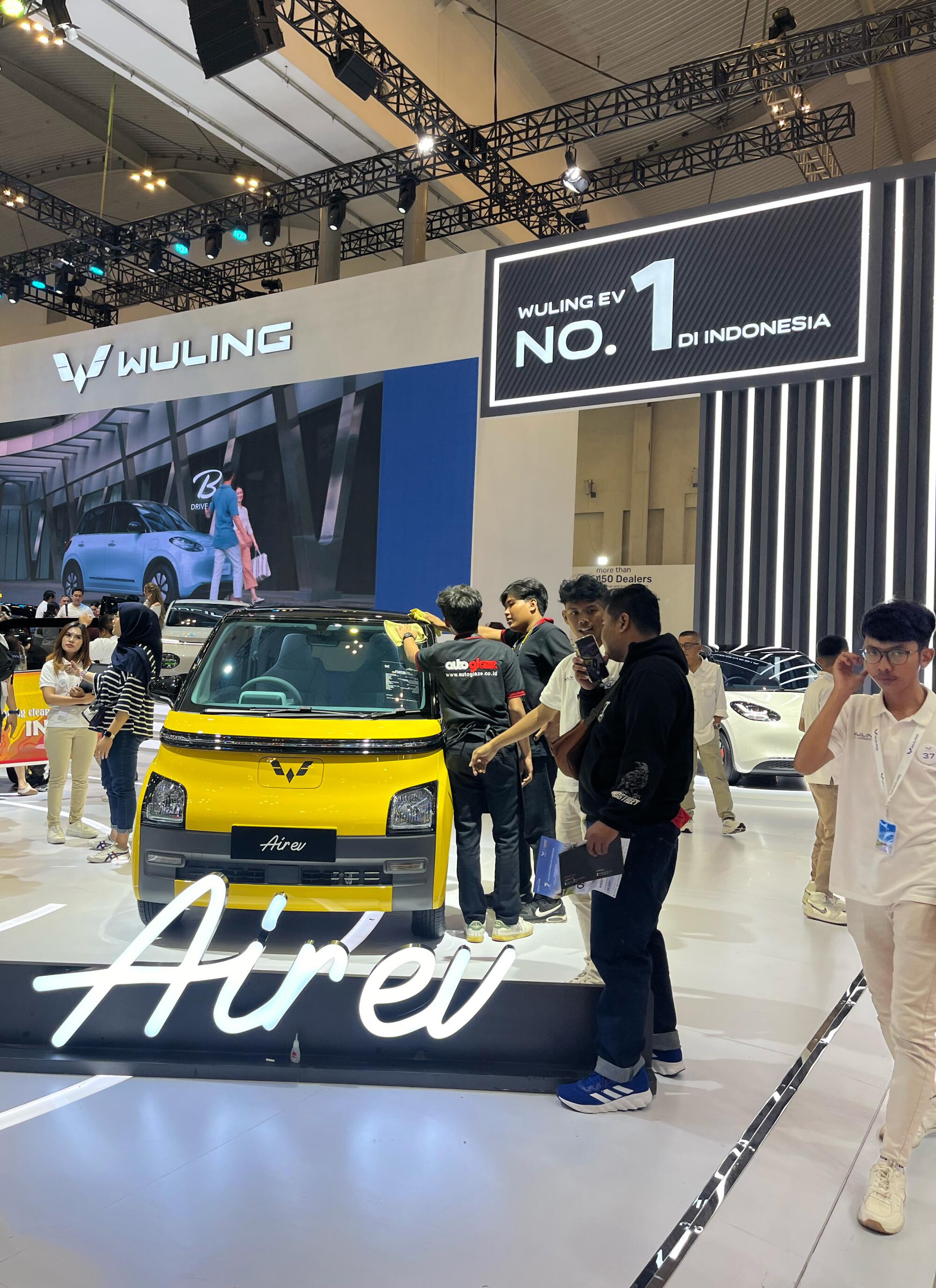
Wuling, a Chinese EV brand, accounts for about 40% of EV sales in Indonesia. But electric cars still only make up about 2% of total car sales, hampered by insufficient charging infrastructure.
(Stephanie Yang / Los Angeles Times)
“Southeast Asia, specifically Thailand and Indonesia, is the beachhead, both as a market and a production base,” said Lei Xing, an independent auto analyst and former chief editor of the China Automotive Review. “It’s not like you’re going into Europe and competing against the Volkswagens and the BMWs. Now with the EV opportunity, Chinese brands are jumping on that.”
BYD recently announced plans to build a $1.3-billion EV plant two hours from Jakarta that will begin operations in 2026, joining other Chinese brands Neta and Wuling to build electric cars in Indonesia.
It’s no coincidence that Indonesia also happens to be one of the world’s leading producers of nickel and other minerals needed in EV batteries.
China has already invested billions of dollars in Indonesian nickel mines in order to procure the strategic metal. Now Indonesia is trying to attract more Chinese funding to process its natural resources and build cars at home.
In an op-ed this year for China Daily, a state-run newspaper, a senior Indonesian transportation official declared his country’s EV industry “open for business.”
The official, Rachmat Kaimuddin, the deputy coordinating minister of transportation and infrastructure, also encouraged Chinese carmakers to take advantage of the “golden opportunity” of recently announced tax incentives for international car brands producing in Indonesia.
For brands like BYD, building more facilities in other countries is a critical part of global expansion, particularly as the U.S. and EU have threatened to implement harsher policies to keep cheap Chinese models from pushing out their own domestic manufacturers.
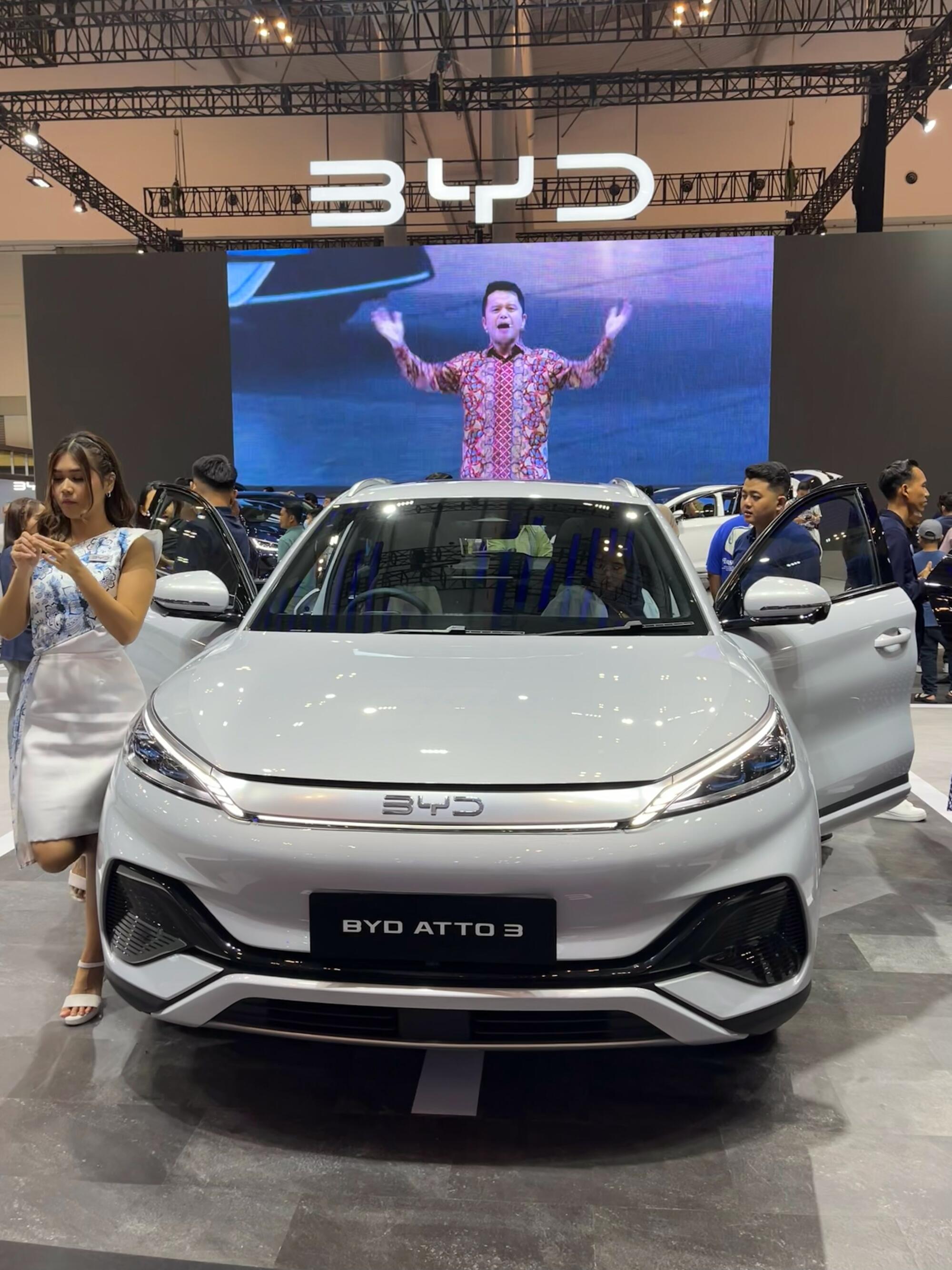
Leading Chinese automaker BYD delivered its first 1,000 EVs to Indonesian consumers this year, as it expands its manufacturing and sales in one of Southeast Asia’s biggest auto markets.
(Stephanie Yang / Los Angeles Times)
Last month, the EU announced tariffs of up to 37.6% on Chinese EVs. In the U.S., President Biden raised the existing 25% tariff on Chinese EVs to 100%.
BYD has also opened a plant in Thailand, and has announced investment plans for Turkey, Hungary and Mexico, which could help the automaker sidestep foreign import taxes in the U.S. and Europe on Chinese goods.
“These are very strategic locations,” said Xing, the auto analyst. “In order to be global, I think the U.S. and Europe are the last two frontiers.”
In the meantime, there is Southeast Asia. At the auto show, Ricky Aristin, 23, spent two hours browsing cars that could potentially replace his Honda Accord. The highlight was climbing into the driver’s seat of a BYD Seal, an electric sedan that sells for about $44,000.
“It feels like an expensive car,” Aristin said. “It’s a good experience from the car with the lowest price.”
Nonetheless, he decided he wouldn’t buy an EV until Jakarta has more charging stations.





A total of 59 gigawatts of U.S. clean energy projects are facing delays at a time when demand for power from AI data centers is surging, according to a trade group study.
Developers are seeing an average delay of 19 months over issues such as long interconnection times, supply constraints and regulatory barriers, the American Clean Power Assn. said in a quarterly market report.
The backlog is happening despite the growing need for power on grids that are being taxed by energy-hungry data centers and increased manufacturing. The Trump administration has implemented a slew of policies to slow the build-out of solar and wind projects, including delaying approvals on federal lands.
The potential energy generation facing delays is the equivalent of 59 traditional nuclear reactors, enough to power more than 44 million homes simultaneously.
“Current policy instability is beginning to impact investor confidence and negatively impact project timelines at a time when demand is surging,” American Clean Power Chief Policy Officer JC Sandberg said in a statement.
Despite the hurdles, developers were able to bring more than 50 gigawatts of wind, solar and batteries online in 2025, accounting for more than 90% of all new power capacity in the U.S., the report found. Clean power purchase agreements declined 36% in 2025 compared with 2024, signaling that the build-out of clean power in the U.S. could be lower in the 2028 to 2030 time period, according to the report.
Chediak writes for Bloomberg.

The high-stakes feud between Paramount Skydance President Jeff Shell and Las Vegas gambler and self-professed “fixer” Robert James “R.J.” Cipriani spilled into court on Monday.
Cipriani filed a lawsuit against Shell on claims of fraud and eight other counts, alleging that he reneged on an oral agreement to develop an English-language version of a Spanish music show that streams on Roku TV.
He is seeking $150 million in damages.
In the 67-page lawsuit, filed in Los Angeles County Superior Court, Cipriani claims that in exchange for providing “sophisticated, high-value crisis communications services, entirely without compensation” over 18 months, Shell had agreed to develop the show “Serenata De Las Estrellas,” (Star Serenade), but failed to do so. Cipriani and his wife were to be named as co-executive producers.
“This case arises from the oldest form of fraud: a powerful man took everything a less powerful man had to offer, promised to repay him, lied to him when he asked about it, and then refused to compensate him at all,” states the complaint.
Cipriani — who has producer credits on a 2020 documentary about Vegas, “Money Machine: Behind the Lies,” and the 2015 movie “Wild Card” — intended to make “Serenata” as a “lasting legacy for his mother,” Regina, saying the effort “has been the driving force and the most important thing consuming [Cipriani’s] entire life of almost sixty-five years,” according to the suit.
The show was inspired by a song that the Philadelphia-born Cipriani used to sing to his late mother when he was growing up.
The litigation is the latest twist in a simmering behind-the-scenes scandal that has left much of Hollywood slack-jawed.
For weeks, Cipriani had threatened to file a lawsuit against Shell, with the potential to derail his comeback at Paramount, three years after he lost his job as NBCUniversal’s chief executive over an inappropriate relationship with an underling.
Cipriani’s suit alleges Shell wasdesperate for help in quelling negative stories about him.
It also portrays him as someone who was indiscreet, allegedly sharing sensitive information during the period when the Ellison family, through Skydance Media, was preparing to close its deal to acquire Paramount and then was actively pursuing Warner Bros. Discovery to add to its growing entertainment and media empire.
The eventual rift between the unlikely pair began in August 2024. Patty Glaser, the high-powered entertainment litigator, convened a meeting between the two men.
During the meeting with Shell, the executive expressed to Cipriani his concern that emails and texts between him and Hadley Gamble, the CNBC anchor Shell had been involved with, would come out, saying “that would absolutely destroy me,” according to the suit.
Cipriani claims in his lawsuit Shell was facing “catastrophic personal exposure arising from his conduct toward yet another woman in the media industry,” similar to what had prompted his ouster from NBCUniversal and that he “solicited” his “crisis communications services.”
According to the suit, Cipriani was in a position to help him, having engaged in a “longstanding practice of exposing misconduct in the entertainment and media industries.”
Robert James “R.J.” Cipriani in Amazon Prime Video’s 2025 series “Cocaine Quarterback.”
(Courtesy of Prime)
A high-rolling blackjack player, Cipriani’s colorful résumé includes aiding the FBI in the arrest and conviction of USC athlete-turned global drug kingpin Owen Hanson, who was sentenced to 21 years in federal prison, and filing a RICO suit against Resorts World Las Vegas.
Leveraging his “unique media relationships and industry influence,” Cipriani said in his complaint that he provided Shell with “ongoing threat-monitoring and intelligence services,” and “took proactive steps to suppress, redirect, or neutralize” negative coverage against Shell before publication.
Cipriani said Shell expressed “effusive gratitude” to him after he planted a story about another entertainment industry figure “in order to divert media attention” away from Shell. “Thank you thank you thank you,” Shell wrote in a text to Cipriani, according to the lawsuit, which included a copy of the text.
During tense negotiations over Paramount’s streaming rights for the highly successful “South Park” franchise last summer, Shell allegedly asked to talk to Cipriani about the matter. Cipriani then “orchestrat[ed] the placement of a highly favorable news article,” that was “devastating to Shell’s and Paramount’s adversaries in the dispute,” the suit states.
After a story published in a Hollywood trade, Cipriani wrote to Shell on WhatsApp, “I’m the one that put the article out for you!!!” and “I didn’t want to tell you till it hit so you have plausible deniability.”
According to a message cited in the lawsuit, Shell responded, “I love you!!!! …Thank you Rj,” adding “I owe you dinner at least!”
Despite those boasts, Paramount ultimately paid “South Park” creators millions more than Skydance had intended. To remove obstacles from Skydance’s path to buy Paramount, the media company agreed to two blockbuster deals that include paying the “South Park” production company more than $1.25 billion to continue the cartoon — making it one of the richest deals in television history.
During the course of their relationship, Cipriani further alleges that Shell alerted him to a then-pending $7.7-billion Paramount deal for the rights to UFC fights, while Netflix “believed” it had a “handshake deal” for the same rights, according to the suit.
Cipriani disclosed in his lawsuit that he filed a whistleblower complaint with the Securities and Exchange Commission over the disclosure of material information, claiming that Shell told him that not even UFC President Dana White knew of the transaction. In a WhatsApp message cited in the lawsuit, Shell told Cipriani that the deal was “very hush, hush until we sign.”
While the gambler continued to provide his services to Shell gratis, their relationship began to sour.
Cipriani became enraged that Shell did not uphold his end of the alleged deal to help him with the TV show, viewing it as a slap to him and his mother.
In February, the pair met to resolve their growing dispute. According to the lawsuit, also in attendance was an unidentified entertainment attorney who had represented both men in separate matters.
Patty Glaser has been widely reported as having represented Shell and Cipriani. She introduced them in summer 2024, as The Times reported Saturday.
“We were presented with a draft complaint riddled with clear errors of fact and law,” Glaser said in a statement last week. “We will strongly respond.”
The February meeting did not go well.
Shell not only “refused to compensate” Cipriani, but also told him that he could not “assist” him “in obtaining a television show or other entertainment industry opportunity.”
Cipriani further alleged in his lawsuit that during their “failed summit,” Shell revealed his “disdain” for David Zaslav, the Warner Bros. Discovery CEO, and disclosed that Paramount intended to “sweeten” its pending hostile offer for the studio to fend off Netflix prior to announcing its intention to do so publicly.
After the meeting, Cipriani stated in his complaint that Shell’s attorney privately offered Cipriani a “$150,000 personal loan” to resolve the dispute.
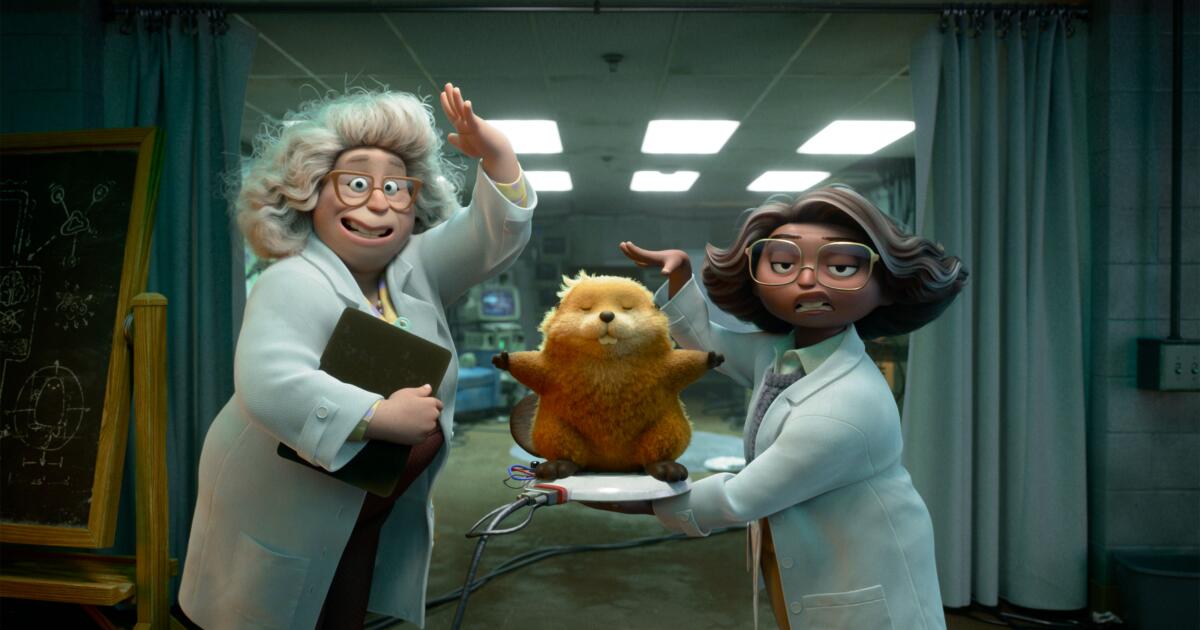
Walt Disney Co. and Pixar’s “Hoppers” took the box office crown this weekend in an encouraging sign for the company’s original animated films.
The film generated $46 million in ticket sales in the U.S. and Canada, marking the highest domestic opening for an original animated movie since 2017’s “Coco,” according to studio estimates. The global box office total for “Hoppers” was $88 million.
The zany movie features a young environmental advocate who “hops” her consciousness into a robotic beaver and bands together with other woodland creatures to stop a planned freeway expansion through a glade.
The film is directed by Daniel Chong, who created the Cartoon Network animated series “We Bare Bears.”
The muscular debut for “Hoppers,” as well as the strong performance from Sony Pictures Animation’s “Goat” last month, has been a positive sign for audience interest in original animated films.
Since the pandemic, theatrical returns for animated sequels have far surpassed that of original films. Disney’s “Zootopia 2,” for instance, has grossed more than $1.8 billion in global box office revenue, with more than $426 million domestically. Disney and Pixar’s 2024 hit “Inside Out 2” also crossed more than $1.6 billion globally.
By contrast, Disney and Pixar’s 2025 original film “Elio” brought in about $154 million in worldwide box office revenue.
Original films are vital to Pixar’s future, as the Emeryville, Calif.-based studio built its reputation on its string of nearly uninterrupted original blockbuster hits, including 1995’s “Toy Story” and 2004’s “The Incredibles.”
Paramount Pictures and Spyglass Media Group’s “Scream 7” came in second at the box office with $17.3 million in its second weekend in theaters. Warner Bros. Pictures’ “The Bride!,” Sony’s “Goat” and Warner Bros.’ “Wuthering Heights” rounded out the top five at the box office, according to data from Comscore.
With several strong releases, as well as popular holdover films from 2025 that continue to bring in revenue, the first few months at the box office have been a notable improvement over last year’s dismal first quarter.
Domestic box office revenue so far is up more than 12% compared with the same time period in 2025, according to Comscore.

With U.S. at war with Iran, political upheaval could engulf World Cup

Israeli air strike targets building in south Lebanon

Ed Martin, outspoken Justice Department lawyer, is formally accused of ethical violations | CNN Politics

‘Utterly unaffordable’: Study reveals how deep blue city’s minimum wage law is ravaging key industry

What’s next for Kristi Noem? 2026 Senate chatter grows after DHS exit

Florida High School Football Rankings: Top 25 teams – Oct. 21

Cleary's 21 help Le Moyne down Central Connecticut State 69-64 in OT

How old is Bo Nix? What to know about Oregon quarterback ahead of 2024 NFL Draft

99th annual Pony Swim held in Virginia

Indiana Members Credit Union announced as new anchor tenant at Bottleworks District
Israeli air strike targets building in south Lebanon
Ed Martin, outspoken Justice Department lawyer, is formally accused of ethical violations | CNN Politics

Trump reveals top issues GOP should focus on to secure midterms victory: ‘I’ve never been more confident’

NATO intercepts another Iranian missile in Turkish airspace

Is Iran another Iraq? : Sources & Methods
-

 Wisconsin1 week ago
Setting sail on iceboats across a frozen lake in Wisconsin
-

 Massachusetts1 week ago
Massachusetts man awaits word from family in Iran after attacks
-

 Maryland1 week ago
AM showers Sunday in Maryland
-

 Florida1 week ago
Florida man rescued after being stuck in shoulder-deep mud for days
-

 Pennsylvania5 days ago
Pa. man found guilty of raping teen girl who he took to Mexico
-

 Sports6 days ago
Keith Olbermann under fire for calling Lou Holtz a ‘scumbag’ after legendary coach’s death
-

 Virginia6 days ago
Giants will hold 2026 training camp in West Virginia
-

 Politics1 week ago
Mamdani’s response to Trump’s Iran strike sparks conservative backlash: ‘Rooting for the ayatollah’