Business
Why Tech Giants Are Ditching the Power Grid


It is the industrial version of what homeowners might do to get through a hurricane. Only in this case, some technology companies are planning to rely on off-grid gas power for many years.
This is happening as electricity is becoming a major political issue, with fights breaking out over how much energy costs, where it comes from and who ought to pay for what. Data centers, which consume huge amounts of energy, are at the center of these debates.
Going off grid was no one’s first choice. Off-grid power generally costs a lot more, partly because developers need to install more equipment than will be used at any one time in case machines break or need servicing. A lot of this gear is also less efficient than the airplane-size machines used at big power plants, meaning it needs to burn more gas to generate the same amount of electricity.
But in some states, it might take years to get permission to plug new power plants into the grid.
By the end of 2025, an estimated 39 percent of the gas power capacity being developed in the United States was designed to serve data centers on-site, according to the Global Energy Monitor, a nonprofit organization that tracks energy projects. That is up from 5 percent at the end of 2024.
“Necessity is the mother of invention,” said Joe Kava, a consultant who previously led global data center development for Google. “The hyperscalers are not going to be curtailed because they can’t get power,” he said, using a term that refers to large tech companies.
Power plants have bloomed in New Albany, Ohio, near Columbus, as if overnight. It was little more than a year ago that Sloan Spalding, the mayor, learned that a data center developer wanted to build the town’s first gas-fired power plant. Now, three are under construction, all meant to exclusively power data centers, and at least one other is planned.
“Frankly, we were all a little surprised,” Mr. Spalding said.
Together, the plants that are already under construction are expected to rely on about 61 engines, 30 small turbines and 16 other generators, regulatory filings show. All of that equipment burns natural gas to generate electricity, but each operates differently. That does not include battery storage systems to manage demand fluctuations and diesel generators for backup power in emergencies.
It is the kind of equipment you might expect in remote oil fields. Were they connected to the grid, the machines being installed in New Albany could potentially power around 600,000 homes. Another power plant that was proposed last week would be big enough to provide electricity for an additional 200,000 homes or more if regulators approve it.
“For better or for worse, we are the pioneers in this process,” Mr. Spalding said. “There’s not a lot we can do to stop it.”
Tech giants generally say they don’t want to build or operate power plants. In some places, the companies are fighting efforts to require data centers to rely on their own power sources or reduce energy consumption when electricity systems are under strain.
But the tech industry’s appetite for energy has become almost insatiable because of artificial intelligence, and there are only so many places where companies can draw large amounts of power from the grid quickly. Wait times vary by region, but it now takes an average of four years or more for data centers to connect to U.S. grids, according to JLL, a real estate services firm.
One of the first companies to go it alone was Elon Musk’s xAI, which opened a data center in Memphis in 2024, powering it with more than a dozen gas turbines rolled in on flatbed trucks. The Southern Environmental Law Center later claimed the company flouted permitting requirements and violated the federal Clean Air Act in Memphis and at another location in Southaven, Miss. xAI, which eventually received permits for some turbines in Memphis and stopped using others, did not respond to requests for comment.
Dozens of natural gas plants being built to serve data centers will be off the grid
An armada of off-grid power plants
By that point, tech companies were flocking to Ohio, so much so that the main electric utility serving the Columbus area stopped accepting data center applications for new grid connections in March 2023. The state quickly became one of the first battlegrounds between utilities and some of the world’s most valuable companies.
It was against that backdrop that some developers started going off-grid in New Albany, which is near the western edge of a large natural gas deposit.
EdgeConneX, a Washington-area data center developer that did not respond to requests for comment, is behind one of the power plants. Williams Companies, an Oklahoma pipeline operator, is building at least two for Meta, Facebook’s parent company.
Meta has agreed to buy the power that Williams generates for at least a decade, said Chad Zamarin, Williams’s chief executive.
“Whether they use it or not, we will get paid,” Mr. Zamarin said.
The power deal is among the most expensive that Paul Zimbardo, an analyst at the investment firm Jefferies, said he had come across. Meta may have agreed to pay Williams $140 to $160 per megawatt-hour, the investment bank estimated, well above the price of grid power.
Last week, Williams told regulators that it wanted to build a third power plant in New Albany for an undisclosed customer.
These plants will not affect the price of electricity for Ohio residents because the facilities are not connected to the grid, though higher gas demand could drive up fuel prices over time.
Meta said the local utility’s pause on serving new data centers, which ended last year, influenced its decision to go off grid. The company, which has pledged to fully offset its greenhouse-gas emissions by 2030, is buying renewable energy to compensate for the electricity it gets from fossil fuels, said Ryan Daniels, a company spokesman.
Companies are gravitating to gas because it can theoretically generate electricity all day, unlike the wind or sun. And smaller gas generators and engines can be installed much faster than nuclear power plants.
Power capacity of publicly disclosed equipment
Natural gas will provide most of the onsite power for U.S. data centers
That worries Noah Malik, who lives several miles from New Albany’s new plants. “By building this infrastructure, you’ve cemented that dependence on fossil fuels,” said Mr. Malik, who is 25.
Most of the off-grid power plants being planned around the country are either under construction or about to be, meaning the full environmental effects have yet to be felt.
New Albany’s new power plants are expected to release more nitrogen oxides — a group of pollutants linked to respiratory diseases like asthma — for each unit of electricity they produce than the larger gas plants that power most of Ohio, according to an analysis of regulatory filings and manufacturer data by the Environmental Defense Fund. That analysis, performed for The New York Times, accounts for the emissions controls that the developers have said they would install.
“I do worry about the near-term impacts of this choice on air quality and communities today,” said Mark Brownstein, a senior vice president at the Environmental Defense Fund. “Why exactly are we rushing?” he added. “There is a concern that haste is making waste here.”
A Williams spokesman said the company would “meet and exceed all state-established requirements to protect public health and the environment.” A spokesman for the Ohio Environmental Protection Agency said it modeled air quality to assess the facilities’ cumulative impact and ensure compliance with federal standards before giving developers permission to build the plants.
Noise levels must remain within five decibels of ambient levels, said a spokesman for the Ohio Power Siting Board, which also reviews major energy projects.
A big question is how long this gas power frenzy will last. Manufacturers of gas turbines and related equipment have been wrestling with how much money to invest in new manufacturing lines. Their big concern is that, by the time the new capacity is ready, demand for the equipment might have weakened significantly.
Baker Hughes, an oil field service company that makes the kinds of turbines being used off grid, is betting on strong data center demand for at least several years. It is one of many oil and gas companies that have piled into the power business as oil field work has slowed.
“We don’t see this being a fad,” said Lorenzo Simonelli, the company’s chief executive.
Industry analysts and executives also question whether power plants built alongside data centers will remain competitive if it becomes easier to connect to the grid.
Siemens Energy makes some of the equipment that the New Albany power plants plan to use. But even that company’s chief executive, Christian Bruch, is skeptical about using smaller machines as permanent power sources.
“These will not be long-term installations,” Mr. Bruch said in a recent interview, discussing the broader trend. “Is it good in terms of efficiency? And is that a smart power supply solution? Absolutely not.”


A rule intended to prevent rent gouging in the wake of the Eaton and Palisades fires has lapsed in Los Angeles County, possibly exposing some renters to hikes.
The executive order that blocked rent increases was issued by Gov. Gavin Newsom amid the devastating wildfires last year. Under the order, landlords couldn’t increase rents by more than 10% above their prefire levels.
The rule, which was supposed to be temporary and was repeatedly extended, ended Friday after a vote to extend it again failed to garner enough votes. Supervisor Lindsey Horvath, whose district includes Pacific Palisades, sounded the alarm in a motion to extend price protections that failed to pass at the Board of Supervisors’ May 19 meeting.
“These price gouging protections continue to be necessary as construction and rebuilding continue, and as thousands of people remain displaced,” the motion said. “Families which signed short-term leases could face drastic price increases of 50% or more without further price gouging protection.”
Los Angeles County is home to more than 1 million rental properties, though not all of them needed protection from the new rule. There are already stricter rent increase caps for many residences, depending on the location, type and age of the building. Despite the rent control in the region, the people of Los Angeles pay among the highest rents in the country.
It is uncertain whether renters will face rapidly rising rents now that the protection has lapsed. But some real estate experts and policymakers said there was no need for the temporary rule that was part of the governor’s state of emergency.
Supervisors Kathryn Barger, Janice Hahn and Holly Mitchell abstained from voting on the motion to extend the protection, while Supervisors Hilda Solis and Horvath supported it.
“I abstained because I did not see sufficient evidence to justify extending this emergency ordinance, nor did I see evidence to eliminate it entirely,” Hahn said.
Barger’s office said she supported allowing the protections to sunset while waiting to see whether new information emerged.
“Market data already shows countywide rents are only about 2% above pre-emergency levels and rental inventory has grown,” Barger representative Helen E. Chavez Garcia said. “The Supervisor is also mindful of the burden these ongoing protections place on small property owners throughout the county.”
Mitchell did not immediately respond to a request for comment.
There haven’t been steep rent hikes in neighborhoods within three miles of the Palisades fire, according to a Times analysis of data from Zillow, the property listing company.
In ZIP Codes within three miles of the Palisades fire, rent increased 4.8% from December 2024 to April 2025. In areas around the Eaton fire, which destroyed swaths of Altadena, rent jumped 5.2% in the same period.
In L.A. County, ZIP Codes farther from the fires saw only about a 2% increase.
A landlords representative, Jesus Rojas of the Apartment Owners Assn. of Greater Los Angeles, told the supervisors during public comment at the meeting that the county’s rent-gouging rules have “long outlived the emergency they were intended to address” and are now being “wrongfully used to harm thousands of rental housing providers throughout the county.”
“There is no proof that multifamily rental housing providers are hugely increasing rents for impacted homeowners,” Rojas said.
Indeed, there are strong signs that the property market in the Los Angeles area has at last begun to cool.
L.A. metro-area rent prices recently fell to a four-year low, with the median rent slipping to $2,167 in December.
Meanwhile, condominium sales had their slowest start of the year in decades. Condo sales in Los Angeles have plummeted to a 20-year low, with fewer than 2,000 units sold in January and February — the worst start to the year since 2005.
Newsom defended the price-gouging protections shortly after they went into effect.
“In the days following the Los Angeles firestorms, we worked quickly to protect Los Angeles survivors from any form of exploitation,” he said in February 2025. “The state has the tools in place to not only block price gouging during this emergency, but also to prosecute bad actors.”
The Los Angeles County Department of Consumer and Business Affairs said it received more than 2,000 complaints after the fires, alleging that retailers and landlords were taking advantage of people put in hardship by their losses, and sent out more than 2,000 cease-and-desist letters to businesses and landlords for alleged price gouging, said Morine Merritt, who oversees department investigations into consumer and real estate fraud.
“Close to 90% of the complaints that we received involved allegations of rent increases,” Merritt said in an interview. Now that the fire-related protections have expired, existing laws and “regular market conditions determine price increases for goods and services, including rents,” she said.
Crackdowns on fire-related rent gouging have been rare, said Chelsea Kirk of the activist organization the Rent Brigade, which analyzed L.A. County’s rental market in the year after the fires. It reported 18,360 potential examples of price gouging in listings but said that few lawsuits had been filed by authorities so far.
Last week, Rent Brigade announced what it said was the first private civil lawsuit brought by a family that claimed to be rent-gouged in the aftermath of the wildfires. Plaintiffs Randall and Candy Renick, whose Altadena home was damaged, said they were charged nearly three times the maximum permitted rate for nearly 10 months. They seek restitution of $96,000 plus civil penalties and attorneys’ fees.
The rental market has probably stabilized since the fires, Kirk said, but other families may still be “locked into illegal rents” that they agreed to pay when they were in a rush to find housing after they were displaced.


Dear Mr. Pelley:
I meant what I said in my letter last week to the 60 Minutes team: joining 60 Minutes is the honor of my career and I am grateful to be working alongside the people who have contributed to the most important television journalism brand this country has ever produced. While I’m new to 60 Minutes, I’ve devoted my career to investigative journalism and storytelling. I started this job excited to collaborate and to benefit from the wisdom and experience of the 60 Minutes veterans, with you among them. For that reason, one of the first things I did in my new role was call you to talk and invite you to dinner. It is a profound disappointment that you rejected that overture and chose ambush instead. Yesterday, you hijacked my first meeting with staff to disparage me, my qualifications, and my intentions with remarkable incivility and contempt. I welcome a diversity of viewpoints and respectful debate among the team, but this was nothing of the sort. Yesterday’s performative display of hostility enacted in front of the staff instead of in a civil, private conversation-demonstrated that you have no interest in contributing to the future success of the show, or approaching my new tenure with a mind open to collaboration and progress. I am here to deliver first-in-class news programming, not to make headlines about newsroom drama. I am eager to work alongside those who share this goal.
Despite yesterday’s misconduct, I had hoped that in sitting down with you today we could find a path forward together. You made clear that you are not interested in such a path.
Your antipathy to the future of the show has come through loud and clear. And I have heard you. I therefore write on behalf of CBS News, Inc. (“CBS”) to inform you that your employment with CBS is terminated for cause effective immediately. Enclosed is your formal termination letter.
Sincerely,
Nick Bilton
Executive Producer, 60 Minutes

The co-founder of Aspiration, Joseph Sanberg, was sentenced to 14 years in prison on Monday after defrauding investors and lenders of over $248 million.
The startup, an eco-friendly digital banking company boasting fossil fuel-free investments, carbon offsets for gas purchases, and a debit card with cash-back benefits for shopping at clean companies, was founded by Sanberg and Andrei Cherny. Cherny left the company in 2022 and has not been charged.
Sanberg, an Orange County native, pleaded guilty to wire fraud in October after being arrested in March last year. Aspiration subsequently filed for bankruptcy and liquidated all of its assets by July.
Sanberg and venture capitalist Ibrahim AlHusseini, who also faces charges, together forged a series of bank statements in order to obtain loans. From 2020 to 2021, the pair forged AlHusseini’s bank statements to show millions of dollars in assets in order to obtain millions of dollars from lenders.
Additionally, they forged a letter from their audit committee stating that $250 million in funds were available, when in reality Aspiration had less than $1 million. The amount of loans defrauded exceeded $248 million.
In 2021, Sanberg artificially inflated Aspiration’s 2021 revenue by $44 million by recruiting 27 fake customers to sign letters of intent pledging tens of thousands of dollars per month for tree planting services. Sanberg himself funded the contracts and used the inflated revenue numbers to obtain more loans.
The charges sparked an NBA investigation into salary cap allegations due to Aspiration’s connections with Clippers owner Steve Ballmer.
Ballmer personally invested $60 million in Aspiration, all of which was lost. He is now the target of a civil lawsuit alleging his participation in the scheme. Ballmer denies the allegations.
The team announced a $300-million sponsorship deal with Aspiration, and Clippers player Kawhi Leonard signed a four-year, $28-million marketing contract with the company, which reportedly performed no duties. The issue has raised concerns about how players are circumventing the NBA’s salary cap.
The team lost the $300-million sponsorship deal and an additional $20 million paid for carbon offset purchases.
-

 Sports59 seconds ago
AJ Brown trade outcome: Dianna Russini paid a heavy price while Mike Vrabel emerged unscathed
-

 Technology4 minutes ago
Could your Samsung phone replace your passport?
-
Business9 minutes ago
Rent-hike ban to protect fire victims ends despite gouging concerns
-
 Entertainment16 minutes ago
Two of music’s most powerful executives maxed out donations to Spencer Pratt
-
 Lifestyle19 minutes ago
Vintage-obsessed millennial parents are driving L.A.’s booming kids’ clothing resale market
-
 Politics24 minutes ago
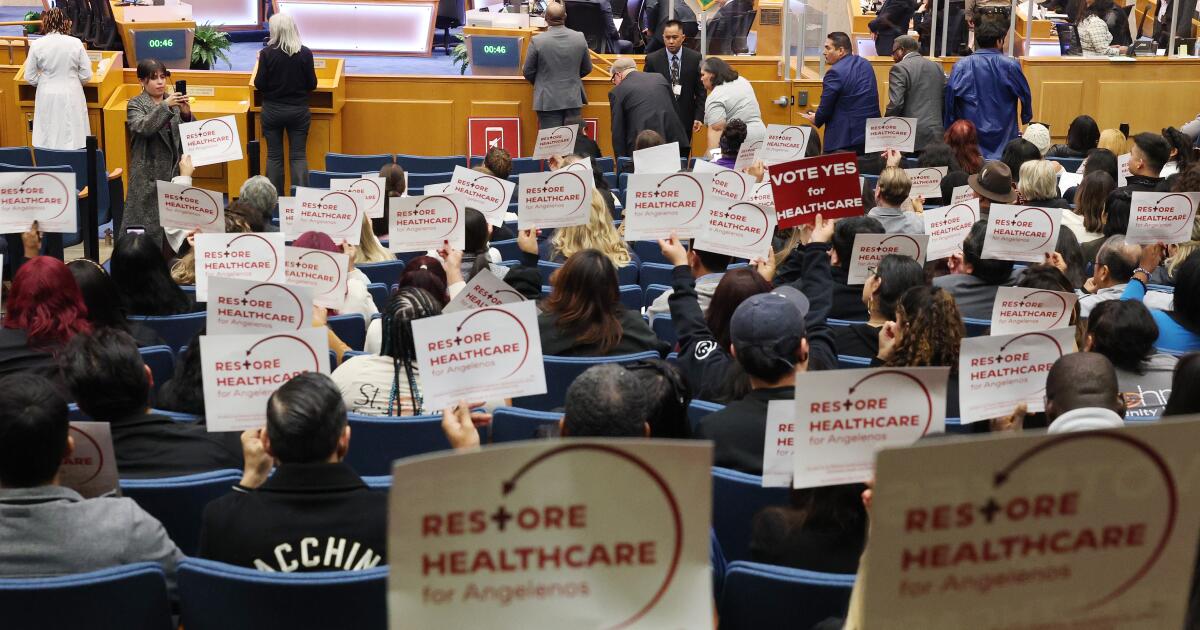
Early returns indicate L.A. County voters have doubts about healthcare sales tax measure
-
 Sports34 minutes ago
Nelly Korda, Michelle Wie West and more: Who to watch at U.S. Women’s Open
-

 World46 minutes ago
EU launches major tech push to break US and China dependence

