Business
Why are California’s Indian truck drivers disappearing during the holiday rush?


It is supposed to be the busiest time of year for the Roadies trucking company, but dozens of its trucks sit idle — unlikely casualties of a surprise scrutiny of laborers from India.
The Bakersfield company has 200 big rigs but a dearth of drivers after authorities canceled thousands of commercial driver’s licenses in California, forcing more than 20 Roadies drivers out of the business and spooking others into quitting.
A Roadies truck leaves for a delivery past unused parked trucks in Bakersfield.
(Myung J. Chun/Los Angeles Times)
Chief Executive Avninder Singh says he has doubled pay, but still can’t recruit enough drivers. He says he is now losing more each month than he usually makes in a year.
“My trucks are sitting,” with no one to drive them, he said. “It has put my livelihood in danger.”
Outside of tech, medicine, and family businesses, truck driving is one of the largest sources of employment for the Indian diaspora in America. Indian truckers say they are being unfairly targeted after a horrific accident triggered extra scrutiny of migrant drivers and tighter regulations.
Some drivers — many of whom claim to have fled persecution in India and requested asylum in the U.S. — are sitting on expensive investments they cannot use. Joban Singh, 27, based in Bakersfield, spent $80,000 to buy a truck because even though truck driving is a tough life, it provides a steady income to support his family.
“We have invested everything in trucking, thinking it’ll be good for us,” he said. “Now if we have our licenses canceled, who will buy these trucks and trailers from us?”

Truck driver Rahul Narwal said if the current licensing situation remains, he won’t be able to renew when his license expires in 2028.
(Myung J. Chun/Los Angeles Times)
Singh is a common surname in the Sikh community from India’s state of Punjab. None of the people mentioned in this story are related.
Punjabi Sikh truckers have emerged as the backbone of the American trucking industry. For decades, many have sought asylum in the U.S. and entered the transportation industry.
There are around 750,000 Punjabi Sikhs in the United States. Of those, about 150,000 work in the trucking industry, with the majority based on the West Coast.
The more devout Sikhs sport turbans and beards as symbols of their faith, which is neither Hindu nor Muslim. This can make them a target on the road, says Manpreet Kaur, the vice mayor of the city of Bakersfield.
“The Sikh community within trucking is really being squished in the middle of a battle between the state of California and the federal government,” said Kaur, whose father was a truck owner and operator.
Instances of racism and racial profiling of the community have risen, with Indian truckers reporting incidents of doors getting slammed in their faces and racial slurs being used at truck stops.
“Feeling a sense of not belonging in a place where you have worked, earned, contributed, [and where] your children have grown up,” is convincing drivers to leave the industry, she said. “All of a sudden, because of the decisions of one administration, the hate is presenting so strongly.”
The surge in negative attention started in August when three people were killed in an accident in Florida after an Indian driver with a license from California allegedly made an illegal U-turn.
The Trump administration blamed California for failing to enforce English proficiency and other driver requirements. In September, the Trump administration issued an emergency rule to try to shut down the issuance of commercial driver’s licenses to noncitizens

Members of the Sikh community gather in support of Harjinder Singh, a truck driver who is accused of manslaughter and vehicular homicide after an accident in Florida.
(Al Diaz/Miami Herald)
The Department of Transportation put pressure on California, revoking $40 million in federal funding for failing to enforce English proficiency tests and threatening to cut additional federal support.
Last month, California’s Department of Motor Vehicles announced plans to revoke 17,000 commercial driver’s licenses issued to immigrants. The licenses were canceled, the DMV said, because they were set to expire after the time the migrants were legally allowed to remain in the U.S.
Sukhdeep Singh, owner of Cali Brothers Truck Lines, which has 60 trucks and is based in Merced, said 10 of his Sikh drivers quit last month. They have valid licenses and work papers, but are afraid to go back on the road, worried that if they get stopped, they could get sent home.
“They don’t want to drive anymore,” he said.
About 25 of Roadies’ truck drivers received the cancellation notice. The company is now losing hundreds of thousands of dollars in revenue each month as its clients go elsewhere.
Policy changes regarding noncitizen commercial licenses and English language proficiency enforcement could remove more than 400,000 commercial drivers from the market over the next three years, according to J.B. Hunt, one of the largest trucking companies.
Some say the driver shortage concerns are overblown and that there are enough U.S. citizens to meet the demand for drivers if they are given sufficient training and salaries.
“I do not buy the idea that there aren’t enough American truck drivers to meet demands in this country,” Transport Secretary Sean Duffy said in an October news conference. “I think you will see American truck drivers fill the space when we do what is right and take out these unlawful drivers.”
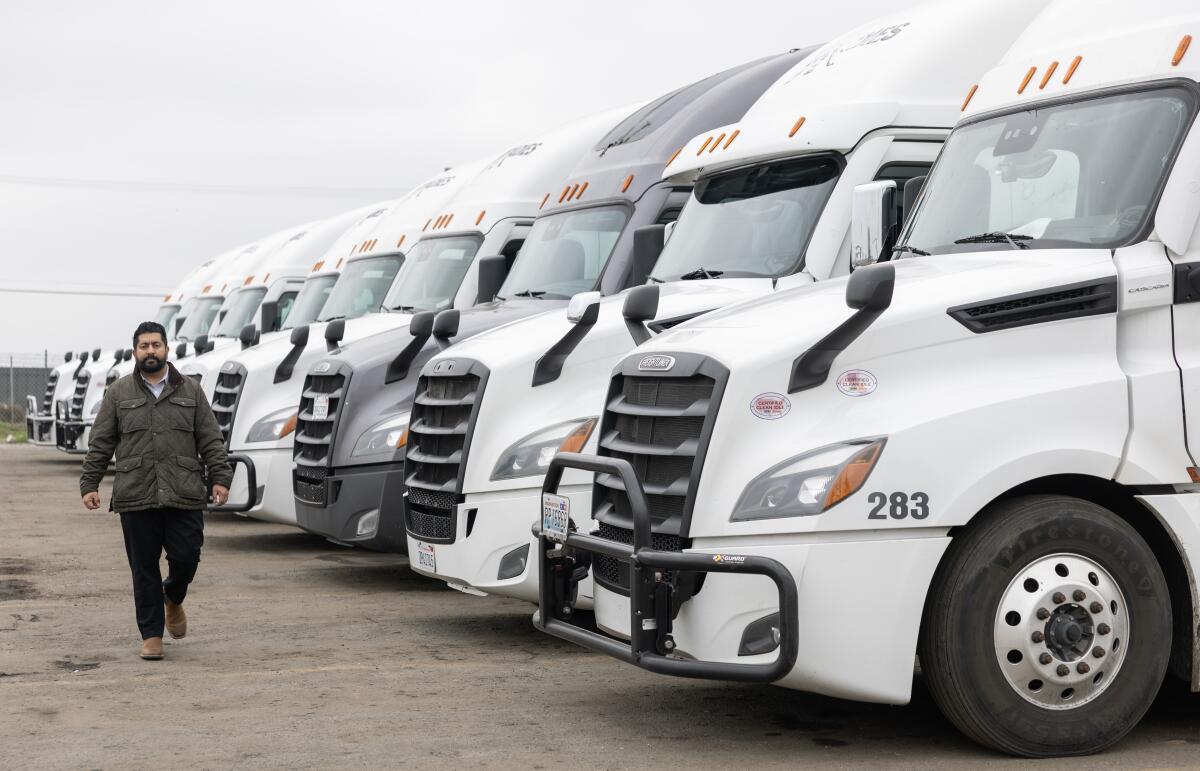
Avninder Singh, CEO of Roadies, says about 100 of 300 of his drivers will be affected by the license pause. He walks past nine trucks that are parked at his business because he doesn’t have drivers.
(Myung J. Chun/Los Angeles Times)
Advocacy groups such as the American Trucking Assn., which in the past has lobbied for looser licensing rules to address driver shortages, have backed the tighter restrictions.
Regulators need to enforce rules requiring truckers to be well-trained and qualified, said ATA Chief Economist Bob Costello.
“Qualified means you can speak English, read road signs, understand safety rules and respect our laws,” he said. “Qualified means you earned your CDL the right way, not through a rubber-stamped process in a state that looks the other way.”
Companies that rely on Indian truckers may have to reconsider their business model.
The trucking industry is packed with small carriers operating 10 or fewer trucks. Most have been operating for years without incident, but many could now go out of business as they wait for the new normal to emerge.
“I am excited about the holiday season,” said Sukhdeep Singh of Cali Brothers Truck Lines. “But for the truckers, it’s not bringing any happiness.”



Disneyland Resort President Thomas Mazloum has been named chairman of Walt Disney Co.’s experiences division, the company said Tuesday.
Mazloum succeeds soon-to-be Disney Chief Executive Josh D’Amaro as the head of the Mouse House’s vital parks portfolio, which has become the economic engine for the Burbank media and entertainment giant. His purview includes Disney’s theme parks, famed Imagineering division, merchandise, cruise line, as well as the Aulani resort and spa in Hawaii.
Jill Estorino will become the head of Disneyland Resort in Anaheim. She previously served as president and managing director of Disney Parks International and oversaw the company’s theme parks and resorts in Europe and Asia.
Estorino and Mazloum will assume their new roles on March 18, the same day as D’Amaro and incoming Disney President and Chief Creative Officer Dana Walden.
“Thomas Mazloum is an exceptional leader with a genuine appreciation for our cast members and a proven track record of delivering growth,” D’Amaro said in a statement. “His focus on service excellence, broad international leadership and strong connection to the creativity that brings our stories to life make him the right leader to guide Disney Experiences into its next chapter.”
Mazloum had been about a year into his tenure at Disneyland. Before that, he was head of Disney Signature Experiences, which includes the cruise line. He was trained in hospitality in Europe.
In his time at Disneyland, Mazloum oversaw the park’s 70th anniversary celebration and recently pledged to eliminate time limitations for park-hopping, which are designed to manage foot traffic at Disneyland and California Adventure.
Mazloum will now oversee a 10-year, $60-billion investment plan for Disney’s overall experiences business, which includes new themed lands in Disneyland Resort and Walt Disney World. At Disneyland, that expansion could result in at least $1.9 billion of development.
The size of that investment indicates how important the parks are to Disney’s bottom line. Last year, the experiences business brought in nearly 57% of the company’s operating income. Maintaining that momentum, as well as fending off competitors such as Universal Studios, is key to Disney’s continued growth.
In his new role, Mazloum will have to keep an eye on “international visitation headwinds” at its U.S.-based parks, which the company has said probably will factor into its earnings for its fiscal second quarter. At Disneyland Resort, that dip was mitigated by the park’s high percentage of California-based visitors.
Times staff writer Todd Martens contributed to this report.

It has been a bumpy road for the electric vehicle market as declining federal support and plateauing public interest have eaten away at sales.
But EV sellers could soon receive a boost from an unexpected source: The war in Iran is pushing up gas prices.
As Americans look to save money at the pump, more will consider switching to an electric or hybrid vehicle. Average gas prices in the U.S. have risen nearly 17% since Feb. 28 to reach $3.48 per gallon. In California, the average is $5.20 per gallon.
Electric vehicles are pricier than gasoline-powered cars and charging them isn’t cheap with current electricity prices, but sky-high gas prices can tip the scales for consumers deciding which kind of vehicle to buy next.
“We probably will see an uptick in EV adoption and particularly hybrid adoption” if gas prices stay high, said Sam Abuelsamid, an auto analyst at Telemetry Agency. “The last time we had oil prices top $100 per barrel was early 2022 and that’s when we saw EV sales really start to pick up in the U.S.”
In a 2022 AAA survey, 77% of respondents said saving money on gas was their primary motivator for purchasing an electric vehicle. That year, 25% of survey respondents said they were likely or very likely to purchase an EV.
As oil prices cooled, the number fell to16% in 2025.
In California, annual sales of new light-duty zero-emission vehicles jumped 43% in 2022, according to the state’s Energy Commission. The market share of zero-emission vehicles among all light-duty vehicles sold rose from 12% in 2021 to 19% in 2022.
“Prior to 2022, we didn’t really have EVs available when we had oil price shocks,” Abuelsamid said. “But every time we did, it coincided with a move toward more fuel-efficient vehicles.”
Dealers are anticipating a windfall.
Brian Maas, president of the California New Car Dealers Assn., predicted enthusiasm for EVs will rebound across California if oil prices don’t come down.
“If prior gasoline price spikes are any indication, you tend to see interest in more fuel-efficient vehicles,” he said.
Rising gas prices could be a lifeline for EV makers at a time when federal support for green cars has been declining.
Under President Trump, a federal $7,500 tax incentive for new electric vehicles was eliminated in September, along with a $4,000 incentive for used electric vehicles.
In California, the zero-emission vehicle share of the total new-vehicle market was 22% through the first 10 months of 2025, then dropped sharply to 12% in the last two months of the year, according to the California Auto Outlook.
Meanwhile Tesla, the most popular EV brand in the country, has grappled with an implosion of its reputation with some consumers after its chief executive, Elon Musk, became one of Trump’s most vocal supporters and helped run the controversial Department of Government Efficiency.
Over the last several months, Ford, General Motors and Stellantis have pared back EV ambitions.
Other automakers, including Nissan, announced plans to stop producing their more affordable electric models.
The Trump administration has moved to roll back federal fuel economy standards and revoked California’s permission to implement a ban on new gas-powered car sales by 2035.
David Reichmuth, a researcher with the Clean Transportation program in the Union of Concerned Scientists, said the shift in production plans will affect EV availability, even if demand surges.
That could keep people from switching to cleaner vehicles regardless of higher gas prices.
“This is a transition that we need to make for both public health and to try to slow the damage from global warming, whether or not the price of gasoline is $3 or $5 or $6 a gallon,” he said.
According to Cox Automotive, new EV sales nationally were down 41% in November from a year earlier. Used EV sales were down 14% year over year that month.
To be sure, oil prices can fluctuate wildly in times of uncertainty. It will take time for consumers to decide on new purchases.
Brian Kim, who manages used car sales at Ford of Downtown LA, said he has yet to see a jump in the number of people interested in EVs, hybrids or more fuel-efficient gas-powered engines.
Still, if the price at the pump stays stuck above its current level, it could happen soon.
“Once the gas prices hit six [dollars per gallon] or more and people feel it in their pocket, maybe things will start to change,” he said.

A total of 59 gigawatts of U.S. clean energy projects are facing delays at a time when demand for power from AI data centers is surging, according to a trade group study.
Developers are seeing an average delay of 19 months over issues such as long interconnection times, supply constraints and regulatory barriers, the American Clean Power Assn. said in a quarterly market report.
The backlog is happening despite the growing need for power on grids that are being taxed by energy-hungry data centers and increased manufacturing. The Trump administration has implemented a slew of policies to slow the build-out of solar and wind projects, including delaying approvals on federal lands.
The potential energy generation facing delays is the equivalent of 59 traditional nuclear reactors, enough to power more than 44 million homes simultaneously.
“Current policy instability is beginning to impact investor confidence and negatively impact project timelines at a time when demand is surging,” American Clean Power Chief Policy Officer JC Sandberg said in a statement.
Despite the hurdles, developers were able to bring more than 50 gigawatts of wind, solar and batteries online in 2025, accounting for more than 90% of all new power capacity in the U.S., the report found. Clean power purchase agreements declined 36% in 2025 compared with 2024, signaling that the build-out of clean power in the U.S. could be lower in the 2028 to 2030 time period, according to the report.
Chediak writes for Bloomberg.

Cowboys Team Doctor Played Role in Maxx Crosby-Ravens Trade Debacle

2-year-old boy bitten in face by two pit bulls in Miami Gardens backyard, police say

Shay Maloney’s overtime goal lifts Boston Fleet to road victory

Our dumpling challenge boils down to eight Denver metro restaurants

Seattle goal overturned for goalie interference as Predators complete 4-2 comeback win

Florida High School Football Rankings: Top 25 teams – Oct. 21

Cleary's 21 help Le Moyne down Central Connecticut State 69-64 in OT

How old is Bo Nix? What to know about Oregon quarterback ahead of 2024 NFL Draft

99th annual Pony Swim held in Virginia

Indiana Members Credit Union announced as new anchor tenant at Bottleworks District

EXCLUSIVE: ICE says El Paso detention facility will stay open under new contractor after $1.2B deal scrapped

Von der Leyen ‘acting outside of competence,’ Araud tells Euronews

Wheelchair curler Steve Emt’s path from drunk driver to three-time Paralympian

Map: 2.3-Magnitude Earthquake Reported North of New York City

Trump stirs GOP primary drama with visit to Massie’s Kentucky home turf
-

 Wisconsin1 week ago
Setting sail on iceboats across a frozen lake in Wisconsin
-

 Massachusetts1 week ago
Massachusetts man awaits word from family in Iran after attacks
-

 Pennsylvania6 days ago
Pa. man found guilty of raping teen girl who he took to Mexico
-

 Detroit, MI5 days ago
U.S. Postal Service could run out of money within a year
-

 Miami, FL7 days ago
City of Miami celebrates reopening of Flagler Street as part of beautification project
-

 Sports6 days ago
Keith Olbermann under fire for calling Lou Holtz a ‘scumbag’ after legendary coach’s death
-

 Virginia7 days ago
Giants will hold 2026 training camp in West Virginia
-

 Culture1 week ago
Try This Quiz on the Real Locations in These Magical and Mysterious Novels