Business
What is CrowdStrike, and how did it cripple so many computers?

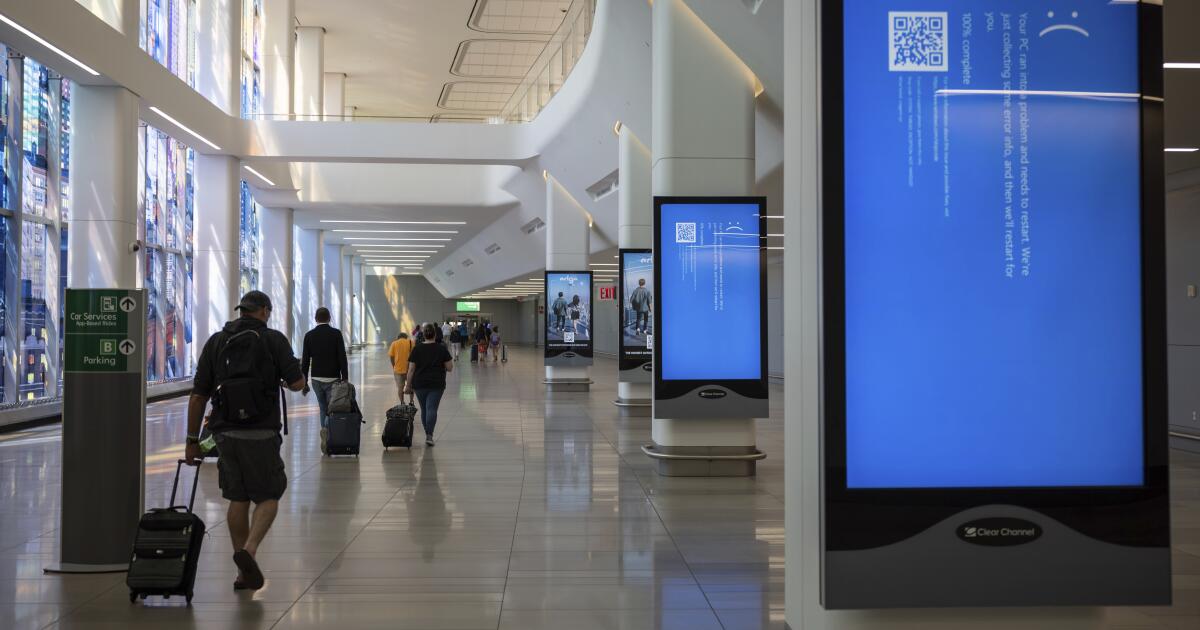
Talk about irony: The software that paralyzed Windows computers around the world late Thursday night and early Friday morning was planted by a company that protects Windows computers against malware.
That company is CrowdStrike, a publicly traded cybersecurity firm based in Austin, Texas. It acknowledged the problem around 11 p.m. Thursday and started working on a solution, offering a workaround in the wee hours Friday and a fix a few hours later.
The vast sea of Blue Screens of Death triggered by CrowdStrike’s error is a testament to the market-leading status of the company’s software, which detects and defends against malicious code planted by hackers. Its approach is known as “endpoint security” because it installs its defenses on devices that connect to the internet, such as computers and smartphones.
According to the website 6sense.com, CrowdStrike has more than 3,500 customers, which represent about one of every four companies buying endpoint security. Although most of its customers are based in the United States, it has hundreds in India, Europe and Australia, 6sense reports.
Here’s a quick explanation for how things went wrong so quickly for so many Windows users around the world, including airlines, hospitals, banks and government agencies.
The Falcon Sensor update
One of the selling points of CrowdStrike service is that it can improve its defenses rapidly as new threats are discovered. As part of that service, it continuously and automatically updates the Falcon Sensor software on its customers’ machines.
Automatic updates are, under normal circumstances, a good cybersecurity practice because they prevent clients from having machines with outdated defenses on their networks. But the latest incident reveals the flip side of the coin.
According to CrowdStrike, the problem was triggered by a “single content update” for its customers with Windows PCs. The buggy code wasn’t detected until after it had downloaded and installed on many of CrowdStrike’s clients machines.
Once loaded, the bad update interfered with core functions of the PC, causing Microsoft’s infamous blue error screen to pop up and convey a message along the lines of, “Your PC ran into a problem and needs to restart.” And as long as the update remained in place, restarting the machine led to the same errant result.
The fix offered by CrowdStrike
CrowdStrike stopped sending out the faulty update early Friday morning, so machines that had not loaded it yet were spared the turmoil.
For machines caught in the cycle of blue-screen hell, the company initially offered step-by-step instructions for how to reboot Windows in a mode that would allow them to find and delete the buggy update. The drawback, as many commenters online noted, is that this machine-by-machine approach isn’t much help for organizations with hundreds or thousands of bricked PCs.
According to the tech website 404, Microsoft also suggested rebooting a crashed machine multiple times — as many as 15 — could solve the problem.
Within a few hours, CrowdStrike was distributing a piece of software that removed the buggy code. This worked only for customers whose machines were able to connect to the internet and download the fix, though; everyone else would be left with the PC-by-PC workaround.
The lessons from the CrowdStrike debacle
Some Macintosh and Linux users, who were immune to the CrowdStrike-induced upheaval, devoted a portion of their morning Friday to spiking the football on Windows, even though the problem wasn’t caused by Microsoft.
Other observers argued that the incident demonstrated the risk of having one potential point of failure affecting millions of computers — a problem that has been demonstrated repeatedly during the broadband era.
Steve Garrison, founder of Stellar Cyber in San Francisco, said it’s more important to figure out how to make improvements than to play the blame game. This incident, he said, underscores the need for companies to spend plenty of time checking the quality of their products in a controlled environment before releasing them to customers.
Another lesson, he said, is the need for companies, their competitors and their customers to work together as a community to spot problems. “What do we need to do to check the checkers of our supply chain?” he asked.
Dan O’Dowd, a developer of security software for the military, said the fiasco demonstrates that we need better software in critical systems.
“The immense body of software developed using Silicon Valley’s ‘move fast and break things’ culture means that the software our lives depend on is riddled with defects and vulnerabilities,” O’Dowd said in a statement. “Defects in this software can result in a mass failure event even more serious than the one we have seen today.”
He added, “We must convince the CEOs and Boards of Directors of the companies that build the systems our lives depend on to rewrite their software so that it never fails and can’t be hacked. … These companies will not take cybersecurity seriously until the public demands it. And we must demand it now, before a major disaster strikes.”


The electric vehicle company Slate Auto set out in 2022 to make the most affordable electric truck in the country. This week, it unveiled the price tag: $24,950.
At a time when demand for new electric vehicles is cooling and cars are getting harder to afford, Slate’s customizable truck could bring a fresh wave of excitement to the industry.
Deliveries will begin later this year and accelerate in 2027, the company said. Slate’s vehicle is built around a simple concept — pay only for what you actually want.
Buyers will start with a basic truck without power windows or even paint and can then customize it however they like. They can tailor-make their “blank slate” by paying extra for smart phone-compatible screens, speakers, colored wrap or paint. A $5,000 kit even converts the truck into an SUV.
Slate’s design team is based in Los Angeles County and recently moved into a new space in Carson, which employs about 50 workers. The company’s headquarters are in Troy, Mich., and its vehicles will be produced in Warsaw, Ind.
Squeezing out as much cost as possible while making it as easy as Legos to snap on different options has required complex engineering, which is why the company decided to set up its design studio in Southern California. The region is full of experts.
“Slate has done something smart,” said auto industry analyst Brian Moody. “Their EV isn’t only about price, there’s also a strong personalization element. In Southern California, the boxy, retro look will earn it a lot of attention.”


Slate is an EV startup that makes electric trucks and SUVs. Customers buy only the features they want. Photographed on Friday, Dec. 19, 2025. (Myung J. Chun/Los Angeles Times)
The company is building a marketplace of accessories for customers to choose from, including 54 basic wraps that cost less than $500 each. In contrast, a paint job on a car can cost thousands of dollars. The marketplace also offers roof stacks, zip-on seat covers and stereos.
For just under $30,000 total, customers can get a basic SUV in a fastback or squareback style. Whether it’s configured as a truck or SUV, the EV will have an estimated range of 205 miles and will be compatible with Tesla chargers.
“This is the first time in automotive history that consumers are going to get to choose,” said Slate Chief Executive Peter Faricy, who joined the company in March after 13 years with Amazon.
“It started with design, then engineering, and eventually manufacturing, and we figured out innovations in all three of those phases that make the vehicle less expensive,” he said.
For example, Slate vehicles were designed from the beginning to be wrapped instead of painted. The company will offer more than 100 colors of wrap at its launch, or customers can choose a custom color.
Slate did not disclose financial information or how much the vehicles cost to produce. However, Faricy said the company will generate a positive gross margin on its vehicles, meaning they are selling for more than what they cost to make.
“Whether Slate succeeds or fails, it has already influenced the conversation … forcing the industry to ask why affordable vehicles have become so rare,” said Jesse Toprak, an industry analyst and founder of OptiCar.ai. “They are betting on making higher profit margins on the accessories and do-it-yourself angle.”
Slate says it has already received more than 180,000 reservations. The earlier a customer placed their reservation, the sooner they’ll get their vehicle. Pre-orders opened Wednesday for $300, or $250 if the customer has already paid a $50 reservation fee.
Despite the hype, Slate is still a startup that has yet to prove itself in the market. The company has about 750 employees and has raised more than $700 million from Amazon’s Jeff Bezos and others.
“For the vehicle itself, the concept is brilliant,” Toprak said. “I think the execution risk is enormous.”
The EV industry has been under fire from the Trump administration, which has removed incentives for ownership and clean-car goals. Major automakers including Ford and Stellantis have pared back their EV offerings, and other startups have struggled to turn a profit.
The Irvine-based EV company Rivian, which hasn’t reached profitability since its founding in 2009, recently laid off hundreds of workers. It launched its highly anticipated R2 SUV earlier this month, which will eventually be available for less than $45,000.
Lucid, the luxury electric vehicle maker based in Newark, Calif., announced this week that it’s reducing its workforce by 18%. The cuts come just months after it laid off 319 Bay Area employees in February.
Faricy, Slate’s chief executive, said the company’s vehicle will appeal to a wide range of customers.
“There will be a lot of people that are attracted to the affordability but have never had an EV before,” he said.
According to Cox Automotive, the average transaction price for a new EV in the U.S. is $55,000, compared with $49,000 for a gas-powered vehicle.
“The EV market at this point doesn’t have a technology problem anymore,” Toprak said. “It has an affordability problem. Slate is one of the first companies built entirely around solving that.”

Sony Pictures will invest $100 million and take a minority stake in virtual reality venue operator Cosm, as the studio continues to build a business in communal experiences.
As part of the investment, Sony Pictures Chief Executive Ravi Ahuja will also join Cosm’s board of directors, the studio said Wednesday. The size of Sony’s minority stake was not disclosed.
The El Segundo-based Cosm currently operates three venues — one at Hollywood Park in Inglewood, and the others in Dallas and Atlanta. The company plans to open additional venues in Detroit and Cleveland.
Cosm bills itself as a “shared reality venue,” and its facilities center around a massive, wraparound screen that is intended to envelop viewers with additional digital effects. The company has largely focused on sports, though it has also shown Cirque du Soleil shows and done several collaborations with Warner Bros., including recent screenings of 2001’s “Harry Potter and the Sorcerer’s Stone” in honor of the film’s 25th anniversary.
“Cosm sits at the intersection of several trends shaping the future of entertainment,” Ahuja said in a statement. “We’ve followed Cosm since before launch and have been impressed with the quality of the experience and the enthusiasm it’s generating with audiences.”
The investment is Sony’s latest venture into experiential entertainment. In 2024, the Culver City-based studio acquired dine-in theater chain Alamo Drafthouse Cinema.

The Los Angeles City Council on Tuesday unanimously advanced an ordinance to halt new oil and gas drilling and phase out all existing production over the next 20 years. L.A. is home to more than 2,000 active oil wells.
The measure revives a similar ban passed in 2022, which was struck down by a judge following legal challenges from the oil and gas industry.
It must pass a second vote before final adoption later this summer, and would make L.A. the largest city in the United States to phase out existing oil wells.
“Today, Los Angeles is making a decision that aligns with our need to turn the page on urban oil drilling,” Councilmember Katy Yaroslavsky said during Tuesday’s council meeting. “The absence of an enforceable oil ordinance has had real consequences for our communities.”
The ban in 2022 was seen as a historic move for a region built on the petroleum industry.
But in 2024, a Los Angeles County Superior Court judge invalidated the law, ruling that the state, not the city, has jurisdiction over petroleum production. The legal challenge was brought by oil companies including Warren Resources, which operates a large oil field in Wilmington. Much of the field is beneath the city of Long Beach, but it also extends under Los Angeles.
Shortly after that, state legislators advanced Assembly Bill 3233, which reaffirmed city and county authority to regulate oil and gas activity. It was largely seen as the missing piece that made the original ordinance vulnerable.
“It’s now unequivocal that cities have the authority to regulate, limit and prohibit oil and gas operations within our jurisdiction,” Yaroslavsky said.
The new ordinance, written by the Department of City Planning, prohibits new oil and gas extraction, including drilling, redrilling or deepening existing oil wells for the purposes of production. It also designates all existing and active idle wells as “nonconforming uses,” meaning they may only operate during the phaseout period and are no longer compliant with current zoning.
Warren Resources, which led the lawsuit against the previous ban, did not immediately respond to a request for comment. The company previously argued that the 2022 ban was rushed and would lead to more oil imports to the area, causing increased emissions from tankers and trucks and other environmental consequences.
Many wells in the city operate near schools, homes and parks. Most are concentrated in low-income areas and communities of color, such as Wilmington and the harbor district, West L.A. and South L.A., where residents have long reported respiratory issues, headaches, throat irritation and other health problems. Studies have found oil wells can emit carcinogens and are linked to adverse health effects.
“This ordinance is such an important step toward giving every frontline community in Los Angeles access to clean air,” Silvia Esparza, a South L.A. resident and member of environmental justice group Stand-L.A., said in a news conference ahead of Tuesday’s vote.
Ashley Hernandez, a Wilmington resident and organizer with the nonprofit Communities for a Better Environment, said bloody noses and noxious fumes were a regular part of life in the neighborhood growing up.
She noted that in addition to oil drilling, L.A. residents continue to face other environmental hazards, such as the recent oil pipeline rupture that sent crude into the L.A. River or the ongoing cold storage warehouse fire in Boyle Heights that is spewing toxic smoke.
“I’m here to remind L.A. city and these toxic neighbors that Wilmington residents are more important than any ‘black gold’ under their homes,” Hernandez said. “We need our city to protect our families now and to stop the oil industry’s reign of power in our city. A passage of the oil phaseout ordinance today gives the city a chance to correct this wrong.”
Times staff writer Dakota Smith contributed to this report.
-
 Lifestyle20 minutes ago
Great movies you may have missed : Pop Culture Happy Hour
-

 Technology28 minutes ago
The best Apple deals you can get during Prime Day
-

 World35 minutes ago
Trump says Venezuela earthquakes left ‘devastating number of deaths’ as US readies aid
-

 Politics38 minutes ago
Closed-door outburst turns into victory for Trump’s Iran negotiations
-

 Health43 minutes ago
Former reality star opens up about new diagnosis after years-long health ordeal
-

 Sports50 minutes ago
Terrion Arnold, Lions’ 2024 first-round pick, charged with kidnapping and armed robbery in Florida
-
Business58 minutes ago
An electric truck for less than $25,000? Deliveries begin this year
-
 Entertainment1 hour ago
Kylie Jenner hit with third lawsuit as former chef claims Palm Springs party led to miscarriage

