Business
What Are Stablecoins?


There’s a new type of money spreading rapidly across the internet, propelled by the crypto boom. It’s supposed to be worth a dollar, but it’s not issued by any government. Called a stablecoin, it is a digital currency that is subject to very little legal oversight — and its growing popularity has recently transformed it into a $300 billion market.
You can use stablecoins to buy things online, make investments or send money abroad with minimal fees.
Hundreds of different brands of stablecoins exist now, with more to come. The Trump family introduced its own version this year. Walmart has been exploring one, as have major banks, tech companies and others.
And as big businesses flock to the cryptocurrency, so have bad actors. When pushing for stablecoin legislation in March, Senator Bill Hagerty, Republican of Tennessee, said the United States could not ignore the use of these digital dollars for “illicit activities by drug cartels, foreign terrorist organizations and state actors.”
Financial experts worry that the increasing adoption of these cryptocurrencies could pose large risks to the financial system. You can use them to easily move official money into digital currencies and back again. But they do not come with deposit insurance, like money in a savings account from a bank will have. There are no fraud protections. And there is scant regulation in place to make sure people are not using them for illegal transactions.
Stablecoin companies “enjoy the privileges of being a bank without the responsibilities,” said Corey Frayer, a former official at the Securities and Exchange Commission focused on crypto policy and a director at the Consumer Federation of America, a consumer advocacy group.
The mechanics of how stablecoins work are straightforward. You can buy them, usually from a large online crypto exchange, in a matter of minutes with a wire transfer or credit card. The coins sit in your digital wallet, available for cheap and fast transactions anywhere in the world.
Imagine you want to buy this pair of Nike Air Force 1 shoes. They cost $222 from Crepslocker, a British online reseller of luxury goods. Here’s what happens at checkout:
Mani Fazeli, the vice president of product at Shopify, said that since cryptocurrency regulations were still evolving, consumer protections can differ from traditional card payments. He added that the company worked with regulated partners to handle compliance for different parts of the process for payments.
Until recently, stablecoins served two main purposes: buying other cryptocurrencies and making risky crypto bets. But new regulations, including the GENIUS Act that President Trump signed into law this year, legitimized them for traditional payments and banking.
As it becomes more mainstream, many people may not even know they’re using stablecoins for transactions, said John Collison, a founder of Stripe, a payments company.
He cited Félix Pago, a popular app that allows people to send money transfers through WhatsApp and other platforms. Using Stripe technology, Félix Pago converts money into stablecoins to cut out foreign exchange fees, but doesn’t advertise cryptocurrency anywhere on its website.
“For me, this is a sign of the maturity of the industry and the utility of the technology,” Mr. Collison said in an interview.
The lack of transparency worries Mr. Frayer. He predicts that payment companies will slip stablecoins into updated terms of service, so consumers unknowingly agree to crypto transactions every time they swipe their card. But those transactions “will come with none of the protections” that Americans expect, like chargebacks and fraud protection, he said.
Mr. Frayer warns that the proliferation of the coins echoes a dangerous era in American finance. In the 19th century, before federal regulations, private banks issued their own currencies that frequently collapsed, wiping out people’s savings.
Here’s how stablecoins in your crypto wallet differ from a traditional bank deposit:
A niche invention that grew bigger than nations’ G.D.P.s
Five years ago, stablecoins were mostly niche assets for crypto traders. Today, they’re worth more than the yearly economic output of Greece.
Tether, one of the most well-known issuers of stablecoins, made $13 billion in profit last year, according to company disclosures, just from the interest on customer funds. It now has roughly $180 billion in circulation. Circle, which issues the stablecoin USDC, has about $78 billion.
The Rise of Tether and Circle
To understand why that matters, you need to understand Treasury bills, or T-bills.
T-bills are essentially short term loans taken by the U.S. government to fund its operations, accounting for 20 percent of all U.S. debt. They’re considered some of the safest investments in the world because the United States is very unlikely to default on its debt, especially over shorter time periods. So banks, pension funds, foreign governments and money market funds all heavily invest in this market as a way to safely park enormous amounts of cash while earning a return.
Now, stablecoin issuers are some of the biggest purchasers of Treasury bills. Circle and Tether together hold roughly $136 billion in T-bills, according to an analysis of their financial statements, putting them on par with large nations and institutional investors.
Top Purchases of Treasury Bills in 2024
With the passage of the GENIUS Act, the Trump administration’s signature crypto policy, the adoption of stablecoins is projected to skyrocket.
The Federal Reserve estimates that the total market could be worth $3 trillion in five years. That’s nearly the entire 2024 gross domestic product of France, according to the World Bank.
Industry giants are celebrating. “We love, we love the GENIUS Act,” said Rubail Birwadker, the global head of growth at Visa, which has expanded into stablecoin payments. He added that the new regulation “makes it so much easier for more legitimate banks, technology companies, others to actually enter the ecosystem because they know exactly what they’re getting into.”
Mr. Frayer, the Consumer Federation of America director, said the law fell far short of existing regulations for financial firms. It hands financial power to companies, he argued, that “fundamentally don’t believe that the federal government has any role in regulating financial transactions.”
A coin that provides all of the power, with none of the oversight.
Because stablecoins exist in a regulatory gray zone, Tether has become a favorite currency of criminals and money launderers.
ISIS has used it to fund operations, according to the U.S. Financial Crimes Enforcement Network.
Russian oligarchs moved millions of dollars in Tether across borders to evade sanctions in Europe, the Treasury Department said.
On Telegram, underground channels openly advertise weapons and narcotics, accepting Tether payments while promoting “zero fees” and untraceable transactions.
In a statement, a Tether spokesperson said the company worked closely with law enforcement agencies and that it regularly froze assets of bad actors. “Blockchain transactions are traceable in ways that cash and traditional banking channels are not,” the company said. “Criminals predominantly use cash along with every form of money, but digital assets create immutable records that law enforcement can trace.”
The risks of stablecoins extend beyond criminal use. Because they have connected crypto markets directly to traditional finance, failures in either system can spread to the other.
When the price of Bitcoin slid recently, people used stablecoins to cash out, according to data from CoinMarketCap, an industry firm. The overall value of the number of Circle stablecoins decreased nearly 3 percent over a 13-day period.
The sell off was relatively slow, happening over the course of nearly two weeks. But had withdrawals happened more rapidly, it could have meant something much more damaging. Here’s how that could have played out.
The value of cryptocurrency crashes, pushing investors into stablecoins, in part to help them cash out of their investments.

As crypto continues to tumble, stablecoin companies begin to sell Treasury bills in order to pay back customers.
T-bills, as a result, lose their value, affecting bank and money market fund reserves.
A crash could also work in the other direction, a danger that became clear two years ago.
Banks or money market funds go under.
In March 2023, Silicon Valley Bank collapsed.
The money that is backing stablecoins disappears.
Circle had $3.3 billion trapped in the failed bank, causing its USDC currency to plunge to 87 cents per coin.
Panic cascades, sending cryptocurrency into free-fall.
Crypto exchanges froze withdrawals, margin calls resulted in forced selling and the contagion spread to Bitcoin and Ethereum.
The crisis ended only when federal regulators guaranteed all Silicon Valley Bank deposits. The episode, however, exposed a critical vulnerability: Unlike bank deposits, stablecoin holdings have no federal safety net, so customers are at risk if the issuer falters. Had Circle lost its $3.3 billion, many everyday users would simply have been out of luck.
The risk isn’t just hypothetical. Stablecoin issuers have a checkered record when it comes to managing customer funds, according to Hilary Allen, a professor at American University.
In 2021, for example, Tether reached a settlement with the New York attorney general after investigators found it had falsely claimed to hold sufficient assets to match the amount of Tether in circulation, according to court documents. Had there been a surge in withdrawals, Tether might not have been able to cover all its stablecoin holders.
On Nov. 26, S&P Global, a ratings firm, downgraded its assessment of Tether’s holdings to “weak,” the firm’s lowest rating, citing “persistent gaps in disclosure” and overreliance on high risk assets like bitcoin, gold and corporate bonds.
In a statement, a Tether spokesperson said its currency “has remained stable through banking crises, exchange failures, and extreme market volatility.” Since the New York attorney general settlement years ago, Tether has increased its holdings of safe assets, the company said.
Tether’s checkered history nonetheless does not inspire confidence, according to Ms. Allen. Any doubt about solvency, she said, could generate a run.



Business
Commentary: Trump wants you to invest your 401(k) in crypto and private equity. Should you bite?
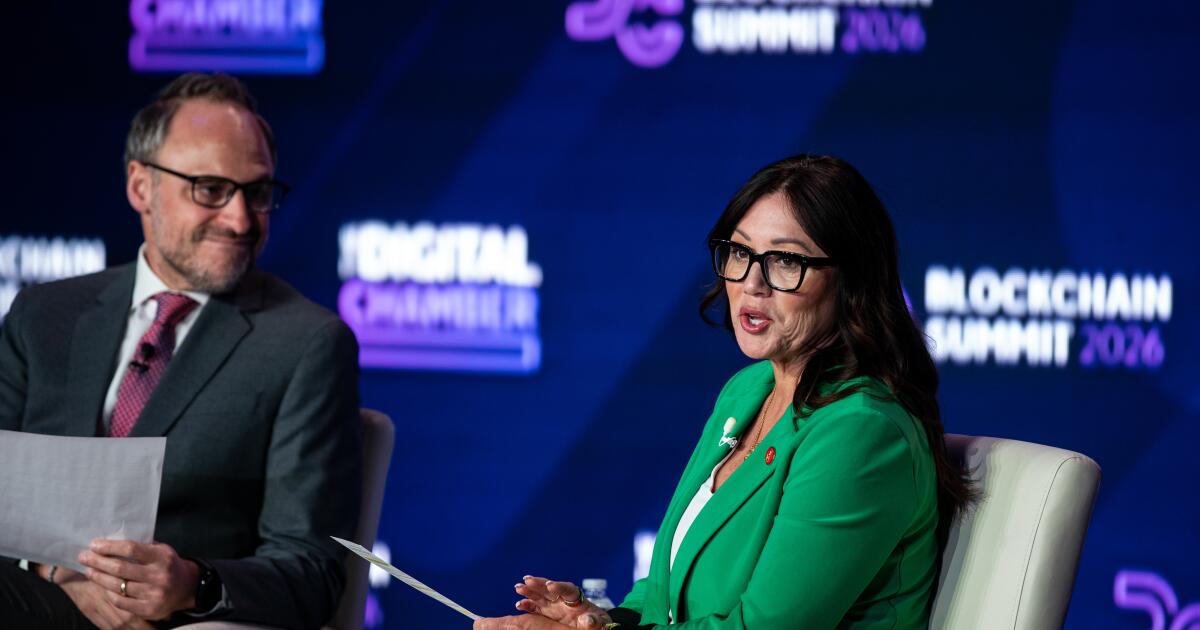
Trump is opening the door to risky ‘alternative investments’ such as crypto and private equity in 401(k) plans. But employers have had good reasons to keep them out of their plans.
If you believe Labor Secretary Lori Chavez-DeRemer, American 401(k) accounts are about to get much better.
Thanks to President Trump’s “bold new vision of a new golden age for America,” Chavez-DeRemer wrote in the Wall Street Journal on March 30, her agency is taking steps to open these crucial retirement accounts to a raft of new investment options, such as cryptocurrencies and private equity funds.
Her goal, she wrote, is to “unwind regulatory overreach and litigation abuse that have stifled innovation.” Her instrument is a proposed regulation that in effect would provide a safe harbor for plan sponsors — that is, employers — to offer those options in their employees’ plans without risking lawsuits or government scrutiny over whether they’re sufficiently prudent for workers to choose.
We have seen a number of proposals from private equity funds where the returns are really not calculated in a manner that I would regard as honest.
— Warren Buffett (2019)
Notwithstanding Chavez-DeRemer’s assertion that this change would be all to the good for workers, the truth is that she and Trump are acting at the behest of alternative investment promoters, who have long slavered for access to the nearly $14 trillion in assets held in 401(k)s and other such defined contribution retirement plans.
Far be it for me to offer anyone investment advice. But there are a few things that Trump and DeRemer aren’t telling you about these proposed new options. Namely, the dangers they present to unwary small investors.
The first clue that something is being hidden appeared in DeRemer’s op-ed, in which she blamed “Washington bureaucrats” and “plaintiff lawyers” for stifling the financial innovation that people supposedly have been clamoring to put in their retirement accounts.
You know who rails against “Washington bureaucrats” and “plaintiff lawyers”? Businesses that are fearful that government regulators and juries will clamp down on their wrongdoing. These critiques are often described as efforts to get government off the backs of the people. What they don’t explain is that once government has climbed off, big business will saddle up.
(As I’ve reported, among the businesses that have recently been demonizing plaintiff lawyers is Uber, which is pushing a ballot measure in California that would all but shut the courthouse doors to some passengers injured during Uber rides.)
So let’s examine the unacknowledged issues with “innovative” alternative investments. Private equity firms are known for buying companies that are either held privately, or are public companies due to be taken private. In many cases, they turn profits for their investors by cutting payrolls and reducing services at their portfolio companies, then draining what’s left until there is nothing left. Cryptocurrencies, as I’ve written, are a scam all their own.
We’ll start with the implicit and explicit rules guiding employers when they decide what investment choices to offer workers in their 401(k)s.
“Employers are fiduciaries, which means they must make decisions about retirement investments that are in their employees’ best interest,” observes Eileen Applebaum of the Center for Economic and Policy Research. “They must be prudent in curating a menu of retirement plan options for their workers. And they have been successfully sued for lack of prudence by workers whose retirement accounts held high fee, illiquid, risky investments that failed to perform.”
The fiduciary standards are developed in part by government bureaucrats. And the successful lawsuits? They’re brought by plaintiff lawyers.
In 2021, the Biden-era Labor Department warned that most sponsors of 401(k) plans and other defined contribution plans “are not likely suited to evaluate the use of [private equity] investments” in those plans. The administration shied away from outlawing such investments outright in 401(k)s. Nevertheless, employers understandably saw the warning as a yellow light, if not a flashing red light.
As of 2024, only about 4% of plan sponsors offered alternative investments, Applebaum reported. The threat of litigation also stayed their hand; 66 lawsuits were filed against plan sponsors that year, according to Encore Financial, a personal finance firm. High fees and other fiduciary failures were at the heart of most of the cases.
This isn’t the first time that Trump has tried to wedge private equity investments into 401(k)s. In 2020, during his first term, then-Labor Secretary Eugene Scalia issued an opinion that the mere presence of private equity investments among 401(k) choice was not in itself a fiduciary violation.
Scalia said his goal was to “remove barriers to the greatest engine of economic prosperity the world has ever known: the innovation, initiative, and drive of the American people.”
Until then, individuals were effectively barred from the investments by a Securities and Exchange Commission rule allowing only “accredited” investors — those who could show annual income of more than $200,000 or net worth of $1 million or more, not including their homes.
I didn’t offer an opinion then about the wisdom of these investments, but wrote only that “if I were inclined to invest my 401(k) money in private equity, I would hope that my family would arrange to have my head examined.”
My reasoning then was that private equity funds produce limited disclosure, or no useful disclosure at all; there are no commonly accepted formulas to measure their returns; and they’re subject to management fees immensely higher than conventional stock, bond or money market funds.
No less an experienced investor than Warren Buffett warned his own shareholders away from the sector, I pointed out.
“We have seen a number of proposals from private equity funds where the returns are really not calculated in a manner that I would regard as honest,” Buffett said at the May 2019 annual meeting of Berkshire Hathaway, which held his corporate investment portfolio.
Since then — indeed, since the Great Recession of 2007-2009 — the private equity sector has been promoting itself as a source of financial returns superior than those of conventional stock portfolios while glossing over cavils such as Buffett’s.
The promoters boast that their funds have low correlations with public markets — that is, when the public markets falter, the private markets gain; that they’re skilled at finding bargains among targeted businesses; and that they impose profit-gaining efficiencies on their acquired businesses.
In recent years, however, the private equity argument has faded. “Current data raises questions concerning these predicate assumptions,” wrote Nori Gerardo Lietz of Harvard Business School in 2024. Private equity fund performance, she observed, has “eroded materially.”
That’s true. From 2022 through the first three quarters of 2025, according to the research firm MSCI, private equity firms turned in annualized returns of 5.8%, while the Standard & Poor’s 500 index of public firms yielded 11.6%. Institutional investors such as public employee pension funds have begun to ask whether the sector deserves their money.
In the last year, the Yale University endowment and the public employee pension fund of New York City have sold off billions of dollars in private equity investments, some at a discount to their stated values. (To be fair, the California Public Employees’ Retirement System, or CalPERS, has remained a fan, attributing its recent improvement in overall returns to a strengthened investment in private equity.)
The doubts being voiced by these major investors has turbocharged the push by the private equity sector to reach into individual retirement accounts. By some measures, however, individual investors have even less tolerance for some of the features of private equity than do institutions. Unlike publicly traded stocks, these investments are illiquid, meaning they can’t be sold at will and they can’t be reliably priced.
As for crypto, the other major alternative investment being touted by Trump, its shortcomings are well documented.
In contrast to conventional stocks and bonds, they don’t represent stakes in anything concrete and as a result are extremely volatile.
Bitcoin, for instance, ran as high as $126,000 in October; as of Thursday it was priced below $72,000. Among other queasy-induced crashes, bitcoin lost 35% of its value in less than four weeks between mid-January and early February, falling from $96,929 on Jan. 13 to $62,702 on Feb. 4.
These are all factors demanding notice from small investors contemplating adding these sectors to their retirement funds. For that reason, some retirement professionals doubt that even the Trump administration’s favor will persuade many plan sponsors to open their doors to alternative investments. Trump’s regulators may be taking a hands-off approach to these sectors, but plaintiff lawyers aren’t likely to back off.
For individual investors, these are sectors that were made for the phrase “caveat emptor.” If you don’t know your Latin, it means “buyer beware.”

In-N-Out is known for hewing to convention.
So don’t expect the popular burger chain to embrace mobile ordering anytime soon.
That was a message Lynsi Snyder-Ellingson, owner of the family-run chain, delivered in a speech posted this week on YouTube.
Snyder expressed concern that such automation would taint the company’s efforts to sustain its in-person customer service and fresh food.
“What makes In-N-Out and the experience so special is the interaction and the customer service that we’re able to give, the smile, the greeting. Just that warmth and feeling, the culture,” Snyder-Ellingson said. “The mobile ordering will definitely take a piece of that away.”
The owner spoke and took audience questions during an event at Pepperdine University.
Snyder-Ellingson intends to keep operations as close to how it was when her grandparents, the founders, were at the helm, she said.
Snyder-Ellingson, who took charge of the family-run chain in 2010, spoke about her 2023 book, “The Ins-N-Outs of In-N-Out Burger,” and opened up during the talk about her journey reconnecting with God, the struggles she faced with drinking, as well as her divorce.
The beloved burger chain, whose long lines often wrap around the block, has stood out against fast food competitors in its resistance to automated ordering.
The company was born in 1948, when Harry and Esther Snyder opened a small food stand in Baldwin Park. For decades, the burgers could only be found in Southern California, until the chain eventually expanded, mostly to nearby states.
The original location gave birth to drive-thru ordering, and revolutionized fast food culture in the state.
To this day, all orders are custom-made and nothing is frozen, a practice that stays true to the founding couple’s promise of “Quality, Cleanliness and Service.” The menu is simple, and has remained mostly the same.
“My passion in leading is making sure that I’m preserving um the legacy of my grandparents and my family,” Snyder-Ellingson said. “I want to make them proud. I want to champion everything that they would want, especially in today’s world.”
The company’s future in Southern California has been shaky since Snyder-Ellingson announced she was moving to Tennessee, where the company plans to open a second headquarters. The company has scaled back in the Golden State, consolidating its corporate operations to Baldwin Park.
“There’s a lot of great things about California, but raising a family is not easy here. Doing business is not easy here,” Snyder said on a podcast in July. Her comments come amid a broader corporate exodus from California, with businesses like Tesla and Chevron jumping ship.
Today, there are locations in 10 states across the country, mostly in the west coast and as far east as Tennessee. The company recently announced five new locations set to open soon outside California.

In late March, Iran circulated a shaky video supposedly showing an American F/A-18 under attack. Iranian officials claimed they had destroyed the jet, though the Pentagon denied that. The video quickly earned millions of views online, demonstrating how Iran has exploited the global media ecosystem to propagate an image of military prowess.
The New York Times reconstructed how Iran was able to use overt and covert global networks alongside unwitting participants to spread its message through social media, state-affiliated news organizations and American influencers.
Here is how the claim went from a single post to a global audience of millions in 69 minutes.
1:04 p.m.
An obscure account on X, linked to Iran, posted the video first, in English, at 1:04 Eastern, followed a minute later by a post on Telegram by Iran’s Islamic Revolutionary Guards Corps. The posts received little attention at first, according to an analysis based on data from Alethea, Graphika and Cyabra, three companies monitoring online activity during the war.
1:04 p.m.
Almost simultaneously, official accounts of Iranian embassies and consulates repeated the claim on X, giving the narrative an imprimatur of legitimacy.
1:06 p.m.
An Iranian state television network then shared the video on X. Within a minute, RT, Russia’s international network, reposted the video with its own logo. The timing suggested coordinated coverage of the war from Iran and Russia.
1:14 p.m.
One of the most popular posts about the attack, from a pro-Russian influencer account known as Megatron, amassed nearly two million views, according to Graphika. At that point, there was no confirmation of an attack from any other sources.
1:21 p.m.
Sixteen minutes after its first post on Telegram, the Revolutionary Guards posted an update, claiming that the jet had been “precisely hit” and “fell into the Indian Ocean,” a detail that may have been intended to explain why there was no evidence of wreckage on the ground.
1:25 p.m.
The conversation surrounding these posts included suspected bot accounts mingled with authentic profiles, according to an analysis by Cyabra, suggesting some of the engagement was manufactured. Replies to RT’s post, for instance, often featured “short, affirmative comments” with celebratory emojis to show support for Iran, Cyabra’s analysis said.
1:32 p.m.
As the video spread, prominent influencers began posting about it, giving a boost to Iran’s narrative whether they intended to or not. Sulaiman Ahmed, an anti-Israeli activist with more than 800,000 followers on X, shared RT’s video about 10 minutes later.
1:33 p.m.
Ed Krassenstein, an American influencer, shared the claim to his more than one million followers on X. While his post made it clear that the attack was not confirmed by any other sources, influence campaigns benefit from the attention of prominent voices to amplify their narratives to broader audiences.
“I am always as careful as I can be to note where the information is coming from if it’s from a foreign government,” Mr. Krassenstein said in response to questions.
The number of posts mentioning the F-18 or similar terms began to surge, generating more than 35 million views on X alone that day, according to data from Tweet Binder by Audiense. Some users doubted the claim, but many pro-Iranian accounts celebrated the attack as a military triumph.
2:00 p.m.
Barely an hour had gone by, and the narrative had reached millions of views on social media, amplified by authentic and fake accounts based in dozens of countries, from Afghanistan to Yemen. The video appeared not only on X and Telegram but also on TikTok, Facebook and Instagram.
2:01 p.m.
Mario Nawfal, an influencer who has spread right-wing talking points and misinformation in the past, also shared RT’s post and video to his more than 3.2 million followers, noting the historical significance of an attack — “if true.”
“Our approach is to present claims transparently while clearly signaling their verification status, allowing our audience to assess credibility in real time,” Mr. Nawfal wrote in a statement.
2:05 p.m.
Prominent news organizations around the world began reporting on the claim. They included Pravda, Al Jazeera, the India Economic Times and official state media in China. Many repeated Iran’s claim that it had shot down the jet.
2:13 p.m.
An hour and nine minutes after the claim, the United States Central Command posted a denial on X, saying no American aircraft had been shot down. Its post created a new flurry of debate. Some users wrestled with the language, asking whether the plane had in fact been hit but not “shot down.” It declined to comment further.
Despite the statement from Central Command, Iranian, Chinese and Russian state broadcasters continued to feature the video over the next 24 hours, and to post about it across social media. An anchor on Russia 24 reported on “the destruction of yet another U.S. Air Force aircraft,” citing Iranian sources along with the denial from Central Command.
Since the video appeared, no evidence has emerged that Iran shot down an American F/A-18 jet. (This month, Iran successfully downed an F-15E Strike Eagle and an A-10 Warthog.) Still, millions consumed the narrative, spread by witting and unwitting actors.
“By the time an official denial lands,” the monitoring company Alethea wrote in an analysis, “audiences in multiple countries have already processed the story as confirmed.”

Video: Mayor Mamdani Answers Questions From New Yorkers

How to buy Detroit Pistons 2026 NBA playoff tickets

Home of Sam Altman, CEO of OpenAI, hit with Molotov cocktail

Review: Sicily Comes to Dallas at Caffe Lucca, With Some Kinks to Work Out

A long line awaited the opening of Uniqlo in Downtown Crossing. Take a look inside. – The Boston Globe

Florida High School Football Rankings: Top 25 teams – Oct. 21

How old is Bo Nix? What to know about Oregon quarterback ahead of 2024 NFL Draft

Cleary's 21 help Le Moyne down Central Connecticut State 69-64 in OT

99th annual Pony Swim held in Virginia

Indiana Members Credit Union announced as new anchor tenant at Bottleworks District

Rep Randy Fine joins House Freedom Caucus: ‘Strongest group of conservative patriots in Congress’

Trump issues NATO ultimatum to reopen Strait of Hormuz ‘within days’

Women are getting most of the new jobs. What’s going on with men?

Video: How Trump’s Advisers Felt About Going to War With Iran

Unearthed clip exposes shocking claim by Newsom’s wife about inmates at violent California prison
-

 Atlanta, GA6 days ago
1 teenage girl killed, another injured in shooting at Piedmont Park, police say
-

 Education1 week ago
Video: We Put Dyson’s $600 Vacuum to the Test
-

 Movie Reviews1 week ago
Vaazha 2 first half review: Hashir anchors a lively, chaos-filled teen tale
-

 Education1 week ago
Video: YouTube’s C.E.O. on the Rise of Video and the Decline of Reading
-

 Georgia3 days ago
Georgia House Special Runoff Election 2026 Live Results
-

 Pennsylvania4 days ago
Parents charged after toddler injured by wolf at Pennsylvania zoo
-

 Education1 week ago
Video: Toy Testing with a Discerning Bodega Cat
-
 Milwaukee, WI4 days ago
Potawatomi Casino Hotel evacuated after fire breaks out in rooftop HVAC system