Business
'We will not be closing.' Amid the fires, employers and employees walk a fine line between work and safety


When Brigitte Tran arrived Wednesday morning at the Rodeo Drive boutique where she works as a sales associate, she was on edge.
Smoke from multiple wildfires raging across Los Angeles County billowed overhead. The luxury shopping corridor usually bustling with tourists appeared a ghost town.
Tran’s co-worker texted their boss to let her know neighboring stores had closed, and described the acrid smoke in the air. But the woman, at home in Orange County, did not seem to grasp their concerns. “We will not be closing unless the mall instructs us to close,” she replied.
Tran, who, fearing professional repercussions, asked that her place of work not be named, grew more anxious as the hours ticked by. Around 3 p.m., she and the two other employees working that day mutinied. They packed up, told the security guard to head home, and locked the doors a few hours before closing time.
As the wildfires have raged across Los Angeles County, choking the air, closing schools and forcing tens of thousands of people to evacuate, employers and employees alike have had to manage a difficult balancing act between work and well being. Some employers responded swiftly to the crisis, shutting down offices and shifting to remote work, providing outdoor workers with masks and other protective equipment, and offering support for employees forced to evacuate. Others have been less adept, clumsy in their communications or wholly unmoved by worker concerns — sparking anger among their ranks as a result.
The fires have underscored the need for companies to have a clear plan in place to respond to emergencies, said Jonathan Porter, a meteorologist at private weather forecaster AccuWeather. The obligation, he said, goes beyond monitoring whether an office is in an evacuation zone. For example, as the current devastation unfolds, businesses should be aware of the “copious amounts of dangerous smoke that’s wafting into the air” and be prepared to provide outdoor workers with quality respirators or move them away from polluted air.
Some employers gave employees flexibility. Snap, the Santa Monica-based creator of the photo messaging app Snapchat, for example, kept its offices open on Wednesday but encouraged employees to work remotely, said a company spokesperson.
Others changed course after fielding criticism.
An announcement by UCLA that the campus would remain open for classes and regular operations on Wednesday drew anger from some instructors and students on social media.
Victor Narro, project director for the UCLA Labor Center and a lecturer on campus, said in a post on X he would ignore UCLA’s mandate and hold an optional class online.
“Students have been up all night panicked about sleeping through evacuation orders, winds still high, branches falling all over Westwood, power outages across city, & our new chancellor (on his 2nd day) thought this should be his first bold call…” wrote Nour Joudah, an assistant professor in UCLA’s Asian American Studies Department, in another X post.
That evening, UCLA changed course as conditions worsened, announcing it would close campus.
On Saturday, UCLA Chancellor Julio Frenk released a statement saying classes would be held remotely for at least another week and campus operations would be curtailed. “We ask for continued flexibility and understanding as we all work through these difficult times,” Frenk wrote.
But for many workers, the chaos of the last few dayshas left them feeling like they are fending for themselves.
Tim Hernandez, a driver with Amazon Flex, an on-demand Uber-like program in which people use their own cars to deliver packages, was assigned a route Tuesday along the Pacific Coast Highway toward Malibu, which was rife with closures.
When he questioned whether making the delivery was safe, he said dispatchers at a Amazon facility in Camarillo brushed him off, leaving him to choose between concerns for his safety and worries that his rating in the Flex app would be hurt if he refused to go. He decided to try to make the deliveries, battling gusts of wind that knocked him over at one point. He lost cell signal, however, and was forced to return to the warehouse without completing the vast majority.
And when he arrived for his shift Tuesday, Alfred Muñoz, 43, an Amazon delivery driver who works out of a warehouse in the City of Industry, said he was handed an N95 mask but given little other instruction.
“It was just kind of business as usual,” Muñoz said.
High package counts and the number of stops on his assigned routes this week have made work even more difficult. On Tuesday, with wind gusts whipping debris around making it difficult to see, he had about 180 stops and 290 packages to deliver. On Thursday, the air thick with smoke and ash, he had more than 300 packages.
He woke up Thursday morning with a bloody nose and a sooty black crust in the corners of his eyes.
In response to a request for comment, Montana MacLachlan, an Amazon spokesperson, said the company was “closely monitoring the wildfires across Southern California and adjusting our operations to keep our employees and those delivering for us safe.”
“If a driver arrives at a delivery location and the conditions are not safe to make a delivery, they are not expected to do so and the driver’s performance will not be impacted,” she said.
At the Brentwood location of popular Italian eatery Jon & Vinny’s, staff complained of headaches and sore throats in a text message group chat. An employee, who asked not to be named fearing retaliation at work, said that on Tuesday, staff huddled around an iPad with a fire map pulled up to keep an eye on the expanding evacuation zone. From the front of the restaurant, they could see the glow of the Palisades fire.
The employee said they were frustrated management kept the restaurant open when the perimeter of the mandatory evacuation zone was just two blocks away. On Wednesday, every server scheduled to work called in to say they were not coming, the employee said.
A spokesperson for Joint Venture Restaurant Group, which owns Jon & Vinny’s, did not immediately respond to a request for comment.
During natural disasters and extreme weather, employers’ choices can sometimes mean life or death, said David Michaels, a professor at the Milken Institute School of Public Health and a former assistant secretary of labor for the Occupational Safety and Health Administration.
He pointed to recent floods from Hurricane Helene that killed several workers at a plastics manufacturer. The tragedy has drawn scrutiny from state investigators, and a wrongful death lawsuit accuses the company of requiring employees to stay on site amid flooding after they requested permission to leave.
“It’s incumbent on employers to ensure the safety of their workers,” Michaels said. “The safety of their employees must take precedence over business concerns.”
Yasha Timenovich, 48, a driver for rideshare app Lyft and food delivery platform DoorDash, is more worried about declining earnings than on-the-job safety. With many restaurants and other businesses closed and would-be customers fleeing the city, he said that rides and deliveries have been slow. Traffic patterns have been strange and unpredictable with families piling into vehicles to flee fires.
Timenovich, who faced an order to evacuate his Hollywood apartment with his fiance and 6-year-old daughter Wednesday night, said he planned to stay with relatives for a few days in San Luis Obispo, where he hopes business will be better.
“I’m going to get out of here because it’s too crazy with these fires,” Timenovich said.



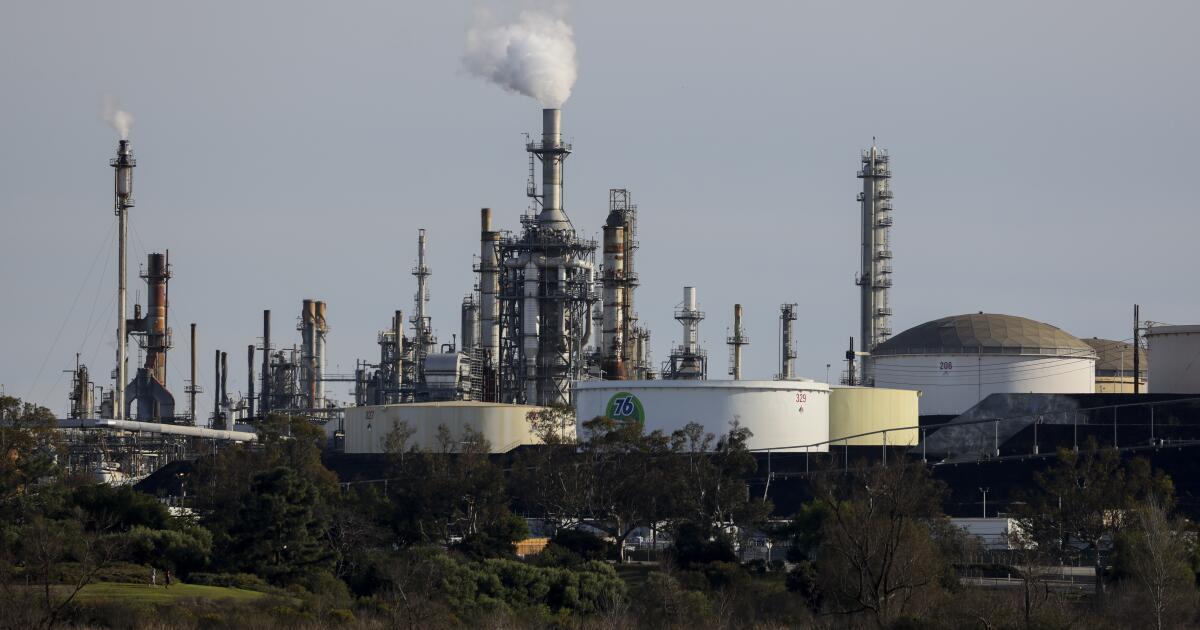
The U.S. attack on Iran is expected to have an unwelcome impact on California drivers — a jump in gas prices that could be felt at the pump in a week or two.
The outbreak of war in the Middle East, which virtually closed a key Persian Gulf shipping lane, spiked the price of a barrel of Brent crude oil by as much as $10, with prices rising as high as $82.37 on Monday before settling down.
The price of the international standard dictates what motorists pay for gas globally, including in California, with every dollar increase translating to 2.5 cents at the pump, said Severin Borenstein, faculty director of the Energy Institute at UC Berkeley’s Haas School of Business.
That would mean drivers could pay at least 20 cents more per gallon, though how much damage the conflict will do to wallets remains to be seen.
“The real issue though is the oil markets are just guessing right now at what is going to happen. It’s a time of extreme volatility,” Borenstein said. “We don’t know whether the war will widen or end quickly, and all of those things will drive the price of crude.”
President Trump has lauded the reduction of nationwide gas prices as a validation of his economic agenda despite worries about a weak job market and concerns of persistent inflation.
The upheaval in the Middle East could be more acutely felt in the state.
Californians already pay far more for gas than the rest of the country, with the average cost of a gallon of regular at $4.66, up 3 cents from a week ago and 30 cents from a month ago, according to AAA. The current nationwide average is about $3 per gallon.
The disruption in international crude markets also comes as refiners are switching to producing California’s summer-blend gas, which is less volatile during the state’s hot summers. The switch can drive up the price of a gallon of gas at least 15 cents.
The prices in California are largely driven by higher taxes and a cleaner, less polluting blend required year-round by regulators to combat pollution — and it’s long been a hot-button issue.
The politics were only exacerbated by recent refinery closures, including the Phillips 66 refinery in Wilmington in October and the idling and planned closure of the Valero refinery in Benicia, Calif., which reduced refining capacity in the state by about 18%.
California also has seen a steady reduction in its crude oil production, making it more reliant on international imports of oil and gasoline.
In 2024, only 23.3% of the crude oil refined in the state was pumped in California, with 13% from Alaska and 63% from elsewhere in the world, including about 30% from the Middle East, said Jim Stanley, a spokesperson for the Western States Petroleum Assn.
“We could see a supply crunch and real price volatility” if the Middle East supply is interrupted, he said.
The Strait of Hormuz in the Persian Gulf, through which about 20% of the world’s oil passes, was virtually closed Monday, according to reports. Though it produces only about 3% of global oil, Iran has considerable sway over energy markets because it controls the strait.
Also, in response to the U.S. attack, Iran has fired a barrage of missiles at neighboring Persian Gulf states. Saudi Arabia said it intercepted Iranian drones targeting one of its refinery complexes.
California Republicans and the California Fuels & Convenience Alliance, a trade group representing fuel marketers, gas station owners and others, have blamed Gov. Gavin Newsom’s policies for driving up the price of gas.
A landmark climate change law calls for California to become carbon neutral by 2045, and Newsom told regulators in 2021 to stop issuing fracking permits and to phase out oil extraction by 2045. He also signed a bill allowing local governments to block construction of oil and gas wells.
However, last year Newsom changed his stance and signed a bill that will allow up to 2,000 new oil wells per year through 2036 in Kern County despite legal challenges by environmental groups. The county produces about three-fourths of the state’s crude oil.
Borenstein said he didn’t expect that the new state oil production would do much to lower gas prices because it is only marginally cheaper than oil imported by ocean tankers.
Stanley said the aim of the law was to support the Kern County oil industry, which was facing pipeline closures without additional supplies to ship to state refineries.
Statewide, the industry supports more than 535,000 jobs, $166 billion in economic activity and $48 billion in local and state taxes, according to a report last year by the Los Angeles County Economic Development Corp.
Bloomberg News and the Associated Press contributed to this report.

Fintech company Block said Thursday that it’s cutting more than 4,000 workers or nearly half of its workforce as artificial intelligence disrupts the way people work.
The Oakland parent company of payment services Square and Cash App saw its stock surge by more than 23% in after-hours trading after making the layoff announcement.
Jack Dorsey, the co-founder and head of Block, said in a post on social media site X that the company didn’t make the decision because the company is in financial trouble.
“We’re already seeing that the intelligence tools we’re creating and using, paired with smaller and flatter teams, are enabling a new way of working which fundamentally changes what it means to build and run a company,” he said.
Block is the latest tech company to announce massive cuts as employers push workers to use more AI tools to do more with fewer people. Amazon in January said it was laying off 16,000 people as part of effort to remove layers within the company.
Block has laid off workers in previous years. In 2025, Block said it planned to slash 931 jobs, or 8% of its workforce, citing performance and strategic issues but Dorsey said at the time that the company wasn’t trying to replace workers with AI.
As tech companies embrace AI tools that can code, generate text and do other tasks, worker anxiety about whether their jobs will be automated have heightened.
In his note to employees Dorsey said that he was weighing whether to make cuts gradually throughout months or years but chose to act immediately.
“Repeated rounds of cuts are destructive to morale, to focus, and to the trust that customers and shareholders place in our ability to lead,” he told workers. “I’d rather take a hard, clear action now and build from a position we believe in than manage a slow reduction of people toward the same outcome.”
Dorsey is also the co-founder of Twitter, which was later renamed to X after billionaire Elon Musk purchased the company in 2022.
As of December, Block had 10,205 full-time employees globally, according to the company’s annual report. The company said it plans to reduce its workforce by the end of the second quarter of fiscal year 2026.
The company’s gross profit in 2025 reached more than $10 billion, up 17% compared to the previous year.
Dorsey said he plans to address employees in a live video session and noted that their emails and Slack will remain open until Thursday evening so they can say goodbye to colleagues.
“I know doing it this way might feel awkward,” he said. “I’d rather it feel awkward and human than efficient and cold.”

The Writers Guild of America West has canceled its awards ceremony scheduled to take place March 8 as its staff union members continue to strike, demanding higher pay and protections against artificial intelligence.
In a letter sent to members on Sunday, WGA West’s board of directors, including President Michele Mulroney, wrote, “The non-supervisory staff of the WGAW are currently on strike and the Guild would not ask our members or guests to cross a picket line to attend the awards show. The WGAW staff have a right to strike and our exceptional nominees and honorees deserve an uncomplicated celebration of their achievements.”
The New York ceremony, scheduled on the same day, is expected go forward while an alternative celebration for Los Angeles-based nominees will take place at a later date, according to the letter.
Comedian and actor Atsuko Okatsuka was set to host the L.A. show, while filmmaker James Cameron was to receive the WGA West Laurel Award.
WGA union staffers have been striking outside the guild’s Los Angeles headquarters on Fairfax Avenue since Feb. 17. The union alleged that management did not intend to reach an agreement on the pending contract. Further, it claimed that guild management had “surveilled workers for union activity, terminated union supporters, and engaged in bad faith surface bargaining.”
On Tuesday, the labor organization said that management had raised the specter of canceling the ceremony during a call about contraction negotiations.
“Make no mistake: this is an attempt by WGAW management to drive a wedge between WGSU and WGA membership when we should be building unity ahead of MBA [Minimum Basic Agreement] negotiations with the AMPTP [Alliance of Motion Picture and Television Producers],” wrote the staff union. “We urge Guild management to end this strike now,” the union wrote on Instagram.
The union, made up of more than 100 employees who work in areas including legal, communications and residuals, was formed last spring and first authorized a strike in January with 82% of its members. Contract negotiations, which began in September, have focused on the use of artificial intelligence, pay raises and “basic protections” including grievance procedures.
The WGA has said that it offered “comprehensive proposals with numerous union protections and improvements to compensation and benefits.”
The ceremony’s cancellation, coming just weeks before the Academy Awards, casts a shadow over the upcoming contraction negotiations between the WGA and the Alliance of Motion Picture and Television Producers, which represents the studios and streamers.
In 2023, the WGA went on a strike lasting 148 days, the second-longest strike in the union’s history.
Times staff writer Cerys Davies contributed to this report.

Kansas City man sentenced for cocaine trafficking, possession of illegal firearm

Kentucky vs. Texas A&M Injury Report: The usual suspects are out
Louisiana Lottery Powerball, Pick 3 results for March 2, 2026

How the Good Neighbor Day of Giving telethon is impacting Maine’s communities

50 years on the run: Maryland family killing suspect still never caught

Florida High School Football Rankings: Top 25 teams – Oct. 21

Cleary's 21 help Le Moyne down Central Connecticut State 69-64 in OT

How old is Bo Nix? What to know about Oregon quarterback ahead of 2024 NFL Draft

99th annual Pony Swim held in Virginia

Indiana Members Credit Union announced as new anchor tenant at Bottleworks District

Trump sends official notification to Congress on strikes against Iran

Unexpected birth brings hope to near-extinct Amazon tribe

Supreme Court blocks redrawing of New York congressional map, dealing a win for GOP

Map: Earthquake Shakes Central California

Gas prices could jump as Middle East tensions threaten global oil supply
-

 World5 days ago
Exclusive: DeepSeek withholds latest AI model from US chipmakers including Nvidia, sources say
-

 Massachusetts6 days ago
Mother and daughter injured in Taunton house explosion
-

 Denver, CO5 days ago
10 acres charred, 5 injured in Thornton grass fire, evacuation orders lifted
-

 Louisiana1 week ago
Wildfire near Gum Swamp Road in Livingston Parish now under control; more than 200 acres burned
-

 Technology1 week ago
YouTube TV billing scam emails are hitting inboxes
-

 Politics1 week ago
OpenAI didn’t contact police despite employees flagging mass shooter’s concerning chatbot interactions: REPORT
-

 Technology1 week ago
Stellantis is in a crisis of its own making
-

 Oregon4 days ago
2026 OSAA Oregon Wrestling State Championship Results And Brackets – FloWrestling