Business
Video: How the Iran War Is Affecting Inflation


new video loaded: How the Iran War Is Affecting Inflation

By Ben Casselman, Nour Idriss, Stephanie Swart and Sutton Raphael
April 11, 2026



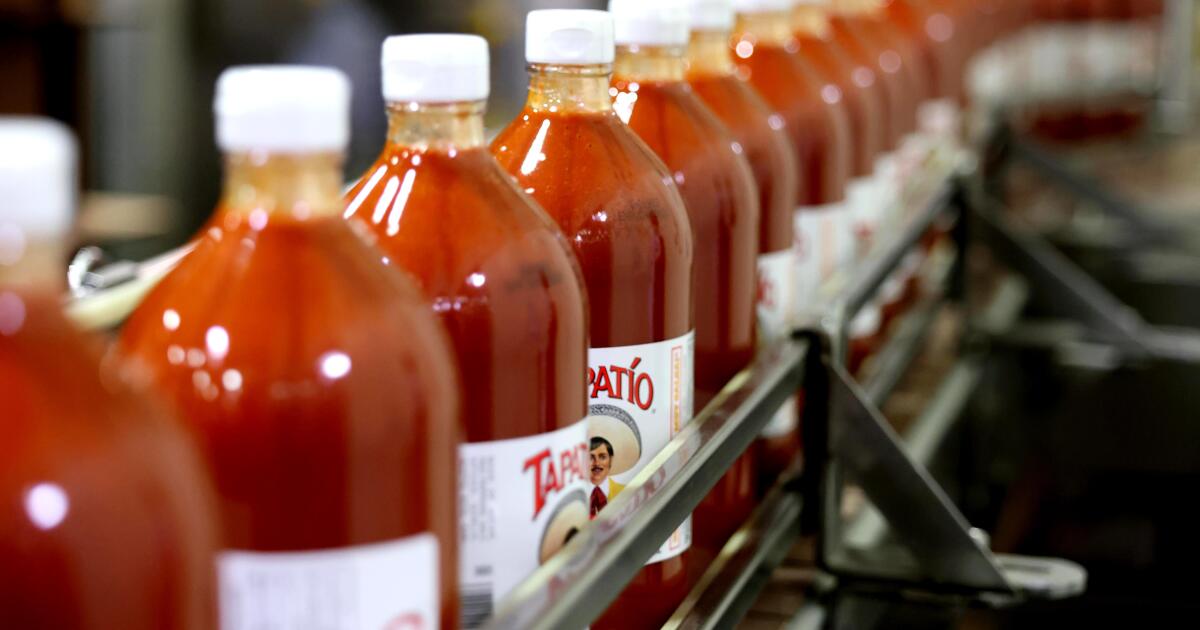
For 55 years, the family behind Tapatío has refused to even write down the recipe for Los Angeles’ iconic hot sauce, passing its secret formula for success only from lip to ear in closed rooms.
The Saavedra family put the ingredients on paper for the first time earlier this year as they sold the beloved brand to backers who plan to make their salsa picante even bigger beyond California’s borders. It is a weight off the shoulders of Luis Saavedra, the founder’s son and one of the few people who knew the recipe.
“We didn’t want anyone to know what we were using,” he told The Times in an interview at Tapatío’s factory in Vernon. “That always scared my sisters, because what if something happens?”
Demand for hot sauces had taken off for unexpected reasons just as the Saavedras were looking to sell. The millions of people on Ozempic and other powerful weight-loss drugs often have cravings for more flavor. The values of some sauce companies have skyrocketed. Bachan’s, a Japanese barbecue sauce brand, was acquired in February for $400 million.
While the Dallas private investment firm that bought Tapatío, Highlander Partners, wouldn’t share the terms of the deal, the company’s new chairman, Jeff Partridge, said it hopes to capitalize on the growing appetite for more heat to splash on proteins.
“Whether it’s GLP-1 or desire for proteins, Tapatío and hot sauces enhance that experience,” he said. “Consumers are increasingly seeking flavors.”
Red peppers drive Tapatío’s taste, though the company won’t share which exact peppers are used. The thin sauce uses garlic, salt and other spices for a tangy, peppery punch. It has a mild heat that doesn’t linger.
Luis Saavedra, right, former chief executive officer of Tapatío Foods and son of company founder Jose-Luis Saavedra, speaks with Eric Beatty, the current chief executive, at the company’s manufacturing facility on Wednesday.
(Genaro Molina / Los Angeles Times)
The big acquisition is a long way from the brand’s birth in founder Jose-Luis Saavedra’s kitchen more than 50 years ago.
Saavedra, originally from Mexico City, long dreamed of making his way north. He landed in Chicago in his late 20s, working as a Spanish translator. He met his wife and moved to Southern California.
He worked at an aerospace parts manufacturer in Los Angeles. The homemade hot sauce he brought for lunch was a hit with co-workers who asked for more. When he was laid off in the late ’60s during an oil recession, he started selling bottles.
As sales rose, he rented a small space for production in Maywood and it officially became a business in 1971. The whole family pitched in. His son, Luis, remembers twisting on caps and attaching labels to bottles when he was 13.

Bottles are filled with Tapatío hot sauce before being labeled at the Tapatío manufacturing facility on Wednesday. The hot sauce company was recently acquired by Dallas-based private investment firm Highlander Partners.
(Genaro Molina / Los Angeles Times)
Saavedra and his son would drive a van up and down Los Angeles, manually packing and unloading the product to local corner stores. Many of the first bottles were stocked in East Los Angeles stores.
About five years in, the company made enough for Saavedra to quit the two part-time jobs he had picked up to keep the business afloat. Operations remained in Maywood for 14 years before they expanded to a 7,000-square-foot building in Vernon.
In 1996, the company made its boldest bet, splurging on a 30,000-square-foot building.
In the same facility today, the strong aroma of spices tickles visitors’ noses. The precise portioning of the secret ingredients, matching the ratios of the founder’s original formula, happens in a room locked off from employees. The magic mix is then rapidly poured into a long line of empty bottles that march along a conveyor belt like soldiers.
It’s the legacy of the founder, who refused to be deterred by naysayers or obstacles to growth, said Saavedra’s son.
“Let’s go around it,” the younger Saavedra said, quoting his father’s mantra in the face of problems. “Let’s go under. Let’s go above it.”
His father’s stubbornness paid off in court as the company was sued for its name. It was once called Cuervo — his wife’s original last name — and tequila giant Jose Cuervo came after it. Saavedra had already trademarked the name in California, so it got a big payout to give up the name.
Saavedra briefly entertained the name “Charro,” a reference to Mexican cowboys, before landing on Tapatío, a nickname used for people born in Guadalajara, Jalisco, where all three of his children were born. Its logo evolved into a beaming cowboy with bright blue eyes in a wide-brimmed hat.
The Tapatío name was also challenged. Del Monte Foods sued Saavedra in the ’80s, claiming the name was too similar to its brand “Patio.” Saavedra won that case.
The founding father’s hardheadedness could also sometimes cause trouble.

Luis Saavedra, son of company founder Jose-Luis Saavedra, shows the original Tapatío label, left, compared to the current version.
(Genaro Molina / Los Angeles Times)
The younger Saavedra battled with his father in the late ’90s about changing the brand’s label to help it stand out on crowded shelves. The old bottles were largely black and white and looked a little outdated. Eventually, the senior Saavedra gave in. Sales skyrocketed.
Today, Tapatío is shaken over meals around the globe, though its dominance is strongest in California. It has been used in collaborations with other companies to spike mashed potatoes, protein powder, pickles and ramen.
Tacked to a wall at the Vernon factory is an old photo of the dozen people who were there to launch the brand’s new facility 30 years ago. Some of the employees still work there, including Jorge Cuervo, the production supervisor, and Fabian Diaz, who mans the forklift.
Diaz, who moves countless pallets of product, jokes he was born at the factory, having spent almost his entire adult life working for the company.
Under the new ownership, all 25 current employees were retained, and the firm has committed to hiring more.
“They’ve been doing this for a long time,” Luis Saavedra said. “They have a passion for it.”
The family began exploring options for a sale in late 2024, right after the founder, now 97, suffered a stroke.
Jose-Luis Saavedra had remained closely involved in day-to-day operations despite his age, often spending from sun-up to sun-down at the factory.
As he took on all his father used to do as well as his own workload, the younger Saavedra was getting burnt out and started to worry that keeping the company family-owned could be hurting the brand.
“Work was really devouring me,” Luis Saavedra said. “It was a tough decision, very difficult. We cried together as a family, then we said, ‘In the long run, it’s better.’”

“It was a tough decision, very difficult. We cried together as a family, then we said, ‘In the long run, it’s better,’” Luis Saavedra said of the decision to sell the company.
(Genaro Molina / Los Angeles Times)
Once it let potential suitors know the company was in play, the offers poured in. The family considered offers from around 40 companies before choosing Highlander Partners.
In a few years, the company’s new leaders hope to use the growing demand for flavor triggered by weight-loss drugs to bring California’s top sauce to many more markets east of the Rockies, said Eric Beatty, the company’s current chief executive.
“We believe that we’ve got these sector tailwinds behind us,” Beatty said. “It’s going to be a really good story.”

Eric Beatty, current chief executive officer of Tapatío Foods LLC, stands next to boxes of the hot sauce that are ready for shipping at the Tapatío manufacturing facility on Wednesday.
(Genaro Molina / Los Angeles Times)
New leadership has grand plans for the brand, hoping to build more facilities and add new products.
“We’ll always be a California company,” Beatty said. “This will always be the center of the Tapatío universe.”
Meanwhile, the Saavedra family still has a minority stake in the company and will continue to help manage it.
“They are the essence of the brand, and really understand the heartbeat of the brand,” said Partridge, Tapatío’s new chairman. “We certainly want to make sure that they always have a voice.”

A man was arrested Friday morning after he set multiple fires inside stores at the Ontario Mills mall, officials said.
Ontario police said they responded to the mall at about 10:30 a.m. after callers reported that a man with a lighter and a backpack was intentionally setting fires.
Officers found the suspect, who they identified as 28-year-old Luis Javier Gallegos Jr. of Rancho Cucamonga.
The police said in a statement that Gallegos did not comply with their requests, and they used force to arrest him.
Both Gallegos and an officer suffered non-life-threatening injuries during the arrest, the police said.
After being treated at a hospital, Gallegos was booked into the West Valley Detention Center and charged with felony arson, the police said.
Police said they are working to identify a motive for the crime and whether there is any connection to the April 7 arson at the Kimberly-Clark warehouse in Ontario.
Prosecutors say the inferno destroyed the 1.2 million square-foot warehouse and the paper products inside, resulting in $500 million in damages.
Chamel Abdulkarim, a Highland resident who worked at the warehouse, is facing both state and federal arson charges for setting the fire.
Abdulkarim, 29, filmed himself setting fire to multiple pallets of paper goods, according to the U.S. attorney’s office for the Central District of California.
In the video, he says, “If you’re not going to pay us enough to [expletive] live or afford to live, at least pay us enough not to do this [expletive].”
Anyone with information about the fires Friday at Ontario Mills Mall is asked to contact the city’s police department at (909) 986-6711.
Business
‘It’s killing everything.’ California’s truckers are buckling under country’s priciest diesel
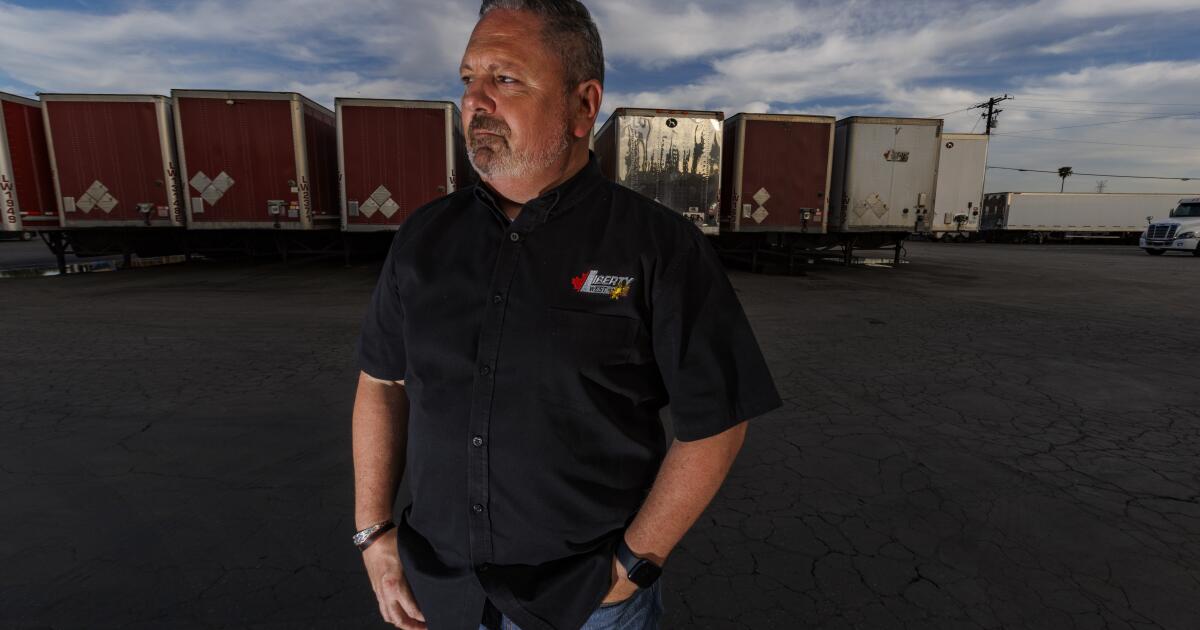
Record diesel prices are crushing California’s truckers, forcing them to adjust to avoid losses as they grapple with the most expensive pump prices in the country.
Greg Dubuque’s 40 drivers are in a constant diesel-devouring loop. Their big rigs pick up loads of electronics, office furniture and other goods around Los Angeles. They drive close to 1,000 miles through the Mojave Desert and over the Rocky Mountains to Denver. They bring back containers full of everything from pinto beans to home remodeling products.
One tank of gas for his vehicles cost $600 a couple of months ago. Today it costs $1,000. That’s a record high and more than 35% above the country’s average.
“California sets itself apart from the rest of the country when it comes to pricing,” said Dubuque, a third-generation trucker and general manager of Liberty Linehaul West. “Now it’s really out of control.”
The average price of a gallon of diesel in California got close to $7.75 this week, up 50% from a month ago, according to the American Automobile Assn. The national average of diesel is closer to $5.65 at recent peaks.
Dubuque, general manager of Liberty Linehaul West, says small truckers are hurting with out-of-control gas prices.
(Gina Ferazzi / Los Angeles Times)
The trucking industry was already reeling from a prolonged freight recession, a crackdown on immigrant drivers, and the adverse impacts of tariffs, all of which contributed to a significant increase in bankruptcy filings in the industry.
Now, the price shock from the war with Iran has become yet another headache for the beleaguered industry that hauls 70% of all freight in America.
“It’s got a tremendous impact on the industry,” said Eric Sauer, the chief executive of California Trucking Assn.
And it is not just truckers being affected. The rising prices of ground and air transportation will eventually be paid for by consumers.
The biggest companies are already passing the extra transportation costs on to consumers. FedEx, United Parcel Service, the U.S. Postal Service and Amazon said they will all start charging an extra fee. Amazon said it would apply a 3.5% charge to merchants for its fulfillment service. USPS will charge an 8% delivery fee for certain packages.
“The longer energy prices remain elevated, the more households will need to confront tradeoffs,” said Philip N. Jefferson, vice chairman of the Federal Reserve, at a recent lecture.

Liberty Linehaul West trucking company keeps a daily list of fuel prices to help its truckers on April 3 in Montebello, Calif.
(Gina Ferazzi / Los Angeles Times)
This could eventually dampen demand for other products and further hurt the economy, Jefferson noted.
“Families who depend on petroleum products to commute to jobs and school and to heat their homes may need to pull back on more discretionary forms of spending,” he said. “That could potentially result in lower spending at restaurants or retailers. It could also result in households carrying elevated levels of debt.”
Truckers often rely on fuel surcharges to cover rising fuel costs. It’s an industry practice for customers to pay a fuel surcharge, on top of the base freight rate, to offset unexpected fuel price increases. The fee is calculated based on a weekly diesel price index.
Sukhdeep Singh, who owns Merced County-based Cali Brothers Truck Lines, said standard surcharge policies are insufficient when there are wild swings in fuel prices.
“It’s killing everything,” he said.
Singh’s business faced challenges earlier this year when a crackdown on immigrant drivers led to sudden departures, shrinking the available labor pool and leaving 15 of his trucks unused. Despite the diminished fleet, his weekly fuel expenses have surged from $80,000 to $130,000.
Smaller trucking companies are getting hit first.
Major carriers with thousands of trucks have different ways to hedge against price fluctuations that insulate them from temporary volatility. They have long-term shipping contracts and have greater flexibility in surcharges.
Smaller carriers are often paid at a flat rate and have no certainty about whether they will recover the higher fuel costs.
On a recent trip to Denver, one of Dubuque’s trucks had to consider returning empty, as the going rate barely covered gas to get back to Los Angeles.
“I wouldn’t be able to cover my cost,” he said.
He has been instructing drivers to save on fuel by planning their routes, finding truck stops with the best rates, and avoiding California when possible.
“Where we’re trying to avoid buying fuel is here in the state of California,” he said.
He is also asking his regular customers to pitch in.

A Roadies Inc. truck, right, leaves for a delivery in Bakersfield on Nov. 29.
(Myung J. Chun / Los Angeles Times)
Liberty Linhaul West’s fleet also works with L.A.’s entertainment and event industries, transporting staging, lighting and other equipment for events such as the Oscars, Grammys and Country Music Awards. He’s started calling customers with whom he had flat rates to renegotiate prices.
“We started calling customers, saying, ‘Okay, we need some emergency help here,’” Dubuque said.
While he appreciates that the extra fees and restrictions on fuel help build roads and protect the environment in California, he would love to see more support from the state.
“I think the government needs to interact with the oil and fuel world and talk about how they can take this pain away from us, or at least try to lessen this blow,” he said.
Without an end to high oil prices or some help from the government, customers can expect the same sticker shock the trucking industry is struggling with.
“Whether you’re a grocer, a meatpacking plant, a vegetable grower, that cost has to be factored in, because it doesn’t matter who you are, you’re faced with it,” Dubuque said. “The impact was so hard and so fast, I would think we’re going to start seeing just another increase to the cost of goods for people.”

Mississippi reveals its full history for America’s anniversary year, a contrast to federal efforts
KCPD investigating after 1 man hurt in Saturday shooting

The ugly truth behind ‘restoring Montana values’ • Daily Montanan

Nebraska OL Details What He’s Looking for From Iowa State

Winter storm warning blankets parts of California, Sierra Nevada

Florida High School Football Rankings: Top 25 teams – Oct. 21

How old is Bo Nix? What to know about Oregon quarterback ahead of 2024 NFL Draft

Cleary's 21 help Le Moyne down Central Connecticut State 69-64 in OT

99th annual Pony Swim held in Virginia

Indiana Members Credit Union announced as new anchor tenant at Bottleworks District

Carney casts himself as NATO defender amid Trump beef, despite Canada missing key benchmark for decades

‘Enough of war!’ says Pope Leo XIV who grows increasingly frustrated

Artemis II splashdown captures nationwide attention

Video: Police Fatally Shoot Man After Stabbings at Grand Central Subway Station

Trump blasts Spanberger ahead of Virginia meetings, says state faces tax base exodus like New York, California
-

 Atlanta, GA1 week ago
1 teenage girl killed, another injured in shooting at Piedmont Park, police say
-

 Georgia5 days ago
Georgia House Special Runoff Election 2026 Live Results
-

 Pennsylvania6 days ago
Parents charged after toddler injured by wolf at Pennsylvania zoo
-

 Arkansas2 days ago
Arkansas TV meteorologist Melinda Mayo retires after nearly four decades on air
-
 Milwaukee, WI6 days ago
Potawatomi Casino Hotel evacuated after fire breaks out in rooftop HVAC system
-

 Indianapolis, IN1 week ago
Fighting Illini begin Final Four preparations in Indianapolis
-

 Technology1 week ago
Anthropic essentially bans OpenClaw from Claude by making subscribers pay extra
-

 Detroit, MI1 week ago
Puppy rescued after getting stuck on chimney in Detroit