Business
Trump, the Deal Maker in Chief, Is Back


The questions facing a new Trump era
Good morning on this Inauguration Day. Welcome to Round 2 of President Donald Trump. No matter your politics, it is likely to be a historic ride.
For business and policy leaders, the next administration is expected to be filled with deals of all sorts — from White House agreements brokered over secure phone lines with foreign powers to congressional backroom pacts to headline-making deals negotiated by Wall Street.
This is a transactional president, perhaps the most transactional ever. He wants to engage with the business community, which is a big distinction from the Biden administration. He takes great pride in publicly name-dropping the C.E.O.s he’s talking with. “Today, I spoke with Tim Cook of Apple,” he told supporters last night. “He said they’re going to make a massive investment in the United States because of our big election win.”
Trump is rooting for big business, until he isn’t. He’s fickle. And uncertain.
That poses a big challenge for business leaders: How and when might Trump’s unpredictability emerge? Is there a red line? C.E.O. calculations have been that a second term means that uncertainty — something many dislike — is a certainty. But many think that they can manage it, or at least they tell themselves they can.
After Trump’s 2016 win, he invited tech C.E.O.s to meet with him (that was, of course, a photo op). They showed up, though many came reluctantly. Others joined his administration’s various councils only to depart when he said things that appeared to cross a line.
This time, many are all-in — at least for now. Some genuinely support him, or at least think he was better than the alternative. Others have taken an “if you can’t beat ’em, join ’em” attitude. Or it may be that his threats, real and imagined, are working. He said as much in a candid moment about his threats to arrest Mark Zuckerberg, Meta’s C.E.O., and the company’s decision to abandon fact-checking on the platform, saying Zuckerberg’s decision was “probably” the result of those threats. (Many of these same people rebuked him after the Jan. 6 attack on the Capitol in 2021).
We will see how long the love affair with business lasts. It may be longer than some skeptics suggest. Now that he’s in power, the business community needs Trump to like them: It’ll need his support if deals and investments are to flourish; it needs him to push the corporate tax rate lower; and the crypto world needs him. (He also needs it given his and his family’s forays into the sector). All of this raises all sorts of questions, as we get into below.
We’ll be here, every morning, reporting on all of it, as well as raising and asking tough questions. I imagine there will be a lot of them. — Andrew Ross Sorkin
TikTok’s fuzzy future
TikTok users in the United States breathed sighs of relief on Sunday after the video platform began to resume service, thanks to Donald Trump’s pledge to suspend a ban of the app.
But while the president-elect took credit for saving the hugely popular app — “So I like TikTok! I had a slightly good experience, wouldn’t you say?” he said at a rally on Sunday — his thinly sketched proposal leaves some big questions unanswered.
What Trump said: His “initial thought,” he wrote on Truth Social, was a 50-50 joint venture between ByteDance, TikTok’s Chinese owner, and an unspecified American entity. It represented Trump’s favorite thing — a deal — and on the surface had some appeal.
Trump added that he envisioned ByteDance handing over half of the company to the U.S. and that the U.S. wouldn’t pay a dime. “Whether you like TikTok or not, we’re going to make a lot of money,” he said.
But hold on a second. Trump hasn’t addressed the thorny national security concerns that persuaded a bipartisan group of lawmakers and President Biden to back the TikTok ban, not to mention who controls the ByteDance algorithm that is the key to the app’s success.
Moreover, it’s not clear how Trump can legally get around the ban. While he has promised to issue an executive order saving the app, the law is still on the books — though Trump can choose how aggressively to enforce parts of it, legal experts say.
Republicans and their allies criticized Trump’s efforts to circumvent the law:
-
Senator Tom Cotton, the Arkansas senator who chairs the Senate Intelligence Committee, warned on X that any company that aids “communist-controlled TikTok could face hundreds of billions of dollars of ruinous liability under the law.”
-
Speaker Mike Johnson added that he expected the law to be enforced: “The law is very precise, and the only way to extend that is if there is an actual deal in the works,” he said on “Meet the Press” on Sunday.
-
Joe Lonsdale, the venture capitalist who’s close to Trump allies like Peter Thiel, wrote on X, “Tomorrow he becomes POTUS, NOT King. Congress and SCOTUS were clear. He can give TikTok 90 days, then if it’s not sold, any company facilitating it is breaking the law.”
-
And Elon Musk reiterated that while he didn’t believe in banning TikTok, he found it “unbalanced” that TikTok be allowed to operate in the U.S. but X remains blocked in China. (That said, China’s vice president, Han Zheng, met with Musk and other business leaders to say his country was open to American business.)
What next? Trump will need to flesh out his proposal in the coming days to persuade lawmakers and others that it’s legally sound. Meanwhile, other bidders for TikTok are circling, including the billionaire Frank McCourt, who has assembled a group that wants to buy the app without its key algorithm, and reportedly Perplexity, an artificial intelligence start-up.
For ByteDance’s U.S. investors, which include General Atlantic, Susquehanna and Sequoia, a preferred course — second only to keeping the whole thing intact — may well be to spin the company to themselves. But if China won’t let them keep the algorithm, what would they be left with?
Executive orders galore
In between the dining, dancing and speechifying, President-elect Donald Trump is expected to unveil a flurry of executive orders on Monday.
First up, according to Stephen Miller, Trump’s deputy chief of staff, are major policy shake-ups for energy, immigration and border security, work protections for federal employees, as well as halting or scaling back key planks of the Biden administration’s climate agenda.
D.E.I. is also in the cross hairs. President Biden’s diversity, equity and inclusion measures for federal agencies are expected to be rolled back, just as big companies, such as Meta and Amazon, plan to eliminate or revamp some of these policies.
Electric vehicle credits are on the chopping block. Trump has long promised to undo the Inflation Reduction Act, a law that has supporters among some oil executives. It also extends credits to electric vehicle customers. Withdrawing those could dent sales of E.V.s.
That said, Elon Musk, Tesla’s C.E.O. and a key Trump ally, has suggested his company could weather a pullback.
Crypto bulls rejoice
Stock and bond markets are closed in the United States for Martin Luther King’s Birthday. But crypto trading is available — and it has helped mint Donald Trump as the latest crypto billionaire.
This weekend saw a frenzied rally for Donald Trump and Melania Trump meme coins, prompted by Trump himself. “GET YOUR $TRUMP NOW,” the president-elect told his followers on Truth Social this weekend.
It rallied further when Robinhood, the trading platform that made a big donation to Trump’s inauguration fund, began letting its customers trade the $TRUMP coin.
Bitcoin, which hit a record on Monday, and other digital tokens have soared since Election Day on the hope that the incoming administration will loosen regulation around the sector. That said, the rally in $Trump and $Melania tokens has astounded longtime market watchers.
Ethics watchdogs see the coin as a “profound conflict of interest” for Trump. Though organizers of the Trump coin say that buying it is neither a political donation nor an investment contract, skeptics say it raises questions about the president-elect benefiting from an industry he is supposed to be regulating.
There’s also the question of whether foreign governments could buy into the coin, potentially violating the foreign emoluments clause of the Constitution.
“This may represent the single worst conflict of interest in the modern history of the presidency,” Norm Eisen, a White House ethics adviser during the Obama administration, told The Washington Post.
The big money behind the inauguration
As Donald Trump prepares to take office, one thing is becoming especially clear: Washington is increasingly becoming a city where it pays to pay up.
The inaugural committee has already raised more than $170 million, shattering a record set by the first Trump committee.
Corporations as well as donors have opened their wallets. Apple, Google, Meta and Microsoft all gave millions to Trump this time, taking advantage of the more-permissive rules around donations for post-election activities such as the inauguration.
“Corporate America has embraced President Trump,” Brian Ballard, a powerful lobbyist and Trump fund-raiser, told The Washington Post. “Every corporate client I have wants to be a part of it.”
Critics of such donations point to a pay-to-play culture. An analysis by OpenSecrets of giving to the first Trump inauguration found that more than half of the 63 federal contractors who gave won multimillion-dollar bids in 2017.
Among them:
-
For-profit prison operators, including CoreCivic and Geo Group, saw huge increases in contract awards.
David Rubenstein, the billionaire co-founder of the Carlyle Group, put it bluntly to The Times:
Big donors, he said, “would like to get the policies they believe in from the federal government — more oil drilling, easier antitrust policy, more favorable crypto policy, less bank oversight. They also want more support for helping American companies invest overseas, and have ready access to government officials.”
How Trump’s inauguration stacks up
The inauguration of Donald Trump as president will be a pricey and star-studded affair.
Carrie Underwood, Rascal Flatts and the Village People are set to perform. And Snoop Dogg headlined Friday’s black-tie “Crypto Ball,” a $2,500-a-ticket gala that hailed Trump as “the first crypto president.”
Inauguration celebrations have changed significantly over the course of American history: The more lavish the festivities, the greater the statement. On the unpretentious side were those for Thomas Jefferson and Jimmy Carter. The co-chairman of Carter’s inaugural committee told The Times that the goal was “an inauguration which is traditional but modest in one, not extravagant.”
Barack Obama declined corporate donations for his first inauguration (though he still managed 10 official balls and a performance by Jay-Z) before accepting them for his second inauguration. President Biden’s pandemic-marred inauguration ended with fireworks, but there were no galas.
Trump’s festivities may draw comparisons to those of Ronald Reagan, whose 1981 inauguration fund set a record by raising $8 million (about $29 million in today’s money). As The Times described the day:
In white and black tie, in sequins and sables and clouds of perfume, Republican revelers stepped out tonight to the most lavish series of inaugural balls ever held in the nation’s capital.
It was an evening of shiny black limousines and nostalgic swing bands, of glittery Hollywood celebrities and wealthy Western oil men. The aura of big money was everywhere.
We’d like your feedback! Please email thoughts and suggestions to dealbook@nytimes.com.



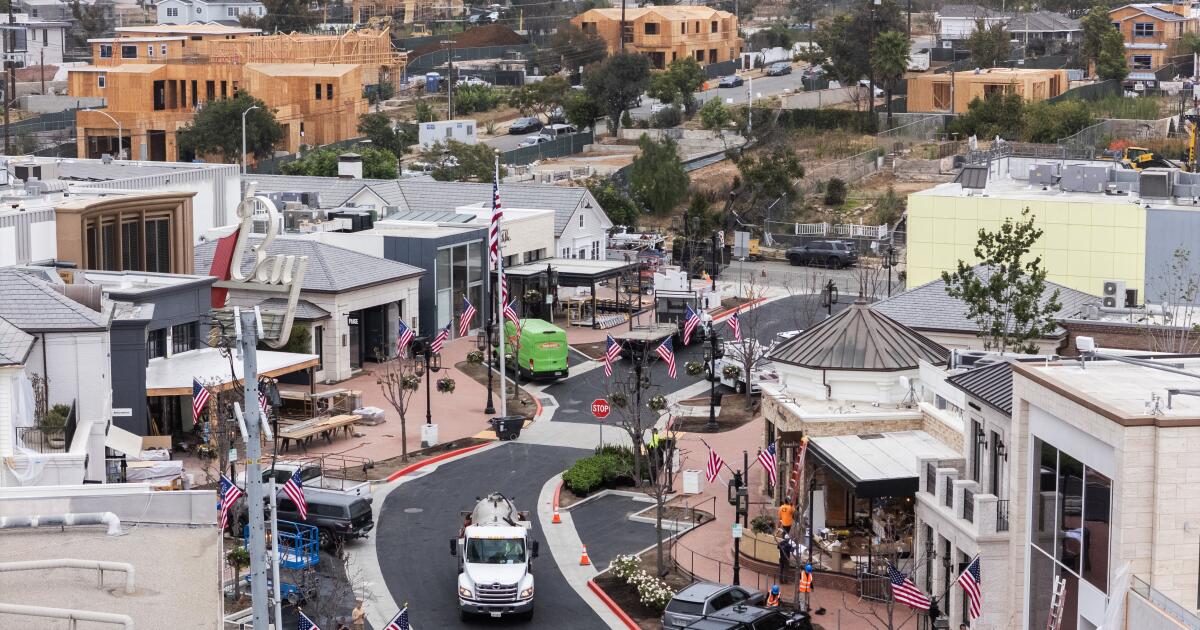
The luxury shopping center in Pacific Palisades will reopen next month after more than $100 million in renovations forced by the January 2025 wildfire that devastated the Los Angeles neighborhood.
Palisades Village will reopen Aug. 15, owner Rick Caruso announced Wednesday. The outdoor center survived the blaze that destroyed homes and other businesses but needed refurbishment to eliminate contaminants that the fire could have spread.
Crews are putting finishing touches on mall buildings after tearing them down to the studs, treating the wood and rebuilding the walls, Caruso said.
“Everybody’s working, and stores are moving their products in,” he said. “It’s a really cool feeling that people have really locked arms and are working together.”
An electrician installs lighting for a restaurant at Rick Caruso’s Palisades Village on Thursday. The shopping center is scheduled to reopen mid-August.
(Myung J. Chun / Los Angeles Times)
Pacific Palisades resident Allison Polhill, who is rebuilding the home of 30 years that her family lost in the blaze, said she is “thrilled” at the prospect of returning to the mall she used to frequent. Its comeback is a boost for the community, she said.
“Every single step that we make to reopen our commercial corridors is going to bring more people back into the Palisades,” said Polhill, who expects to move back into her home at the end of August.
A total of 6,822 structures were destroyed in the Palisades fire, including more than 5,500 residences and 100 commercial businesses, according to the California Department of Forestry and Fire Protection.
Caruso previously attributed the mall’s survival to the hard work of private firefighters and the fire-resistant materials used in the mall’s construction.
The $200-million shopping and dining center opened in 2018 with a movie theater and a roster of upmarket tenants, including Erewhon, which may be the only grocer in the heart of the fire-ravaged neighborhood when it opens.
Caruso’s company was able to fill the mall with tenants despite the long shutdown.
Palisades Village is 99% leased, with the majority of tenants returning, said Jackie Levy, chief financial and revenue officer. Nearly one-third of the shops and restaurants are new to the property.
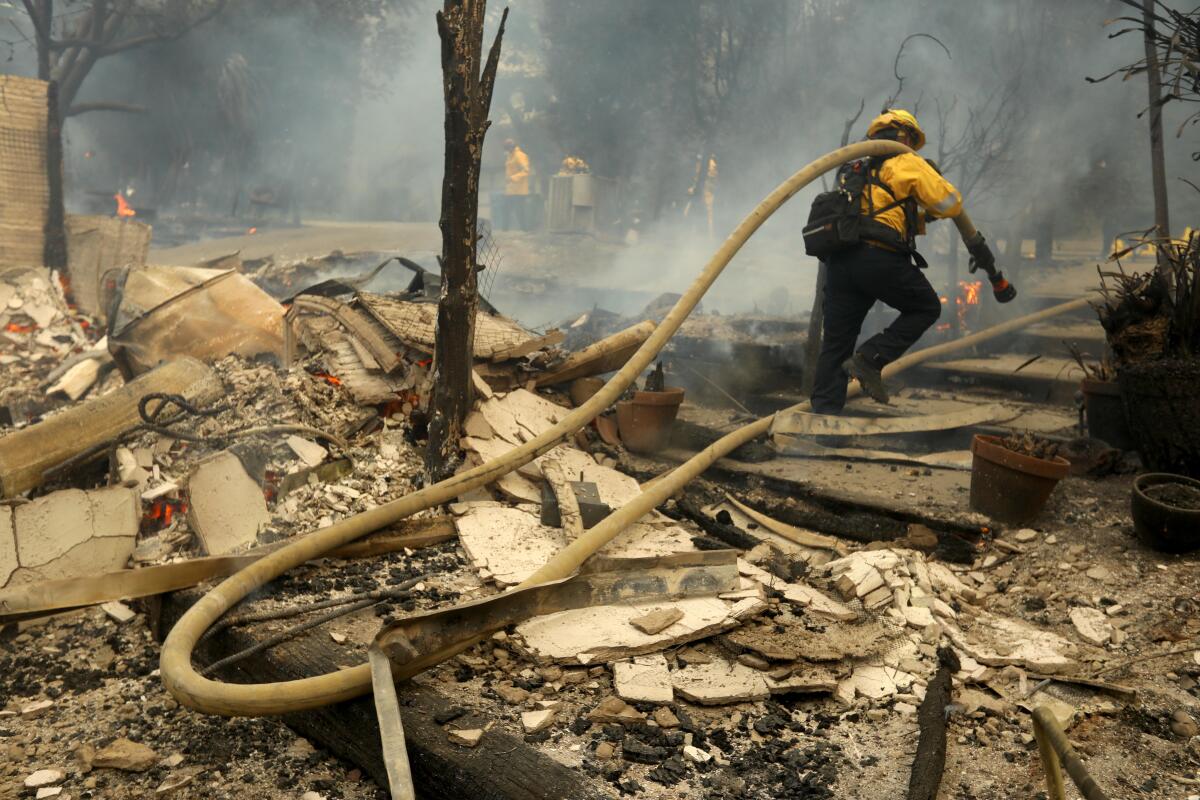
A firefighter carries a hose back to his rig while walking through a destroyed home from the Palisades fire in Pacific Palisades on Jan. 7, 2025.
(Genaro Molina / Los Angeles Times)
Last year, Pacific Palisades-based fashion designer Elyse Walker said she would reopen her eponymous store in Palisades Village after losing her 25-year flagship location on Antioch Street to the inferno.
Other neighborhood shops destroyed in the fire that are reopening at the mall include K Bakery and Loomey’s Toys, which caters to children up to age 12 and used to be across the street from Palisades Elementary Charter School.
“It’s been a journey and I’m excited because I wasn’t sure that there was going to be a place to come back to,” said toy store owner Amanda Rastegar. “Hopefully we can bring some of that magic back.”
Rastegar’s home in the Palisades survived but was damaged by the fire. The family returned about eight weeks ago. Her last memory of the fire was a burning supermarket.
“I just couldn’t wrap my brain around what was happening,” she said. “By the time I left, Gelson’s was on fire.”
Among the returning tenants is Angelini Ristorante & Bar. Well-known Los Angeles chef Gino Angelini said he will be in the kitchen next month for a return of the Italian restaurant.
“We won’t do a big celebrity open,” he said. “We want to have a very soft opening and see our customers come back.”

Construction takes place at Rick Caruso’s Palisades Village on Thursday. The shopping center is scheduled to reopen mid-August.
(Myung J. Chun / Los Angeles Times)
An elaborate celebration would not feel “correct for me,” Angelini said, because the devastation has been “very sad” for so many.
Other new tenants include local chef Nancy Silverton, who has agreed to move in with a new Italian steakhouse called Spacca Tutto. Women’s activewear retailer LESET will open its first West Coast location.
Caruso said he is optimistic that customers will return to the center, even though many Pacific Palisades residents are still dispersed. One tracking system estimated that about 30% of the Village’s customer base was impacted by the fire, he said.
“That means 70% did not get impacted, so there’s a lot of customers still left out there,” Caruso said. Historically, the center drew customers from as far away as Beverly Hills and Calabasas, as well as Malibu, Brentwood and Santa Monica.
He also hopes many will be inspired to visit the revived mall.
“I believe in the goodness of people and I believe that people are going to want to support the Palisades,” he said. “They’re going to want to be there and support the businesses that have had the courage and the heart to reopen.”

Walmart is rapidly expanding its network of electric vehicle chargers designed for customers to use while they shop.
The network could help fill gaps in EV infrastructure in states with greater need for chargers. Walmart, which has more than 5,000 locations in the U.S. and hundreds in California, says more than 90% of Americans live within 10 miles of one of its stores.
The chargers also offer an incentive for customers to choose Walmart — Walmart Plus members will receive a 10% discount off an average price of $0.46 per kilowatt-hour of energy at the company’s chargers.
Walmart chargers are already available at more than 75 locations in 17 states, with Texas boasting the most charging stations, followed by Florida and Arizona.
Matthew Nelson, Walmart’s director of energy policy, said last week on LinkedIn that the network will soon reach 29 states, including California.
“We are delivering on the promise of affordable, reliable and convenient charging,” Nelson said in his post.
According to Walmart’s website, six charging stations are coming to California soon, though the company did not offer a specific timeline.
The chargers will be installed at stores in Antelope, Brea, Fresno, Stockton, Suisun City and Vallejo.
Most charging sites in California will include eight to 16 fast-charging stalls, said Walmart spokesperson Kelsey Bohl.
The company first announced plans in April 2023 to install its own EV chargers at Walmart and Sam’s Club stores, with a goal of installing thousands of chargers by 2030. Partnering with ABB E-Mobility and Alpitronic, it added 25 new charging sites this past May and six more in June.
“Walmart is building a leading retail-integrated EV fast-charging network, focused on delivering an affordable, reliable and convenient charging experience where customers already shop,” Bohl said in an emailed statement. “Customers can charge while they shop, access stations through the Walmart app they already use, and benefit from affordable pricing.”
The charging stations already available include 612 individual charging stalls using 400-kilowatt chargers. Each stall has a dual charging cord with both Combined Charging System and North American Charging Standard connectors. The standard connectors, designed by Tesla, are smaller and lighter than the combined systems.
The primary way to pay for the chargers is through the Walmart app, but the company is also experimenting with built-in credit card readers to allow those without the app to use the stations.
Customers can check charger availability on the Walmart app. The company said the chargers will be available 24 hours a day.

Robotaxis could be turning into robocops.
A self-driving Waymo reported two teens to San Mateo, Calif., police on Monday after they were found drinking alcohol and shooting toy guns in the back of the vehicle.
According to a social media post from the San Mateo Police Department, officers detained two 15-year-olds after the Waymo they were riding in contacted the department and stopped in a parking lot until law enforcement arrived.
“Parents do you know where your teens are?” the San Mateo Police Department wrote on Facebook following the incident. “Waymo does!”
Officers removed both teens from the vehicle and determined they were using toy guns to shoot Orbeez out the windows. Orbeez are small, water-absorbing beads sold at toy stores.
“Toy guns, water guns, and BB guns all pose real dangers, especially to an untrained eye,” the Police Department said. “The simple handling of them can cause fear in [passersby].” “
A video posted on Facebook shows at least five officers and a police dog responding to the scene and approaching the Waymo with their weapons raised.
Waymo did not immediately respond to a request for comment.
Waymo vehicles have internal cameras and microphones that may be used in an emergency or to “promote safety and security,” according to Waymo’s online support page.
The cameras are also used to ensure the vehicles are clean and to help find lost items, according to the support page.
The company said it does not use facial recognition or other biometric identification technologies to identify individuals.
“In more urgent circumstances, support may access live video during a trip,” the Waymo page said.
The San Mateo Police Department’s Facebook post has garnered nearly 60 comments, with one user accusing Waymo of “snitching.”
“At least they got a designated driver?!” one user commented.
-

 Los Angeles, Ca28 minutes ago
Loved ones search for missing 34-year-old Southern California woman
-

 Detroit, MI48 minutes ago
Chickens, geese found at vacant home after nonprofit reports them stolen
-

 San Francisco, CA58 minutes ago
What’s next for San Francisco Giants as MLB trade deadline approaches?
-
 Dallas, TX1 hour ago
Dallas millionaire files lawsuit against groundwater district
-

 Miami, FL1 hour ago
7 more women arrested at southwest Miami-Dade massage parlors, accused of prostitution in undercover sting
-

 Boston, MA1 hour ago
‘They’re my buddies’: 96-year-old Back Bay woman befriends French soccer team
-

 Denver, CO1 hour ago
Denver officers cited for separate incidents, 1 fired
-

 Seattle, WA1 hour ago
Study finds dangerous chemicals in the breast milk of Seattle moms

