Business
Ties between California and Venezuela go back more than a century with Chevron


As a stunned world processes the U.S. government’s sudden intervention in Venezuela — debating its legality, guessing who the ultimate winners and losers will be — a company founded in California with deep ties to the Golden State could be among the prime beneficiaries.
Venezuela has the largest proven oil reserves on the planet. Chevron, the international petroleum conglomerate with a massive refinery in El Segundo and headquartered, until recently, in San Ramon, is the only foreign oil company that has continued operating there through decades of revolution.
Other major oil companies, including ConocoPhillips and Exxon Mobil, pulled out of Venezuela in 2007 when then-President Hugo Chávez required them to surrender majority ownership of their operations to the country’s state-controlled oil company, PDVSA.
But Chevron remained, playing the “long game,” according to industry analysts, hoping to someday resume reaping big profits from the investments the company started making there almost a century ago.
Looks like that bet might finally pay off.
In his news conference Saturday, after U.S. Special Forces snatched Venezuelan President Nicolás Maduro and his wife in Caracas and extradited them to face drug-trafficking charges in New York, President Trump said the U.S. would “run” Venezuela and open more of its massive oil reserves to American corporations.
“We’re going to have our very large U.S. oil companies, the biggest anywhere in the world, go in, spend billions of dollars, fix the badly broken infrastructure, the oil infrastructure, and start making money for the country,” Trump said during a news conference Saturday.
While oil industry analysts temper expectations by warning it could take years to start extracting significant profits given Venezuela’s long-neglected, dilapidated infrastructure, and everyday Venezuelans worry about the proceeds flowing out of the country and into the pockets of U.S. investors, there’s one group who could be forgiven for jumping with unreserved joy: Chevron insiders who championed the decision to remain in Venezuela all these years.
But the company’s official response to the stunning turn of events has been poker-faced.
“Chevron remains focused on the safety and well-being of our employees, as well as the integrity of our assets,” spokesman Bill Turenne emailed The Times on Sunday, the same statement the company sent to news outlets all weekend. “We continue to operate in full compliance with all relevant laws and regulations.”
Turenne did not respond to questions about the possible financial rewards for the company stemming from this weekend’s U.S. military action.
Chevron, which is a direct descendant of a small oil company founded in Southern California in the 1870s, has grown into a $300-billion global corporation. It was headquartered in San Ramon, just outside of San Francisco, until executives announced in August 2024 that they were fleeing high-cost California for Houston.
Texas’ relatively low taxes and light regulation have been a beacon for many California companies, and most of Chevron’s competitors are based there.
Chevron began exploring in Venezuela in the early 1920s, according to the company’s website, and ramped up operations after discovering the massive Boscan oil field in the 1940s. Over the decades, it grew into Venezuela’s largest foreign investor.
The company held on over the decades as Venezuela’s government moved steadily to the left; it began to nationalize the oil industry by creating a state-owned petroleum company in 1976, and then demanded majority ownership of foreign oil assets in 2007, under then-President Hugo Chávez.
Venezuela has the world’s largest proven crude oil reserves — meaning they’re economical to tap — about 303 billion barrels, according to the U.S. Energy Information Administration.
But even with those massive reserves, Venezuela has been producing less than 1% of the world’s crude oil supply. Production has steadily declined from the 3.5 million barrels per day pumped in 1999 to just over 1 million barrels per day now.
Currently, Chevron’s operations in Venezuela employ about 3,000 people and produce between 250,000 and 300,000 barrels of oil per day, according to published reports.
That’s less than 10% of the roughly 3 million barrels the company produces from holdings scattered across the globe, from the Gulf of Mexico to Kazakhstan and Australia.
But some analysts are optimistic that Venezuela could double or triple its current output relatively quickly — which could lead to a windfall for Chevron.
The Associated Press contributed to this report.




The fiery debate about a proposed ballot measure to tax California’s billionaires has sparked some soul-searching across the state.
While the idea of a one-time tax on more than 200 people has a long way to go before getting onto the ballot and would need to be passed by voters in November, the tempest around it captures the zeitgeist of angst and anger at the core of California. Silicon Valley is minting new millionaires while millions of the state’s residents face the loss of healthcare coverage and struggle with inflation.
Supporters of the proposed billionaire tax say it is one of the few ways the state can provide healthcare for its most vulnerable. Opponents warn it would squash the innovation that has made the state rich and prompt an exodus of wealthy entrepreneurs from the state.
The controversial measure is already creating fractures among powerful Democrats who enjoy tremendous sway in California. Progressive icon Sen. Bernie Sanders (I-Vt.) quickly endorsed the billionaire tax, while Gov. Gavin Newsom denounced it .
The Golden State’s rich residents say they are tired of feeling targeted. Their success has not only created unimaginable wealth but also jobs and better lives for Californians, they say, yet they feel they are being punished.
“California politics forces together some of the richest areas of America with some of the poorest, often separated by just a freeway,” said Thad Kousser, a political science professor at UC San Diego. “The impulse to force those with extreme wealth to share their riches is only natural, but often runs into the reality of our anti-tax traditions as well as modern concerns about stifling entrepreneurship or driving job creation out of the state.”
The state budget in California is already largely dependent on income taxes paid by its highest earners. Because of that, revenues are prone to volatility, hinging on capital gains from investments, bonuses to executives and windfalls from new stock offerings, and are notoriously difficult for the state to predict.
The tax proposal would cost the state’s richest residents about $100 billion if a majority of voters support it on the November ballot.
Supporters say the revenue is needed to backfill the massive federal funding cuts to healthcare that President Trump signed this summer. The California Budget & Policy Center estimates that as many as 3.4 million Californians could lose Medi-Cal coverage, rural hospitals could shutter and other healthcare services would be slashed unless a new funding source is found.
On social media, some wealthy Californians who oppose the wealth tax faced off against Democratic politicians and labor unions.
An increasing number of companies and investors have decided it isn’t worth the hassle to be in the state and are taking their companies and their homes to other states with lower taxes and less regulation.
“I promise you this will be the final straw,” Jessie Powell, co-founder of the Bay Area-based crypto exchange platform Kraken, wrote on X. “Billionaires will take with them all of their spending, hobbies, philanthropy and jobs.”
Proponents of the proposed tax were granted permission to start gathering signatures Dec. 26 by California Secretary of State Shirley Weber.
The proposal would impose a one-time tax of up to 5% on taxpayers and trusts with assets, such as businesses, art and intellectual property, valued at more than $1 billion. There are some exclusions, including property.
They could pay the levy over five years. Ninety percent of the revenue would fund healthcare programs and the remaining 10% would be spent on food assistance and education programs.
To qualify for the November ballot, proponents of the proposal, led by the Service Employees International Union-United Healthcare Workers West, must gather the signatures of nearly 875,000 registered voters and submit them to county elections officials by June 24.
The union, which represents more than 120,000 healthcare workers, patients and healthcare consumers, has committed to spending $14 million on the measure so far and plans to start collecting signatures soon, said Suzanne Jimenez, the labor group’s chief of staff.
Without new funding, the state is facing “a collapse of our healthcare system here in California,” she said.
U.S. Rep. Ro Khanna (D-Fremont) speaks during a news conference at the U.S. Capitol on Nov. 18.
(Celal Gunes / Anadolu via Getty Images)
Rep. Ro Khanna (D-Fremont) spoke out in support of the tax.
“It’s a matter of values,” he said on X. “We believe billionaires can pay a modest wealth tax so working-class Californians have the Medicaid.”
The Trump administration did not respond to requests for comment.
The debate has become a lightning rod for national thought leaders looking to target California’s policies or the ultra-rich.
On Tuesday, Sanders endorsed the billionaire tax proposal and said he plans to call for a nationwide version.
“This is a model that should be emulated throughout the country, which is why I will soon be introducing a national wealth tax on billionaires,” Sanders said on X. “We can and should respect innovation, entrepreneurship and risk-taking, but we cannot respect the extraordinary level of greed, arrogance and irresponsibility that is currently being displayed by much of the billionaire class.”
But there isn’t unanimous support for the proposal among Democrats.
Notably, Newsom has consistently opposed state-based wealth taxes. He reiterated his opposition when asked about the proposed billionaires’ tax in early December.
“You can’t isolate yourself from the 49 others,” Newsom said at the New York Times DealBook Summit. “We’re in a competitive environment. People have this simple luxury, particularly people of that status, they already have two or three homes outside the state. It’s a simple issue. You’ve got to be pragmatic about it.”
Newsom has opposed state-based wealth taxes throughout his tenure.
In 2022, he opposed a ballot measure that would have subsidized the electric vehicle market by raising taxes on Californians who earn more than $2 million annually. The measure failed at the ballot box, with strategists on both sides of the issue saying Newsom’s vocal opposition to the effort was a critical factor.
The following year, he opposed legislation by a fellow Democrat to tax assets exceeding $50 million at 1% annually and taxpayers with a net worth greater than $1 billion at 1.5% annually. The bill was shelved before the legislature could vote on it.
The latest effort is also being opposed by a political action committee called “Stop the Squeeze,” which was seeded by a $100,000 donation from venture capitalist and longtime Newsom ally Ron Conway. Conservative taxpayer rights groups such as the Howard Jarvis Taxpayers Assn. and state Republicans are expected to campaign against the proposal.
The chances of the ballot measure passing in November are uncertain, given the potential for enormous spending on the campaign — unlike statewide and other candidate races, there is no limit on the amount of money donors can contribute to support or oppose a ballot measure.
“The backers of this proposed initiative to tax California billionaires would have their work cut out for them,” said Kousser at UC San Diego. “Despite the state’s national reputation as ‘Scandinavia by the Sea,’ there remains a strong anti-tax impulse among voters who often reject tax increases and are loath to kill the state’s golden goose of tech entrepreneurship.”
Additionally, as Newsom eyes a presidential bid in 2028, political experts question how the governor will position himself — opposing raising taxes but also not wanting to be viewed as responsible for large-scale healthcare cuts that would harm the most vulnerable Californians.
“It wouldn’t be surprising if they qualify the initiative. There’s enough money and enough pent-up anger on the left to get this on the ballot,” said Dan Schnur, a political communications professor who teaches at USC, Pepperdine and UC Berkeley.
“What happens once it qualifies is anybody’s guess,” he said.
Lorena Gonzalez, president of the California Federation of Labor Unions, called Newsom’s position “an Achilles heel” that could irk primary voters in places like the Midwest who are focused on economic inequality, inflation, affordability and the growing wealth gap.
“I think it’s going to be really hard for him to take a position that we shouldn’t tax the billionaires,” said Gonzalez, whose labor umbrella group will consider whether to endorse the proposed tax next year.

Peter Thiel speaks at the Cambridge Union in 2024.
(Nordin Catic / Getty Images for the Cambridge Union)
California billionaires who are residents of the state as of Jan. 1 would be impacted by the ballot measure if it passes . Prominent business leaders announced moves that appeared to be a strategy to avoid the levy at the end of 2025. On Dec. 31, PayPal co-founder Peter Thiel announced that his firm had opened a new office in Miami, the same day venture capitalist David Sacks said he was opening an office in Austin.
Wealth taxes are not unprecedented in the U.S. and versions exist in Switzerland and Spain, said Brian Galle, a taxation expert and law professor at UC Berkeley.
In California, the tax offers an efficient and practical way to pay for healthcare services without disrupting the economy, he said.
“A 1% annual tax on billionaires for five years would have essentially no meaningful impact on their economic behavior,” Galle said. “We’re funding a way of avoiding a real economic disaster with something that has very tiny impact.”
Palo Alto-based venture capitalist Chamath Palihapitiya disagrees. Billionaires whose wealth is often locked in company stakes and not liquid could go bankrupt, Palihapitiya wrote on X.
The tax, he posted, “will kill entrepreneurship in California.”
Business
Commentary: A leading roboticist punctures the hype about self-driving cars, AI chatbots and humanoid robots

It may come to your attention that we are inundated with technological hype. Self-driving cars, human-like robots and AI chatbots all have been the subject of sometimes outlandishly exaggerated predictions and promises.
So we should be thankful for Rodney Brooks, an Australian-born technologist who has made it one of his missions in life to deflate the hyperbole about these and other supposedly world-changing technologies offered by promoters, marketers and true believers.
As I’ve written before, Brooks is nothing like a Luddite. Quite the contrary: He was a co-founder of IRobot, the maker of the Roomba robotic vacuum cleaner, though he stepped down as the company’s chief technology officer in 2008 and left its board in 2011. He’s a co-founder and chief technology officer of RobustAI, which makes robots for factories and warehouses, and former director of computer science and artificial intelligence labs at Massachusetts Institute of Technology.
Having ideas is easy. Turning them into reality is hard. Turning them into being deployed at scale is even harder.
— Rodney Brooks
In 2018, Brooks published a post of dated predictions about the course of major technologies and promised to revisit them annually for 32 years, when he would be 95. He focused on technologies that were then — and still are — the cynosures of public discussion, including self-driving cars, human space travel, AI bots and humanoid robots.
“Having ideas is easy,” he wrote in that introductory post. “Turning them into reality is hard. Turning them into being deployed at scale is even harder.”
Brooks slotted his predictions into three pigeonholes: NIML, for “not in my lifetime,” NET, for “no earlier than” some specified date, and “by some [specified] date.”
On Jan. 1 he published his eighth annual predictions scorecard. He found that over the years “my predictions held up pretty well, though overall I was a little too optimistic.”
For example in 2018 he predicted “a robot that can provide physical assistance to the elderly over multiple tasks [e.g., getting into and out of bed, washing, using the toilet, etc.]” wouldn’t appear earlier than 2028; as of New Year’s Day, he writes, “no general purpose solution is in sight.”
The first “permanent” human colony on Mars would come no earlier than 2036, he wrote then, which he now calls “way too optimistic.” He now envisions a human landing on Mars no earlier than 2040, and the settlement no earlier than 2050.
A robot that seems “as intelligent, as attentive, and as faithful, as a dog” — no earlier than 2048, he conjectured in 2018. “This is so much harder than most people imagine it to be,” he writes now. “Many think we are already there; I say we are not at all there.” His verdict on a robot that has “any real idea about its own existence, or the existence of humans in the way that a 6-year-old understands humans” — “Not in my lifetime.”
Brooks points out that one way high-tech promoters finesse their exaggerated promises is through subtle redefinition. That has been the case with “self-driving cars,” he writes. Originally the term referred to “any sort of car that could operate without a driver on board, and without a remote driver offering control inputs … where no person needed to drive, but simply communicated to the car where it should take them.”
Waymo, the largest purveyor of self-driven transport, says on its website that its robotaxis are “the embodiment of fully autonomous technology that is always in control from pickup to destination.” Passengers “can sit in the back seat, relax, and enjoy the ride with the Waymo Driver getting them to their destination safely.”
Brooks challenges this claim. One hole in the fabric of full autonomy, he observes, became clear Dec. 20, when a power blackout blanketing San Francisco stranded much of Waymo’s robotaxi fleet on the streets. Waymos, which can read traffic lights, clogged intersections because traffic lights went dark.
The company later acknowledged its vehicles occasionally “require a confirmation check” from humans when they encounter blacked-out traffic signals or other confounding situations. The Dec. 20 blackout, Waymo said, “created a concentrated spike in these requests,” resulting in “a backlog that, in some cases, led to response delays contributing to congestion on already-overwhelmed streets.”
It’s also known that Waymo pays humans to physically deal with vehicles immobilized by — for example — a passenger’s failure to fully close a car door when exiting. They can be summoned via the third-party app Honk, which chiefly is used by tow truck operators to find stranded customers.
“Current generation Waymos need a lot of human help to operate as they do, from people in the remote operations center to intervene and provide human advice for when something goes wrong, to Honk gig workers scampering around the city,” Brooks observes.
Waymo told me its claim of “fully autonomous” operation is based on the fact that the onboard technology is always in control of its vehicles. In confusing situations the car will call on Waymo’s “fleet response” team of humans, asking them to choose which of several optional paths is the best one. “Control of the vehicle is always with the Waymo Driver” — that is, the onboard technology, spokesman Mark Lewis told me. “A human cannot tele-operate a Waymo vehicle.”
As a pioneering robot designer, Brooks is particularly skeptical about the tech industry’s fascination with humanoid robots. He writes from experience: In 1998 he was building humanoid robots with his graduate students at MIT. Back then he asserted that people would be naturally comfortable with “robots with humanoid form that act like humans; the interface is hardwired in our brains,” and that “humans and robots can cooperate on tasks in close quarters in ways heretofore imaginable only in science fiction.”
Since then it has become clear that general-purpose robots that look and act like humans are chimerical. In fact in many contexts they’re dangerous. Among the unsolved problems in robot design is that no one has created a robot with “human-like dexterity,” he writes. Robotics companies promoting their designs haven’t shown that their proposed products have “multi-fingered dexterity where humans can and do grasp things that are unseen, and grasp and simultaneously manipulate multiple small objects with one hand.”
Two-legged robots have a tendency to fall over and “need human intervention to get back up,” like tortoises fallen on their backs. Because they’re heavy and unstable, they are “currently unsafe for humans to be close to when they are walking.”
(Brooks doesn’t mention this, but even in the 1960s the creators of “The Jetsons” understood that domestic robots wouldn’t rely on legs — their robot maid, Rosie, tooled around their household on wheels, a perception that came as second nature to animators 60 years ago but seems to have been forgotten by today’s engineers.)
As Brooks observes, “even children aged 3 or 4 can navigate around cluttered houses without damaging them. … By age 4 they can open doors with door handles and mechanisms they have never seen before, and safely close those doors behind them. They can do this when they enter a particular house for the first time. They can wander around and up and down and find their way.
“But wait, you say, ‘I’ve seen them dance and somersault, and even bounce off walls.’ Yes, you have seen humanoid robot theater. “
Brooks’ experience with artificial intelligence gives him important insights into the shortcomings of today’s crop of large language models — that’s the technology underlying contemporary chatbots — what they can and can’t do, and why.
“The underlying mechanism for Large Language Models does not answer questions directly,” he writes. “Instead, it gives something that sounds like an answer to the question. That is very different from saying something that is accurate. What they have learned is not facts about the world but instead a probability distribution of what word is most likely to come next given the question and the words so far produced in response. Thus the results of using them, uncaged, is lots and lots of confabulations that sound like real things, whether they are or not.”
The solution is not to “train” LLM bots with more and more data, in the hope that eventually they will have databases large enough to make their fabrications unnecessary. Brooks thinks this is the wrong approach. The better option is to purpose-build LLMs to fulfill specific needs in specific fields. Bots specialized for software coding, for instance, or hardware design.
“We need guardrails around LLMs to make them useful, and that is where there will be lot of action over the next 10 years,” he writes. “They cannot be simply released into the wild as they come straight from training. … More training doesn’t make things better necessarily. Boxing things in does.”
Brooks’ all-encompassing theme is that we tend to overestimate what new technologies can do and underestimate how long it takes for any new technology to scale up to usefulness. The hardest problems are almost always the last ones to be solved; people tend to think that new technologies will continue to develop at the speed that they did in their earliest stages.
That’s why the march to full self-driving cars has stalled. It’s one thing to equip cars with lane-change warnings or cruise control that can adjust to the presence of a slower car in front; the road to Level 5 autonomy as defined by the Society of Automotive Engineers — in which the vehicle can drive itself in all conditions without a human ever required to take the wheel — may be decades away at least. No Level 5 vehicles are in general use today.
Believing the claims of technology promoters that one or another nirvana is just around the corner is a mug’s game. “It always takes longer than you think,” Brooks wrote in his original prediction post. “It just does.”
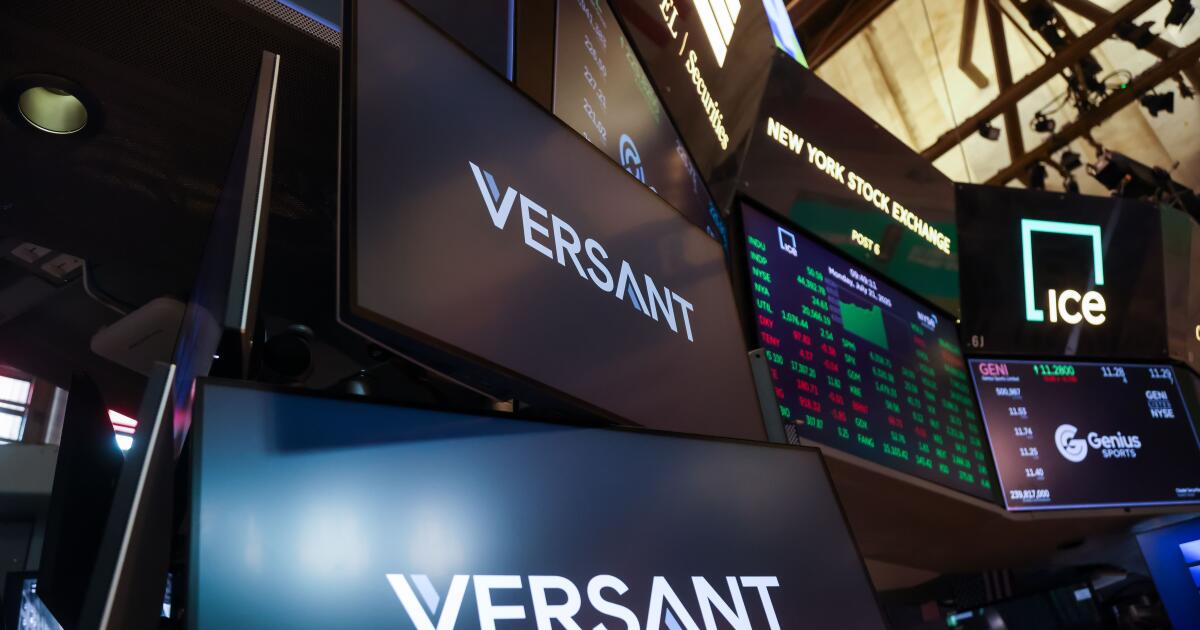
Comcast has officially spun off its cable channels, including CNBC and MS NOW, into a separate company, Versant Media Group.
The transaction was completed late Friday. On Monday, Versant took a major tumble in its stock market debut — providing a key test of investors’ willingness to hold on to legacy cable channels.
The initial outlook wasn’t pretty, providing awkward moments for CNBC anchors reporting the story.
Versant fell 13% to $40.57 a share on its inaugural trading day. The stock opened Monday on Nasdaq at $45.17 per share.
Comcast opted to cast off the still-profitable cable channels, except for the perennially popular Bravo, as Wall Street has soured on the business, which has been contracting amid a consumer shift to streaming.
Versant’s market performance will be closely watched as Warner Bros. Discovery attempts to separate its cable channels, including CNN, TBS and Food Network, from Warner Bros. studios and HBO later this year. Warner Chief Executive David Zaslav’s plan, which is scheduled to take place in the summer, is being contested by the Ellison family’s Paramount, which has launched a hostile bid for all of Warner Bros. Discovery.
Warner Bros. Discovery has agreed to sell itself to Netflix in an $82.7-billion deal.
The market’s distaste for cable channels has been playing out in recent years. Paramount found itself on the auction block two years ago, in part because of the weight of its struggling cable channels, including Nickelodeon, Comedy Central and MTV.
Management of the New York-based Versant, including longtime NBCUniversal sports and television executive Mark Lazarus, has been bullish on the company’s balance sheet and its prospects for growth. Versant also includes USA Network, Golf Channel, Oxygen, E!, Syfy, Fandango, Rotten Tomatoes, GolfNow, GolfPass and SportsEngine.
“As a standalone company, we enter the market with the scale, strategy and leadership to grow and evolve our business model,” Lazarus, who is Versant’s chief executive, said Monday in a statement.
Through the spin-off, Comcast shareholders received one share of Versant Class A common stock or Versant Class B common stock for every 25 shares of Comcast Class A common stock or Comcast Class B common stock, respectively. The Versant shares were distributed after the close of Comcast trading Friday.
Comcast gained about 3% on Monday, trading around $28.50.
Comcast Chairman Brian Roberts holds 33% of Versant’s controlling shares.

Oregon women score the last 14 points to beat No. 21 USC 71-66

Police hunt for masked suspects who looted a Pennsylvania Lululemon overnight
RI Lottery Mega Millions, Lucky For Life winning numbers for Jan. 6, 2026

South Carolina Lottery Mega Millions, Pick 3 results for Jan. 6, 2026
SD Lottery Mega Millions, Lucky For Life winning numbers for Jan. 6, 2026

Florida High School Football Rankings: Top 25 teams – Oct. 21

Cleary's 21 help Le Moyne down Central Connecticut State 69-64 in OT

How old is Bo Nix? What to know about Oregon quarterback ahead of 2024 NFL Draft

99th annual Pony Swim held in Virginia

Video: ‘It Didn’t Have to Happen This Way:’ U.Va. Faculty Call for Review of Police Response to Protests

Wyoming Supreme Court rules laws restricting abortion violate state constitution

How strong are Latin America’s military forces, as they face US threats?

Trump says Venezuela will turn over 30 million to 50 million barrels of oil to US | CNN Business

Video: Nvidia Shows Off New A.I. Chip at CES

Pelosi heir-apparent calls Trump’s Venezuela move a ‘lawless coup,’ urges impeachment, slams Netanyahu
-

 World1 week ago
Hamas builds new terror regime in Gaza, recruiting teens amid problematic election
-
 News1 week ago
For those who help the poor, 2025 goes down as a year of chaos
-
 Business1 week ago
Instacart ends AI pricing test that charged shoppers different prices for the same items
-

 Health1 week ago
Did holiday stress wreak havoc on your gut? Doctors say 6 simple tips can help
-

 Technology1 week ago
ChatGPT’s GPT-5.2 is here, and it feels rushed
-
 Business1 week ago
A tale of two Ralphs — Lauren and the supermarket — shows the reality of a K-shaped economy
-

 Science1 week ago
We Asked for Environmental Fixes in Your State. You Sent In Thousands.
-

 Politics1 week ago
The biggest losers of 2025: Who fell flat as the year closed