Business
'The bane of retail.' To prevent theft, many big chains now lock up all kinds of merchandise


Detergent and deodorant, toothpaste, the entire shampoo aisle.
“It’s all locked up,” Corey Potter sighed, describing shelves encased behind security glass at a Target near her Echo Park home. “I hate it.”
Potter recalled once waiting 15 minutes for an employee to unlock a case at another Target location. These days, if she sees several other shoppers waiting for too few frenzied workers, the 30-year-old video editor typically skips items on her list and later does something she doesn’t feel great about: buys more home essentials on Amazon.
“Rather than go to Target and wait,” she said, shrugging, “I’ll just give Daddy Bezos my hard-earned cash.”
Shoplifting is as old as shopping itself. And retailers have long played a game of cat and mouse with thieves, searching for ways to thwart them while still giving paying customers easy access to merchandise.
The true severity and scope of the problem remain an enduring mystery of the free market, as national chains eagerly point to retail theft as a key drag on profits, but are reticent to publicly discuss internal numbers on shrink — the industry term for theft and other types of loss — or specifics of new anti-theft measures. Adding to the murkiness, the issue has become more politicized in recent years as some voters and elected officials in Los Angeles, San Francisco and other city centers clamor for a response to what they see as a worsening problem.
But what is clear to anyone who has shopped at a drug, grocery or home improvement store in L.A. in recent years is that retailers are increasingly resorting to the drastic step of barricading entire swaths of their stores behind lock and key.
Using a tactic once reserved for a few pricey, high-demand items — cold medication, electronics, baby formula and razors to name a few — big chains now routinely lock up almost every type of merchandise. A shopper looking to grab a box of condoms or a $1.99 set of crayons, ointment to remove calluses or a container of instant coffee, now often has no choice but to hit a button to summon a store employee with a key and wait.
Executives focused on their companies’ bottom lines are no happier about taking the drastic step to deter shoplifters. Although they’re in the business of selling as much as possible, they’ve been left to make the seemingly backward calculation that thefts require them to make it harder for paying customers to buy things.
“Locking a product,” a spokesperson for CVS said in an email, “is a measure of last resort.”
Retail theft has become a priority for California leaders in recent years.
In September, Gov. Gavin Newsom sent $267 million to cities and counties to increase arrests and prosecutions of organized retail crimes. A few weeks earlier, L.A. Mayor Karen Bass announced a task force focused on such crimes, following a string of robberies at high-end stores such as Gucci and Yves Saint Laurent that garnered a flurry of media attention and helped further cement a new phrase into the zeitgeist: A smash-and-grab.
In February, California Atty. Gen. Rob Bonta filed criminal charges against a woman he called the ringleader of a retail theft group prosecutors say stole nearly $8 million in beauty products to resell on her Amazon storefront. And last week, the coalition behind a tough-on-crime ballot initiative that would roll back the landmark Proposition 47 by stiffening penalties for some retail thefts in California submitted enough signatures that it appears the measure will go before voters in November.
The initiative was bankrolled largely by big chains, including Walmart, Target and Home Depot.
While the companies work publicly to change California law, they are taciturn about discussing their efforts to stop shoplifters, making it hard to quantify how much more merchandise is now locked up and which stores have embraced the strategy.
Representatives for several of the region’s largest retailers — Target, Vons, Rite Aid and CVS — either didn’t respond to requests to discuss internal deliberations on stemming theft or sent brief statements about their anti-theft measures.
David Johnston, vice president of asset protection and retail operations at the National Retail Federation, said that locking up more merchandise is “an unfortunate necessity” to combat theft and what he characterized as a rise in organized retail crime and violent incidents in stores.
Toothbrushes are among the many products now locked behing security glass at a Target in Pasadena.
(Ryan Fonseca / Los Angeles Times)
Retailers know that the additional supplies and labor needed to lock up more merchandise cut into their bottom line and frustrate customers, Johnston said, but some have decided it’s a necessary trade-off to keep shelves stocked with often-stolen items such as baby formula and medications.
“Right now, the best approach in many instances is putting it behind lock and key,” Johnston said. “These measures are last-ditch efforts.”
Joe Budano, the chief executive of Indyme, a San Diego-based company that makes buttons to beckon sales associates to specific aisles, estimated that frustration over waiting for locked merchandise leads to a 10% to 25% reduction in sales, calling the cages “the bane of retail.”
His company also has developed technology — the Freedom Case, they call it — that allows shoppers to open cases themselves using personal information such as their cellphone number or by scanning their face.
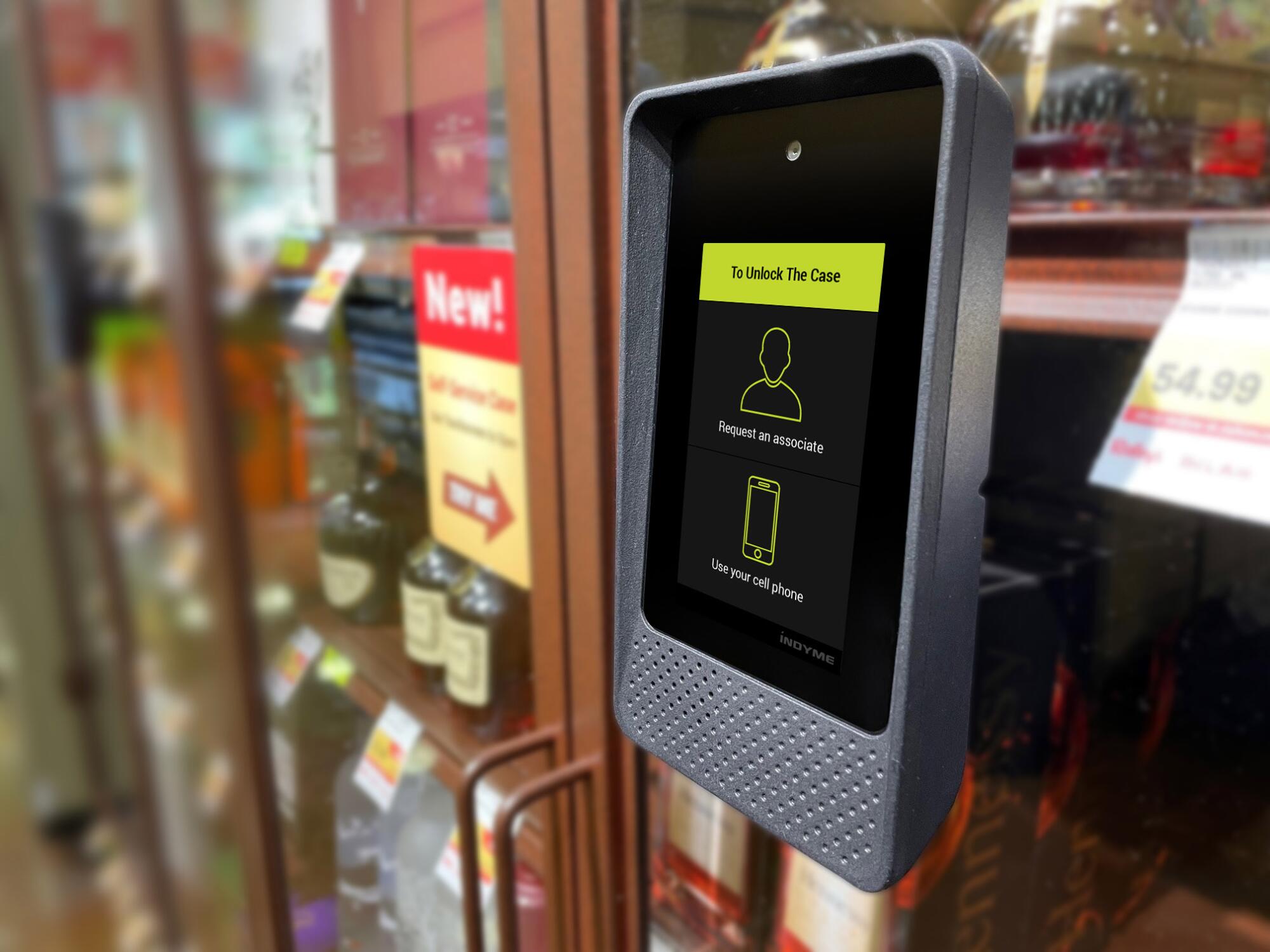
The Freedom Case, technology developed by a San Diego-based company called Indyme, allows shoppers to open locked merchandise themselves using personal information such as their cellphone number.
(Joseph Budano)
More than 40 retailers are testing the Freedom Case in stores, Budano said, including a national chain he declined to name.
To combat theft, Budano said, companies often scrutinize missing merchandise using individual SKUs, the most granular data possible.
“They know all the way down to which flavor of Oil of Olay is most stolen,” he said. “The pace at which things have gotten locked up tells you the magnitude of the problem.”
But that magnitude — which retail industry groups say has reached “unprecedented” and “epidemic” levels, despite data showing such characterizations are overblown — varies by city.
The Council on Criminal Justice, a nonpartisan research organization, tracked shoplifting trends in 24 cities from 2019 to the middle of 2023 and found that rates were down in more than two-thirds of the cities. New York City and L.A. were the two biggest exceptions, logging increases of 64% and 61%, respectively.
Even in light of the recent surge in L.A., the rate of reported shoplifting incidents in L.A. County in late 2022 was slightly lower than it had been 2014, according to a report from the Public Policy Institute of California, a nonpartisan think tank that analyzed state Department of Justice statistics. During that eight-year period, only three of the state’s 15 most populous counties — all in the San Francisco Bay Area — saw increased rates of shoplifting, a misdemeanor crime defined as stealing goods valued at less than $950.
The report’s author, Magnus Lofstrom, said that rates of reported shoplifting dropped in much of the state, including L.A. County, when stores emptied out during the 2020 shutdowns. But the region saw a steady rise in the summer of 2021, he said, and by late 2022, the most recent data at the time of his report, the rate was at least 10% above the pre-pandemic level.
In recent months, several companies, including the 99 Cents Only chain and Target, have cited theft or shrink as a reason that factored into their decisions to shutter locations.
Charis Kubrin, a professor of criminology at UC Irvine who studies retail theft, said that although some stores lock up lots of merchandise, others cage almost nothing.
“It’s kind of an uneven distribution,” she said. “A mixed bag.”
A Times analysis from 2022 found that stores in higher-income areas locked up fewer items even in places where property crime rates were higher, creating an additional burden for shoppers in certain neighborhoods. And inconsistencies in how locked merchandise is released to customers — sometimes workers hand you items to put in your cart, other times they escort merchandise to the register — raise the same questions of racial profiling that have long plagued retail establishments.
“The owners and employees have wide-scale discretion,” Kubrin noted.
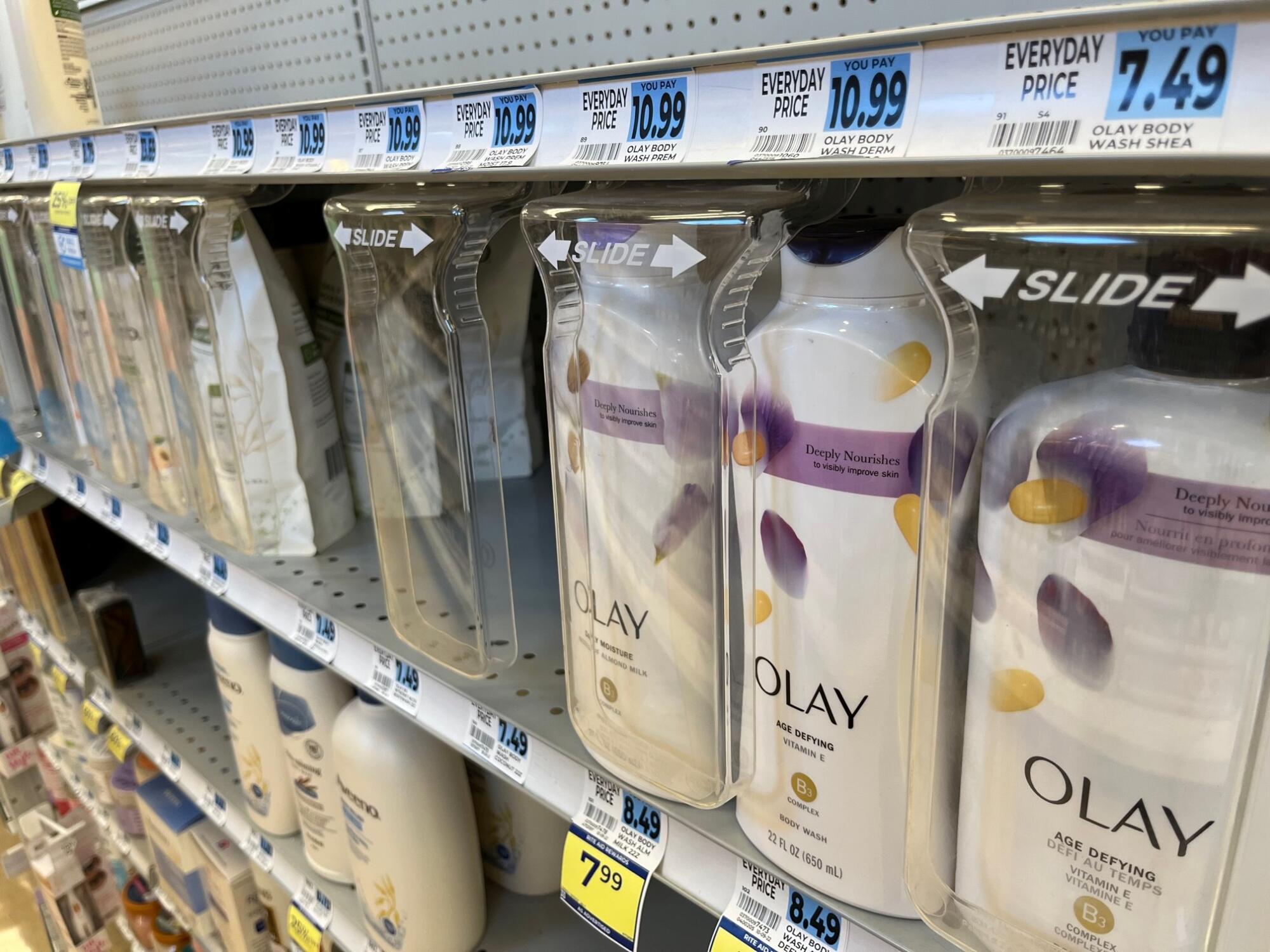
Security devices at Walgreens are designed to slow down shoplifters.
(Hugo Martin / Los Angeles Times)
The scale of merchandise theft, Kubrin added, is sometimes overblown by a retail industry happy to pin its problems, which include market forces such as inflation and a shift to online shopping, on stolen merchandise.
Crime, she acknowledged, is part of the equation. As a consumer, Kubrin distilled her frustration with locked merchandise down to the same word many other shoppers used: “Annoying.”
A man posted on TikTok recently that CVS was treating a bag of Werther’s Original caramel candies like a controlled substance and on Reddit someone said the anti-theft measures should force an entire genre of retailer to rebrand themselves:
“Inconvenience store.”
In interviews with five employees at retail locations across the Southland, workers said rushing to unlock merchandise for often-peeved customers has made their slammed shifts more hectic.
“I apologize a lot and I get yelled at a lot,” said a supervisor at a Vons in Pasadena.
But several workers said they understood their employers’ decisions, noting that around late 2021 or early 2022, they’d noticed an uptick in people putting multiples of a single piece of merchandise into big bags and walking out — boosters, as they call shoplifters they suspect will resell the merchandise.
The criminal complaint filed by Bonta’s office this year included text messages suggesting that the defendants, who prosecutors say targeted beauty retailers Ulta and Sephora, used that method.
“I’m not stealing regular I’m going to start filling up my bag quick,” one defendant wrote. “I want to know stuff I can grab.”
Rogelio Madrigal, a shift supervisor at a CVS in San Pedro, started 16 years ago and has noticed changes through the years.
There was a time, he said, when the main thing they locked up was Sudafed. Eventually, items such as Plan B and razors got added and then, a couple years ago, he noticed more people swiping Tide Pods. Now, he mainly sees people walk out with boxes of diapers and cosmetics.
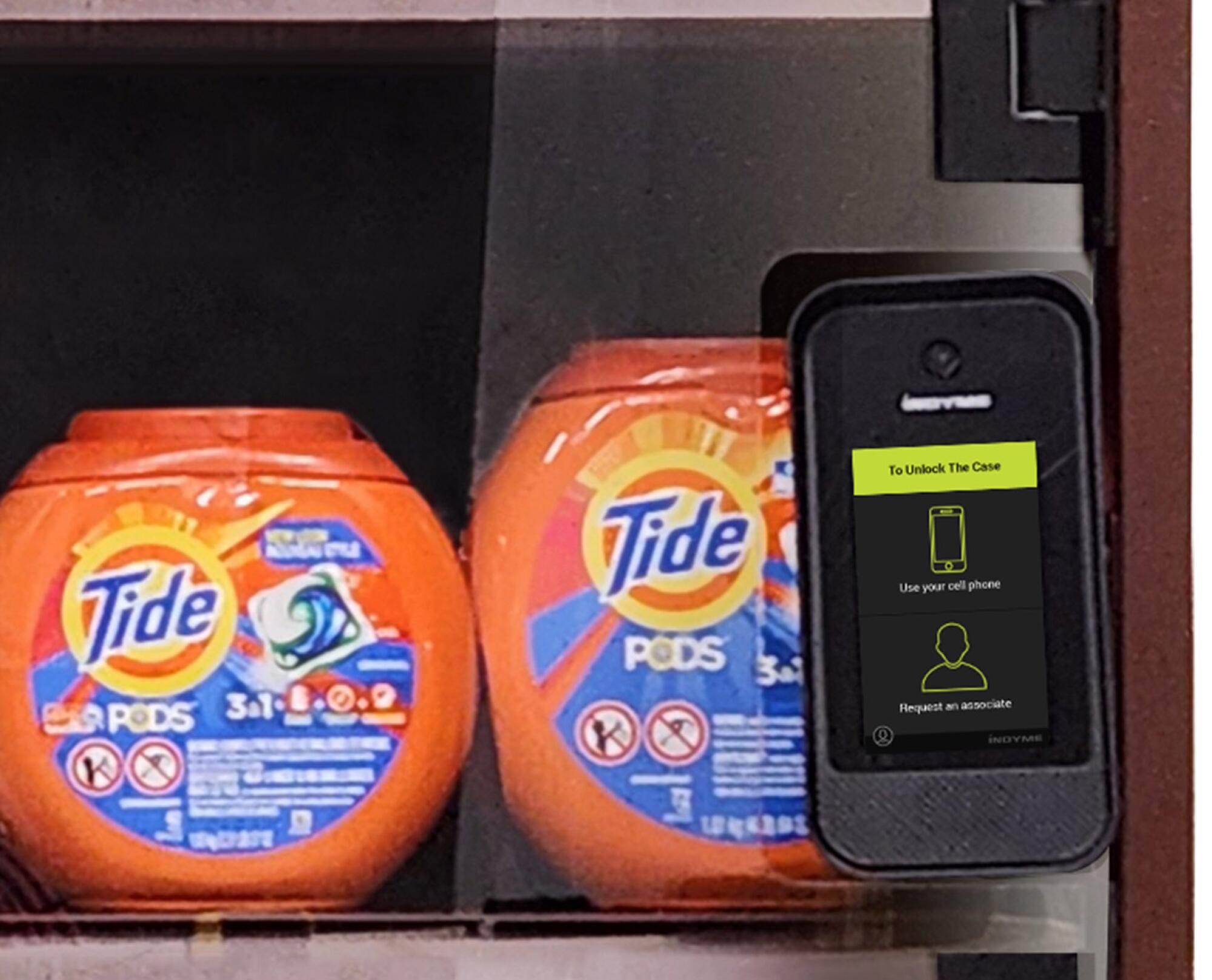
Laundry detergent items are stored in the Freedom Case.
(Joseph Budano)
“It was happening before,” he said, “but not as bad as now.”
On a recent morning at a Rite Aid in East Hollywood, the lone cashier greeted customers who walked through a doorway lined with security alarm panels.
“Welcome in,” he said.
Many of the aisles were lined with anti-theft mechanisms, including red magnets at the end of metal prongs holding items like eyelash curlers and an individual plastic cage around a $22 box of lice treatment. Some sections, including all the toothpaste and most of the detergent, were locked behind long, clear cages.
A customer steadying himself with a cane peeked through a cage at a bottle of Tide and shrugged, settling instead on a small container of Persil, one of the few non-caged detergents, before walking to the register.
At a nearby Vons, the greeting cards and candy were out on shelves, but an assortment of school supplies, including a ruler for $1.47, was locked up.
In the medication aisle, a woman with a full cart sighed when she realized that one of the last items she needed — a small bottle of Claritin, an allergy medication — was locked up. She pressed the button and an automated refrain that, during busy hours, rings out like the store’s soundtrack played: “Thank you, someone will be with you shortly.”
Less than a minute later, when a worker with a key ring rounded the corner, her eyes widened in surprise.
“That was fast!” she told him.
“We try,” he said.


The race to bring air travel to the sky is heating up as Santa Cruz-based Joby Aviation and Toyota launch a joint venture to commercially produce air taxis.
The companies said in a news release Tuesday that they will work together on productivity, quality and costs and move toward mass production of Joby’s electric vertical takeoff aircraft. Joby and Toyota were first linked when Toyota made a nearly $400-million investment in the company in 2020. It has since increased its backing of the company to $900 million.
“It’s really meaningful for us to take on this challenge together with Joby, a partner that shares the same vision,” Toyota Chair Akio Toyoda said. “We believe this strengthened relationship is an important step forward in realizing the future mobility society.”
Joby‘s all-electric vertical takeoff vehicles are designed to hold four passengers and a pilot and can travel at up to 200 mph. The vehicle uses six tilting propellers to achieve vertical takeoff before switching to forward flight.
In February, Joby announced a partnership with Uber to start service in the United Arab Emirates this year, bringing on-demand air taxi rides to the country. It plans to expand to the U.S. after the completion of its final stage of Federal Aviation Administration testing.
Prior to its full FAA certification, Joby is hoping to launch early flight operations later this year as part of a White House program that will bring flights to several states, including New York, Texas and Arizona. Flights in California will not begin until after obtaining FAA certification.
Joby has been in a fierce battle to be the first with taxis in the sky with its Northern California competitor Archer Aviation. The two companies are involved in overlapping lawsuits, with Joby alleging corporate espionage against Archer, and Archer filing a suit alleging dubious ties to China that sparked an investigation into Joby by the U.S. International Trade Commission.
“Toyota has been by Joby’s side for nearly a decade, providing invaluable guidance and support as we built the foundation for manufacturing our aircraft,” JoeBen Bevirt, Joby’s chief executive and founder, said in the news release. “Together, we share a vision of making aerial mobility an everyday reality, and we look forward to delivering on that promise together.”
Joby Aviation’s shares, which have fallen more than 30% this year, climbed 3% on Tuesday to $8.92.
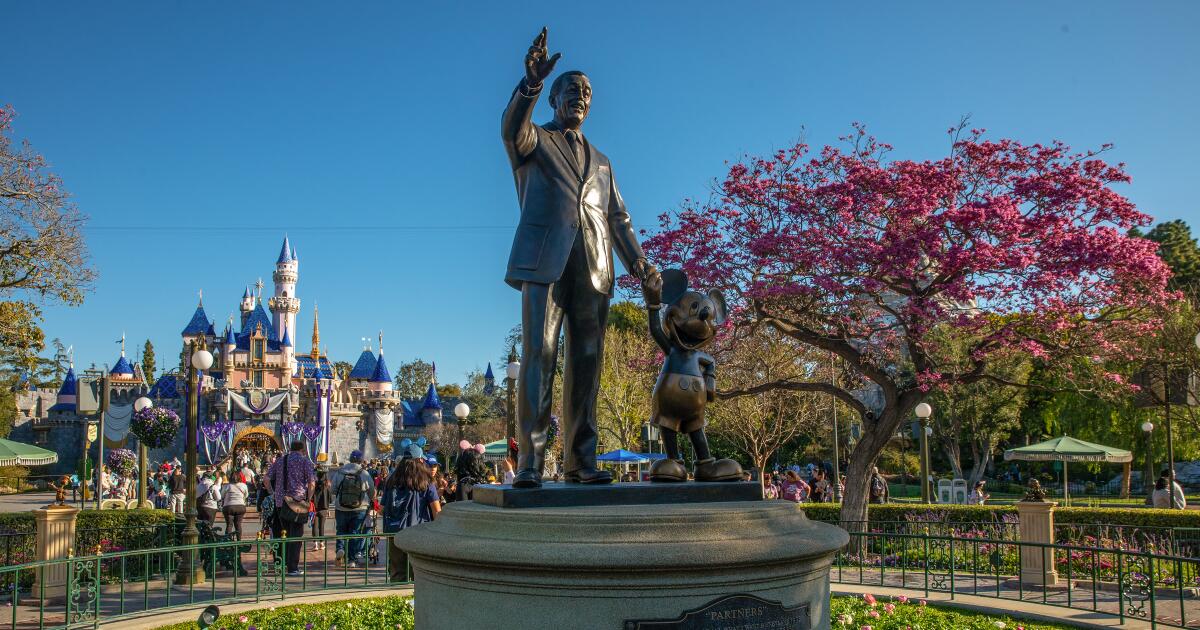
Disneyland Resort in Anaheim will offer $59 tickets for select evening admission to either theme park as part of a new promotion.
The one-day, one-park evening ticket offer will allow attendees to enter Disney California Adventure at 5 p.m. or Disneyland at 7 p.m. Park reservations are still required, as has been the case since the COVID-19 pandemic.
The offer only applies for admission from July 12 through Aug. 5 on Sundays to Wednesdays.
Disneyland Resort is commemorating its 70th anniversary through Aug. 9, and has introduced new shows and additions to rides as part of the occasion.
Walt Disney Co.’s theme parks and experiences business are a crucial boost to its finances, making up about 56% of the company’s operating income last fiscal year.
During the Burbank-based company’s most recent earnings call in May, Disney executives said attendance at its U.S.-based parks was down 1% compared with the prior year, a shift they attributed to “continued softness” in international visitations. However, the company said at the time that it was starting to move past those issues.
Disney’s experiences division reported $9.5 billion in revenue in that fiscal second quarter, up 7% compared with the same period a year ago, something executives said was due to higher guest spending domestically and more capacity on its cruise line.

An aging downtown office complex will be converted into apartments as part of an ambitious plan by local real estate companies to create 4,000 affordable housing units in Los Angeles.
The first project will be a $200-million makeover of the L.A. World Trade Center, a sprawling white elephant of an office complex on Figueroa Street built in the 1970s that will be turned into 512 apartments in one of the largest affordable housing conversions to date downtown.
Future projects being planned in the central city for delivery over the next five years will include other office-to-apartment conversions and new housing built from the ground up.
The 10-story World Trade Center, right, at Figueroa and Fourth streets in downtown Los Angeles, was built in the mid-1970s.
(Myung J. Chun / Los Angeles Times)
Behind the building campaign unveiled Monday are two of the region’s largest real estate companies, Jamison and Kennedy Wilson. Jamison is the city’s most prolific converter of offices to market-rate apartments and currently has a major makeover of a downtown office skyscraper underway for tenants who can pay top rents.
Kennedy Wilson, a real estate investment company based in Beverly Hills, owns Vintage Housing, which builds and operates affordable housing using tax credits and other state and federal financing to help fund it.
Vintage Housing and Jamison’s new affordable housing division, Arden Residential, will take on the campaign to build the housing where qualified tenants will pay rents below market rates.
Rents in the World Trade Center — which will be renamed Sky Castle when it opens in early 2028 — are expected to start at $937 for a one-bedroom unit. Some two- and three-bedroom units would rent for $1,100 and $1,300 per month, respectively, developers said.
Sky Castle will have shared amenities found in more expensive modern apartments, the developers said, such as a fitness center, resident lounge and co-working space. It already has six tennis courts on the roof, which may be converted to pickleball courts, Jamison Chief Executive Garrett Lee said.
The goal is to build higher quality affordable housing by using efficient construction methods Jamison has learned through building more than 8,000 market-rate apartments in the past, Lee said. The makeover of the World Trade Center will mark Jamison’s 15th conversion of an office building to housing.
The plan to redevelop the L.A. World Trade Center, bottom left, is one of the largest affordable housing conversions to date downtown.
(Myung J. Chun / Los Angeles Times)
The 10-story World Trade Center was built in the mid-1970s to fanfare saying it would be home to international companies. In 1976, The Times described the center as a place to prepare for an overseas trip where visitors could get passports and visas, as well as exchange dollars for francs, marks, rubles and other currency. There was a language school and branches of U.S., Swiss and Japanese banks.
By the mid-1980s, the 400,000-square-foot office complex covering a city block at Figueroa and Fourth streets had lost its international flavor and was falling out of favor with corporate tenants who were moving into glossy new skyscrapers on Bunker Hill and in other locations.
The building has been cleared of remaining office tenants to allow work to begin in August, Lee said.
Kennedy Wilson is a nationwide operator of market-rate apartments that has also moved into building affordable housing in the last decade, said Nicholas Bridges, global head of capital markets at the company.
Building affordable, workforce housing “in almost all cases requires public subsidies,” Bridges said, and Kennedy Wilson has developed expertise in assembling “a cocktail of public financing sources” that includes low-income housing tax credits and tax-exempt bonds.
In the past, many housing developers have shied away from building affordable housing because assembling the subsidies needed to make construction profitable is challenging.

An artist’s rendering shows what the L.A. World Trade Center could look like after being redeveloped into affordable housing. The new complex is to be called Sky Castle.
(Ian Camarillo)
“It’s complicated,” Bridges said, “and not for the faint of heart.”
Eligible tenants must earn between 30% and 80% of the median income in the area where the housing is built.
Jamison and Kennedy Wilson will develop about 15 affordable housing projects between downtown and the 405 Freeway, Bridges said, many of them in aging office buildings such as the World Trade Center that are already owned by Jamison and are close to public transit.
Substantial potential for affordable housing lies in L.A.’s underused office buildings, he said.
“In this post-COVID world, the way people are utilizing office buildings, particularly older office buildings, has just fundamentally changed,” he said.
It makes sense for developers of conventional multifamily housing to move to building affordable housing, Lee said, because the government supports it through subsidies, zoning reform and the fast-tracking of construction permits. The city of Los Angeles also recently streamlined its adaptive reuse rules to make it easier to convert office buildings to housing.
“There are a lot of incentives pushing us in this direction,” Lee said.
-

 Illinois4 minutes ago
Illinois Product Farmers Market Highlights Local Flavors and Family Traditions
-

 Indiana11 minutes ago
2 Indiana men plead guilty in Montana oxycodone conspiracy case
-

 Iowa14 minutes ago
Iowa’s governor and her family on weeklong tour of Iowa tourist sites – Radio Iowa
-

 Kansas19 minutes ago
New mural to be unveiled Thursday afternoon in North Topeka
-

 Kentucky26 minutes ago
Former Northern Kentucky school bus driver sentenced in child pornography case
-

 Louisiana29 minutes ago
Audit finds barriers hinder Louisiana WIC enrollment – American Press
-

 Maine34 minutes ago
How to safely enjoy the water in Maine as temperatures rise
-

 Maryland41 minutes ago
Rep. Glenn Ivey, Community Members Discuss Gun Violence Solutions

