Business
So you want to be a social media star? What to know about the creator economy in 2024

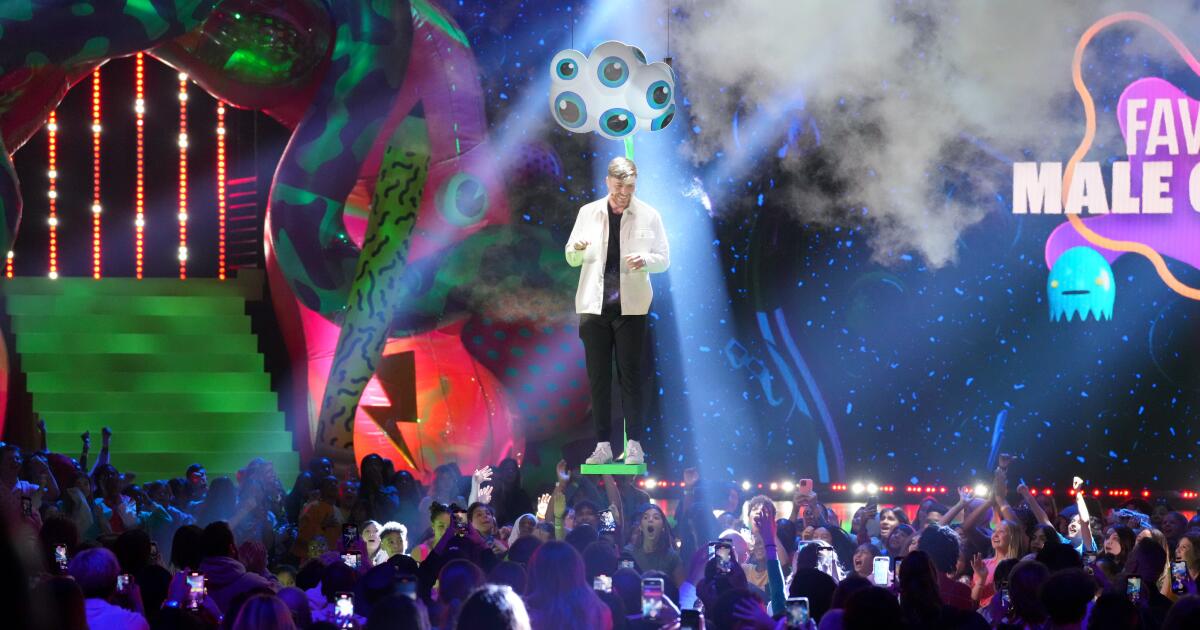
Half a trillion dollars. That’s how large the creator economy, currently pegged at $250 billion, is predicted to grow in the next four years, according to Goldman Sachs.
While people have been making a living off of creating content for online audiences for nearly two decades, what was once a nascent industry is growing up. Brands are getting more strategic about influencer marketing, a thriving ecosystem has emerged to serve creators and their needs, and social platforms are increasingly nudging consumers to spend while they scroll.
What does this mean for influencers and their audiences? The Times asked those who have been in the creator economy for decades to opine on what the new year will bring. We’re still in the early innings, they said, but in 2024, the industry will continue to mature in significant ways.
It will get tougher to build a ‘real’ business.
Most creators start off as one-man bands. They brainstorm, film, edit and post content on their own. Day by day, they grow their followings, and eventually begin to make money. But then what?
“There are two options: You either bring in a manager or agent externally, or you hire a COO or business partner internally,” said Jon Youshaei, a creator and founder of Youshaei Studios. “And more and more, I’m seeing creators bring in a right-hand person internally.”
A lot of this has to do with competition. Although the barrier to entry has never been lower, building a “real business” in the creator economy is getting harder, Youshaei said.
Blake Michael, chief strategy officer of Fourteen Media Group, a consulting firm for creator economy startups, said this necessitates bringing in outsiders to help with growth strategies.
“Niche verticals are so quickly becoming saturated, and that means you’ve got to put more effort into your content to stand out,” Michael said.
Companies will be more selective about who they work with …
In the early days of influencer marketing, creators quickly attracted money and attention from companies clamoring to get in on social media. This year, businesses won’t be as willing to throw money at any influencer that comes their way.
“I just think they’re getting a lot smarter,” said Joe Gagliese, co-founder of Viral Nation, one of the world’s first influencer marketing agencies. “They want to understand: Does this person really align with my brand? What are their views and perspectives on things that might not align with my brand?”
As brands become more disciplined in their efforts in 2024, they will increasingly want to see results they can measure, Gagliese said.
Two influencers who may look the same on paper might produce completely different results. Companies are learning to look at metrics such as community engagement over number of followers, and they’re scrutinizing the type of relationships creators have with their audience.
“There’s creators who people look to and trust for their opinion, and then there’s creators who folks like to be entertained by,” Gagliese said, “and those two types of engagement are very different as it relates to being able to help a brand.”
… But this could mean more opportunities for ‘micro influencers.’
Counterintuitively, the push to formalize channels of influencer marketing will mean more opportunities for creators with smaller followings.
Traditionally, several “inefficiencies” have slowed down the process when companies want to work with influencers, said Zach Ferraro, head of strategic partnerships at Fourthwall, a platform that helps creators sell products and launch memberships.
First, brands had to look for the right creator — and often they didn’t know exactly what they were looking for or what to expect realistically in terms of outcomes, Ferraro said. They had to go back and forth with a manager on rates, which can vary widely, and provide deliverables, such as a certain number of Instagram posts or videos.
To make it worth the friction and costs involved, brands would look only to ink larger deals.
But as companies have become more experienced, platforms that connect creators with brands have proliferated and the process has become more transparent. For example, the company F*** You Pay Me, allows creators to anonymously review brands they’ve worked with and share how much they got paid.
“Smaller, mid-tier micro influencers are going to get more opportunities as friction goes down,” Ferraro said.
Gagliese of Viral Nation agrees.
“I think that creators who have really developed core audiences and communities and have the ability to convert and create those business outcomes will likely get paid more,” he said. These are the influencers who might not have millions of followers but boast smaller, devoted audiences.
Another possibility is for brands to hire smaller creators for in-house content, Ferraro said. “Middle-class” creators who might not be doing as well financially as they want to be could find opportunities offering their expertise to brands looking to build their audiences.
Consumers will pay you for your content too.
With the advent of in-app “tipping” features on social platforms, creators have another way to make money: Their fans can pay them directly without going through a third-party platform, such as Patreon or Buy Me A Coffee.
On TikTok, users can purchase coins to spend on virtual gifts for livestreamers on the platform that can then be converted into earnings. The most popular form of spending is a $19.99 bundle of coins that makes up a quarter of the app’s in-app purchase revenue (TikTok takes 50% of the payout).
Lexi Sydow, head of insights at data.ai, said this is a compelling trend because they represent one-off micro-transactions given in the moment for specific creators that consumers enjoy.
“There’s not necessarily a subscription tied to it,” Sydow said. “You’re saying, ‘Kudos. I like this. I want more of it.’ And I think that that’s powerful for this space because I really do believe we’re in the early days of the growth rates.”
In 2023, TikTok became the first non-game app to generate $10 billion in consumer spending, according to data.ai. This bodes well for social media spending overall, which is only projected to grow.
Other platforms such as Instagram and YouTube have also jumped on the bandwagon to introduce tipping features.
Authenticity will rule…
Eric Wei, co-founder of Karat, a startup that helps creators with their finances and credit, describes the current era of social media content as “sensationalist” — and predicts a trend toward authenticity in 2024.
Just take a look at the top subscribed YouTube channel by an individual, MrBeast, whose recent videos include “I Rescued 100 Abandoned Dogs!” and “$1 vs $100,000,000 Car!”
Although MrBeast will continue to be popular, Wei predicts a movement of creators toward more unedited content. They include fitness YouTuber Sam Sulek, who has 2.75 million subscribers.
“Everyone’s focusing on Sam, why? The guy doesn’t edit,” Wei said. “It’s just him working out at the gym for over an hour.”
Youshaei, who also has a YouTube channel, said he sees the rise of this kind of content counteracting the “hyper-edited” videos that have taken over YouTube in recent years.
… But the rise of fake influencers is coming.
Lil Miquela, self-described as a “19-year-old Robot living in LA,” is one of the first virtual influencers. She charges up to hundreds of thousands of dollars for a deal and has worked with brands such as Burberry, Prada and Givenchy, the Financial Times reported recently.
She posts photos of herself vacationing in Europe, dyeing her hair at the salon and eating at taquerias. Does it matter that she’s not real? She has 2.6 million followers.
Human influencers may soon have to worry about competition from such AI-generated avatars.
Digital avatars that amass followers is not a new idea. Consider Japanese Vocaloid Hatsune Miku and K/DA, a virtual K-pop girl group featuring League of Legends characters.
And Wei points to Iron Mouse, one of the most subscribed female creators on Twitch who uses a virtual avatar and is known as a VTuber.
“It’s already a billion dollar industry,” he said.


Surcharges that California homeowners have been hit with statewide by insurers defraying the costs of Los Angeles County’s wildfires were ruled legal in a decision released late Tuesday.
L.A. County Superior Court Judge Tiana Murillo turned down a petition by advocacy group Consumer Watchdog to halt the charges, which insurers began levying last year after the state’s insurer of last resort couldn’t pay all its January 2025 fire claims.
The California FAIR Plan, financially backed and operated by the state’s licensed home insurers, needed a $1-billion bailout from the insurers after it was hit with some $4 billion in claims.
Under a deal Insurance Commissioner Ricardo Lara worked out with the FAIR Plan in 2024, the insurers could seek state approval to surcharge their residential policyholders for up to half of any assessment totaling $1 billion in case the plan needed a bailout in an “extreme worst case scenario” — as it turned out it did.
A total of 105 insurers, including State Farm General — California’s largest home insurer — Farmers and Mercury sought and received approval for the surcharges.
Because the FAIR Plan assessed its member insurers based on their share of the state’s home insurance market, the policyholder surcharges were in the same ballpark. The median fee for homeowners was $28, according to the department of insurance.
The fee can be more or less according to the size of a homeowner’s premium and is split into monthly payments that insurers can spread over one or two years. Condo owners and renters on average were surcharged less.
In a court filing, Consumer Watchdog said $420 million in surcharges were approved.
In its April 2025 lawsuit filed against Lara, the Los Angeles group made a series of arguments in seeking to overturn the residential surcharges, which it deemed an industry bailout. It did not sue over related commercial surcharges.
Consumer Watchdog contended in its lawsuit that the surcharges violated Proposition 103 — the 1988 measure that governs insurer rate hikes — because the proposition does not allow for them.
It also claimed Lara did not follow regulatory protocol in promulgating the new policy.
The group further alleged that the FAIR Plan’s governing statutes do not give Lara the authority to permit the surcharges — and that the statutes require insurers to share in the plan’s profits and losses, and not shift losses to policyholders.
Murillo, and another judge who previously heard the case, turned down all of the consumer group’s arguments in separate rulings, the last of which Murillo issued Tuesday night.
Lara celebrated his legal victory over Consumer Watchdog, which has accused Lara of having close ties to insurers and sought to oust him from office. His terms ends in January.
“This victory sends a loud and clear message: The era of allowing special interests to derail consumer choice is over. We have the momentum, we have the authority, and we will continue to fight until every Californian has access to the coverage they deserve,” Lara said in a statement.
Attorney Will Pletcher, litigation director of Consumer Watchdog, said the group disagreed with the decision and would “consider all options to move this forward.”
“It’s important to try to protect California consumers from these surcharges that we think are in pretty clear conflict with both Proposition 103 and the FAIR Plan,” he said.
Hilary McLean, a spokesperson for the plan, said in a statement it did not have any position on the ruling, given the plan “does not have a role in determining how insurers manage costs associated with assessment.”
Denni Ritter, vice president of state government relations for the American Property Casualty Insurance Assn., a major industry trade group, said the decision rejected “the reckless lawsuit brought by the self-interested group Consumer Watchdog…”
“This ruling preserves a vital tool to protect the stability of the California insurance market. Blocking cost recovery would have undermined the state’s last-resort coverage option,” she said in a statement.
The 2024 policy was issued in response to the rapid growth of the plan due to a series of wildfires over the last decade that prompted multiple insurers to retreat from the state’s home insurance market.
The plan had 264,000 homeowners on its rolls in September 2022, a figure that rose to 452,0000 in the months before the fires — and its residential policyholders have since increased to 663,000 as of March.
The FAIR Plan offers policies that typically cost more than those issued by regular insurers while offering less coverage.
A Times analysis last year found that in the Palisades and Eaton fire zones, the plan’s rolls nearly doubled to 28,440 from 2020 to 2024.
That concentration of policyholders led to the plan’s large losses during the Jan. 7 wildfires, which damaged or destroyed more than 18,000 structures, killing at least 31 people.
It’s been estimated that the insured losses for the wildfires could ultimately total as much as $40 billion, exceeding any past wildfires worldwide. Ritter said that so far insurers have paid $23.7 billion in claims.
The 2025 wildfires were not the only time the FAIR Plan has needed a bailout, though it is the first time its member insurers surcharged policyholders.
In 1993, it assessed carriers after fires in Altadena and Malibu, and in 1994 it did so after the Northridge earthquake. The assessments totaled $260 million.
The plan received approval this year from the insurance department for a 29% rate increase for its homeowner dwelling policy that will take effect in October.

An electric Tesla Semi truck crashed into two vehicles in Dayton, Nev., over the weekend, killing two people and raising questions about the truck’s safety features.
The Lyon County Sheriff’s Office responded to a major collision around 7 a.m. on Sunday at the intersection of Highway 50 and Traditions Parkway about 40 miles east of Reno, the office said.
The office confirmed a semi-truck was involved in the accident, and footage of the scene shows it was a Tesla Semi.
It is the first known crash involving a Tesla Semi, an electric Class 8 truck that Tesla is building in Nevada and plans to ramp up production of. As interest in Tesla’s electric passenger vehicles wanes, the company is betting on the truck to give it a needed boost.
The trucks do not have the Full Self-Driving mode available in Tesla cars, but Tesla’s website says they come standard “with active safety features that pair with advanced motor and brake controls to deliver traction and stability in all conditions.”
According to the Lyon County Sheriff’s Office, preliminary statements obtained at the scene suggest the truck driver may have fallen asleep behind the wheel.
The crash is under investigation by the Nevada State Police Highway Patrol, which said additional information may be released next week.
The Record-Courier identified the victims as Sergio and Jennifer Villanueva, a couple who got married in 2022.
Tesla has not clarified if its semitruck has an automatic emergency braking system. Federal regulators are currently weighing a mandate for emergency braking systems in vehicles more than 10,000 pounds.
Decades of Hollywood empire-building ended with a quake in 2017 when Australian media mogul Rupert Murdoch decided to sell much of his Fox entertainment holdings amid the rise of Netflix and other tech giants.
This week, another titan who has been instrumental in shaping American media and telecommunications began to unwind his Hollywood holdings.
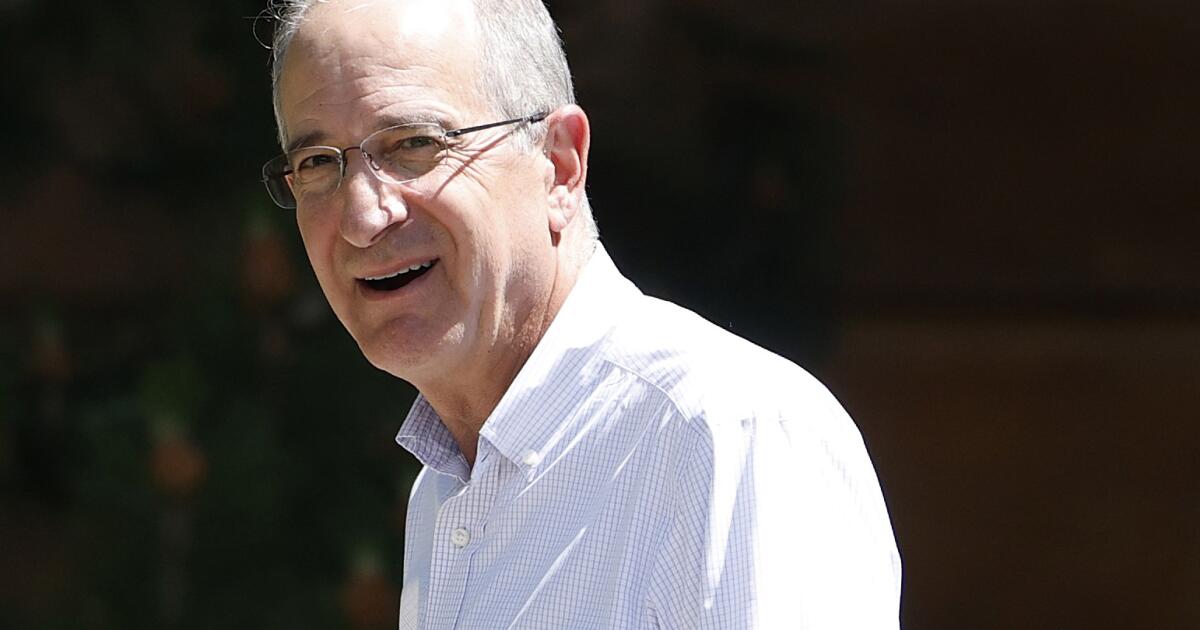
Brian L. Roberts — who with his father built Comcast into a cable TV and internet colossus — announced his company would spin off its prestigious NBCUniversal unit into a separate publicly traded company sometime next year.
The move reverses Roberts’ purchase of NBCUniversal in 2011 — a bold bet that created a behemoth with popular programming and cable pipes to pump that content into consumer homes.
Comcast’s breakup marks the close of a Hollywood era, one dominated for 40 years by a class of maverick moguls: Murdoch, CNN founder Ted Turner, Viacom’s Sumner Redstone, cable titan John Malone and the Philadelphia-based Roberts family.
Now, a new crop of leaders has emerged, reflecting Silicon Valley’s vast influence over the film and and TV business, which has been upended by streaming and, now, artificial intelligence.
“There was a time that Murdoch, Malone and Brian were really industry leaders who could affect change,” said Bank of America managing director Jessica Reif Ehrlich in an interview. “That’s not true any longer.”
Analysts widely believe Monday’s announcement is a prelude to eventual sales of both Comcast and NBCUniversal, a theory that Comcast rejects.
Roberts, 67, told analysts he will remain involved in both NBCUniversal and Comcast after the separation. Still, he plans to relinquish his chief executive role after 25 years and a half century at Comcast. Roberts has picked trusted associates to run each firm, and his family will continue to hold controlling shares of both companies.
But the shift underscores a dramatic loss of clout by Comcast and other traditional media enterprises. Netflix, Apple, Amazon and Google’s YouTube have diminished the industry’s financial pillars — box office receipts and cable programming fees — and given consumers control over when and how they watch programming.
Murdoch was the first to flee. In 2014, he was rebuffed in his $80-billion bid to beef up his 21st Century Fox by buying HBO, CNN and other Time Warner assets. Murdoch’s defeat led to the Fox asset sale to Walt Disney Co.
Last fall, Comcast made a run for the same properties with a plan to unite NBCUniversal with Warner Bros.
Instead, 43-year-old tech scion David Ellison — with help from his billionaire father, Oracle software co-founder Larry Ellison — scooped up the prize for a staggering $111 billion.
The pending blockbuster merger of Ellison’s Paramount Skydance and Warner Bros. Discovery is expected to reshape the industry and leave NBCUniversal increasingly vulnerable to a takeover.
“It looks like Comcast’s NBCUniversal was left standing on the dance floor without a partner,” MoffettNathanson media analyst Robert Fishman wrote in a Tuesday note to investors.
Paramount’s play for Warner Bros. came a month after Ellison finalized his family’s purchase of cash-strapped Paramount from Shari Redstone. The one-two acquisition punch would propel the Ellison family to top-tier moguls with influence over CNN, CBS News, HBO, Turner Classic Movies and two historic Hollywood studios.
“It’s a flagging industry. … The industry will have to consolidate to survive,” said C. Kerry Fields, a USC Marshall School of Business economics professor. “Those who have content plus [streaming] distribution are going to be the winners.”
Roberts knows distribution. His father in 1963 bought his first cable TV system in Tupelo, Miss. It was a quirky bet for Ralph Roberts, who figured his belts and suspenders business would soon be toast as beltless polyester pants became the rage.
Brian Roberts joined Comcast as a high school intern, setting up supermarket promotions. In 1975, he became a trainee cable installer, climbing poles and stringing cables. He joined Comcast full time in 1981 after graduating the Wharton School at the University of Pennsylvania.
For more than 30 years, he worked in tandem with his dad. With key associates, they built the nation’s foremost cable TV service — then the entertainment gateway — and grew stronger by offering internet, phone and then wireless service.
Analysts credit the 2011 purchase of NBCUniversal as a huge success; Comcast rescued a company that was on the ropes due to General Electric’s under-investment.
Over the years, Comcast rebuilt NBC and Spanish-language Telemundo, writing big checks for the best sports rights, including the FIFA World Cup, NFL, NBA and Major League Baseball.
Comcast also recognized value in theme parks and invested heavily, building Universal Studios as a formidable rival to Disney. NBC finished the season in first-place among traditional TV broadcasters and its L.A. film studio is an industry leader.
But the world has changed.
“One of the defining characteristics of this company has always been our willingness to look ahead, embrace change, and position ourselves for the future,” Roberts told analysts during a Monday call.
Reif Ehrlich, the Bank of America analyst, said Comcast needed to do something — or watch its stagnant stock sink farther.
Wall Street has punished the company amid steep losses in its cable TV and broadband internet units, and because NBCUniversal has historically generated its biggest profits from its cable channels.
In January, Comcast spun off those networks, including CNBC, MS NOW, USA Network and Golf Channel, to create a new entity called Versant.
But the move failed to boost Comcast’s battered stock, which dropped 3.3% on Wednesday to $23.73.
Five years ago, Comcast stock topped $50 a share.
“It was just a very challenged market on both sides, and it’s getting worse, not better,” Reif Ehrlich said.
Comcast faces competitors beyond traditional telecommunications firms, including AT&T and T-Mobile. SpaceX’s Starlink provides satellite internet service.
NBCUniversal must jockey alongside other well-capitalized players, including Amazon, Netflix and Disney. NBC’s streaming service, Peacock, has struggled to get traction. It counted 46 million paying subscribers as of the first quarter, a fraction of Netflix’s 325 million and the nearly 132 million subscribers of Disney+.
“It’s kind of a subscale player,” Reif Ehrlich said. “It’s just a real battle, and NBC has expensive sports rights.”
Roberts conceded the difficult landscape on the analyst call.
“The world is changing faster than ever,” Roberts said. “Technology, consumer behavior, competition, capital requirements are all evolving at an unprecedented pace … When we acquired NBCUniversal, more than 15 years ago, the industry looked very different.”
He will retain control for at least three years. The NBCUniversal spin-off is envisioned as a tax-free transaction for shareholders, providing a short-term buffer from deal-making to preserve that structure.
NBCUniversal could be up for grabs by 2029 — a pivotal year when the NFL is expected to open negotiations for a new round of broadcast rights. That auction is expected to draw heavy interest from Amazon and other streamers — not just veterans Fox, NBC, Disney’s ESPN and Paramount’s CBS.
“Brian Roberts has already proven his willingness to play the long game and with continued control should be the end decision maker,” Fishman said.
Much like Murdoch, who is now 95 and partially retired.
“Rupert was the smartest guy in Hollywood — he got out at the top,” Reif Ehrlich said.
He entrusted power to his 54-year-old son, Lachlan, who has been busy remaking Fox after the 2019 sale to Disney, which included Fox’s film and TV studios, streaming service Hulu and the FX and National Geographic channels. Fox also unloaded its regional cable sports networks — a savvy move before that business cratered.
The Murdochs kept Fox Sports, the Fox broadcast network, TV stations, Fox News Channel and the studio lot.
The company has been expanding. Lachlan Murdoch led Fox’s purchase of Tubi, which provides free TV channels and movies for smart televisions, keeping Fox in the streaming game. The company launched Fox News and weather products, and subscription service Fox One, which streams the company’s sports and news.
Earlier this month, Lachlan Murdoch stunned the industry by agreeing to pay $22 billion for Roku, a leading streaming platform that reaches 100 million viewers worldwide. Murdoch called the proposed purchase “a defining moment for Fox.”
-

 Colorado2 minutes ago
Suspect arrested after starting vehicle fire in Colorado Springs
-

 Connecticut5 minutes ago
Motorcyclist seriously injured after crashing into parked, unoccupied vehicle in Meriden
-

 Delaware10 minutes ago
Delaware Man Killed by Falling Camel
-

 Florida17 minutes ago
Florida Supreme Court reverses rule on knock-and-announce evidence
-

 Georgia20 minutes ago
FBI assigns 260 staffers to Georgia election investigation
-

 Idaho20 minutes ago
Trump OKs disaster declaration for northern Idaho counties
-

 Hawaii22 minutes ago
Hawaii commemoration of America’s birthday funded on a shoestring – The Garden Island
-

 Illinois32 minutes ago
Fireworks Near Me: July 4th Events Around Chicago Heights For 2026

