Business
Red state coal towns still power the West Coast. We can't just let them die

In the early morning light, it’s easy to mistake the towering gray mounds for an odd-looking mountain range — pale and dull and devoid of life, some pine trees and shrublands in the foreground with lazy blue skies extending up beyond the peaks.
But the mounds aren’t mountains.
They’re enormous piles of dirt, torn from the ground by crane-like machines called draglines to open paths to the rich coal seams beneath. And even though we’re in rural southeastern Montana, more than 800 miles from the Pacific Ocean, West Coast cities are largely to blame for the destruction of this landscape.
Workers at the Rosebud mine load coal onto a conveyor belt, which carries the planet-wrecking fuel to a power plant in the small town next door. Plant operators in Colstrip burn the coal to produce electricity, much of which is shipped by power line to homes and businesses in the Portland and Seattle areas. It’s been that way for decades.
“The West Coast markets are what created this,” Anne Hedges says, as we watch a dragline move dirt.
An aerial view of the coal mine outside Colstrip that feeds the town’s power plant.
(Robert Gauthier / Los Angeles Times)
She sounds frustrated, and with good reason.
Hedges and her fellow Montana environmentalists were happy when Oregon and Washington passed laws requiring 100% clean energy in the next two decades. But they’re furious that electric utilities in those states are planning to stick with coal for as long as the laws allow, and in some cases making deals to give away their Colstrip shares to co-owners who seem determined to keep the plant running long into the future.
“Coal is not dead yet,” Hedges says. “It’s still alive and well.”
That’s an uncomfortable reality for West Coasters critical of red-state environmental policies but not in the habit of urging their politicians to work across state lines to change them — especially when doing so might involve compromise with Republicans.
One example: California lawmakers have refused to pass bills that would make it easier to share clean electricity across the West, passing up the chance to spur renewable energy development in windy red states such as Montana and Wyoming — and to show them it’s possible to create construction jobs and tax revenues with renewable energy, not just fossil fuels.
Instead, California has prioritized in-state wind and solar farms, bowing to the will of labor unions that want those jobs.
It’s hard to blame Golden State politicians, and voters, for taking the easy path.
But global warming is a global problem — and whether we like it or not, the electric grid is a giant, interconnected machine. Coal plants in conservative states help fuel the ever-deadlier heat waves, fires and storms battering California and other progressive bastions. The electrons generated by those plants flow into a network of wires that keep the lights on across the American West.
Also important: Montana and other sparsely populated conservative states control two U.S. Senate seats each, and at least three electoral votes apiece in presidential elections. Additional federal support for clean energy rests partly in their hands.
Those are the practical considerations. Then there are the ethical ones.
For years, the West’s biggest cities exported their emissions, building distant coal generators to fuel their explosive growth. Los Angeles looked to Delta, Utah. Phoenix turned to the Navajo Nation. Albuquerque turned to the Four Corners region.
That wave of coal plants — some still standing, some demolished — created well-paying jobs, lots of tax payments and a thriving way of life for rural towns and Native American tribes. All are now struggling to map out a future without fossil fuels.
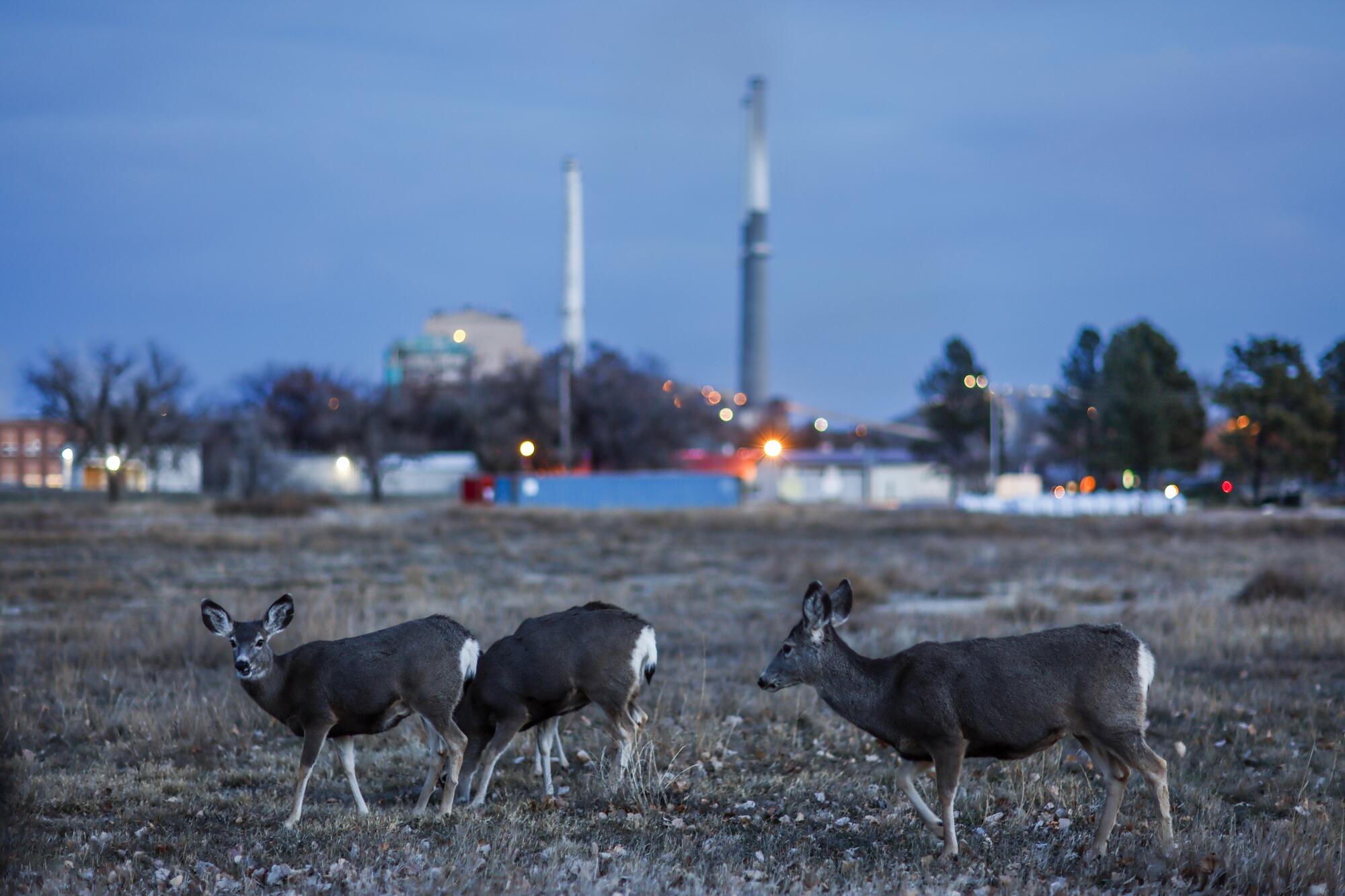
Mule deer roam through the town of Colstrip, not far from the power plant.
(Robert Gauthier / Los Angeles Times)
What do big cities owe those towns and tribes for producing our power and living with our air and water pollution? Can we get climate change under control without putting them out of business? What’s their role in the clean energy transition?
If they refuse to join the transition, how should we respond?
A team of Los Angeles Times journalists spent a week in Montana trying to answer those questions.
We explored the town of Colstrip, hearing from residents about how the coal plant and mine have made their prosperous lives possible. We talked with environmental activists who detailed the damage coal has caused, and with a fourth-generation rancher whose father fought in vain to stop the power plant from getting built — and wrote poems about his struggle.
Coal is going to die, sooner or later. For the sake of myself and other young people, I hope it’s sooner.
And for the sake of places like Colstrip, I hope it’s the beginning of a new chapter, not the end of the story.

Coal pays the bills. For now
For a community of 2,000 people, Colstrip doesn’t lack for nice things.
The city is home to 32 public parks and a gorgeous community center, complete with child care, gym, spin classes, tanning booth and water slide. The spacious health clinic employs three nurses and two physical therapists, with a doctor coming to visit once a week. There’s an artificial lake filled with Yellowstone River water and circled by a three-mile walking and biking trail.
Everybody knows where the good fortune comes from.
The high school pays homage to the source of Colstrip’s wealth with the hashtag #MTCOAL emblazoned on the basketball court’s sparkling floor. A sign over the entrance to campus celebrates the town’s 2023 centennial: “100 Years of Colstrip. Powered by Coal, Strengthened by People.”
“We have nothing to hide,” Jim Atchison tells me. “We just hope that you give us a fair shake.”
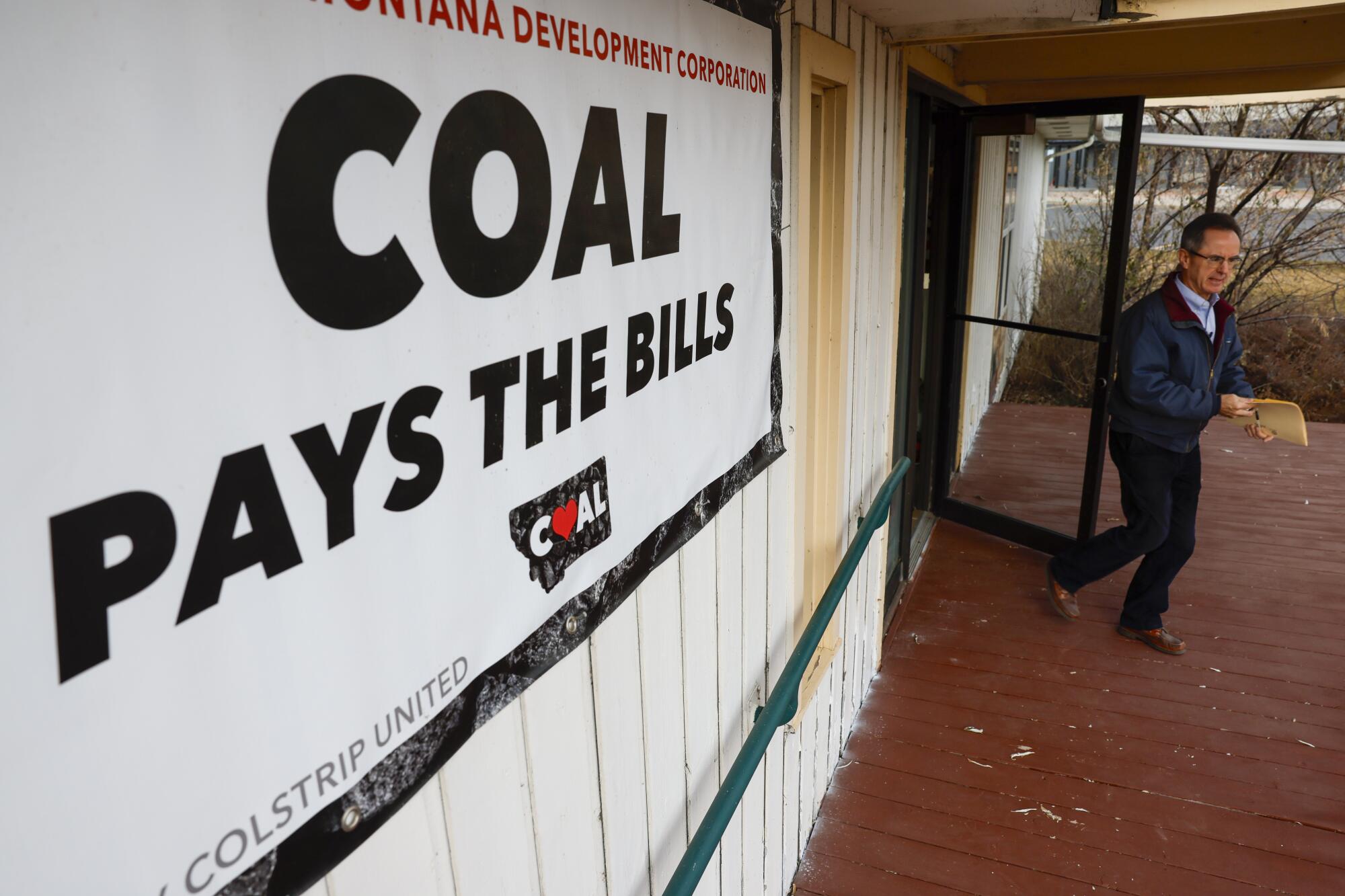
Jim Atchison steps out of his office in Colstrip.
(Robert Gauthier / Los Angeles Times)
I couldn’t have asked for a better tour guide than Atchison, who for 22 years has lived in Colstrip and led the Southeast Montana Economic Development Corp. He’s soft-spoken and meticulous, with a detailed itinerary for our day and a less ironclad allegiance to coal than many of the locals we’ll meet.
They include Bill Neumiller, a former environmental engineer at the power plant. We start our day with him, watching the sun rise over the smokestacks across the lake. He moved to Colstrip 40 years ago, when the coal plant was being built. He enjoys fishing in the well-stocked lake and teaching kids about its history, in his role as president of the parks district.
The plant, he says, pays the vast majority of the city’s property taxes.
“It’s been a great place to raise a family,” he says.
So many people have similar stories — the general manager of a local electrical contractor, the administrator of the health clinic. I especially enjoy chatting with Amber and Gary Ramsey, who have run a Subway sandwich shop here for 30 years.
“It takes us two to three hours to get through the grocery store, because you know everybody,” Gary says.
He didn’t plan to spend his life here. Sitting at a table at Subway, he tells us he grew up in South Dakota and went to college in North Dakota before taking a job teaching math and coaching wrestling in Colstrip. He planned to stay for a year or two.
Then he met Amber, who was working part time as a bartender and doing payroll at the coal plant.
“Forty years later, I’m still here,” he says. “We raised our kids here.”
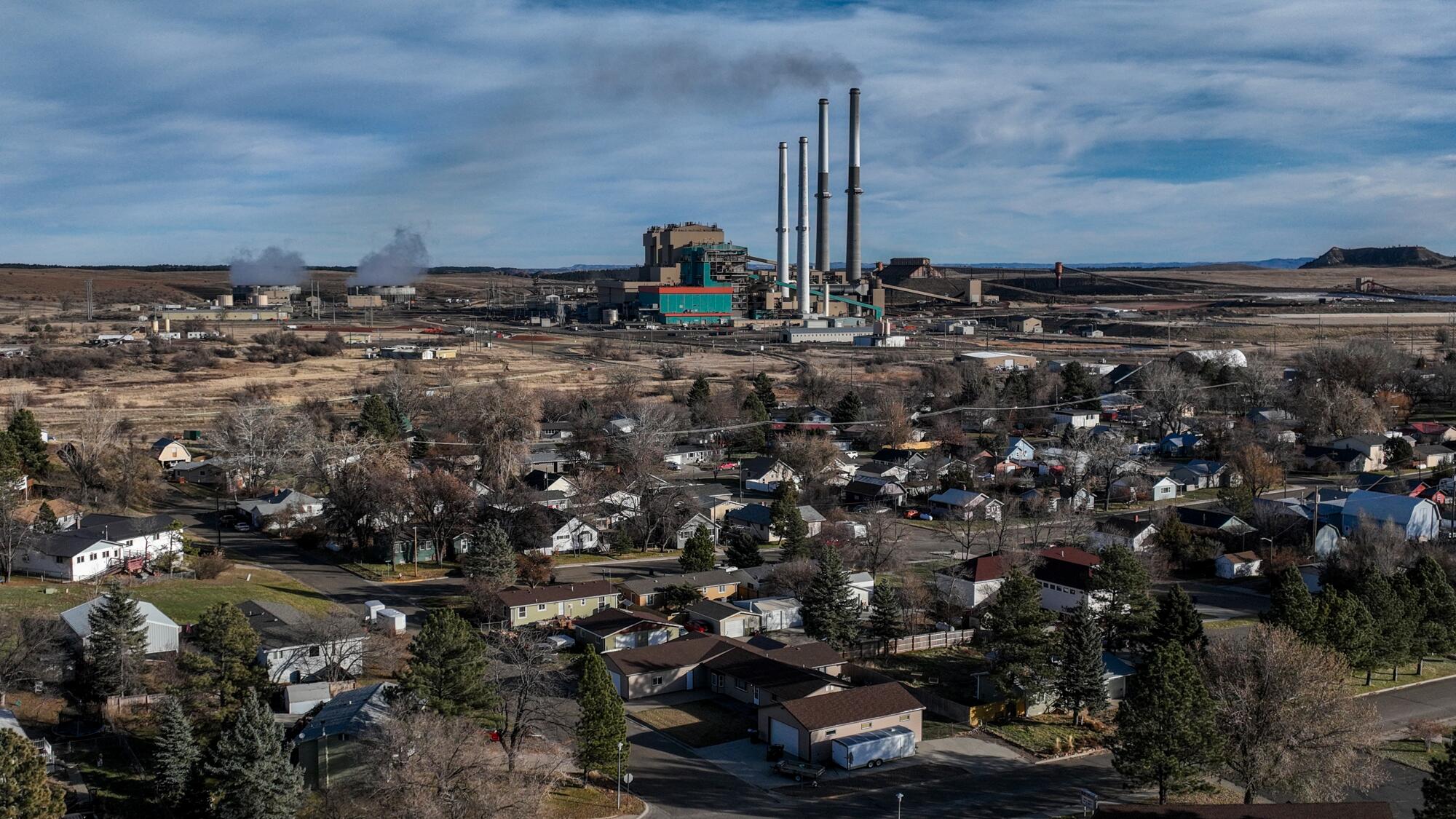
The power plant’s smokestacks are visible from miles away in the town of Colstrip.
(Robert Gauthier / Los Angeles Times)
John Williams was one of the first Montana Power Co. employees to move to Colstrip, as planning for the plant’s construction got started. Today he’s the mayor. He’s well-versed in local history, from the first coal mining in the 1920s — which supplied railroads that later switched to diesel — to the economic revitalization when the Portland and Seattle areas came calling.
Unlike many of the other Colstrip lifers who share their stories, several of Williams’ kids have left town. But one of his sons lives in a part of Washington where some of the electricity comes from Colstrip. Same for another son who lives in Idaho.
It’s hard for Williams to imagine a viable future for his home without the power plant.
“I believe they are intimately tied together,” he says.
And what about climate change, I ask?
Nearly everyone in Colstrip has a version of the same answer: Even if it’s real, it’s not nearly as bad as liberals claim. And without coal power, blackouts will reign. West Coast city dwellers don’t understand how badly they need us here in Montana.
Atchison is an exception.
Yes, he’s dubious about climate science. And yes, he wants to save the mine and power plant. His office is plastered with pro-coal messages — a sign that says, “Coal Pays the Bills,” a magnet reading, “Prove you’re against coal mining: Turn off your electricity.”
But he knows the market for coal is shrinking as the nation’s most populous cities and most profitable companies increasingly demand climate-friendly energy. So he’s preparing for a future in which Colstrip has no choice but to start providing it.
“We have one horse in the barn now,” Atchison says. “We need to add two or three more horses to the barn.”
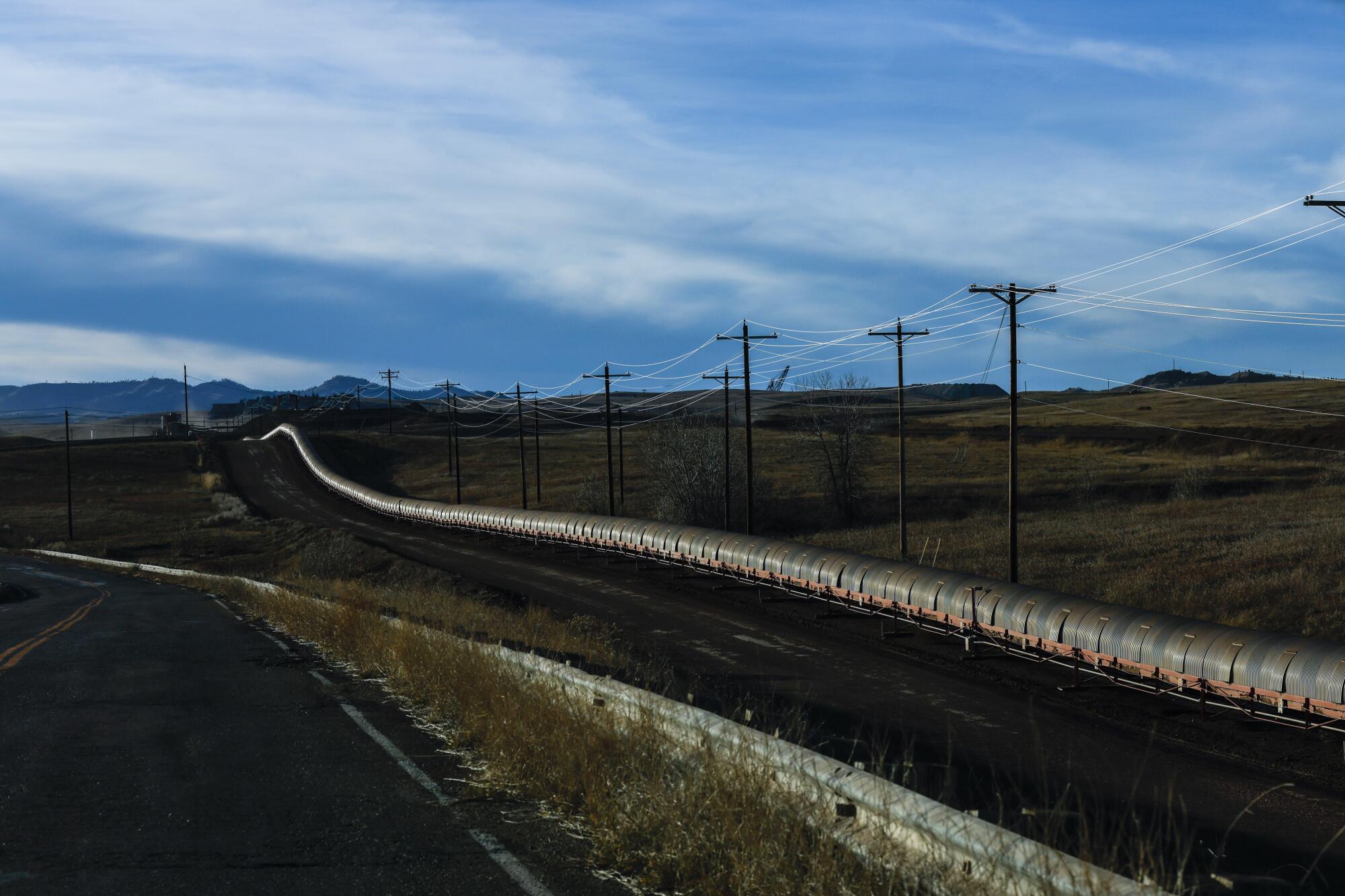
A conveyor belts carries coal from the Rosebud Mine to the Colstrip power plant.
(Robert Gauthier / Los Angeles Times)
Ever since President Obama started trying to tighten regulations on coal power, Atchison has been developing and implementing an economic diversification strategy for Colstrip. It involves expanding broadband capacity, building a business innovation center and broadening the local energy economy beyond coal. The transmission lines connecting Colstrip with the Pacific Northwest are an especially valuable asset, capable of sending huge amounts of clean electricity to the Pacific coast.
“Colstrip is evolving from a coal community into an energy community,” Atchison says. “We’re changing. We’re not closing.”
Already, Montana’s biggest wind farm is shipping electricity west via the Colstrip lines. A Houston company is planning another power line that would run from Colstrip to North Dakota. Federal researchers are studying whether Colstrip’s coal units could be replaced with advanced nuclear reactors, or with a gas-fired power plant capable of capturing and storing its climate pollution.
West Coast voters and politicians could speed up the evolution, for Colstrip and other coal towns. Instead of just congratulating themselves for getting out of coal, they could fund training programs and invest in clean energy projects in those towns.
They’ll never fully replace the ample jobs, salaries and tax revenues currently provided by coal. But nothing lasts forever. One hundred years is a pretty good run.
Some inconvenient truths
“Great God, how we’re doin’! We’re rolling in dough,
As they tear and they ravage The Earth.
And nobody knows…or nobody cares…
About things of intrinsic worth.”
—Wally McRae, “Things of Intrinsic Worth” (1989)
Growing up outside Colstrip in the 1970s could lead to strange moments for Clint McRae, the son of a cowboy poet.
He was a teenager then, and Montana Power Co. was working to build public support for Units 3 and 4 of the coal plant. One day his eighth-grade teacher instructed everyone who supported the new coal-fired generators to stand on one side of the classroom. Everyone opposed should stand on the other side.
McRae was the only student opposed.
“And then [the teacher] gave a lecture about how important the construction of these plants was and handed out bumper stickers that said, ‘Support Colstrip Units 3 and 4,’” McRae tells me, shaking his head. “It was terribly uncomfortable.”
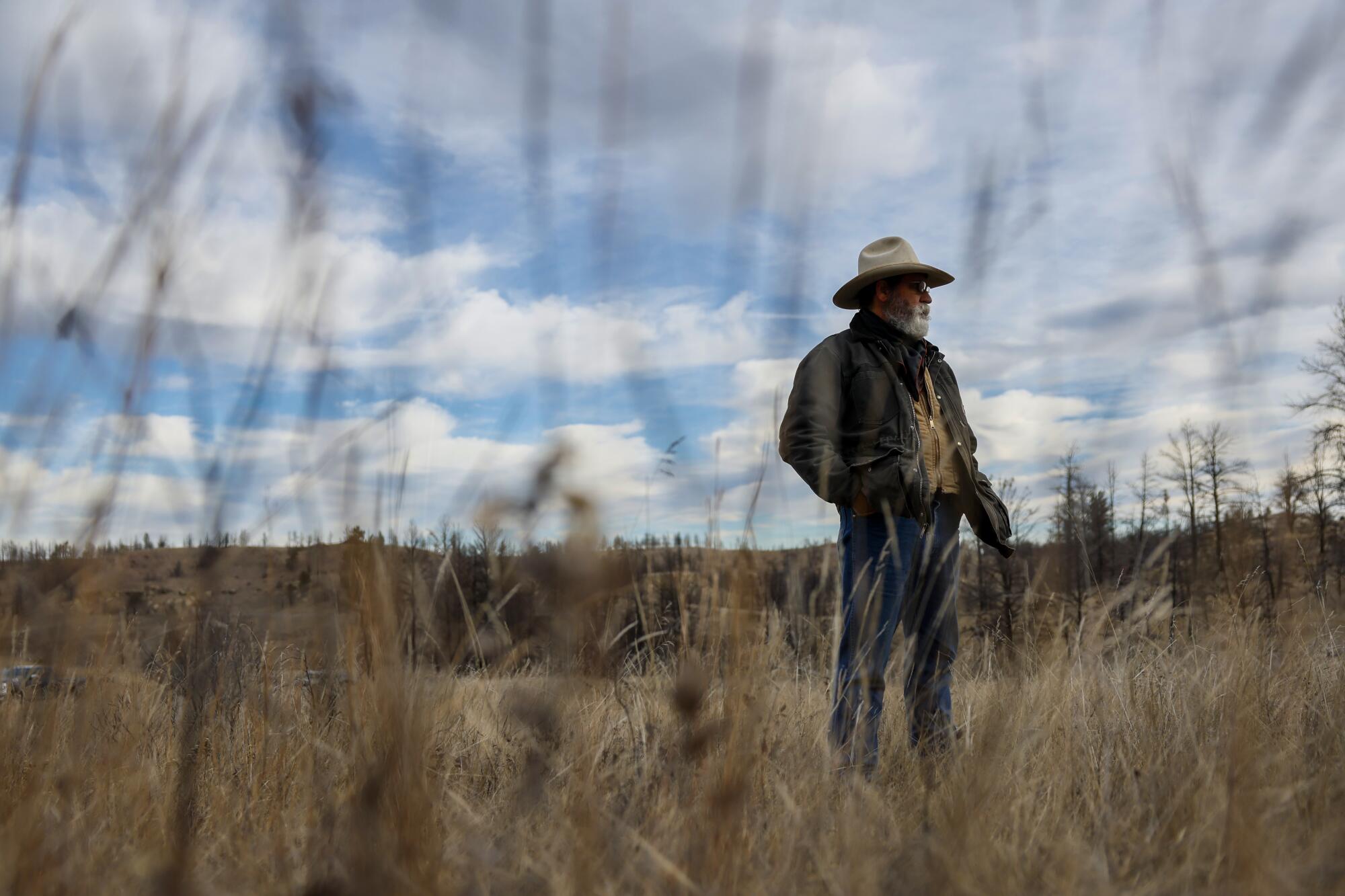
Rancher Clint McRae was raised outside Colstrip and has followed in his father’s footsteps.
(Robert Gauthier / Los Angeles Times)
Later, his mom was doing laundry and found a pro-coal bumper sticker in his pants pocket. She showed it to his cattle rancher father, Wally, “and I guess he went over there [to the school] and kicked ass and took names,” McRae says with a laugh.
Fifty years later, he’s carrying on his dad’s legacy.
We spend a morning in the Colstrip area on McRae’s sprawling ranch, admiring sandstone rock formations and herds of black Angus cows. The scenery is harsh but elegant, rolling hills and pale green grasses and pink-streaked horizon lines.
“This country has a sharp edge to it,” McRae says, quoting a photographer who visited the property years ago.
The land has been in his family since the 1880s, when his great-grandfather emigrated from Scotland. He hopes his youngest daughter — who recently moved back home with her husband — will be the fifth generation to raise cattle here.
“And we just had a grandchild seven months ago, and she’s the sixth,” he says.
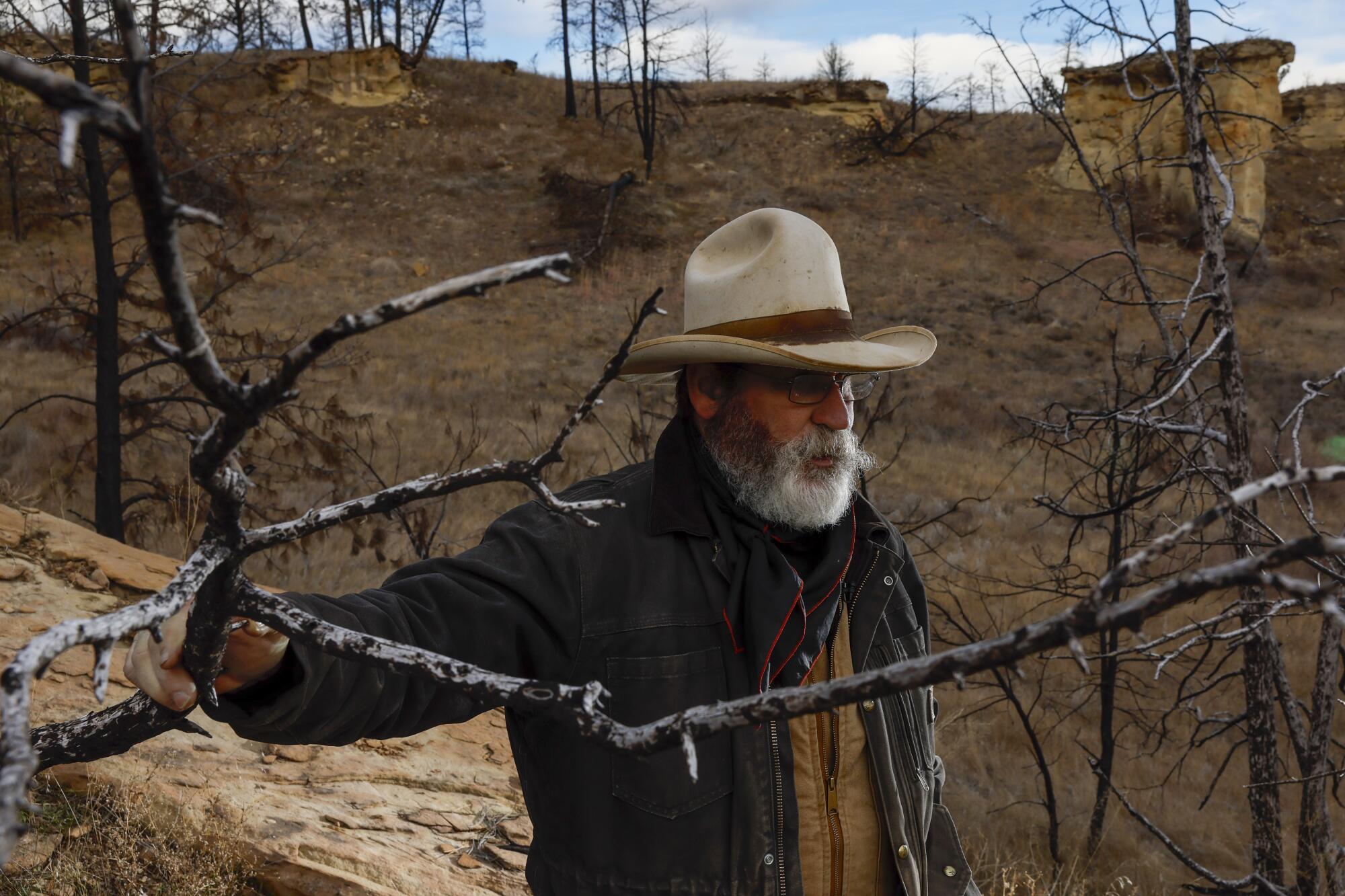
Rancher Clint McRae contemplates the environmental threats facing his family’s land.
(Robert Gauthier / Los Angeles Times)
McRae wears a cowboy hat and drives a pickup truck. He tells me right away that he’s “not the kind of person who participates in government programs unless I absolutely have to.” He’s certainly got no qualms about making a living selling beef.
But McRae and his forebears defy stereotypes.
His father, Wally, not only raised cows but was also a celebrated poet, appointed by President Clinton to the National Council on the Arts. In the 1970s, he joined with other ranchers to help found Northern Plains Resource Council, an advocacy group. They were moved to act by a utility industry plan for nearly two dozen coal plants between Colstrip and Gillette, Wyo.
“I and others like me will not allow our land to be destroyed merely because it is convenient for the coal company to tear it up,” Wally McRae said, as quoted in a 50th-anniversary book published by Northern Plains.
Now in his late 80s and retired from the ranch, Wally’s got every reason to be proud of his son.
Clint has fought to limit pollution from the coal plant his dad couldn’t stop — and to ensure the cleanup of dangerous chemicals already emitted by the plant and mine. He’s written articles calling for stronger regulation of coal waste, and slamming laws that critics say would let coal companies pollute water with impunity. Like his father, he’s a member of Northern Plains.
McRae wants me to know that even though he and his dad “damn sure have a difference of opinion” with many of the people who live in town, “it was never personal.” The coal plant employees are friends of his. He doesn’t want them to lose their jobs.
“Our kids went to school together, played sports together,” he says.
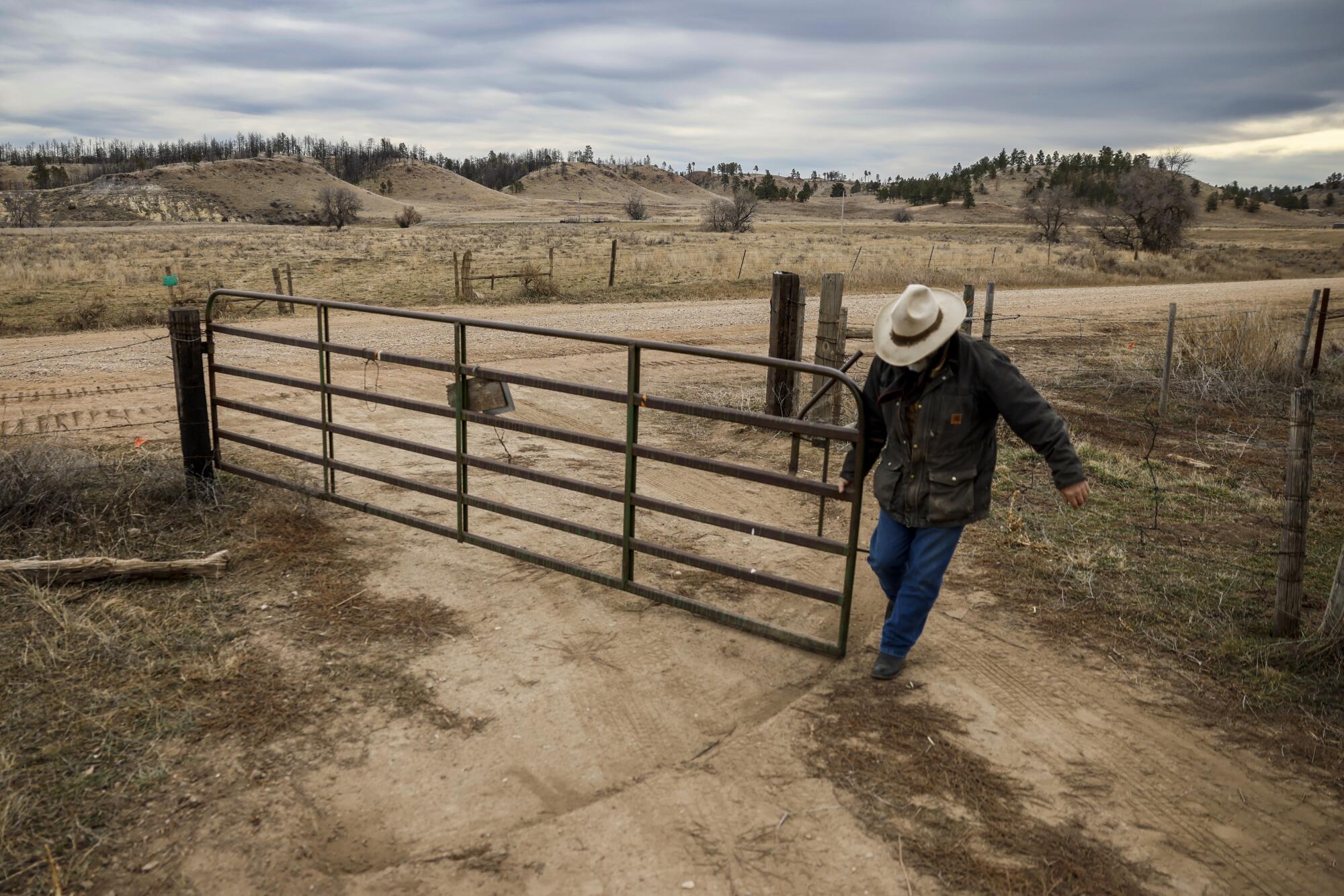
Rancher Clint McRae opens a gate on his family’s land outside Colstrip.
(Robert Gauthier / Los Angeles Times)
But even though McRae believes “we can have it both ways” — coal generation coupled with environmental protection — he’s not optimistic. And history suggests he’s right to be skeptical. Various analyses have found rampant groundwater contamination from coal plants, including Colstrip. Air pollution is another deadly concern. A peer-reviewed study last year estimated that fine-particle emissions from coal plants killed 460,000 Americans between 1999 and 2020.
Then there’s the climate crisis.
McRae doesn’t want to talk about global warming — “that’s not my bag,” he says. But he’s seen firsthand what it can look like.
In August 2021, the Richard Spring fire tore across 171,000 acres, devastating much of his ranch and nearly torching both of his family’s houses. He was on the front lines of the fast-moving blaze as part of the local volunteer firefighting crew. Temperatures topped 100 degrees, adding to the strain of dry conditions and fierce winds. McRae had never seen anything like it.
Two and a half years later, he’s still building back up his cattle numbers and letting the grass regrow.
“It burned all of our hay. It was awful,” he says.
McRae has a strong sense of history. As we drive toward the Tongue River, which forms a boundary of his ranch, he points out where members of the Arapaho, Lakota Sioux and Northern Cheyenne tribes camped before the Battle of the Little Bighorn in 1876, a few years ahead of his great-grandfather’s arrival in Montana. A few minutes later he stops to show off a series of tipi rings — artifacts of Indigenous life that he’s promised local tribes he’ll protect.
McRae is acutely aware that this wasn’t always ranchland — and that it probably won’t be forever.
“It’s gonna change,” he says. “Whether we embrace it or not.”
The wind and the water
Sturgeon. Bubbles. Salamander. Jimmy Neutron.
Those are “call signs” for some of the 13 employees at the Clearwater wind farm, where 131 turbines are spread across 94 square miles of Montana ranchland a few hours north of Colstrip. The nicknames are scrawled on a whiteboard in the trailer office.
Raptor. Goose. Sandman.
Clearly, they have fun here. And it’s an industry where you can make good money.
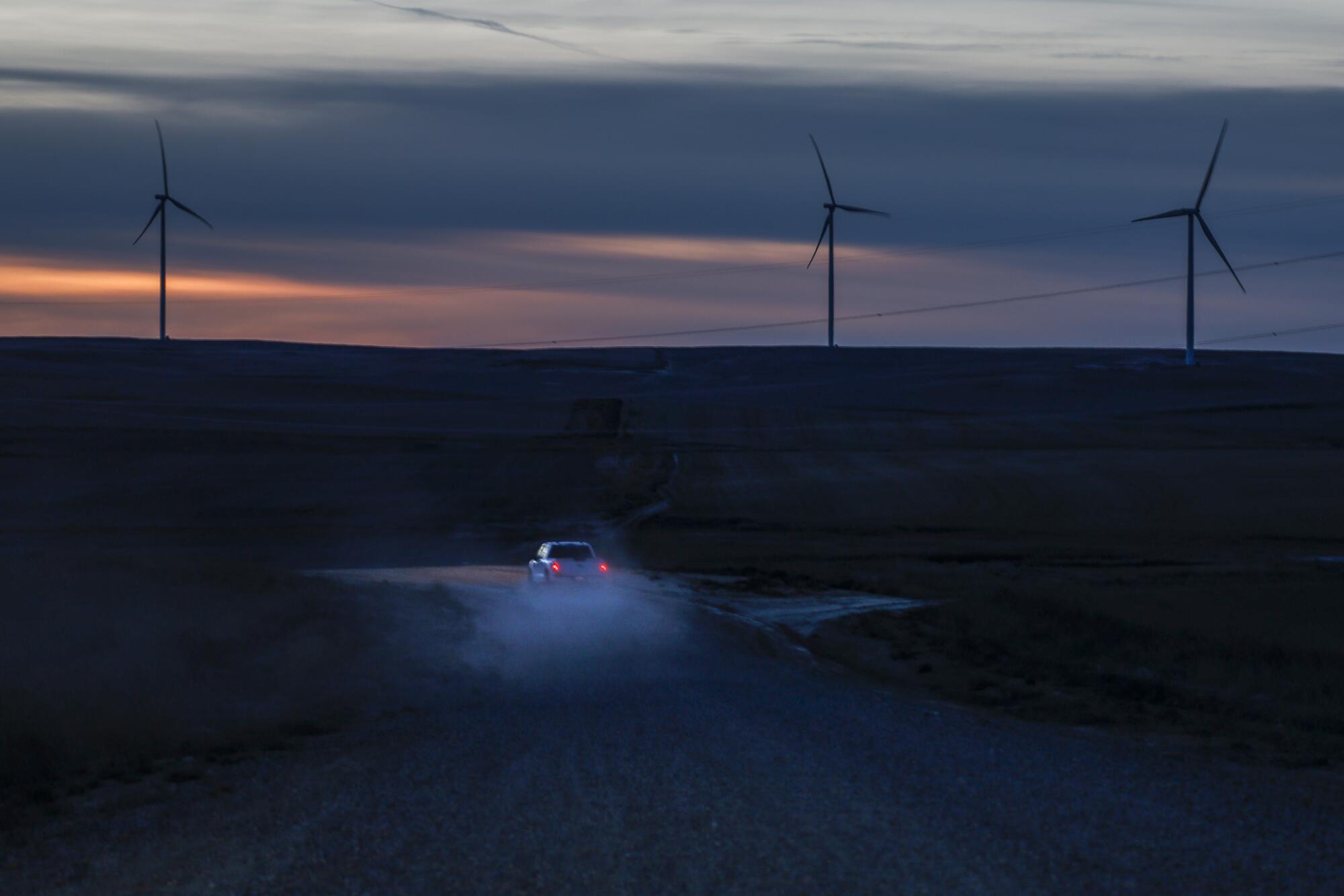
Turbines spin at sundown at NextEra Energy’s Clearwater wind farm, which sends power from Montana to Oregon and Washington.
(Robert Gauthier / Los Angeles Times)
Clearwater’s operator, Florida-based NextEra Energy, won’t disclose a salary range. But as of 2022, the median annual wage for a U.S. wind turbine technician working in electric power was $59,890, compared with $46,310 for all occupations nationally.
“If someone wants to stay close to home and still have a good career, we provide them that opportunity,” Alex Vineyard says.
Vineyard lives in nearby Miles City and manages Clearwater for NextEra, America’s largest renewable energy company. Clad in a hard hat, sweater vest and orange work gloves, he drives to a nearby turbine and walks up a staircase to show us the machinery inside. The tower is 374 feet high, meaning the tips of the blades reach 582 feet into the air.
Not far from here, hundreds of construction laborers are finishing the next two phases of the Clearwater project.
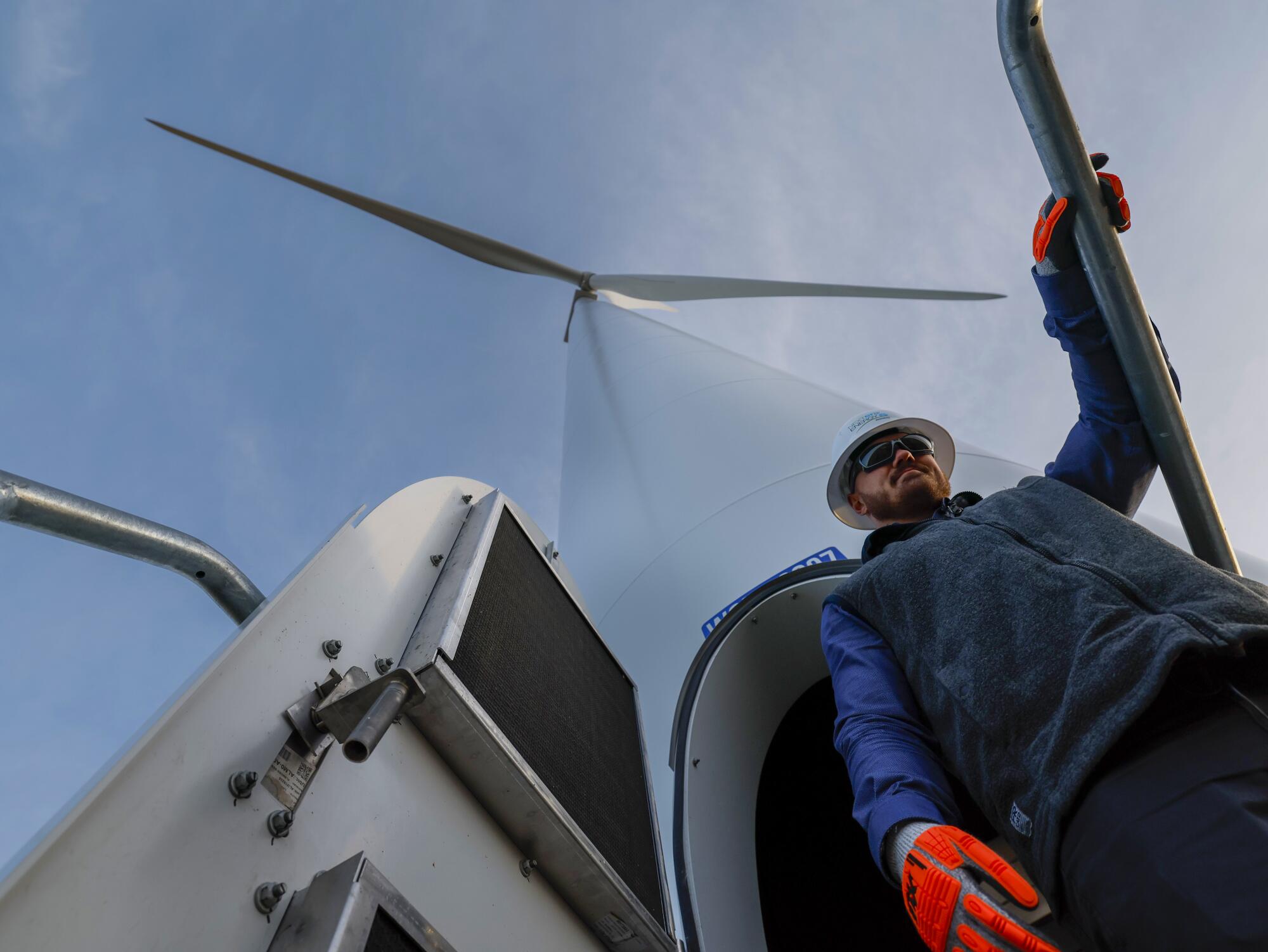
Alex Vineyard manages the Clearwater wind farm for NextEra, America’s largest renewable energy company.
(Robert Gauthier / Los Angeles Times)
“You can see where we build wind sites. It’s not downtown L.A.,” Vineyard says, the sunset casting a brilliant orange glow behind him. “Generally it’s rural areas — and there are limited opportunities for kids in those areas. Not a lot of great careers.”
Wind will never replace coal. The construction jobs are temporary, the permanent jobs far fewer.
But they’re better than nothing. A lot better.
As much as West Coast megacities owe it to coal towns like Colstrip to bring them along for the clean energy ride, coal towns like Colstrip owe it to themselves to take what they can get — and not let stubbornness or politics condemn them to oblivion.
Fortunately, they’ve got the power grid on their side.
In today’s highly regulated, thoroughly litigated world, long-distance power lines are incredibly hard to build. They can take years if not decades to secure all the necessary approvals — if they can get those approvals at all. As a result, wind and solar developers prize existing transmission lines, like those built to carry power from Colstrip and other coal plants to big cities.
The Clearwater wind farm offers a telling case study.
Two of Colstrip’s four coal units shut down in 2020 due to poor economics, opening up precious space on the plant’s power lines. That open space made it easier for NextEra to sign contracts to sell hundreds of megawatts of wind power to two of Colstrip’s co-owners, Portland General Electric and Puget Sound Energy — and thus get Clearwater built.
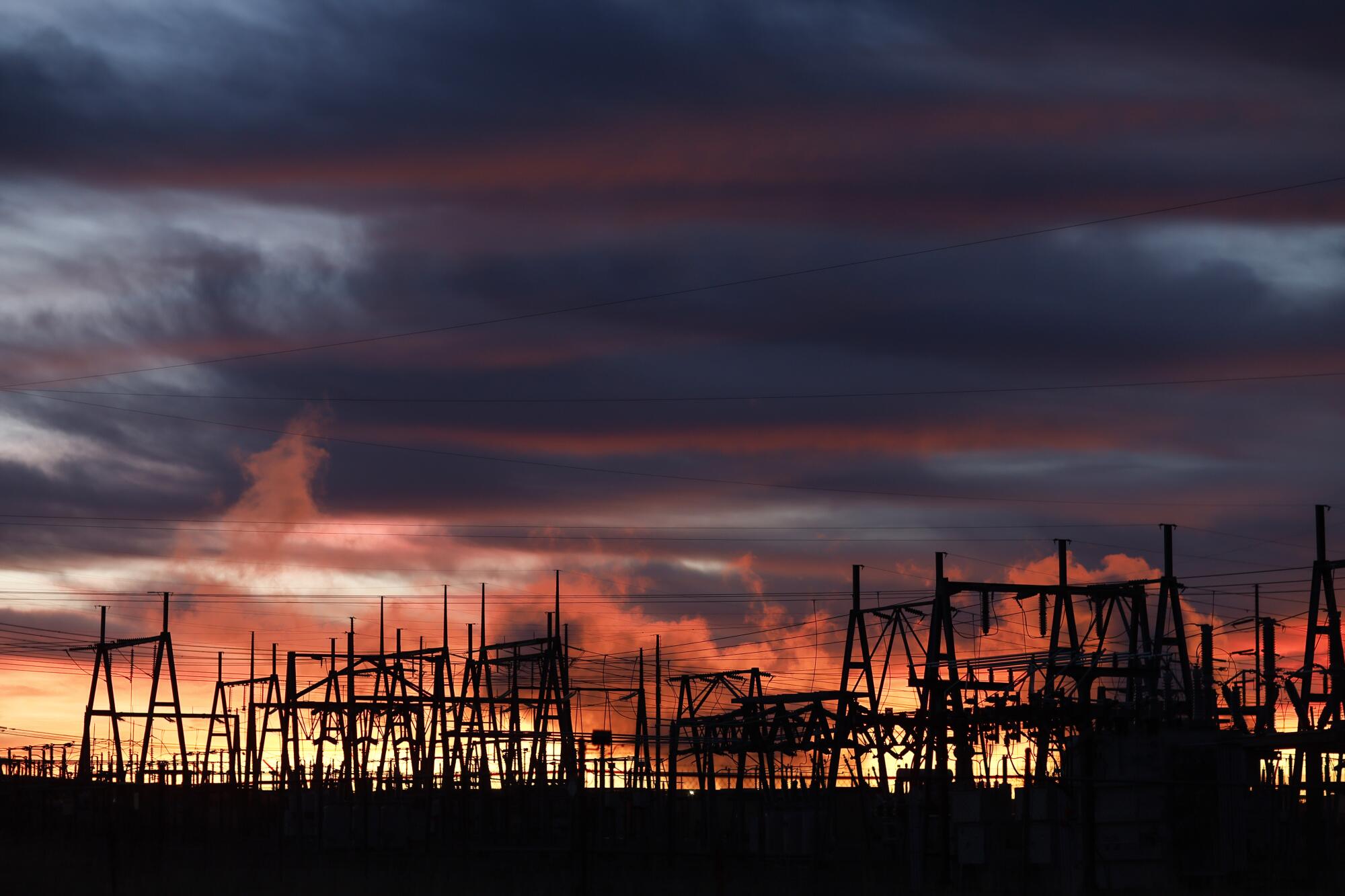
An electrical substation flanks the Colstrip power plant.
(Robert Gauthier / Los Angeles Times)
Montana wind is especially useful for Oregon and Washington because it blows strongest during winter, when those states need lots of energy to stay warm. On that front, Clearwater has been a huge success. During its first winter, it had a capacity factor of 60%, meaning it produced 60% of all the power it could possibly produce, if there were enough wind 24/7.
Sixty percent is a lot — “like a home run,” Puget Sound Energy executive Ron Roberts says.
He and his colleagues want more. Puget Sound plans to build more Montana wind turbines to serve its Washington customers — again taking advantage of the Colstrip power lines.
West Coast states need to keep investing in exactly this type of project if they hope to persuade their conservative neighbors to stop fighting to save coal. The more they can bring the benefits of wind and solar power to the rest of the West, the better.
And what about those low-wind, cloudy days when wind turbines and solar panels aren’t enough to avoid blackouts?
Carl Borgquist has a plan for that.
I meet up with him near Gordon Butte — a flat-topped landmass that juts up 1,025 feet from the floor of Montana’s Musselshell River valley, four hours west of Colstrip but just over five miles from the coal plant’s power lines. There are already wind turbines atop the butte, built by the landowning Galt family with Borgquist’s help.
Borgquist assures me as we drive to the top that I’ll soon understand why this steep butte is perfect for energy storage.
“It will intuitively make sense, the elegance and simplicity of gravity as a storage medium,” he says.
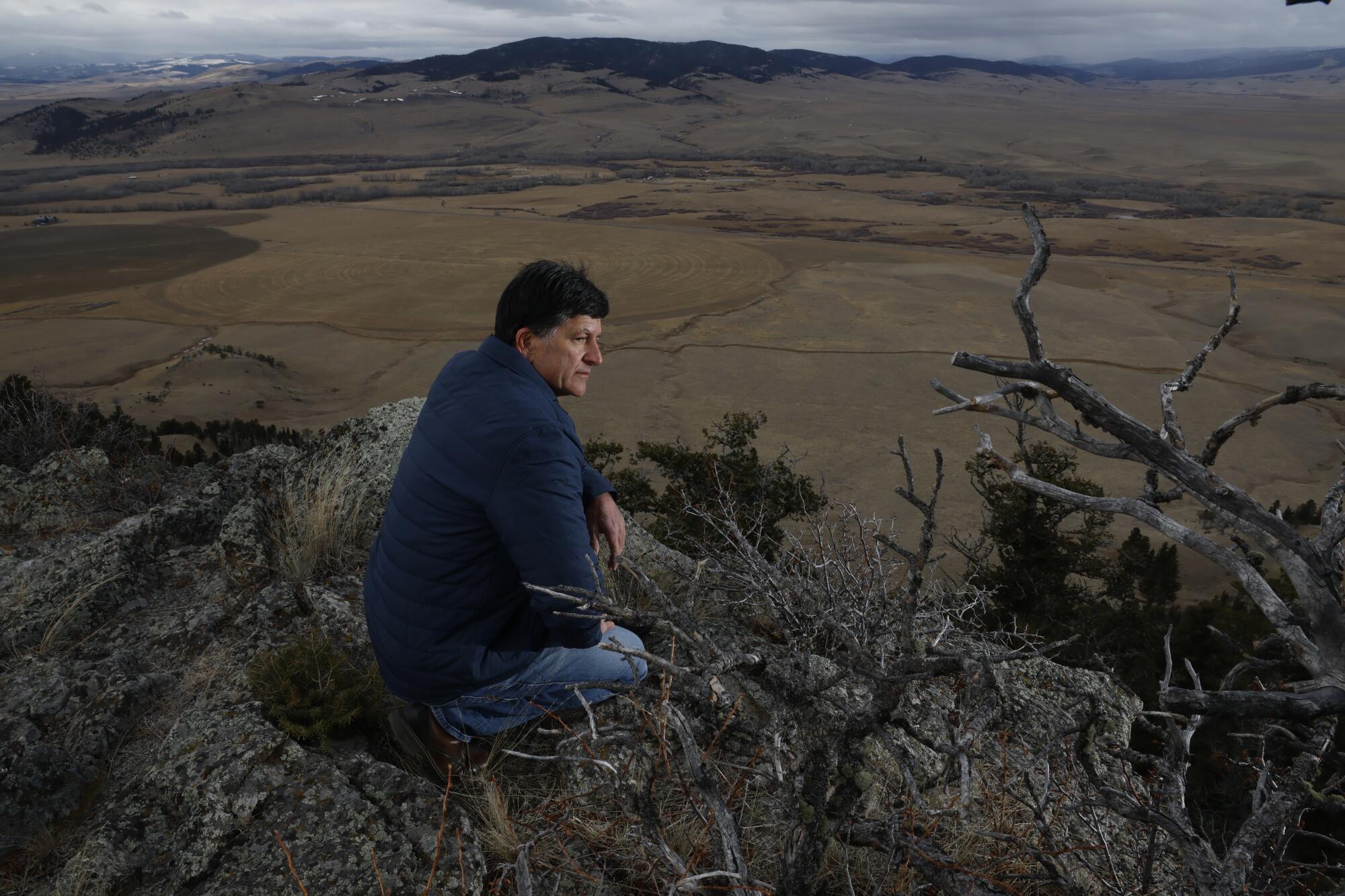
Carl Borgquist admires the views from atop Gordon Butte, where he’s got plans for a pumped storage project to augment Montana wind power.
(Robert Gauthier / Los Angeles Times)
There will be two reservoirs — one up on the butte, another 1,000 feet below. They’ll be filled with water from a nearby creek.
During times of day when there’s extra power on the Western electric grid — maybe temperatures are moderate in Portland and Seattle, but Montana winds are blowing strong — the Gordon Butte project will use that extra juice to pump water uphill, from the lower reservoir to the upper reservoir. During times of day when the grid needs more power — maybe there’s a record heat wave, and not enough wind to go around — Gordon Butte will let water flow downhill, generating electricity.
It’s called pumped storage, and it’s not a new concept. But compared with other proposals across the parched West, this one is almost miraculously noncontroversial. No environmentalists making hay over water use. No nearby residents crying foul.
Borgquist still needs to sign up a utility customer, or he would have already flipped Gordon Butte to a developer better suited to build the $1.5-billion project, which will employ 300 to 500 people during construction. But Borgquist is confident that before too long, one or two of the Pacific Northwest electric utilities preparing to ditch Colstrip will see the light.
“I’ve been waiting for the market to catch up to me,” he says.
Let’s hope it catches up soon. Because even though pumped storage won’t keep us heated and cooled and well-lit every hour of every day, neither will wind, or solar, or batteries, or anything else. No one technology will solve all our climate problems.
The sooner we learn that lesson, the sooner we can move on to the hard part.
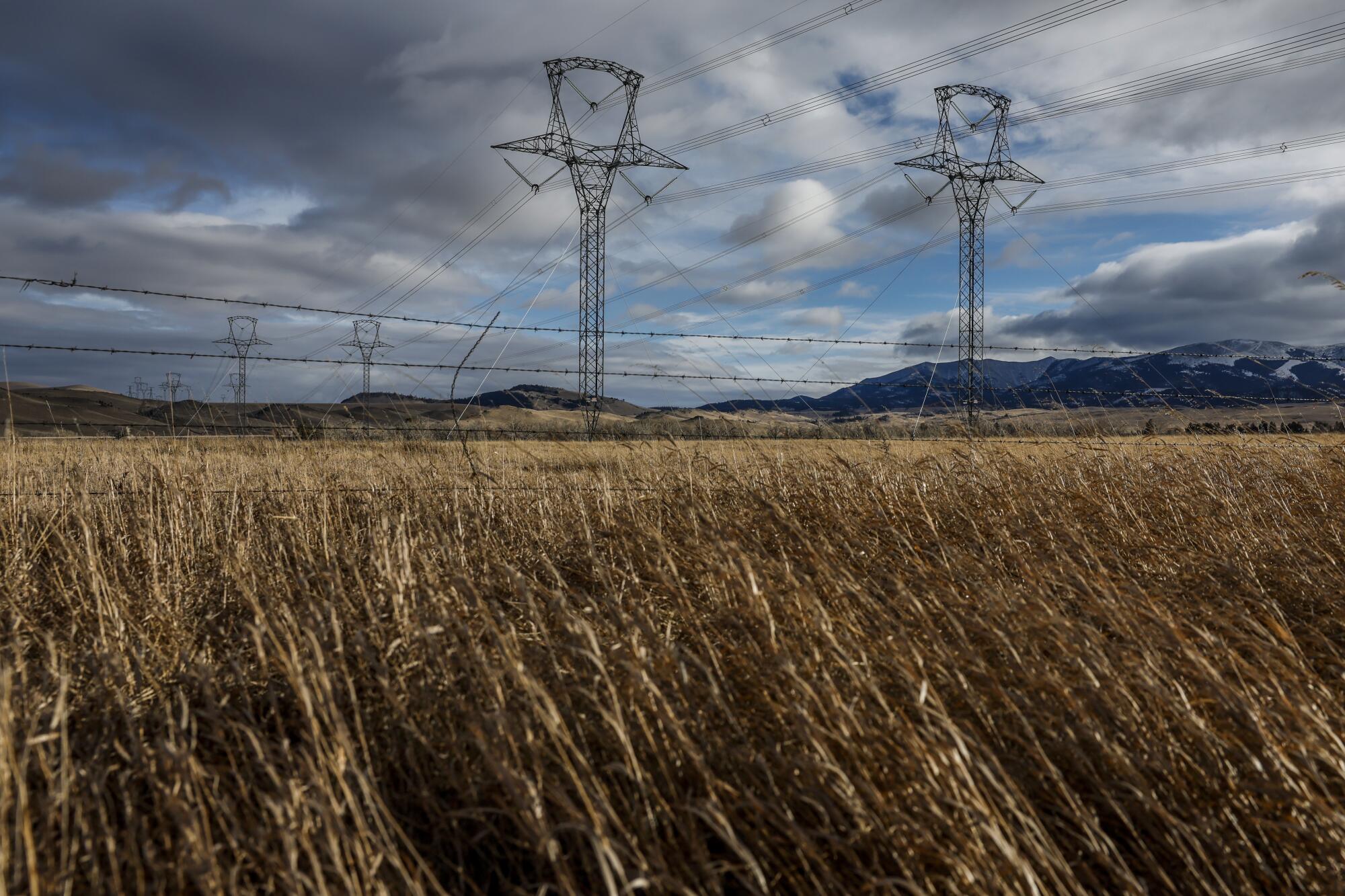
The Colstrip power lines run near Gordon Butte, carrying coal-fired electricity — and increasingly wind energy — from Montana to Oregon and Washington.
(Robert Gauthier / Los Angeles Times)
The art of the deal
I find myself wandering the halls of the state Capitol in Helena. Christmas is a few weeks away, and there’s a spectacular tree beneath the massive dome, flanked by murals of white settlers and Indigenous Americans.
On a whim, I step into Gov. Greg Gianforte’s office and ask if he’s in. Gianforte has fought to keep the Colstrip plant open, and I want to ask him about it. I’m also curious to meet a man who easily won election despite having assaulted a journalist.
One of his representatives takes down my contact info. I never get an interview.
Despite the state’s deep-red turn in recent years, Montanans have a history of environmental consciousness, owing to their love of fishing, hunting and the great outdoors (as seen in the film “A River Runs Through It”). They approved a new state constitution in 1972 that enshrined the right to a “clean and healthful environment in Montana for present and future generations.”
To the frustration of Gianforte and his supporters, that right may include a stable climate.
This time last year, a Montana judge revoked the permit for a gas-fired power plant being built by the state’s largest electric utility, NorthWestern Energy, along the banks of the Yellowstone River. The judge ruled that the state agency charged with approving the gas plant had failed to consider how the facility’s heat-trapping carbon emissions would contribute to the climate crisis.
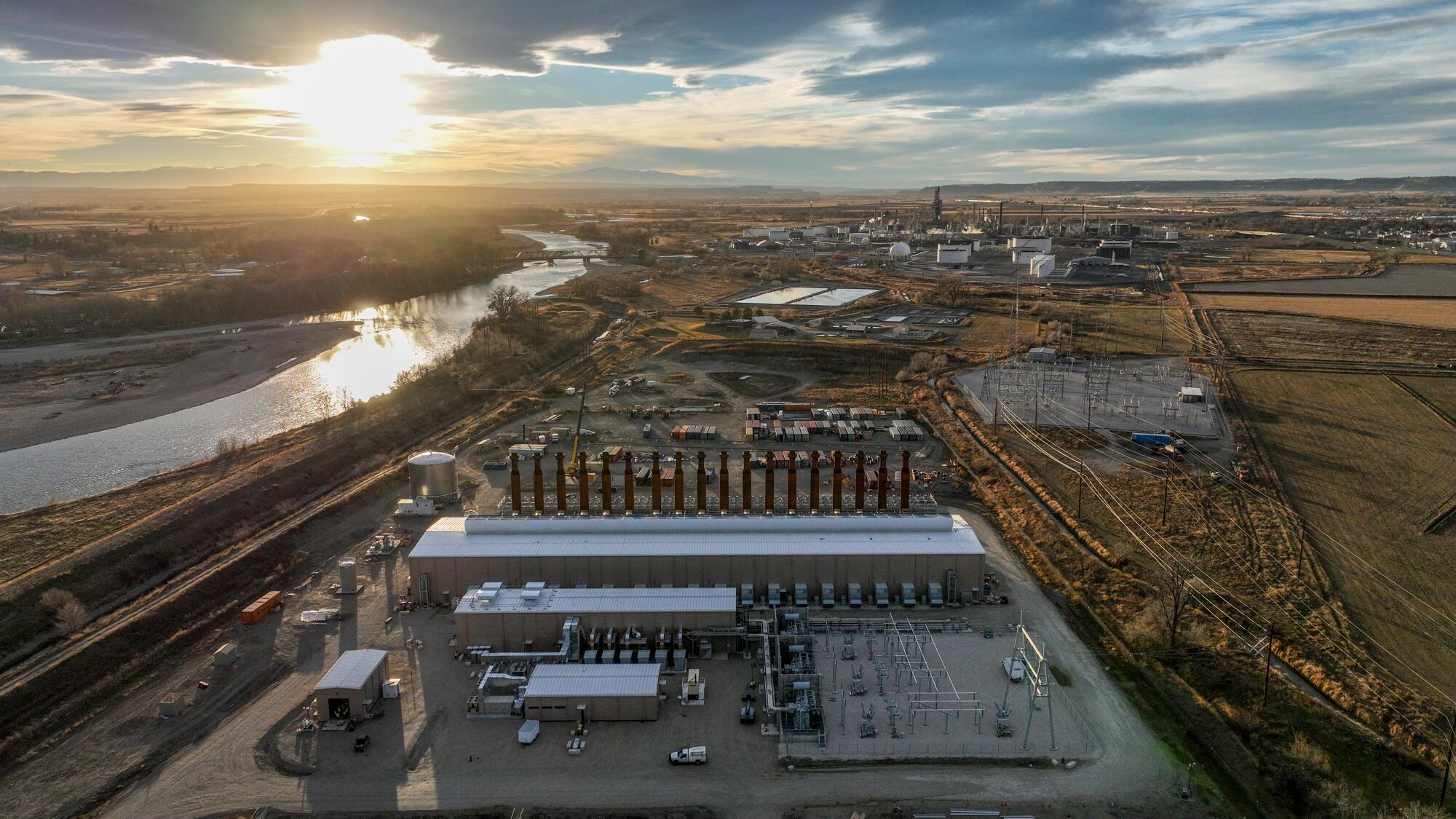
NorthWestern Energy says this gas-fired power plant on the Yellowstone River is needed to help keep the lights on for homes and businesses.
(Robert Gauthier / Los Angeles Times)
Legislators responded by rushing to pass a law that barred state agencies from considering climate impacts.
The Yellowstone River gas plant moved forward, but the law didn’t last long. A few months after it passed, another judge ruled in favor of 16 young people suing the state over global warming, agreeing that the legislation violated their constitutional right to a clean and healthful environment.
“This is such a solvable problem,” says Hedges, the Montana environmentalist critical of coal mining. “It’s just that nobody wants to solve it.”
Hedges is a leader of the Montana Environmental Information Center, where she’s spent three decades battling for clean air, clean water and a healthy climate. It was her advocacy group, along with the Sierra Club, that sued Montana over the state’s approval of the Yellowstone River gas plant, setting off the chain of increasingly consequential court rulings.
But as mad as she is at Gianforte — and at the local utility company executives who insist they need coal to keep the lights on in Montana — Hedges is at her most caustic when discussing the Pacific Northwest environmentalists who, in her view, have failed to do everything they can to get the Colstrip power plant shut down.
That includes the Sierra Club, which, Hedges says, has shifted its focus too quickly from shutting down coal plants to blocking the construction of new gas plants — even in places such as Montana, where coal, the dirtiest fossil fuel, isn’t dead yet.
Hedges’ frustration also includes the Washington state lawmakers who passed a much-lauded bill, signed by Gov. Jay Inslee, requiring electric utilities to stop buying coal power by 2025 — only to sit idly by as some of those utilities then made arrangements to give away their shares in the Colstrip plant to coal-friendly co-owners rather than negotiate agreements to shut the coal units.
“So they’re not actually decreasing carbon dioxide emissions even a little tiny bit. They are allowing this plant to continue, instead of using their vote to close this source of pollution. It’s maddening,” Hedges says.
1
2
3
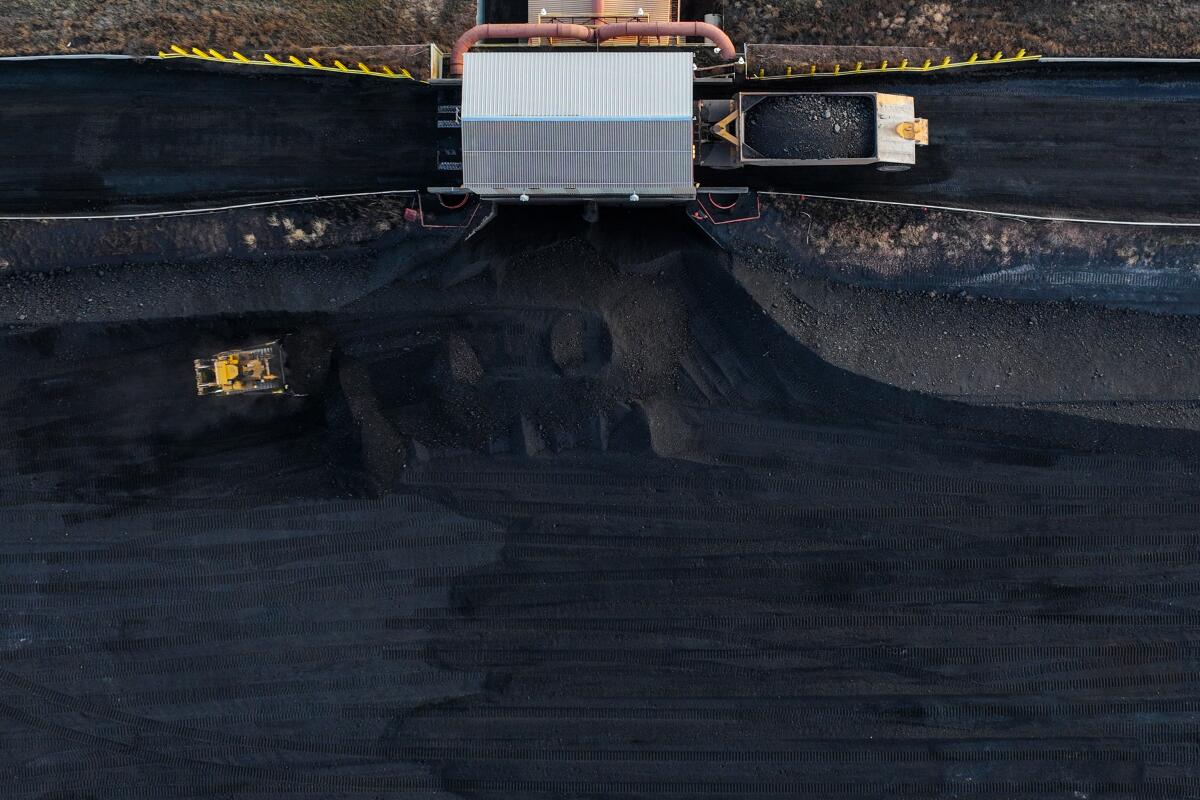
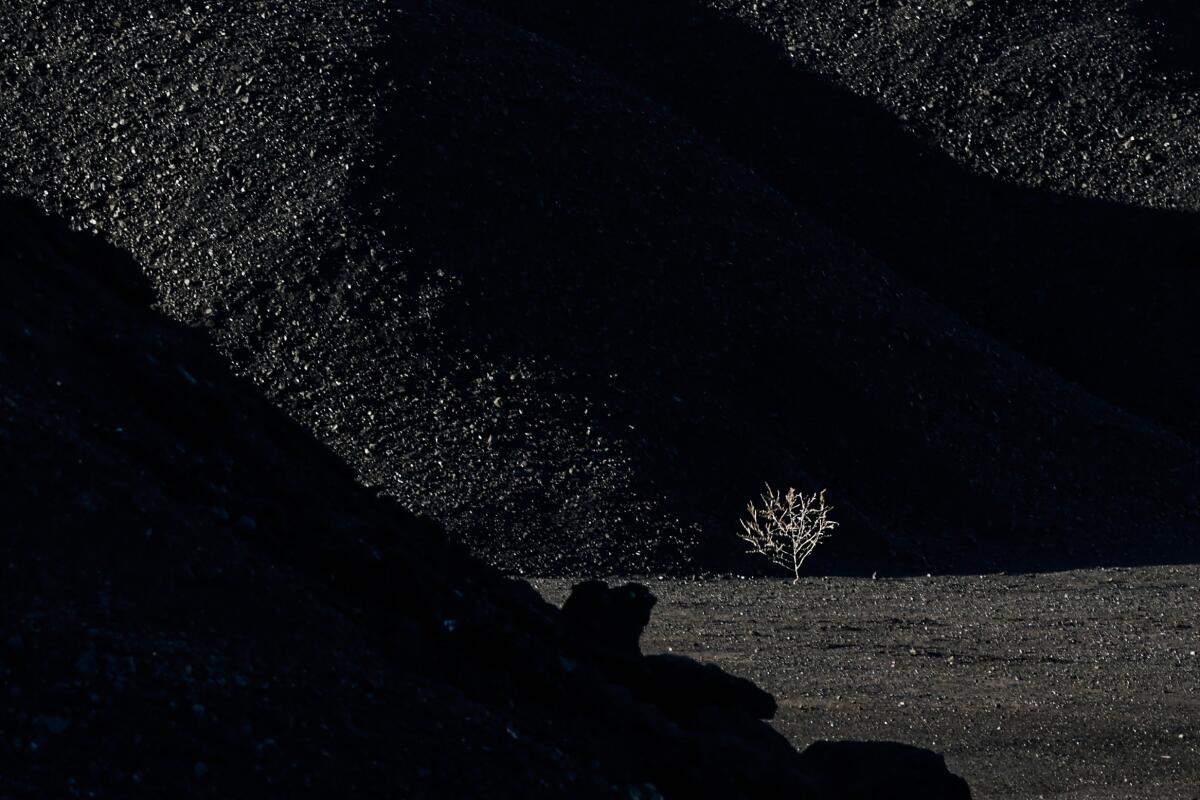
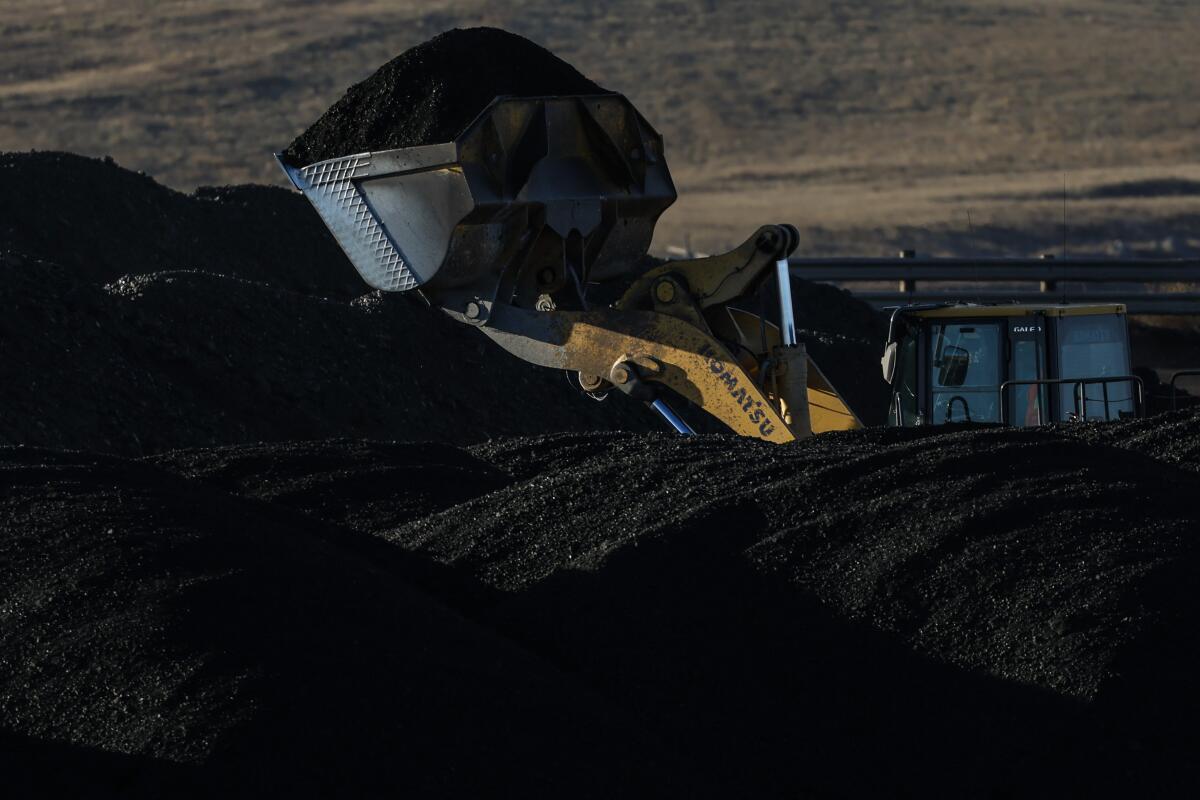
1. A lone tumbleweed blows through piles of coal at the Rosebud Mine outside Colstrip, a few miles from the power plant. 2. Coal is prepped for transport at the mine. 3. Coal is transferred to a truck at the mine. (Robert Gauthier / Los Angeles Times)
Washington officials say they tried to get Colstrip shut down but were stymied by the plant’s complicated six-company ownership structure, and by the Montana Legislature’s staunch support for coal. Sierra Club activists, meanwhile, say they’re still pushing for Colstrip’s closure, and for coal shutdowns across the country — even as they also oppose the construction of gas plants.
“From a climate perspective, gas is just as bad as coal,” says Laurie Williams, director of the Sierra Club’s Beyond Coal campaign.
To avoid a future of ever-more-dangerous fires, floods and heat, we need to ditch both fossil fuels — fast.
This is the hard part. This is the part that will require compromise — for conservatives who believe anything smacking of climate change is “woke” liberal propaganda, and for liberals who want nothing to do with conservatives spouting that belief.
So how do we do it? How do we stop clashing and start cooperating?
First off, West Coasters need to engage in good faith with the people who have supplied their power for decades — and strike deals that might persuade those red-staters to move on from coal. Deals like building more wind farms in Montana and not as many back home, even if that means fewer union jobs and lower tax revenues for California, Oregon and Washington.
It’s great that the coastal states are targeting 100% clean energy, but it’s not enough. They must bring the rest of the West along for the ride, or it won’t matter. Every solar farm in California is undermined by every ton of coal burned at Colstrip.
The lesson for folks who live in Colstrip and other Western coal towns might be even more difficult to swallow.
L.A. and Phoenix and Portland have funded your comfortable lifestyles a long time. Now they want something different.
If Colstrip wants to stick around, it needs to start offering something different.
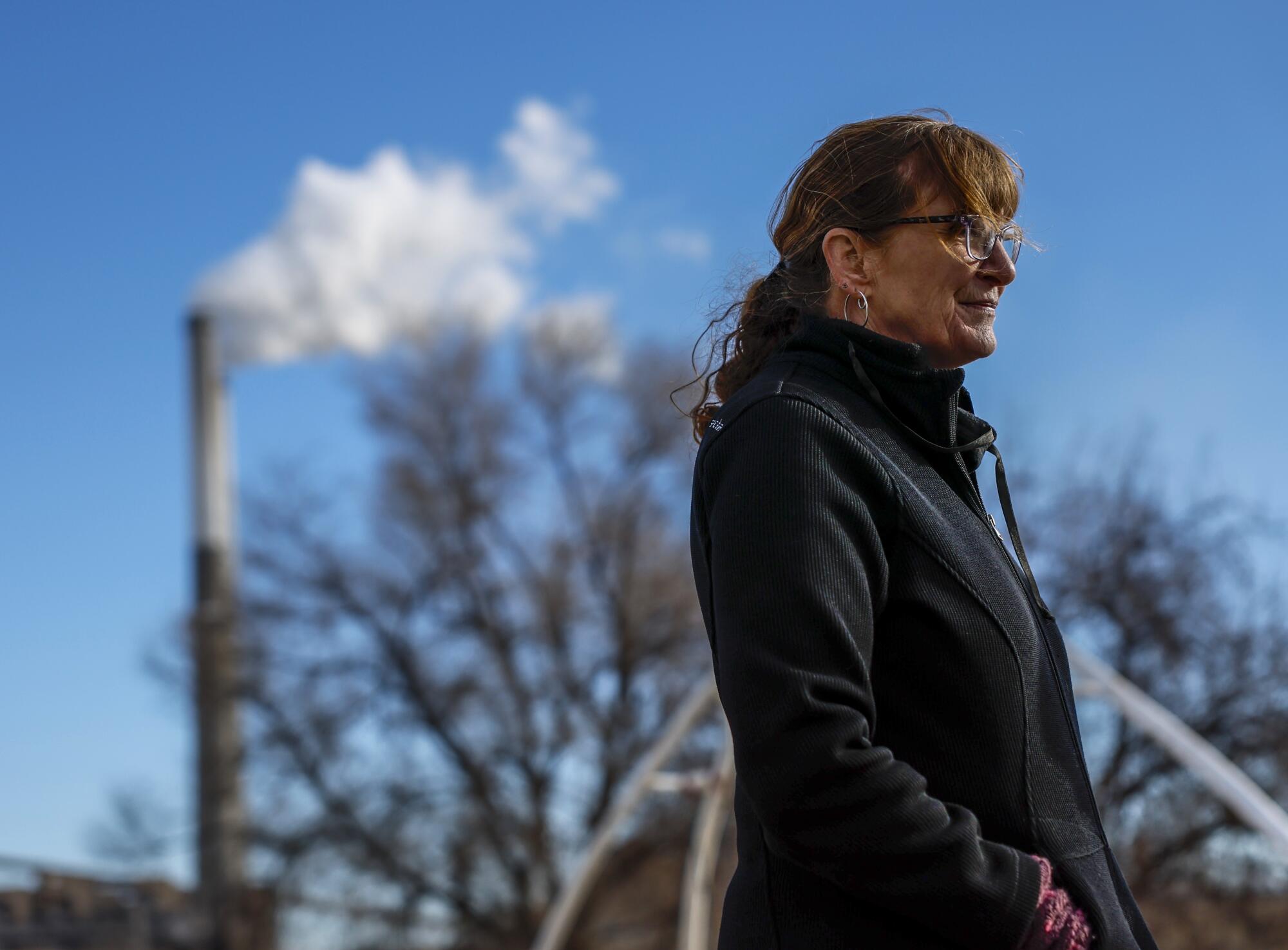
Climate activist Anne Hedges stands in a public park near the Colstrip power plant.
(Robert Gauthier / Los Angeles Times)
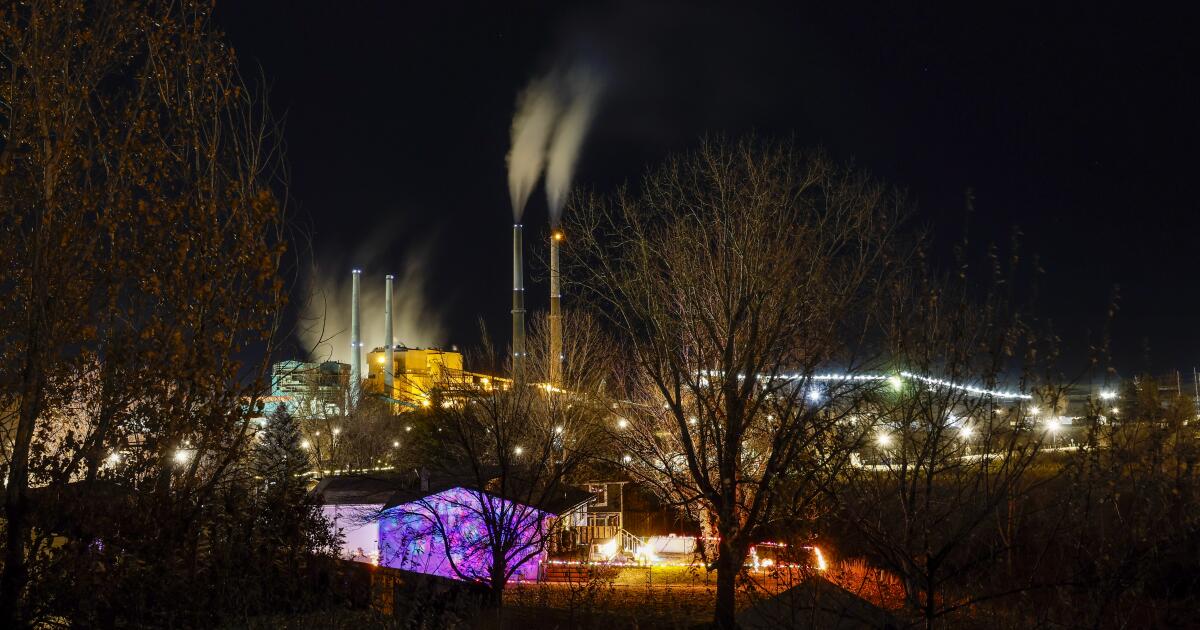
It’s easy to see why that’s a scary prospect. After we finish exploring the coal mine with Hedges, we drive into town and stop at one of the immaculately maintained public parks. The power plant’s two active smokestacks aren’t far, looming 692 feet over a swing set and red-and-blue bench with the letters “USA” carved into the backing.
“The climate doesn’t care who owns the power plant,” Hedges says, as steam and carbon and soot spew from the stacks.
The climate won’t care any more when Houston-based Talen Energy — which operates the plant, and which didn’t respond to requests for a tour or interview — becomes the facility’s largest owner next year, acquiring Puget Sound Energy’s shares.
Our ability to solve this problem doesn’t depend on which company is profiting off all that coal.
What it does depend on is our willingness to make hard choices, ranchers and miners and activists setting aside their differences and writing the West’s next chapter together, rather than fighting so long and so hard that the tale ends badly for everyone.
Change is scary. But it’s inevitable. Cowboy poet Wally McRae learned that the hard way.
Maybe 50 years from now, his great-grandchildren will wax poetic about the beauty of Colstrip without coal.
Support our journalism
Your support helps us deliver the news that matters most. Subscribe to the Los Angeles Times.
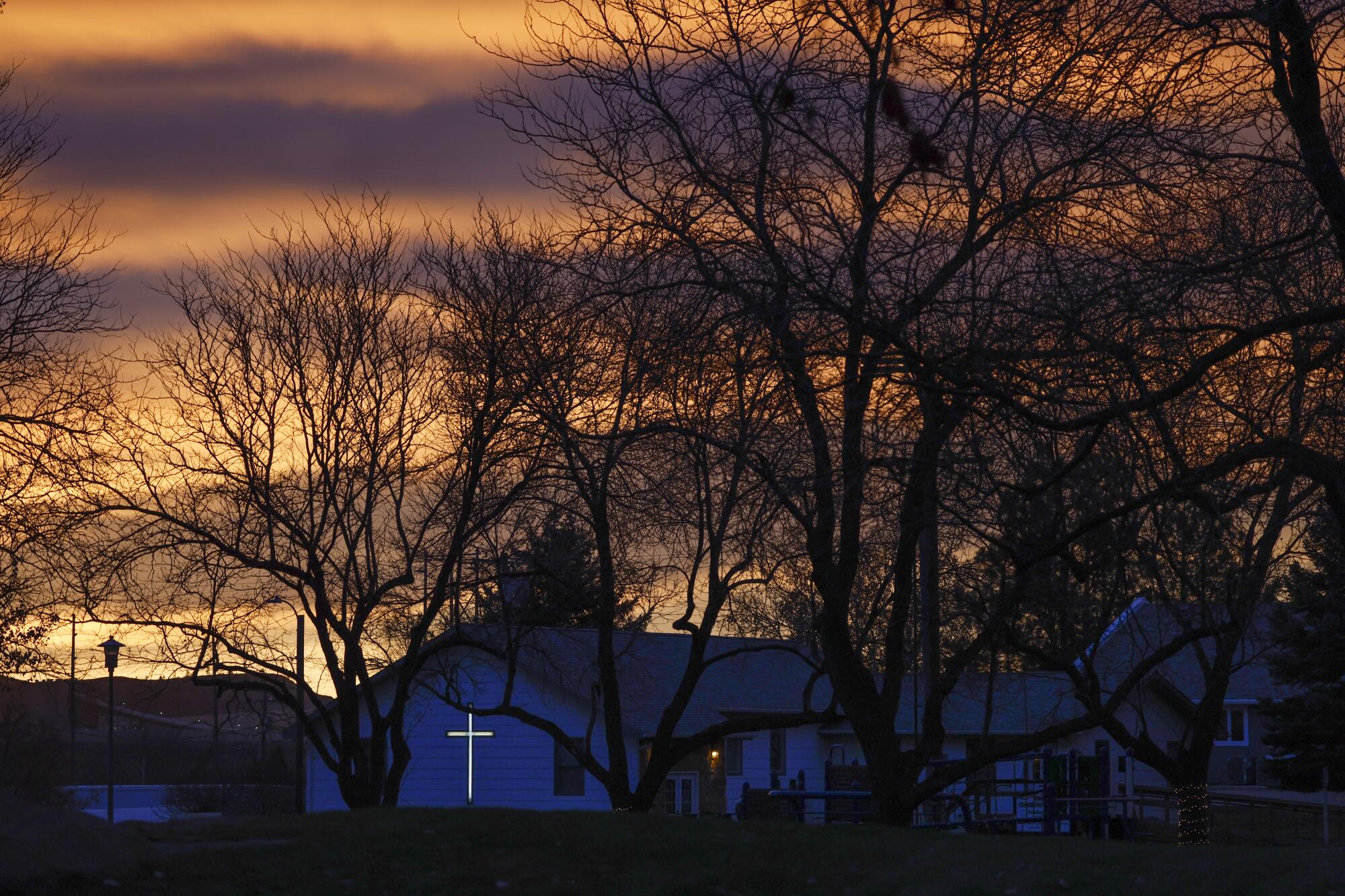
The early-morning sky glows red over the town of Colstrip.
(Robert Gauthier / Los Angeles Times)




Kanye West, the rapper now known as Ye, is suing his former project manager and his lawyers, alleging they wrongfully put a $1.8-million lien on his former Malibu mansion.
The suit, filed in Los Angeles Superior Court on Thursday, alleges that Tony Saxon, Ye’s former project manager on the property, and the law firm West Coast Trial Lawyers, “wrongfully” placed an “invalid” lien on the property “while simultaneously launching an aggressive publicity campaign designed to pressure Ye, chill prospective transactions, and extract payment on disputed claims already being litigated in court.”
Saxon’s lawyers were not immediately available for comment.
Saxon, who was also employed as West’s security guard and caretaker at the Malibu property, sued the controversial rapper in Los Angeles Superior Court in September 2023, claiming a slate of labor violations, nonpayment of services and disability discrimination.
In January 2024, Saxon placed the $1.8-million “mechanics” lien on the property in order to secure compensation for his work as project manager and construction-related services, according to court filings.
A mechanics lien, also referred to as a contractor’s lien, is usually filed by an unpaid contractor, laborer or supplier, as a hold against the property. If the party remains unpaid, it can prompt a foreclosure sale of the property to secure compensation.
Ye has denied Saxon’s allegations. In a November 2023 response to the complaint, Ye disputed that Saxon “has sustained any injury, damage, or loss by reason of any act, omission or breach by Defendant.”
According to Ye’s recent complaint, he listed the property for sale in December 2023. A month later, he alleged, Saxon and his attorneys recorded the lien and “immediately” issued statements to the media.
The suit cites a statement Saxon’s attorney, Ronald Zambrano, made to Business Insider: “If someone wants to buy Kanye’s Malibu home, they will have to deal with us first. That sale cannot happen without Tony getting paid first.”
“These statements were designed to create public pressure and to interfere with the Plaintiffs’ ability to sell and finance the Property by falsely conveying that Defendants held an adjudicated, enforceable right to block a transaction and divert sale proceeds,” the complaint states.
The filing contends that last year the Los Angeles Superior Court granted Ye’s motion to release the lien from the bond and awarded him attorneys fees.
The Malibu property’s short existence has a long history of legal and financial drama.
In 2021, West purchased the beachfront concrete mansion — designed by Pritzker Prize-winning Japanese architect Tadao Ando — for $57.3 million. He then gutted the property on Malibu Road, reportedly saying “This is going to be my bomb shelter. This is going to be my Batcave.”
Three years later, the hip-hop star sold the unfinished mansion (he had removed the windows, doors, electricity and plumbing and broke down walls), at a significant loss to developer Steven Belmont’s Belwood Investments for $21 million.
Belmont, who spent more money to renovate the home, had spent three years in prison after being charged with attempted murder for a pitchfork attack in Napa County. He promised to restore the architectural jewel to its former glory.
However, the property has been mired in various legal and financial entanglements including foreclosure threats.
Last August, the notorious mansion was once again put on the market with a $4.1 million price cut after a previous offer reportedly fell through, according to Realtor.com.
The legal battle surrounding Ye’s former Malibu pad is the latest in a series of public and legal dramas that the music impresario has been involved in recent years.
In 2022, the mercurial superstar lost numerous lucrative partnerships with companies like Adidas and the Gap, following a raft of antisemitic statements, including declaring himself a Nazi on X (which he later recanted).
Two years later, Ye abruptly shut down Donda Academy, the troubled private school he founded in 2020.
Ye, the school and some of his affiliated businesses faced faced multiple lawsuits from former employees and educators, alleging they were victims of wrongful termination, a hostile work environment and other claims.
In court filings, Ye has denied each of the claims made against him by former employees and educators at Donda.
Several of those suits have been settled.

After the dot-com bubble burst in the early 2000s, Candace Nelson reevaluated her career. She had just been laid off from a boutique investment banking firm in San Francisco’s tech startup scene, and realized she wanted a change.
From her home, she launched a custom cake service that soon morphed into an idea for a cupcake-focused bakery. Nelson and her husband — whom she met at the Bay Area firm where she had worked — then pooled their savings, moved to Southern California and together opened Sprinkles Cupcakes from a 600-square-foot Beverly Hills storefront.
The store quickly sold out on opening day in 2005, and over the next two decades, the Sprinkles brand exploded across the country, opening dozens of locations of its specialty bakeries as well as mall kiosks and its signature around-the-clock cupcake ATMs in several states.
“It was an unproven concept and a big risk,” Nelson told the Times in 2013, at which point the business had 400 employees at 14 locations and dispensed upward of a thousand cupcakes a day from its Beverly Hills ATM alone.
But now, the iconic cupcake brand is no longer.
Sprinkles abruptly shut down all of its locations on Dec. 31, leaving hundreds of retail employees across Arizona; California; Washington, D.C.; Florida; Nevada; Texas; and Utah in a lurch with little notice, no severance and scrambling to fulfill a surge of orders from customers clamoring to get their last tastes.
Candace Nelson, the founder of Sprinkles cupcakes, in Beverly Hills in 2018.
(Mel Melcon / Los Angeles Times)
Although Nelson long ago exited the company, having sold it to private equity firm KarpReilly LLC in 2012, she shared her disappointment with its fate on social media.
“As many of you know, I started Sprinkles in 2005 with a KitchenAid mixer and a big idea,” Nelson said in the post. “It’s surreal to see this chapter come to a close — and it’s not how I imagined the story would unfold.”
The company, now headquartered in Austin, Texas, made no formal announcement regarding the closures and Nelson has not said more than what she posted online. The company did share a comment with KTLA, saying “After thoughtful consideration, we’ve made the very difficult decision to transition away from operating company-owned Sprinkles bakeries.” Neither Nelson nor representatives of Sprinkles and KarpReilly responded to The Times’ requests for comment.
Sprinkles’ demise comes at a tough time for the food and beverage industry. At brick-and-mortar food retail locations, the non-negotiable ingredient and labor costs can be high. And shifting consumer sentiments away from sugar-filled sweets and toward more healthy and functional options, strained pocketbooks, as well as pushes by federal and state governments to nix artificial colors and flavoring, are creating uncertainties for businesses, those in the food industry said.

A 24-hour cupcake ATM at Sprinkles Cupcakes in Beverly Hills in 2012.
(Damian Dovarganes / Associated Press)
“Over the last 10 years the consumer has wizened up tremendously and is looking at the back of the label and choosing where to spend their sweets,” said David Jacobowitz, founder of Austin-based Nebula Snacks, an online food retailer.
At the same time, it’s also not uncommon for businesses owned by private-equity firms to close on a whim, where relentlessly profit-driven decisions might be made simply to pursue more lucrative projects. In recent years, private-equity deals have been seen to milk businesses for profit by slashing costs and quality, and have appeared to play a role in the breakup of some legacy retail brands, including Toys ‘R’ Us, Red Lobster, TGI Fridays and fabrics chain JoAnn Inc. On the flip side, private equity can help infuse much-needed cash into a business and extend its life.
Stevie León and her co-workers received a text the night before New Year’s Eve informing them the franchise Sprinkles location in Sarasota, Fla., where they worked would close permanently after their shifts the next day.
León, 33, said her position as a scratch baker mixing batter and frosting cupcakes overnight had been a dream job, since she had been searching for ways to develop baking skills without paying for expensive schooling.
“I really thought it was my forever job and it was taken away literally in a day,” she said. “I’m just taking it one day at a time.”
Ivy Hernandez, 27, the general manager at the Sarasota store, said that after the news was delivered to her boss, the franchise owner, they rushed to learn their options to keep the store afloat but quickly learned it could be legally precarious to continue operating. The store had been open less than a year.
A nearby corporate store, Hernandez said, had been in disarray for months, with employees contending with broken fridges and lapsed ingredient shipments, as managers implored higher-ups to pay the bills so the business could operate properly.
“It really felt like they were trying to do everything they could to screw everyone over as hard as possible until the end,” Hernandez said.
Sprinkles did not respond to questions about the franchise program or allegations of mismanagement in the lead-up to the closure.

A person walks by Sprinkles on the Upper East Side in New York City in 2020.
(Cindy Ord / Getty Images)
The obsession with tiny cakes in paper cups traces back to an episode of “Sex and the City” aired in 2000 showing Miranda and Carrie savoring cupcakes on a bench outside a West Village bakery called Magnolia’s Cupcakes.
“Big wasn’t a crush, he was a crash,” Carrie says to Miranda as she peels down the wrapper on a cupcake topped with bright pink buttercream frosting. She punctuates the quip by taking a big bite, leaving a glob of frosting on her face.
The scene sparked a tourism phenomenon for the bakery — which went on to create a “Carrie” line of cupcakes — and helped propel the burgeoning cupcake industry and companies like Sprinkles Cupcakes, Crumbs Bake Shop and Baked by Melissa to new heights.
Within a decade there was already talk of a “Cupcake Bubble,” coined by writer Daniel Gross in a 2009 Slate article where he argued that the 2008 economic recession laid the groundwork for a proliferation of cupcake stores across America, because a lot of people could figure out how to make tasty cupcakes cheaply and scale up without a huge capital investment.
Amid the decimation of many other local retail businesses, one could take over storefronts in heavily trafficked areas for cheap. As a result, “casual baking turned into an urban industry,” Gross said.
The cupcake fervor hit its peak when Crumbs, which had started as a single bakery on Manhattan’s Upper West Side in 2003, went public in a reverse merger worth $66 million in 2011. The wildly popular mini-cakes were selling at $4.50 a pop. But it became clear very quickly that it had grown too large, too fast. It closed in 2014 after it lost its stock listing on Nasdaq and defaulted on about $14.3 million in financing.
Analysts at the time said consumers were cooling on opulent desserts and suggested tougher times were ahead for bakeries that focused solely on cupcakes.
But Baked by Melissa has thus far proved those analysts wrong. The company has remained privately owned, and according to its founder, is focused on nationwide e-commerce operations — and on expanding the brand beyond sweets. Founder Melissa Ben-Ishay has gained a following on social media by sharing recipes for nutritious, easy-to-make meals.
“Businesses that prioritize quick value increases to get acquired often crash,” Ben-Ishay told Forbes last year. “We’re committed to maintaining product quality and steady, long-term growth.”
Before its unceremonious and sudden closure, Spinkles company leadership had pushed to diversify its business as part of a strategy to recover from a pandemic-era lull.
Chief Executive Dan Mesches told trade publication Nation’s Restaurant News in 2021 that comparable sales had grown since pre-pandemic years. He said the company had ramped up its direct-to-consumer and off-premises offerings and created a line of chocolates made to look like the tops of their cupcakes. The company also introduced a new franchise program with the goal of opening some 200 locations in the U.S. and abroad over three years.
“Innovation is everything for us,” Mesches said.
Sprinkles was known for, among other things, inventive and somewhat corny methods of customer delivery. Besides the trademark ATMs, the company’s vending machines found at many airports made loud, attention-drawing jingles, drawing dramatic complaints and jokes from TikTok travelers. In the 2010s, the company debuted a custom-built truck — “the Sprinklesmobile” — to deliver cupcakes to cities without physical locations.
Frances Hughes, co-founder of online wholesale marketplace Starch, said there’s no question that gourmet sweet treats are still in vogue. But brick-and-mortar locations are much more risky, with more unpredictability. Having large fixed costs makes a business “extremely sensitive to small changes in traffic or frequency,” while online or e-commerce models can be more flexible.
“I think cupcakes as a product still have demand. But the novelty paths that support that rapid retail expansion have passed,” Hughes said.
When Nelson, the Sprinkles founder, posted her somber message about the closure, she asked people to share memories of the company. Many offered heartfelt responses, her comments flooded with stories, for example, of poor college students making the trek to the Beverly Hills location for a limited number of first-come, first-served free cupcakes.
But many of the comments also criticized Nelson’s sale to private equity.
“You sold it to PE and expected it to not close?? What planet are you living on? I don’t begrudge you for selling as that’s entirely your choice but to think any PE firm cares about a company in the slightest is insanity,” one Instagram user said.
Nicole Rucker, an L.A.-based pastry chef and owner of Fat+Flour Pie Shop, said she didn’t observe a decline in the quality of the product after the private-equity takeover. She has been a longtime admirer of the company, driving up from San Diego to sample the cupcakes when its store opened. The simple attractiveness of the box and the logo, and the consistency in the way cupcakes were decorated, “was inspiring,” she said.
“It had a strong hold on people for years,” Rucker said.
Rucker said however that when a private-equity-owned business shutters, she doesn’t feel sadness: “I would rather give my money to a fellow small-business owner, because I would rather know that every dollar and every sale matters.”
Michelle Wainwright, the owner and founder of Indiana-based bakery Cute as a Cupcake! said that although the niche cupcake industry may no longer be in its heyday — with “Sex and the City” no longer airing and competitive baking show “Cupcake Wars” (which Candace Nelson served as a judge on) now canceled — they are still versatile treats, with great potential for creativity.
And they are sentimental to her, because she uses her grandmother’s recipe.
“Cupcakes are still a winner,” Wainwright said. “It’s my belief that a life with out cupcakes is a life without love.”

Semiconductor testing equipment company FormFactor is laying off more than 200 workers and closing manufacturing facilities as it seeks to cut costs after being hit by higher import taxes.
The Livermore, Calif.,-based company plans to shutter its Baldwin Park facility and cut 113 jobs there on Jan. 30, according to a layoff notice sent to the California Employment Development Department this week. Its facility in Carlsbad is scheduled to close in mid-December later this year, which will result in 107 job losses, according to an earlier notice.
Technicians, engineers, managers, assemblers and other workers are among those expected to lose their jobs, according to the notices.
The company offers semiconductor testing equipment, including probe cards, and other products. The industry has been benefiting from increased AI chip adoption and infrastructure spending.
FormFactor is among the employers that have been shedding workers amid more economic uncertainty.
Companies have cited various reasons for workforce reductions, including restructuring, closures, tariffs, market conditions and artificial intelligence, which can help automate repetitive tasks or generate text, images and code.
The tech industry — a key part of California’s economy — has been hit hard by job losses after the pandemic, which spurred more hiring, and amid the rise of AI tools that are reshaping its workforce.
As tech companies and startups compete fiercely to dominate the AI race, they’ve also cut middle management and other workers as they move faster to release more AI-powered products. They’re also investing billions of dollars into data centers that house computing equipment used to process the massive troves of information needed to train and maintain AI systems.
Companies such as chipmaker Nvidia and ChatGPT maker OpenAI have benefited from the AI boom, while legacy tech companies such as Intel are fighting to keep up.
FormFactor’s cuts are part of restructuring plans that “are intended to better align cost structure and support gross margin improvement to the Company’s target financial model,” the company said in a filing to the U.S. Securities and Exchange Commission this week.
The company plans to consolidate its facilities in Baldwin Park and Carlsbad, the filing said.
FormFactor didn’t respond to a request for comment.
FormFactor has been impacted by tariffs and seen its growth slow. The company employs more than 2,000 people and has been aiming to improve its profit margins.
In October, the company reported $202.7 million in third-quarter revenue, down 2.5% from the third quarter of fiscal 2024. The company’s net income was $15.7 million in the third quarter of 2025, down from $18.7 million in the same quarter of the previous year.
FormFactor’s stock has been up 16% since January, surpassing more than $67 per share on Friday.

George Kittle used bottle of tequila to deal with devastating Achilles injury

Parents fear closing of Good Street Learning Center as leaders push to stay open

College football player transferred from Miami to Indiana before national championship

When will the big nor’easters return? Boston in midst of second-longest streak without hefty snowfalls. – The Boston Globe

Broncos healthy compared to Bills

Florida High School Football Rankings: Top 25 teams – Oct. 21

Cleary's 21 help Le Moyne down Central Connecticut State 69-64 in OT

How old is Bo Nix? What to know about Oregon quarterback ahead of 2024 NFL Draft

99th annual Pony Swim held in Virginia

Video: ‘It Didn’t Have to Happen This Way:’ U.Va. Faculty Call for Review of Police Response to Protests

San Antonio ends its abortion travel fund after new state law, legal action

UN top court set to open Myanmar Rohingya genocide case

Arson engulfs Mississippi synagogue, a congregation once bombed by Ku Klux Klan

Federal judge blocks Trump administration from enforcing mail-in voting rules in executive order

Four killed, 20 injured in overnight Russian strikes across Ukraine
-

 Detroit, MI1 week ago
2 hospitalized after shooting on Lodge Freeway in Detroit
-

 Technology6 days ago
Power bank feature creep is out of control
-

 Dallas, TX4 days ago
Anti-ICE protest outside Dallas City Hall follows deadly shooting in Minneapolis
-

 Delaware3 days ago
MERR responds to dead humpback whale washed up near Bethany Beach
-

 Dallas, TX1 week ago
Defensive coordinator candidates who could improve Cowboys’ brutal secondary in 2026
-

 Iowa6 days ago
Pat McAfee praises Audi Crooks, plays hype song for Iowa State star
-

 Montana2 days ago
Service door of Crans-Montana bar where 40 died in fire was locked from inside, owner says
-

 Health1 week ago
Viral New Year reset routine is helping people adopt healthier habits