Business
Problems at Mattel: Despite 'Barbie' success, its stock is a dud. Now an activist investor is circling

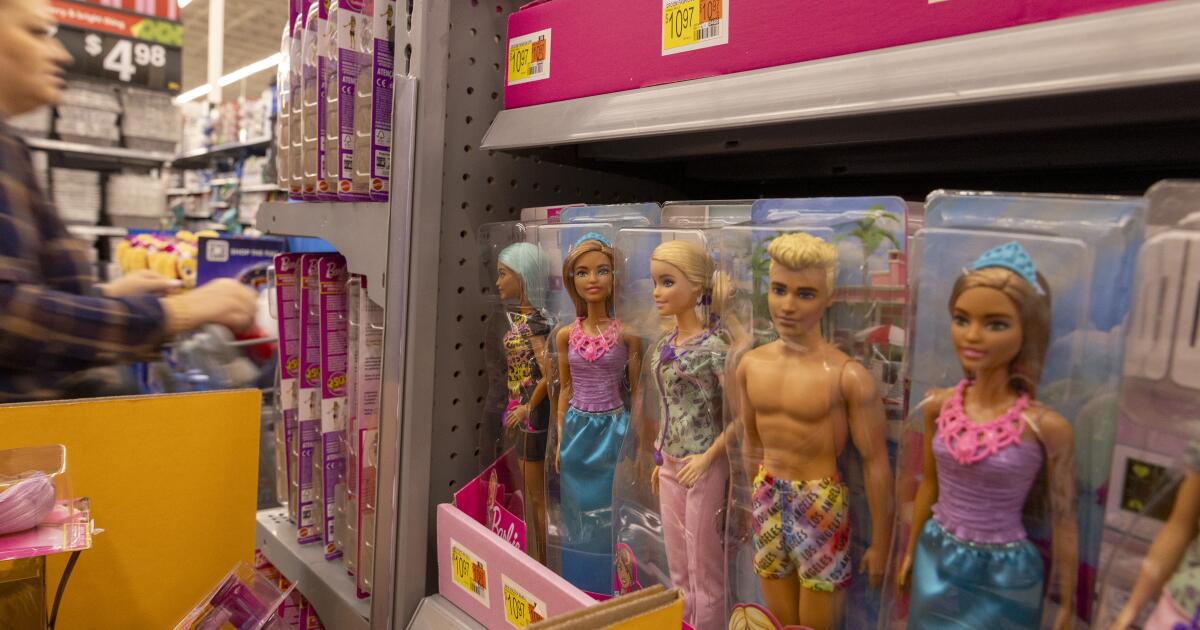
If “Barbie” is awarded best picture at next month’s Academy Awards, it would only crown what has been an unprecedented moment for the world’s No. 1 selling doll.
The glossier half of the “Barbenheimer” sensation not only brought in nearly $1.5 billion at the global box office, but also renewed the cachet of a toy old enough to be Medicare eligible next month — earning Mattel some $150 million, including doll sales and other revenue streams last year.
It all seemed to validate the toy maker’s strategy of turning its legacy brands into modern media properties, with more than a dozen other live-action films coming up.
“Our job is to take brands that are timeless and make them timely,” is how Mattel Chairman and Chief Executive Ynon Kreiz put it in an interview.
Yet the El Segundo company is not feeling much affection from investors. (Nope, Mattel is not based in the film’s imposing Century City high-rise.) After surging during the pandemic, the company’s stock performance has been middling, despite a surge after “Barbie” was released and the recent stock market rally.
This has caught the attention of an activist investor, which is pressuring Mattel to change course and better reward its shareholders.
The New York hedge fund Barington Capital Group isn’t calling for Barbie to be put on the auction block, but the same can’t be said for two of its other top brands: Its line of premium-priced American Girl dolls and its iconic Fisher-Price line of baby, toddler and preschool toys.
The marquee of the Los Feliz Theater features the films “Barbie” and “Oppenheimer,” last year.
(Chris Pizzello / Associated Press)
Barington, which kicked off its campaign with a Feb. 1 letter to Kreiz, is also taking aim at Mattel’s executive compensation and governance structure, while calling for $2 billion in stock buybacks to provide a better return for investors. It hasn’t disclosed its stake in the company.
“We want to enhance value for all of the shareholders and owners of the company, including the management team,” said James Mitarotonda, chairman of Barington. “The company needs to either fix the businesses or sell them.”
Barington calculated that Mattel’s stock fell 13.2% in the two years preceding its letter, underperforming the Standard & Poor’s 500 index by more than 20%. Shares of Mattel have risen about 7% during February’s stock rally, closing at $19.61 on Tuesday. The stock hit a high of $26.97 during Kreiz’s tenure in May 2022.
Mattel’s got big people behind these other movies but you can’t assume these properties are going to be blockbusters
— Jim Chartier of Monness Crespi Hardt
The hedge fund doesn’t have as high a profile as some other shareholder activists, such as Carl Icahn or Nelson Peltz, who is currently battling Disney. Barington, though, has waged roughly 100 campaigns, Mitarotonda said, including convincing L Brands, which is now Bath & Body Works, to spin off Victoria’s Secret as a separate company.
In response to the campaign, Mattel said it was looking “forward to engaging with Barington as we do with all our shareholders. We welcome this initial outreach and we are reviewing their letter.” Mitarotonda said Barington has since had “positive” discussions with Kriez but declined to discuss them in detail.
Given the unprecedented success of “Barbie,” Mattel seems an unlikely target for an activist investor.
Despite past turmoil in the toy industry and stiff competition from digital games, the company has experienced a comeback since Kreiz took over in 2018 — a year when the company posted a $1-billion loss. Barington acknowledged that, pointing to the company’s higher margins, lower debt leverage and $700 million growth in annual revenue by the third quarter of last year.
“We recognize the meaningful improvements that you and your team have delivered over the last six years,” the letter stated.
However, the big growth in net sales was achieved in 2021 when parents were still saying home en masse with their kids. Since then, annual net sales have flatlined at $5.4 billion while annual net income declined about 75% over the three years to $214 million last year, according to FactSet. For the fourth quarter, the company reported a 16% increase in net sales, with sales flat for all of 2023.
Mattel wasn’t the only company hit by the toy industry’s soft 2023, which saw a 7% sales decline in 12 global markets, according to Circana. The consumer data analyst cited inflation and the continuing challenge of lower birth rates as issues. Mattel rival Hasbro, the maker of Transformers and G.I. Joe, reported a fourth-quarter decline in revenue and higher losses, sending shares skidding.
An Israeli native and UCLA business school graduate, Kreiz, 58, previously led YouTube content producer Maker Studios, which Disney acquired in 2014. He also had worked for Haim Saban, who made billions of dollars on the Power Rangers franchise. Kreiz was Mattel’s chairman when he was named chief executive, becoming the fourth person to hold the CEO title since 2012.
From the start, Kreiz’s goal was to supercharge Mattel’s lagging efforts to become a higher-valued entertainment company. That meant reviving efforts to get Barbie a starring role. The broader strategy includes television, digital games, publishing and consumer products. Mattel also is opening a small theme park in suburban Phoenix.
“Barbie” succeeded beyond Mattel’s wildest expectations after Kreiz gave unusual creative control to director Greta Gerwig. (That choice paid off at the box office, but it didn’t do Kreiz any favors considering the film’s less-than-flattering portrayal of Mattel’s corporate chief by comedian Will Ferrell).
The company’s slate of films includes an upcoming Barney motion picture produced by Academy Award winning actor Daniel Kaluuya, a Hot Wheels movie by blockbuster producer J.J. Abrams and a Rock ‘Em Sock ‘Em Robots movie starring Vin Diesel.
It appears to be a formula for continued success, though analyst Jim Chartier of Monness Crespi Hardt & Co. said it’s important to remember the truism: There’s no guarantees in Hollywood. He noted how Mattel rival Hasbro had a hit with its 2007 “Transformers” film but couldn’t duplicate that with some other properties.
“Mattel’s got big people behind these other movies but you can’t assume these properties are going to be blockbusters,” said Chartier, who has a “buy” rating on Mattel and a $26 price target.
Still, no one is doubting the long-established toy industry strategy of courting Hollywood — the issue Barington has is with the other two big brands.
Mattel’s infant, toddler and preschool segment, which includes Fisher-Price, has experienced a more than 40% decline in annual revenue since 2015 through the third quarter of last year, even as global revenue for such toys grew, according to Barington’s letter. Similarly, it said, American Girl’s annual revenue fell 61% since 2016, even as global doll revenue grew.
Barington calculated that without those sales declines, Mattel would have nearly doubled its four-year revenue growth rate. The investor suggested selling the businesses. “Mattel may not be the right owner of these brands,” its letter stated.
Mattel acquired Fisher-Price in 1993 and, according to the company, it remains the bestselling infant and preschool brand in the world. Even before Barington’s letter, Mattel announced a shake-up at Fisher-Price, telling employees in January that the toy line’s general manager and global head of infant and preschool, Chuck Scothon, would be leaving after six years at the helm.
The American Girl line of premium large dolls, which feature multiple collections, generally are priced at more than $100. The dolls are sold online and at major retailers, while Mattel operates retail boutiques, including in Los Angeles, where kids can hold parties, receive salon services and share tea time with their dolls.
Analyst Linda Bolton Weiser of D.A. Davidson said she thinks it’s more likely that Mattel would sell American Girl than Fisher-Price, since the doll line suffers from lower-priced competition.
(Target, for example, sells an exclusive line of rival dolls called Our Generation that can cost a quarter of the price.)
Mattel shows no signs of abandoning the doll line it acquired in 1998. It is developing a film with Paramount for the big screen, and during comments Kreiz made in response to Barington’s letter on the Feb. 7 earnings call, he said Mattel is “very confident in the long-term value of American Girl.”
Mattel’s earnings announcement also stated that its board had approved a $1-billion share repurchase after buying back $203 million worth of shares in 2023. And the company announced two new directors with experience in media, tech and finance. Kreiz cautioned against reading into those developments. “These are things that we take our time to consider and analyze,” he said during the earnings call.
Mitarotonda called the $1-billion share buyback a “good start” and said he was “looking forward to more” in the future.
Barrington also has taken issue with Mattel over alleged excessive stock-based compensation to the management team. It said in its letter that Kreiz received $29.8 million in such compensation from 2020 through 2022, which was 44% higher than the median aggregate of what his peer chief executives received during that period.
“Barbie” director Greta Gerwig and Mattel Chief Executive Ynon Kreiz are seen at the 2024 Oscars Nominees Luncheon at the Beverly Hilton Hotel this month.
(Jason Armond / Los Angeles Times)
Kreiz’s total compensation in 2022 was $11.9 million, including a base pay of $1.5 million, stock awards of $7.69 million and stock options of $2.56 million, according to a regulatory filing.
Weiser said that Kreiz has done an “excellent job” in a difficult industry. “He brought the company back from the brink of bankruptcy,” she said.
The criticism of Kreiz’s compensation was based on a peer group developed by the company to set its own compensation, Mitarotonda said, adding the fund’s letter didn’t note how the group appears stacked with higher-revenue companies, minimizing how excessive the stock awards actually were. Hershey, Live Nation and Campbell Soup are among the members.
In regards to governance, Barington wants Kreiz to step down from his board chairmanship. Splitting the role from his chief executive duties are a fundamental principle of good corporate governance, Mitarotonda said, likening it to the checks and balances system enshrined in the U.S. Constitution.
“Does good governance create value in and of itself? No, it does not. But it does set the right culture in order for you to have a good management team that does deliver the right results,” he said.
Mattel is forecasting flat sales but profit growth this year as it continues to cut costs. Global toy sales are expected again to be soft, though not as poor as 2023.
The company plans an investor day March 7 when it is expected to roll out new products. During the earnings call, Kreiz said that this year it will expand Fisher-Price’s core product lines and introduce an “exciting new segment.”
Mitarotonda said he is eager to hear any company initiatives regarding Fisher-Price and American Girl.
“Part of what we wanted to make sure is that they have a compelling plan to improve these businesses,” he said.



Dear Mr. Pelley:
I meant what I said in my letter last week to the 60 Minutes team: joining 60 Minutes is the honor of my career and I am grateful to be working alongside the people who have contributed to the most important television journalism brand this country has ever produced. While I’m new to 60 Minutes, I’ve devoted my career to investigative journalism and storytelling. I started this job excited to collaborate and to benefit from the wisdom and experience of the 60 Minutes veterans, with you among them. For that reason, one of the first things I did in my new role was call you to talk and invite you to dinner. It is a profound disappointment that you rejected that overture and chose ambush instead. Yesterday, you hijacked my first meeting with staff to disparage me, my qualifications, and my intentions with remarkable incivility and contempt. I welcome a diversity of viewpoints and respectful debate among the team, but this was nothing of the sort. Yesterday’s performative display of hostility enacted in front of the staff instead of in a civil, private conversation-demonstrated that you have no interest in contributing to the future success of the show, or approaching my new tenure with a mind open to collaboration and progress. I am here to deliver first-in-class news programming, not to make headlines about newsroom drama. I am eager to work alongside those who share this goal.
Despite yesterday’s misconduct, I had hoped that in sitting down with you today we could find a path forward together. You made clear that you are not interested in such a path.
Your antipathy to the future of the show has come through loud and clear. And I have heard you. I therefore write on behalf of CBS News, Inc. (“CBS”) to inform you that your employment with CBS is terminated for cause effective immediately. Enclosed is your formal termination letter.
Sincerely,
Nick Bilton
Executive Producer, 60 Minutes

The co-founder of Aspiration, Joseph Sanberg, was sentenced to 14 years in prison on Monday after defrauding investors and lenders of over $248 million.
The startup, an eco-friendly digital banking company boasting fossil fuel-free investments, carbon offsets for gas purchases, and a debit card with cash-back benefits for shopping at clean companies, was founded by Sanberg and Andrei Cherny. Cherny left the company in 2022 and has not been charged.
Sanberg, an Orange County native, pleaded guilty to wire fraud in October after being arrested in March last year. Aspiration subsequently filed for bankruptcy and liquidated all of its assets by July.
Sanberg and venture capitalist Ibrahim AlHusseini, who also faces charges, together forged a series of bank statements in order to obtain loans. From 2020 to 2021, the pair forged AlHusseini’s bank statements to show millions of dollars in assets in order to obtain millions of dollars from lenders.
Additionally, they forged a letter from their audit committee stating that $250 million in funds were available, when in reality Aspiration had less than $1 million. The amount of loans defrauded exceeded $248 million.
In 2021, Sanberg artificially inflated Aspiration’s 2021 revenue by $44 million by recruiting 27 fake customers to sign letters of intent pledging tens of thousands of dollars per month for tree planting services. Sanberg himself funded the contracts and used the inflated revenue numbers to obtain more loans.
The charges sparked an NBA investigation into salary cap allegations due to Aspiration’s connections with Clippers owner Steve Ballmer.
Ballmer personally invested $60 million in Aspiration, all of which was lost. He is now the target of a civil lawsuit alleging his participation in the scheme. Ballmer denies the allegations.
The team announced a $300-million sponsorship deal with Aspiration, and Clippers player Kawhi Leonard signed a four-year, $28-million marketing contract with the company, which reportedly performed no duties. The issue has raised concerns about how players are circumventing the NBA’s salary cap.
The team lost the $300-million sponsorship deal and an additional $20 million paid for carbon offset purchases.

Residents in the city of Monterey Park will be the first in the nation to vote on a permanent ban on data centers Tuesday.
If approved, Measure NDC would prohibit data centers within the city limits and could only be overturned by another vote.
Yard signs saying “No Data Center” in English and Chinese with images of dragons line sidewalks in the San Gabriel Valley city.
As a wave of data center opposition sweeps the country, numerous towns and counties across the U.S. have instituted temporary moratoria and other restrictions on the facilities. But only a handful have instituted indefinite bans, and just four other towns have sent related matters to the ballot.
Supporters are hoping the vote will set a precedent for the rest of the region, where residents are fighting proposals in Vernon and City of Industry.
“This is about as permanent a ban as we can get,” said Steven Kung, co-founder of the group No Data Center Monterey Park. “Winning Measure NDC would send a huge message to the rest of the San Gabriel Valley about how residents don’t want data centers.”
The ballot measure emerged from the fight against a 247,000-square-foot center proposed in 2024 by the Australian-owned investment firm HMC StratCap for a residential area in Monterey Park.
The facility would have sat less than 500 feet away from the nearest home and used three times the electricity of the 60,000-person, predominantly Asian American city.
While the developer touted the potential for jobs and tax revenue, residents expressed concerns about noise and air pollution, rising electricity rates and a potential to lower property values.
The company pulled its plans in late March following public outcry and a March 4 city council vote to extend a temporary data center moratorium and place a ban on Tuesday’s ballot.
In a letter to the city council, HMC StratCap said it would pursue a different use for the land and would not engage in a ballot measure fight.
The city council later banned data centers indefinitely, the first in California to do so, said Mayor Elizabeth Yang. But she’s still been out campaigning for the measure with all four other council members.
“If a council puts in an ordinance, a future council can reverse it too,” said Yang. “With the ballot measure, unbanning it is a lot harder because you need the entire city to vote on it.”
The measure proposes the ban “to protect air quality, drinking water resources, and public health” and “prevent impacts to electricity and water rates.”
While California places third in the country for existing data centers with about 300 facilities, it hasn’t been a hot spot in the recent AI-driven data center boom. High electricity rates, expensive land and regulatory hurdles mean that fewer, and smaller, facilities are currently planned than in Virginia, Texas, Georgia, Illinois or Arizona.
“Most of California’s data centers are small by today’s standards,” said Shaolei Ren, an engineering professor at UC Riverside who studies how to reduce the environmental impacts of data centers. “Ten years ago, they would be medium-sized, but the power demand for new AI data centers has increased a lot.”
The average operating data center demands 45 megawatts, according to the Washington Post, while the average planned one would draw 430 MW. The one proposed for Monterey Park would have required about 50 MW at peak demand.
As proposals crop up in SoCal, they’re met with fierce opposition. Montebello, El Monte and Baldwin Park have all enacted temporary moratoria, and Alhambra recently banned data centers as part of a zoning code update. City of Industry, Vernon, City of Commerce and Santa Fe Springs are moving in the other direction, trying to court developers and streamline data center approvals. Community groups are fighting that.
Outside the San Gabriel Valley, residents of Coachella and Imperial County are showing up in droves to protest local proposals.
Matthew Shaw, a volunteer with the Coalition for Responsible Data Center Development, who recently published a report on opposition to AI data centers, said a vote to ban them in Monterey Park “would lead to copycats, partially because so many groups are just opposed to any data center development at all.”
While there is no formal opposition to Measure NDC, some building trades like Ironworker Local 433 supported the Monterey Park data center when it was still live before city council. Those in the data center industry are lamenting the state of public opinion.
“These are multi-billion-dollar assets that are built by multi-trillion-dollar companies. These things will get done,” said Mehdi Paryavi, chairman of the International Data Center Authority. “My biggest problem is that our industry does not invest enough in community engagement.”
Paryavi said towns that seek to limit data centers are missing out on thousands of jobs generated by data center construction, operations and customers, as well as faster artificial intelligence speeds and better performance.
Kung said local community organizers are “looking at the empirical evidence” and seeing a ban as a win.
“We’ve never seen a city that embraces a data center and is like, ‘Look how our quality of life has increased, look how all the revenue has gone into citywide improvements,’” he said. “That just doesn’t exist.”
-

 San Diego, CA32 seconds ago
Morning Report: Runoffs Largely Set
-

 Milwaukee, WI6 minutes ago
MPS staffer who got plea deal in slapping case had earlier incident
-

 Atlanta, GA13 minutes ago
19 new metro Atlanta restaurants opened in May, but 11 closed
-

 Minneapolis, MN16 minutes ago
Motorcyclist seriously injured in north Minneapolis hit-and-run
-

 Indianapolis, IN21 minutes ago
New stores in Indianapolis include indoor kid’s playground, cafe
-

 Pittsburg, PA27 minutes ago
Blanche says DOJ
-
Augusta, GA31 minutes ago
Amy Elizabeth Black Obituary May 29, 2026 – Platt’s Funeral Home
-
Washington, D.C31 minutes ago
Sherry Abedi has been appointed as General Manager at LINE DC


