Business
Pro-Palestinian activists protest at Google developer conference amid Israel-Hamas war

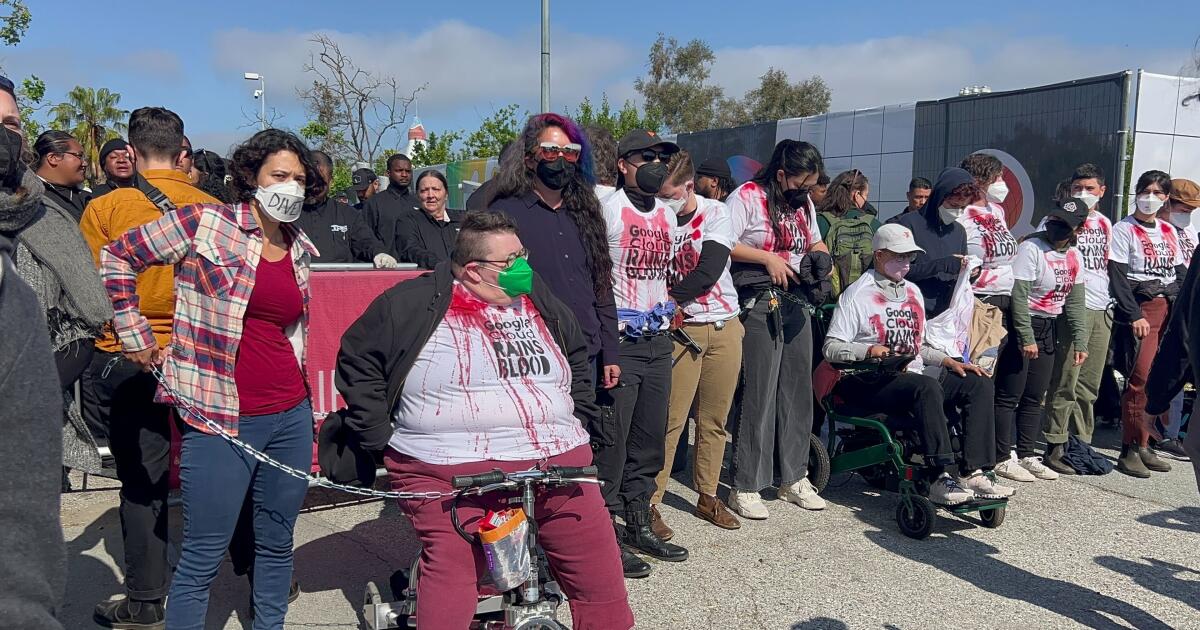
Dozens of protesters blocked the entrance of Google’s developer conference in Mountain View, Calif., for roughly 90 minutes on Tuesday, demanding that the tech giant drop its work with the Israeli government amid the country’s war with Hamas in the Gaza Strip.
The protest group, which accuses Israel of committing genocide against Palestinians in Gaza, held two events on Tuesday that it said involved hundreds of participants.
A group chanted “Shame on Google” and “Google Cloud rains blood” in the front of the entrance to the conference at Shoreline Amphitheatre, where the tech giant was expected to announce updates to business including its Android and Gemini AI systems. Separately, the protesters held a rally at a nearby park.
The protesters, who call themselves No Tech for Genocide, have been demanding that Google end its cloud computing contract with the Israeli government, known as Project Nimbus.
The latest Israel-Hamas war began when Hamas militants attacked southern Israel on Oct. 7, killing about 1,200 people and taking an additional 250 hostage, according to the Israeli government. Palestinian militants still hold about 100 captives, and Israel’s military has killed more than 35,000 people in Gaza, according to Gaza’s Health Ministry, which doesn’t distinguish between civilians and combatants.
Protesters at the Google event said they believe the company’s technology is being used by the Israeli military for surveillance of people in Gaza through facial recognition, leading to the arrest and detention of Palestinians.
Google did not immediately respond to a request for comment.
The company has said that its technology is used to support numerous governments around the world, including Israel’s, and that the Nimbus contract is for work running on its commercial cloud network, with the Israeli government ministries agreeing to comply with Google’s terms of service and acceptable use policy.
“This work is not directed at highly sensitive, classified, or military workloads relevant to weapons or intelligence services,” Google said in an April statement.
One of the protesters at the Tuesday conference was Ariel Koren, a former Google employee who alleges the company retaliated against her in 2021 after she raised concerns about the contract. Google said at the time that it had investigated the case and found no evidence of retaliation.
“We want to make sure that every single person who comes here and who might think that today’s a day about celebrating technological advancements — every single one of those people needs to understand that the reality is much darker than what Google has painted,” Koren said.
Organizers estimated that 50 people participated in the demonstration in front of the conference. The rally at the park drew a bigger crowd.
One of the participants objected to Google holding its conference the day before Palestinians commemorate 76 years since their mass expulsion from what is now Israel. Palestinians refer to their displacement during the 1948 Israeli-Arab war as the Nakba, which is Arabic for catastrophe.
The protest in front of the Google I/O conference began at around 9:30 a.m., with protesters moving toward a bag checkpoint. Conference attendees had been asked to take out their laptops and have their bags searched.
The event’s security closed the entrance as protesters moved to stand in front, leaving a large line of attendees who were later directed to another area to proceed to the conference. A line of protesters held a red sign that proclaimed “Google Stop Fueling Genocide.” The demonstration ended at about 11 a.m.
Google’s developer conference draws thousands of people each year, many of whom are developers eager to learn about the company’s latest technology.
After witnessing the protest, several attendees said they planned to do more research on Project Nimbus.
“I feel that it is worth a shot to listen to others when they have a point of view,” said Andres Haro, a 30-year-old software security engineer from Utah, as he waited in a long redirected line into Google I/O’s entrance.
The protest comes after more than 50 Google employees were fired following sit-ins and protests that took place at Google office locations last month protesting Project Nimbus. Google said it terminated those workers after an investigation determined they were involved in disruptive activity that violated its policies governing employee conduct.
A spokesperson for the group behind the sit-ins, called No Tech for Apartheid, said they were not involved with Tuesday’s protest.
“We’re asking more questions about what role we and our employers are playing in the world,” said Roni Zeiger, a product developer who participated in the rally on Tuesday at Charleston Park, near the Google event. “World events have continued to evolve and … people, including employees, are asking harder questions and wanting to work at places that are consistent with their values.”


new video loaded: Jury Rejects Elon Musk’s Lawsuit Against OpenAI and Microsoft
transcript
transcript
Jury Rejects Elon Musk’s Lawsuit Against OpenAI and Microsoft
Elon Musk had accused OpenAI of “stealing a charity” by attaching a commercial company to Open AI, which was founded as a nonprofit. But a jury ruled that the statute of limitations had expired.
-
“The evidence that Mr. Musk’s lawsuit was an after-the-fact contrivance by a competitor was overwhelming.” “This reminds me of key moments in this country’s history. The siege of Charleston, the Battle of Bunker Hill, these were major losses for Americans. But who won the war? And this one is not over. And to sum it up, I can sum it up in one word: appeal.”

By Meg Felling
May 18, 2026

Five Guys will close two Los Angeles-area locations later this month.
The burger chain announced in a recent state filing that its locations in City of Industry and Whittier will close in late May. An outlet in Merced will also close its doors in late June, and one in Hanford will shut down in early July, according to state court filings.
The burger giant is the latest fast-food chain to shutter locations as the industry struggles with rising labor and real estate costs in the state.
The company cited “financial hardship” as a reason for the closures, according to a filing.
Employers are legally required to submit a Worker Adjustment and Retraining Notification, or WARN notice, to alert employers, state and local officials at least 60 days before major layoffs. The initial notices were submitted in late April and early May.
The chain had steady growth in 2024, but seems to have stumbled in California. It opened 37 new storefronts that year, according to the company’s franchise disclosure document. Yet California stores accounted for eight of the 14 locations that closed that year.
The closures will result in 55 jobs lost across the four locations, according to the WARN notice.
A spokesperson for Five Guys did not immediately respond to a request for comment.
Fast food chains have struggled against rising operational costs and increasingly cost-conscious customers.
California’s economic landscape has further complicated business in the state. While aerospace and defense companies have continued to flock to the state, companies in other sectors, including food, have started to bail out.
Five Guys ranked 42 in QSR Magazine’s top 50 U.S. restaurants list for 2026 and the number of locations in the country rose by 2% in 2025.
The chain got its start around 40 years ago in Virginia and now operates over 1,900 locations, according to its website.
The restaurant’s website lists over 85 locations in California, including at least 15 storefronts in the Los Angeles area.

A federal jury sided with OpenAI and its top executives on Monday in a feud with Elon Musk, who accused them of betraying a shared vision for it to guide artificial intelligence’s development as a nonprofit.
The nine-person jury unanimously found that Musk waited too long to file his lawsuit and missed the deadline for the statute of limitations.
Musk, the world’s richest man, was a co-founder of OpenAI, the company that launched in 2015 and went on to create ChatGPT. After investing $38 million in its first years, Musk accused OpenAI CEO Sam Altman and his top deputy of shifting into a moneymaking mode behind his back.
The jury served in an advisory role, but Judge Yvonne Gonzalez Rogers accepted the verdict Monday as the court’s own and dismissed Musk’s claims.
The trial that began on April 27 in Oakland shed light on the bitter falling-out between the two Silicon Valley titans and the origins of OpenAI, now a company valued at $852 billion and poised to become one of the largest initial public offerings in history.
The high-profile high-stakes showdown between two of the most powerful companies and leaders in technology was billed as a battle that could change the trajectory of AI.
There were two weeks of testimony from the dueling entrepreneurs and other key players in OpenAI’s history, providing a rare inside glimpse into the company, which evolved from a startup to one of the world’s most influential companies.
Musk had fallen out with his fellow co-founders, then, after OpenAI became arguably the most important company in AI, he decided he was not happy with how the trailblazer was managed after he left.
Musk claimed Altman, the startup’s chief executive officer, and OpenAI President Greg Brockman “stole a charity” by exploiting his early support for an altruistic research project so that they could later get rich by turning into a regular for-profit company.
OpenAI and its leaders said Musk was suing them to gain a competitive advantage for his own startup, xAI.
Musk was seeking more than $100 billion in damages — to be awarded to OpenAI’s nonprofit arm instead of to himself — as well as the removal of Altman and Brockman.
The case was seen as an existential threat to OpenAI. If the decision had gone the other way, it would have sparked a shakeup that would have destabilized the company just as it is working to ensure the U.S. takes the lead in AI and prepares for a public offering with a valuation approaching $1 trillion.
Associated Press and Bloomberg contributed to this article.
-

 Montana5 minutes ago
Citing Wyoming corner-crossing case, hunters sue Montana for public land access – WyoFile
-

 Nebraska11 minutes ago
Nebraska ranchers struggle to recover from historic wildfires as drought worsens crisis
-

 Nevada17 minutes ago
Nevada workers fear homelessness as housing, jobs vanish before July deadline | Fox News Video
-
 New Hampshire23 minutes ago
Opinion: The nostalgia of a small town – Concord Monitor
-

 New Jersey29 minutes ago
NJ, NY governors cut World Cup transit costs. Where is host committee?
-

 New Mexico35 minutes ago
Are National Guard troops, emergency state funds effective in Rio Arriba County?
-
North Dakota47 minutes ago
Behind the Badge – Does Poaching Really Matter?
-

 Ohio53 minutes ago
Where to find splash pads, pools in central Ohio during heat wave

