Business
Most Prosthetics Blend In. Her ‘Fun’ Eyes Stand Out.


As a maker of prosthetic eyes, Christina Leitzel was told as an apprentice to treat her craft much as an expert art forger would: create a perfect match of one of nature’s most intricate canvases.
But just as there are many ways to lose an eye — to cancer or to a fall; to a broom that strikes the wrong part of the brow — Leitzel wants to show there are many ways to gain one.
On a damp afternoon in Portland, Ore., a man in his 30s who had recently lost his eye to a BB gun stepped out of her office with a grin. His eyes matched his forest green beanie. But in his left, a shimmering gold vortex swirled within the pupil.
Leitzel, also known as “Christina Oculara” on TikTok and Instagram, creates what she calls “fun eyes.” Her designs include pupils painted in the shape of a sunflower and the diamond slit of a beloved cat. She has fulfilled requests as strange as they are touching: A man who arrived with a box of ashes, wishing for his late wife to “see everything that he did.” A woman adorned in piercings who thought, Why not a pierced iris, too?
That one, Leitzel said, turned out to be her favorite. The resulting TikTok was so popular that eye doctors felt compelled to post warnings against piercing actual eyeballs.
Social media has helped turn Leitzel’s practice into a mecca for the one-eyed community. Perhaps, she suggests, blending in is often for the comfort of the fully sighted, rather than those who are not. Some prefer to have their difference visible — and start a conversation.
“I just want my patients to be happy,” Leitzel said. “At the end of the day, they have to feel comfortable with themselves.”
It hasn’t always been so straightforward. Her profession, ocularistry, requires at least five years of training in how to properly design, fabricate and maintain prosthetics. Leitzel hears from colleagues who worry that her “fun” eyes confuse medical devices with props or costumes. A few years ago, her professional association chastised her for one of her designs, which it said “lowered the esteem of the profession.” (It involved a cartoon penis.)
In case of any regrets, Leitzel requires new patients to first receive a standard prosthetic, which costs about $5,000 before insurance. Then, if they wish, she’ll create a fun one for $500. She and Rachel Yee, a friend and patient, raise money to cover the expense through a nonprofit called the Fun Eye Fund.
Leitzel was unaware of ocularistry until a classmate at her Philadelphia art school popped out her eye and handed it to her. She was surprised that it was not a glass orb, like in the movies, and that it was immaculately hand-painted. The classmate sent Leitzel around the corner to her ocularist, who took her on as an apprentice.
There, she learned the art of making eyes: How to cast a mold with an organic putty called alginate. How to create the illusion of dilation by carefully layering light and dark pigment.
Strands of red thread embedded in the resin give the appearance of veins. To arrive at a true-to-life level of irritation in the eye, Leitzel asks questions: Had the patient slept well the night before? Any recreational substances? (“It’s Portland, after all,” she said.)
She also listens to stories of accidents and operations. For some patients, she turns away the mirrors during fittings, knowing the sight of their raw socket is too much to bear.
In 2021, Leitzel met Yee, who had lost her eye to cancer as a toddler, for a fitting. Yee was 31 and had always wanted an eye with a pupil that was gold and glittering. But ocularists turned her down, telling her it wasn’t what they did. Leitzel didn’t.
It was the first time, Yee recalled, that she was happy with a new prosthetic. But she wore it only among friends at first, unsure if she could handle the attention. She kept wearing her realistic prosthetic instead.
It wasn’t until she later saw hateful comments on TikTok about her eye that she realized there was no point in hiding. “It’s human nature to spot differences in people’s faces,” Yee said. “If they’re going to look, I wanted to give them something to look at.”
Today, she has dozens of fun designs by Leitzel and reserves her realistic eye for rare occasions, like renewing her driver’s license. “It depends on my mood — and my outfit,” Yee said. Jet black for the gym. Pearly white, with Swarovski crystals and gold under the protective acrylic layer, for her wedding.
Not all of Leitzel’s experiments pan out. Attempts to embed insects — a bee, a scorpion — have resulted in crushed blobs, though the latter surprised her when it glowed under a black light.
Leitzel’s latest pursuit was a snow-globe effect, involving glitter that would dance in diluted glycerin. It wasn’t working as she hoped. “Liquid is not a thing,” she said, scrutinizing the translucent plastic between her fingers. “At least, not until I figure it out.”



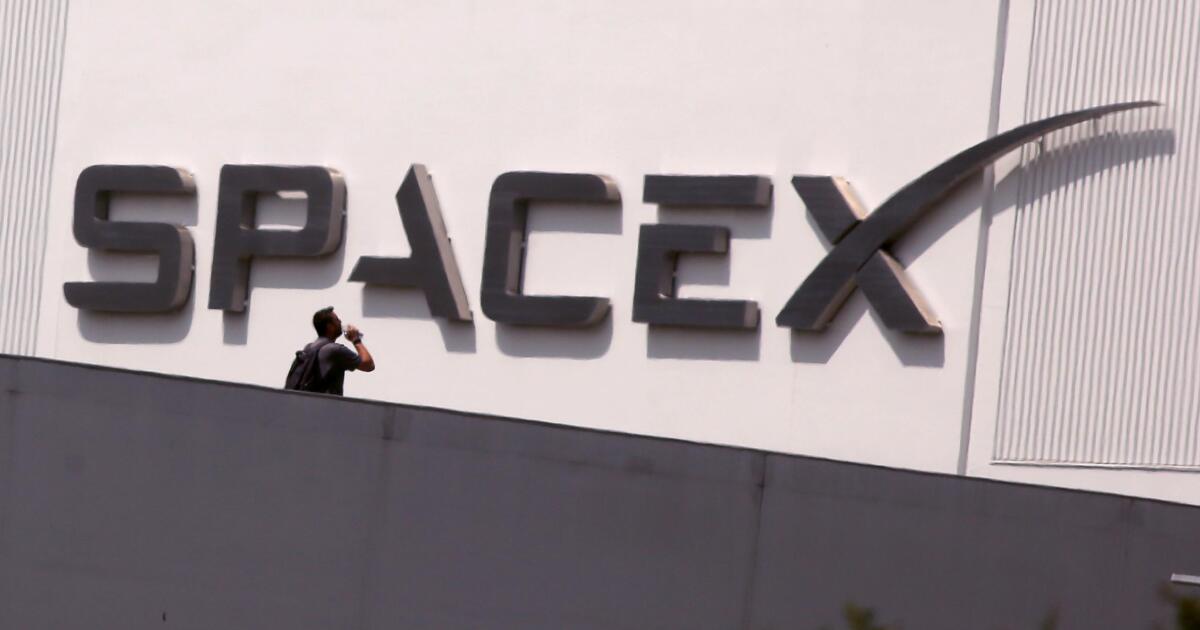
SpaceX, the once fledgling aerospace company that Elon Musk predicted had a slim chance of survival, reached new heights on Friday with a historic initial public offering.
Shares of SpaceX, trading under the ticker SPCX, closed the day at $160.95, 19% above the offering price, transforming it into one of the world’s most valuable companies with a $2.2-trillion market cap. The IPO also made the 54-year-old Musk the world’s first trillionaire.
The IPO capped a remarkable journey for a 24-year-old company that nearly shut down after a series of failed launches until its Falcon 1 rocket in 2008 orbited the earth and clinched a crucial NASA contract.
“It is certainly hard to believe that a little company that started in a warehouse in El Segundo is now going public with the largest IPO ever,” Musk told cheering employees at the company’s Texas headquarters.
The company raised $75 billion in the offering after selling 555 million shares at $135 to institutional and retail investors. With the shares in high demand, SpaceX could raise even more money.
It granted the nearly two dozen underwriters of the IPO, led by Goldman Sachs and Morgan Stanley, an additional 83 million shares, which could raise its total take to $86 billion.
The IPO is easily the largest on record, surpassing the 2019 offering by Saudi Aramco, Saudi Arabia’s state-owned oil giant, which raised $29.4 billion.
“They clearly priced it right, at least for one day. It should just make you optimistic for the markets for, especially for growth stocks,” said Robert Gruendyke, senior portfolio manager at Allspring Global Investments.
Musk has big plans for the company, which already dominates the world’s rocket launch business and is the leading satellite-based broadband provider with its Starlink service. It also has spent billions to buy spectrum for satellite-based mobile communications service.
Key to its efforts is Starship, a rocket being tested that is larger than the Saturn V that took astronauts to the moon. NASA is relying on it to return Americans there, while Musk eventually wants to fly it to Mars.
Musk sees it as crucial to his AI ambitions. Musk merged his xAI artificial intelligence company into SpaceX this year, with the combined entity recently announcing it was leasing computer power to rivals Anthropic and Google at two terrestrial data centers it has constructed.
Musk contends the future of AI lies in launching thousands of satellite data centers into space, where they will perform computer calculations while orbiting the Earth powered by a continuous supply of solar energy — a vision critics see as far-fetched.
However, Musk has proved skeptics wrong in the past, especially those who bet against Tesla when it conducted its $1.7-billion IPO in 2010. At the time, CNBC personality Jim Cramer called the $17 shares a “sell, sell, sell.”
While it took until 2020 for the stock to really take off as Model 3 sales grew, shares of the electric vehicle maker closed Friday at $406.43, giving Tesla a market capitalization of $1.5 trillion.
The SpaceX IPO was a gold mine for Musk’s venture capital backers in Silicon Valley, including Peter Thiel’s Founders Fund, Andreessen Horowitz and Sequoia Capital, which reportedly had stakes now valued at $10 billion or more.
It also made an estimated 4,000 current and former SpaceX employees millionaires, with another 400 achieving a net worth exceeding $100 million, said Andrew Benson, chief executive of Hill.com, an investment platform for trading stock in pre-IPO tech companies.
SpaceX is currently headquartered in south Texas after moving there in 2024 from Hawthorne, where it had its executive offices for years after expanding from its original El Segundo warehouse.
However, the company retains large operations in the South Bay city, where it has more than 6,000 employees out of at least 22,000 companywide. And it blasts off its Falcon 9 rocket regularly from Vandenberg Space Force Base in Santa Barbara County.
Benson said that he estimates the “vast majority” of current and former employees with more than $100 million in stock are in Southern California due to a stock awards plan that has favored length of tenure over an employee’s role.
“It’s just great to see employees be able to convert their labor into capital,” he said.
Even before Friday’s IPO, former employees of SpaceX have helped seed an aerospace and defense boom largely in Southern California, starting some 70 companies, including well-known startups Relativity Space, Impulse Space and K2 Space, according to the alumnifounders.com tracking site.
Van Espahbodi, co-founder of Generational Partners, a Los Angeles venture capital fund, expects the IPO will result in even more employees taking a crack at their own firms.
“It will allow many of them to pursue their vision,” he said. “I am aware of extreme cases where people took on credit card debt to maximize preserving their shares and not having to sell off, so that they can go and do their thing.”
Demand for the IPO shares was feverish on Wall Street.
The offering was reported to be oversubscribed four times over by big institutional investors. Blackrock, the New York money manager that is the world’s largest, was seeking to buy as much as $5 billion of the stock, Bloomberg reported.
That was despite concerns by critics that the company was overvalued and skepticism of a governance structure that puts few constraints on Musk. He holds special shares with 10 times the voting power of common shares that put him in control of the company’s board.
Investment research firm Morningstar placed a $780 billion valuation on SpaceX, focusing on its core rocket and Starlink broadband satellite businesses. It suggested investors wait a few months for the stock to settle before buying in.
With AI leaders OpenAi and Anthropic next lined up to conduct initial public offerings, Jim Chanos, a veteran short seller, likened the era to the first dot.com boom, which ended with a tech bust — except more extreme.
“This is much bigger,” he said, in a Bloomberg News interview.
Whatever the hype or unease about the offering, SpaceX reached the IPO after an impressive record of achievements that transformed the space business.
After outgrowing its original El Segundo space and moving into a massive former Northrop facility in 2007, the next year it launched its first successful rocket and set about developing its now workhorse Falcon 9.
The rocket, first launched in 2010, is partially reusable and is estimated to have lowered launch costs by some 95% compared to traditional single-use rockets.
It’s estimated the Falcon 9 accounted for more than 80% of the mass sent up into space last year — giving rise to the new generation of aerospace companies that rely on it.
It also has been key to the company’s Starlink business, which sent up its first satellites in 2019. SpaceX even launched 29 Starlinks on Friday. There are now more than 10,000 in orbit with plans for thousands more as demand grows.
Paul Habibi, a real estate lecturer at UCLA and principal of Grayslake Advisors in El Segundo, said he believes the IPO should boost the South Bay real estate market, as insiders granted stocks spend some of their newfound wealth.
“A lot of those folks are probably going to line up around the block to buy into neighborhoods like Manhattan Beach,” he said.
Meanwhile, retail investors placed more than $100 billion in orders, far more than had been reserved for them in the IPO, Bloomberg said. It was expected individual investors would end up with a 20% share of the offering.
Many of those retail buyers are devoted Musk fans and are assumed to want to hold the stock, but others were expected to have flipped the stock Friday for a quick profit.
Angela Lee, a professor at Columbia Business School, thinks the individual investors who think they will strike it rich could be mistaken — though she doesn’t entirely discount the possibility.
“I think they think it’s a golden ticket, when it’s more likely they are holding a lottery ticket,” she said.
Bloomberg News contributed to this report.

Betting is fundamentally about risk: You might win or you might lose. But what if you could always win?
Enter prediction markets, sites that let users bet on pretty much anything. Most of those users lose. But a savvy few have made a fortune using basic math.
Will Gavin Newsom win the 2028 Democratic presidential nomination?
Will the Fed raise interest rates in 2026?
Will Jannik Sinner win Wimbledon?
Here, you can bet “Yes” for 60 cents, implying a 60 percent probability; or you can bet “No” for 40 cents, implying a 40 percent probability. If either bet hits, you win $1.
Prediction sites like Polymarket and Kalshi offer many of the same markets. And usually, they post the same odds.
But sometimes the odds diverge — like in these markets about the 2028 Democratic presidential primary race.
In March, Kalshi had Gavin Newsom’s odds of winning at 29 percent, but Polymarket had them at 24 percent. These disparities are good news, if you’re gambling.
Taking both sides of the same bet is usually a wash. But not when there’s a price disparity.
If this sounds like printing money, that’s because it basically is. It’s called “arbitrage,” long a favorite strategy of quantitative traders trying to juice profits from the stock market with minimal risk. You buy something at a cheap price, and simultaneously sell it at a more expensive price. It’s a win-win.
Some bettors are now using the same strategy to rake in thousands of dollars from online prediction sites. Moving quickly, they can take advantage of price gaps between exchanges like Polymarket and Kalshi, or even between the prediction sites and sports-betting sites like DraftKings and FanDuel. The wider the spread, the bigger the potential profit.
Ryan Noel, 25, has built a career arbitrage-betting (or “arbing,” as he calls it) during sports games. He regularly makes more than 1,000 arbitrage bets per week on prediction sites like Polymarket, Kalshi, Novig and ProphetX, in addition to online sportsbooks, he said.
“Software shows me the price of every sort of market at the same time,” said Mr. Noel, who started arbing in late 2023, while working as an actuary, before quitting his job last year. So far, the strategy has netted him more than $1 million, he said. “I don’t care about sports at all. I think watching sports is the most boring thing you can do with your time. I’m a mathematician.”
Math skills are essential — but so are the right tools, said Aidan Gawlowski, a Chicago-based college student who started arbing last year before coding his own software to hunt down prediction-market price discrepancies. Mr. Noel buys software from OddsJam, Pick the Odds and Bookie Beats that tracks price changes across thousands of markets, flagging the possible arbitrage.
“I figured out that there was this opportunity,” said Mr. Gawlowski, 21, who said he started betting when he was 14. “You’re mathematically guaranteed to make money.”
Some moneymaking opportunities last longer than others. The arbitrage with Mr. Newsom? It existed, unexploited, for weeks. During that period, you could’ve bought “Yes” on Polymarket and “No” on Kalshi, for a roughly 3 percent profit. (The probability spread of around five percentage points, minus Kalshi’s transaction fee.)
But there are a couple of reasons that opportunity was an anomaly. For one, the market doesn’t resolve for two years. That’s a long time to tie up money you could invest elsewhere, said Abraham Wyner, a professor of statistics and data science at the Wharton School at Penn. There’s also additional risk that some bets carry more than others: What if the election gets weird, and the sites don’t agree on what defines a Newsom nomination? Then, you might lose both sides of your bet.
That was enough to deter Mr. Noel and Mr. Gawlowski, who spend most of their time arbing on sports. There are loads of sites that let users bet on sports, meaning more chances for price discrepancies. And during games, odds must constantly update to keep up with live developments. That process takes time, which can translate into arbitrage opportunities.
“You can make a significant amount of money on a big N.B.A. day,” Mr. Gawlowski said. During sports games, Mr. Noel’s price-tracking programs catch an arbitrage opportunity every minute or so, he said.
These discrepancies often emerge when casual users, betting based on vibes, move a market just a hair out of alignment. Then arb bettors pounce, and their actions end up evening the odds across the sites again.
Taking advantage of these short-lived opportunities is hard enough for you and me. But the window is closing even for bettors like Mr. Noel and Mr. Gawlowski, as big financial institutions get in on the action with automated bots that can trade faster than any human.
Sophisticated bots compare prices across platforms and identify arbitrage opportunities — just like software Mr. Noel and Mr. Gawlowski use — but they also execute trades, fast. Many prediction platforms let computerized agents place orders without a human. That gives institutions with the wherewithal to deploy bots effectively, and at scale, a huge edge.
Wall Street quant firms like Susquehanna International Group have been recruiting algorithmic traders specifically for prediction markets.
“In the prediction-market space, arbitrage is being dominated by bots,” said Ron Yurko, director of the Carnegie Mellon Sports Analytics Center. “Kalshi and Polymarket encourage it.”
Unlike traditional sportsbooks, prediction markets make money mainly from transaction fees — more transactions, more money. And because bots facilitate speedier trading at higher volumes, the sites have a financial incentive to allow them.
“The big institutions will take out a lot of the arbitrages,” said Nicholas Burgess, who builds and deploys bots for financial institutions, “but they’ll always leave the small ones for retail investors.”
Even so, what’s left is slim pickings. More bots mean the disparities between sites are smaller, and they vanish faster.
“Back in 2022, these arbitrage opportunities would last 30 seconds,” said Alex Llewellyn, 36, a professional sports bettor. “These days I execute bets in two to five seconds. And instead of 8 percent arbs, you generally see 4 to 5 percent.”
Prediction sites are also raising their fees, squeezing the tiny statistical edges that make arbitrage possible. When Polymarket added new fees in late March, Mr. Noel calculated that they would have cost him more than $30,000 a month, if he kept trading at his usual volume.
All this means that free money on prediction markets is probably out of reach now for many ordinary investors.
Prediction sites, awash in Wall Street money and bots, are heading toward the same fate as other major financial markets. One-tenth of the top one percent of accounts on Polymarket rake in more than two-thirds of the profits, a Wall Street Journal analysis found.
“You’re not betting against Joe Schmo anymore,” said Alex Monahan, the founder of OddsJam. “You’re betting against a quant firm with infinitely better technology than you.”

The U.S. Justice Department cleared the way for Paramount Skydance’s $111-billion purchase of Warner Bros. Discovery — a major milestone that moves David Ellison closer to his goal.
After a months-long review, Justice Department antitrust regulators on Friday concluded the combination would not violate federal anti-competition laws. Approval had been expected because President Trump — who has friendly ties with Ellison and his father, tech billionaire Larry Ellison — favors the deal.
The government stopped short of asking Paramount to make concessions or divestitures.
Antitrust regulators found that “based on the evidence received in its investigation … the transaction is not likely to result in harm to competition or American consumers,” the Justice Department division said in a statement.
They looked at whether the merger would give Paramount too much power in the streaming video on demand market; the linear television channel space and “studio development, production, or distribution of films for theatrical release” but did not find potential antitrust violations, the Justice Department said.
Ellison has promised to continue releasing 30 films a year with a combined Warner Bros.-Paramount studio.
“We are grateful for the Department of Justice’s thorough review of this transaction, as well as the work of the other agencies that have completed their reviews and provided clearance to date,” Paramount said in a statement.
“This deal is pro-competitive, resulting in a stronger company better positioned to compete against dominant technology platforms in an industry increasingly defined by intense competition for audiences, talent, technology, and investment. We remain focused on completing the transaction as soon as possible and delivering its benefits to consumers, creators, and the entertainment industry as a whole,” Paramount said.
Paramount wants to finalize its purchase by September.
With Friday’s victory, Paramount is staying on that timetable, but regulators in Europe and Britain have opened their own regulatory investigations and are expected to make their own determinations in the coming months.
Separately, California Atty. Gen. Rob Bonta and other state attorneys general have been scrutinizing the proposed merger, and are widely expected to file a lawsuit, perhaps as early as this month, to try to block it.
Paramount applied for the Justice Department’s approval in December — more than two months before it edged out Netflix in the Warner sweepstakes.
Buying Warner Bros. would allow Paramount — Hollywood’s smallest major company — to bulk up with such prestigious properties as HBO, CNN, HGTV and Food Network. Those would be combined with properties Paramount already owns, including CBS, Comedy Central, Nickelodeon and MTV.
The deal would put two historic film studios, and two prominent news organizations under the same roof. It would give Paramount four streaming services, including HBO Max, and dozens of cable channels.
Justice Department approval could complicate efforts by Bonta and other state attorneys general to block the deal. Should Bonta or others sue, they would have to convince a judge that the nation’s top antitrust regulators failed to make a proper finding.
That may pose a high bar for the state officials, who are facing political pressure to stop the deal.
“State AGs must block this merger,” U.S. Sen. Elizabeth Warren (D-Mass.) said in a statement Friday, adding that the Justice Department‘s approval was “terrible news for every American who doesn’t want Trump-aligned billionaires to control what they watch and how much they pay.”
-

 Wisconsin4 minutes ago
Minnesota man convicted of ‘tree stand killings’ of 6 Wisconsin hunters dies
-

 West Virginia11 minutes ago
Electrifying 2027 RB Khamoni Williams Commits to West Virginia
-

 Wyoming14 minutes ago
‘Pride Lives Here’: Belonging, visibility, identity in Casper’s queer community
-

 Crypto19 minutes ago
South Korea Police Detain Bithumb CEO Lee Jae-won as Bribery Probe Widens After Raid
-

 Finance26 minutes ago
2 Awkward Talks to Have With Your Kids Before They’re 18 (Not ‘That’ One)
-

 Fitness29 minutes ago
Best Fitness Trackers 2026 | Trainer Tested – Forbes Vetted
-

 Movie Reviews41 minutes ago
TODAY Film Critic Gene Shalit Dies After ‘100 Years of an Amazing Life’
-

 World49 minutes ago
Kristin Scott Thomas Receives Crystal Nymph From Prince Albert II at Monte-Carlo Television Festival Opening

