Business
McDonald’s E. coli outbreak tied to fresh onions is over


An E. coli outbreak that hit McDonald’s Corp. is over, the U.S. Centers for Disease Control and Prevention said Tuesday.
Fresh, slivered onions at McDonald’s were the likely source of the outbreak, the CDC said, in line with previous reports. Beef had been ruled out earlier as the potential cause.
The Food and Drug Administration also said Tuesday that it had closed its investigation. The announcements give “certainty and validation from leading health authorities, which will be meaningful for our customers and communities,” McDonald’s said.
A total of 104 people in 14 states reported illnesses, according to the CDC. However, the number of sickened individuals probably was much larger because many recover without medical care and aren’t tested for E. coli. McDonald’s had stopped sourcing onions from a Colorado facility of supplier Taylor Farms, which issued a recall after the outbreak.
It’s not yet clear how or at what stage E. coli entered the supply chain, a McDonald’s spokesperson said in a media briefing. That’s why the chain has stopped sourcing from both the facility that processed the onions and the farm where they originated, the representative said.
McDonald’s said it’s working with industry groups and health officials to see if additional checks are needed for produce, adding that it’s confident in its supply chain processes.
The chain disclosed the outbreak on Oct. 22 and temporarily yanked Quarter Pounders, which have the slivered onions, from many restaurants. It also pledged to spend $100 million to revive sales and support franchisees after the E. coli news scared away many diners.
In a memo sent to employees and franchisees that was seen by Bloomberg News, McDonald’s said the company was investing $35 million in marketing and ads. Additionally, the company told Bloomberg it is spending $65 million on programs that support franchisees, such as deferrals on rent and royalties.
Lately, the company has been seeking to bring customers in with the limited-time-offer McRib and the announcement of a new value menu.
Foot traffic and sales took a beating after officials announced they were investigating an E. coli outbreak linked to the fresh slivered onions.
In the week that ended Oct. 27, sales fell nearly 12% compared with the previous week, according to Bloomberg Second Measure data, which tracks debit and credit card transactions by U.S. consumers.
The outbreak came as McDonald’s had been working to overcome slow sales with splashy promotions and steep discounts. Its $5 value meal resonated with low-income customers in the U.S. and drove guest counts in the third quarter, before the chain was rocked by E. coli.
Shares of the company, which finished trading Tuesday up 0.7% at $294.50, are nearly flat for the year.






Buffeted by upheavals in the tech and entertainment industries, California led the nation in job cuts last year — but the pace of layoffs slowed sharply in December both in the state and nationwide as company hiring plans picked up.
State employers announced just 2,739 layoffs in December, well down from the 14,288 they said they would cut in November.
Still, with the exception of Washington, D.C., California led all states in 2025 with 175,761 job losses, according to a report from outplacement firm Challenger, Gray & Christmas.
The slowdown in December losses was experienced nationwide, where U.S.-based employers announced 35,553 job cuts for the month. That was down 50% from the 71,321 job cuts announced in November and down 8% from the 38,792 job cuts reported the same month last year.
That amounted to good news in a year that saw the nation’s economy suffer through 1.2 million layoffs — the most since the economic destruction caused by the pandemic, which led to 2.3 million job losses in 2020, according to the report.
“The year closed with the fewest announced layoff plans all year. While December is typically slow, this coupled with higher hiring plans, is a positive sign after a year of high job cutting plans,” Andy Challenger, a workplace expert at the firm, said in a statement.
The California economy was lashed all year by tumult in Hollywood, which has been hit by a slowdown in filming as well as media and entertainment industry consolidation.
Meanwhile, the advent of artificial intelligence boosted capital spending in Silicon Valley at the expense of jobs, though Challenger said the losses were also the result of “overhiring over the last decade.”
Workers were laid off by the thousands at Intel, Salesforce, Meta, Paramount, Walt Disney Co. and elsewhere. Apple even announced its own rare round of cuts.
The 75,506 job losses in technology California experienced last year dwarfed every other industry, according to Challenger’s data. It attributed 10,908 of the cuts to AI.
Entertainment, leisure and media combined saw 17,343 announced layoffs.
The losses pushed the state’s unemployment rate up a tenth of a point to 5.6% in September, the highest in the nation aside from Washington, D.C., according to the U.S. Bureau of Labor Statistics data released in December.
September also marked the fourth straight month the state lost jobs, though they only amounted to 4,500 in September, according to the bureau data.
Nationally, Washington, D.C., took the biggest jobs hits last year due to Elon Musk’s initiative to purge the federal workforce. The district’s 303,778 announced job losses dwarfed those of California, though there none reported for December.
The government sector led all industries last year with job losses of 308,167 nationwide, while technology led in private sector job cuts with 154,445. Other sector with losses approaching 100,000 were warehousing and retail.
Despite the attention focused on President Trump’s tariffs regime, they were only cited nationally for 7,908 job cuts last year, with none announced in December.
New York experienced 109,030 announced losses, the second most of any state. Georgia was third at 80,893.
These latest figures follow a report from the Labor Department this week that businesses and government agencies posted 7.1 million open jobs at the end of November, down from 7.4 million in October. Layoffs also dropped indicating the economy is experiencing a “low-hire, low-fire” job market.
At the same time, the U.S. economy grew at an 4.3% annual rate in the third quarter, surprising economists with the fastest expansion in two years, as consumer and government spending, as well as exports, grew. However, the government shutdown, which halted data collection, may have distorted the results.
Still, December’s announced hiring plans also were positive. Last month, employers nationwide said they would hire 10,496 employees, the highest total for the month since 2022 when they announced plans to hire 51,693 workers, Challenger said.
The December plans contrasted sharply with the 12-month figure. Last year, U.S. employers announced they would hire 507,647 workers, down 34% from 2024.
The Associated Press contributed to this report.
That shrill, high-pitched squeal you’ve been hearing lately? Don’t bother trying to adjust your TV or headphones, or calling your doctor for a tinnitis check. It’s just America’s beleaguered billionaires keening over a proposal in California to impose a one-time wealth tax of up to 5% on fortunes of more than $1 billion.
The billionaires lobby has been hitting social media in force to decry the proposed voter initiative, which has only started down the path toward an appearance on November’s state ballot. Supporters say it could raise $100 billion over five years, to be spent mostly on public education, food assistance and California’s medicaid program, which face severe cutbacks thanks to federal budget-cutting.
As my colleagues Seema Mehta and Caroline Petrow-Cohen report, the measure has the potential to become a political flash point.
The rich will scream The pundits and editorial-board writers will warn of dire consequences…a stock market crash, a depression, unemployment, and so on. Notice that the people making such objections would have something personal to lose.
— Donald Trump advocating a wealth tax, in 2000
Its well-heeled critics include Jessie Powell, co-founder of the Bay Area-based crypto exchange platform Kraken, who warned on X that billionaires would flee the state, taking with them “all of their spending, hobbies, philanthropy and jobs.”
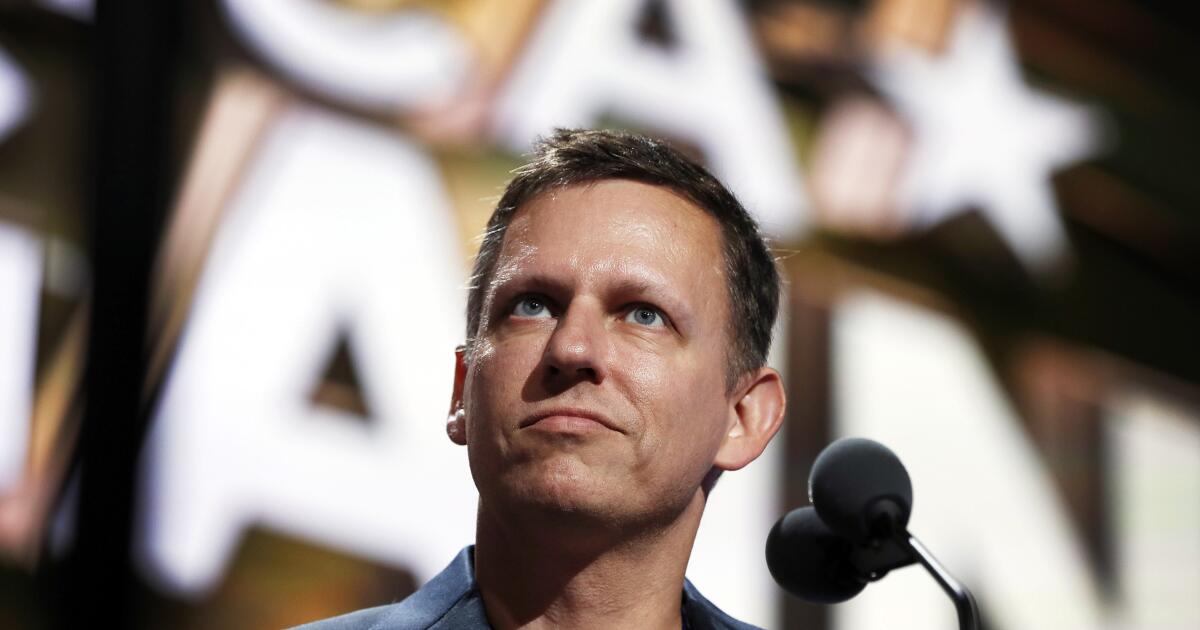
Venture investor Chamath Palihapitiya claimed on X that “$500 billion in wealth has already fled the state” but didn’t name names. San Francisco venture investor Ron Conway has seeded the opposition coffers with a $100,000 contribution. And billionaire Peter Thiel disclosed on Dec. 31 that he has opened a new office in Miami, in a state that not only has no wealth tax but no income tax.
Already Gov. Gavin Newsom, a likely candidate for the Democratic nomination for president, has warned against the tax, arguing that it’s impractical for one state to go it alone when the wealthy can pick up and move to any other state to evade it.
On the other hand. Rep. Ro Khanna (D-Fremont), usually an ally of Silicon Valley entrepreneurs, supports the measure: “It’s a matter of values,” he posted on X. “We believe billionaires can pay a modest wealth tax so working-class Californians have Medicaid.”
Not every billionaire has decried the wealth tax idea. Jensen Huang, the CEO of the soaring AI chip company Nvidia — and whose estimated net worth is more than $160 billion — expressed indifference about the California proposal during an interview with Bloomberg on Tuesday.
“We chose to live in Silicon Valley and whatever taxes, I guess, they would like to apply, so be it,” he said. “I’m perfectly fine with it. It never crossed my mind once.”
And in 2000, another plutocrat well known to Americans proposed a one-time tax of 14.25% on taxpayers with a net worth of $10 million or more. That was Donald Trump, in a book-length campaign manifesto titled “The America We Deserve.”
“The rich will scream,” Trump predicted. “The pundits and editorial-board writers will warn of dire consequences … a stock market crash, a depression, unemployment, and so on. Notice that the people making such objections would have something personal to lose.” (Thanks due to Tim Noah of the New Republic for unearthing this gem.)
Trump’s book appeared while he was contemplating his first presidential campaign, in which he presented himself as a defender of the ordinary American. His ghostwriter, Dave Shiflett, later confessed that he regarded the book as “my first published work of fiction.”
All that said, let’s take a closer look at the proposed initiative and its backers’ motivation. It’s gaining nationwide attention because California has more billionaires than any other state.
The California measure’s principal sponsor, the Service Employees International Union, and its allies will have to gather nearly 875,000 signatures of registered voters by June 24 to reach the ballot. The opposition is gearing up behind the catchphrase “Stop the Squeeze” — an odd choice for a rallying cry, since it’s hard to imagine the average voter getting all het up about multibillionaires getting squoze.
The measure would exempt directly held real estate, pensions and retirement accounts from the calculation of net worth. The tax can be paid over five years (with a fee charged for deferrals). It applies to billionaires residing in California as of Jan. 1, 2026; their net worth would be assessed as of Dec. 31 this year. The measure’s drafters estimate that about 200 of the wealthiest California households would be subject to the tax.
The initiative is explicitly designed to claw back some of the tax breaks that billionaires received from the recent budget bill passed by the Republican-dominated Congress and signed on July 4 by President Trump. The so-called One Big Beautiful Bill Act will funnel as much as $1 trillion in tax benefits to the wealthy over the next decade, while blowing a hole in state and local budgets for healthcare and other needs.
California will lose about $19 billion a year for Medi-Cal alone. According to the measure’s drafters, that could mean the loss of Medi-Cal coverage for as many as 1.6 million Californians. Even those who retain their eligibility will have to pay more out of pocket due to provisions in the budget bill.
The measure’s critics observe that wealth taxes have had something of a checkered history worldwide, although they often paint a more dire picture than the record reflects. Twelve European countries imposed broad-based wealth taxes as recently as 1995, but these have been repealed by eight of them.
According to the Tax Foundation Europe, that leaves wealth taxes in effect only in Colombia, Norway, Spain and Switzerland. But that’s not exactly correct. Wealth taxes still exist in France and Italy, where they’re applied there to real estate as property taxes, and in Belgium, where they’re levied on securities accounts valued at more than 1 million euros, or about $1.16 million.
Switzerland’s wealth tax is by far the oldest, having been enacted in 1840. It’s levied annually by individual cantons on all residents, at rates reaching up to about 1% of net worth, after deductions and exclusions for certain categories of assets.
The European countries that repealed their wealth taxes did so for varied reasons. Most were responding at least partially to special pleading by the wealthy, who threatened to relocate to friendlier jurisdictions in a continent-wide low-tax contest.
That’s the principal threat raised by opponents of the California proposal. But there are grounds to question whether the effect would be so stark. For one thing, notes UC Berkeley economist Gabriel Zucman, an advocate of wealth taxes generally, “it has become impossible to avoid the tax by leaving the state.” Billionaires who hadn’t already established residency elsewhere by Jan. 1 this year have missed a crucial deadline.
The initiative’s drafters question the assumption that millionaires invariably move from high- to low-tax jurisdictions, citing several studies, including one from 2016 based on IRS statistics showing that elites are generally unwilling to move to exploit tax advantages across state lines.
As for the argument that billionaires could avoid the tax by moving assets out of the state, “the location of the assets doesn’t matter,” Zucman told me by email. “Taxpayers would be liable for the tax on their worldwide assets.”
One issue raised by the burgeoning controversy over the California proposal is how to extract a fair share of public revenue from plutocrats, whose wealth has surged higher while their effective tax rates have declined to historically low levels.
There can be no doubt that in tax terms, America’s wealthiest families make out like bandits. The total effective tax rate of the 400 richest U.S. households, according to an analysis by Zucman, his UC Berkeley colleague Emmanuel Saez, and their co-authors, “averaged 24% in 2018-2020 compared with 30% for the full population and 45% for top labor income earners.” This is largely due to the preferences granted by the federal capital gains tax, which is levied only when a taxable asset is sold and even then at a lower rate than the rate on wage income.
The late tax expert at USC, Ed Kleinbard, used to describe the capital gains tax as our only voluntary tax, since wealthy families can avoid selling their stocks and bonds indefinitely but can borrow against them, tax-free, for funds to live on; if they die before selling, the imputed value of their holdings is “stepped up” to their value at their passing, extinguishing forever what could be decades of embedded tax liabilities. (The practice has been labeled “buy, borrow, die.”)
Californians have recently voted to redress the increasing inequality of our tax system. Voters approved what was dubbed a “millionaires tax” in 2012, imposing a surcharge of 1% to 3% on incomes over $263,000 (for joint filers, $526,000). In 2016, voters extended the surcharge to 2030 from the original phase-out date of 2016. That measure passed overwhelmingly, by a 2-to-1 majority, easily surpassing that of the original initiative.
But it may be that California’s ability to tax billionaires’ income has been pretty much tapped out. Some have argued that one way to obtain more revenue from wealthy households is to eliminate any preferential rate on capital gains and other investment income, but that’s not an option for California, since the state doesn’t offer a preferential tax rate on that income, unlike the federal government and many other states. The unearned income is taxed at the same rate as wages.
One virtue of the California proposal is that, even if it fails to get enacted or even to reach the ballot, it may trigger more discussion of options for taxing plutocratic fortunes. One suggestion came from hedge fund operator Bill Ackman, who reviled the California proposal on X as “an expropriation of private property” (though he’s not a California resident himself), but acknowledged that “one shouldn’t be able to live and spend like a billionaire and pay no tax.”
Ackman’s idea is to make loans backed by stock holdings taxable, “as if you sold the same dollar amount of stock as the loan amount.” That would eliminate the free ride that investors can enjoy by borrowing against their holdings.
The debate over the California wealth tax may well hinge on delving into plutocrat psychology. Will they just pay the bill, as Huang implies would be his choice? Or relocate from California out of pique?
California is still a magnet for the ambitious entrepreneur, and the drafters of the initiative have tried to preserve its allure. Those who come into the state after Jan. 1 to pursue their ambitious dreams of entrepreneurship would be exempt, as would residents whose billion-dollar fortunes came after that date. There may be better ways for California to capture more revenue from the state’s population of multibillionaires, but a one-time limited tax seems, at this moment, to be as good as any.

Google and Character.AI, a California startup, have agreed to settle several lawsuits that allege artificial intelligence-powered chatbots harmed the mental health of teenagers.
Court documents filed this week show that the companies are finalizing settlements in lawsuits in which families accused them of not putting in enough safeguards before publicly releasing AI chatbots. Families in multiple states including Colorado, Florida, Texas and New York sued the companies.
Character.AI declined to comment on the settlements. Google didn’t immediately respond to a request for comment.
The settlements are the latest development in what has become a big issue for major tech companies as they release AI-powered products.
Suicide prevention and crisis counseling resources
If you or someone you know is struggling with suicidal thoughts, seek help from a professional and call 9-8-8. The United States’ first nationwide three-digit mental health crisis hotline 988 will connect callers with trained mental health counselors. Text “HOME” to 741741 in the U.S. and Canada to reach the Crisis Text Line.
Last year, California parents sued ChatGPT maker OpenAI after their son Adam Raine died by suicide. ChatGPT, the lawsuit alleged, provided information about suicide methods, including the one the teen used to kill himself. OpenAI has said it takes safety seriously and rolled out new parental controls on ChatGPT.
The lawsuits have spurred more scrutiny from parents, child safety advocates and lawmakers, including in California, who passed new laws last year aimed at making chatbots safer. Teens are increasingly using chatbots both at school and at home, but some have spilled some of their darkest thoughts to virtual characters.
“We cannot allow AI companies to put the lives of other children in danger. We’re pleased to see these families, some of whom have suffered the ultimate loss, receive some small measure of justice,” said Haley Hinkle, policy counsel for Fairplay, a nonprofit dedicated to helping children, in a statement. “But we must not view this settlement as an ending. We have only just begun to see the harm that AI will cause to children if it remains unregulated.”
One of the most high-profile lawsuits involved Florida mom Megan Garcia, who sued Character.AI as well as Google and its parent company, Alphabet, in 2024 after her 14-year-old son, Sewell Setzer III, took his own life.
The teenager started talking to chatbots on Character.AI, where people can create virtual characters based on fictional or real people. He felt like he had fallen in love with a chatbot named after Daenerys Targaryen, a main character from the “Game of Thrones” television series, according to the lawsuit.
Garcia alleged in the lawsuit that various chatbots her son was talking to harmed his mental health, and Character.AI failed to notify her or offer help when he expressed suicidal thoughts.
“The Parties request that this matter be stayed so that the Parties may draft, finalize, and execute formal settlement documents,” according to a notice filed on Wednesday in a federal court in Florida.
Parents also sued Google and its parent company because Character.AI founders Noam Shazeer and Daniel De Freitas have ties to the search giant. After leaving and co-founding Character.AI in Menlo Park, Calif., both rejoined Google’s AI unit.
Google has previously said that Character.AI is a separate company and the search giant never “had a role in designing or managing their AI model or technologies” or used them in its products.
Character.AI has more than 20 million monthly active users. Last year, the company named a new chief executive and said it would ban users under 18 from having “open-ended” conversations with its chatbots and is working on a new experience for young people.

National Park Service will void passes with stickers over Trump’s face

Portland agitators clash with police after 2 shot by federal immigration agent

Pam Bondi dispatches federal prosecutors to Minnesota following Somali fraud allegations

Republican senators hit border, touting tougher security and tax cuts, in 2026 kickoff

Naked woman allegedly assaults deputy while intoxicated, claims she was ‘trying to be a mermaid’

Florida High School Football Rankings: Top 25 teams – Oct. 21

Cleary's 21 help Le Moyne down Central Connecticut State 69-64 in OT

How old is Bo Nix? What to know about Oregon quarterback ahead of 2024 NFL Draft

99th annual Pony Swim held in Virginia

Video: ‘It Didn’t Have to Happen This Way:’ U.Va. Faculty Call for Review of Police Response to Protests
National Park Service will void passes with stickers over Trump’s face

Trump plans to meet with Venezuela opposition leader Maria Corina Machado next week

Trump says meeting Iran’s ‘Crown Prince’ Pahlavi would not be appropriate

Federal immigration agents shoot 2 people in Portland, Oregon, police say

“This is the Berlin Wall moment in Iran”: Masih Alinejad on the nationwide protests
-

 Detroit, MI6 days ago
2 hospitalized after shooting on Lodge Freeway in Detroit
-

 Technology3 days ago
Power bank feature creep is out of control
-

 Dallas, TX4 days ago
Defensive coordinator candidates who could improve Cowboys’ brutal secondary in 2026
-

 Health5 days ago
Viral New Year reset routine is helping people adopt healthier habits
-

 Nebraska2 days ago
Oregon State LB transfer Dexter Foster commits to Nebraska
-

 Iowa3 days ago
Pat McAfee praises Audi Crooks, plays hype song for Iowa State star
-
 Nebraska3 days ago
Nebraska-based pizza chain Godfather’s Pizza is set to open a new location in Queen Creek
-
 Entertainment2 days ago
Spotify digs in on podcasts with new Hollywood studios