Business
L.A. wildfires prompt surge in local home furnishings market


The day after the Palisades fire broke out, luxury staging company Vesta began manufacturing beds around the clock.
Vesta produced 1,000 that first week from its factory near downtown Los Angeles. The beds — along with the company’s supply of sofas, dining tables, outdoor furniture, area rugs, linens, kitchenware and even faux plants — were quickly rented by displaced wildfire victims.
“We’re doing basically toothbrush-ready homes. Everything needed to get back up and running,” co-founder Brett Baer said. Some clients had lost all of their possessions except “the pair of shoes that they got out of the fire with.”
The January wildfires created a highly unusual situation in the local home furnishings market. Thousands of residential structures and everything inside them burned down, setting off a frantic scramble to find new lodging and replace the entirety of a home’s contents.
Many of those items, such as furniture and appliances, are typically big-ticket purchases with long life cycles, making rebuying an infrequent occurrence under normal circumstances.
Now, sellers of furniture and other home decor around L.A. are seeing an unexpected rise in sales. It’s a trend they anticipate will accelerate in the months to come as those affected by the fires receive insurance payouts and move out of temporary accommodations, where many still remain, into permanent residences.
“Natural disasters such as the California fires, floods, hurricanes, etc., create incredible spikes in demand,” said Ray Allegrezza, a director for the International Home Furnishings Representatives Assn. “West Coast furniture retailers are realizing a windfall of sorts…. It is a shame that the business had to come as a result of this disaster.”
About two weeks after the start of the Palisades and Eaton blazes, Ikea stores in Los Angeles County began noticing an uptick in sales for sleep and kitchen basics, said Gus Tinajero, the company’s Los Angeles area manager.
Ikea stores in the L.A. area saw an increase in sales of bedding and kitchenware after the fires.
(Adam Tschorn / Los Angeles Times)
“Once we started to see the trend, we started to react,” he said, which included increasing orders from its Kern County distribution center and allocating more in-store floor space and pallets for coveted essentials such as comforters.
“We have planned for a prolonged period where we see high demand in those categories,” said Tinajero, who was Ikea’s area manager in Houston when Hurricane Harvey hit in 2017. “It’s not something you ever hope for or plan for, but the reality is it’s [thousands of destroyed] structures — of course you see that there’s going to be a need in the market.”
By far, the biggest impact of the January wildfires was on homes.
In all, just under 13,000 households were displaced by the Palisades and Eaton fires. They came from nearly 9,700 single-family homes and condominiums, almost 700 apartment units, more than 2,000 units of duplexes and bungalow courts and 373 mobile homes that Cal Fire determined were either destroyed or heavily damaged.

A firefighting plane makes a drop on a burning home in Pacific Palisades on Jan. 7.
(Brian van der Brug / Los Angeles Times)
Related businesses, such as interior designers and home staging companies, are also mobilizing to meet the unprecedented demand. Many have started to offer turnkey packages, outfitting new homes from top to bottom.
Vesta’s swift pivot to mass-manufacturing beds and other furniture and renting its stock of lightly used home goods has upended its business model: The company’s luxury leasing division now accounts for more than 90% of its sales, a massive jump from just 15% at the start of the year. Baer said Vesta is on track to take in $100 million in revenue this year.
On a recent Tuesday morning, Baer made his way through Vesta’s 6,000-square-foot Florence factory, maneuvering past stacks of upholstered headboards and newly built armchairs wrapped in green plastic as workers sanded down wooden tables and benches.

Brett Baer, co-founder of Vesta, at the company’s Florence factory.
(Carlin Stiehl / For The Times)
Vesta was founded in 2017 and serves affluent customers in L.A., San Francisco, New York and Miami. Today it has 360 employees, 30 of them hired since the wildfires began to keep up with the surge in business.
Originally focused on residential and commercial staging, Vesta branched out to include interior design, retail sales and short-term rentals; it designs all of its furniture, producing half in L.A. and outsourcing the rest to third-party manufacturers.
The company doesn’t lease its pieces a la carte, instead offering tailored whole-home packages with on-site setup. Many wildfire victims have been forced to downsize from large homes in Pacific Palisades to condos and apartments, so Vesta has been working with customers to adapt to smaller-format spaces, like sourcing trundle beds for families with young children.
“For displaced people, we’re doing anything between like 1,000 square feet, which may be a couple thousand dollars a month, to one that’s 20,000 square feet in Brentwood that’ll probably be $20,000 a month to rent everything: furniture, cutlery, linens, pillows, mattresses,” Baer said. “A lot of people are like, ‘I just want to move into a completely done house, down to toilet paper holders.’”
The revenue boost comes after a sluggish period for the furniture industry, which experienced a boom during the pandemic as people quarantined and spent heavily on sprucing up their homes.
That tapered off in recent years due to a number of factors including shifts in consumer spending, high inflation and a slowdown in the housing market, leading to a surplus of merchandise for many home furnishing retailers going into this year.
“Fortunately for consumers in distress and needing furniture in short order, inventory levels are still abundant,” Allegrezza said.
Consumer spending for residential furniture and bedding fell 3% last year to $116.1 billion, according to the American Home Furnishings Alliance. The number of production workers for furniture and related products fell to 235,500 people from 244,800 in 2023, the group said.
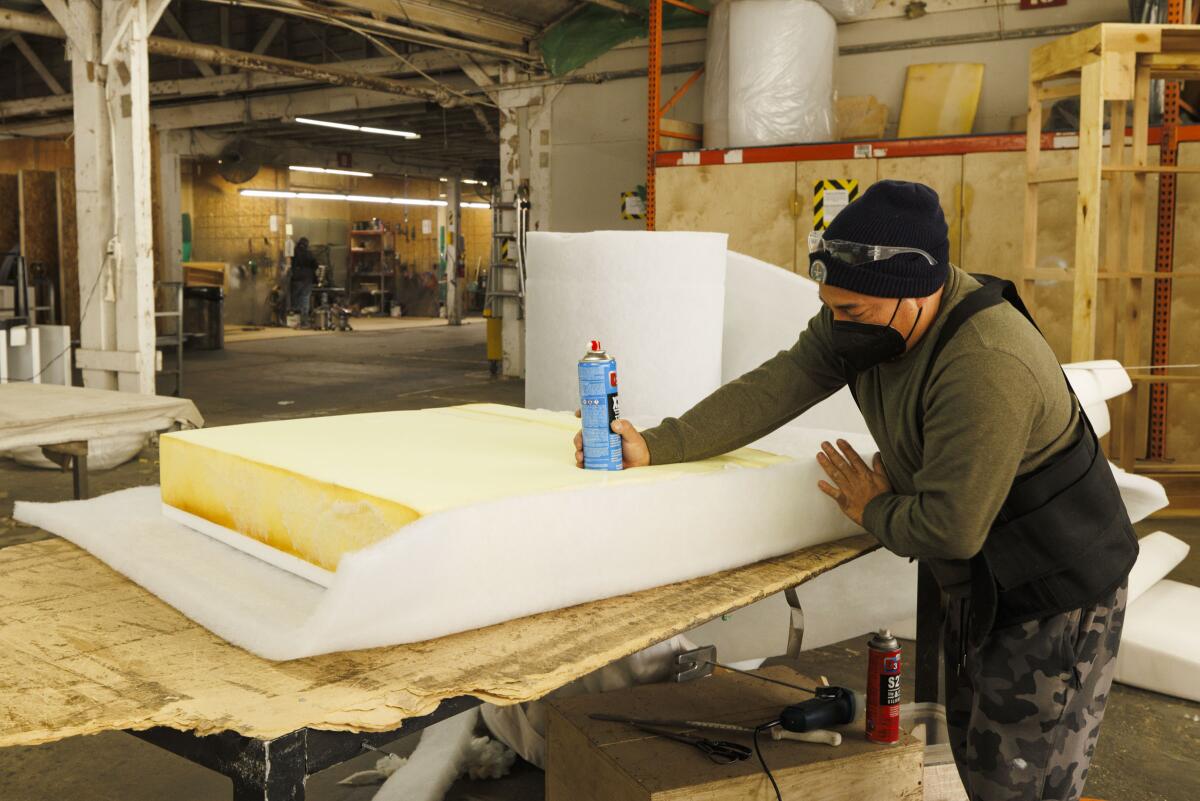
A Vesta worker builds a sofa cushion at the company’s factory.
(Carlin Stiehl / For The Times)
Later that morning, at Vesta’s cavernous warehouse in Pico Rivera, workers packaged and loaded furniture onto trucks as the company’s interior designers browsed the aisles for items including lamps, board games, stuffed animals, Peloton bikes and framed art.
The last couple of months have been “incredibly turbulent” for the company, Baer said. Thirty-four homes that were staged with Vesta’s furnishings burned down or were damaged in the Palisades fire, and he said insurance would cover only about 70% of the losses.
“It’s been a double-edged sword. We took a huge hit there,” he said. “But then there’s like this regeneration on the other side: Everything on the Westside is selling. Most of those people want furniture, too. We’re trying to replenish all that inventory as fast as we can.”



Ships near the Strait of Hormuz before and after attacks began
Every day, around 80 oil and gas tankers typically pass through the Strait of Hormuz, the narrow waterway off Iran’s southern coast that carries a fifth of the world’s oil and a significant amount of natural gas.
On Monday, just two oil and gas tankers appear to have crossed the strait, according to a New York Times analysis of shipping activity from Kpler, an industry data firm. Since then, one tanker passed through.
“It’s a de facto closure,” said Dan Pickering, chief investment officer of Pickering Energy Partners, a Houston financial services firm. “You’ve got a significant number of vessels on either side of the strait but no one is willing to go through.”
Tankers have been staying away from Hormuz since the U.S.-Israeli attacks on Iran that began on Saturday. A prolonged conflict could ripple broadly across the global economy, threatening the energy supplies of countries halfway around the world and stoking inflation.
International oil prices have climbed 12 percent since the fighting began, trading Tuesday around $81 a barrel, and natural gas prices have surged in Europe and in Asia.
A senior Iranian military official threatened on Monday to “set on fire” any ships traveling through the Strait of Hormuz. Vessels in the region have already come under attack. Several oil and gas facilities have also been struck or affected by nearby shelling, though the damage did not initially appear to be catastrophic.
Where ships and energy facilities have been damaged
A fire broke out Tuesday at a major energy hub in Fujairah, United Arab Emirates, from the falling debris of a downed drone, the authorities said. On Monday, Qatar halted production of liquefied natural gas, or fuel that has been cooled so that it can be transported on ships, after attacks on its facilities.
The sharp reduction in tanker traffic is reducing the supply of oil and gas to world markets, pushing up prices for both commodities. And the longer that ships stay away from the Strait of Hormuz, the less oil and gas get out to the world, which could raise prices even more.
Shipping companies have paused their tankers to protect their crew and cargo, and because insurance companies are charging significantly more to cover vessels in the conflict area.
On Tuesday, President Trump said that “if necessary,” the U.S. Navy would begin escorting tankers through the strait. He also said a U.S. government agency would begin offering “political risk insurance” to shipping lines in the area.
In addition to tankers, other large vessels regularly go through the strait, including car carriers and container ships. In normal conditions, nearly 160 make the trip each day.
Some ships in the region turn off the devices that broadcast their positions, while others transmit false locations — making it hard to give a full picture of the traffic in the strait.
The Shiva is a small oil tanker that has repeatedly faked its location, according to TankerTrackers.com, which tracks global oil shipments. It is suspected of carrying sanctioned Iranian oil, according to Kpler. The Shiva was one of the two tankers that crossed the strait on Monday.
The oil and gas that typically move through the strait come from big producing countries like Saudi Arabia, Iraq, Iran and United Arab Emirates, and are exported around the world.
Where tankers moving through the Strait have traveled
In 2024, more than 80 percent of the oil and gas transported through the Strait of Hormuz went to Asia. China, India, Japan and South Korea were the top importers, according to the U.S. Energy Information Administration.
Countries have energy stockpiles that could last them into the coming months, but a continued shutdown of the strait could damage their economies.
Several big disruptions have roiled supply chains in recent years, but the tanker standstill in the Strait of Hormuz could have an outsize impact.

Paramount Skydance’s jubilation over its come-from-behind victory to claim Warner Bros. Discovery has entered a new phase:
Call it the deal-debt hangover.
Two major ratings agencies have raised concerns about Paramount’s credit because of the enormous debt the David Ellison-led company will have to shoulder — at least $79 billion — once it absorbs the larger Warner Bros. Discovery, bringing CNN, HBO, TBS and Cartoon Network into the Paramount fold.
Fitch Ratings said Monday that it placed Paramount on its “negative” ratings watch, and downgraded its credit to BB+ from BBB-, which puts the company’s credit into “junk” territory. Fitch said it took action due to “uncertainty” surrounding Paramount’s $110-billion deal for Warner Bros. Discovery, which the boards of both companies approved on Friday.
S&P Global Ratings took similar action.
To finance the Warner takeover, Ellison’s billionaire father, Larry Ellison, has agreed to guarantee the $45.7 billion in equity needed. Bank of America, Citibank and Apollo Global have agreed to provide Paramount with more than $54 billion in debt financing.
“Potential credit risks include the prospective debt-funded structure, Fitch’s expectation of materially elevated leverage and limited visibility on post-transaction financial policy and capital structure,” Fitch said.
Late last week, Paramount sent $2.8 billion to Netflix as a “termination fee” to officially end the streaming giant’s pursuit of Warner Bros. That payment paved the way for Warner and Paramount’s board to enter into the new merger agreement.
Paramount hopes the merger will be wrapped up by the end of September. It needs the approval of Warner Bros. Discovery shareholders and regulators, including the European Union.
Paramount executives acknowledged this week the new company would emerge with $79 billion in debt — a considerably higher total than what Warner Bros. Discovery had following its spinoff from AT&T. That 2022 transaction left Warner Bros. Discovery with nearly $55 billion of debt, a burden that led to endless waves of cost-cutting, including thousands of layoffs and dozens of canceled projects.
Warner still has $33.5 billion in debt, a lingering legacy that will be passed on to Paramount.
Paramount plans to restructure about $15 billion in Warner Bros. Discovery’s existing debt.
Paramount CEO David Ellison at a 2024 movie premiere for a Netflix show.
(Evan Agostini / Invision / AP)
Paramount told Wall Street it would find more than $6 billion in cost cuts or “synergies” within three years — a number that has weighed heavily on entertainment industry workers, particularly in Los Angeles.
Hollywood already is reeling from previous mergers in addition to a sharp pullback in film and television production locally as filmmakers chase tax credits offered overseas and in other states, including New York and New Jersey.
Some entertainment executives, including Netflix Co-Chief Executive Ted Sarandos, have speculated that Paramount will need to find more than $10 billion in cost cuts to make the math work. More recently, Sarandos went higher, telling Bloomberg News that Paramount may need $16 billion in cuts.
Cognizant of widespread fears about additional layoffs, Paramount Chief Operating Officer Andrew Gordon took steps this week to try to tamp down such concerns.
Gordon is a former Goldman Sachs banker and a former executive with RedBird Capital Partners, an investor in Paramount and the proposed Warner Bros. deal. He joined Paramount last August as part of the Ellison takeover.
During a conference call Monday with analysts, Gordon said Paramount would look beyond the workforce for cuts because the company wants to maintain its film and TV production levels.
Paramount plans to look for cost savings by consolidating the “technology stacks and cloud providers” for its streaming services, including Paramount+ and HBO Max, Gordon said. The company also would search for reductions in corporate overhead, marketing expenses, procurement, business services and “optimizing the combined real estate footprint.”
It’s unclear whether Paramount would sell the historic Melrose Avenue lot or simply centralize the sprawling operations onto the Warner Bros. and Paramount lots in Burbank and Hollywood.
Workers are scattered throughout the region.
HBO, owned by Warner Bros. Discovery, maintains its West Coast headquarters in Culver City; CBS television stations operate from CBS’ former lot off Radford Avenue in Studio City; and CBS Entertainment and Paramount cable channels executive teams are located in a high-rise off Gower Street and Sunset Boulevard, blocks from the Paramount movie studio lot.
“The combination of PSKY and WBD could create a materially stronger business than either individual entity,” Standard & Poor’s said in its note to investors. “However, this transaction presents unique challenges because it would involve the combination of three companies, with the smallest, Skydance, being the controlling entity.”
David Ellison’s production firm, Skydance Media, was the entity that bought Paramount, creating Paramount Skydance.
Ellison has not announced what the combined company will be called.
Paramount shares closed down more than 6% Tuesday to $12.45.
Warner Bros. Discovery fell 1% to $28.20. Netflix added less than 1% to close at $97.70.

So much Trump-related news has appeared lately on the airwaves and in web pixels — what with Iran and Epstein and Minnesota and so on — that inevitably a nugget will fall between the cracks.
That seems to have been the fate of the most recent annual financial report of Trump Media and Technology Group, which covered calendar year 2025 and was issued Friday.
Trump Media, which is 52% owned by Donald Trump and trades on Nasdaq with a ticker symbol based on his initials (DJT), is the holding company for Trump’s social media platform, Truth Social.
The value of TMTG’s brand may diminish if the popularity of President Donald J. Trump were to suffer.
— A risk factor disclosed by Trump Media
The annual financial disclosure has garnered minimal press coverage. That’s a pity, because it makes fascinating reading, though not in a good way.
Here are the top and bottom lines from the 10-k annual report: Trump Media lost $712.1 million last year on revenue of about $3.7 million. That’s quite a bit worse than its performance in 2024, when it lost $409 million on revenue of about $3.6 million. The company attributed most of the flood of red ink to “loss from investments,” of which more in a moment.
Truth Social isn’t an especially strong keystone of this operation. The platform is chiefly an outlet for Trump’s social media ramblings and the occasional official White House statements. But no one has to sign in to Truth Social to see them — they’re almost invariably picked up by the news media or reposted by users on other platforms such as X.
That might explain Truth Social’s relatively scrawny user base. The platform is estimated to have about 2 million active users, according to the analytical firm Search Logistics. By comparison, X has about 450 million monthly active users and Facebook has more than 2.9 billion.
It’s no mystery, then, why TMTG disdains “traditional performance metrics like average revenue per user, ad impressions and pricing, or active user accounts, including monthly and daily active users,” according to its annual report.
Relying on those metrics, which are used to judge TMTG’s social media rivals, “might not align with the best interests of TMTG or its stockholders, as it could lead to short-term decision-making at the expense of long-term innovation and value creation.”
Instead, the company says it should be evaluated based on “its commitment to a robust business plan that includes introducing innovative features, new products, new technologies.” But it also acknowledges that, at its heart, TMTG is a proxy for “the reputation and popularity of President Donald J. Trump.” The company warns that “the value of TMTG’s brand may diminish if the popularity of President Donald J. Trump were to suffer.”
How has that played out in real time? Trump Media notched its highest closing price as a public company, $66.22, on March 27, 2024, the day after its initial public offering. In midday trading Monday, the shares were quoted at $11.08, for a loss of 83% since the IPO.
One can’t quibble with stock market price quotes; nor can one finagle annual profit and loss statements, at least not without receiving questions, and perhaps lawsuit complaints, from attentive investors and the Securities and Exchange Commission.
In recent months, TMTG has engaged in a number of baroque financial transactions.
In May, the company announced that it was planning to raise $3.5 billion from institutions to invest in bitcoin, with the money to come from issues of common and preferred shares. The goal was to climb onto the cryptocurrency train, which Trump himself was fueling by, among other things, issuing an executive order promoting the expansion of crypto in the U.S. and denigrating enforcement efforts by the Biden administration as reflecting a “war on cryptocurrency.”
Under Trump, federal regulators have dropped numerous investigations related to cryptocurrencies. Trump has also talked about creating a government crypto strategic reserve, which would entail large government purchases of bitcoin and other cryptocurrencies; a March 3 announcement on that subject briefly sent bitcoin prices soaring by nearly 20%, though they promptly fell back.
Then there’s TMTG’s relationship with Crypto.com, a Singapore-based crypto “service provider” best known to Angelenos unfamiliar with the crypto world as the firm with naming rights to the Los Angeles arena that hosts the NBA Lakers and Clippers, WNBA Sparks and NHL Kings.
In August, Crypto.com and TMTG announced a deal in which TMTG would pursue a crypto treasury strategy consisting mostly of Cronos tokens, a cryptocurrency sponsored by Crypto.com. The initial infusion would consist of 6.4 billion Cronos valued at $1 billion, or about 15.8 cents per Cronos.
As of Dec. 31, TMTG said in its 10-K, it owned 756.1 million Cronos, acquired at a cost of about $114 million, or 15 cents each. By year’s end, they were worth only about nine cents each, for a paper loss of about $46 million. In trading this week, Cronos was quoted at about 7.6 cents, producing a paper loss for TMTG of about $56.5 million, or roughly half the investment.
The financial maneuvering involved in this trade is a little dizzying. The initial transaction was a 50% stock, 50% cash trade in which Crypto.com bought $50 million in TMTG stock and TMTG bought $105 million in Cronos. Who gained in this deal? It’s almost impossible to say.
Crypto.com did gain, if not purely in cash, then arguably through the Trump administration’s good graces.
On March 27, the SEC formally closed an investigation of the company that it had launched during the Biden administration, when the agency was headed by a known crypto skeptic, Gary Gensler. Trump appointed a crypto-friendly regulator, Paul Atkins, as Gensler’s successor.
It’s reasonable to note that as a business model, crypto treasuries have been in vogue over the last year or so, allowing investors to play the crypto market without all the complexities of actually buying and holding the digital assets by buying shares in treasury companies.
I asked Crypto.com whether the steady decline in Cronos’ price suggested that the hookup with TMTG wasn’t bearing fruit. “The fluctuation in value during this time period is consistent with the entire crypto market, which is typical in a bear market,” company spokeswoman Victoria Davis told me by email.
Davis also asserted that the SEC’s investigation of the company had been closed by Gensler, “not the current administration” (i.e., Trump). That’s misleading, at best. Gensler put the investigation on hold after the 2024 election, when it became clear that Trump was going to be in charge.
Crypto.com’s March 27 announcement of the formal end of the case attributed the action to “the current SEC leadership” and blamed the case on “the previous administration.” I asked Davis to explain the discrepancy but got no reply.
TMTG, like Crypto.com, attributed the decline in Cronos’ value to the secular bear market raging in the entire cryptocurrency space, a reflection of “temporary price swings across the crypto market,” said TMTG spokeswoman Shannon Devine. She said the price decline “will not diminish our enthusiasm for the enormous potential of the [CRONOS] ecosystem.”
Trump’s coziness with crypto companies hasn’t gone unnoticed by Democrats on the House Judiciary Committee, who issued a scathing report on the topic in November. (The White House scoffed at the report, saying in response to the report that Trump “only acts in the best interests of the American public.”)
In mid-December, TMTG launched yet another remaking — this time, plunging into the business of fusion power. The instrument is TAE Technologies, a Foothill Ranch-based company working to develop the technology of nuclear fusion as a clean energy source. According to a Dec. 18 announcement, TMTG and TAE will merge, creating what they say is a $6-billion company.
According to the announcement, TMTG will contribute $200 million to the merged company when the deal closes in mid-2026, and an additional $100 million subsequently. Following the merger, TMTG said last month, it will consider spinning off Truth Social into a new publicly traded company.
These arrangements are murky. TAE is privately held and the value of Truth Social is conjectural at best, so TMTG shareholders could be hard-pressed to assess their gains or losses from the merger and spin-off.
What makes them even murkier is the speculative nature of fusion as an electrical power source. Although numerous companies have leaped into the field — and TAE, which has been backed by Alphabet, the parent of Google, is among the oldest — none has shown the capability of generating electrical power at commercial scale with the elusive technology.
Although some researchers say that fusion could become a technically and economically feasible power source within 10 years, only in 2022 did fusion researchers (at Lawrence Livermore National Laboratory) achieve the goal of using fusion to produce more energy than is required to sustain a reaction. They were able to do so only for less than a billionth of a second.
Others working on the technology have expressed doubts that fusion could become a viable power source before the 2040s. The technical challenges, including how to convert the energy produced by a fusion reactor into electricity, remain daunting.
All this points to the fundamental question of what TMTG is supposed to be. TMTG’s original mission, according to its own publicity statements, was to build Truth Social into an alternative social media platform “to end Big Tech’s assault on free speech by opening up the Internet.”
Spinning off Truth Social would place that goal on the side. TMTG is on its way too becoming a hodgepodge of crypto, fusion and other investments selected without regard to whether they fit together or are even achievable. The only constant is Trump himself.
If you want to invest in him, TMTG may be the best way to do it. But judging from its latest financial disclosure, that’s not the same as being a good way to do it.

Detroit Pistons’ loss to Cavs shows weaknesses before playoffs

Floats for San Francisco Chinese New Year Parade get finishing touches

Hip-hop hitmaker Cardi B coming to AAC in Dallas

Shooting in northwest Miami-Dade leaves man in critical condition, sheriff’s office says

Charlotte plays Boston on 5-game win streak

Florida High School Football Rankings: Top 25 teams – Oct. 21

Cleary's 21 help Le Moyne down Central Connecticut State 69-64 in OT

How old is Bo Nix? What to know about Oregon quarterback ahead of 2024 NFL Draft

99th annual Pony Swim held in Virginia

Indiana Members Credit Union announced as new anchor tenant at Bottleworks District

Video: Senators Question Kristi Noem on ICE Immigration Tactics

Combustible Republican Senate primary in Texas heading into overtime

Hungarian veto proves EU needs less unanimity, says new Dutch PM

Pregnant migrant girls are being sent to a Texas shelter flagged as medically risky

Fraud-plagued Minnesota sues Trump admin for withholding $243M in Medicaid payments
-

 World6 days ago
Exclusive: DeepSeek withholds latest AI model from US chipmakers including Nvidia, sources say
-

 Massachusetts7 days ago
Mother and daughter injured in Taunton house explosion
-

 Denver, CO7 days ago
10 acres charred, 5 injured in Thornton grass fire, evacuation orders lifted
-

 Louisiana1 week ago
Wildfire near Gum Swamp Road in Livingston Parish now under control; more than 200 acres burned
-

 Oregon5 days ago
2026 OSAA Oregon Wrestling State Championship Results And Brackets – FloWrestling
-

 Florida3 days ago
Florida man rescued after being stuck in shoulder-deep mud for days
-

 Maryland3 days ago
AM showers Sunday in Maryland
-

 Culture1 week ago
Try This Quiz on Thrilling Books That Became Popular Movies