Business
Gig drivers strike in L.A. and other major cities, hoping to disrupt Valentine's Day business

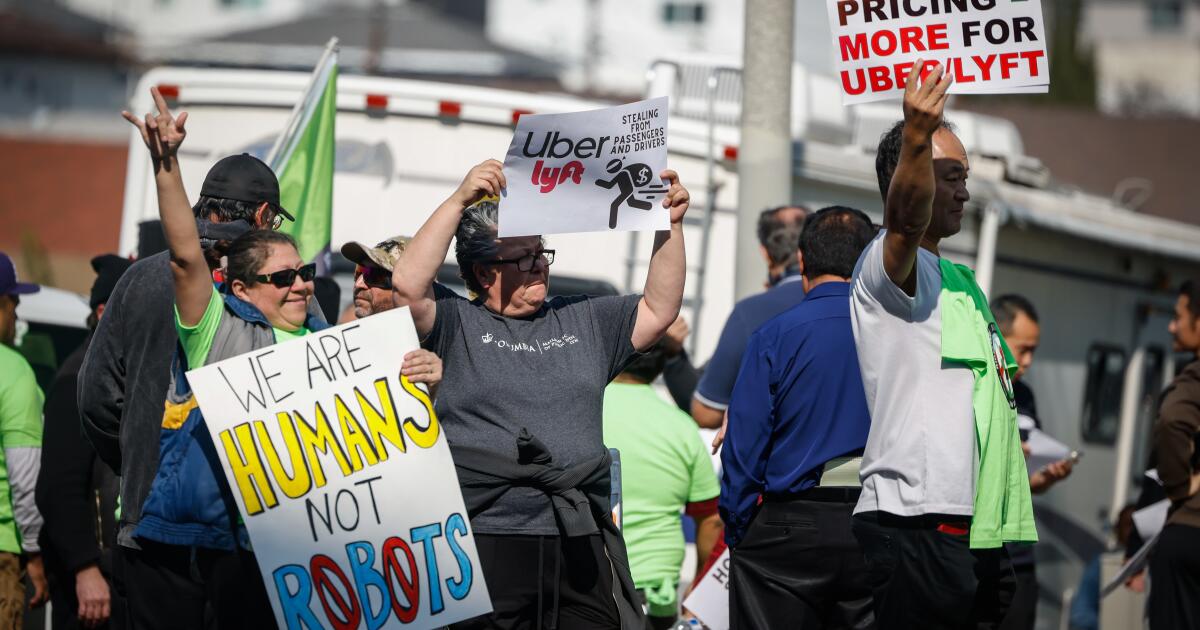
Los Angeles Lyft driver Shan Sedigh held out his phone. On the screen, Lyft’s app detailed a Feb. 9 ride for which Sedigh’s passenger paid $105.40. Sedigh earned a little more than half of that at $53.11.
“This is why I’m here,” Sedigh said, surrounded by scores of ride and food delivery drivers Wednesday as they protested outside an Uber drivers support hub in Westlake, west of downtown Los Angeles, part of a one-day work stoppage to demand better wages.
“I pay gas, insurance, repairs,” the 50-year-old West Hills resident said. “Lyft just connects the driver to the customer. Why do they get 50%?”
The one-day strike hit more than 20 major cities across the U.S. and Canada, including Los Angeles. Food delivery drivers in London joined in, vowing to turn off the apps between 5 and 10 p.m., according to the Associated Press. The action targets what is typically a busy holiday for ride-hailing and delivery giants.
Although there have been sporadic, isolated protests by drivers in various cities in recent years, organizers say the Valentine’s Day protest could be the most ambitious labor action to date, with drivers across the country coalescing organically.
Drivers are protesting what they describe as poor wages and rapidly shrinking transparency in how the companies pay drivers their share of earnings.
California gig law Proposition 22 — which was established by a voter initiative bankrolled by Uber, Lyft, DoorDash and other companies in 2020 — has hurt drivers, said Nicole Moore, a driver and the president of Rideshare Drivers United, the 20,000-member Los Angeles group coordinating local drivers.
The law promised some benefits to drivers — including a minimum earnings guarantee and healthcare reimbursement — but they have proved difficult to access or so minimal as to be useless, she said.
Drivers have complained that companies track their behavior on the apps to determine what the companies will pay the drivers, and the workers’ only power is to accept or decline a job.
Rideshare Drivers United protest in front of the Uber Greenlight Hub in Los Angeles.
(Jason Armond/Los Angeles Times)
“It’s a shell game and there’s no way to enforce this stuff because it’s all an algorithm in a black box — how we’re paid and whether or not we get benefits,” Moore said.
Gig drivers group Justice for App Workers told the Associated Press that thousands of drivers had stopped working at some point Wednesday, with protests at airports in cities including San Francisco, Chicago, Miami and Newark, N.J.
Uber and Lyft representatives dismissed any effect from the strike.
“These types of events have rarely had any impact on trips, prices or driver availability,” Uber spokesperson Zahid Arab said in an email. “During last year’s Valentine’s Day ‘strike,’ we saw an increase in trips in the U.S.”
Lyft spokesperson CJ Macklin said that “traditionally, these events have not had a meaningful impact on wait times or service levels.” As of Wednesday afternoon, the company had not noticed any significant disruptions, he said.
Drivers interviewed at the Wednesday protest in Los Angeles said that about a year ago companies began showing drivers their rates offered on rides, giving them the option to accept or decline, but around the same time appeared to offer fewer well-paying longer rides, leaving them with shrinking earnings.
Frank Kash, 30, waved a sign reading, “Corporate Lies Are No Surprise.” Scrawled across the sign in Farsi was an expletive aimed at Uber Chief Executive Dara Khosrowshahi, who, like Kash, is Persian.
“He is basically stealing from us,” Kash said. “Khosrowshahi, you owe me money.”
For an Uber trip he drove Tuesday, Kash said he earned $24; the customer told Kash he paid about $60, making Kash’s earnings about 40% of the fare.
“It’s a shame,” he said.
Macklin said Lyft made new commitments this month to increase driver pay and transparency. They include providing a clearer summary of the “new minimum earnings guarantee that drivers will always make at least 70% of the weekly rider fares after external fees,” he said.
He said the company is also providing a new in-app button for drivers to appeal deactivation decisions and providing direct access to a specialized support team focused on appeals. Drivers have complained that the apps haphazardly shut down their account access, and that the decisions are difficult to get reversed.
“We are constantly working to improve the driver experience,” Macklin said in an email.
Of concerns raised by drivers, Uber spokesperson Arab said the “vast majority of drivers are satisfied.”
He disputed that drivers’ take of fares represented a small portion relative to Uber’s and said the company has made significant investments in driver benefits afforded by Proposition 22, investing more than $800 million since January 2021.
“Uber’s effective take rate in the U.S., net of commercial insurance costs, is well below 20%,” he said. “Every driver on the Uber platform benefits from the historic protections and benefits afforded by Prop. 22.”
Uber said its U.S. drivers earn an average of $33 an hour, while Lyft said its U.S. drivers make an average of $30.68 an hour, or $23.46 per hour after expenses.
Rideshare Drivers United demonstrated in front of the Uber Greenlight Hub on Valentines Day in Los Angeles.
(Jason Armond/Los Angeles Times)
Drivers held isolated protests over the last year in various cities, including Chicago, Las Vegas, Denver, New Orleans, Los Angeles, Minneapolis, Miami and Tampa. Most recently, drivers protested at airports in San Diego and Atlanta in December.
Luis Arias, 32, who has driven for Uber and Lyft since 2017, said he had never participated in driver protests before December.
But long workdays and shrinking earnings prompted him to help organize recent protests at San Diego Airport. Drivers protested at the airport’s waiting lot on Dec. 19 and marched to Terminal 2 in a Dec. 23 action.
“We have to work too many hours to get the money, and we spend a lot of money on gas, on car services. It feels very unfair,” Arias said.
Nascent organizing among San Diego drivers is gaining traction, he said. About 100 drivers participated in the first protest; now, the informal San Diego group has grown to some 600 members, Arias said.
At the Los Angeles rally, driver Teresa Pitt addressed the crowd from atop a pickup truck, calling on gig workers to push the companies for more.
“There should be drivers lined up this whole street,” she said.
Some drivers sporting neon-green “Rideshare Drivers United” shirts held signs themed to the holiday: “It’s time for a break up with Uber and Lyft,” read one, with a graphic of a red broken heart.
By about 2p.m., the group of about 100 protesters had thinned out. Some left to head over to Los Angeles International Airport, where another driver protest was scheduled to be held later in the afternoon, while others left for their other day jobs.


With SpaceX’s historic initial public offering minting a small army of new millionaires overnight, the Southern California housing market is bracing for a big wave of buyers looking to upgrade their digs or perhaps snag a second home, potentially driving up prices in some in-demand neighborhoods.
Shares of SpaceX started trading June 12 and ended the day having raised $75 billion and making founder Elon Musk the world’s first trillionaire. It was by far the largest IPO on record, more than double the 2019 offering by Saudi Arabia’s state-owned oil giant Saudi Aramco.
At least 4,000 current and former SpaceX employees are expected to become millionaires, with about 400 of them earning $100 million or more, said Andrew Benson, chief executive of Hill.com, an investment platform for trading stock in pre-IPO tech companies.
SpaceX’s compensation philosophy historically favored equity over cash salaries, so this windfall extends well beyond executives and engineers to include nontechnical staff, entry-level workers and even cafeteria employees.
Because SpaceX has its highest concentration of employees in humble Hawthorne south of the 105 Freeway, the homebuying spree is expected to be most pronounced in the sandy South Bay and the “Silicon Beach” tech corridor that includes Venice and Santa Monica, but it may also appear in other upmarket Los Angeles-area neighborhoods or even farther away in the form of second homes.
One SpaceX buyer has been eyeing a $32-million pocket listing of his in tony Brentwood for months while waiting for the IPO, according to real estate broker Cory Weiss of Douglas Elliman.
“People are starting to look,” he said, and most will spend $5 million or more.
Melissa Pilon, a real estate agent in the South Bay with Compass, heard from one SpaceX buyer the day the company went public on a property in north Redondo Beach, and expects to hear from more would-be homeowners.
“I’m not sure how this will play out, but I think real estate agents are feeling optimistic,” Pilon said. “I think there will definitely be an uptick, but I don’t know if it will be a sustainable thing. There might be some superficially inflated prices.”
The SpaceX IPO and planned initial public offerings of OpenAI and Anthropic could generate millions in capital gains tax revenue for the state over years as shareholders cash out.
Even without inclusion of those IPOs, state finance officials this year upped their forecast of capital gains income Californians would earn due to the huge run-up in the stock market driven by AI companies. On average, gains are taxed at 10%.
While SpaceX shares have fallen recently, current and former employees who were granted shares or options still would come away winners given the stock remains above the $135 IPO price. Shares closed Friday at $153.23, up 0.15%.
It could take several months for the housing market to feel the full effect of SpaceX millions, said Paul Habibi, a UCLA lecturer and real estate expert witness at Grayslake Advisors.
The most significant buying boom is likely to take place early next year, he predicted, after the standard lockup on stock sales is fully ended in December. Batches of limited stock sales will be allowed in the coming months, however, and some real estate agents and bankers are putting together workarounds to help expectant millionaires leverage their future gains to secure loans.
Habibi expects the largest concentration of purchases to be focused in the South Bay, primarily Manhattan Beach and Redondo Beach, with some spillover into Culver City and possibly north Orange County.
The gush of new money stands to drive up the cost of homes in neighborhoods already in hot demand, echoing a pattern that has occurred in the San Francisco Bay Area.
“A place like Manhattan Beach has roughly 11,000 housing units, so there could be a pretty significant impact if a lot of those folks decide that they want to go buy houses in those neighborhoods that have such a supply constraint,” Habibi said. “Those markets are already among the priciest in Southern California and I can only imagine that will continue with this new wealth creation.”
Hermosa Beach real estate agent Ed Kaminsky agrees interest will center in the South Bay, including Palos Verdes, and he has already heard from prospective SpaceX buyers. Their dream houses have ocean views, swimming pools and four or more bedrooms, which may be hard to find.
“There are a lot of buyers that were in rentals from the Palisades fire looking to buy now and combined with all of the IPOs this summer, I think inventory in South Bay could be tight,” Kaminsky said, “The question is whether we have the kinds of properties on the market that they’re looking for.”
The concentration of buyers looking to purchase property in the South Bay could temporary inflate prices in the area, similar to when Snap Inc., social media platform Snapchat’s parent company, went public in 2017 valued at $24 billion, Habibi said. SpaceX by comparison was valued at $1.77 trillion.
“What’s interesting about Snap is that the workforce was largely clustered on the Westside, and you could see almost immediate effects in Venice and Santa Monica within months of the IPO,” Habibi said. “That was a pretty notable and significant effect on that local housing market” that temporarily inflated prices in an already hot market.
“The amount of wealth and how it comes into L.A. is always very different and vacillates,” Weiss said. “I’m not saying this is groundbreaking and nothing like L.A.’s ever seen before, but I do know that there are people who have been waiting for this to happen.”
Among them are potential buyers who have toured condominiums in Century City, where some of the region’s most luxurious condo towers stand, he said.
Certain buyers may want to buy a condo in a fancy full-service building in L.A. to use as a pied-à-terre, Weiss said, while moving their families to a distant city or state where they could commute by plane on weekends.
San Diego County should see an influx of new buyers with SpaceX dollars, said Del Mar real estate agent Kristina Quesada, co-owner of the Yost Quesada Team at Douglas Elliman. They’ll join a recent wave of house hunters from the Bay Area flush with new tech fortunes and an appetite for second homes or vacation properties near the ocean.
Buyers want to “obtain that coastal lifestyle” for less money than it would cost in other California waterfronts, she said. Popular San Diego County locations run west of Interstate 5 from Carlsbad south through such seaside communities as Encinitas, Del Mar, La Jolla and Coronado Island. Prices start around $2 million.
San Francisco real estate agent Butch Haze of Compass has seen tech booms followed by ravenous bursts of homebuying since the first internet gold rush of the late 1990s.
“Show me a great job market and I’ll show you a really strong real estate market,” he said.
San Francisco’s surging tech industry, which is getting a burst of new business around artificial intelligence, may even have a knock-on effect on Los Angeles-area real estate, Haze said.
After making a fortune through an IPO or acquisition of their companies, “the single tech guys love to move down to L.A. to be closer to the beautiful people,” Haze said. “And they get their beachfront property.”

Tech stocks took another big hit Tuesday as investors sold off shares of companies that have powered the artificial intelligence boom.
Technology companies have been spending billions of dollars investing in data centers and infrastructure needed to support the race to advance AI. But sky-high valuations and geopolitical tensions have some investors questioning whether massive AI spending will pay off, analysts said.
Reflecting the unease, the tech-heavy Nasdaq composite dropped roughly 2%. The Standard & Poor’s 500, a stock market index that tracks the performance of the largest U.S. publicly traded companies, fell by more than 1%.
Share prices for major California tech companies including Nvidia, Qualcomm, Intel and Marvell Technology all dropped. Meta Platforms, Apple, and Google’s parent company, Alphabet, also saw their stock prices slide, though the decline wasn’t as large as the drop in chip stocks.
Shares of Micron Technology, a U.S. memory chip manufacturer, plunged by more than 13% a day before the company was scheduled to report its third-quarter financial results. Anxiety in the U.S. spilled over from Asia, where South Korean tech companies SK Hynix and Samsung Electronics, both major computer memory chip manufacturers, saw their stocks plunge Tuesday by more than 12%.
“Investors are just a bit skittish after very strong moves in tech stocks where any hint of caution causes some investors to hit the sell button,” said Dan Ives, an analyst who heads technology research at Wedbush Securities, adding that it’s a “gut-check moment.”
On Monday, SpaceX saw its shares plunge 16% after a record-breaking initial public offering this month. Its share price then rebounded Tuesday, closing up less than 1% to roughly $156.
Tech companies have been making big bets on the role AI will play in people’s work and personal lives. They’ve been improving chatbots that can generate code, words, photos and videos. The companies also are betting that “AI agents” will be able to proactively tackle more in the future, automating repetitive tasks in customer service, online shopping and other industries. They’re releasing more AI-powered hardware such as smartglasses.
Major tech companies are going head-to-head in the race to dominate AI, competing to sway talent and consumers into using their products. Alphabet saw its stock slip after two of the company’s prominent AI researchers left for rival companies OpenAI and Anthropic.
Despite profitability questions, AI use has been growing. Roughly half of U.S. adults use an AI chatbot, according to a Pew Research Center report released this month. They’re using these tools for search, work tasks, entertainment and even companionship. More U.S. adults reported using OpenAI’s ChatGPT, followed by Google’s Gemini, Microsoft Copilot and Meta AI.
Amid all the hype and spending, there also have been growing fears about whether AI will take over people’s jobs and whether the boom will lead to a bubble that will eventually burst. California AI startups OpenAI, valued at $852 billion, and Anthropic, valued at nearly $1 trillion, are preparing to potentially become publicly traded companies.
“I don’t view this as a bubble,” Ives said. “I view it as we’re going to go through these white-knuckle moments as tech stocks continue to move higher, but the bears will continue to yell fire in a crowded theater when we have these pullbacks.”
Economic factors also could affect how much people are willing to invest in tech company stocks. There’s anxiety over whether the new Federal Reserve Chair Kevin Warsh will raise interest rates, making it more expensive to borrow money. That could cut into a company’s profit margin or decrease consumer spending. United States’ war with Iran is driving up gas prices while the U.S. inflation rate rose to 4.2% in May.
The AI boom is fueling the demand for memory and storage chips, but prices for them are on the rise, prompting some companies such as Apple to look at raising prices for consumer electronics.
Globally, AI spending is projected to increase to $2.59 trillion in 2026, up 47% year over year, according to a forecast by research firm Gartner.
Driven by AI demand, memory and storage vendors have significantly outperformed the S&P 500 and the SOX index, a global semiconductor and microchip index, since the start of 2025, according to a note to clients from BNP Paribas.
Still, investors are on edge ahead of Idaho-based Micron Technology’s earnings report Wednesday, said Gil Luria, head of technology research at financial services company D.A. Davidson. Since January, Micron Technology’s stock has climbed more than 233% to more than $1,000 per share.
“Any indication of a slowdown in demand for AI is seen as a potential turn in the cycle,” Luria said. “While the overwhelming sense is that demand is still far exceeding supply, investors are waiting for Micron to indicate that is still the case.”
Times staff writer Nilesh Christopher contributed to this report.

Tired of the same old dating apps like Bumble and Hinge, Marie Lansley tried talking to an artificial intelligence matchmaker.
For roughly 15 minutes, she chatted with an AI voice on the dating app Known, answering questions about her upbringing, personality, education, lessons from past relationships and whether she’s looking for a serious relationship or something more casual.
“Divorced at 36. Yea, you’re not here to waste time. The way you build your days matter,” the AI voice told her after Lansley replied she was looking for a serious relationship.
Weeks later, the San Francisco resident got a match along with a written summary of why the pair could be compatible. But the stranger wasn’t her type and she wasn’t keen on paying $15 to meet up.
Startups like Known are roping in new users by hosting in-person dating events in San Francisco.
“I want to be able to use AI to improve efficiency in dating and to help navigate a pretty frustrating dating landscape. But there are just some things that are so deeply human that AI technology cannot capture,” said Lansley, who has posted about her dating experience on social media.
Singles like Lansley are dipping their toes into the wacky world of AI dating but they’re also skeptical if it will make it easier to find love. Online dating is ripe for disruption, and tech companies big and small are turning to AI as a potential solution to find people better matches more quickly and help them improve their chances of landing a date.
For years, people have been frustrated and exhausted by the seemingly endless amount of swiping and small talk that go nowhere on dating apps. They’re turning to in-person options such as running clubs, pickleball and speed dating but finding the right partner is still tough.
Online dating remains a popular way people search for a partner but some are dumping the platforms. Tinder’s monthly active users in March dropped 7% year-over-year, though its parent company Match Group noted that the rate of decline has been slowing as it revamps the app.
West Hollywood-based Tinder, which has roughly 50 million monthly users, has been experimenting with using AI to analyze a user’s camera roll and recommend better matches.

Known, an AI dating app, has its branding plastered on a storefront in the Marina District in San Francisco.
Its rival Bumble — an app that initially stood out for having women message their matches first — saw its paying users drop 21% to 3.2 million in the first quarter this year compared to 2025. The company has been working on AI matchmaking and plans to ditch swiping in the last three months of the year in select markets.
Even dating services that have grown users such as West Hollywood-based Grindr, an app for the LGBTQ+ community, and Facebook Dating, which is included in the main social network, are also leveraging AI more.
And new AI dating startups are popping up in California, New York and other states that could change the way people find a partner online. Former Hinge co-founder and Chief Executive Justin McLeod is working on an AI dating app called Overtone, stating on its website that “AI, if used correctly, can help us invent an entirely new way for people to find their partners that is far more personal, far more efficient, and far more effective.”
Some of those startups started in the San Francisco Bay area, where AI dating apps are hosting parties, speed dating, coffee meet-ups and other in-person events to rope people into using their new service.

Singles who downloaded the Known dating app mingle over drinks at Left Door, a cocktail lounge in San Francisco, on Thursday.
On one recent Thursday night, dating app startup Known hosted a dating event at a swanky San Francisco cocktail lounge for people who completed their matchmaking call on the app. The event’s description said attendees would be greeted with “champagne, caviar bumps, and a mysterious envelope” that reveals who the AI matchmaker paired them up with.
Known Chief Executive and co-founder Celeste Amadon, who dropped out of Stanford University to create the AI dating app, said Americans are spending more time alone at home as online services have made it more convenient to do everything from getting food delivered, online shop and date. Young people complain about traditional dating apps yet they’re also still on them.
“The more I understood today’s dating apps, the more clear it became that they have been for the better part of two decades now, designed, tweaked, redesigned, rebuilt, to not work,” she said.
1

2

3

1. A sign that reads, “I love my AI boyfriend” hangs in a San Francisco window. 2. Known, an AI-driven dating app, has their branding plastered on a store front in the Marina District in San Francisco. 3. Celeste Amadon, CEO of Known, poses for a portrait.
The company charges per date to ensure people show up but the startup also has a business incentive to find people a match they actually want to meet, she said. Known plans to expand to San Diego in July, she said. Amadon said she expects the AI matching technology to become more accurate over time.
Known hasn’t shared its user numbers or revenue figures. Founded in 2025, the startup launched the dating app in February and has raised roughly $10 million from investors such as Coelius Capital, Forerunner Ventures and NFX, according to PitchBook.
Grindr is learning more about how much users are willing to use and pay for AI features.
The company has been testing a subscription tier called “Edge” in Australia, New Zealand, the United States and Canada that includes AI tools that recap meaningful chats, display personalized profile recommendations and show users who they’re likely to match with.
Unlike other dating apps, Grindr users don’t swipe through profiles. The app displays a grid of people who are nearby that they’re able to chat with. Grindr has expanded beyond casual dating, allowing people to find friends, travel companions and others in the LGBTQ+ community.
Grindr’s Chief Product Officer AJ Balance said the company is still testing subscription pricing for Edge but some users are willing to pay $350 per month because they’re “seeing a lot of value” and saving time.
“We view AI and new paradigm shifts like it as opportunities to build great, new product experiences that haven’t been developed before,” he said. “Our approach is really to leverage AI, like we did with mobile, to facilitate better conversations, deeper connections, ultimately more success in dating in the real world.”
Other popular dating services aren’t charging for AI matchmaking features. On Facebook Dating, which has more than 21.5 million daily users worldwide, users can use AI to write their profile intro and chat with an dating assistant for free.

AI dating startups are popping up in California, New York and other states that could change the way people find a partner online.
The AI assistant can recommend people looking for a serious relationship, someone with common hobbies or even above a certain height or age. Roughly 1 million people use Facebook Dating’s AI assistant daily in the United States and Canada, Meta said.
Facebook Dating product manager Neha Kumar said AI can help combat “swipe fatigue” facing online dating users.
“You’re sifting through a bunch of profiles. It’s really hard to understand and find somebody that’s compatible for you based on your specific types of preferences,” she said. “We really wanted to think about leveraging AI to solve this growing pain point.”
Technology is also a double-edged sword. The rise of AI tools means people can use technology to easily manipulate photos and craft messages on dating apps that might make them seem much more attractive or charismatic than they are in person. Some people are even turning to AI chatbots for companionship.
“How do we maintain human authenticity and human connection through an AI world? I don’t have a perfect answer to that. I think we’re still figuring it out,” Kumar said.
Lansley, the online dating user, said apps do make dating more convenient but it’s much more interesting to meet people face-to-face. She worries people will rely too much on AI as a “crutch” to replace human intimacy or emotional judgment.
“Chemistry,” she said, “is always going to be analog.”
-
 Sports3 minutes ago
Lions release cornerback Terrion Arnold soon after judge sets his bond at $1 million
-

 World11 minutes ago
EU will ‘come to its senses’ on Israel, former Netanyahu adviser says
-
 News36 minutes ago
Senate Ethics Committee dismisses complaint against Sen. Ruben Gallego
-

 New York2 hours ago
Read the Indictment of Malik Beasley
-

 Los Angeles, Ca2 hours ago
Stolen Sea Scouts boat found in Marina del Rey, suspect arrested
-

 Detroit, MI2 hours ago
Michigan House passes bill to restrict big investors from amassing single-family homes
-

 San Francisco, CA2 hours ago
San Francisco rolls out heightened security measures ahead of World Cup knockout match, 4th of July
-

 Dallas, TX3 hours ago
Klyde Warren Park reveals expansion plans, construction timeline

