Business
Fontana's Black mayor is cracking down on Latino street vendors. Both sides allege racism


FONTANA, Calif. — At meeting after meeting, activists, social justice groups and residents took their turn at the lectern in the Fontana City Council chambers in the fall to sound off against Mayor Acquanetta Warren. Their denunciations of the city’s first Black mayor were relentless, and their anger resonated beyond the council chambers.
For months, Warren had been the driving force behind a crackdown on street food vendors selling goods without proper permits. Under a series of regulations approved by the City Council, unlicensed sellers could be arrested on misdemeanor charges. Their food and equipment were now fair game to impound and trash.
“It’s time to take a stand,” Warren told the packed chamber at one October meeting, standing firm against the onslaught. “We’ve tried everything we can to help people get legal. … Now it’s time to grab a couple of hammers.”
In a city where Latinos make up the majority of residents, some view the criminalization of street vending as a direct attack.
“It’s fascist, classist, racist, xenophobic and a grave injustice,” Fontana resident Evan Webb, a staunch ally of local activist groups, told the council at another October meeting. “Because of your votes, people will be traveling to poverty, debt, trauma and deportation.”
In the months since, activists have continued to ramp up their campaign against Warren, a Republican who has been open in her concerns about illegal immigration. Their verbal attacks, some laced with profanity and racial overtones, ripple across social media. And even as critics accuse city leaders of an ethnically motivated crackdown on working-class Latinos, Warren’s defenders say the backlash itself is racist in nature — a move to undermine a clear-eyed leader because she is a Black woman.
“I have followed this anti-Black behavior brought on by this immigration group since it surfaced back in October,” Hardy Brown, a longtime activist in San Bernardino’s Black community, said during a December City Council meeting. “They have called us everything but a child of God and using racial stereotype language I choose not to repeat.”
Fontana city leaders say their crackdown on street vending is about protecting health and local businesses. Activists call it an attack on Latino culture.
(Gina Ferazzi / Los Angeles Times)
The cat-and-mouse game between unlicensed street vendors and city code enforcement is not new for Southern California. It’s been an ongoing point of tension in relatively white suburban communities for years, particularly in Orange County’s posh beach cities. But what’s unfolding in Fontana represents a new front in the battle as the debate spreads into unfamiliar terrain: the Inland Empire, where large numbers of Latino families are relocating to escape unaffordable housing in Los Angeles and Orange counties.
In Fontana, the talking points in the standoff are in many ways the same as what’s played out elsewhere: City officials say unlicensed vendors represent a health risk to consumers, unfair competition to bricks-and-mortar restaurants and lost civic revenue from unpaid taxes and fees. Those defending street vendors say their trade offers an economic lifeline to hardworking people and, for many Latinos, calls up a nostalgic mainstay of Mexican culture.
But the discourse in Fontana has also veered into barbed and more personal territory, highlighting the growing pains of a Latino-majority community led by Warren, a controversial figure determined to establish Fontana as an up-and-coming suburb.
Alfonso Gonzales Toribio, an associate professor of ethnic studies at UC Riverside, notes another distinction: Along with Warren, many of those taking on street vendors in Fontana are Latinos and other people of color using nonracial terms to say why it’s a problem.
“There is this class dynamic that they’re trying to sell the Inland Empire as sort of the middle-class suburban alternative to living in Orange County,” Gonzales Toribio said. “And in doing that, they’re trying to create the image of these pristine uniform suburban spaces that don’t have room for street vending.”
Fontana officials say they pursued ordinances criminalizing street vending only after the city had exhausted efforts to bring unlicensed vendors into compliance.
(Gina Ferazzi / Los Angeles Times)
Fontana indeed has transformed since its founding. Unofficially dubbed “Fontucky,” the area was once home to agriculture and rolling hills and later to the Kaiser Steel mill, the largest steel plant on the West Coast during World War II.
Warren joined the City Council in 2002, and her successful mayoral bid in 2010 was lauded as a historic turning point in a city with a cruel history of segregation. As mayor, she has courted warehouse development, bringing in scores of facilities and hundreds of jobs. Critics of the approach dub her “Warehouse Warren” and question the environmental fallout of a local economy reliant on mass distribution centers and truck traffic.
From the start, Latino activists also took issue with her stance on illegal immigration.
Street vendors are quick to pull out their cellphones and call up a clip where Warren says, “If you get here illegally, you need to learn how to speak English. You need to understand the culture in America.” The doctored clip is presented as if Warren said this amid street vending discussions. In fact, the clip is from a 2010 council meeting where a San Bernardino public official called Warren racist after a newspaper story quoted her expressing support for a controversial Arizona law, passed that same year, that gave police broad powers to detain anyone suspected of being in the country illegally. Portions of the measure were subsequently voided by the U.S. Supreme Court.
Warren, a council member at the time, rebutted the accusations of racism and said she advocated for stronger border protections because people entering the country illegally were taking low-skilled jobs from impoverished Black communities.
Digna Orozco sets up a roadside sign for her Fontana food stand.
(Irfan Khan / Los Angeles Times)
Still, street vendors tend to think the mayor’s crusade against their vocation is rooted in animosity toward Latinos and immigrant culture.
“She doesn’t know us,” said Digna Orozco, who sells pambazos and tacos de canasta on a dirt patch near semi-trailer truck lots in Fontana.
Orozco said she turned to street vending after suffering a heart attack triggered by stressful work as a seamstress at high-end wedding boutiques. She didn’t think her heart could handle a return to boutique work, but she had bills to pay, so she turned to vending at the start of the COVID-19 pandemic.
“She doesn’t know that it’s out of necessity.” Orozco said. “I wanted to tell her, ‘I’m an American citizen from Fontana and my children grew up here.’”
Fontana city officials have repeatedly said the vending ordinances are not meant to target a demographic group. Warren declined The Times’ request for an in-person interview, but offered a statement blaming the tensions on social activists who have twisted the dispute into a “racial or social equity issue to promote their political agenda.”
“The businesses most impacted by their intentional disregard for our ordinance are mostly Latino-owned small businesses,” Warren said in the emailed statement. “They are the ones requesting city action, and they are the ones negatively impacted by this outrageous behavior. This group has attempted to make this a racial issue, and they are the ones who have resorted to personal attacks and threats of violence. The city will continue to enforce the law and stand up for local residents and businesses, regardless of the tactics employed by this group.”
The Times reached out to several Mexican food establishments, whose owners declined to speak on the record. Some cited fear of retaliation from pro-vendor activists, while others worried they might alienate fellow restaurateurs if they expressed support for street vendors. In general, they said they agreed with the need to curb unlicensed vendors; some suggested setting a radius clause where the same goods couldn’t be sold in front of a bricks-and-mortar establishment. Yes, street vendors are common in Mexico, one owner said, but in the U.S., fellow Latinos should shake off old habits and strive to eat better and cleaner.
Amanda Morales, a self-identifying Latina and special projects coordinator for the Fontana Chamber of Commerce, said the street vendor ordinances are not racist in nature but instead an effort to lift and support Latino-owned businesses.
“We have heard story after story of our restaurant owners on the verge of shutting down and laying off their employees that live in the city because they are unable to compete with the price points of street vendors,” Morales said.
Digna Orozco, right, prepares pambazo at her food stand.
(Irfan Khan / Los Angeles Times)
Council members contend they pursued the new ordinances only after the city had exhausted its efforts to work with unlicensed street vendors to bring them into compliance.
Code enforcement officers have distributed fliers explaining the licensing rules in English and Spanish. The city created a program in June to offer financial assistance of up to $2,000 to help cover expenses involved with obtaining permits from the city and county. Three months later, the city shut down the program because no applications were submitted.
Instead, Deputy City Manager Phillip Burum said, illicit vendors have memorized when officers begin their patrols. They pack up their food when officers drive by — and wait until the officers are gone to start selling again.
In October, the City Council approved spending $600,000 to bring in a third-party vendor to help with the crackdown. Pleasanton, Calif.-based 4Leaf Inc. will provide code enforcement services, such as giving warnings to first-time unlicensed vendors, impounding equipment and food from repeat offenders and, if necessary, calling in police for support. Under the six-month contract, six security workers will patrol the city during eight-hour shifts six days a week.
“We’re not objecting to people making money, but you need to do it the right way,” Warren told audience members at the October meeting where the expenditure was approved. “Our public looks upon our council and our region to keep them safe, and if you looked at the conditions they cooked [in], you wouldn’t be eating at these places. There’s no bathrooms. How [are] you going to sit there for eight hours with no bathroom? Where are you going to wash your hands?”
Warren’s admonitions have done nothing to quiet the pro-vendor forces. And as tensions have heightened, Fontana has added more police officers to stand watch during council meetings.
In October, Edin Alex Enamorado, whose strident activism has made him a social media sensation, organized a protest in front of the mayor’s house that police declared an unlawful assembly. Enamorado and a cohort of activists have since been jailed and await trial on allegations they used violent tactics to harass and intimidate perceived enemies of street vendors and certain other causes in multiple cities. The defendants deny the accusations, presenting themselves as crusaders using their 1st Amendment rights to stand up for the oppressed.
Coalition groups such as the Center for Community Action and Environmental Justice have galvanized vendors to share testimony at council meetings about what drew them to the occupation. Several explained in Spanish that the vending ordinances were upending a food service many residents appreciate and see as part of their heritage. Frustration has mounted as city-provided interpreters sometimes struggle to accurately convey what Spanish speakers say within the time frame allotted for public comment.
“When you talk about public health and safety of the community, you say that street vendors are a danger, that street vendors are a nuisance,” Joaquin Castillejos told the mayor at an October meeting. “You know what to me is a danger and a nuisance? It’s PM2.5 contamination from trucks going into our lungs every single day in the streets, and you wanna put warehouses next to a school—”
Before he could finish, his allotted time elapsed.

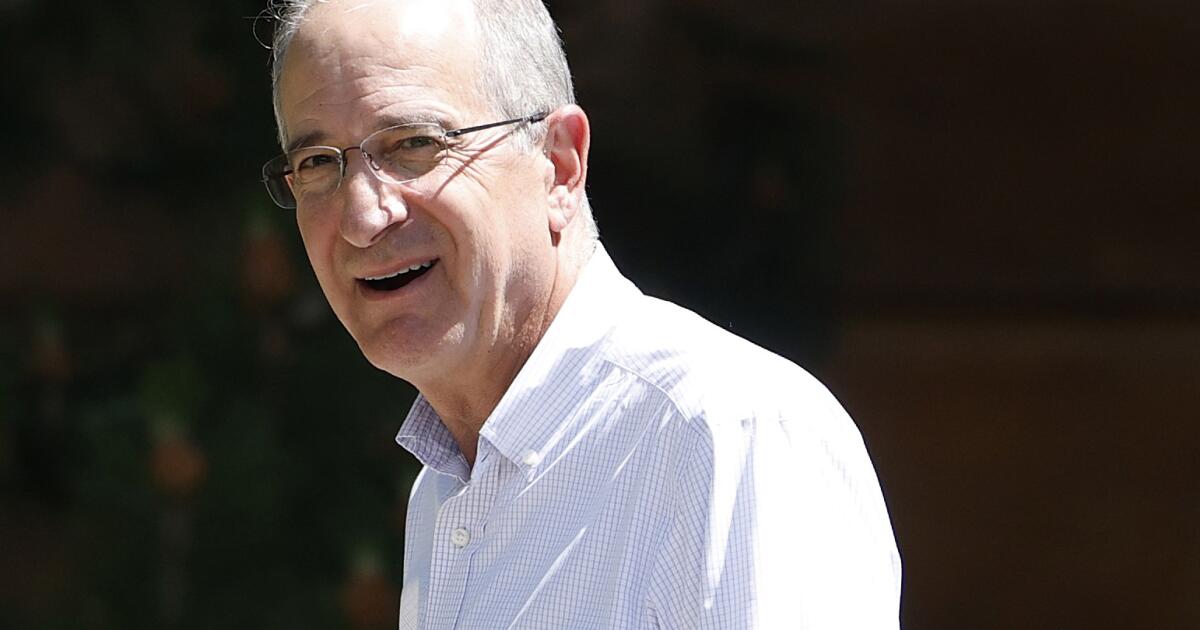
Decades of Hollywood empire-building ended with a quake in 2017 when Australian media mogul Rupert Murdoch decided to sell much of his Fox entertainment holdings amid the rise of Netflix and other tech giants.
This week, another titan who has been instrumental in shaping American media and telecommunications began to unwind his Hollywood holdings.
Brian L. Roberts — who with his father built Comcast into a cable TV and internet colossus — announced his company would spin off its prestigious NBCUniversal unit into a separate publicly traded company sometime next year.
The move reverses Roberts’ purchase of NBCUniversal in 2011 — a bold bet that created a behemoth with popular programming and cable pipes to pump that content into consumer homes.
Comcast’s breakup marks the close of a Hollywood era, one dominated for 40 years by a class of maverick moguls: Murdoch, CNN founder Ted Turner, Viacom’s Sumner Redstone, cable titan John Malone and the Philadelphia-based Roberts family.
Now, a new crop of leaders has emerged, reflecting Silicon Valley’s vast influence over the film and and TV business, which has been upended by streaming and, now, artificial intelligence.
“There was a time that Murdoch, Malone and Brian were really industry leaders who could affect change,” said Bank of America managing director Jessica Reif Ehrlich in an interview. “That’s not true any longer.”
Analysts widely believe Monday’s announcement is a prelude to eventual sales of both Comcast and NBCUniversal, a theory that Comcast rejects.
Roberts, 67, told analysts he will remain involved in both NBCUniversal and Comcast after the separation. Still, he plans to relinquish his chief executive role after 25 years and a half century at Comcast. Roberts has picked trusted associates to run each firm, and his family will continue to hold controlling shares of both companies.
But the shift underscores a dramatic loss of clout by Comcast and other traditional media enterprises. Netflix, Apple, Amazon and Google’s YouTube have diminished the industry’s financial pillars — box office receipts and cable programming fees — and given consumers control over when and how they watch programming.
Murdoch was the first to flee. In 2014, he was rebuffed in his $80-billion bid to beef up his 21st Century Fox by buying HBO, CNN and other Time Warner assets. Murdoch’s defeat led to the Fox asset sale to Walt Disney Co.
Last fall, Comcast made a run for the same properties with a plan to unite NBCUniversal with Warner Bros.
Instead, 43-year-old tech scion David Ellison — with help from his billionaire father, Oracle software co-founder Larry Ellison — scooped up the prize for a staggering $111 billion.
The pending blockbuster merger of Ellison’s Paramount Skydance and Warner Bros. Discovery is expected to reshape the industry and leave NBCUniversal increasingly vulnerable to a takeover.
“It looks like Comcast’s NBCUniversal was left standing on the dance floor without a partner,” MoffettNathanson media analyst Robert Fishman wrote in a Tuesday note to investors.
Paramount’s play for Warner Bros. came a month after Ellison finalized his family’s purchase of cash-strapped Paramount from Shari Redstone. The one-two acquisition punch would propel the Ellison family to top-tier moguls with influence over CNN, CBS News, HBO, Turner Classic Movies and two historic Hollywood studios.
“It’s a flagging industry. … The industry will have to consolidate to survive,” said C. Kerry Fields, a USC Marshall School of Business economics professor. “Those who have content plus [streaming] distribution are going to be the winners.”
Roberts knows distribution. His father in 1963 bought his first cable TV system in Tupelo, Miss. It was a quirky bet for Ralph Roberts, who figured his belts and suspenders business would soon be toast as beltless polyester pants became the rage.
Brian Roberts joined Comcast as a high school intern, setting up supermarket promotions. In 1975, he became a trainee cable installer, climbing poles and stringing cables. He joined Comcast full time in 1981 after graduating the Wharton School at the University of Pennsylvania.
For more than 30 years, he worked in tandem with his dad. With key associates, they built the nation’s foremost cable TV service — then the entertainment gateway — and grew stronger by offering internet, phone and then wireless service.
Analysts credit the 2011 purchase of NBCUniversal as a huge success; Comcast rescued a company that was on the ropes due to General Electric’s under-investment.
Over the years, Comcast rebuilt NBC and Spanish-language Telemundo, writing big checks for the best sports rights, including the FIFA World Cup, NFL, NBA and Major League Baseball.
Comcast also recognized value in theme parks and invested heavily, building Universal Studios as a formidable rival to Disney. NBC finished the season in first-place among traditional TV broadcasters and its L.A. film studio is an industry leader.
But the world has changed.
“One of the defining characteristics of this company has always been our willingness to look ahead, embrace change, and position ourselves for the future,” Roberts told analysts during a Monday call.
Reif Ehrlich, the Bank of America analyst, said Comcast needed to do something — or watch its stagnant stock sink farther.
Wall Street has punished the company amid steep losses in its cable TV and broadband internet units, and because NBCUniversal has historically generated its biggest profits from its cable channels.
In January, Comcast spun off those networks, including CNBC, MS NOW, USA Network and Golf Channel, to create a new entity called Versant.
But the move failed to boost Comcast’s battered stock, which dropped 3.3% on Wednesday to $23.73.
Five years ago, Comcast stock topped $50 a share.
“It was just a very challenged market on both sides, and it’s getting worse, not better,” Reif Ehrlich said.
Comcast faces competitors beyond traditional telecommunications firms, including AT&T and T-Mobile. SpaceX’s Starlink provides satellite internet service.
NBCUniversal must jockey alongside other well-capitalized players, including Amazon, Netflix and Disney. NBC’s streaming service, Peacock, has struggled to get traction. It counted 46 million paying subscribers as of the first quarter, a fraction of Netflix’s 325 million and the nearly 132 million subscribers of Disney+.
“It’s kind of a subscale player,” Reif Ehrlich said. “It’s just a real battle, and NBC has expensive sports rights.”
Roberts conceded the difficult landscape on the analyst call.
“The world is changing faster than ever,” Roberts said. “Technology, consumer behavior, competition, capital requirements are all evolving at an unprecedented pace … When we acquired NBCUniversal, more than 15 years ago, the industry looked very different.”
He will retain control for at least three years. The NBCUniversal spin-off is envisioned as a tax-free transaction for shareholders, providing a short-term buffer from deal-making to preserve that structure.
NBCUniversal could be up for grabs by 2029 — a pivotal year when the NFL is expected to open negotiations for a new round of broadcast rights. That auction is expected to draw heavy interest from Amazon and other streamers — not just veterans Fox, NBC, Disney’s ESPN and Paramount’s CBS.
“Brian Roberts has already proven his willingness to play the long game and with continued control should be the end decision maker,” Fishman said.
Much like Murdoch, who is now 95 and partially retired.
“Rupert was the smartest guy in Hollywood — he got out at the top,” Reif Ehrlich said.
He entrusted power to his 54-year-old son, Lachlan, who has been busy remaking Fox after the 2019 sale to Disney, which included Fox’s film and TV studios, streaming service Hulu and the FX and National Geographic channels. Fox also unloaded its regional cable sports networks — a savvy move before that business cratered.
The Murdochs kept Fox Sports, the Fox broadcast network, TV stations, Fox News Channel and the studio lot.
The company has been expanding. Lachlan Murdoch led Fox’s purchase of Tubi, which provides free TV channels and movies for smart televisions, keeping Fox in the streaming game. The company launched Fox News and weather products, and subscription service Fox One, which streams the company’s sports and news.
Earlier this month, Lachlan Murdoch stunned the industry by agreeing to pay $22 billion for Roku, a leading streaming platform that reaches 100 million viewers worldwide. Murdoch called the proposed purchase “a defining moment for Fox.”

Ethics experts sounded the alarm Wednesday after new financial disclosure reports revealed that President Trump’s income ballooned to $2.2 billion in 2025, with $1.4 billion coming from various new cryptocurrency-related businesses.
“It’s bribery. It’s graft. It’s exploitation of public power for private financial gain,” said Kathleen Clark, a law professor at Washington University and an expert in government ethics. “Trump has — with the acquiescence of a somnolent, GOP-controlled Congress and the active assistance of John Roberts’ Supreme Court — transformed the presidency into a massive corruption racket.”
Trump reported income of over $600 million in 2024. But after he entered the White House in 2025, he reported that his income had soared to more than $2.2 billion.
The 2025 annual disclosure report filed with the Office of Government Ethics shows that Trump ramped up his real estate business in countries across the globe, particularly in the Middle East, at a time when his government was negotiating over vital issues of military aid and economic tariffs. The president also expanded his dealings in the relatively new realm of cryptocurrency.
According to the 927-page report, Trump made $635 million in royalties from Celebration Coins and more than $500 million from his World Liberty Financial crypto firm. He drew in millions from a raft of Trump-branded merchandise including God Bless the USA Bibles and sneakers depicting him with his hand raised in a fist. He also brought in $10.4 million from a property in the United Arab Emirates and $9 million from a property in Saudi Arabia.
Noah Bookbinder, an ethics expert and former president of Citizens for Responsibility and Ethics, a nonprofit watchdog group in Washington, described Trump’s business dealings while in the White House as “entirely unprecedented, certainly in modern history, but I think by most ways of measuring, in all of American history.”
“This is corruption,” Bookbinder said. “You have a president who has been quite transparently using the presidency in ways that benefit his business interests and intertwining the presidency and business interests.”
But the president and the White House brushed aside ethics concerns about the money Trump is making.
Trump told reporters Wednesday that he made a lot of money before he came to the White House, he had “big institutions” run his money, and that he had benefited, like every other American, as the stock market went up.
“We’re all profiting,” he said. “I’m profiting because I have a lot of money and a lot of cash.”
In a statement, White House spokesperson Anna Kelly said: “Neither the President nor his family has ever engaged — or will ever engage — in conflicts of interest. … All actions by President Trump and his administration are taken in the best interest of the American people.”
Although the report does not show exactly how much Trump is earning — it provides details of revenue, rather than profit — the scale of the president’s cryptocurrency dealings elevated ethics watchdogs’ long-standing concerns.
Jordan Libowitz, a vice president at Citizens for Responsibility and Ethics, said the most concerning detail of the new report is the hundreds of millions of dollars coming in from various crypto ventures partnered with companies that the American public knows little about.
“At a time when his own administration itself is setting regulation for these types of companies,” Libowitz said, “there’s just this massive opportunity for corruption when foreign governments and foreign nationals can pour tens of millions of dollars into the president’s pocket.”
As a real estate mogul, Trump has long invested in hotels, condominiums and golf courses. But cryptocurrency, Libowitz said, offers vastly more potential for corruption.
“There’s only so many hotel rooms you can book, so many rounds of golf, but there’s no limit with crypto,” Libowitz said. “You can just buy his meme coin and he gets a cut, so you kind of take out the middleman, but also the cap or the amount of money you can funnel to the president.”
Libowitz said it was also problematic for Trump to expand his real estate empire in foreign countries, particularly in the Middle East.
“Now it seems that almost all his new developments are in foreign countries, and that opens up, if you’re building this giant resort, you’re going to need help from the local government, whether it’s tax breaks or utility issues, or building a road, or speeding up permits,” Libowitz said. “These are ways that foreign governments can do favors for the American president.”
In the half a century before Trump was elected, ethics experts say, presidents from Nixon to Obama publicly released their tax returns, sold properties or put the proceeds in a blind trust managed by someone they did not know.
“They weren’t doing it because they legally had to, but because they thought it was the right thing to do,” Libowitz said.
Ever since Trump was first elected in 2016 and opted to not sell his businesses or put them in blind trusts, ethics experts have urged Congress to impose more aggressive financial oversight over money in politics.
“Congress needs to update the law, and basically, mandate blind trusts and sale of assets and disclosure of tax returns,” Libowitz said.
Noting that the Constitution’s Emoluments Clause explicitly states that the president cannot accept things of value from foreign or domestic governments, ethics experts say Trump is flouting the law and Congress has chosen to not enforce it.
Richard Painter, a law professor at the University of Minnesota and former White House ethics lawyer under President George W. Bush, said Congress needed to close loopholes that exempt presidents from federal conflict of interest laws as well as enforce the Foreign Emoluments Clause.
“Nobody holding a position of trust with the United States government can accept emoluments, profits and benefits from foreign governments, and that is flatly prohibited under the United States Constitution,” Painter said. “Now, if the United Arab Emirates put money into Liberty Financial, as I understand they did … and then Trump makes money off Liberty Financial, that’s a Foreign Emoluments Clause problem.”
Congress, he said, should empower an independent prosecutor to investigate such conflicts.
“The problem with the Foreign Emoluments Clause is how do we enforce it?” Painter said. “The founders and head of the Congress enforced it by impeaching anybody who took a bunch of foreign government money, but I guess that system’s not working. That’s a serious problem.”

The race to bring air travel to the sky is heating up as Santa Cruz-based Joby Aviation and Toyota launch a joint venture to commercially produce air taxis.
The companies said in a news release Tuesday that they will work together on productivity, quality and costs and move toward mass production of Joby’s electric vertical takeoff aircraft. Joby and Toyota were first linked when Toyota made a nearly $400-million investment in the company in 2020. It has since increased its backing of the company to $900 million.
“It’s really meaningful for us to take on this challenge together with Joby, a partner that shares the same vision,” Toyota Chair Akio Toyoda said. “We believe this strengthened relationship is an important step forward in realizing the future mobility society.”
Joby‘s all-electric vertical takeoff vehicles are designed to hold four passengers and a pilot and can travel at up to 200 mph. The vehicle uses six tilting propellers to achieve vertical takeoff before switching to forward flight.
In February, Joby announced a partnership with Uber to start service in the United Arab Emirates this year, bringing on-demand air taxi rides to the country. It plans to expand to the U.S. after the completion of its final stage of Federal Aviation Administration testing.
Prior to its full FAA certification, Joby is hoping to launch early flight operations later this year as part of a White House program that will bring flights to several states, including New York, Texas and Arizona. Flights in California will not begin until after obtaining FAA certification.
Joby has been in a fierce battle to be the first with taxis in the sky with its Northern California competitor Archer Aviation. The two companies are involved in overlapping lawsuits, with Joby alleging corporate espionage against Archer, and Archer filing a suit alleging dubious ties to China that sparked an investigation into Joby by the U.S. International Trade Commission.
“Toyota has been by Joby’s side for nearly a decade, providing invaluable guidance and support as we built the foundation for manufacturing our aircraft,” JoeBen Bevirt, Joby’s chief executive and founder, said in the news release. “Together, we share a vision of making aerial mobility an everyday reality, and we look forward to delivering on that promise together.”
Joby Aviation’s shares, which have fallen more than 30% this year, climbed 3% on Tuesday to $8.92.
-
 Science5 minutes ago
Contributor: Alcohol should be stigmatized like smoking
-
 Sports12 minutes ago
Thousand Oaks native Claire Liu finally reaches Wimbledon’s third round, will face Coco Gauff
-

 World20 minutes ago
Could water become a flashpoint between Islamabad and New Delhi?
-
 News45 minutes ago
Ukraine latest / Limits of military might / Can major powers regain dominance? : Sources & Methods
-

 Los Angeles, Ca2 hours ago
Juvenile charged with murder after 4-month-old Claremont infant thrown to her death
-

 Detroit, MI2 hours ago
Silence from Jalen Duren’s camp is what the Pistons want to hear
-

 San Francisco, CA3 hours ago
Jury deadlocked on 2 counts for Golden Gate Bridge pro-Palestinian protesters
-

 Dallas, TX3 hours ago
Ross Tower hits the market as Downtown Dallas sale wave builds

