Business
Downtown L.A.’s struggle is overstated and fixable, says the mogul who built the Grand


Downtown L.A. is doing better than you think it is, but the government needs to do more to energize the city, said one of the region’s longest and most successful real estate leaders.
Bill Witte is retiring after running Related California, a large-scale developer of both luxury and low-income apartments, for more than three decades.
The Grand LA, designed by Frank Gehry and developed by Rick Vogel, executive vice president at Related, is located across from the Walt Disney Concert Hall.
(Jay L. Clendenin / Los Angeles Times)
Among the high-profile projects he oversaw was the creation of the Grand LA, a $1-billion mega-project with housing, a hotel and restaurants designed by Frank Gehry across the street from the architect’s famous Walt Disney Concert Hall in downtown Los Angeles.
Witte founded Related California in 1989 with Stephen M. Ross, chairman of New York-based Related Cos. Related California is now one of the largest real estate companies on the West Coast with a portfolio of more than 21,000 residential units, including the Century condominium skyscraper in Century City, where television heiress Candy Spelling lives on the top two floors.
Related’s most recent project is 700 Broadway in Santa Monica, an upscale apartment complex with a private park, a grocery store and an Equinox Fitness Club. Related is also building a housing project for low-income families and seniors called Alveare in downtown Los Angeles’s South Park neighborhood.
Witte’s interest in development dates to his childhood in New York. His father was a builder, and young Witte enjoyed tramping around construction sites.
“I developed a fascination with cities,” he said.
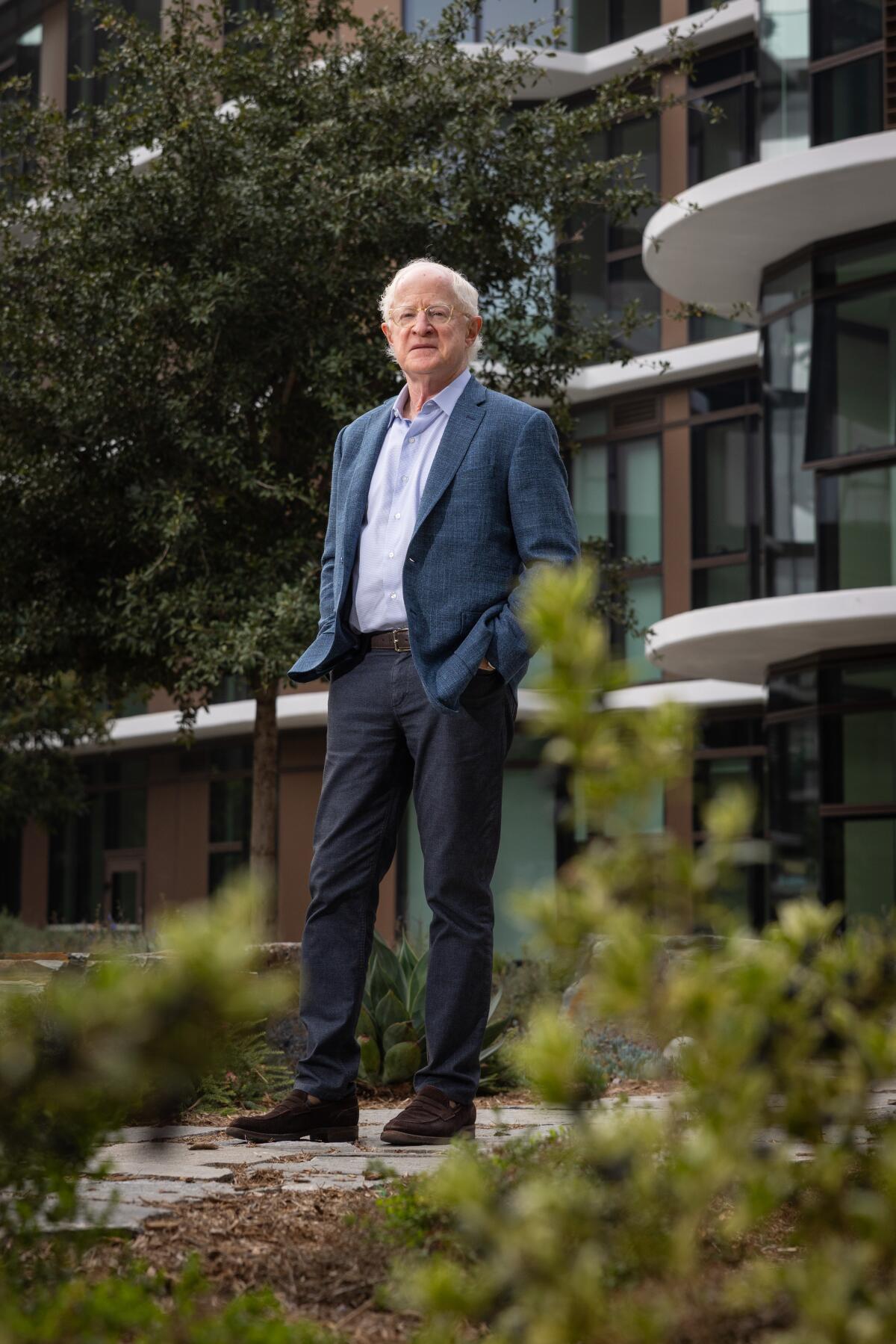
Bill Witte at 700 Broadway in Santa Monica.
(Jason Armond / Los Angeles Times)
He went on to earn degrees in urban studies and urban planning from the University of Pennsylvania and broke into the field as a member of the Philadelphia planning staff in the freewheeling administration of Mayor Frank Rizzo in the mid-1970s, when the city had 25,000 abandoned housing units.
“It was very parochial in Philadelphia, part Rust Belt and part ‘Sopranos,’ ” Witte said. “I loved it.”
Witte later served as San Francisco’s deputy mayor for housing before joining Related Cos. More than 35 years later, he is stepping down as chairman Jan. 1. Succeeding him will be Gino Canori as chief executive of Related California’s market-rate division, and Ann Silverberg as chief executive of its affordable division. Witte will become chairman emeritus.
The Times met with Witte to discuss the challenges facing the region and the real estate industry in the years ahead. His answers have been edited for clarity and brevity.
Downtown’s reputation has suffered since the pandemic as many people express concern about homelessness and safety. How could it get back on track?
First of all, I’d say, it’s not as bad as you think it is. It’s better than you think it is. It’s still the cultural core of the region.
I don’t have a single magic bullet for addressing the homeless problem. It’s not just about bricks and mortar and shelter. It’s got all sorts of issues attached to it. I’m not completely happy with everything that’s gone on in L.A., but frankly, I think Mayor Bass and her team have done a pretty good job since they’ve been in office, trying to address the homeless problem. They’re making some progress.

700 Broadway, Bill Witte’s latest luxury apartment complex project.
(Jason Armond / Los Angeles Times)
I’m told that the sidewalks are cleaned like once a month. It has to be more frequent.
You really have to go out of your way to show that you’re trying to make a difference. I’m told there are food carts and things near the entrances of buildings. You add all these things together, and if you’re going to work downtown, it’s not the most welcoming environment.
They always say don’t sweat the small stuff, but I think it’s the small stuff that ultimately makes a difference here.
Prominent firms have decided they’d rather have their offices somewhere else, such as Century City or Pasadena. What can be done about that?
I think the city, the mayor’s office, needs to become very engaged in talking to tenants who are still here. What are the problems downtown? What can we do about them? We’ve seen a very big change in San Francisco in that regard, actively promoting the city and taking steps. I think there needs to be active discussions with people, including some who have left downtown.
Make sure that people’s security needs are being addressed, have some visible success stories and actively promote it. Downtown is just one neighborhood in the whole city, but it’s probably the one that was most affected by the pandemic.
What do you say about complaints about the lack of public-sector employees downtown, which makes the sidewalks, stores and restaurants less busy?
What do you think the private sector thinks when the government, with taxpayer dollars, can’t seem to get people to come back to the office? That is not helpful. There are examples where the private sector looks and says, ‘Wait a minute, maybe we shouldn’t be here either.’
The real estate community has been critical of 2022’s Measure ULA, saying it cuts into profits and makes developments financially unfeasible. How is it affecting your company?
We’re on both sides of that. Our Alveare project that just started in construction has 105 affordable units for low- and extremely low-income families, got $10 million from the city’s ULA funds.
1

2

3

4

1. Bill Witte, real estate developer, tours 700 Broadway-his firm’s newest luxury apartment complex project on Tuesday, Dec. 16, 2025 in Santa Monica, CA. (Jason Armond/Los Angeles Times) 2. Bill Witte, real estate developer, tours 700 Broadway-his firm’s newest luxury apartment complex project on Tuesday, Dec. 16, 2025 in Santa Monica, CA. (Jason Armond/Los Angeles Times) 3. Bill Witte, real estate developer, tours 700 Broadway—his firm’s newest luxury apartment complex project on Tuesday, Dec. 16, 2025 in Santa Monica, CA. (Jason Armond/Los Angeles Times) 4. Bill Witte, real estate developer, tours 700 Broadway-his firm’s newest luxury apartment complex project on Tuesday, Dec. 16, 2025 in Santa Monica, CA. (Jason Armond/Los Angeles Times)
In the market-rate commercial real estate world, it’s a problem. It is not helpful. It’s part of the package of things that the investment community has been concerned about in L.A. You can agree or disagree whether that should be true, but it is a fact. And I know Mayor Bass is trying to work on some modifications to make it perhaps less onerous. But again, it comes up because there is no obvious source of funds for affordable housing.
Sometimes there is pushback from neighbors when affordable housing is proposed. How would you address their concerns?
We’ve done almost 20,000 units across the state, including in L.A., and we’ve taken just neighbors on bus tours of some of our existing developments that are not just new but maybe 10 years old.
It’s not just us. The affordable housing world has grown significantly over the years, including qualitatively. Most projects have on-site services and the design is getting better. We’ve won more design awards for affordable housing in California than any other developer.
It doesn’t always require spending gobs more money. It’s being thoughtful, thinking about the long term, thinking about the public spaces, which is what brands these projects. And since we’ve often done affordable development next to or as part of market-rate housing, it forces us to think that way.
I think the financial side is the bigger challenge right now. You will hear pushback that these things are ridiculously expensive — $800,000 a unit to build. Why is that? Well, first of all, everything is more expensive. But there is a longtime tendency, not just in L.A., to apply a whole series of admittedly desirable public policy objectives onto affordable housing because the government is involved.
Some of it is labor standards, higher disability requirements — all of that adds to the cost. You can argue on their behalf, but I think local and state governments are beginning to understand that it’s going to be very difficult to keep selling initiatives here, not because of NIMBYism, but because it’s hard to justify the cost.
There is a perception among developers that it is tough to build a financially successful project in L.A beyond such money-related challenges as construction costs, labor shortages and high interest rates faced by developers in other California cities. Why is that?
You’ve got a relatively young City Council that has been pushing some very progressive goals, not just on housing, but also on minimum wage and other issues.
The challenge for L.A. right now in the growth area is sending some signals to the entities that provide debt and equity to these projects that you are very concerned with protecting existing tenants who are income- and rent-stressed, but you’re not opposed to some growth. Without growth, there’s not going to be any growth in revenues and the city’s budget is going to continue to be stressed.
There are other parts of the state where the investment community looks more favorably for that reason.




Kanye West, the rapper now known as Ye, is suing his former project manager and his lawyers, alleging they wrongfully put a $1.8-million lien on his former Malibu mansion.
The suit, filed in Los Angeles Superior Court on Thursday, alleges that Tony Saxon, Ye’s former project manager on the property, and the law firm West Coast Trial Lawyers, “wrongfully” placed an “invalid” lien on the property “while simultaneously launching an aggressive publicity campaign designed to pressure Ye, chill prospective transactions, and extract payment on disputed claims already being litigated in court.”
Saxon’s lawyers were not immediately available for comment.
Saxon, who was also employed as West’s security guard and caretaker at the Malibu property, sued the controversial rapper in Los Angeles Superior Court in September 2023, claiming a slate of labor violations, nonpayment of services and disability discrimination.
In January 2024, Saxon placed the $1.8-million “mechanics” lien on the property in order to secure compensation for his work as project manager and construction-related services, according to court filings.
A mechanics lien, also referred to as a contractor’s lien, is usually filed by an unpaid contractor, laborer or supplier, as a hold against the property. If the party remains unpaid, it can prompt a foreclosure sale of the property to secure compensation.
Ye has denied Saxon’s allegations. In a November 2023 response to the complaint, Ye disputed that Saxon “has sustained any injury, damage, or loss by reason of any act, omission or breach by Defendant.”
According to Ye’s recent complaint, he listed the property for sale in December 2023. A month later, he alleged, Saxon and his attorneys recorded the lien and “immediately” issued statements to the media.
The suit cites a statement Saxon’s attorney, Ronald Zambrano, made to Business Insider: “If someone wants to buy Kanye’s Malibu home, they will have to deal with us first. That sale cannot happen without Tony getting paid first.”
“These statements were designed to create public pressure and to interfere with the Plaintiffs’ ability to sell and finance the Property by falsely conveying that Defendants held an adjudicated, enforceable right to block a transaction and divert sale proceeds,” the complaint states.
The filing contends that last year the Los Angeles Superior Court granted Ye’s motion to release the lien from the bond and awarded him attorneys fees.
The Malibu property’s short existence has a long history of legal and financial drama.
In 2021, West purchased the beachfront concrete mansion — designed by Pritzker Prize-winning Japanese architect Tadao Ando — for $57.3 million. He then gutted the property on Malibu Road, reportedly saying “This is going to be my bomb shelter. This is going to be my Batcave.”
Three years later, the hip-hop star sold the unfinished mansion (he had removed the windows, doors, electricity and plumbing and broke down walls), at a significant loss to developer Steven Belmont’s Belwood Investments for $21 million.
Belmont, who spent more money to renovate the home, had spent three years in prison after being charged with attempted murder for a pitchfork attack in Napa County. He promised to restore the architectural jewel to its former glory.
However, the property has been mired in various legal and financial entanglements including foreclosure threats.
Last August, the notorious mansion was once again put on the market with a $4.1 million price cut after a previous offer reportedly fell through, according to Realtor.com.
The legal battle surrounding Ye’s former Malibu pad is the latest in a series of public and legal dramas that the music impresario has been involved in recent years.
In 2022, the mercurial superstar lost numerous lucrative partnerships with companies like Adidas and the Gap, following a raft of antisemitic statements, including declaring himself a Nazi on X (which he later recanted).
Two years later, Ye abruptly shut down Donda Academy, the troubled private school he founded in 2020.
Ye, the school and some of his affiliated businesses faced faced multiple lawsuits from former employees and educators, alleging they were victims of wrongful termination, a hostile work environment and other claims.
In court filings, Ye has denied each of the claims made against him by former employees and educators at Donda.
Several of those suits have been settled.

After the dot-com bubble burst in the early 2000s, Candace Nelson reevaluated her career. She had just been laid off from a boutique investment banking firm in San Francisco’s tech startup scene, and realized she wanted a change.
From her home, she launched a custom cake service that soon morphed into an idea for a cupcake-focused bakery. Nelson and her husband — whom she met at the Bay Area firm where she had worked — then pooled their savings, moved to Southern California and together opened Sprinkles Cupcakes from a 600-square-foot Beverly Hills storefront.
The store quickly sold out on opening day in 2005, and over the next two decades, the Sprinkles brand exploded across the country, opening dozens of locations of its specialty bakeries as well as mall kiosks and its signature around-the-clock cupcake ATMs in several states.
“It was an unproven concept and a big risk,” Nelson told the Times in 2013, at which point the business had 400 employees at 14 locations and dispensed upward of a thousand cupcakes a day from its Beverly Hills ATM alone.
But now, the iconic cupcake brand is no longer.
Sprinkles abruptly shut down all of its locations on Dec. 31, leaving hundreds of retail employees across Arizona; California; Washington, D.C.; Florida; Nevada; Texas; and Utah in a lurch with little notice, no severance and scrambling to fulfill a surge of orders from customers clamoring to get their last tastes.
Candace Nelson, the founder of Sprinkles cupcakes, in Beverly Hills in 2018.
(Mel Melcon / Los Angeles Times)
Although Nelson long ago exited the company, having sold it to private equity firm KarpReilly LLC in 2012, she shared her disappointment with its fate on social media.
“As many of you know, I started Sprinkles in 2005 with a KitchenAid mixer and a big idea,” Nelson said in the post. “It’s surreal to see this chapter come to a close — and it’s not how I imagined the story would unfold.”
The company, now headquartered in Austin, Texas, made no formal announcement regarding the closures and Nelson has not said more than what she posted online. The company did share a comment with KTLA, saying “After thoughtful consideration, we’ve made the very difficult decision to transition away from operating company-owned Sprinkles bakeries.” Neither Nelson nor representatives of Sprinkles and KarpReilly responded to The Times’ requests for comment.
Sprinkles’ demise comes at a tough time for the food and beverage industry. At brick-and-mortar food retail locations, the non-negotiable ingredient and labor costs can be high. And shifting consumer sentiments away from sugar-filled sweets and toward more healthy and functional options, strained pocketbooks, as well as pushes by federal and state governments to nix artificial colors and flavoring, are creating uncertainties for businesses, those in the food industry said.

A 24-hour cupcake ATM at Sprinkles Cupcakes in Beverly Hills in 2012.
(Damian Dovarganes / Associated Press)
“Over the last 10 years the consumer has wizened up tremendously and is looking at the back of the label and choosing where to spend their sweets,” said David Jacobowitz, founder of Austin-based Nebula Snacks, an online food retailer.
At the same time, it’s also not uncommon for businesses owned by private-equity firms to close on a whim, where relentlessly profit-driven decisions might be made simply to pursue more lucrative projects. In recent years, private-equity deals have been seen to milk businesses for profit by slashing costs and quality, and have appeared to play a role in the breakup of some legacy retail brands, including Toys ‘R’ Us, Red Lobster, TGI Fridays and fabrics chain JoAnn Inc. On the flip side, private equity can help infuse much-needed cash into a business and extend its life.
Stevie León and her co-workers received a text the night before New Year’s Eve informing them the franchise Sprinkles location in Sarasota, Fla., where they worked would close permanently after their shifts the next day.
León, 33, said her position as a scratch baker mixing batter and frosting cupcakes overnight had been a dream job, since she had been searching for ways to develop baking skills without paying for expensive schooling.
“I really thought it was my forever job and it was taken away literally in a day,” she said. “I’m just taking it one day at a time.”
Ivy Hernandez, 27, the general manager at the Sarasota store, said that after the news was delivered to her boss, the franchise owner, they rushed to learn their options to keep the store afloat but quickly learned it could be legally precarious to continue operating. The store had been open less than a year.
A nearby corporate store, Hernandez said, had been in disarray for months, with employees contending with broken fridges and lapsed ingredient shipments, as managers implored higher-ups to pay the bills so the business could operate properly.
“It really felt like they were trying to do everything they could to screw everyone over as hard as possible until the end,” Hernandez said.
Sprinkles did not respond to questions about the franchise program or allegations of mismanagement in the lead-up to the closure.

A person walks by Sprinkles on the Upper East Side in New York City in 2020.
(Cindy Ord / Getty Images)
The obsession with tiny cakes in paper cups traces back to an episode of “Sex and the City” aired in 2000 showing Miranda and Carrie savoring cupcakes on a bench outside a West Village bakery called Magnolia’s Cupcakes.
“Big wasn’t a crush, he was a crash,” Carrie says to Miranda as she peels down the wrapper on a cupcake topped with bright pink buttercream frosting. She punctuates the quip by taking a big bite, leaving a glob of frosting on her face.
The scene sparked a tourism phenomenon for the bakery — which went on to create a “Carrie” line of cupcakes — and helped propel the burgeoning cupcake industry and companies like Sprinkles Cupcakes, Crumbs Bake Shop and Baked by Melissa to new heights.
Within a decade there was already talk of a “Cupcake Bubble,” coined by writer Daniel Gross in a 2009 Slate article where he argued that the 2008 economic recession laid the groundwork for a proliferation of cupcake stores across America, because a lot of people could figure out how to make tasty cupcakes cheaply and scale up without a huge capital investment.
Amid the decimation of many other local retail businesses, one could take over storefronts in heavily trafficked areas for cheap. As a result, “casual baking turned into an urban industry,” Gross said.
The cupcake fervor hit its peak when Crumbs, which had started as a single bakery on Manhattan’s Upper West Side in 2003, went public in a reverse merger worth $66 million in 2011. The wildly popular mini-cakes were selling at $4.50 a pop. But it became clear very quickly that it had grown too large, too fast. It closed in 2014 after it lost its stock listing on Nasdaq and defaulted on about $14.3 million in financing.
Analysts at the time said consumers were cooling on opulent desserts and suggested tougher times were ahead for bakeries that focused solely on cupcakes.
But Baked by Melissa has thus far proved those analysts wrong. The company has remained privately owned, and according to its founder, is focused on nationwide e-commerce operations — and on expanding the brand beyond sweets. Founder Melissa Ben-Ishay has gained a following on social media by sharing recipes for nutritious, easy-to-make meals.
“Businesses that prioritize quick value increases to get acquired often crash,” Ben-Ishay told Forbes last year. “We’re committed to maintaining product quality and steady, long-term growth.”
Before its unceremonious and sudden closure, Spinkles company leadership had pushed to diversify its business as part of a strategy to recover from a pandemic-era lull.
Chief Executive Dan Mesches told trade publication Nation’s Restaurant News in 2021 that comparable sales had grown since pre-pandemic years. He said the company had ramped up its direct-to-consumer and off-premises offerings and created a line of chocolates made to look like the tops of their cupcakes. The company also introduced a new franchise program with the goal of opening some 200 locations in the U.S. and abroad over three years.
“Innovation is everything for us,” Mesches said.
Sprinkles was known for, among other things, inventive and somewhat corny methods of customer delivery. Besides the trademark ATMs, the company’s vending machines found at many airports made loud, attention-drawing jingles, drawing dramatic complaints and jokes from TikTok travelers. In the 2010s, the company debuted a custom-built truck — “the Sprinklesmobile” — to deliver cupcakes to cities without physical locations.
Frances Hughes, co-founder of online wholesale marketplace Starch, said there’s no question that gourmet sweet treats are still in vogue. But brick-and-mortar locations are much more risky, with more unpredictability. Having large fixed costs makes a business “extremely sensitive to small changes in traffic or frequency,” while online or e-commerce models can be more flexible.
“I think cupcakes as a product still have demand. But the novelty paths that support that rapid retail expansion have passed,” Hughes said.
When Nelson, the Sprinkles founder, posted her somber message about the closure, she asked people to share memories of the company. Many offered heartfelt responses, her comments flooded with stories, for example, of poor college students making the trek to the Beverly Hills location for a limited number of first-come, first-served free cupcakes.
But many of the comments also criticized Nelson’s sale to private equity.
“You sold it to PE and expected it to not close?? What planet are you living on? I don’t begrudge you for selling as that’s entirely your choice but to think any PE firm cares about a company in the slightest is insanity,” one Instagram user said.
Nicole Rucker, an L.A.-based pastry chef and owner of Fat+Flour Pie Shop, said she didn’t observe a decline in the quality of the product after the private-equity takeover. She has been a longtime admirer of the company, driving up from San Diego to sample the cupcakes when its store opened. The simple attractiveness of the box and the logo, and the consistency in the way cupcakes were decorated, “was inspiring,” she said.
“It had a strong hold on people for years,” Rucker said.
Rucker said however that when a private-equity-owned business shutters, she doesn’t feel sadness: “I would rather give my money to a fellow small-business owner, because I would rather know that every dollar and every sale matters.”
Michelle Wainwright, the owner and founder of Indiana-based bakery Cute as a Cupcake! said that although the niche cupcake industry may no longer be in its heyday — with “Sex and the City” no longer airing and competitive baking show “Cupcake Wars” (which Candace Nelson served as a judge on) now canceled — they are still versatile treats, with great potential for creativity.
And they are sentimental to her, because she uses her grandmother’s recipe.
“Cupcakes are still a winner,” Wainwright said. “It’s my belief that a life with out cupcakes is a life without love.”

Semiconductor testing equipment company FormFactor is laying off more than 200 workers and closing manufacturing facilities as it seeks to cut costs after being hit by higher import taxes.
The Livermore, Calif.,-based company plans to shutter its Baldwin Park facility and cut 113 jobs there on Jan. 30, according to a layoff notice sent to the California Employment Development Department this week. Its facility in Carlsbad is scheduled to close in mid-December later this year, which will result in 107 job losses, according to an earlier notice.
Technicians, engineers, managers, assemblers and other workers are among those expected to lose their jobs, according to the notices.
The company offers semiconductor testing equipment, including probe cards, and other products. The industry has been benefiting from increased AI chip adoption and infrastructure spending.
FormFactor is among the employers that have been shedding workers amid more economic uncertainty.
Companies have cited various reasons for workforce reductions, including restructuring, closures, tariffs, market conditions and artificial intelligence, which can help automate repetitive tasks or generate text, images and code.
The tech industry — a key part of California’s economy — has been hit hard by job losses after the pandemic, which spurred more hiring, and amid the rise of AI tools that are reshaping its workforce.
As tech companies and startups compete fiercely to dominate the AI race, they’ve also cut middle management and other workers as they move faster to release more AI-powered products. They’re also investing billions of dollars into data centers that house computing equipment used to process the massive troves of information needed to train and maintain AI systems.
Companies such as chipmaker Nvidia and ChatGPT maker OpenAI have benefited from the AI boom, while legacy tech companies such as Intel are fighting to keep up.
FormFactor’s cuts are part of restructuring plans that “are intended to better align cost structure and support gross margin improvement to the Company’s target financial model,” the company said in a filing to the U.S. Securities and Exchange Commission this week.
The company plans to consolidate its facilities in Baldwin Park and Carlsbad, the filing said.
FormFactor didn’t respond to a request for comment.
FormFactor has been impacted by tariffs and seen its growth slow. The company employs more than 2,000 people and has been aiming to improve its profit margins.
In October, the company reported $202.7 million in third-quarter revenue, down 2.5% from the third quarter of fiscal 2024. The company’s net income was $15.7 million in the third quarter of 2025, down from $18.7 million in the same quarter of the previous year.
FormFactor’s stock has been up 16% since January, surpassing more than $67 per share on Friday.

George Kittle used bottle of tequila to deal with devastating Achilles injury

Parents fear closing of Good Street Learning Center as leaders push to stay open

College football player transferred from Miami to Indiana before national championship

When will the big nor’easters return? Boston in midst of second-longest streak without hefty snowfalls. – The Boston Globe

Broncos healthy compared to Bills

Florida High School Football Rankings: Top 25 teams – Oct. 21

Cleary's 21 help Le Moyne down Central Connecticut State 69-64 in OT

How old is Bo Nix? What to know about Oregon quarterback ahead of 2024 NFL Draft

99th annual Pony Swim held in Virginia

Video: ‘It Didn’t Have to Happen This Way:’ U.Va. Faculty Call for Review of Police Response to Protests

San Antonio ends its abortion travel fund after new state law, legal action

UN top court set to open Myanmar Rohingya genocide case

Arson engulfs Mississippi synagogue, a congregation once bombed by Ku Klux Klan

Federal judge blocks Trump administration from enforcing mail-in voting rules in executive order

Four killed, 20 injured in overnight Russian strikes across Ukraine
-

 Detroit, MI1 week ago
2 hospitalized after shooting on Lodge Freeway in Detroit
-

 Technology6 days ago
Power bank feature creep is out of control
-

 Dallas, TX4 days ago
Anti-ICE protest outside Dallas City Hall follows deadly shooting in Minneapolis
-

 Delaware3 days ago
MERR responds to dead humpback whale washed up near Bethany Beach
-

 Dallas, TX1 week ago
Defensive coordinator candidates who could improve Cowboys’ brutal secondary in 2026
-

 Iowa6 days ago
Pat McAfee praises Audi Crooks, plays hype song for Iowa State star
-

 Montana2 days ago
Service door of Crans-Montana bar where 40 died in fire was locked from inside, owner says
-

 Health1 week ago
Viral New Year reset routine is helping people adopt healthier habits