Business
Disney’s Dana Walden sets leadership team; Bergman remains film studios chief


Walt Disney Co.’s incoming president and chief creative officer, Dana Walden, has unveiled her leadership team, which includes several familiar faces from the company’s film, television and marketing units.
Walden will become Disney’s first female president on Wednesday. She will report to Josh D’Amaro, who will succeed Bob Iger as Disney’s chief executive, after the company’s annual meeting with shareholders and its high-profile leadership handoff.
Walden’s senior team includes her longtime creative partner, Alan Bergman. As chairman of Disney Entertainment, Studios, Bergman will continue to oversee Disney’s film studios, including production, marketing and distribution.
Bergman also will retain oversight of Disney’s streaming programming in concert with Walden.
Disney executives Joe Earley and Adam Smith were named co-presidents of Disney Entertainment’s direct-to-consumer offerings, Disney+ and Hulu. Both executives will be responsible for strategy and financial performance and report to Walden and Bergman.
Earley and Walden worked together when they were Fox executives; Earley will also serve as head of content strategy.
Smith continues in his role as Disney Entertainment chief product and technology officer. He also will continue to collaborate with ESPN Chairman Jimmy Pitaro on matters related to ESPN and ESPN+.
Debra OConnell will step into a newly formed role as chairman of Disney Entertainment Television.
She will have a broad TV portfolio that includes ABC Entertainment, Disney-branded cable channels, Hulu Originals as well as programming from National Geographic, 20th Television and 20th Television Animation.
OConnell will continue to oversee ABC News and the ABC-owned television stations, including KABC-TV Channel 7 in Los Angeles.
In a separate memo late Monday, OConnell introduced her team, including Craig Erwich, who now will oversee 20th Television and 20th Television Animation in addition to ABC Entertainment and Hulu Originals.
Several executives report to OConnnell, including Ayo Davis of Disney Branded Television; Courteney Monroe of National Geographic Content;
Almin Karamehmedovic of ABC News; Chad Matthews of ABC stations; ad executives Rita Ferro and Jimmy Zasowski (who also will report to Bergman and Pitaro); and Sean Cocchia, who overseas strategic scheduling and programming.
Disney’s incoming president, Dana Walden, has established her senior leadership team.
(Richard Shotwell / Invision/AP)
Sean Shoptaw, who serves as executive vice president for games and digital entertainment, and his organization will shift from Disney Experiences and into Walden’s division.
Shoptaw oversees Disney’s games business and its collaboration with Epic Games to develop a Disney universe connected to Fortnite.
John Landgraf remains chairman of FX and will continue to report directly to Walden.
Asad Ayaz, who is chief marketing and brand officer, has an influential remit across Disney’s various business segments. He will report to D’Amaro and Walden.
“The strength of Disney has always been the emotional connection between our stories and the people who love them,” Walden said in a statement. “As fans engage with Disney across more formats and platforms than ever before, we are bringing together the full power of our creative businesses to build an even more connected experience for audiences.”




As much of downtown L.A. continues to feel dark and deserted, local businesses want the city to steal San Francisco’s secret for firing up foot traffic.
The tech mecca has slowly begun to emerge from one of the country’s deepest declines in downtown retail, in part through a program that peppered the city with subsidized pop-up shops.
The Vacant to Vibrant program turned abandoned spaces into bakeries, bookstores, cafes, chocolateries, galleries and other things.
Local entrepreneurs were given grants and support from the city and charities, as well as months of free rent to set up shop. The idea is to leverage empty storefronts to build buzz and entice more shoppers to city sidewalks.
While San Francisco is still far from its pre-pandemic peaks, backers say the program has brightened struggling retail areas.
“We’re creating a window on what downtown could look like,” said Simon Bertrang, executive director of SF New Deal, the nonprofit behind Vacant to Vibrant. The hollowing-out created by COVID-19 could be an opportunity to turn downtown San Francisco into a “mixed-use neighborhood with a lot of small businesses and maybe more residential,” he said.
While San Francisco is still far from its pre-pandemic peaks, backers of Vacant to Vibrant say the program has brightened struggling retail areas.
(Justin Sullivan / Getty Images)
Both L.A. and S.F. have grappled with keeping stores and restaurants in their business districts since the pandemic emptied office buildings. While most employees are working from the office again, a significant number are still working from home, and many aren’t coming in every weekday. The diminished presence of workers continues to make it hard on the lunch spots, bars and shops that rely on them to survive.
Though it is difficult to compare how businesses are doing in each downtown, there are some indicators that San Francisco has been growing more in the last year.
Reservation platform OpenTable said online reservations in the Northern Californian city shot up more than 20% compared with most months last year. Reservation growth in L.A. was capped below 10% for most of the same period.
Downtowns across the country need to find solutions, experts warn, as dark storefronts can lead to a downward spiral, with companies hesitant to lease office space in vacant areas.

Looking down Broadway from its intersection with 7th Street in downtown in Los Angeles.
Retailers are already opting out of downtown L.A. due to its slow recovery from the pandemic shutdown, said real estate broker Derrick Moore of CBRE, who helps arrange commercial property leases.
“A lot of operators are just electing to skip over downtown,” he said. “They’re leasing spaces elsewhere, where they feel they have a greater chance at higher sales.”
Brands have headed to more vibrant, nearby neighborhoods such as Echo Park and Silver Lake because of downtown’s weaker business.
Downtown Los Angeles residents, businesses and other city boosters want to try to prime the pump, using a program like San Francisco’s to help small businesses take over vacant storefronts and turn the lights back on, said Cassy Horton, co-founder of the Downtown Residents Assn.
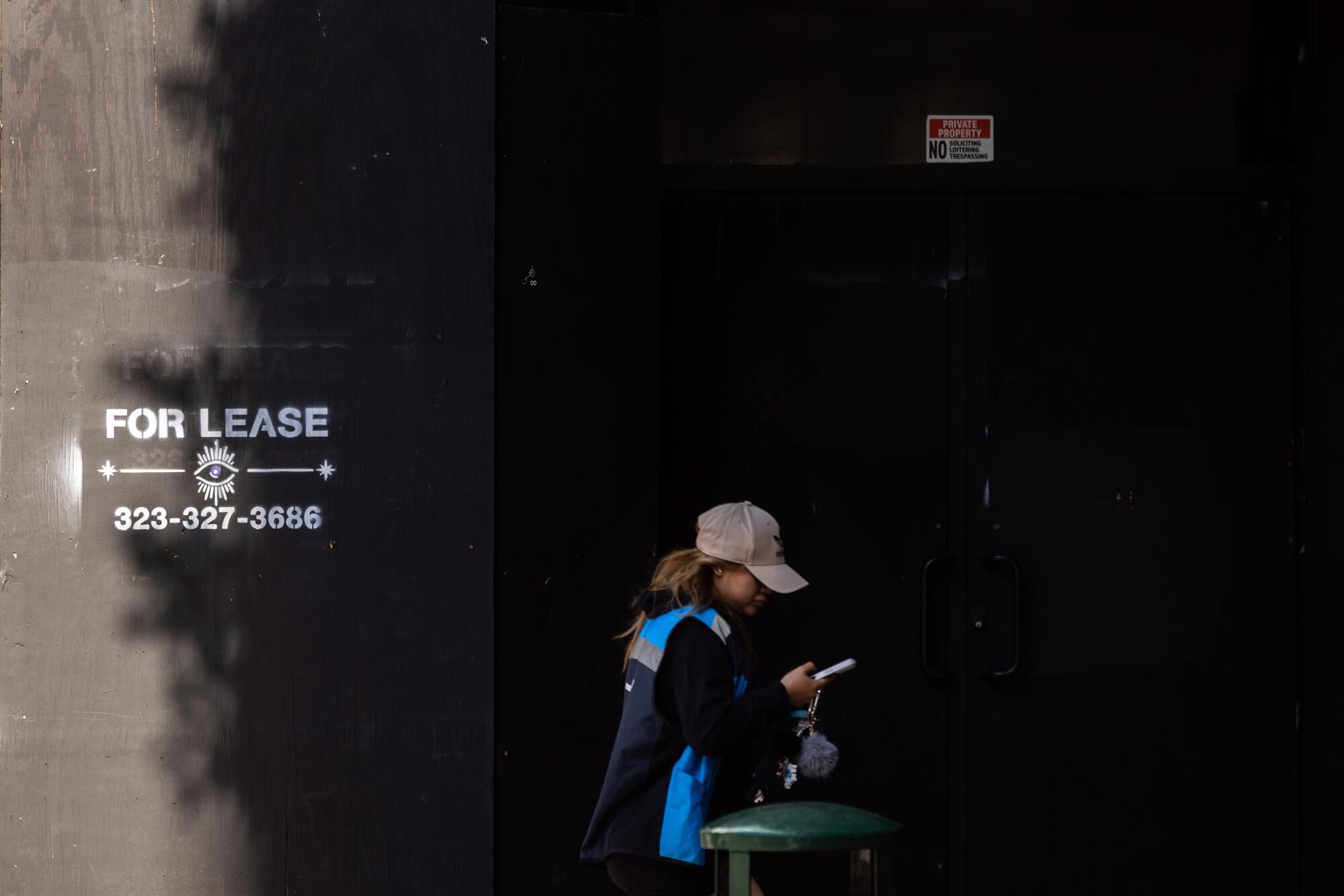
A pedestrian walks past a building for lease on Broadway in downtown Los Angeles.
(Etienne Laurent / For The Times)
Surveys by the group have found that what residents love most about downtown is its walkability, restaurants, bars and coffee shops, she said.
“I love being able to live a lifestyle where I can run all of my core errands within a couple blocks,” Horton said. “I don’t have a car.”
Retail property vacancy downtown could be as high as 40%, Moore said, with some neighborhoods, such as the Historic Core, suffering more than others. Nike recently closed its store on Broadway.
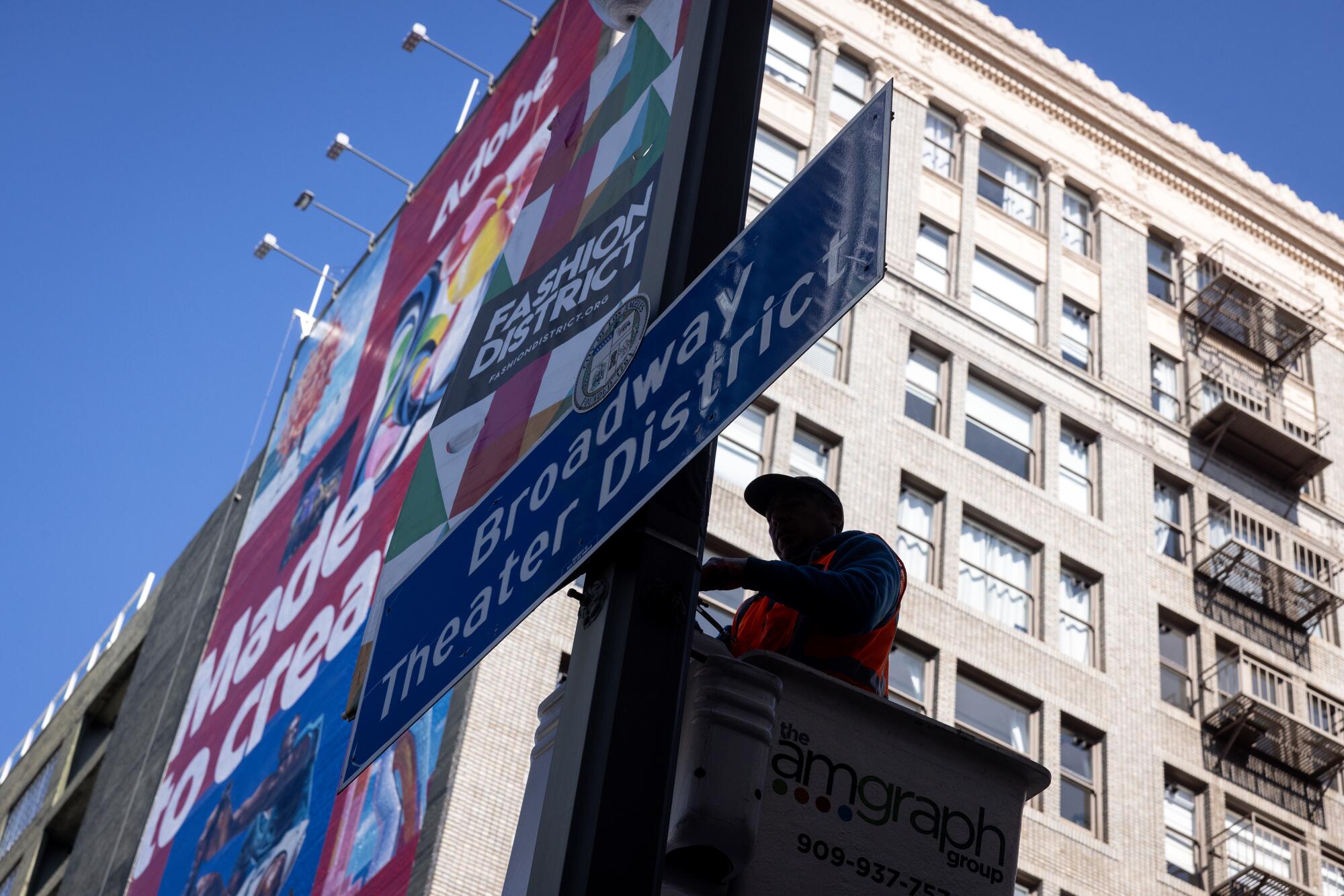
A worker removes a banner on Broadway. Retailers are already opting out of downtown L.A. due to its slow recovery from the pandemic shutdown, a broker said.
(Etienne Laurent / For The Times)
“Downtown’s commercial vacancy crisis is visible on every block,” a recent report by the residents’ group said.
The report called for a “safe sidewalks” public safety campaign to work in tandem with a plan to bring back retail tenants.
In San Francisco, participating businesses can get their feet wet with a three-month pop-up to test the waters in a high-traffic location with low financial overhead and technical support from SF New Deal and the mayor’s office.
Businesses are offered grants to operate, help with lease negotiations, assistance with obtaining city permits, insurance, marketing support, business mentoring, and three to six months of free rent.
The intention is to transition many of the pop-ups into long-term leases, creating permanent fixtures in the downtown landscape. So far, more than 10 of the 40 small businesses that started as pop-ups have moved on to multiyear leases with their landlords.

A boarded-up storefront on Broadway. “Downtown’s commercial vacancy crisis is visible on every block,” a recent report by the Downtown Residents Assn. said.
(Etienne Laurent / For The Times)
Property owners with storefronts they need to fill receive funding to cover the cost of preparing the space for tenants and other property expenses, help with city permits and other support.
San Francisco launched the program in 2023 with $700,000 and contracted with SF New Deal, which focuses on supporting small businesses in the city.
The program is also supported by corporate philanthropy from Wells Fargo, JPMorgan Chase, Visa, Gap and others.
Among the first stores to open through the program was Devil’s Teeth Baking Co., a popular bakery in the Outer Sunset neighborhood that established an outpost in the moribund Financial District and brought followers with it.
“Suddenly, there are lines out the door on the weekend” of people waiting for breakfast sandwiches, Bertrang said.
The bakery now has a long-term lease, as do other graduates of the program, including Mello flower shop, arts-and-crafts studio Craftivity and Whack Donuts.
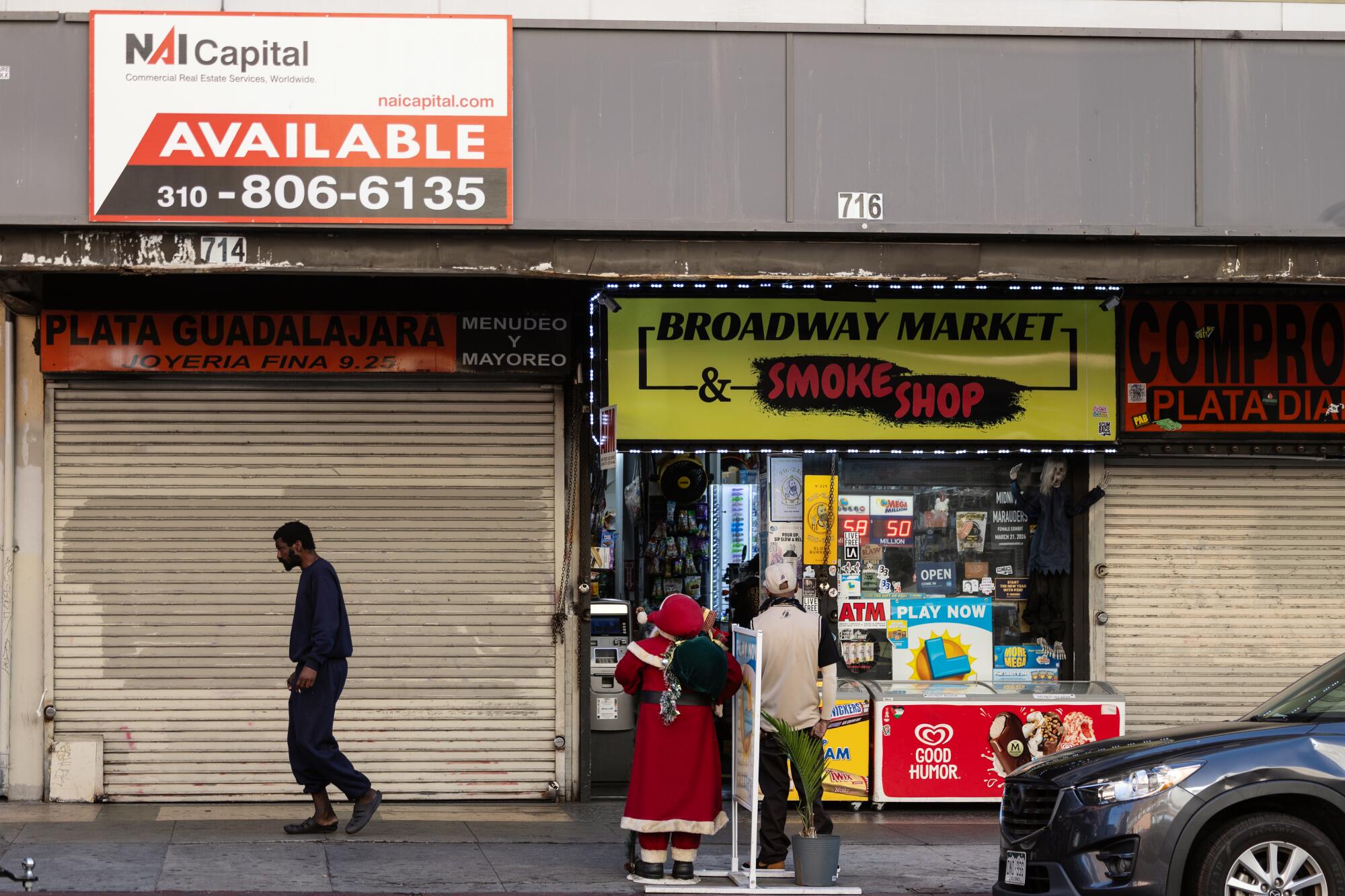
A pedestrian walks past shuttered stores on Broadway in Los Angeles.
(Etienne Laurent / For The Times)
San Francisco’s business centers were particularly hard-hit by the pandemic as its technology companies quickly adapted to remote work and kept at it even as the crisis eased, triggering widespread office and retail vacancies.
“San Francisco had the worst return-to-work situation in the nation,” Bertrang said. “It was the most extreme version of what L.A., New York and other cities in our country are dealing with.”
Representatives of nearly 40 organizations in cities across the country have reached out to him for advice on how similar programs might work in their stricken neighborhoods.
Among them was downtown L.A. business advocacy group Central City Assn., which has called for L.A. to subsidize retailers’ rents to help fill vacant storefronts in key corridors. It is working with city officials, looking into a program like Vacant to Vibrant for Los Angeles.
Adding businesses to the streets while improving public safety would help halt the “downward spiral and turn it into more of a virtuous cycle,” said Nella McOsker, president of the association.
“San Francisco has demonstrated this larger ripple effect of success,” she said. “This is really, really doable in targeted pockets of downtown,” she said.
Nick Griffin of the business improvement district DTLA Alliance said activating storefronts is a worthy goal as long as the city first makes the streets both safe and pleasant for pedestrians.
The city needs to provide clean sidewalks, street lighting and graffiti removal before consumers and businesses return, he said.
“San Francisco was the poster child for the doom loop and has pivoted to downtown recovery,” he said. “ We are building that story right now.”

Warner Bros. tied the record for most wins for a studio in a single night with 11 Academy Awards on Sunday, a milestone that comes as the company faces an uncertain future.
The studio won six Academy Awards for “One Battle After Another” and four awards for “Sinners.”
Notable among the accolades was Michael B. Jordan’s Academy Award for lead actor for his dual roles as twins in “Sinners,” “One Battle After Another’s” win for best picture and Amy Madigan’s win for supporting actress in “Weapons.”
The record of 11 is jointly held by MGM for 1959’s “Ben-Hur,” Paramount for 1997’s “Titanic” and New Line Cinema with “The Lord of the Rings: The Return of the King” in 2003, before it was absorbed into Warner Bros.
Netflix was second with seven wins. Walt Disney Co., Apple, Universal-owned Focus Features and Neon all won one each.
The awards come at a precarious time for Warner Bros., which is set to be acquired by Paramount Skydance in a mega $111-billion deal for its entire parent company, Warner Bros. Discovery.
The film and TV studios, HBO and HBO Max were originally set to be acquired by Netflix before the streaming company dropped its bid last month after an aggressive pursuit by Paramount.
To buy the company, Paramount is taking on $79 billion in debt, a massive amount that many in Hollywood expect will result in steep layoffs targeting overlapping functions and departments across the two companies.
Paramount executives have already identified $6 billion in cost cuts, though they have said the majority of that will come from “nonlabor sources.” The company also said it does not plan to reduce production capacity, with Paramount Chief Executive David Ellison vowing to produce 30 films a year — 15 from each studio.

The hottest new gig-economy job in Los Angeles is performing at home to help artificial intelligence understand how humans move.
Hundreds of people from Santa Monica to Los Feliz are strapping cameras on their heads and hands as they do chores at home so bots can watch how they make coffee, scrub toilets, water plants and wash dishes.
At a corner table at Urth Caffe downtown, a woman is sitting next to a big black bag. A constant flow of visitors stops by. She slips each a package and instructions, and they move on.
“People think I am selling” drugs, she says.
She’s actually a manager for a San Francisco-based firm called Instawork that connects companies and blue-collar workers, and she’s handing out headbands with phone mounts, a simple piece of equipment that lets people record their every move — movements that will be turned into data to train robots how to act.
She hands Salvador Arciga a headmount and tells him to go home and do the dishes and clean his kitchen.
He has done odd jobs all over town: DoorDash delivery, handing out hats at Dodger Stadium, washing dishes at Disneyland, hanging holiday lights at the Los Angeles Zoo and more. This job seems relatively easy, and it pays $80 for two hours of footage.
“I need to do chores anyway,” he says. “Now I get a chance to get paid to do it.”
Salvador Arciga checks in for work in front of Urth Caffe to collect his headset in January.
(Ronaldo Bolanos / Los Angeles Times)
AI chatbots like ChatGPT learned to converse, make music, generate images, and write code by using all the information they could get from the internet. Now, as AI and robotics companies figure out how to do the same in the physical world, the models need much more information about real-world movements.
It is not as readily available online, so the quest to capture data on human movement has given rise to a micro-economy that supplies real-world demonstrations of what some call “physical AI” systems, such as humanoid robots.
“Humans are supplying ground truth, judgment, or structured feedback that models can’t reliably produce on their own yet,” said Jason Saltzman, head of insights at market intelligence firm CB Insights.
Some countries already have “arm farms,” dedicated facilities where hundreds of humans record first-person footage of them opening doors or folding laundry for robotics. In China, there are more than 40 state-owned training centers where humans operate robots wearing virtual reality headsets.
The development of robotic models is a key focus for major tech companies like Tesla and Google, as well as California startups such as Figure AI and Dyna Robotics.
Goldman Sachs forecasts the market for humanoids could reach $38 billion by 2035. Much of that will be led by China, but California is also a growing center of next-generation robotics.
This intense demand is driving significant activity among niche data providers. San Francisco-based Encord, for instance, raised $60 million in February after its physical AI operations revenue increased tenfold in the last year. In the same vein, Meta-backed Scale AI has gathered 100,000 hours of footage for robotics, while its Palo Alto-based competitor Micro1 employs 1,000 people across 60 countries to record household tasks.
The global data collection and labeling market alone could reach $17 billion by 2030, says market intelligence firm Grand View Research.
Critics argue this work is extractive and poorly compensated, especially when these AI systems are being trained to ultimately replace human labor.
Still, in an embattled economy, with rising inflation and growing unemployment, more workers like Arciga are turning to these jobs for quick cash. In some cases, entire families sign up to record video, speech and images for AI training to supplement their income.
“It’s one of the biggest gig economies that is going to exist in the whole world,” said Shahbaz Magsi, co-founder of Sunain, a human data capture startup.

Arciga adjusts the headset to record himself doing housework in Koreatown.
(Ronaldo Bolanos / Los Angeles Times)
Arciga fastens the headset over his black beanie and enables “Do Not Disturb” on his iPhone, before fastening the phone to his head to record.
As he grabs a paper towel to wipe a stain on his stovetop, he narrates what he is doing, as the manager he met at the cafe had instructed him to do. She said it didn’t matter whether he said it in Spanish or English.
“Right now, I am going to use the spray,” he says.
Each task recorded — be it plant watering or kitchen cleaning — has to last between two and 15 minutes.
Instawork, the company that hired Arciga and more than 50 others like him that day, has historically catered to stadiums, hotels, kitchens and other businesses that need temporary workers.
It has also entered the human movement data capture business to leverage its workforce to train and support robotics systems.
Many new startups have begun building custom hardware — cameras and bodysuits — to capture nuances of human movement, pressure, depth of touch and human pose reconstruction for their datasets.
Egyptian immigrants Azzam and Samra Ahmed are padding their savings by performing for bots in their one-bedroom apartment in Pasadena.
They put on wrist and head cameras before preparing dinner.
The wrist camera captures how every muscle moves as they chop vegetables, season and grill chicken and roll up their shawarmas. This level of detail is needed for a robotic model to learn exact hand movements that cannot be caught by the standard human point of view.
Sunain, the human data capture startup, ships these custom wrist cameras to vetted contributors in its network. It has more than 1,400 contributors in Los Angeles, from Culver City and Santa Monica in the west to Pasadena and Los Feliz in the east.

Arciga cleans a kitchen counter while narrating his actions.
(Ronaldo Bolanos / Los Angeles Times)
“The region offers unmatched diversity of homes, lifestyles and people,” said Magsi, CEO of Sunain.
Where Instawork orders scripted movements, Sunain encourages its gig workers to record natural human behavior, including jumping between tasks.
If humans hear a running tap in the bathroom while cooking, they pause cooking to go close the tap before returning to cooking. That’s how robots will be expected to behave in the real world.
“These robots need to understand the context switching that humans do,” Magsi said.
For the Ahmeds, who work during the day as a mechanic and a nail salon employee, life in their apartment has been reshaped by robot training. They watch Netflix, cook and play table tennis wearing their gear. Their parents are shocked to see the couple living their normal lives covered in cameras.
“We are making money off something that we do every single day,” Azzam Ahmed said. “That’s like getting paid for breathing.”
It’s not always easy work.
Some workers complain that receiving calls and messages can interrupt their recordings, and having a phone strapped to their head is uncomfortable. Some complain that their videos aren’t accepted sometimes, so it takes longer than they expect to get the right footage to get paid.
A recent attempt by the Ahmeds to record cooking was disqualified for payment after reviewers found that steam from the dish had blocked the video. Since then, the couple have avoided cooking steamy dishes.
Still, they each earned $1,200 by doing chores they recorded.
“That money goes directly to our savings,” Azzam Ahmed said.
Sunain has expanded its robot data capture to homes in Turkey, Singapore, Canada and Malaysia. The company has 25,000 contributors across 30 countries to work on voice, video and text completion tasks.
Arciga says some of his friends have challenged him to reconsider whether he should be training AI to do what only humans can do. “Sometimes they do tell me, ‘Well, you’re the problem,’” he said.
His response is that new technology always brings fear and change and it also creates new kinds of jobs, like his latest gig, and people will always demand a human connection.
“People will still need people,” he said.

U.S. Court Rules Against RFK Jr.’s Vaccine Policies

Our 2026 Oscars Recap : Pop Culture Happy Hour

The Live Nation trial restarts with a ‘velvet hammer’

Cuba’s entire electrical grid collapses, leaving whole island without power

Minnesota bill would ban warrants allowing police to collect data from devices near a crime scene

Florida High School Football Rankings: Top 25 teams – Oct. 21

How old is Bo Nix? What to know about Oregon quarterback ahead of 2024 NFL Draft

Cleary's 21 help Le Moyne down Central Connecticut State 69-64 in OT

99th annual Pony Swim held in Virginia

Indiana Members Credit Union announced as new anchor tenant at Bottleworks District
Minnesota bill would ban warrants allowing police to collect data from devices near a crime scene

Kallas says ‘no appetite’ to shift mandate of EU Hormuz naval mission

Trump predicts US will have ‘honour of taking Cuba’ amid power blackout

MTG on Trump’s Iran war: ‘Why would an American president do that?’

Video: Michael B. Jordan Celebrates Oscar Win at In-N-Out
-

 Oklahoma1 week ago
OSSAA unveils Class 6A-2A basketball state tournament brackets, schedule
-

 Oklahoma2 days ago
Family rallies around Oklahoma father after head-on crash
-

 Michigan1 week ago
Operation BBQ Relief helping with Southwest Michigan tornado recovery
-

 Southeast1 week ago
‘90 Day Fiancé’ alum’s boyfriend on trial for attempted murder over wild ‘Boca Bash’ accusations
-

 Nebraska4 days ago
Wildfire forces immediate evacuation order for Farnam residents
-

 Health1 week ago
Ancient herb known as ‘nature’s Valium’ touted for improving sleep and anxiety
-
 Business1 week ago
Commentary: In two new court cases, judges find that AI does not have human intelligence
-

 Technology1 week ago
Time’s running out to get a free gift card when you preorder a new MacBook