Business
Disney is doubling its fleet of cruise ships. What that says about the company's strategy

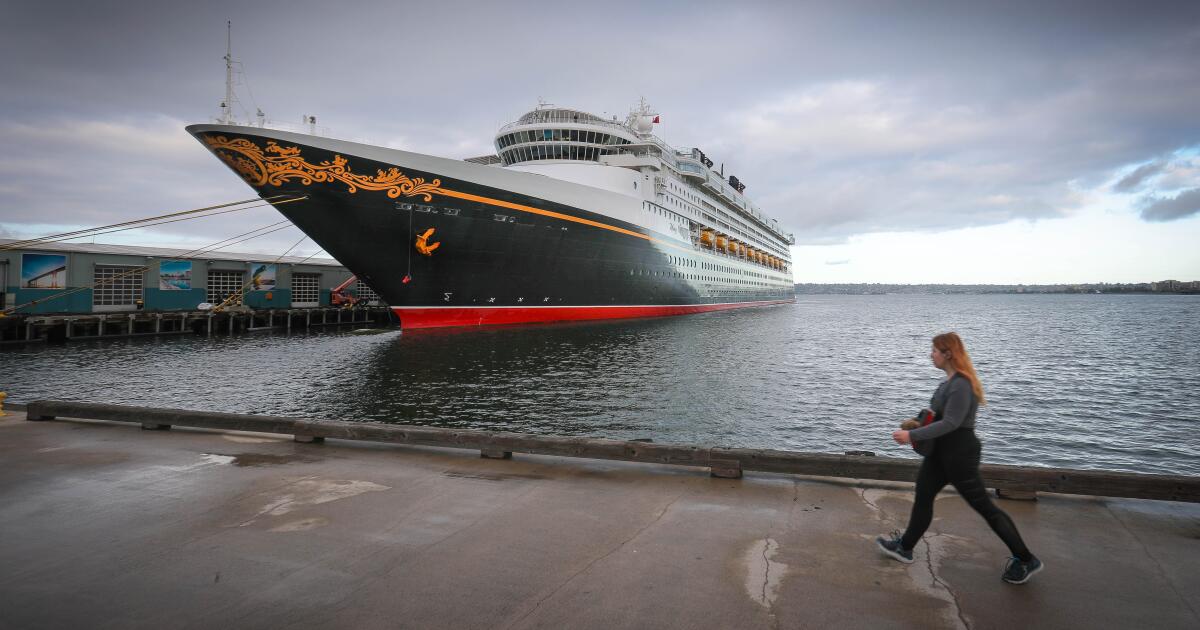
When Cal State Fullerton professor Andi Stein set sail on her first Disney Cruise trip to the Bahamas for research more than a decade ago, she was on the fence about the idea. Unsure what it would be like voyaging with so many youngsters, she booked a short four-day journey.
By the time she came back, Stein was hooked. She booked another Disney cruise to the Mexican Riviera aboard the Disney Wonder with her mom about two months later. Her fandom has persisted since then. Last year, she took a seven-day cruise on the Disney Fantasy to the Caribbean.
“Disney really understands entertainment, and that carries through onto their cruise ships,” said Stein, who wrote a book about the Disney brand. “But they add the luxury experience that a cruise can provide that you’re not necessarily going to get in the theme parks.”
Walt Disney Co. is banking on winning over more vacationers like Stein, and it’s spending big bucks to do so.
Disney plans to expand its five-ship fleet to eight ships by next year. By 2031, the company will have 13 ships worldwide, Disney experiences chairman Josh D’Amaro said in August at the D23 fan event in Anaheim.
“Expanding our fleet gives more people, in more parts of the world, the opportunity to experience a vacation at sea like only Disney can provide,” he said at the event.
The fact that the company is investing heavily in the cruise line indicates that it sees future opportunity there, said Brent Penter, associate analyst at investment banking firm Raymond James. He expects Disney’s capital expenditures to rise 27% to $7 billion companywide next year, an increase driven primarily by final payments for the new ships.
Penter said the ships are “billion-dollar investments,” but they’re worth the expense.
“It’s a business that’s still small enough that demand really outstrips supply,” he said. “We think they’re doing the smart thing by investing in this business so that they can serve a lot more of that demand.”
Though still a relatively small business, the Disney Cruise Line is becoming an increasingly important part of the company’s financial picture, and is currently a bright spot as the firm’s parks segment begins seeing signs of softening demand.
The Burbank media and entertainment giant doesn’t break out financial results for the cruise line, but Raymond James estimates it brings in about $3 billion a year, comprising 3% of Disney’s overall 2023 revenue.
Disney in August said the cruise line, among other segments, had “improved results” compared to the prior year for Disney’s fiscal third quarter while its overall “experiences” division reported a 3% decrease in operating income. (That division includes the theme parks, merchandise and travel and leisure offerings such as the Aulani resort and spa in Hawaii.)
Disney is willing to take a short-term financial hit from its investment in an expanded fleet. The company warned analysts during its third-quarter earnings call that its fourth-quarter results would reflect pre-launch costs for two of its new ships.
“The business, even prior to COVID, … continues to generate double-digit return on investment for our shareholders,” said Thomas Mazloum, president of Disney’s New Experiences Portfolio and Disney Signature Experiences, which includes the cruise line. “With our expansions, we certainly expect similar, attractive returns from our future ships.”
The cruise industry was growing before the pandemic, but took a big plunge once the virus spread. Demand for such tourist voyages have since rebounded. Last year’s global passenger volume was up 6.8% to 31.7 million, compared to 29.7 million in 2019, according to a May report from the Cruise Lines International Assn. trade group. By 2027, the number of cruise passengers is expected to reach nearly 40 million.
“It’s part of the total pent-up demand for tourism coming out of COVID,” said Andrew Coggins, Jr., a cruise industry analyst who teaches at Pace University’s Lubin School of Business. “The industry is very bullish about what’s coming up ahead.”
That’s why many cruise lines, ranging from major players such as Royal Caribbean and Carnival Corp., which is the biggest cruise parent company, to smaller operators like Disney, are building new ships and expanding their business.
For Disney, that’s meant adding new routes, particularly in the Asia market, and new onboard attractions. The company now represents about 5% of the total Caribbean market and 2.5% of the worldwide market, Mazloum said.
He called the cruise line a “significant contributor” to the experiences division, with a “long runway left.”
After launching in 1998, the Disney cruise line has capitalized on the company’s virtuous cycle strategy of having parks and experiences fuel interest in its movies and TV shows, and vice versa.
Disney cruises offer themed experiences at sea that focus on characters from popular franchises such as Pixar, Star Wars and Marvel. Guests interact with Disney characters aboard, hear talks from animators, eat at themed restaurants, and watch Disney stage productions.
Disney views the cruise line as a “movable asset” that serves as an ambassador of the company’s brand, Mazloum said. The ship allows guests from all areas of the U.S. and world to interact with Disney characters outside of the parks and combines that experience with travel destinations, he said.
“This growing fleet … truly enables us to bring that experience — that Disney experience, that vacation experience — to new audiences and new places all around the world,” Mazloum said.
While some have groused that Disney theme park prices have gotten too expensive, the same hasn’t been said of the cruise line, according to a survey conducted this summer by Raymond James. A recent two-day cruise aboard the Disney Magic from Auckland, New Zealand, for one person started at $728.
Only 31% of respondents said the cruises were overpriced, despite Disney cruises being about two to three times more expensive than that of competitors, according to the survey, which interviewed 20 Disney “superfans,” annual passholders, travel agents and local business owners. Though comments acknowledged that the cruises were expensive, respondents felt it was worth it because of the “all-in” price.
David Hahn of Dothan, Ala., has been on many cruises and said he was willing to pay the high price for Disney’s quality of service. He tells family members to choose a Disney cruise over a visit to the theme parks because it’ll be enjoyable with less stress.
For years, Hahn channeled his love for all things Disney through the company’s sprawling parks, visiting Walt Disney World hundreds of times. But as the magic wore off in recent years because of massive crowds and long lines, this 37-year-old waste hauling operations manager turned to cruises instead. (He also worked at Disney’s resorts for several years until 2020.)
He’s taken three Disney cruise trips so far, sailing to the Bahamas aboard Disney ships and in 2019 proposing to his now-wife, April, aboard the Disney Dream. The crew helped him get his room ready for the proposal, with rose petals, champagne and towels shaped into hearts and animals.
“When you go on the ship, you’re kind of secluded, you’re surrounded by all the Disney, the atmosphere, you get that feeling of great hospitality,” said Hahn. “You’re going to pay for it, of course, … but you’re going to get what you pay for.”



In an expansion of its business of processing pharmaceuticals in Earth’s orbit, Varda Space Industries is renting a large El Segundo plant where toy manufacturer Mattel used to design Hot Wheels and Barbie dolls.
The plant in El Segundo’s aerospace corridor will be an extension of Varda Space Industries’ headquarters in a much smaller building on nearby Aviation Boulevard.
Varda will occupy a 205,443-square-foot industrial and office campus at 2031 E. Mariposa Ave., which will give it additional capacity to manufacture spacecraft at scale, the company said.
Originally built in the 1940s as an aircraft facility, the complex has a history as part of aerospace and defense industries that have long shaped the South Bay and is near a host of major defense and space contractors. It is also close to Los Angeles Air Force Base, headquarters to the Space Systems Command.
Workers test AstroForge’s Odin asteroid probe, which was lost in space after launch this year.
(Varda Space Industries)
Varda is one of a new generation of aerospace startups that have flourished in Southern California and the South Bay over the last several years, particularly in El Segundo, often with ties to SpaceX.
Elon Musk’s company, founded in 2002 in El Segundo, has revolutionized the industry with reusable rockets that have radically lowered the cost of lifting payloads into space. Though it has moved its headquarters to Texas, SpaceX retains large-scale operations in Hawthorne.
Varda co-founder and Chief Executive Will Bruey is a former SpaceX avionics engineer, and the company’s spacecraft are launched on SpaceX’s workhorse Falcon 9 rockets from Vandenberg Space Force Base in Santa Barbara County.
Varda makes automated labs that look like cylindrical desktop speakers, which it sends into orbit in capsules and satellite platforms it also builds. There, in microgravity, the miniature labs grow molecular crystals that are purer than those produced in Earth’s gravity for use in pharmaceuticals.
It has contracts with drug companies and also the military, which tests technology at hypersonic speeds as the capsules return to Earth.
Its fifth capsule was launched in November and returned to Earth in late January; its next mission is set in the coming weeks. Varda has more than 10 missions scheduled on Falcon 9s through 2028.
For the last several decades, the Mariposa Avenue property served as the research and development center for Mattel Toys. El Segundo has also long been a center for the toy industry as companies like to set up shop in the shadow of Mattel.
The Mattel facility “has always been an exceptional property with a legacy tied to aerospace innovation, and leasing to Varda Space Industries feels like a natural continuation of that story,” said Michael Woods, a partner at GPI Cos., which owns the property.
“We are proud to support a company that is genuinely pushing the boundaries of what’s possible, and are excited to watch Varda grow and thrive here in El Segundo,” Woods said.
As one of the country’s most active hubs of aerospace and defense innovation, El Segundo has seen its industrial property vacancy fall to 3.4% on demand from space companies, government contractors and technology startups, real estate brokerage CBRE said.
Successful startups often have to leave the neighborhood when they want to expand, real estate broker Bob Haley of CBRE said. The 9-acre Mattel facility was big enough to keep Varda in the city.
Last year, Varda subleased about 55,000 square feet of lab space from alternative protein company Beyond Meat at 888 Douglas St. in El Segundo, which it started moving into in June.
Varda will get the keys to its new building in December and spend four to eight months building production and assembly facilities as it ramps up operations. By the end of next year, it expects to have constructed 10 more spacecraft.
In the future, Varda could consolidate offices there, given its size. Currently, though, the plan is to retain all properties, creating a campus of three buildings within a mile of one another that are served by the company’s transportation services, Chief Operating Officer Jonathan Barr said.
“We already have Varda-branded shuttles running up and down Aviation Boulevard,” he said.

Ships near the Strait of Hormuz before and after attacks began
Every day, around 80 oil and gas tankers typically pass through the Strait of Hormuz, the narrow waterway off Iran’s southern coast that carries a fifth of the world’s oil and a significant amount of natural gas.
On Monday, just two oil and gas tankers appear to have crossed the strait, according to a New York Times analysis of shipping activity from Kpler, an industry data firm. Since then, one tanker passed through.
“It’s a de facto closure,” said Dan Pickering, chief investment officer of Pickering Energy Partners, a Houston financial services firm. “You’ve got a significant number of vessels on either side of the strait but no one is willing to go through.”
Tankers have been staying away from Hormuz since the U.S.-Israeli attacks on Iran that began on Saturday. A prolonged conflict could ripple broadly across the global economy, threatening the energy supplies of countries halfway around the world and stoking inflation.
International oil prices have climbed 12 percent since the fighting began, trading Tuesday around $81 a barrel, and natural gas prices have surged in Europe and in Asia.
A senior Iranian military official threatened on Monday to “set on fire” any ships traveling through the Strait of Hormuz. Vessels in the region have already come under attack. Several oil and gas facilities have also been struck or affected by nearby shelling, though the damage did not initially appear to be catastrophic.
Where ships and energy facilities have been damaged
A fire broke out Tuesday at a major energy hub in Fujairah, United Arab Emirates, from the falling debris of a downed drone, the authorities said. On Monday, Qatar halted production of liquefied natural gas, or fuel that has been cooled so that it can be transported on ships, after attacks on its facilities.
The sharp reduction in tanker traffic is reducing the supply of oil and gas to world markets, pushing up prices for both commodities. And the longer that ships stay away from the Strait of Hormuz, the less oil and gas get out to the world, which could raise prices even more.
Shipping companies have paused their tankers to protect their crew and cargo, and because insurance companies are charging significantly more to cover vessels in the conflict area.
On Tuesday, President Trump said that “if necessary,” the U.S. Navy would begin escorting tankers through the strait. He also said a U.S. government agency would begin offering “political risk insurance” to shipping lines in the area.
In addition to tankers, other large vessels regularly go through the strait, including car carriers and container ships. In normal conditions, nearly 160 make the trip each day.
Some ships in the region turn off the devices that broadcast their positions, while others transmit false locations — making it hard to give a full picture of the traffic in the strait.
The Shiva is a small oil tanker that has repeatedly faked its location, according to TankerTrackers.com, which tracks global oil shipments. It is suspected of carrying sanctioned Iranian oil, according to Kpler. The Shiva was one of the two tankers that crossed the strait on Monday.
The oil and gas that typically move through the strait come from big producing countries like Saudi Arabia, Iraq, Iran and United Arab Emirates, and are exported around the world.
Where tankers moving through the Strait have traveled
In 2024, more than 80 percent of the oil and gas transported through the Strait of Hormuz went to Asia. China, India, Japan and South Korea were the top importers, according to the U.S. Energy Information Administration.
Countries have energy stockpiles that could last them into the coming months, but a continued shutdown of the strait could damage their economies.
Several big disruptions have roiled supply chains in recent years, but the tanker standstill in the Strait of Hormuz could have an outsize impact.

Paramount Skydance’s jubilation over its come-from-behind victory to claim Warner Bros. Discovery has entered a new phase:
Call it the deal-debt hangover.
Two major ratings agencies have raised concerns about Paramount’s credit because of the enormous debt the David Ellison-led company will have to shoulder — at least $79 billion — once it absorbs the larger Warner Bros. Discovery, bringing CNN, HBO, TBS and Cartoon Network into the Paramount fold.
Fitch Ratings said Monday that it placed Paramount on its “negative” ratings watch, and downgraded its credit to BB+ from BBB-, which puts the company’s credit into “junk” territory. Fitch said it took action due to “uncertainty” surrounding Paramount’s $110-billion deal for Warner Bros. Discovery, which the boards of both companies approved on Friday.
S&P Global Ratings took similar action.
To finance the Warner takeover, Ellison’s billionaire father, Larry Ellison, has agreed to guarantee the $45.7 billion in equity needed. Bank of America, Citibank and Apollo Global have agreed to provide Paramount with more than $54 billion in debt financing.
“Potential credit risks include the prospective debt-funded structure, Fitch’s expectation of materially elevated leverage and limited visibility on post-transaction financial policy and capital structure,” Fitch said.
Late last week, Paramount sent $2.8 billion to Netflix as a “termination fee” to officially end the streaming giant’s pursuit of Warner Bros. That payment paved the way for Warner and Paramount’s board to enter into the new merger agreement.
Paramount hopes the merger will be wrapped up by the end of September. It needs the approval of Warner Bros. Discovery shareholders and regulators, including the European Union.
Paramount executives acknowledged this week the new company would emerge with $79 billion in debt — a considerably higher total than what Warner Bros. Discovery had following its spinoff from AT&T. That 2022 transaction left Warner Bros. Discovery with nearly $55 billion of debt, a burden that led to endless waves of cost-cutting, including thousands of layoffs and dozens of canceled projects.
Warner still has $33.5 billion in debt, a lingering legacy that will be passed on to Paramount.
Paramount plans to restructure about $15 billion in Warner Bros. Discovery’s existing debt.
Paramount CEO David Ellison at a 2024 movie premiere for a Netflix show.
(Evan Agostini / Invision / AP)
Paramount told Wall Street it would find more than $6 billion in cost cuts or “synergies” within three years — a number that has weighed heavily on entertainment industry workers, particularly in Los Angeles.
Hollywood already is reeling from previous mergers in addition to a sharp pullback in film and television production locally as filmmakers chase tax credits offered overseas and in other states, including New York and New Jersey.
Some entertainment executives, including Netflix Co-Chief Executive Ted Sarandos, have speculated that Paramount will need to find more than $10 billion in cost cuts to make the math work. More recently, Sarandos went higher, telling Bloomberg News that Paramount may need $16 billion in cuts.
Cognizant of widespread fears about additional layoffs, Paramount Chief Operating Officer Andrew Gordon took steps this week to try to tamp down such concerns.
Gordon is a former Goldman Sachs banker and a former executive with RedBird Capital Partners, an investor in Paramount and the proposed Warner Bros. deal. He joined Paramount last August as part of the Ellison takeover.
During a conference call Monday with analysts, Gordon said Paramount would look beyond the workforce for cuts because the company wants to maintain its film and TV production levels.
Paramount plans to look for cost savings by consolidating the “technology stacks and cloud providers” for its streaming services, including Paramount+ and HBO Max, Gordon said. The company also would search for reductions in corporate overhead, marketing expenses, procurement, business services and “optimizing the combined real estate footprint.”
It’s unclear whether Paramount would sell the historic Melrose Avenue lot or simply centralize the sprawling operations onto the Warner Bros. and Paramount lots in Burbank and Hollywood.
Workers are scattered throughout the region.
HBO, owned by Warner Bros. Discovery, maintains its West Coast headquarters in Culver City; CBS television stations operate from CBS’ former lot off Radford Avenue in Studio City; and CBS Entertainment and Paramount cable channels executive teams are located in a high-rise off Gower Street and Sunset Boulevard, blocks from the Paramount movie studio lot.
“The combination of PSKY and WBD could create a materially stronger business than either individual entity,” Standard & Poor’s said in its note to investors. “However, this transaction presents unique challenges because it would involve the combination of three companies, with the smallest, Skydance, being the controlling entity.”
David Ellison’s production firm, Skydance Media, was the entity that bought Paramount, creating Paramount Skydance.
Ellison has not announced what the combined company will be called.
Paramount shares closed down more than 6% Tuesday to $12.45.
Warner Bros. Discovery fell 1% to $28.20. Netflix added less than 1% to close at $97.70.

Report: Lions tender K Jake Bates ERFA offer

SF scientists build robotic storm samplers to track pollutants before they reach the Bay

Public frustration grows as Dallas leaders debate billion‑dollar City Hall fix or relocation

City of Miami celebrates reopening of Flagler Street as part of beautification project

Each mile is for her miracle: This Granby mom is running the Boston Marathon with her daughter in mind

Florida High School Football Rankings: Top 25 teams – Oct. 21

Cleary's 21 help Le Moyne down Central Connecticut State 69-64 in OT

How old is Bo Nix? What to know about Oregon quarterback ahead of 2024 NFL Draft

99th annual Pony Swim held in Virginia

Indiana Members Credit Union announced as new anchor tenant at Bottleworks District

US submarine sinks Iranian warship by torpedo in a first since World War II

Which oil and gas facilities in the Gulf have been attacked?

Mojtaba Khamenei, son of former supreme leader, tipped to become Iran’s next head of state

Video: Senators Question Kristi Noem on ICE Immigration Tactics

Combustible Republican Senate primary in Texas heading into overtime
-

 World7 days ago
Exclusive: DeepSeek withholds latest AI model from US chipmakers including Nvidia, sources say
-

 Massachusetts1 week ago
Mother and daughter injured in Taunton house explosion
-

 Wisconsin3 days ago
Setting sail on iceboats across a frozen lake in Wisconsin
-

 Denver, CO1 week ago
10 acres charred, 5 injured in Thornton grass fire, evacuation orders lifted
-

 Louisiana1 week ago
Wildfire near Gum Swamp Road in Livingston Parish now under control; more than 200 acres burned
-

 Maryland4 days ago
AM showers Sunday in Maryland
-

 Florida4 days ago
Florida man rescued after being stuck in shoulder-deep mud for days
-

 Oregon5 days ago
2026 OSAA Oregon Wrestling State Championship Results And Brackets – FloWrestling