Business
Commentary: Why an AI firm known for fighting plagiarism has real authors in a fury


The online service Grammarly originated in 2009 as a suite of tools to help ferret out plagiarism in schoolwork or help students hone their grammar and spelling. Eventually it incorporated artificial intelligence bots as sources of its writing assistance.
In August 2025, however, the firm stepped way over the line of what is — or should be — permissible as an AI-generated service.
This was its “expert review” service, available to those willing to fork over up to $30 a month. The pitch was that subscribers could get their writing samples reviewed by established writers, including some household names as Stephen King and Neil DeGrasse Tyson, and receive feedback from them about how to improve their prose.
This is an area I cover and there have been a lot of lows. But I still feel like this is a new low.
— Julia Angwin, technology journalist and plaintiff in a lawsuit against Grammarly
A few problems have surfaced about this.
First, it appears that many, if not all, the cited “experts” haven’t granted Grammarly permission to use their names or work in connection with this service. Second, none of them actually reviewed the submitted writing samples — the samples were screened by AI bots, which generated the suggestions based on the authors’ published works.
Third, Grammarly didn’t make the truth clear to its users — the suggestions seemed on first impression to come directly from the cited “experts”; it was only when a user clicked through for more detail that Grammarly disclosed that its suggestions were “inspired” by the experts’ published works.
Last week, Grammarly suspended the “expert review” function. That happened the same day that Julia Angwin, a veteran technology and investigative journalist who has worked at the Wall Street Journal and Propublica, filed a federal class-action lawsuit alleging that Grammarly had in effect stolen the real authors’ identities and attributed to them advice that the authors might disagree with, or that might even undermine the authors’ reputations for sound writing.
This isn’t the first time that someone has tried to use AI as a shortcut, with parlous consequences. Over the last couple of years, AI-generated material has appeared in legal briefs and medical diagnoses. Not a few news organizations have been caught publishing AI-generated articles without adequately disclosing that they weren’t written by humans.
Often, the shortcuts have been exposed because the AI bot outputs were riddled with errors — citations to nonexistent legal precedents, proposed medical treatments that were actually life-threatening, factual mistakes that even novice human journalists would know to avoid.
“Expert review” appeared at a time when many authors and artists are taking AI companies to court for allegedly violating copyright law by “training” their bots on published work without acknowledgment or payment.
Numerous lawsuits are making their way through the courts, although the judiciary hasn’t settled on a single conclusion about where the line stands distinguishing “fair use” from copyright infringement.
Yet one doesn’t need an AI bot to explain why Grammarly’s stunt has to rank among the sleaziest misuses of AI technology yet to appear.
San Francisco-based Grammarly didn’t make things any better with a mea culpa posted on LinkedIn by its chief executive, Shishir Mehrotra. Grammarly’s AI agent, he wrote, “was designed to help users discover influential perspectives and scholarship relevant to their work, while also providing meaningful ways for experts to build deeper relationships with their fans.”
In other words, he asserted that “expert review” was designed as a boon not only for Grammarly’s users, but for the experts whose names and works had been exploited for the firm’s profit and without their say-so. He stated that Grammarly will “reimagine” its service to give the experts “real control over how they want to be represented — or not represented at all.”
In an email, Mehrotra responded to my request for comments by acknowledging that “we believe this feature missed the mark on what both experts and users expect out of us.” He added, however, that Grammarly considers the claims in Angwin’s lawsuit to be “without merit and will strongly defend against them.”
Grammarly hasn’t been shy about pushing AI-powered services to users. In November, it changed its corporate name to Superhuman, reflecting what it called its “mission … to unlock the superhuman potential in everyone.”
By then, “expert review” already had been launched. From the outset, the company was a little vague about what the service actually entailed. According to the web page originally posted to pitch the service (the page has since been removed but survives in a web archive), users could improve their writing by “drawing on insights from subject-matter experts and trusted publications.”
Users were instructed to upload their document to the system. The bot then “cross-referenced your writing with relevant experts” and offered “specific … expert-informed feedback.” Users could then choose from a list of a few such experts, each offering a couple of lines of feedback.
Buried in the pitch were subtle disclaimers.
Grammarly slipped a warning onto its web page noting that its feedback was merely “inspired by real experts” and a further notification that its references to “experts” were “for informational purposes only and do not indicate any affiliation with Grammarly or endorsement by those individuals.”
The roster of experts was impressive indeed. They included novelist King, astrophysicist Tyson and numerous book and magazine writers of varied eminence. I couldn’t reach King, and Tyson didn’t respond to my request for comment, but some other writers have made their reactions known via other routes.
The tech journalist Kara Swisher, for instance, answered a query from a fellow journalist by labeling the Grammarly folks “rapacious information and identity thieves.”
It might have become obvious to some users that the likelihood was remote that their work was being personally vetted by the cited experts. I might have asked the respected grammarian William Strunk Jr., author of that indispensable primer “The Elements of Style,” what he thought about having been offered up by Grammarly as an expert writing coach, except that he died in 1946. Other deceased writers also have appeared on the roster, such as astronomer Carl Sagan (d. 1996).
“Expert review” coasted under the radar for months, until a few tech journalists caught its scent. The first may have been Miles Klee of Wired, whose report appeared on March 3. Within days, similar reports appeared on The Verge and Defector.
It was a post by Casey Newton of Platformer, which listed several of Grammarly’s “experts,” that alerted Angwin that the company was exploiting her name and work. “They were attempting to take my livelihood and automate it,” she told me. “They were literally selling a service that claims that Julia Angwin will edit your piece. Obviously, that’s a direct threat to me and my ability to earn a living.”
Moreover, Angwin says, the edits that Grammarly proposed under her name to a user were “terrible — so they weren’t just stealing my livelihood but ruining my reputation.”
In its initial response to the burgeoning controversy, Grammarly offered to allow writers to opt out of “expert review” by sending the company an email. The problem there is that the “experts” have no way of knowing that there’s anything to opt out from, since Grammarly hasn’t published a comprehensive roster.
As the author of eight books and years of newspaper columns, I was interested to know if my own name or works were offered. Grammarly told me only that its “data on experts was sourced from third-party LLMs [that is, AI bots]. … Experts were surfaced based on their expertise with the topic.” It added that it “won’t be providing additional comment at this time.”
The extent of Superhuman’s legal exposure for this program is hard to gauge. Angwin’s lawsuit, which seeks to empower a class of authors whose names were used by the company without their consent, cites California and New York laws barring the use of anyone’s name or likeness for commercial purposes without their consent.
As for how many people have been affected, Angwin’s attorney, Peter Romer-Friedman, told me that obtaining the full roster would be his first task under discovery if the case heads to trial. (Superhuman hasn’t yet responded to the lawsuit in court.) But he says more than 100 writers have reached out to say they want to be part of the case since it was filed, and speculates that the total number could be in the thousands.
“This is an area I cover,” Angwin says, “and there have been a lot of lows. But I still feel like this is a new low.”



Dear Mr. Pelley:
I meant what I said in my letter last week to the 60 Minutes team: joining 60 Minutes is the honor of my career and I am grateful to be working alongside the people who have contributed to the most important television journalism brand this country has ever produced. While I’m new to 60 Minutes, I’ve devoted my career to investigative journalism and storytelling. I started this job excited to collaborate and to benefit from the wisdom and experience of the 60 Minutes veterans, with you among them. For that reason, one of the first things I did in my new role was call you to talk and invite you to dinner. It is a profound disappointment that you rejected that overture and chose ambush instead. Yesterday, you hijacked my first meeting with staff to disparage me, my qualifications, and my intentions with remarkable incivility and contempt. I welcome a diversity of viewpoints and respectful debate among the team, but this was nothing of the sort. Yesterday’s performative display of hostility enacted in front of the staff instead of in a civil, private conversation-demonstrated that you have no interest in contributing to the future success of the show, or approaching my new tenure with a mind open to collaboration and progress. I am here to deliver first-in-class news programming, not to make headlines about newsroom drama. I am eager to work alongside those who share this goal.
Despite yesterday’s misconduct, I had hoped that in sitting down with you today we could find a path forward together. You made clear that you are not interested in such a path.
Your antipathy to the future of the show has come through loud and clear. And I have heard you. I therefore write on behalf of CBS News, Inc. (“CBS”) to inform you that your employment with CBS is terminated for cause effective immediately. Enclosed is your formal termination letter.
Sincerely,
Nick Bilton
Executive Producer, 60 Minutes

The co-founder of Aspiration, Joseph Sanberg, was sentenced to 14 years in prison on Monday after defrauding investors and lenders of over $248 million.
The startup, an eco-friendly digital banking company boasting fossil fuel-free investments, carbon offsets for gas purchases, and a debit card with cash-back benefits for shopping at clean companies, was founded by Sanberg and Andrei Cherny. Cherny left the company in 2022 and has not been charged.
Sanberg, an Orange County native, pleaded guilty to wire fraud in October after being arrested in March last year. Aspiration subsequently filed for bankruptcy and liquidated all of its assets by July.
Sanberg and venture capitalist Ibrahim AlHusseini, who also faces charges, together forged a series of bank statements in order to obtain loans. From 2020 to 2021, the pair forged AlHusseini’s bank statements to show millions of dollars in assets in order to obtain millions of dollars from lenders.
Additionally, they forged a letter from their audit committee stating that $250 million in funds were available, when in reality Aspiration had less than $1 million. The amount of loans defrauded exceeded $248 million.
In 2021, Sanberg artificially inflated Aspiration’s 2021 revenue by $44 million by recruiting 27 fake customers to sign letters of intent pledging tens of thousands of dollars per month for tree planting services. Sanberg himself funded the contracts and used the inflated revenue numbers to obtain more loans.
The charges sparked an NBA investigation into salary cap allegations due to Aspiration’s connections with Clippers owner Steve Ballmer.
Ballmer personally invested $60 million in Aspiration, all of which was lost. He is now the target of a civil lawsuit alleging his participation in the scheme. Ballmer denies the allegations.
The team announced a $300-million sponsorship deal with Aspiration, and Clippers player Kawhi Leonard signed a four-year, $28-million marketing contract with the company, which reportedly performed no duties. The issue has raised concerns about how players are circumventing the NBA’s salary cap.
The team lost the $300-million sponsorship deal and an additional $20 million paid for carbon offset purchases.
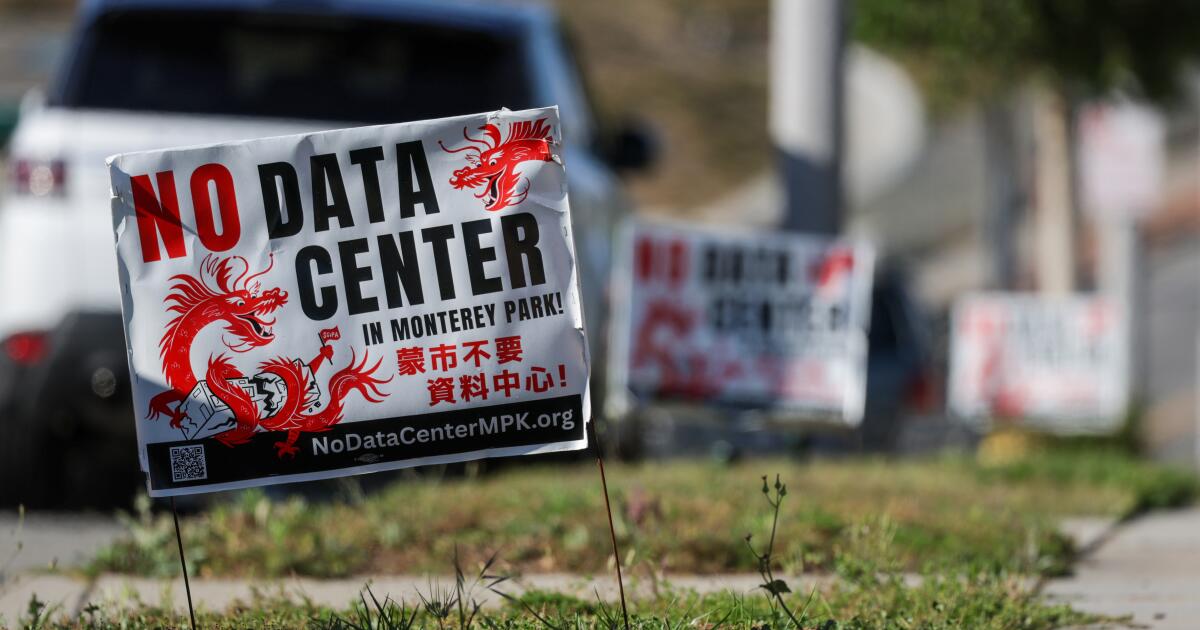
Residents in the city of Monterey Park will be the first in the nation to vote on a permanent ban on data centers Tuesday.
If approved, Measure NDC would prohibit data centers within the city limits and could only be overturned by another vote.
Yard signs saying “No Data Center” in English and Chinese with images of dragons line sidewalks in the San Gabriel Valley city.
As a wave of data center opposition sweeps the country, numerous towns and counties across the U.S. have instituted temporary moratoria and other restrictions on the facilities. But only a handful have instituted indefinite bans, and just four other towns have sent related matters to the ballot.
Supporters are hoping the vote will set a precedent for the rest of the region, where residents are fighting proposals in Vernon and City of Industry.
“This is about as permanent a ban as we can get,” said Steven Kung, co-founder of the group No Data Center Monterey Park. “Winning Measure NDC would send a huge message to the rest of the San Gabriel Valley about how residents don’t want data centers.”
The ballot measure emerged from the fight against a 247,000-square-foot center proposed in 2024 by the Australian-owned investment firm HMC StratCap for a residential area in Monterey Park.
The facility would have sat less than 500 feet away from the nearest home and used three times the electricity of the 60,000-person, predominantly Asian American city.
While the developer touted the potential for jobs and tax revenue, residents expressed concerns about noise and air pollution, rising electricity rates and a potential to lower property values.
The company pulled its plans in late March following public outcry and a March 4 city council vote to extend a temporary data center moratorium and place a ban on Tuesday’s ballot.
In a letter to the city council, HMC StratCap said it would pursue a different use for the land and would not engage in a ballot measure fight.
The city council later banned data centers indefinitely, the first in California to do so, said Mayor Elizabeth Yang. But she’s still been out campaigning for the measure with all four other council members.
“If a council puts in an ordinance, a future council can reverse it too,” said Yang. “With the ballot measure, unbanning it is a lot harder because you need the entire city to vote on it.”
The measure proposes the ban “to protect air quality, drinking water resources, and public health” and “prevent impacts to electricity and water rates.”
While California places third in the country for existing data centers with about 300 facilities, it hasn’t been a hot spot in the recent AI-driven data center boom. High electricity rates, expensive land and regulatory hurdles mean that fewer, and smaller, facilities are currently planned than in Virginia, Texas, Georgia, Illinois or Arizona.
“Most of California’s data centers are small by today’s standards,” said Shaolei Ren, an engineering professor at UC Riverside who studies how to reduce the environmental impacts of data centers. “Ten years ago, they would be medium-sized, but the power demand for new AI data centers has increased a lot.”
The average operating data center demands 45 megawatts, according to the Washington Post, while the average planned one would draw 430 MW. The one proposed for Monterey Park would have required about 50 MW at peak demand.
As proposals crop up in SoCal, they’re met with fierce opposition. Montebello, El Monte and Baldwin Park have all enacted temporary moratoria, and Alhambra recently banned data centers as part of a zoning code update. City of Industry, Vernon, City of Commerce and Santa Fe Springs are moving in the other direction, trying to court developers and streamline data center approvals. Community groups are fighting that.
Outside the San Gabriel Valley, residents of Coachella and Imperial County are showing up in droves to protest local proposals.
Matthew Shaw, a volunteer with the Coalition for Responsible Data Center Development, who recently published a report on opposition to AI data centers, said a vote to ban them in Monterey Park “would lead to copycats, partially because so many groups are just opposed to any data center development at all.”
While there is no formal opposition to Measure NDC, some building trades like Ironworker Local 433 supported the Monterey Park data center when it was still live before city council. Those in the data center industry are lamenting the state of public opinion.
“These are multi-billion-dollar assets that are built by multi-trillion-dollar companies. These things will get done,” said Mehdi Paryavi, chairman of the International Data Center Authority. “My biggest problem is that our industry does not invest enough in community engagement.”
Paryavi said towns that seek to limit data centers are missing out on thousands of jobs generated by data center construction, operations and customers, as well as faster artificial intelligence speeds and better performance.
Kung said local community organizers are “looking at the empirical evidence” and seeing a ban as a win.
“We’ve never seen a city that embraces a data center and is like, ‘Look how our quality of life has increased, look how all the revenue has gone into citywide improvements,’” he said. “That just doesn’t exist.”
-
 News23 minutes ago
California’s primary for governor is undecided as candidates vie to be in the top two
-

 Los Angeles, Ca2 hours ago
California primary election results: governor and L.A. mayor races
-

 Detroit, MI2 hours ago
Another bribery scandal hits Detroit. It involves the People Mover
-

 San Francisco, CA2 hours ago
What’s Worth More Than Cash in San Francisco Real Estate? Anthropic Stock
-

 Dallas, TX2 hours ago
Dallas weighs $500 million‑plus repair plans as City Hall’s future comes up for debate
-

 Miami, FL2 hours ago
Miami biotech executive was followed into his condo by man who allegedly threw him from 25th floor
-

 Boston, MA3 hours ago
What a World Cup ‘fan zone’ is and what Boston fans can expect in 2026
-

 Denver, CO3 hours ago
Defensive lineman Jordan Miller has a tough battle to make the Broncos’ final 53-man roster

