Business
Commentary: Claiming a historic gain in blue-collar wage growth, Trump shows how to use statistics to mislead


You may have seen an eye-opening statement recently from the Trump White House crowing about its success in pushing up “blue-collar wage growth.”
The statement was headlined: “Blue-Collar Wage Growth Sees Largest Increase in Nearly 60 Years Under Trump.” It purported to track real wages for hourly workers during Trump’s first five months in office, and compared that figure to the first five months in office of Trump’s predecessors.
“We’re just getting started with pro-growth, pro-prosperity policies that finally put America First,” the White House boasted.
A really strong economy was handed off to the Trump administration, and so far, it has mostly held.
— Josh Bivens, Economic Policy Institute
There are enough questions about how the White House arrived at this conclusion, and why anyone should trust it, to mark it as a sterling demonstration of how to employ cherry-picking to lie with statistics.
In conjunction with the announcement, Treasury Secretary Scott Bessent gave a preening interview to the New York Post, a Trump-friendly daily that repeated the claim without examination. He also appeared on a New York Post podcast to promote the administration’s purportedly near-record-setting achievement.
Bessent didn’t disclose the administration’s methodology, or explain what the first five months of a presidential term was supposed to reveal, so I had to parse the data myself, with the crucial assistance of some professional economists. More on that in a moment.
The basis for Trump’s claim is a government statistic tracking inflation-adjusted hourly earnings for production and nonsupervisory employees in the private sector, pegged to prices in 1982-1984.
The workers tend to be rank-and-file employees, though economic analysts Philippa Dunne and Doug Henwood of TLRAnalytics note that it’s a stretch to call them “blue-collar.” The term customarily applies to laborers, not “bartenders, teachers, or retail workers” whose earnings are also tracked by the statistic.
Trump cited wage growth from Jan. 1 through May 31 this year. As it happens, however, Trump wasn’t president for that entire period; he took office on Jan. 20, so at least some of his claim covered the last three weeks of the Biden administration.
In other words, some of what Trump bragged about was the work of Biden — the strength of whose economy spilled over into Trump’s term. (Trumpworld hasn’t been shy about blaming Biden for economic problems that have bubbled up over the last few months, so it’s a bit churlish of him to deny Biden credit for this.)
Indeed, one important question related to Trump’s claim goes to what he has actually done that would produce wage gains on this scale. The answer is: nothing. The likelihood is that whatever phenomenon is measurable at this point in the year reflects the Biden economy.
“A really strong economy was handed off to the Trump administration,” says Josh Bivens, chief economist at the labor-affiliated Economic Policy Institute, “and so far, it has mostly held.”
In the New York Post podcast, Bessent attributed the purported wage gains to Trump’s “emphasis on manufacturing,” along with “12 or 20 million illegal aliens coming out of the workforce.”
In neither category, however, have Trump policies actually achieved anything solid. Manufacturing output, as measured by the Federal Reserve, fell in three of the first five months of this year, following a powerful gain in December, the last full month of the Biden administration. As of May, U.S. manufacturing is operating at a slightly lower percent of capacity than it was in December.
The Bureau of Labor Statistics says that manufacturing employment fell by 8,000 in May, by 2,000 over the three months ending in May, and by 9,000 over the six months ending in May. If there’s a renaissance in manufacturing jobs attributable to Trump industrial policy, it’s not visible in the official numbers.
Bessent’s statement about the millions of “illegal aliens” coming out of the workforce is especially chimerical. Authoritative estimates place the total of undocumented residents in the U.S. at about 11 million to 11.7 million. Unless Bessent thinks that every one of them is no longer in the workforce, he misspoke. (I am being charitable).
Immigration and Customs Enforcement itself claims to have deported 65,000 immigrants in the first 100 days of Trump’s term, ended April 29. To assert that taking those individuals out of the workforce was enough to have triggered a surge in hourly wages for legal residents is absurd.
That’s especially so because many undocumented workers take jobs that employers find difficult, if not impossible, to fill from among legal residents.
Annualized five-month wage growth has been stronger in 12 of the last 32 months — including a long period during Biden’s term — than in Trump’s first five months (circled).
(Josh Bivens, Economic Policy Institute)
As Amy Taxin and Dorany Pineda of the Associated Press reported, in some parts of California’s agricultural belt as many as 45% of farmworkers have stopped coming to work since federal agents launched sweeping raids on farms and other locations employing immigrants. The construction industry also has suffered from a dwindling supply of immigrant workers, with few legally present workers available to replace them.
A fundamental question about the White House claim is why it chose to measure itself against the first five months of previous administrations. Why not the first five months of all presidential terms? Or any other five-month period?
I asked the White House and Treasury Department to comment on the administration’s statistic. I got no answer from the White House and nothing on the record from Treasury.
The time frame cited by the White House is curiously selective. The historical comparison to the first five months of one-term presidents and the first terms of two-term presidents doesn’t apply to Trump: “This is Trump’s second term, so he’s not really a member of this club,” observe Dunne and Henwood.
They note, further, that the five-month annualized gain in worker wages is “a silly metric.” The statistic is notoriously volatile, and averaging such a short period only exacerbates its ephemerality.
Judging from five-month annualized averages over time, moreover, “Trump’s 1.7% is high, but not eye-popping,” Dunne and Henwood told me.
They’re right. Going back to October 2022, the five-month average was higher than Trump’s in 12 of the last 32 months. That includes five months of Biden’s term — July through October 2024. The highest annualized five-month gain in real average hourly wages was recorded in September 2024, when it reached about 3.2%.
What makes the question especially pertinent is that, with a few notable exceptions, little of significance happens in the first five months of a new presidential term. It takes time for newly-elected presidents to assemble their cabinet, cue up a legislative program, address the problems — or coast on the economic health — bequeathed them by their predecessors.
Obama’s first term was consumed with undoing the damage of the Great Recession, which was a product largely of Republican economic policymaking. During his term, Biden had to deal with the consequences of the COVID pandemic.
It’s proper to recognize that even assembling the statistics that the Trump administration decided to torture for its news release may become more difficult in the future. That’s because Trump is taking a hatchet to the government’s economic data infrastructure.
Several datasets have been deleted from federal websites. Budget cuts and mass firings will hobble data collection, and expert advisory committees serving the Census Bureau, BLS and Bureau of Economic Analysis have been disbanded. The result of these and other assaults, wrote Jed Kolko, a former undersecretary for economic affairs at the Commerce Department overseeing data operations at the Census Bureau and BEA, will include the destruction of trust in U.S. economic data.
“Governments hide or manipulate the numbers only when they’re bad, as Argentina did with inflation, Greece with public finances, and China with its youth unemployment rate,” Kolko wrote.
The consequences will extend beyond government agencies. “In the private sector, businesses use federal statistics for investment and marketing decisions,” Kolko added. “Official statistics on population growth, housing conditions, local demographics, and local spending patterns drive decisions about where to build factories, open stores, locate jobs, and construct housing. … Financial markets trade on macroeconomic releases, and investors rely on clear, confident signals from the Federal Reserve, which itself depends on trustworthy economic data.”
Trump may not realize that he’s playing with fire by crowing about what could be an ephemeral gain in an obscure statistic. Many economists expect the initiatives he is pursuing to produce a slowdown in economic growth, or even a recession. Corporate executives’ uncertainties about Trump’s tariff policies have already stifled industrial planning, including decisions about when and where to build new factories.
That won’t be positive for wage growth, obviously. Do Trump or Bessent care? One would hope so, but the evidence that they do hasn’t appeared anywhere but in this White House news release. If things turn sour, what will they have to brag about?




An Orange County real estate investor accused of criminally defrauding an Arizona bank of nearly $100 million pleaded not guilty Monday and remains in custody.
Mahender Makhijani, 44, of Corona del Mar — who also was ordered by an arbitrator to pay $1.34 billion in a separate civil fraud case — was arraigned in Santa Ana federal court on two charges.
He is accused of bank fraud and making a false statement to a bank in a June 8 case involving a $100 million real estate loan made by Phoenix-based Western Alliance Bank. He was taken into custody on June 10.
Makhijani is accused of providing bogus collateral for the October 2024 loan now in default. In a civil lawsuit, Western Alliance said the outstanding balance as nearly $99 million.
Prosecutors say he falsified title insurance policies that showed the bank would have a first lien on the underlying collateral if the loan went bad, when in fact it did not.
A trial was set for August 11 before U.S. District Judge David O. Carter in Santa Ana.
Michael Schachter, his criminal defense attorney, did not respond to messages seeking comment.
In the civil case, an arbitrator in May ordered Makhijani to pay Laguna Beach real estate mogul Mohammad Honarkar $1.34 billion after ruling he had fraudulently induced him into a 2021 joint venture — and then wrested control and lost to creditors more than two dozen properties Honarkar had owned.
Makhijani has not been criminally charged in that case, but prosecutors alleged in an affidavit in support of the bank fraud charges that he used “force and threats” in his dealings with Honarkar and others — including taking over the landmark Hotel Laguna in 2023 that Honarkar was renovating.
Prosecutors sought to hold Makhijani without bail after his arrest.
The affidavit noted he is a legal Indian immigrant with a home and bank accounts in that country, has access to private jets and threatened to “run away” if caught in a difficult situation.
The request was denied and he was granted $500,000 bail.
However, Makhijani remains in custody after a hearing sought by prosecutors last month before Magistrate Judge Autumn Spaeth.
The judge declined to accept a $450,000 cashier’s check submitted by a Makhijani associate for the bail, finding insufficient proof the source of the funds was legitimate, according to court records.
Makhijani is not prominent outside Orange County real estate circles, but he established a thriving distressed-assets business over the last decade that attracted prominent Southern California real estate investors.
Prosecutors said it paid for a lifestyle that included two multimillion-dollar homes in Corona del Mar, a luxury apartment in Newport Beach and various luxury vehicles.
As of last month, prosecutors had not fully traced his assets, which they believe are not held in his name and some of which may be in India.
The businessman employed an array of shell companies and strawmen to sign documents on his behalf, and to stand in for him as operators of his companies, according to the affidavit.
Makhijani told an associate he took extra precautions because wanted to insulate himself from litigation and that “they were sharks in the distressed world who took advantage of people,” the affidavit stated.
Business
Many indie festival films struggle to get distribution. Alamo Drafthouse is trying to change that

Dine-in movie theater chain Alamo Drafthouse Cinema is launching a new initiative to show unreleased independent films that had successful festival runs, a move that comes as specialty films have struggled to gain distribution.
The Alamo Exclusives program, announced Wednesday, will give limited theatrical runs to films that showed at festivals including Sundance, the Toronto International Film Festival, Tribeca Festival and South by Southwest festival, as well as Alamo’s own Fantastic Fest.
The idea is to help showcase films that received critical acclaim, but did not secure distribution or acquisition deals. The chain will not acquire these films, but instead will enter into agreements with filmmakers to exhibit their films on Alamo Drafthouse screens. By showing these films to audiences on the big screen, these films could get the momentum they need for further opportunities.
The program’s first film will be the documentary “Butthole Surfers: The Hole Truth and Nothing Butt,” which debuted last year at South by Southwest and chronicles the history of the punk rock band.
The film will be shown in Alamo Drafthouse theaters for a limited time later this summer.
The Austin-based chain, which is owned by Sony Pictures, has a long history of curating indie films for its audiences, giving Alamo Drafthouse confidence that its viewers want to see these kinds of movies, company chief executive Michael Kustermann said in a statement.
“Time and again, they’ve shown they’ll come out to support bold, original films when given the opportunity,” he said. The new Alamo Exclusives “gives us another way to champion filmmaker-driven films that deserve to be discovered and connect them with the wider Alamo Drafthouse audience.”
The initiative comes at a difficult time for indie films. Since the pandemic upended the movie business, traditional studios and distributors have had less appetite for risk, including betting on smaller indie films out of festivals.
And as the 2023 dual writers’ and actors’ strikes thinned out theatrical lineups, that aversion to uncertainty became a push for reliable and profitable hits.
“Too many incredible films premiere at festivals and then never receive the theatrical life they deserve,” Lisa Dreyer, director of Fantastic Fest and film innovation at Alamo, said in a statement. “We are actively searching for films across all genres, from horror to comedy, to everything in-between, to champion in this new, exciting way.”
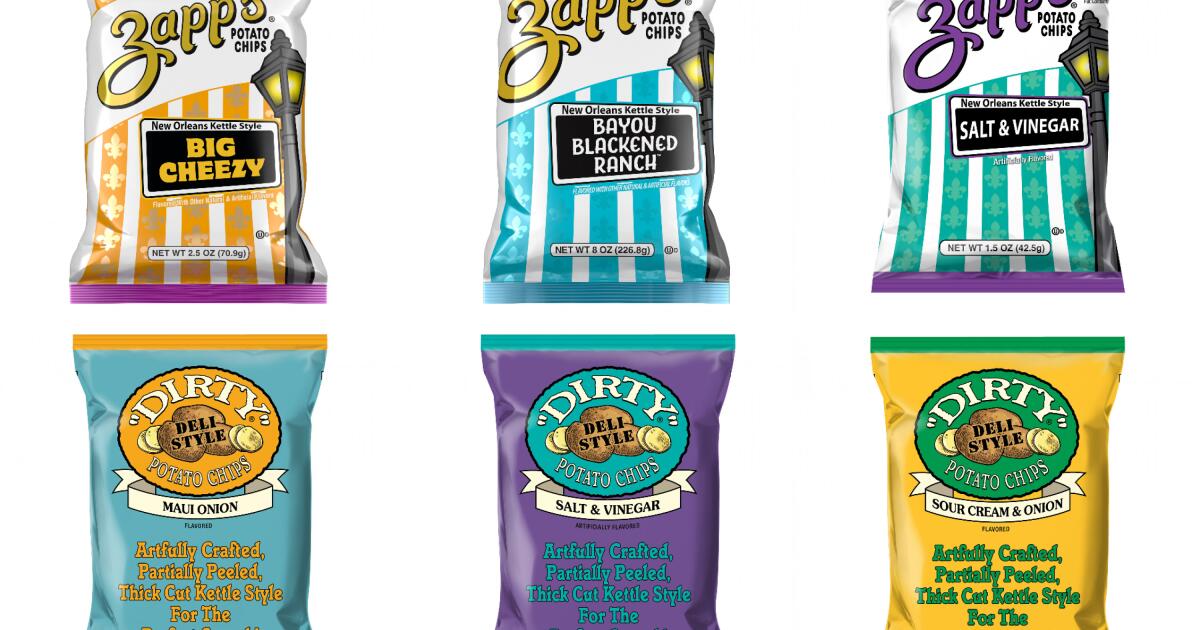
The recall of a popular chip brand over salmonella concerns was recently upgraded to the U.S. Food and Drug Administration’s highest level, just ahead of the Fourth of July holiday and countless backyard barbecues.
On June 24, the FDA designated the recall of several varieties of Zapp’s and Dirty brand potato chips as Class I, meaning it’s “a situation in which there is a reasonable probability that the use of or exposure to a violative product will cause serious adverse health consequences or death.”
FDA has classified the following items as Class I:
Zapp’s
- 1.5-ounce Zapp’s Bayou Blackened Ranch Kettle Chips
- 2.5- and 8-ounce Zapp’s Bayou Blackened Ranch Potato Chips
- 1.5- and 8-ounce Zapp’s Big Cheezy Potato Chips
Dirty
- 1.5- and 2-ounce Dirty Brand Salt and Vinegar Potato Chips
- 2-ounce Dirty Maui Onion Chips
- 2-ounce Dirty Sour Cream and Onion Potato Chips
The chips are produced by Utz Quality Foods, LLC, which on April 28 issued a recall after learning “that a seasoning containing dry milk powder, sourced from California Dairies, Inc. and supplied by a third-party supplier, may contain the presence of Salmonella.”
Salmonella can lead to sometimes deadly infections in elderly people, young children and those with weakened immune systems, according to the FDA.
More than 680,000 bags are included in the recall.
Anyone who has these products should not eat them and should discard them immediately.
What to look for
Salmonella is a foodborne illness that can be fatal to young children, pregnant women, older adults and people with weakened immune systems, according to the National Institutes of Health.
Symptoms may develop 12 to 72 hours after infection, according to the FDA.
The FDA said that people with strong immune systems infected with salmonella may experience fever, diarrhea (which may be bloody), nausea, vomiting and abdominal pain. The illness can last four to seven days.
In rare cases, the infection may produce more severe illnesses such as arterial infections, endocarditis and arthritis, the agency added.
What to do if infected
If you contract salmonella, the Centers for Disease Control and Prevention recommends drinking plenty of fluids to prevent dehydration.
The CDC advises consulting a doctor before taking antidiarrheal medicine or antibiotics. If severe symptoms continue after two days, seek medical help, the agency says.
Because those with diarrhea can spread salmonella to others, it’s also recommended to avoid sharing food or preparing meals for others, sexual contact and swimming in public pools, and to stay home while sick.
Times staff writer Jasmine Mendez contributed to this report.
-

 News1 minute ago
Top Senate Democrats push Trump-affiliated companies for answers about IRS settlement
-

 Los Angeles, Ca1 hour ago
Missing 13-year-old with autism last seen at Los Angeles beach
-

 Videos2 hours ago
Charlie Kirk’s alleged killer appears in court
-
Detroit, MI2 hours ago
GET TO KNOW: Wide receiver Kendrick Law
-

 San Francisco, CA2 hours ago
Multiple people lose eyes, hands in illegal fireworks-related injuries in San Francisco
-
 Dallas, TX2 hours ago
Texas took this Dallas couple’s newborn baby for 3 weeks. A judge says their rights were violated
-

 Miami, FL2 hours ago
South Florida foundation empowering thousands of young girls through education, mentorship, community support
-

 Boston, MA2 hours ago
Where to watch Boston Red Sox vs Chicago White Sox: TV channel, start time, streaming for July 7

