Business
Column: With Live Nation lawsuit, government signals it's fed up with alleged corporate scofflaws

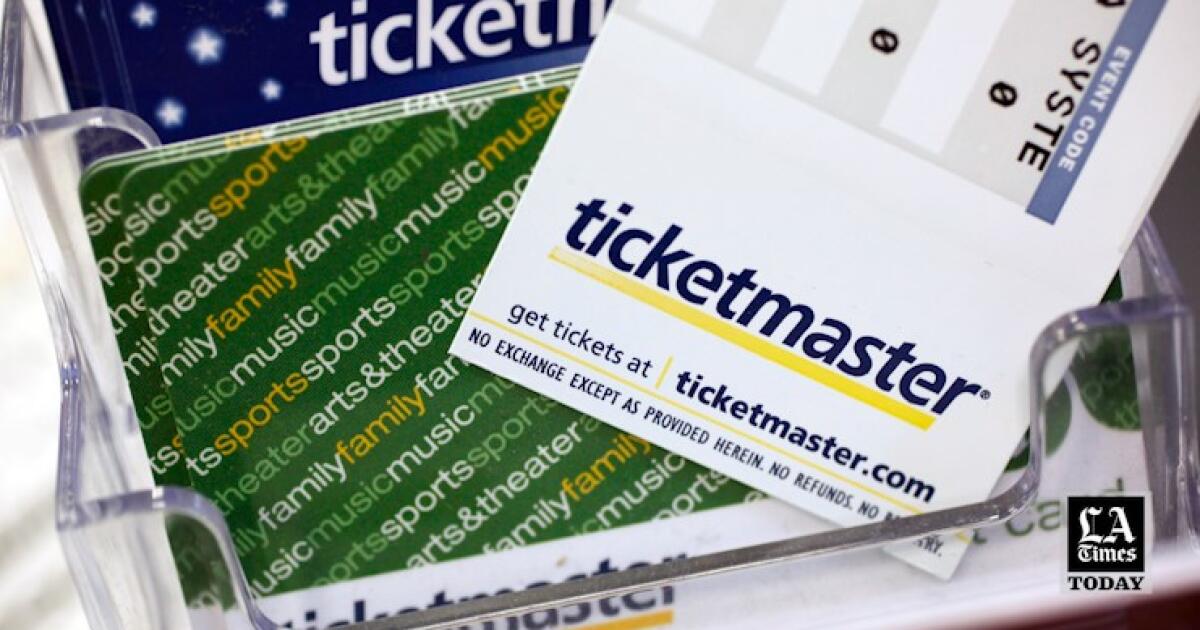
Is there a better example of arrogant corporate behavior than flouting a government decree — not once but multiple times? That’s the question raised by the antitrust lawsuit against the giant concert and ticketing conglomerate Live Nation alleging a raft of monopolistic practices.
The lawsuit, filed Thursday by the Department of Justice, 29 states and the District of Columbia, draws a picture of a company that has ruthlessly exploited its multiple roles as a dominant concert promoter, dominant owner or controller of concert venues, and dominant ticketing manager.
The combination allows Live Nation to exercise “control over which artists perform on which dates at which venues,” as well as “how fans are able to purchase tickets … and what fees those fans will pay,” according to the lawsuit.
Venues throughout the United States have come to expect that refusing to contract with Ticketmaster will result in the venue receiving fewer Live Nation concerts or none at all.
— US v. Live Nation
The plaintiffs’ goal is to break up Live Nation — specifically, to force it to divest Ticketmaster, the ticketing service it merged with in 2010. To the federal officials and the states, the Ticketmaster deal was the original sin allowing Live Nation to build itself a near-monopoly in the live music industry.
This was predictable: Mergers that brought together content producers and content distributors have been a persistent headache for antitrust enforcers — witness the mergers of NBCUniversal with the cable company Comcast and AT&T with Time Warner, the owner of CNN, HBO, Warner Bros. and much more.
Seeing anticompetitive problems on the horizon, the U.S. and 19 states originally sued to block the Live Nation-Ticketmaster deal in 2010. The case was settled with a consent decree in which Live Nation promised not to condition the provision of live shows to venues that chose not to use Ticketmaster as their ticketing agent, or to threaten or retaliate against any venues contracted with a rival ticketer, such as StubHub or SeatGeek.
By 2020, the government said it had compiled evidence that Live Nation had been violating the decree for years by doing exactly what it had promised not to do. “Venues throughout the United States,” the government alleged, “have come to expect that refusing to contract with Ticketmaster will result in the venue receiving fewer Live Nation concerts or none at all. … This is a loss that most venues can ill-afford to risk.”
The government sued again, this time settling the case with a deal that extended the initial consent decree by more than five years (to Dec. 31, 2025), imposed an independent monitor on the company, and set a penalty of $1 million for each violation.
Yet here we are again. Since the 2020 settlement, according to the new lawsuit, “Live Nation and Ticketmaster have committed additional, different, and more expansive violations of the antitrust laws.” The consent decrees, the lawsuit says, have “failed to restrain Live Nation and Ticketmaster from violating other antitrust laws in increasingly serious ways.”
Now the plaintiffs say they’re serious. Live Nation has thumbed its nose at the authorities for more than 20 years, the lawsuit says. Live Nation and Ticketmaster got what they wanted in negotiations with the government in 2010 and “promptly consummated” their deal, but they “failed to live up to their end of the bargain.” Yes, the government has needed some two decades to decide to take a stand, but it may be progress that’s it’s finally trying to do so now.
What does Live Nation have to say about all this? Mostly huffing and puffing. The company attributes the case filing to “intense political pressure on DOJ to file a lawsuit, and a long-term lobbying campaign from rivals trying to limit competition.” It calls itself “another casualty of this Administration’s decision to turn over antitrust enforcement to a populist urge that simply rejects how antitrust law works. … In reality it is just anti-business.”
The political pressure, the company says, derives in part from consumer frustration with high ticket prices and extortionate service fees; it warns that its divesting Ticketmaster won’t do anything to reduce ticket prices or fees and that Ticketmaster’s “commissions” as a share of total prices are much lower than those of other “digital marketplaces” such as Airbnb, Uber and PlayStation.
As far as I’m aware, none of those firms is in the live music business, but Live Nation’s whine may be a hint of what its legal defense may be. One key defense in antitrust cases is to try to define the market allegedly being monopolized as broadly as possible, minimizing the defendant’s share of that relevant market.
The government plaintiffs say Live Nation controls 60% of concert promotions at major venues, owns or controls 60% of the top amphitheaters in the U.S., and through Ticketmaster controls 80% or more of major venues’ primary ticketing for concerts. If Live Nation can guide a judge or jury into thinking of its market as “digital marketplaces” generally, its percentages will look measly.
Live Nation also says that its operating profit margin is only 1.5%, while those of Meta, Alphabet and Apple are all 24% or higher. Of course those companies are all in businesses different from Live Nation’s — indeed, different from one another’s.
Before going more deeply into the allegations against Live Nation, a few words about Ticketmaster’s history. The company’s grip on the live ticketing market and its habit of mulcting concertgoers with junk fees have existed for decades, long predating its merger with Live Nation.
In the mid-1990s, Pearl Jam, then the bestselling band in the country, picked a fight with Ticketmaster over fees it charged for the band’s shows. Even then the ticket agency was too powerful to beat. The conflict, which was closely followed by my late colleague Chuck Philips, ended with a loss for Pearl Jam, which eventually had to give up its plans to stage a concert tour without Ticketmaster’s participation. It resulted in a congressional hearing and an antitrust investigation, but no government action.
Popular touring artists have regularly groused about Ticketmaster since then. Garth Brooks, Neil Young, R.E.M., the Grateful Dead and Aerosmith were among the acts that supported Pearl Jam in its fight. Most recently, technological glitches connected with Ticketmaster’s handling of tickets for Taylor Swift’s Eras tour infuriated fans and provoked another congressional hearing; Ticketmaster blamed the fiasco on scalpers and astronomical demand for the tour.
That brings us back to the latest lawsuit. The government plaintiffs paint Live Nation as a corporation so arrogant it would make Shakespeare’s Iago blush. The plaintiffs offer chapter and verse of episodes in which Live Nation allegedly secured contracts for Ticketmaster by hinting to venues, if not stating outright, that switching to a rival would mean the loss of Live Nation dates.
The lawsuit quotes a 2019 interview with Variety in which Live Nation Chief Executive Michael Rapino acknowledged that under the 2010 consent decree, “We can’t say to a Ticketmaster venue that says they want to use a different ticketing platform, ‘If you do that, we won’t put shows in your building.’” But he also put into words an implicit threat: “We have to put the show where we make the most economics, and maybe that venue [that wants to use a different ticketing platform] won’t be the best economic place anymore because we don’t hold the revenue.”
Rapino also said , “ Every now and then one of our competitors runs to the DOJ. … We get an inquiry from the DOJ … and we’ve never found anything wrong.” If Live Nation was breaching its consent decree, he added, the company “would have been exposed as being in violation long ago.” About three months after he offered that cocksure assurance, the Justice Department filed a second lawsuit alleging that Live Nation had been consistently violating the consent decree.
The most interesting passage in the new lawsuit concerns Live Nation’s relationship with its onetime competitor, Oak View Group. That firm was founded in 2015 by Tim Leiweke, a former executive with Anschutz Entertainment Group, and agent and manager Irving Azoff. According to the lawsuit, the group’s contracts with leading venues and artists quickly turned into a troubling rival to Live Nation.
The two companies reached a cooperative arrangement in which Oak View avoided competing with Live Nation for artists and tours. The deal led to a “cozy relationship” in which Oak View has described itself as a “pimp” and a “hammer” for Live Nation.
The lawsuit quotes exchanges in which Leiweke allegedly assured Rapino that “I always protect you on rebates, promotor [sic] position, ticketing.” Oak View, the government plaintiffs say, has worked to keep Ticketmaster on contract at its venues and “flip” those using other ticket agents to Ticketmaster over time. (Oak View declined comment.)
Independent venues have learned that they thwart Live Nation at their peril, the governments allege. The plaintiffs have kept the names of complaining venues from their legal filings, arguing that it’s necessary “to protect venues” from Live Nation’s “retaliatory conduct,” an approach one typically sees in mob prosecutions.
A 2021 episode involved the Brooklyn, N.Y., arena Barclays Center, which switched from Ticketmaster to SeatGeek, because the latter offered Barclays a higher percentage share of fees from resold tickets (the venue’s name isn’t mentioned in the lawsuit, but the facts match the case). A Live Nation executive warned the arena’s CEO that the venue “should think about bigger relationship with LN not just who is writing a bigger sponsorship check.”
Live Nation then switched several concerts to other venues, the lawsuit states. Within a year, Barclays returned to Ticketmaster.
In another case, Live Nation threatened to deny admission to any customer holding a ticket issued by StubHub for a concert at the Los Angeles Coliseum in 2021, where Ticketmaster claimed to hold an exclusive ticketing contract; hundreds of concertgoers were turned away.
I couldn’t find a reference to any such concert, but the allegation matches an incident that involved a concert by the Black Keys at the Wiltern theater in 2019, when a dispute between Ticketmaster and StubHub and other ticketing services resulted in hundreds of customers being turned away at the door.
That was one case in which Ticketmaster’s hard-nosed competitive policies led to a wave of consumer discontent. There’s more. In 2022, Ticketmaster inaugurated a policy in which purchased tickets can be transferred only between Ticketmaster account holders.
In other words, members of a party of concertgoers have to all sign up for accounts in other to receive the tickets from the purchaser. That’s a boon for Ticketmaster’s database. The lawsuit quotes Rapino boasting that the transfer rule allows Live Nation to “not only know the person that bought the ticket, but … those three people that you are taking to the show.”
Live Nation, the plaintiffs note, “can monetize this unique trove of data in its various businesses to both increase its bottom line and further entrench its positions across the live entertainment industry.”
Can anything stop Live Nation from continuing these practices? Splitting off Ticketmaster from the rest of Live Nation might be relatively easy, since the original merger was approved based on conditions that the government says have been relentlessly violated.
Theoretically, cleaving the company’s interest in promoting concerts and filling venues from its interest in extracting the maximum in junk fees from powerless customers would do much to foster competition in the ticketing business.
But it’s proper to note that there are multiple businesses that position themselves as stakeholders in live entertainment. Arena, amphitheater and stadium operators might not care about junk fees charged to patrons, as long as they get a cut of the action. Moreover, customers are always going to pay through the nose for tickets to high-profile, massively popular acts like Taylor Swift.
It may be true, as Live Nation says, that this lawsuit may not bring prices down even if it’s successful. In the entertainment industry, there’s always someone looking to take a cut of your dollar.



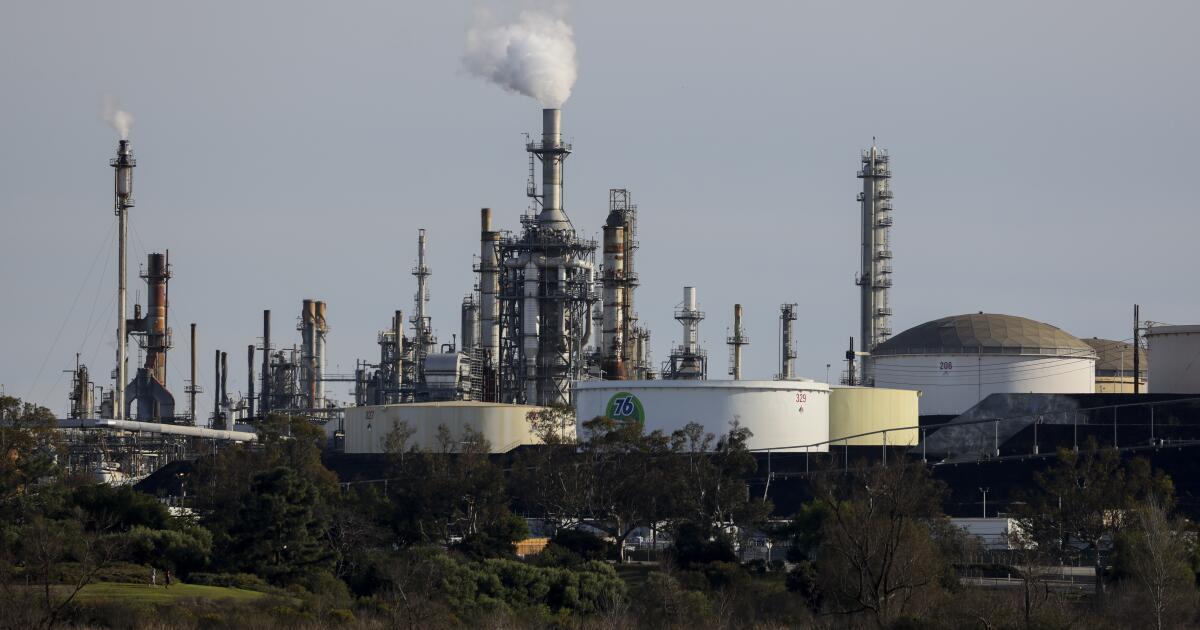
The U.S. attack on Iran is expected to have an unwelcome impact on California drivers — a jump in gas prices that could be felt at the pump in a week or two.
The outbreak of war in the Middle East, which virtually closed a key Persian Gulf shipping lane, spiked the price of a barrel of Brent crude oil by as much as $10, with prices rising as high as $82.37 on Monday before settling down.
The price of the international standard dictates what motorists pay for gas globally, including in California, with every dollar increase translating to 2.5 cents at the pump, said Severin Borenstein, faculty director of the Energy Institute at UC Berkeley’s Haas School of Business.
That would mean drivers could pay at least 20 cents more per gallon, though how much damage the conflict will do to wallets remains to be seen.
“The real issue though is the oil markets are just guessing right now at what is going to happen. It’s a time of extreme volatility,” Borenstein said. “We don’t know whether the war will widen or end quickly, and all of those things will drive the price of crude.”
President Trump has lauded the reduction of nationwide gas prices as a validation of his economic agenda despite worries about a weak job market and concerns of persistent inflation.
The upheaval in the Middle East could be more acutely felt in the state.
Californians already pay far more for gas than the rest of the country, with the average cost of a gallon of regular at $4.66, up 3 cents from a week ago and 30 cents from a month ago, according to AAA. The current nationwide average is about $3 per gallon.
The disruption in international crude markets also comes as refiners are switching to producing California’s summer-blend gas, which is less volatile during the state’s hot summers. The switch can drive up the price of a gallon of gas at least 15 cents.
The prices in California are largely driven by higher taxes and a cleaner, less polluting blend required year-round by regulators to combat pollution — and it’s long been a hot-button issue.
The politics were only exacerbated by recent refinery closures, including the Phillips 66 refinery in Wilmington in October and the idling and planned closure of the Valero refinery in Benicia, Calif., which reduced refining capacity in the state by about 18%.
California also has seen a steady reduction in its crude oil production, making it more reliant on international imports of oil and gasoline.
In 2024, only 23.3% of the crude oil refined in the state was pumped in California, with 13% from Alaska and 63% from elsewhere in the world, including about 30% from the Middle East, said Jim Stanley, a spokesperson for the Western States Petroleum Assn.
“We could see a supply crunch and real price volatility” if the Middle East supply is interrupted, he said.
The Strait of Hormuz in the Persian Gulf, through which about 20% of the world’s oil passes, was virtually closed Monday, according to reports. Though it produces only about 3% of global oil, Iran has considerable sway over energy markets because it controls the strait.
Also, in response to the U.S. attack, Iran has fired a barrage of missiles at neighboring Persian Gulf states. Saudi Arabia said it intercepted Iranian drones targeting one of its refinery complexes.
California Republicans and the California Fuels & Convenience Alliance, a trade group representing fuel marketers, gas station owners and others, have blamed Gov. Gavin Newsom’s policies for driving up the price of gas.
A landmark climate change law calls for California to become carbon neutral by 2045, and Newsom told regulators in 2021 to stop issuing fracking permits and to phase out oil extraction by 2045. He also signed a bill allowing local governments to block construction of oil and gas wells.
However, last year Newsom changed his stance and signed a bill that will allow up to 2,000 new oil wells per year through 2036 in Kern County despite legal challenges by environmental groups. The county produces about three-fourths of the state’s crude oil.
Borenstein said he didn’t expect that the new state oil production would do much to lower gas prices because it is only marginally cheaper than oil imported by ocean tankers.
Stanley said the aim of the law was to support the Kern County oil industry, which was facing pipeline closures without additional supplies to ship to state refineries.
Statewide, the industry supports more than 535,000 jobs, $166 billion in economic activity and $48 billion in local and state taxes, according to a report last year by the Los Angeles County Economic Development Corp.
Bloomberg News and the Associated Press contributed to this report.

Fintech company Block said Thursday that it’s cutting more than 4,000 workers or nearly half of its workforce as artificial intelligence disrupts the way people work.
The Oakland parent company of payment services Square and Cash App saw its stock surge by more than 23% in after-hours trading after making the layoff announcement.
Jack Dorsey, the co-founder and head of Block, said in a post on social media site X that the company didn’t make the decision because the company is in financial trouble.
“We’re already seeing that the intelligence tools we’re creating and using, paired with smaller and flatter teams, are enabling a new way of working which fundamentally changes what it means to build and run a company,” he said.
Block is the latest tech company to announce massive cuts as employers push workers to use more AI tools to do more with fewer people. Amazon in January said it was laying off 16,000 people as part of effort to remove layers within the company.
Block has laid off workers in previous years. In 2025, Block said it planned to slash 931 jobs, or 8% of its workforce, citing performance and strategic issues but Dorsey said at the time that the company wasn’t trying to replace workers with AI.
As tech companies embrace AI tools that can code, generate text and do other tasks, worker anxiety about whether their jobs will be automated have heightened.
In his note to employees Dorsey said that he was weighing whether to make cuts gradually throughout months or years but chose to act immediately.
“Repeated rounds of cuts are destructive to morale, to focus, and to the trust that customers and shareholders place in our ability to lead,” he told workers. “I’d rather take a hard, clear action now and build from a position we believe in than manage a slow reduction of people toward the same outcome.”
Dorsey is also the co-founder of Twitter, which was later renamed to X after billionaire Elon Musk purchased the company in 2022.
As of December, Block had 10,205 full-time employees globally, according to the company’s annual report. The company said it plans to reduce its workforce by the end of the second quarter of fiscal year 2026.
The company’s gross profit in 2025 reached more than $10 billion, up 17% compared to the previous year.
Dorsey said he plans to address employees in a live video session and noted that their emails and Slack will remain open until Thursday evening so they can say goodbye to colleagues.
“I know doing it this way might feel awkward,” he said. “I’d rather it feel awkward and human than efficient and cold.”

The Writers Guild of America West has canceled its awards ceremony scheduled to take place March 8 as its staff union members continue to strike, demanding higher pay and protections against artificial intelligence.
In a letter sent to members on Sunday, WGA West’s board of directors, including President Michele Mulroney, wrote, “The non-supervisory staff of the WGAW are currently on strike and the Guild would not ask our members or guests to cross a picket line to attend the awards show. The WGAW staff have a right to strike and our exceptional nominees and honorees deserve an uncomplicated celebration of their achievements.”
The New York ceremony, scheduled on the same day, is expected go forward while an alternative celebration for Los Angeles-based nominees will take place at a later date, according to the letter.
Comedian and actor Atsuko Okatsuka was set to host the L.A. show, while filmmaker James Cameron was to receive the WGA West Laurel Award.
WGA union staffers have been striking outside the guild’s Los Angeles headquarters on Fairfax Avenue since Feb. 17. The union alleged that management did not intend to reach an agreement on the pending contract. Further, it claimed that guild management had “surveilled workers for union activity, terminated union supporters, and engaged in bad faith surface bargaining.”
On Tuesday, the labor organization said that management had raised the specter of canceling the ceremony during a call about contraction negotiations.
“Make no mistake: this is an attempt by WGAW management to drive a wedge between WGSU and WGA membership when we should be building unity ahead of MBA [Minimum Basic Agreement] negotiations with the AMPTP [Alliance of Motion Picture and Television Producers],” wrote the staff union. “We urge Guild management to end this strike now,” the union wrote on Instagram.
The union, made up of more than 100 employees who work in areas including legal, communications and residuals, was formed last spring and first authorized a strike in January with 82% of its members. Contract negotiations, which began in September, have focused on the use of artificial intelligence, pay raises and “basic protections” including grievance procedures.
The WGA has said that it offered “comprehensive proposals with numerous union protections and improvements to compensation and benefits.”
The ceremony’s cancellation, coming just weeks before the Academy Awards, casts a shadow over the upcoming contraction negotiations between the WGA and the Alliance of Motion Picture and Television Producers, which represents the studios and streamers.
In 2023, the WGA went on a strike lasting 148 days, the second-longest strike in the union’s history.
Times staff writer Cerys Davies contributed to this report.

Why Rebels are keeping pace for Mississippi State CB commit Brandon Allen Jr
Missouri Lottery Powerball, Pick 3 winning numbers for March 2, 2026
Montana Lottery Powerball, Lotto America results for March 2, 2026
Nebraska Lottery results: See winning numbers for Powerball, Pick 3 on March 2, 2026

EDITORIAL: Nevada still vulnerable as tourist downturn continues

Florida High School Football Rankings: Top 25 teams – Oct. 21

Cleary's 21 help Le Moyne down Central Connecticut State 69-64 in OT

How old is Bo Nix? What to know about Oregon quarterback ahead of 2024 NFL Draft

99th annual Pony Swim held in Virginia

Indiana Members Credit Union announced as new anchor tenant at Bottleworks District

Trump sends official notification to Congress on strikes against Iran

Unexpected birth brings hope to near-extinct Amazon tribe

Supreme Court blocks redrawing of New York congressional map, dealing a win for GOP

Map: Earthquake Shakes Central California

Gas prices could jump as Middle East tensions threaten global oil supply
-

 World5 days ago
Exclusive: DeepSeek withholds latest AI model from US chipmakers including Nvidia, sources say
-

 Massachusetts6 days ago
Mother and daughter injured in Taunton house explosion
-

 Denver, CO5 days ago
10 acres charred, 5 injured in Thornton grass fire, evacuation orders lifted
-

 Louisiana1 week ago
Wildfire near Gum Swamp Road in Livingston Parish now under control; more than 200 acres burned
-

 Technology1 week ago
YouTube TV billing scam emails are hitting inboxes
-

 Politics1 week ago
OpenAI didn’t contact police despite employees flagging mass shooter’s concerning chatbot interactions: REPORT
-

 Technology1 week ago
Stellantis is in a crisis of its own making
-

 Oregon4 days ago
2026 OSAA Oregon Wrestling State Championship Results And Brackets – FloWrestling