Business
Column: With his Truth Social stock, Trump may be laughing all the way to the bank — but his investors have reason to weep

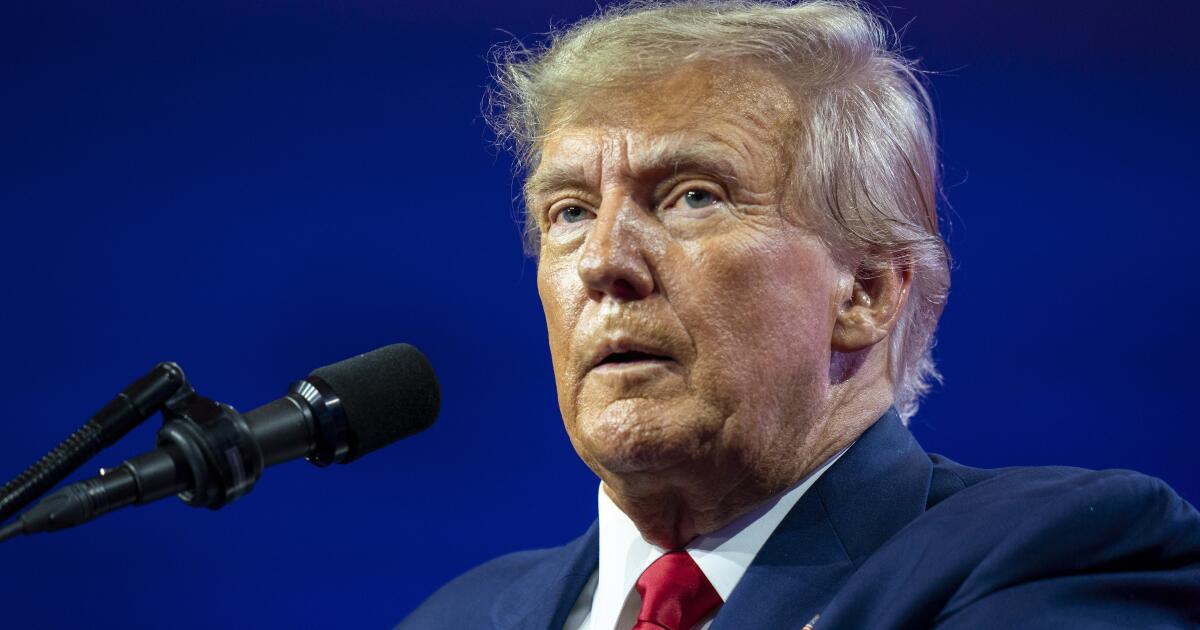
With their life savings, childrens’ college funds and their own retirement prospects at stake, most people probably view investing in stocks as a serious business. Now and then, however, the markets produce comedy gold.
Hello, Trump Media & Technology Group.
The owner of Truth Social, a social media platform exclusively hitched to Donald Trump, staged an initial public offering March 26 amid a torrent of speculation over how many billions the IPO would produce for Trump himself. In the event, the figure was a paper gain of about $5 billion for him, virtually pure profit.
It’s a scam. Just like everything he’s ever been involved in, it’s a con.
— Barry Diller on Trump and Trump Media
The cult of Trump had sent the shares soaring as high as $79.38 on that first day, valuing the company at about $9.5 billion. By the end of the day it had settled back to $57.99. Since then, it has mostly been on the schneid, falling steadily.
As I write, midway in the trading day Tuesday, the shares are quoted at $22.80, down more than 14% on the day. That brings the shares’ slide since they peaked at $79.38 on March 26 to about 70.2%.
Trump, who loves hyperbole, might revel in a three-week plunge that could be some sort of a record. Whether he would call it “beautiful,” one of his favorite superlatives, is another question.
The slide has pared the market value of Trump Media by more than $6 billion from its peak. Trump is still sitting on a paper holding worth more than $2 billion, but his outside investors, many of whom are small investors who bought at or near the top, have been been taken to the abattoir.
“I think they’re dopes,” the veteran entertainment executive Barry Diller said of Trump Media’s investors during a CNBC appearance on April 4.
That’s not to say, given the stock’s volatility, that it might not recover and end up in the green for the day, though whether it can recover the full 69.8% loss, even over time, is subject to doubt.
Still, the raw numbers, being right there for everyone to view in bright red, aren’t as interesting as the underlying grift. Let’s examine that.
It’s fair to say that few if any experienced investment professionals expect Trump Media to have staying power as a high-flying stock. I raised the most pertinent issues a few days before the IPO: The company had meager revenues and huge losses. It was to be taken public via a device — a special purpose acquisition company, or SPAC — that was often used to circumvent government rules for disclosures to investors.
Trump Media’s expected value of $5 billion at the IPO swore at common sense, or at any traditional standard of securities valuation. In short, Trump Media looked like any number of other Trump ventures, such as Trump University — all promise, no delivery.
“It’s a scam,” Diller told his CNBC interviewers. “Just like everything he’s ever been involved in, it’s a con.”
No one at Truth Social responded to my request for a comment about Diller’s remark.
Earlier, I asked whether anyone should believe in the valuation projections, and whether anyone in their right mind would invest. My answers were probably not, and probably not. That was conjecture, not investment advice.
After the IPO, however, more issues were disclosed that contributed to the stock’s precipitous slide. The company’s first annual report, issued April 1, incorporated an obligatory section on risk factors to be pondered by investors that included the traditional warnings about the costs of competition, the prospects of litigation, and the dangers of technology failures — and a couple that aren’t normally seen in corporate disclosures.
One covered the downsides of Trump Media’s linkage with Trump — that Truth Social faced “greater risks than typical social media platforms because of … the involvement of President Trump.” Those risks include “harassment of advertisers or content providers, increased risk of hacking of [Truth Social’s] platform, lesser need for Truth Social if First Amendment speech is no longer believed to be suppressed by other similar platforms, criticism of Truth Social for its moderation practices, and increased stockholder suits.”
The report made clear, if anyone was unaware of this, that the value of its brand “may diminish if the popularity of President Trump were to suffer,” as it would from “the death, incarceration, or incapacity of President Trump.”
Perhaps more telling was the company’s disclosure that it was not planning to “collect, monitor or report” the traditional metrics used by other social media platforms, such as Meta and X (formerly Twitter). Among those performance measures are “average revenue per user, ad impressions and pricing, … monthly and daily active users” — in other words, all the statistics that tell a social media company who, if anyone, is using it, and what their participation is worth in dollars and cents.
Having that information would only “divert” the company’s management, the report said, though it wasn’t clear about how management would fashion a strategy for the future if it doesn’t know where it is at present, including just how many users it has.
The annual report also updated Trump Media’s financial statements to cover the full year 2023: The platform lost more than $58 million on revenue of a bare $4.1 million. Previous disclosures had covered only the first nine months of 2023, when the company said it lost $49 million on $3.4 million in revenue.
On Monday, shareholders got another surprise. Trump Media said in a public filing that it planned to issue 40 million new shares to insiders (36 million of them to Trump himself) and that warrant holders were entitled to 21.5 million additional shares of stock, which could be expected to reach the open market almost immediately upon the warrants’ conversion.
That means existing shareholders are about to be heavily diluted, left with less of the company than they anticipated. The shares plunged more than 18% on Monday.
Who benefits from these maneuvers? Trump does. He is in effect the owner of 64.9% of the company, including the 36 million new shares; no one else owns more than 7.3%. For him this isn’t much of an investment; 36 million of his 114.7 million shares are a handout that didn’t require him to put up his own money. The rest were issued to him via the IPO in return for his interest in Trump Media as a private company.
Trump’s financial role in the founding of Truth Social in 2021 may have been minimal or nonexistent; Reuters reported in 2022 that most of the $38 million raised in the company’s first year came from businessmen who were political allies of Trump and from borrowings from unidentified lenders.
Trump has almost no ability to convert his shareholdings to cash in the near term, however. As a Trump Media insider, he is prevented from selling or borrowing against his shares for at least six months.
If and when he places any of his shares on the market, he would be selling into a declining market. Trump Media is the memiest of “meme stocks,” its value entirely divorced from financial fundamentals and based entirely on his involvement in the enterprise.
That places the value of his stake on a knife-edge. Any indication that he is reducing his commitment would almost certainly provoke a stampede for the exits among other shareholders. Trump would be racing to cash in before the value of his holdings reached the vanishing point.
Who are the other shareholders? According to a survey by the Washington Post, many are retail investors who believe that Trump’s touch is gold, or thought that buying his shares was a way to express faith in Trump and perhaps make some money on the side. At this moment, they are staring into the abyss.


new video loaded: Jury Rejects Elon Musk’s Lawsuit Against OpenAI and Microsoft
transcript
transcript
Jury Rejects Elon Musk’s Lawsuit Against OpenAI and Microsoft
Elon Musk had accused OpenAI of “stealing a charity” by attaching a commercial company to Open AI, which was founded as a nonprofit. But a jury ruled that the statute of limitations had expired.
-
“The evidence that Mr. Musk’s lawsuit was an after-the-fact contrivance by a competitor was overwhelming.” “This reminds me of key moments in this country’s history. The siege of Charleston, the Battle of Bunker Hill, these were major losses for Americans. But who won the war? And this one is not over. And to sum it up, I can sum it up in one word: appeal.”

By Meg Felling
May 18, 2026

Five Guys will close two Los Angeles-area locations later this month.
The burger chain announced in a recent state filing that its locations in City of Industry and Whittier will close in late May. An outlet in Merced will also close its doors in late June, and one in Hanford will shut down in early July, according to state court filings.
The burger giant is the latest fast-food chain to shutter locations as the industry struggles with rising labor and real estate costs in the state.
The company cited “financial hardship” as a reason for the closures, according to a filing.
Employers are legally required to submit a Worker Adjustment and Retraining Notification, or WARN notice, to alert employers, state and local officials at least 60 days before major layoffs. The initial notices were submitted in late April and early May.
The chain had steady growth in 2024, but seems to have stumbled in California. It opened 37 new storefronts that year, according to the company’s franchise disclosure document. Yet California stores accounted for eight of the 14 locations that closed that year.
The closures will result in 55 jobs lost across the four locations, according to the WARN notice.
A spokesperson for Five Guys did not immediately respond to a request for comment.
Fast food chains have struggled against rising operational costs and increasingly cost-conscious customers.
California’s economic landscape has further complicated business in the state. While aerospace and defense companies have continued to flock to the state, companies in other sectors, including food, have started to bail out.
Five Guys ranked 42 in QSR Magazine’s top 50 U.S. restaurants list for 2026 and the number of locations in the country rose by 2% in 2025.
The chain got its start around 40 years ago in Virginia and now operates over 1,900 locations, according to its website.
The restaurant’s website lists over 85 locations in California, including at least 15 storefronts in the Los Angeles area.

A federal jury sided with OpenAI and its top executives on Monday in a feud with Elon Musk, who accused them of betraying a shared vision for it to guide artificial intelligence’s development as a nonprofit.
The nine-person jury unanimously found that Musk waited too long to file his lawsuit and missed the deadline for the statute of limitations.
Musk, the world’s richest man, was a co-founder of OpenAI, the company that launched in 2015 and went on to create ChatGPT. After investing $38 million in its first years, Musk accused OpenAI CEO Sam Altman and his top deputy of shifting into a moneymaking mode behind his back.
The jury served in an advisory role, but Judge Yvonne Gonzalez Rogers accepted the verdict Monday as the court’s own and dismissed Musk’s claims.
The trial that began on April 27 in Oakland shed light on the bitter falling-out between the two Silicon Valley titans and the origins of OpenAI, now a company valued at $852 billion and poised to become one of the largest initial public offerings in history.
The high-profile high-stakes showdown between two of the most powerful companies and leaders in technology was billed as a battle that could change the trajectory of AI.
There were two weeks of testimony from the dueling entrepreneurs and other key players in OpenAI’s history, providing a rare inside glimpse into the company, which evolved from a startup to one of the world’s most influential companies.
Musk had fallen out with his fellow co-founders, then, after OpenAI became arguably the most important company in AI, he decided he was not happy with how the trailblazer was managed after he left.
Musk claimed Altman, the startup’s chief executive officer, and OpenAI President Greg Brockman “stole a charity” by exploiting his early support for an altruistic research project so that they could later get rich by turning into a regular for-profit company.
OpenAI and its leaders said Musk was suing them to gain a competitive advantage for his own startup, xAI.
Musk was seeking more than $100 billion in damages — to be awarded to OpenAI’s nonprofit arm instead of to himself — as well as the removal of Altman and Brockman.
The case was seen as an existential threat to OpenAI. If the decision had gone the other way, it would have sparked a shakeup that would have destabilized the company just as it is working to ensure the U.S. takes the lead in AI and prepares for a public offering with a valuation approaching $1 trillion.
Associated Press and Bloomberg contributed to this article.
-

 Missouri5 minutes ago
Demolition timeline detailed for Providence Road bridge over I-70
-

 Montana11 minutes ago
Citing Wyoming corner-crossing case, hunters sue Montana for public land access – WyoFile
-

 Nebraska17 minutes ago
Nebraska ranchers struggle to recover from historic wildfires as drought worsens crisis
-

 Nevada23 minutes ago
Nevada workers fear homelessness as housing, jobs vanish before July deadline | Fox News Video
-
 New Hampshire29 minutes ago
Opinion: The nostalgia of a small town – Concord Monitor
-

 New Jersey35 minutes ago
NJ, NY governors cut World Cup transit costs. Where is host committee?
-

 New Mexico41 minutes ago
Are National Guard troops, emergency state funds effective in Rio Arriba County?
-
North Dakota53 minutes ago
Behind the Badge – Does Poaching Really Matter?

