Business
Column: With Democratic assent, House votes to open loopholes in crypto regulation

Money, as we all know, is the mother’s milk of politics in America. It can look even more nourishing if you can manufacture it yourself.
That’s surely what accounts for the solicitude that the cryptocurrency industry has been receiving from Congress.
The House on Wednesday passed a law reducing regulation of crypto, despite ample evidence that the asset class has been a haven for fraudsters, extortionists and worse.
The law will “make the United States safer for drug traffickers, for terrorist funders, for child and drug traffickers and those who buy and sell child pornography,” said Rep. Sean Casten (D-Ill.), listing a few of the documented users of crypto in recent years. “I did not know those groups had such proud advocates in Congress.”
The crypto industry’s record of failures, frauds, and bankruptcies is not because we don’t have rules or the because the rules are unclear. It’s because many players in the crypto industry don’t play by the rules.
— SEC Chairman Gary Gensler
Casten may find himself in the House minority in more ways than one. Crypto promoters have managed to peel several Democrats in the House and Senate away from the party’s strong opposition to reducing regulations on the asset class.
Earlier this month, bipartisan majorities in both chambers voted to roll back a two-year-old Securities and Exchange Commission guideline for how financial institutions should account for crypto assets left in their care by customers. President Biden said he would veto the change, and the majorities in neither chamber were large enough to overrule a veto.
The congressional crypto caucus handed the industry another victory Wednesday, when the House passed the Financial Innovation and Technology for the 21st Century Act, known as FIT21. The vote was 279 to 136, with 71 Democrats joining the Republican majority.
The measure’s fate is unsure in the Senate, which hasn’t yet taken it up. Biden has stated his opposition to FIT21 but hasn’t promised a veto, which the crypto gang and its supporters seem to think is a big victory. Biden said that he was willing to negotiate a regulatory system that protects crypto consumers and investors without unduly interfering with innovation, but “further time will be needed.”
If it becomes law, FIT21 would deliver to crypto promoters their most heartfelt desire: removing them from the jurisdiction of the powerful SEC and transferring oversight to the chronically underfunded and understaffed Commodity Futures Trading Commission.
Their goal is understandable, since the SEC has been explicit about its intention to regulate crypto as securities, subjecting the asset class to the disclosure rules and safeguards against fraud that have made the traditional financial markets in the U.S. the safest in the world.
During Wednesday’s floor debate, the bill’s advocates talked of the virtues of freeing an innovative technology from “overzealous regulators” — that was Rep. Cathy McMorris Rodgers (R-Wash.), mouthing words that could have been dictated to her by crypto executives — and relieving them of “regulatory uncertainty.”
SEC Chairman Gary Gensler put the latter claim to rest in a statement about FIT21 he issued Wednesday a few hours before the vote. “The crypto industry’s record of failures, frauds, and bankruptcies is not because we don’t have rules or because the rules are unclear,” he stated. “It’s because many players in the crypto industry don’t play by the rules.”
The bill’s advocates tried to pump up the importance of crypto as a financial asset with claims that 20% of Americans are crypto owners. There’s no evidence for this. On the contrary, the Federal Reserve has found that interest in crypto among ordinary Americans is weak and fading.
In its most recent survey of the economic condition of U.S. households, issued this month, the Fed determined that only 7% of Americans bought or held crypto as an investment (down from 11% in 2021) and only 1% had used it to buy anything or make a payment. That underscores the most important truth about crypto, albeit one its promoters seldom acknowledge: No one has yet identified a genuine purpose for crypto in the real world.
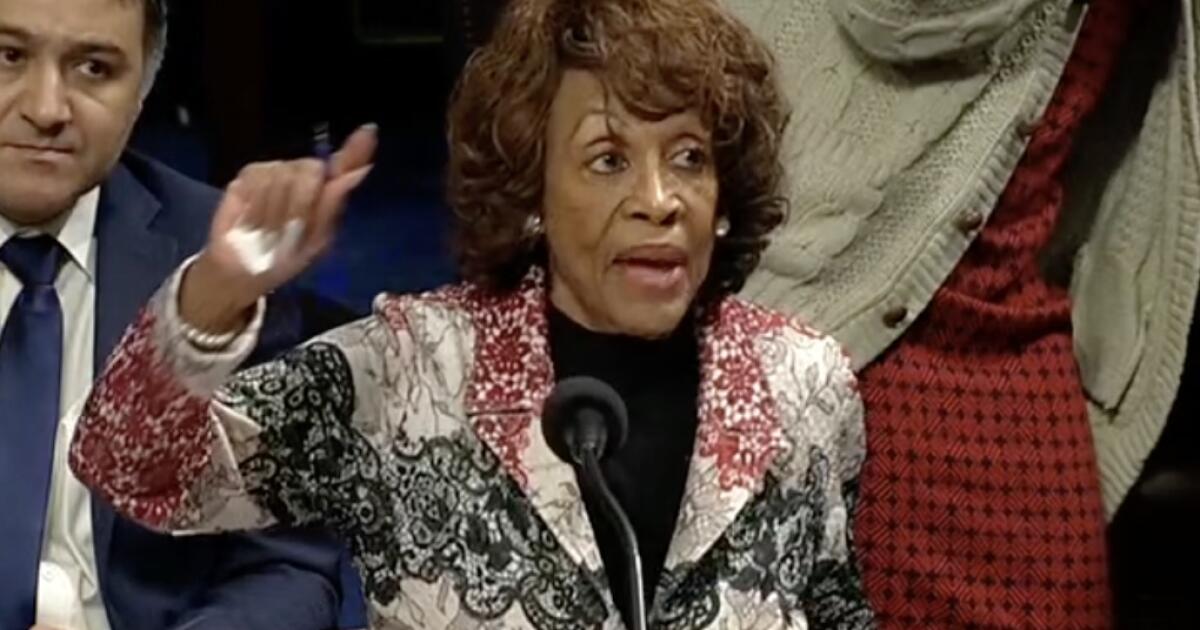
“The entities that stand to benefit from this bill are not ordinary investors trying to build wealth,” Rep. Maxine Waters (D-Los Angeles), the ranking Democrat on the House Financial Services Committee, said from the House floor Wednesday, “but rather the crypto firms. … They have already made billions of dollars unlawfully issuing or facilitating the buying and selling of crypto securities.”
Waters accurately described the effect of FIT21 as placing crypto effectively into a regulatory “no man’s land.” She described the bill as “an extreme MAGA libertarian approach, where companies can operate without regulatory scrutiny, and consumers and investors are on their own on detecting and avoiding fraudulent schemes.”
What’s most striking about the push for FIT21 is that it comes so closely on the heels of major scandals in the crypto space. Sam Bankman-Fried, the founder of the crypto firm FTX, was sentenced in March to 25 years in jail for crypto fraud, after having been convicted in November on seven federal counts related to fraud.
During the heyday of FTX, Bankman-Fried appeared before congressional committees to promote a tailor-made regulatory scheme for crypto bearing close resemblance to the one embodied in FIT21.
Just last month, Changpeng Zhao, founder of the international crypto firm Binance, was sentenced to four months in prison on federal money-laundering charges; Zhao had earlier agreed to pay a $50-million fine, and Binance settled the government case against it for $4.3 billion.
The SEC is pursuing a lawsuit against the crypto exchange Coinbase for selling unregistered securities. In March, federal judge Katherine Polk Failla denied the firm’s motion to quash the case. Her reasoning effectively explains why FIT21 is not only unnecessary, but harmful: “The ‘crypto’ nomenclature may be of recent vintage,” she wrote, “but the challenged transactions fall comfortably within the framework that courts have used to identify securities for nearly eighty years.”
The counterweight to the arguments against FIT21 is cash — the green variety, not the notional type marketed by cryptocurrency firms. Three super PACs formed by crypto executives and investors have raised about $85 million to spend on 2024 political races.
The financial potency of this industry’s campaign spending isn’t in question. One of the PACs, Fairshake, spent more than $10 million over the last year in opposition to Rep. Katie Porter (D-Irvine) in her race for the Democratic nomination for U.S. Senate.
Porter was known as a strong critic of crypto. In 2022 she joined Sen. Elizabeth Warren (D-Mass.) — the most vociferous crypto critic on Capitol Hill — in an investigation of how crypto “mining” by computer had affected the energy grid in Texas and raised energy prices for consumers.
Porter lost the Senate race. Her victorious opponent in the primary, Rep. Adam Schiff, has taken a much more indulgent position toward crypto, listing it on his campaign website among the “new developments in technology … we need to grow” in order to keep jobs and regulatory oversight in U.S. hands.
In the current congressional election cycle, Fairshake has made $702,300 in donations to Democratic campaigns and $551,700 to Republicans. Its largest single recipient is Rep. Patrick McHenry (R-N.C.), chairman of the House Financial Services Committee and sponsor of FIT21. His campaign has received $126,626 even though he has announced that he is not running for reelection this year and retiring from Congress.
In his statement, Gensler tried to strengthen the lawmakers’ understanding of the risks they were endorsing with the measure. The bill would “create new regulatory gaps and undermine decades of precedent” in the regulation of investment contracts, he wrote, “putting investors and capital markets at immeasurable risk.”
It would allow crypto promoters to “self-certify” that their products lay outside traditional regulations and give the SEC only 60 days to respond. By removing crypto trading platforms from the regulatory structure overseeing stock and bond exchanges, it would open the door to conflicts of interest by reducing consumer protections against the platforms commingling their funds with client funds.
The bill also exempts crypto promoters from rules requiring risky investments to be offered only to accredited investors—those with a net worth of more than $1 million, not counting their primary residence, or income over $200,000 (for couples, $300,000) in each of the prior two years.
The cynical device FIT21 uses to neuter the SEC’s oversight of crypto investments is to turn that task over to the CFTC. As the regulatory watchdog Better Markets observes, the CFTC has a budget of only $365 million, versus the SEC’s $2.1 billion, and fewer than 700 employees, compared to the SEC’s approximately 4,500 staffers).
The bill “would heap a whole new set of responsibilities on the CFTC, making it the de facto regulator of countless new crypto exchanges and broker-dealers,” Better Markets wrote, even though the CFTC “does not have the funding to fulfill all its current statutory mandates.”
The debate Wednesday that preceded the House passage of FIT21 was typically tone-deaf and filled with fictitious and factitious assertions. Rep. Mike Flood (R-Neb.) invoked the FTX scandal, which saw billions of dollars in clients’ and investors’ crypto deposits illegally appropriated by the firm’s leaders. “We need to ensure that there are the protective rules that prevent anything like that happening again,” he said.
Flood asserted that, under FIT21, FTX would have been barred from registering as an exchange, and it would not have been able to commingle its funds with those of its clients. One wonders what he was talking about. FTX was barred from registering as an exchange, and didn’t do so. Why? Because Bankman-Fried, its founder, knew that to do so would have subjected the firm to SEC oversight, which no one in crypto wants to undergo.
As for commingling funds, it’s already illegal — it’s one of the practices that landed Bankman-Fried in prison.
The bottom line is very clear. There’s no justification for bestowing on crypto a hand-manufactured regulatory scheme all of its own. Its promoters have no argument other than to claim that they need regulation-lite to foster “innovation,” when the result will be to facilitate the cheating of customers, laundering money or lubricating ransomware attacks like the one that has disrupted the crucial operations of the UnitedHealth Group subsidiary Change Healthcare, which manages reimbursement processes for medical providers nationwide.
If there’s a corner of the financial world crying out for tougher regulation, it’s crypto. For Congress to even contemplate a slackening of the regulation that already exists is nothing short of absurd. But Congress doesn’t respond to practicalities; it responds to money. That’s the only driver of efforts like FIT21.


The race to bring air travel to the sky is heating up as Santa Cruz-based Joby Aviation and Toyota launch a joint venture to commercially produce air taxis.
The companies said in a news release Tuesday that they will work together on productivity, quality and costs and move toward mass production of Joby’s electric vertical takeoff aircraft. Joby and Toyota were first linked when Toyota made a nearly $400-million investment in the company in 2020. It has since increased its backing of the company to $900 million.
“It’s really meaningful for us to take on this challenge together with Joby, a partner that shares the same vision,” Toyota Chair Akio Toyoda said. “We believe this strengthened relationship is an important step forward in realizing the future mobility society.”
Joby‘s all-electric vertical takeoff vehicles are designed to hold four passengers and a pilot and can travel at up to 200 mph. The vehicle uses six tilting propellers to achieve vertical takeoff before switching to forward flight.
In February, Joby announced a partnership with Uber to start service in the United Arab Emirates this year, bringing on-demand air taxi rides to the country. It plans to expand to the U.S. after the completion of its final stage of Federal Aviation Administration testing.
Prior to its full FAA certification, Joby is hoping to launch early flight operations later this year as part of a White House program that will bring flights to several states, including New York, Texas and Arizona. Flights in California will not begin until after obtaining FAA certification.
Joby has been in a fierce battle to be the first with taxis in the sky with its Northern California competitor Archer Aviation. The two companies are involved in overlapping lawsuits, with Joby alleging corporate espionage against Archer, and Archer filing a suit alleging dubious ties to China that sparked an investigation into Joby by the U.S. International Trade Commission.
“Toyota has been by Joby’s side for nearly a decade, providing invaluable guidance and support as we built the foundation for manufacturing our aircraft,” JoeBen Bevirt, Joby’s chief executive and founder, said in the news release. “Together, we share a vision of making aerial mobility an everyday reality, and we look forward to delivering on that promise together.”
Joby Aviation’s shares, which have fallen more than 30% this year, climbed 3% on Tuesday to $8.92.

Disneyland Resort in Anaheim will offer $59 tickets for select evening admission to either theme park as part of a new promotion.
The one-day, one-park evening ticket offer will allow attendees to enter Disney California Adventure at 5 p.m. or Disneyland at 7 p.m. Park reservations are still required, as has been the case since the COVID-19 pandemic.
The offer only applies for admission from July 12 through Aug. 5 on Sundays to Wednesdays.
Disneyland Resort is commemorating its 70th anniversary through Aug. 9, and has introduced new shows and additions to rides as part of the occasion.
Walt Disney Co.’s theme parks and experiences business are a crucial boost to its finances, making up about 56% of the company’s operating income last fiscal year.
During the Burbank-based company’s most recent earnings call in May, Disney executives said attendance at its U.S.-based parks was down 1% compared with the prior year, a shift they attributed to “continued softness” in international visitations. However, the company said at the time that it was starting to move past those issues.
Disney’s experiences division reported $9.5 billion in revenue in that fiscal second quarter, up 7% compared with the same period a year ago, something executives said was due to higher guest spending domestically and more capacity on its cruise line.

An aging downtown office complex will be converted into apartments as part of an ambitious plan by local real estate companies to create 4,000 affordable housing units in Los Angeles.
The first project will be a $200-million makeover of the L.A. World Trade Center, a sprawling white elephant of an office complex on Figueroa Street built in the 1970s that will be turned into 512 apartments in one of the largest affordable housing conversions to date downtown.
Future projects being planned in the central city for delivery over the next five years will include other office-to-apartment conversions and new housing built from the ground up.
The 10-story World Trade Center, right, at Figueroa and Fourth streets in downtown Los Angeles, was built in the mid-1970s.
(Myung J. Chun / Los Angeles Times)
Behind the building campaign unveiled Monday are two of the region’s largest real estate companies, Jamison and Kennedy Wilson. Jamison is the city’s most prolific converter of offices to market-rate apartments and currently has a major makeover of a downtown office skyscraper underway for tenants who can pay top rents.
Kennedy Wilson, a real estate investment company based in Beverly Hills, owns Vintage Housing, which builds and operates affordable housing using tax credits and other state and federal financing to help fund it.
Vintage Housing and Jamison’s new affordable housing division, Arden Residential, will take on the campaign to build the housing where qualified tenants will pay rents below market rates.
Rents in the World Trade Center — which will be renamed Sky Castle when it opens in early 2028 — are expected to start at $937 for a one-bedroom unit. Some two- and three-bedroom units would rent for $1,100 and $1,300 per month, respectively, developers said.
Sky Castle will have shared amenities found in more expensive modern apartments, the developers said, such as a fitness center, resident lounge and co-working space. It already has six tennis courts on the roof, which may be converted to pickleball courts, Jamison Chief Executive Garrett Lee said.
The goal is to build higher quality affordable housing by using efficient construction methods Jamison has learned through building more than 8,000 market-rate apartments in the past, Lee said. The makeover of the World Trade Center will mark Jamison’s 15th conversion of an office building to housing.
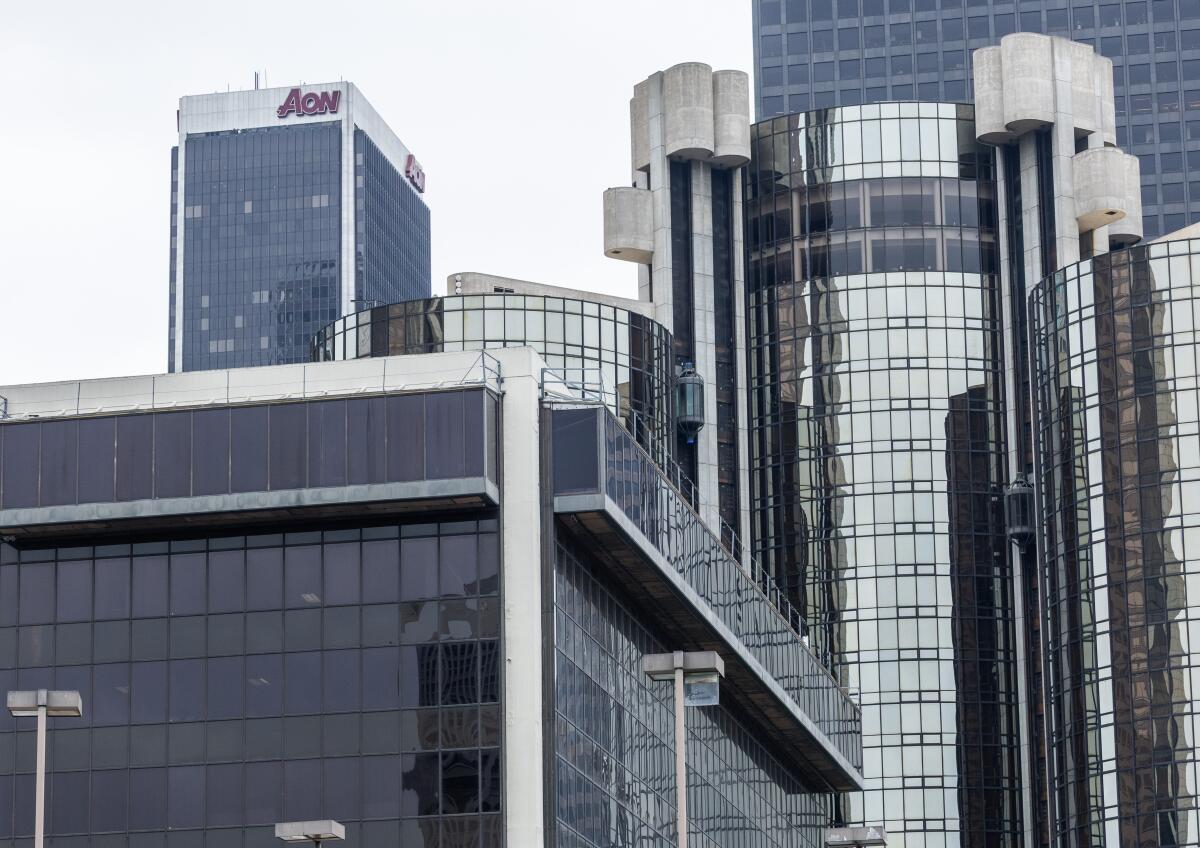
The plan to redevelop the L.A. World Trade Center, bottom left, is one of the largest affordable housing conversions to date downtown.
(Myung J. Chun / Los Angeles Times)
The 10-story World Trade Center was built in the mid-1970s to fanfare saying it would be home to international companies. In 1976, The Times described the center as a place to prepare for an overseas trip where visitors could get passports and visas, as well as exchange dollars for francs, marks, rubles and other currency. There was a language school and branches of U.S., Swiss and Japanese banks.
By the mid-1980s, the 400,000-square-foot office complex covering a city block at Figueroa and Fourth streets had lost its international flavor and was falling out of favor with corporate tenants who were moving into glossy new skyscrapers on Bunker Hill and in other locations.
The building has been cleared of remaining office tenants to allow work to begin in August, Lee said.
Kennedy Wilson is a nationwide operator of market-rate apartments that has also moved into building affordable housing in the last decade, said Nicholas Bridges, global head of capital markets at the company.
Building affordable, workforce housing “in almost all cases requires public subsidies,” Bridges said, and Kennedy Wilson has developed expertise in assembling “a cocktail of public financing sources” that includes low-income housing tax credits and tax-exempt bonds.
In the past, many housing developers have shied away from building affordable housing because assembling the subsidies needed to make construction profitable is challenging.

An artist’s rendering shows what the L.A. World Trade Center could look like after being redeveloped into affordable housing. The new complex is to be called Sky Castle.
(Ian Camarillo)
“It’s complicated,” Bridges said, “and not for the faint of heart.”
Eligible tenants must earn between 30% and 80% of the median income in the area where the housing is built.
Jamison and Kennedy Wilson will develop about 15 affordable housing projects between downtown and the 405 Freeway, Bridges said, many of them in aging office buildings such as the World Trade Center that are already owned by Jamison and are close to public transit.
Substantial potential for affordable housing lies in L.A.’s underused office buildings, he said.
“In this post-COVID world, the way people are utilizing office buildings, particularly older office buildings, has just fundamentally changed,” he said.
It makes sense for developers of conventional multifamily housing to move to building affordable housing, Lee said, because the government supports it through subsidies, zoning reform and the fast-tracking of construction permits. The city of Los Angeles also recently streamlined its adaptive reuse rules to make it easier to convert office buildings to housing.
“There are a lot of incentives pushing us in this direction,” Lee said.
-

 World9 minutes ago
Russia Approved Secret China Military Training At Top Level: Reuters
-

 Science29 minutes ago
This Cell Feeds, Grows and Reproduces. And It’s Manmade.
-
 Lifestyle51 minutes ago
Greetings from London, where Banksy’s flag man is a warning cry
-
Education54 minutes ago
This Little Robot Cleans Windows
-

 Technology59 minutes ago
Comcast’s split could make or break Peacock
-

 World1 hour ago
State Department congratulates Keiko Fujimori as Peru’s president-elect following razor-thin vote count
-

 Politics1 hour ago
Mamdani ripped for claiming victory over capitalism after NYC’s multi-billion dollar taxpayer funded bailout
-

 Health1 hour ago
American vaccines that transformed public health over 250 years: ‘Outweighs harm’

