Business
Column: Trump and RFK Jr. want to make the world safe again for polio and measles. You should be terrified

What are the chances that the noted anti-vaxxers Donald Trump and Robert F. Kennedy Jr. would make common cause to undermine Americans’ health in their pursuit for the presidency?
It didn’t take much hindsight to say the answer is 100%. But there’s no need to speculate any longer — not since this weekend, when Trump and Kennedy both associated themselves with policies that would bring vaccine-preventable diseases such as polio back to the United States.
We’ve already seen that the embrace of pernicious anti-vaccination claptrap by unscrupulous politicians and government officials has had detectable impacts on public health. The Centers for Disease Control and Prevention is now reporting 41 cases of measles, for which a vaccine has been available since 1963, in 16 states.
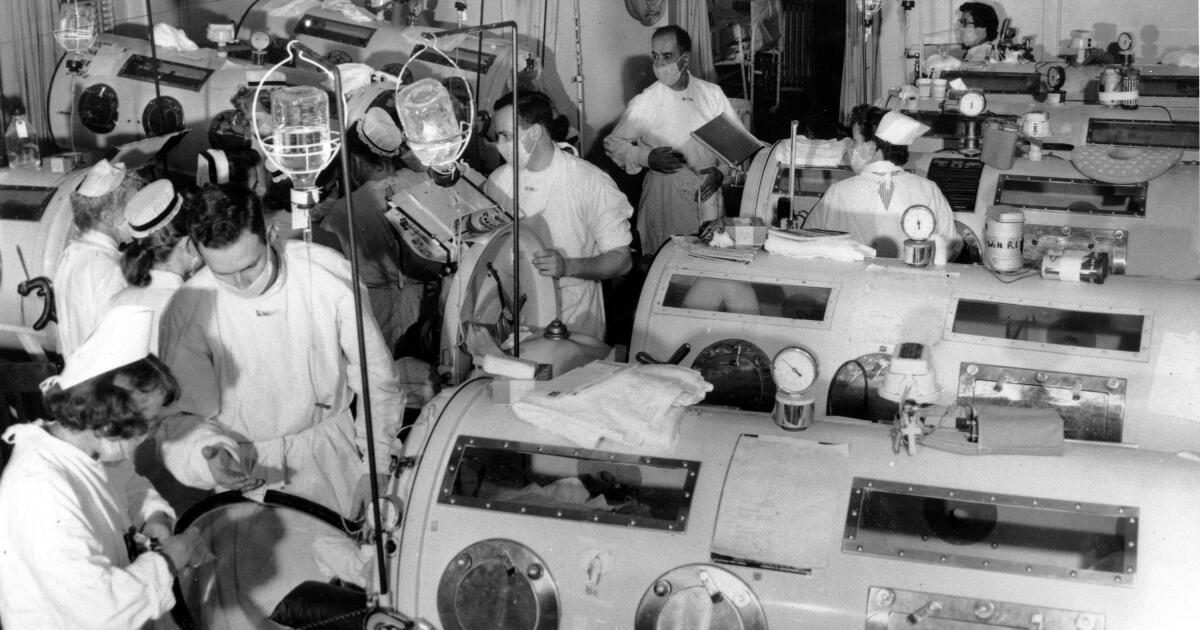
Polio hit without warning. There was no way of telling who would get it….It killed some of its victims and marked others for life, leaving behind vivid reminders for all to see: wheelchairs, crutches, leg braces, breathing devices, deformed limbs.
— David Oshinsky, “Polio: An American Story”
That includes 10 cases in Florida, where public health comes under the jurisdiction of Surgeon General Joseph Ladapo, a leading quack and established anti-vaccine activist.
Resistance or refusal of COVID vaccination, plainly due to anti-vaccine propaganda, has kept the vaccine rate alarmingly low.
In only one state, Minnesota, did the percentage of population that has received the latest updated booster exceed 20% as of the end of last year. In Florida, the adult booster rate is an appalling 7.7%. (In California, it’s 14.2%, which isn’t something to be particularly proud about.)
As I’ve reported, as many as 200,000 Americans may have died unvaccinated from COVID since the vaccines were approved in early 2021 — nearly 1 in 5 of the roughly 1.2 million American deaths from the disease. An average of nearly 20,000 Americans a week were hospitalized for COVID during February.
Now let’s take a look at what Trump and Kennedy have been up to. We’ll start with Trump.
At a campaign rally in Richmond, Va., on Feb. 2, he said this, referring to the policy he would implement as president: “I will not give one penny to any school that has a vaccine mandate or a mask mandate.”
Trump’s words elicited febrile cheers from his Virginia audience, which may be a sign of what I earlier identified as the phenomenon of “herd stupidity” connected with the anti-vaccine movement.
Did these people have any conception of what they were cheering? (We can assume that Trump didn’t.) Did they cotton on to the fact that Trump was advocating depriving all Virginia public and private K-12 schools, nursery schools, child care centers and home schools of federal funding?
We know that would be the consequence of his pledge, because we know that Virginia requires children attending any of those institutions to be vaccinated against 15 diseases, with boosters where appropriate. Virginia’s mandated schedule, like those of every other state, follows the recommendations of the CDC, which calls for some vaccinations within a month or two of birth.
Trump issued his ukase against vaccine mandates right after declaring at the Richmond rally that he would “sign a new executive order to cut federal funding for any school pushing critical race theory, transgender insanity, and any other inappropriate racial, sexual, or political content onto our children,” thus covering pretty much the entire right-wing culture battleground, almost all of which is based on manufactured outrage.
In context, Trump’s opposition to vaccine mandates falls into the category of glorifying individual “freedom” over the communal interest. As I’ve written before, opposing vaccine mandates as a substitute for opposing vaccination itself is a fundamentally incoherent position — little more than garden variety small-government Republican ideology almost invariably invoked to protect the interests of the “haves” over the “have-nots.”
What makes it incoherent is that mandates do work. They’ve saved the lives of millions of schoolchildren who would otherwise be exposed to deadly diseases at school and play.
During the COVID pandemic, requirements that people provide evidence of vaccination before attending public events or entering restaurants or bars were associated with heightened vaccine rates abroad. Employer mandates in the U.S. have raised vaccination rates at workplaces, as United Airlines showed.
Now let’s turn to Robert F. Kennedy Jr., whose campaign for president has allowed his dangerous anti-vaccine hogwash to be mainstreamed into the body politic like an IV drip of strychnine. His pitch so bristles with disinformation and pseudoscience that it’s been disavowed by virtually his entire family, whose name has been synonymous with progressive politics and policy for generations.
Children’s Health Defense, the anti-vaccine organization Kennedy founded and chairs, last week platformed a fatuously inaccurate 2013 book claiming that polio isn’t caused by a virus and that the polio vaccine “doesn’t work.”
The book was conclusively debunked long ago. But last Tuesday, the organization published an interview with its co-author Suzanne Humphries, in which she repeated her claim that polio is caused by toxins, not the virus.
“According to Humphries, there are no worthwhile vaccines, not even smallpox or tetanus, and certainly not the polio vaccine,” the interview read.
Jonas Salk’s polio vaccine changed history after it was licensed in 1955.
(Associated Press)
One telling factor about this interview is who conducted it: Joseph Mercola, a notorious dispenser of health disinformation who, I reported in 2012, was making millions “from hawking ‘organic’ nostrums and casting doubt on medical science.”
By then, Mercola had attracted regulatory warnings from the Food and Drug Administration on three occasions — twice for marketing what the FDA described as illegal drugs and also for touting thermography as an alternative to mammograms for breast-cancer screening, for which the FDA said it was not effective, and for what the FDA said were other unsupported diagnostic claims.
The FDA warned Mercola again in 2021 for hawking unvalidated nostrums as purported treatments for COVID.
Mercola also appeared on the list of the “Disinformation Dozen” published in 2020 by the Center for Countering Digital Hate — 12 individuals who together accounted for as much as 65% of the anti-vaccine content on social media. Kennedy also appeared on the list.
The truth, of course, is that vaccines work. Polio became a massive threat to public health in the 1940s and 1950s, with a per capita infection rate in the U.S. that reached 87.2 per 100,000 population in 1952, sending tens of thousands of children to the hospital and killing a half-million people per year worldwide during those decades.
Jonas Salk’s polio vaccine underwent a massive trial involving 1.6 million children in the U.S., Canada and Finland in 1954; the vaccine was licensed in 1955.
Salk became an international hero, the more so because he refused to patent the vaccine or profit from its distribution. In 1952 the U.S. had 79,000 polio cases, including 21,300 that led to paralysis, and 3,145 deaths. By 1960 the cases had declined to 2,525 with only 230 deaths. In modern times polio cases have all but disappeared — thanks to vaccination.
The same phenomenon occurred with measles. In 1958, the U.S. saw 763,000 cases and 552 deaths. By 1968, a few years after the vaccine became available, there were 22,231 cases and 24 deaths.
Thanks to immunization mandates, even the most recent spike in cases — triggered by an unvaccinated visitor to Disneyland in 2019 — reached only 1,274 cases.
What makes anti-vaccine propaganda so insidious is that it exploits public inattention. Vaccines have something in common with baseball umpires and football referees — when they do their jobs right, they become almost invisible.
“Vaccines are a victim of their own success,” the eminent vaccine expert Paul Offit told me last year. “When vaccines work, nothing happens.”
The best testament to the success of vaccines may be the disappearance of vaccine-preventable diseases from the everyday concerns of families, especially those with children. Smallpox has been eradicated from the face of the Earth. No one in developed countries has had reason to fear measles, whooping cough, diphtheria or polio for decades.
That also means that the public has forgotten what made some of these diseases so fearsome.
Measles has been reduced in public estimation to a nuisance fever. But it’s an exceptionally dangerous and contagious disease that can explode in communities in which the vaccination rate falls below 95% — whether because of complacency or due to the long-refuted and fraudulent claim that the MMR (measles/mumps/rubella) vaccine causes autism.
At the Florida public school that has become the epicenter of that state’s outbreak, the vaccination rate was lower than 90%.
Those whose memories or historical knowledge don’t go back to the mid-20th century may need reminding that polio was a uniquely devastating disease in the 1940s and 1950s.
“No disease drew as much attention, or struck the same terror,” medical historian David Oshinsky wrote in his Pulitzer Prize-winning 2005 book about the period. “And for good reason. Polio hit without warning. There was no way of telling who would get it and who would be spared. It killed some of its victims and marked others for life, leaving behind vivid reminders for all to see: wheelchairs, crutches, leg braces, breathing devices, deformed limbs.”
Philip Roth, in his harrowing 2010 novel “Nemesis,” gave a street-level view of how the disease upended daily life in his native Newark, N.J., during the years when no one knew how it was transmitted and there was no vaccine:
“We were warned not to use public toilets or public drinking fountains or to swig a drink out of someone else’s soda-pop bottle or to get a chill or to play with strangers or to borrow books from the public library or to talk on a public pay phone or to buy food from a street vendor…. We were to keep our distance from anyone who looked sick or complained of any of polio’s telltale symptoms.”
That should underscore the indescribable folly of the anti-vaccine campaigning by Trump and Kennedy. They’re playing with fire, and it’s American families and their children who will be burned. Their efforts to make the world safe again for measles and polio should terrify you.



Dear Mr. Pelley:
I meant what I said in my letter last week to the 60 Minutes team: joining 60 Minutes is the honor of my career and I am grateful to be working alongside the people who have contributed to the most important television journalism brand this country has ever produced. While I’m new to 60 Minutes, I’ve devoted my career to investigative journalism and storytelling. I started this job excited to collaborate and to benefit from the wisdom and experience of the 60 Minutes veterans, with you among them. For that reason, one of the first things I did in my new role was call you to talk and invite you to dinner. It is a profound disappointment that you rejected that overture and chose ambush instead. Yesterday, you hijacked my first meeting with staff to disparage me, my qualifications, and my intentions with remarkable incivility and contempt. I welcome a diversity of viewpoints and respectful debate among the team, but this was nothing of the sort. Yesterday’s performative display of hostility enacted in front of the staff instead of in a civil, private conversation-demonstrated that you have no interest in contributing to the future success of the show, or approaching my new tenure with a mind open to collaboration and progress. I am here to deliver first-in-class news programming, not to make headlines about newsroom drama. I am eager to work alongside those who share this goal.
Despite yesterday’s misconduct, I had hoped that in sitting down with you today we could find a path forward together. You made clear that you are not interested in such a path.
Your antipathy to the future of the show has come through loud and clear. And I have heard you. I therefore write on behalf of CBS News, Inc. (“CBS”) to inform you that your employment with CBS is terminated for cause effective immediately. Enclosed is your formal termination letter.
Sincerely,
Nick Bilton
Executive Producer, 60 Minutes

The co-founder of Aspiration, Joseph Sanberg, was sentenced to 14 years in prison on Monday after defrauding investors and lenders of over $248 million.
The startup, an eco-friendly digital banking company boasting fossil fuel-free investments, carbon offsets for gas purchases, and a debit card with cash-back benefits for shopping at clean companies, was founded by Sanberg and Andrei Cherny. Cherny left the company in 2022 and has not been charged.
Sanberg, an Orange County native, pleaded guilty to wire fraud in October after being arrested in March last year. Aspiration subsequently filed for bankruptcy and liquidated all of its assets by July.
Sanberg and venture capitalist Ibrahim AlHusseini, who also faces charges, together forged a series of bank statements in order to obtain loans. From 2020 to 2021, the pair forged AlHusseini’s bank statements to show millions of dollars in assets in order to obtain millions of dollars from lenders.
Additionally, they forged a letter from their audit committee stating that $250 million in funds were available, when in reality Aspiration had less than $1 million. The amount of loans defrauded exceeded $248 million.
In 2021, Sanberg artificially inflated Aspiration’s 2021 revenue by $44 million by recruiting 27 fake customers to sign letters of intent pledging tens of thousands of dollars per month for tree planting services. Sanberg himself funded the contracts and used the inflated revenue numbers to obtain more loans.
The charges sparked an NBA investigation into salary cap allegations due to Aspiration’s connections with Clippers owner Steve Ballmer.
Ballmer personally invested $60 million in Aspiration, all of which was lost. He is now the target of a civil lawsuit alleging his participation in the scheme. Ballmer denies the allegations.
The team announced a $300-million sponsorship deal with Aspiration, and Clippers player Kawhi Leonard signed a four-year, $28-million marketing contract with the company, which reportedly performed no duties. The issue has raised concerns about how players are circumventing the NBA’s salary cap.
The team lost the $300-million sponsorship deal and an additional $20 million paid for carbon offset purchases.
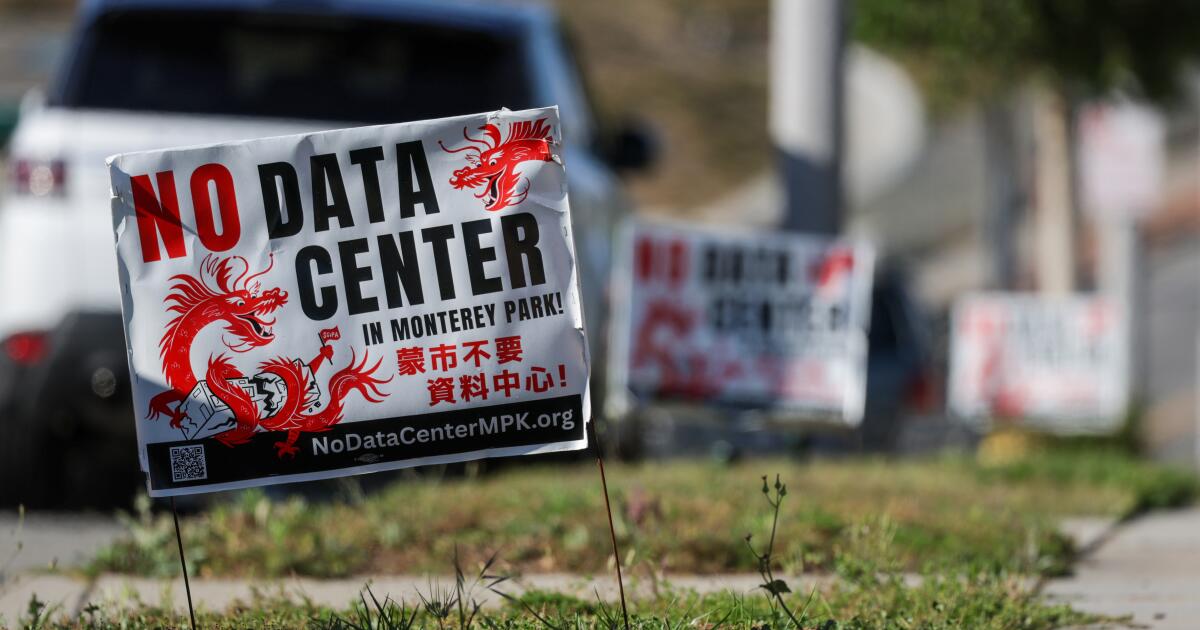
Residents in the city of Monterey Park will be the first in the nation to vote on a permanent ban on data centers Tuesday.
If approved, Measure NDC would prohibit data centers within the city limits and could only be overturned by another vote.
Yard signs saying “No Data Center” in English and Chinese with images of dragons line sidewalks in the San Gabriel Valley city.
As a wave of data center opposition sweeps the country, numerous towns and counties across the U.S. have instituted temporary moratoria and other restrictions on the facilities. But only a handful have instituted indefinite bans, and just four other towns have sent related matters to the ballot.
Supporters are hoping the vote will set a precedent for the rest of the region, where residents are fighting proposals in Vernon and City of Industry.
“This is about as permanent a ban as we can get,” said Steven Kung, co-founder of the group No Data Center Monterey Park. “Winning Measure NDC would send a huge message to the rest of the San Gabriel Valley about how residents don’t want data centers.”
The ballot measure emerged from the fight against a 247,000-square-foot center proposed in 2024 by the Australian-owned investment firm HMC StratCap for a residential area in Monterey Park.
The facility would have sat less than 500 feet away from the nearest home and used three times the electricity of the 60,000-person, predominantly Asian American city.
While the developer touted the potential for jobs and tax revenue, residents expressed concerns about noise and air pollution, rising electricity rates and a potential to lower property values.
The company pulled its plans in late March following public outcry and a March 4 city council vote to extend a temporary data center moratorium and place a ban on Tuesday’s ballot.
In a letter to the city council, HMC StratCap said it would pursue a different use for the land and would not engage in a ballot measure fight.
The city council later banned data centers indefinitely, the first in California to do so, said Mayor Elizabeth Yang. But she’s still been out campaigning for the measure with all four other council members.
“If a council puts in an ordinance, a future council can reverse it too,” said Yang. “With the ballot measure, unbanning it is a lot harder because you need the entire city to vote on it.”
The measure proposes the ban “to protect air quality, drinking water resources, and public health” and “prevent impacts to electricity and water rates.”
While California places third in the country for existing data centers with about 300 facilities, it hasn’t been a hot spot in the recent AI-driven data center boom. High electricity rates, expensive land and regulatory hurdles mean that fewer, and smaller, facilities are currently planned than in Virginia, Texas, Georgia, Illinois or Arizona.
“Most of California’s data centers are small by today’s standards,” said Shaolei Ren, an engineering professor at UC Riverside who studies how to reduce the environmental impacts of data centers. “Ten years ago, they would be medium-sized, but the power demand for new AI data centers has increased a lot.”
The average operating data center demands 45 megawatts, according to the Washington Post, while the average planned one would draw 430 MW. The one proposed for Monterey Park would have required about 50 MW at peak demand.
As proposals crop up in SoCal, they’re met with fierce opposition. Montebello, El Monte and Baldwin Park have all enacted temporary moratoria, and Alhambra recently banned data centers as part of a zoning code update. City of Industry, Vernon, City of Commerce and Santa Fe Springs are moving in the other direction, trying to court developers and streamline data center approvals. Community groups are fighting that.
Outside the San Gabriel Valley, residents of Coachella and Imperial County are showing up in droves to protest local proposals.
Matthew Shaw, a volunteer with the Coalition for Responsible Data Center Development, who recently published a report on opposition to AI data centers, said a vote to ban them in Monterey Park “would lead to copycats, partially because so many groups are just opposed to any data center development at all.”
While there is no formal opposition to Measure NDC, some building trades like Ironworker Local 433 supported the Monterey Park data center when it was still live before city council. Those in the data center industry are lamenting the state of public opinion.
“These are multi-billion-dollar assets that are built by multi-trillion-dollar companies. These things will get done,” said Mehdi Paryavi, chairman of the International Data Center Authority. “My biggest problem is that our industry does not invest enough in community engagement.”
Paryavi said towns that seek to limit data centers are missing out on thousands of jobs generated by data center construction, operations and customers, as well as faster artificial intelligence speeds and better performance.
Kung said local community organizers are “looking at the empirical evidence” and seeing a ban as a win.
“We’ve never seen a city that embraces a data center and is like, ‘Look how our quality of life has increased, look how all the revenue has gone into citywide improvements,’” he said. “That just doesn’t exist.”
-
 News21 minutes ago
California’s primary for governor is undecided as candidates vie to be in the top two
-

 Los Angeles, Ca2 hours ago
California primary election results: governor and L.A. mayor races
-

 Detroit, MI2 hours ago
Another bribery scandal hits Detroit. It involves the People Mover
-

 San Francisco, CA2 hours ago
What’s Worth More Than Cash in San Francisco Real Estate? Anthropic Stock
-

 Dallas, TX2 hours ago
Dallas weighs $500 million‑plus repair plans as City Hall’s future comes up for debate
-

 Miami, FL2 hours ago
Miami biotech executive was followed into his condo by man who allegedly threw him from 25th floor
-

 Boston, MA3 hours ago
What a World Cup ‘fan zone’ is and what Boston fans can expect in 2026
-

 Denver, CO3 hours ago
Defensive lineman Jordan Miller has a tough battle to make the Broncos’ final 53-man roster

