Business
Column: The salmon industry faces extinction — not because of drought, but government policies and politics

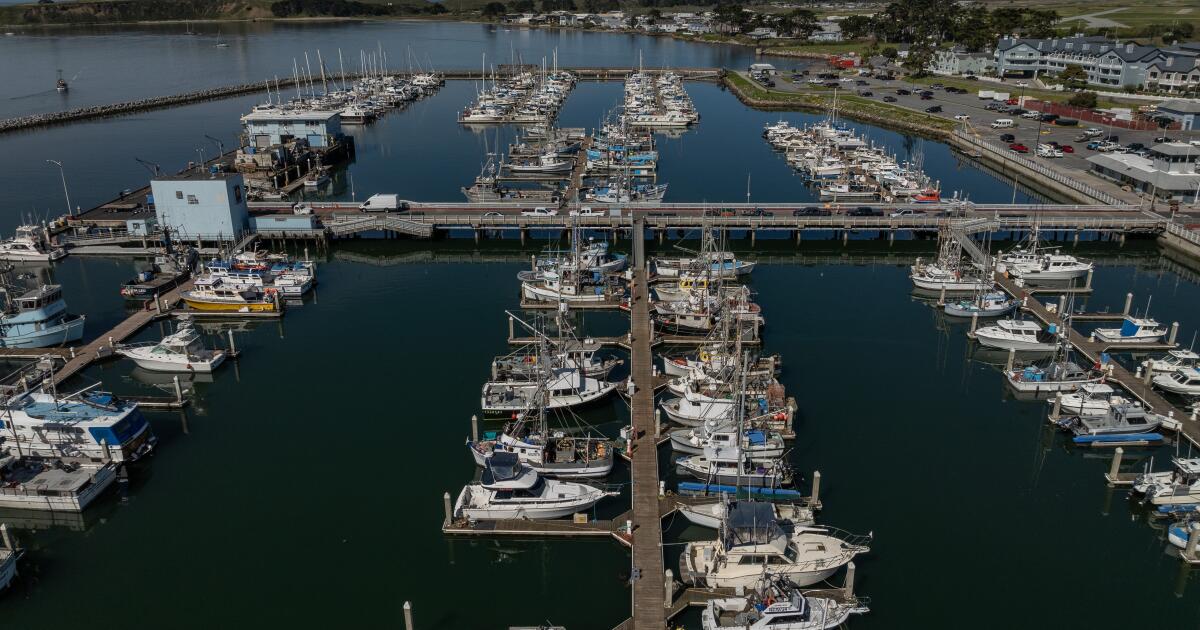
Snapshots from an environmental and economic disaster:
Kenneth Brown, the owner of Bodega Tackle in Petaluma, reckons he has lost almost $450,000 in the last year.
“I haven’t taken a paycheck in seven or eight months,” he says. He has had to lay off all but one employee, leaving himself, his son and the one remaining worker to run the business.
James Stone, board president of the Nor-Cal Guides & Sportsmen’s Assn., says more than 120 guides who serve recreational fishing customers in and around the Sacramento River and San Francisco Bay have been all but put out of business, costing the economy as much as $3.5 million a year.
Salmon have survived droughts in California for millennia. But when on top of that you have incredible water diversions and temperature pollution, you’re killing these baby fish. And when you kill the baby fish, they don’t come back as adults.
— Scott Artis, Golden State Salmon Assn.
Sarah Bates, the owner of a commercial fishing boat in San Francisco, has seen 90% of her income washed away. She has watched a commercial fleet capacity of nearly 500 boats reduced nearly to zero.
The circumstance affecting all three is the shutdown of the crucial fall-run salmon fishing in California, which the Pacific Fishery Management Council, a governmental body, recently extended for 2024, the second year in a row.
The main reason is the decline of the salmon population in the Sacramento River to such an unsustainable level that there’s reason to fear that it may not recover for years, if ever — unless government policies are radically reconsidered.
Commercial fishers who relied on the fall-run salmon as their dominant source of income have struggled to find alternatives.
“Some people are bringing in black cod or rockfish or albacore,” Bates told me. Some land Dungeness crab. But prices for those products don’t match the value of Chinook salmon.
“That allows for some income, but doesn’t really make up the difference for what you lose,” Bates says. “There are members of the fleet who have taken land jobs, or are relying on household members to pay the bills.”
One can’t minimize the scale of the shutdown, which follows a long-term decline in the fishery and is the first such shutdown since 2008-2009, which was driven by a severe drought. In 2022, the last year of salmon fishing in California, the fleet consisted of 464 commercial vessels, down from 4,750 in 1980.
Private and chartered recreational trips in California, which reached 98,900 in 2022—down from 148,000 in 2012—have also been shut down.
The closing of both categories has rippled across the entire fishing economy, affecting hotels and restaurants that catered to recreational fishing customers as well as bait and tackle shops. For Brown’s Petaluma shop, there are no sales of bait or commercial gear — “no more boots, no more rain slickers, all that business is gone and there’s nothing to replace it.”
There’s more to the salmon crisis than the devastation of livelihoods of tens of thousands of Californians working in an industry valued at more than $1.4 billion annually.
The crisis underscores the utter failure of the state’s political leaders to balance the needs of stakeholders in its water supply. In this case, the conflict is between large-scale farms on one side and environmental and fishery interests on the other.
For decades, agribusiness has had the upper hand in this conflict. It’s not hard to discern why: The growers have more money and therefore more political influence. Westlands Water District, the vast irrigation district sprawled over Fresno and Kings counties in the Central Valley—the largest such district in the nation—spent more than $4.7 million on Sacramento lobbying over the last decade.
During the same period, Stewart Resnick, whose Roll International conglomerate owns the Central Valley almond orchards that are the largest growers of those nuts in the world and enormous consumers of water, donated $2.8 million to political campaigns in California, chiefly to Democratic candidates and in support of ballot box initiatives; among his contributions was $125,000 to oppose the 2021 recall of Gov. Gavin Newsom.
Officially valued at $1.4 billion a year, the salmon fishery can’t hope to compete with agriculture on a dollar-for-dollar basis. The market value of all agricultural products in California was $59 billion in 2022, according to state figures; salmon weren’t counted. The 10 most lucrative farm crops, led by dairy products, brought in some $35 billion that year.
The salmon fisheries are bellwethers for ecological health generally. “Fishermen are directly dependent on a healthy ecosystem,” says Barry Nelson, an advisor to the Golden State Salmon Assn. Their fortunes reflect not merely adequacy of water flows in California rivers and bays, but water quality. Any factor that falls outside a given range can produce a crash in fish populations, endangering whole species while putting men and women out of work.
As my colleague Ian James has reported, a key factor in the survival of the salmon population is water temperature. The diversion of ever more water from the federal government’s Shasta Dam for farm irrigation has driven temperatures in the Sacramento River to murderous levels.
That river, Nelson points out, is “the most important salmon-producing system south of the Columbia River.” But California authorities haven’t required the federal Bureau of Reclamation, which owns and manages the dam, to meet temperature standards downstream of the dam, even though it has the power to do so. “The state just hasn’t done its job,” Nelson says.
Talk to stakeholders in the salmon fishery, and one term keeps cropping up: “water management.” Their point is that drought isn’t the most important factor in the survival of the species — policy is, specifically the management of water supplies so that they’re balanced among users and serving irrigation demand from farmers doesn’t wipe out competing interests, especially during dry years.
To better understand the threats to salmon, it helps to know about their life cycle. Salmon live and breed on a three-year timeline. Adult fish swim in the ocean, but migrate upstream to lay eggs in the gravel beds of inland rivers. After they hatch, the baby fry and juveniles, called smolt, begin migrating downstream, typically via San Francisco Bay, and out to sea. Then the cycle begins again.
The critical period for the fall-run salmon in the Sacramento is while the eggs are incubating in their gravel beds. At water temperatures of 54 degrees, they start being cooked to death. Irrigation releases from Shasta suck down the reservoir’s cold water, leaving surface water heated by the sun; that’s what ends up in the Sacramento River at spawning season.
In recent years, water in the spawning beds has been measured at 70 degrees or higher. In 2021, state biologists reported, 99% of winter-run Chinook salmon failed to reach the San Francisco-San Joaquin River delta and the bay.
“Salmon have survived droughts in California for millennia,” says Scott Artis, executive director of the Golden State Salmon Assn. “But when on top of that you have incredible water diversions and temperature pollution, that’s what’s killing these baby fish. And when you kill the baby fish, they don’t come back as adults.”
The need for painstaking water management is the result of human interventions in California’s natural environment. Over the last 100 years, rivers across the Central Valley were dammed to provide irrigation for farms, blocking salmon from their natural habitats. The federal government opened salmon hatcheries to compensate, but they have not produced enough fish to make up for the losses from poor water management.
Meanwhile, the water demands of California growers became less flexible. Crops that could be fallowed during dry spells, leaving more water for the environment, were supplanted by almond and pistachio orchards, which require water in wet years and dry. California almond acreage rose to 1.38 million last year from 418,000 in 1995. In the same period, pistachio acreage rose to more than 461,000 from 60,300.
The crisis that has unfolded in 2023 and this year has its roots in actions taken during the Trump administration. In 2019, Trump installed David Bernhardt, a lobbyist for agricultural water users, as Interior secretary.
As an attorney in private practice, Bernhardt had sued the government on behalf of the giant Westlands Water District to challenge its enforcement of the Endangered Species Act, which conflicted with Westlands’ interests. As Interior secretary, Bernhardt advocated for loosening enforcement of the act.
In 2020, Bernhardt and Trump implemented an increase in water deliveries to big farmers under conditions that spelled disaster for the salmon fishery, among other ecological issues. California objected, asserting that Interior’s official biological opinions, which concluded that the increases wouldn’t adversely affect salmon and other species, bore no “rational connection [with] the facts.” The Natural Resources Defense Council labeled the opinions “a plan for extinction” of salmon and other endangered species.
They went through anyway. The demands from agribusinesses in the Central Valley for more water had received a friendly hearing from the Trump administration and Republicans in Congress, who recognized that the valley was perhaps the only strongly Republican part of California. They decried the passage of water from inland reservoirs to rivers and out to sea as wasteful; as I wrote at the time, their single-minded service for the growers deprived the salmon fishery of its lifeblood.
The impact of the Trump policies was destined to be felt three years on. Indeed, last year only 6,160 adult salmon were estimated to have spawned in the Sacramento River, the worst level since the drought year of 2017 and obviously well below the annual average of 175,000 spawning from 1996 to 2005, the best period for the health of the salmon fishery over the last four decades.
In January, Newsom responded to the salmon crisis with an action plan encompassing restoring salmon habitats, modernizing hatcheries, and removing impediments to salmons’ upstream migrations. The fishery community supports many of those initiatives, but also recognizes that the package is largely aspirational, for money hasn’t been appropriated to fulfill all its elements.
The Newsom administration also outlined plans in March 2022 to reach a series of voluntary agreements with agricultural water users over water sharing. Environmental and fishing groups, which weren’t part of the negotiations, weren’t impressed — a coalition of those groups, including the Sierra Club and the Golden State Salmon Assn., panned the proposal as “incomplete, unenforceable, inequitable, inadequate, and [lacking] a scientific foundation.”
Nor were the proposed voluntary agreements favored by two key federal agencies. The Environmental Protection Agency wrote in January that the absence of strong mandates for higher water flows in the Sacramento River meant that the plan would have only a “insignificant impact” on water temperature in the river. The National Marine Fisheries Service questioned whether the $740 million in state and federal funding needed to implement the voluntary agreements was realistic, since none of it had been appropriated.
In other words, Newsom’s approach involves a heaping helping of hand-waving. From the standpoint of the salmon industry, his other water policies, including a 45-mile water tunnel under the delta and fast-tracking construction of the Sites Reservoir in the western Sacramento Valley, will make things worse. The tunnel would turn the delta into “a deathtrap for salmon,” Nelson says, and the Sites Reservoir would degrade downstream waters, possibly increasing temperatures.
In many respects, the policies on the table are antiques. Some were developed without regard for the effects of global warming, and others reflect thinking that emerged in an era when California authorities thought the water supply was abundant, even unlimited.
That won’t do anymore. The federal government already lists Sacramento River winter-run Chinook salmon as an endangered species and the spring run as a threatened species. The all-important fall run might not be far behind.
California’s water policies need to be subjected to a thorough rethinking, and money to fix all that’s broken needs to be appropriated, not just put on somebody’s wish list.
Fishermen and -women are a constitutionally optimistic class. “There’s always hope that things will get better,” Artis told me. But hope is waning. “We have to educate the Legislature and the public so we get those water flow and temperature protections, or we’ll be here again year after year with fishery closures.”



In an expansion of its business of processing pharmaceuticals in Earth’s orbit, Varda Space Industries is renting a large El Segundo plant where toy manufacturer Mattel used to design Hot Wheels and Barbie dolls.
The plant in El Segundo’s aerospace corridor will be an extension of Varda Space Industries’ headquarters in a much smaller building on nearby Aviation Boulevard.
Varda will occupy a 205,443-square-foot industrial and office campus at 2031 E. Mariposa Ave., which will give it additional capacity to manufacture spacecraft at scale, the company said.
Originally built in the 1940s as an aircraft facility, the complex has a history as part of aerospace and defense industries that have long shaped the South Bay and is near a host of major defense and space contractors. It is also close to Los Angeles Air Force Base, headquarters to the Space Systems Command.
Workers test AstroForge’s Odin asteroid probe, which was lost in space after launch this year.
(Varda Space Industries)
Varda is one of a new generation of aerospace startups that have flourished in Southern California and the South Bay over the last several years, particularly in El Segundo, often with ties to SpaceX.
Elon Musk’s company, founded in 2002 in El Segundo, has revolutionized the industry with reusable rockets that have radically lowered the cost of lifting payloads into space. Though it has moved its headquarters to Texas, SpaceX retains large-scale operations in Hawthorne.
Varda co-founder and Chief Executive Will Bruey is a former SpaceX avionics engineer, and the company’s spacecraft are launched on SpaceX’s workhorse Falcon 9 rockets from Vandenberg Space Force Base in Santa Barbara County.
Varda makes automated labs that look like cylindrical desktop speakers, which it sends into orbit in capsules and satellite platforms it also builds. There, in microgravity, the miniature labs grow molecular crystals that are purer than those produced in Earth’s gravity for use in pharmaceuticals.
It has contracts with drug companies and also the military, which tests technology at hypersonic speeds as the capsules return to Earth.
Its fifth capsule was launched in November and returned to Earth in late January; its next mission is set in the coming weeks. Varda has more than 10 missions scheduled on Falcon 9s through 2028.
For the last several decades, the Mariposa Avenue property served as the research and development center for Mattel Toys. El Segundo has also long been a center for the toy industry as companies like to set up shop in the shadow of Mattel.
The Mattel facility “has always been an exceptional property with a legacy tied to aerospace innovation, and leasing to Varda Space Industries feels like a natural continuation of that story,” said Michael Woods, a partner at GPI Cos., which owns the property.
“We are proud to support a company that is genuinely pushing the boundaries of what’s possible, and are excited to watch Varda grow and thrive here in El Segundo,” Woods said.
As one of the country’s most active hubs of aerospace and defense innovation, El Segundo has seen its industrial property vacancy fall to 3.4% on demand from space companies, government contractors and technology startups, real estate brokerage CBRE said.
Successful startups often have to leave the neighborhood when they want to expand, real estate broker Bob Haley of CBRE said. The 9-acre Mattel facility was big enough to keep Varda in the city.
Last year, Varda subleased about 55,000 square feet of lab space from alternative protein company Beyond Meat at 888 Douglas St. in El Segundo, which it started moving into in June.
Varda will get the keys to its new building in December and spend four to eight months building production and assembly facilities as it ramps up operations. By the end of next year, it expects to have constructed 10 more spacecraft.
In the future, Varda could consolidate offices there, given its size. Currently, though, the plan is to retain all properties, creating a campus of three buildings within a mile of one another that are served by the company’s transportation services, Chief Operating Officer Jonathan Barr said.
“We already have Varda-branded shuttles running up and down Aviation Boulevard,” he said.

Ships near the Strait of Hormuz before and after attacks began
Every day, around 80 oil and gas tankers typically pass through the Strait of Hormuz, the narrow waterway off Iran’s southern coast that carries a fifth of the world’s oil and a significant amount of natural gas.
On Monday, just two oil and gas tankers appear to have crossed the strait, according to a New York Times analysis of shipping activity from Kpler, an industry data firm. Since then, one tanker passed through.
“It’s a de facto closure,” said Dan Pickering, chief investment officer of Pickering Energy Partners, a Houston financial services firm. “You’ve got a significant number of vessels on either side of the strait but no one is willing to go through.”
Tankers have been staying away from Hormuz since the U.S.-Israeli attacks on Iran that began on Saturday. A prolonged conflict could ripple broadly across the global economy, threatening the energy supplies of countries halfway around the world and stoking inflation.
International oil prices have climbed 12 percent since the fighting began, trading Tuesday around $81 a barrel, and natural gas prices have surged in Europe and in Asia.
A senior Iranian military official threatened on Monday to “set on fire” any ships traveling through the Strait of Hormuz. Vessels in the region have already come under attack. Several oil and gas facilities have also been struck or affected by nearby shelling, though the damage did not initially appear to be catastrophic.
Where ships and energy facilities have been damaged
A fire broke out Tuesday at a major energy hub in Fujairah, United Arab Emirates, from the falling debris of a downed drone, the authorities said. On Monday, Qatar halted production of liquefied natural gas, or fuel that has been cooled so that it can be transported on ships, after attacks on its facilities.
The sharp reduction in tanker traffic is reducing the supply of oil and gas to world markets, pushing up prices for both commodities. And the longer that ships stay away from the Strait of Hormuz, the less oil and gas get out to the world, which could raise prices even more.
Shipping companies have paused their tankers to protect their crew and cargo, and because insurance companies are charging significantly more to cover vessels in the conflict area.
On Tuesday, President Trump said that “if necessary,” the U.S. Navy would begin escorting tankers through the strait. He also said a U.S. government agency would begin offering “political risk insurance” to shipping lines in the area.
In addition to tankers, other large vessels regularly go through the strait, including car carriers and container ships. In normal conditions, nearly 160 make the trip each day.
Some ships in the region turn off the devices that broadcast their positions, while others transmit false locations — making it hard to give a full picture of the traffic in the strait.
The Shiva is a small oil tanker that has repeatedly faked its location, according to TankerTrackers.com, which tracks global oil shipments. It is suspected of carrying sanctioned Iranian oil, according to Kpler. The Shiva was one of the two tankers that crossed the strait on Monday.
The oil and gas that typically move through the strait come from big producing countries like Saudi Arabia, Iraq, Iran and United Arab Emirates, and are exported around the world.
Where tankers moving through the Strait have traveled
In 2024, more than 80 percent of the oil and gas transported through the Strait of Hormuz went to Asia. China, India, Japan and South Korea were the top importers, according to the U.S. Energy Information Administration.
Countries have energy stockpiles that could last them into the coming months, but a continued shutdown of the strait could damage their economies.
Several big disruptions have roiled supply chains in recent years, but the tanker standstill in the Strait of Hormuz could have an outsize impact.

Paramount Skydance’s jubilation over its come-from-behind victory to claim Warner Bros. Discovery has entered a new phase:
Call it the deal-debt hangover.
Two major ratings agencies have raised concerns about Paramount’s credit because of the enormous debt the David Ellison-led company will have to shoulder — at least $79 billion — once it absorbs the larger Warner Bros. Discovery, bringing CNN, HBO, TBS and Cartoon Network into the Paramount fold.
Fitch Ratings said Monday that it placed Paramount on its “negative” ratings watch, and downgraded its credit to BB+ from BBB-, which puts the company’s credit into “junk” territory. Fitch said it took action due to “uncertainty” surrounding Paramount’s $110-billion deal for Warner Bros. Discovery, which the boards of both companies approved on Friday.
S&P Global Ratings took similar action.
To finance the Warner takeover, Ellison’s billionaire father, Larry Ellison, has agreed to guarantee the $45.7 billion in equity needed. Bank of America, Citibank and Apollo Global have agreed to provide Paramount with more than $54 billion in debt financing.
“Potential credit risks include the prospective debt-funded structure, Fitch’s expectation of materially elevated leverage and limited visibility on post-transaction financial policy and capital structure,” Fitch said.
Late last week, Paramount sent $2.8 billion to Netflix as a “termination fee” to officially end the streaming giant’s pursuit of Warner Bros. That payment paved the way for Warner and Paramount’s board to enter into the new merger agreement.
Paramount hopes the merger will be wrapped up by the end of September. It needs the approval of Warner Bros. Discovery shareholders and regulators, including the European Union.
Paramount executives acknowledged this week the new company would emerge with $79 billion in debt — a considerably higher total than what Warner Bros. Discovery had following its spinoff from AT&T. That 2022 transaction left Warner Bros. Discovery with nearly $55 billion of debt, a burden that led to endless waves of cost-cutting, including thousands of layoffs and dozens of canceled projects.
Warner still has $33.5 billion in debt, a lingering legacy that will be passed on to Paramount.
Paramount plans to restructure about $15 billion in Warner Bros. Discovery’s existing debt.
Paramount CEO David Ellison at a 2024 movie premiere for a Netflix show.
(Evan Agostini / Invision / AP)
Paramount told Wall Street it would find more than $6 billion in cost cuts or “synergies” within three years — a number that has weighed heavily on entertainment industry workers, particularly in Los Angeles.
Hollywood already is reeling from previous mergers in addition to a sharp pullback in film and television production locally as filmmakers chase tax credits offered overseas and in other states, including New York and New Jersey.
Some entertainment executives, including Netflix Co-Chief Executive Ted Sarandos, have speculated that Paramount will need to find more than $10 billion in cost cuts to make the math work. More recently, Sarandos went higher, telling Bloomberg News that Paramount may need $16 billion in cuts.
Cognizant of widespread fears about additional layoffs, Paramount Chief Operating Officer Andrew Gordon took steps this week to try to tamp down such concerns.
Gordon is a former Goldman Sachs banker and a former executive with RedBird Capital Partners, an investor in Paramount and the proposed Warner Bros. deal. He joined Paramount last August as part of the Ellison takeover.
During a conference call Monday with analysts, Gordon said Paramount would look beyond the workforce for cuts because the company wants to maintain its film and TV production levels.
Paramount plans to look for cost savings by consolidating the “technology stacks and cloud providers” for its streaming services, including Paramount+ and HBO Max, Gordon said. The company also would search for reductions in corporate overhead, marketing expenses, procurement, business services and “optimizing the combined real estate footprint.”
It’s unclear whether Paramount would sell the historic Melrose Avenue lot or simply centralize the sprawling operations onto the Warner Bros. and Paramount lots in Burbank and Hollywood.
Workers are scattered throughout the region.
HBO, owned by Warner Bros. Discovery, maintains its West Coast headquarters in Culver City; CBS television stations operate from CBS’ former lot off Radford Avenue in Studio City; and CBS Entertainment and Paramount cable channels executive teams are located in a high-rise off Gower Street and Sunset Boulevard, blocks from the Paramount movie studio lot.
“The combination of PSKY and WBD could create a materially stronger business than either individual entity,” Standard & Poor’s said in its note to investors. “However, this transaction presents unique challenges because it would involve the combination of three companies, with the smallest, Skydance, being the controlling entity.”
David Ellison’s production firm, Skydance Media, was the entity that bought Paramount, creating Paramount Skydance.
Ellison has not announced what the combined company will be called.
Paramount shares closed down more than 6% Tuesday to $12.45.
Warner Bros. Discovery fell 1% to $28.20. Netflix added less than 1% to close at $97.70.
On the brink of death, a woman is saved by a stranger and his family

MacBook Neo versus an old MacBook Air: good luck

Israel hammers Iranian internal security command centers to open door to uprising

US submarine sinks Iranian warship by torpedo in a first since World War II

Aging process could accelerate due to ‘forever chemicals’ exposure, study finds

Florida High School Football Rankings: Top 25 teams – Oct. 21

Cleary's 21 help Le Moyne down Central Connecticut State 69-64 in OT

How old is Bo Nix? What to know about Oregon quarterback ahead of 2024 NFL Draft

99th annual Pony Swim held in Virginia

Indiana Members Credit Union announced as new anchor tenant at Bottleworks District
US submarine sinks Iranian warship by torpedo in a first since World War II

Which oil and gas facilities in the Gulf have been attacked?

Mojtaba Khamenei, son of former supreme leader, tipped to become Iran’s next head of state

Video: Senators Question Kristi Noem on ICE Immigration Tactics

Combustible Republican Senate primary in Texas heading into overtime
-

 World7 days ago
Exclusive: DeepSeek withholds latest AI model from US chipmakers including Nvidia, sources say
-

 Massachusetts7 days ago
Mother and daughter injured in Taunton house explosion
-

 Denver, CO7 days ago
10 acres charred, 5 injured in Thornton grass fire, evacuation orders lifted
-

 Louisiana1 week ago
Wildfire near Gum Swamp Road in Livingston Parish now under control; more than 200 acres burned
-

 Oregon5 days ago
2026 OSAA Oregon Wrestling State Championship Results And Brackets – FloWrestling
-

 Florida3 days ago
Florida man rescued after being stuck in shoulder-deep mud for days
-

 Maryland3 days ago
AM showers Sunday in Maryland
-

 Wisconsin2 days ago
Setting sail on iceboats across a frozen lake in Wisconsin